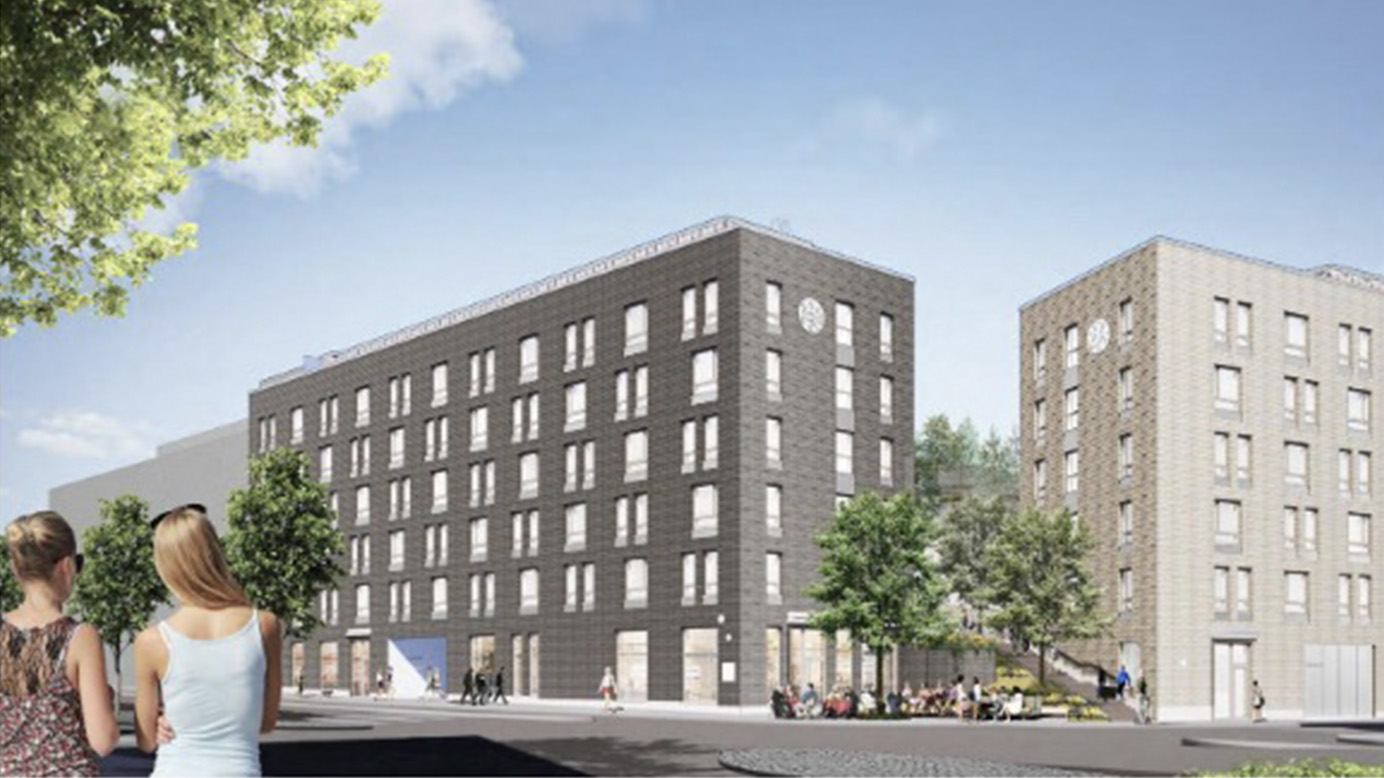
Image: HOAS
05 Hopeakaioksentie 47
Country | Finland |
Typology | Apartment building (student housing) |
Area | 4,424 m² and 308.5 m² retail |
Building phase | Construction (earthworks) |
Hopeakaivoksentie 47 is a development project situated in the district Kruunuvuorenranta in Helsinki. The project encompasses two buildings, each designed to serve as student housing. The buildings are planned to rise six stories high. In addition to the residential units, the buildings will feature a variety of communal amenities, including a sauna and a common area, which are intended to foster a sense of community among residents. Furthermore, the ground floor will house retail spaces.
The load-bearing structure is primarily composed of reinforced concrete, ensuring building stability and longevity. The façade is predominantly clad in grey brick. The façade design includes variations in colour and assembly, adding visual interest and breaking the monotony of the exterior surfaces. The internal surfaces' material specifications were not detailed in the provided documents.
No specific sustainability goals (certifications, limit values, EU taxonomy, etc.) was defined prior to designing the building.
The clinic
Client | HOAS (Foundation for Student Housing in the Helsinki Region) |
Type of client | Building owner (HOAS is a non-profit foundation dedicated to addressing the shortage of student housing in the Helsinki metropolitan area). |
Facilitator | Elina Virolainen (Sweco FIN) |
Participants | Project owner |
Preliminary discussions
HOAS has demonstrated a proactive approach to sustainability by calculating its carbon footprint in accordance with the GHG Protocol. The foundation’s emission reduction efforts are aligned with the Science Based Targets initiative (SBTi), which provides a framework for setting ambitious and science-based emission reduction targets. However, HOAS has not set an official carbon neutrality target, primarily due to concerns about the potential impact on rental income. This cautious approach reflects the foundation’s need to balance sustainability goals with financial viability, ensuring that the cost of low-emission measures does not unduly burden students.
The client, HOAS, had no specific requirements and wishes for the workshop agenda. To facilitate the discussions, HOAS provided preliminary project presentations and energy efficiency certifications. This preparatory information was used to address the client’s specific needs and objectives.
The agenda included introductory sessions, detailed presentations on the Nordic LCA project and the Hopeakaivoksentie project, in-depth discussions on carbon accounting and the formulation of actionable proposals.
Key workshop findings
The workshop revisited HOAS’s general goals for energy efficiency and emission limits. HOAS aims to achieve an energy class A rating for their building projects and are also planning to introduce an emission limit for their projects. They are now conducting the LCA analysis in their projects to see how close they would get to the limit used for Helsinki City’s new residential buildings (16 kgCO2-eq/m2/year). Due to its current construction phase, the life cycle assessment (LCA) limit was not set for this project.
One of the discussions was centred around the project’s plot size. The Hopeakaivoksentie project itself is set on a plot, which is quite small in area, but also had a thick base rock that needed to be detonated. This then guided the discussion to “how to make sure the land mass recycling can be maximised”, when there is little or no use for it in the plot itself, nor are there means to store it there.
Key workshop challenges
The workshop participants raised concerns about the long-term performance of low-carbon materials, particularly over several decades. This highlighted the need for thorough evaluation and testing to ensure that the materials used in the project would meet durability standards while contributing to sustainability goals.
One of the primary challenges is the cost associated with low-emission measures. HOAS faces financial constraints, as it cannot pass on the additional costs of these measures to students through increased rents. This financial limitation poses a significant barrier to setting and achieving ambitious sustainability goals, such as carbon neutrality.
To address this challenge, the workshop highlighted the need for practical and cost-effective solutions. Participants discussed various strategies to optimise material usage and reduce costs without compromising on sustainability.
Follow-up consultation
Discussions in the follow-up meeting centred around making sustainability choices and measures more affordable and feasible for HOAS. The workshop facilitators provided valuable examples of changes that could benefit both emissions and cost, such as optimising material masses and exploring alternative construction methods.
The follow-up also included a review of the workshop’s outcomes and the progress made towards achieving the project’s sustainability goals. This iterative process of review and adjustment ensures that the project remains on track and that any emerging challenges are promptly addressed.