Image: NOAH architecture office
04 Hiedanranta
Country | Finland |
Typology | Apartment building |
Area | 3101,5 m² |
Building Phase | Early design |
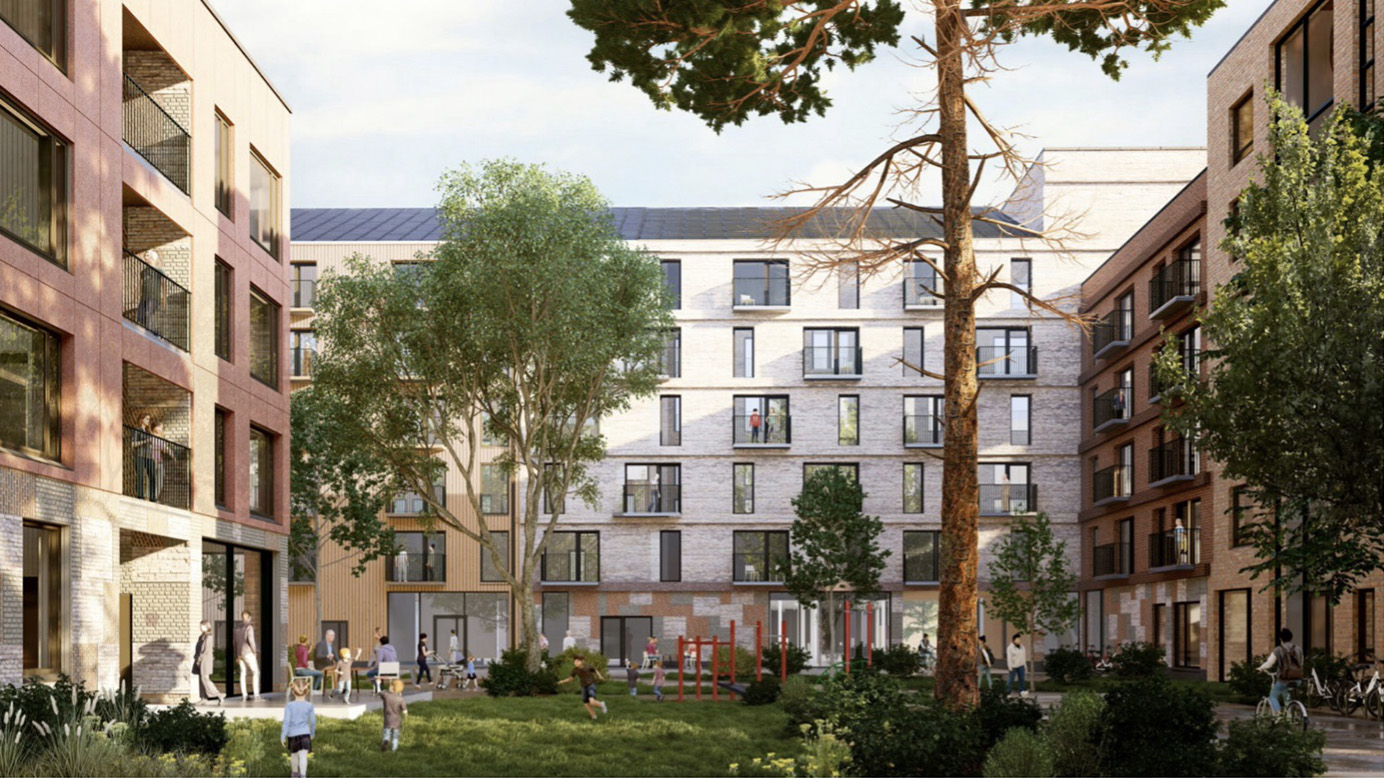
The project is an apartment building located in Hiedanranta, the new district of Tampere, Finland. The building is designed to have four to five floors and will accommodate 37 apartments. In addition to residential units, the building will include general storage spaces, bicycle parking areas, a sauna area and a civil defence shelter.
The building’s structural framework will consist of pillars and slabs in reinforced concrete, providing the necessary support and stability. The walls between apartments will be constructed using light-structured materials to ensure both durability and ease of construction. The primary material for the building’s façade will be brick. The specific materials for internal surfaces have not been detailed at this stage of the design.
One of the key sustainability goals is to obtain an environmental certification for the building: either BREEAM, LEED, or the Finnish RTS certification. Additionally, a comprehensive life cycle analysis (LCA) must be conducted to assess the environmental impact of the building throughout its lifespan. The construction site is mandated to be low-emission and a minimum of 85% (per volume) of the construction waste must be recycled.
The clinic
Client | A-Kruunu |
Type of client | Building owner (A-Kruunu Oy is a state-owned special assignment company operating under the guidance of the Ministry of the Environment. The company’s primary mission is to build affordable rental housing) |
Facilitator | Elina Virolainen (Sweco FIN) |
Participants | Project owner |
Preliminary discussions
A-Kruunu has established sustainability practices for all its projects. The company mandates that all new buildings achieve an energy class-A rating, reflecting high energy efficiency standards. Furthermore, A-Kruunu has set a goal to achieve carbon neutrality in terms of energy consumption by 2030. This commitment to sustainability is evident in the company’s proactive approach to integrating energy-efficient technologies and practices in its building projects.
The client, A-Kruunu, had specific requirements and expectations for the workshop agenda. The client provided a detailed presentation about the project, outlining the sustainability requirements set by their client and shared a preliminary CO2 calculation for different structural frame options.
To effectively address the client’s needs, the workshop was planned by gathering comprehensive information about the project from the client. This included general project information, various design options and specific topics that the client wished to discuss.
Key workshop findings
The key discussion points from in workshop was centred around use of low-carbon concrete in the frame foundation, emission-free construction sites, and waste recycling according to the BREEAM Communities-criteria. Since the goals of the project were already settled, the discussion was focused on how to fulfil them. The workshop facilitators could share knowledge in terms of e.g. material prices and use cases etc.
The project has a requirement to calculate the LCA, but there is no limit value. Climate impact reduction will materialise through use of low-emission materials and energy.
One of the significant findings of the workshop was that the project has highly detailed goals for carbon limits. The required level of the low-carbon concrete classification is GWP70 (emissions are 70% of the CO2e of the average version of the material) for ground, intermediate and top floors, and GWP55 for foundations and load-bearing vertical structures and a deviation from the requirement needs to be compensated in some other structure. It was discussed how such requirements is going to change the material supply industry, most likely in a positive way.
Key workshop challenges
The project team encountered several challenges, primarily due to their limited experience with low-carbon concrete designs. The team required a deeper understanding of how low-carbon concrete would affect the project and procurement processes. They also sought insights from other industry actors who had experience with similar materials, as well as information on potential risks and challenges associated with low-carbon concrete. To address these needs, the workshop facilitators committed to producing a summary of their understanding for a follow-up meeting. Additionally, the topic of climate risk assessment was discussed and the client requested the workshop facilitators to present on this subject in the follow-up meeting.
Follow-up consultation
In the follow-up meeting, the workshop facilitators prepared summaries on two key topics requested by the client: the Global Warming Potential (GWP) of concrete and a climate risk assessment. These summaries were discussed in the follow-up meeting, providing the client with valuable information to support their decision-making. However, it remains unclear whether the client decided to implement a climate risk assessment for the project as an additional sustainability measure. The follow-up discussions highlighted the importance of continuous engagement and knowledge sharing to achieve the project’s sustainability goals.