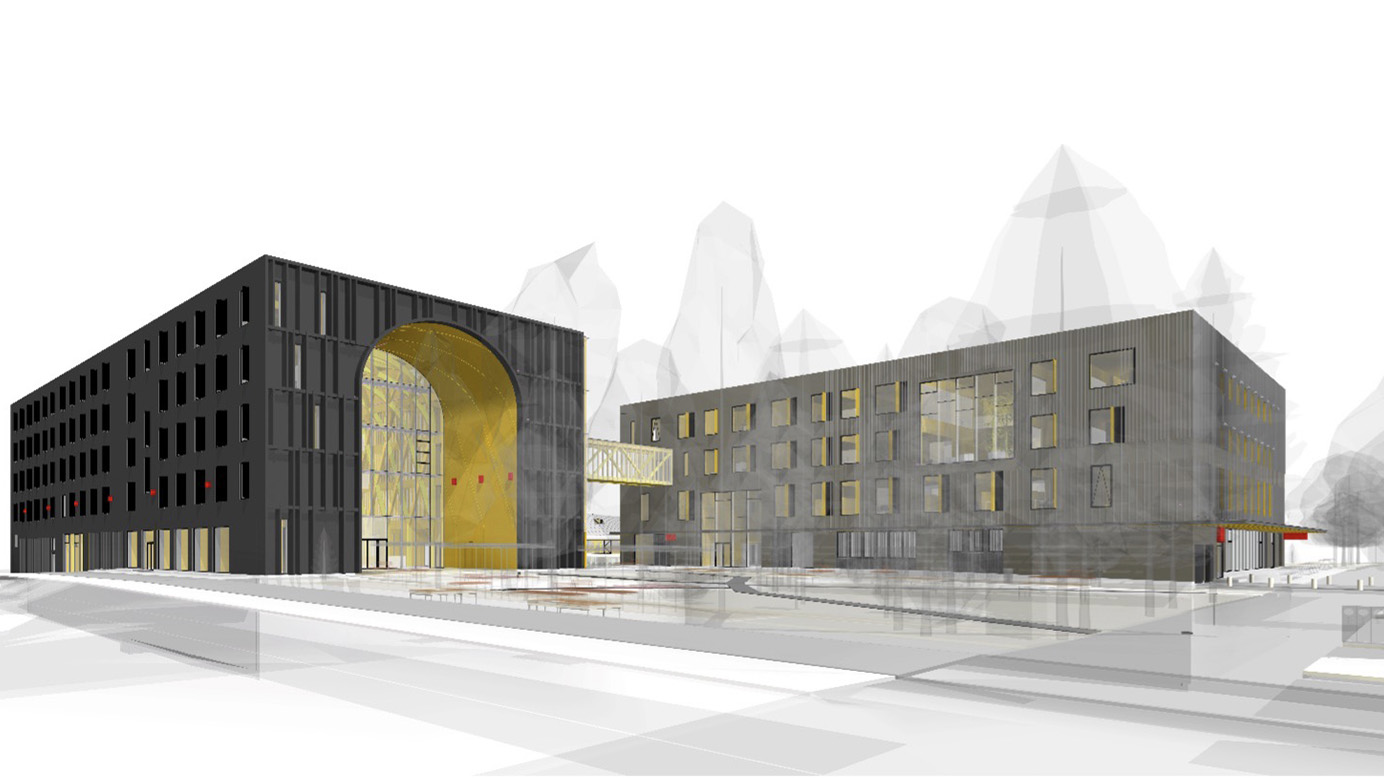
Image: KAVAKAVA office
03 Loodusmaja (The Nature House)
Country | Estonia |
Typology | Museum and office |
Area | 15,250 m² |
Building phase | Construction |
The project is situated within a network of parks, urban blocks, streets, squares, inner courtyards, waterfronts and promenades, creating a cohesive and vibrant district. At the heart of this district lies the Natural History Museum’s open, triangular courtyard, which serves as a landscaped gathering hub and central feature. This courtyard is encircled by three distinct yet interconnected buildings, each contributing to the overall functionality and aesthetic of the area:
- Museum building (ELM): This triangular structure is dedicated to housing the museum, providing cultural and educational value to the district.
- Wooden office building (“Dock”): the Dock includes shared spaces for the ELM lobby and the Nature House on the ground floor. This building utilises timber construction to reduce environmental impact.
- City building with street-level frontage: This multi-use building features rental spaces that open directly to the street, enhancing the district’s social vibrancy. It is designed to accommodate various functions.
The building foundations and the underground two-story parking lot and part of the exhibition area are made of reinforced concrete. The primary load-bearing elements of the Nature House consist of cross-laminated timber (CLT) and laminated veneer lumber (LVL). CLT is extensively used in walls and floors, providing rigidity through interconnected panels. In high-risk areas, special coatings are applied to enhance fire protection, ensuring safety without compromising sustainability. The façade solutions include glass curtain walls supported by laminated glass posts, designed to carry both the weight and wind loads.
The Nature House project is incorporating life cycle assessment (LCA) calculations during both the preliminary and technical design stages. This makes it the first public building in Estonia to include an LCA, setting a precedent for future projects. The primary goal was to understand the insights that LCA could provide before defining concrete sustainability targets. As a result, RKAS has developed a comprehensive sustainability strategy that requires LCA calculations and sets preliminary limit values. This strategy aims to ensure that new projects meet high environmental standards.
The clinic
Client | Riigi Kinnisvara AS (RKAS, State Real Estate PLC) |
Type of client | Building owner |
Facilitator | Anni Oviir (LCA support) |
Participants | Project Manager Environmental Sustainability Expert Development Director Architect Structural Engineer Construction Project Manager Expert from the Ministry of Climate and the Environment Department of Construction and Living Environment from Ministry of Climate and the Environment |
Preliminary discussions
RKAS has incorporated LCA requirements into its sustainability strategy, establishing preliminary limit values to guide new projects. This approach ensures that environmental considerations are integrated into the planning and construction phases, promoting sustainable development. As the availability of environmental data in Estonia improves, RKAS has the opportunity to enhance these standards further, setting more robust and data-driven sustainability goals.
The workshop was planned to address the client’s requirements and provide valuable insights into LCA practices. It included a review of initial LCA studies from 2020, conducted using the One Click LCA tool and Level(s) method at the preliminary and technical design stages. The agenda covered the evolution of LCA practices, comparing planning-stage and as-built LCA and discussing actionable takeaways for RKAS. This structured approach ensured that the workshop was informative and relevant, equipping the client with the knowledge needed to implement LCA practices effectively.
Key workshop findings
The workshop provided a fundamental understanding of the life cycle assessment (LCA) in the context of project planning and construction, tailored to the client’s interest in integrating LCA practices across various project phases. The initial LCA studies conducted in 2020 were reviewed, the evolution of LCA methods was discussed, and practical ways to incorporate LCA findings to support more sustainable decision-making were explored.
During the workshop, the client shared that while they are in the early stages of incorporating sustainability strategies, they have begun developing preliminary requirements for a life cycle assessment (LCA) as part of a broader approach to climate impact reduction. However, specific tools or systematic methods for reducing carbon footprint are not yet fully established within their processes, highlighting a current gap in resources and structured practices for managing carbon impacts. To support these efforts, the client was advised on integrating LCA into project workflows more strategically, explaining how using tools like One Click LCA and leveraging the Estonian national method and database could help refine carbon reduction goals. We also discussed the importance of defining clear, actionable steps within the planning and construction phases to move toward consistent carbon footprint management, positioning the client to better meet upcoming regulatory requirements in Estonia.
The primary recommendation was for RKAS to conduct an as-built LCA to compare with the design phase LCA. This comparison would highlight key differences between the projected and actual environmental impacts, providing critical insights for refining the Estonian national LCA method. Additionally, the workshop emphasised the need for a better understanding of integrating LCA practices across project stages. Establishing actionable steps to incorporate LCA insights more consistently was identified as a priority, ensuring that sustainability considerations are embedded throughout the project life cycle.
Key workshop challenges
The workshop also identified several challenges and support needs that must be addressed to facilitate the effective integration of LCA practices. A key challenge is the need for structured processes and resources to consistently integrate LCA across project phases. Currently, the client faces limitations due to insufficient resources and a lack of standardised procedures for carbon footprint management. Additionally, there is a gap in local environmental data, which has previously limited the accuracy and relevance of LCA calculations. Addressing these challenges requires a concerted effort to develop standardised procedures, allocate necessary resources and improve the availability of environmental data.
Follow-up consultation
The client intends to conduct an as-built LCA upon project completion. The workshop laid a strong foundation for integrating LCA practices, aligning with Riigi Kinnisvara AS’s stated interest in incorporating these methodologies. Continued collaboration with the workshop facilitators could further support the client in successfully implementing the suggested practices and achieving their sustainability goals.