Image: Henning Larsen
02 Svanemølleholm
Country | Denmark |
Typology | Office |
Area | 14,666 m2 |
Building phase | Detailed design |
With a new, modern and flexible lease, the future tenants will have optimal surroundings for both work-related and social activities. Overall, the lease should reflect a quality, architecture and interior design that supports the tenants.
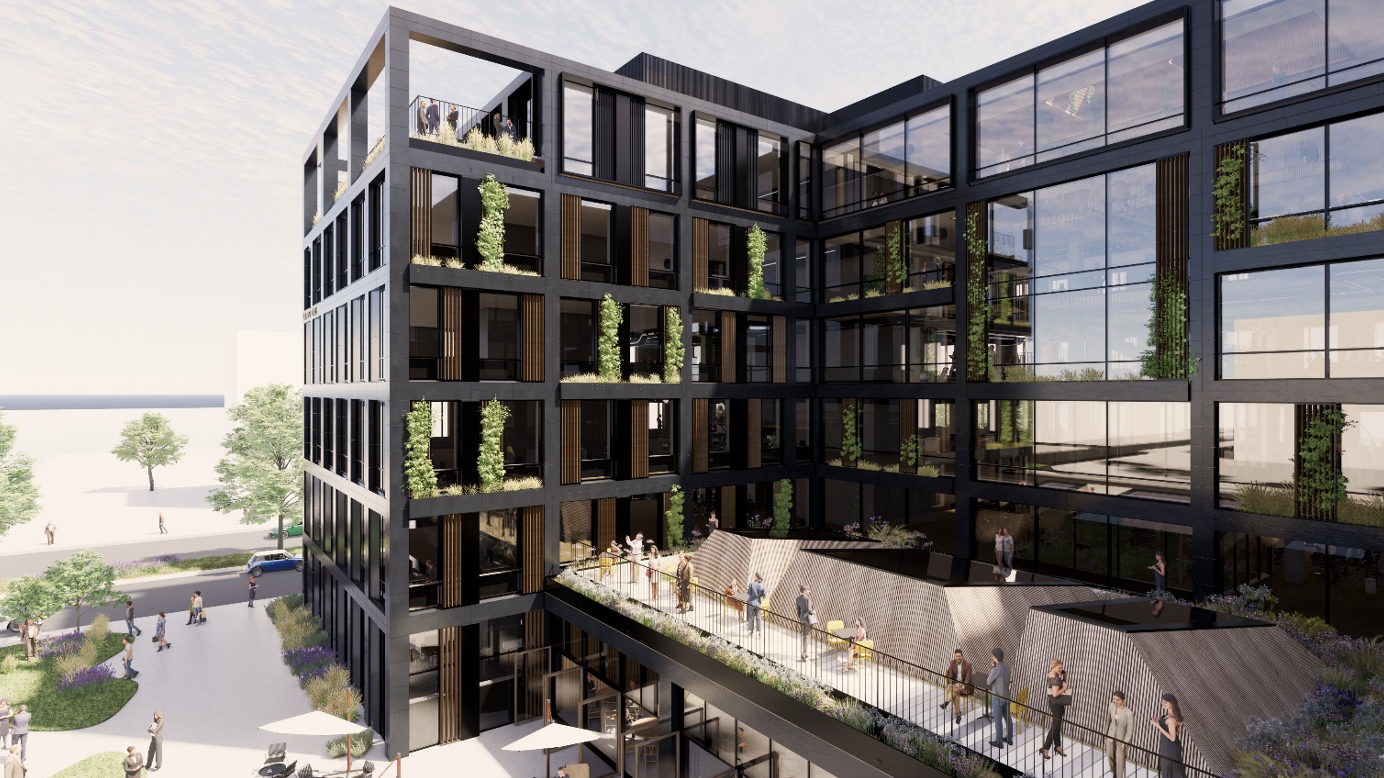
The building structure is compact with six full floors including the ground floor and an articulated roof floor. The ground floor along the waterfront by the South Promenade will be buzzing with life when the building’s tenant, has lunch in the restaurant. The building’s architecture is simple, robust and refined at the same time. The colours are both dark with natural slate façade cladding and warm with internal organic materials.
The project’s primary construction materials include reinforced concrete cores, concrete columns and hollow concrete slabs, which together form the structural framework of the building. In addition to these structural elements, the façade of the building is designed with natural stone, which not only enhances the aesthetic appeal of the structure but also contributes to its durability. The combination of these materials reflects a commitment to robust construction practices, ensuring that the building is both functional and visually appealing.
The project’s sustainability goals are centred around achieving certification at the DGNB Platin level, as outlined in the DGNB system for 2020. In addition, the project aspires to attain the DGNB Diamond certification, recognising exemplary performance in architecture, and the DGNB Heart label, which highlights exceptional efforts in social sustainability aspects. Furthermore, the project aims to align with the EU Taxonomy 7.7, which reflects compliance with the European Union’s criteria for environmentally sustainable economic activities.
The clinic
Client | Nordstern |
Type of client | Contractor |
Facilitator | Rikke Schack (Sweco DK) Nicolaj Langkjær (Sweco DK) |
Participants | Project manager Sustainability manager Sustainability assistant |
Preliminary discussions
Nordstern’s sustainability strategy focuses on reducing CO2 emissions and promoting sustainable practices at construction sites. One element is the procurement of green energy, with sites using electricity from renewable sources like wind, hydro, solar and biomass. Reuse/recycling of building materials is also an important part of Nordstern’s strategy for decreasing the environmental impact. The goal is for Nordstern sites to recycle 70% of their waste in 2025. Furthermore, all newly initiated residential and office construction projects from 2023 onwards must be certified. In 2023, Nordstern did not fully reach its goal, as 80% of the newly started residential and office projects are planned to be certified.
In response to the client’s request to review the Life Cycle Assessment (LCA) delivered before the workshop, a comprehensive workshop was prepared to facilitate an in-depth discussion on critical topics relevant to the construction site’s environmental impact and compliance with EU taxonomy. The client provided a preliminary LCA report which served as the foundational document for the workshop discussions. This document outlined the environmental impacts associated with various life-cycle stages of the project. To enhance the understanding of the LCA results, the workshop facilitators conducted a hotspot analysis. This analysis identified key areas of concern and potential improvement within the LCA. The workshop facilitators utilised the Sweco LCA database to benchmark the project against industry standards. This benchmarking allowed for a comparative analysis at both project and building component level, providing insights into how the current project measures up against similar past projects. This information was instrumental to identifying best practices and areas for enhancement. A segment in the workshop was dedicated to understanding the EU taxonomy requirements and discussing how the project can align with these regulations to enhance sustainability and compliance.
Key workshop findings
The Svanemølleholm project has yielded several key insights, particularly from the LCA exercise and the emissions related to the construction process, which offer valuable lessons for future projects.
At the workshop the LCA was reviewed and Sweco’s experts had prepared a hotspot analysis. The hotspot analysis was compared to Sweco’s extensive LCA database consisting of +225 LCA calculation of building projects. This exercise highlighted some building elements that deviated significantly from the average value in the Sweco database.
Due to the heavy nature of the construction (reinforced concrete), the client and their consultants’ will focus on minimising the environmental impact by selecting products with Environmental Product Declarations (EPDs).
The workshop facilitators provided data on the contributions of different phases concerning the building site (A4 and A5), which Nordstern reviewed in anticipation of upcoming legal requirements (Introduced in the Danish Building Regulations in June 2025). Due to the relatively unexplored area, the client has not yet introduced a thoroughly tested system for gathering data on the construction processes. Several solutions have been proposed and are currently being tested on different sites to enhance this data-gathering process.
- Dashboard implementation: A dashboard will be introduced to monitor consumption throughout the project. Maximum allowable values will be set, with penalties or measures implemented if exceeded.
- On-site training: Training sessions will be introduced on site to improve practices.
- Data collection partnerships: Partnerships will be sought to help collect data, particularly on machinery.
- Improved signage and training: Enhanced signage and training will focus on waste management due to its significant impact.
- Dedicated staff: Personnel will be hired to ensure proper sorting of materials.
- Experience sharing: Experiences from different sites will be collected and shared.
- Electric machinery: Challenges with battery life and cost will be addressed through careful planning.
Key workshop challenges
There are significant challenges regarding data collection for emissions related to the construction site (A4 and A5). Questions arise about the best way to arrange the site, partition the building and landscape, as well as which machines to use and where they will be placed. Poor habits have been identified on site, such as unnecessary idling and failure to turn off lights. Studies show that a lot of electricity is consumed when employees are not present.
Follow-up consultation
The client will use the knowledge presented regarding the emissions associated with phases A4 and A5 to plan activities for monitoring and data collection. Based on the LCA hotspot analysis that was reviewed in the workshop, the entries in the LCA for the project have been reviewed. The presentation of requirements in the EU taxonomy, specifically the requirements for chemicals in buildings materials, provided the client with new ideas for how use them in future projects.