Image: Holsche Nordberg
01 BLVD.31
Country | Denmark |
Typology | Apartment building (young professionals) and hotel/serviced apartments |
Area | 12,800 m2 (8,200 m2 housing and 4,600 m2 hotel) |
Building phase | Detailed design |
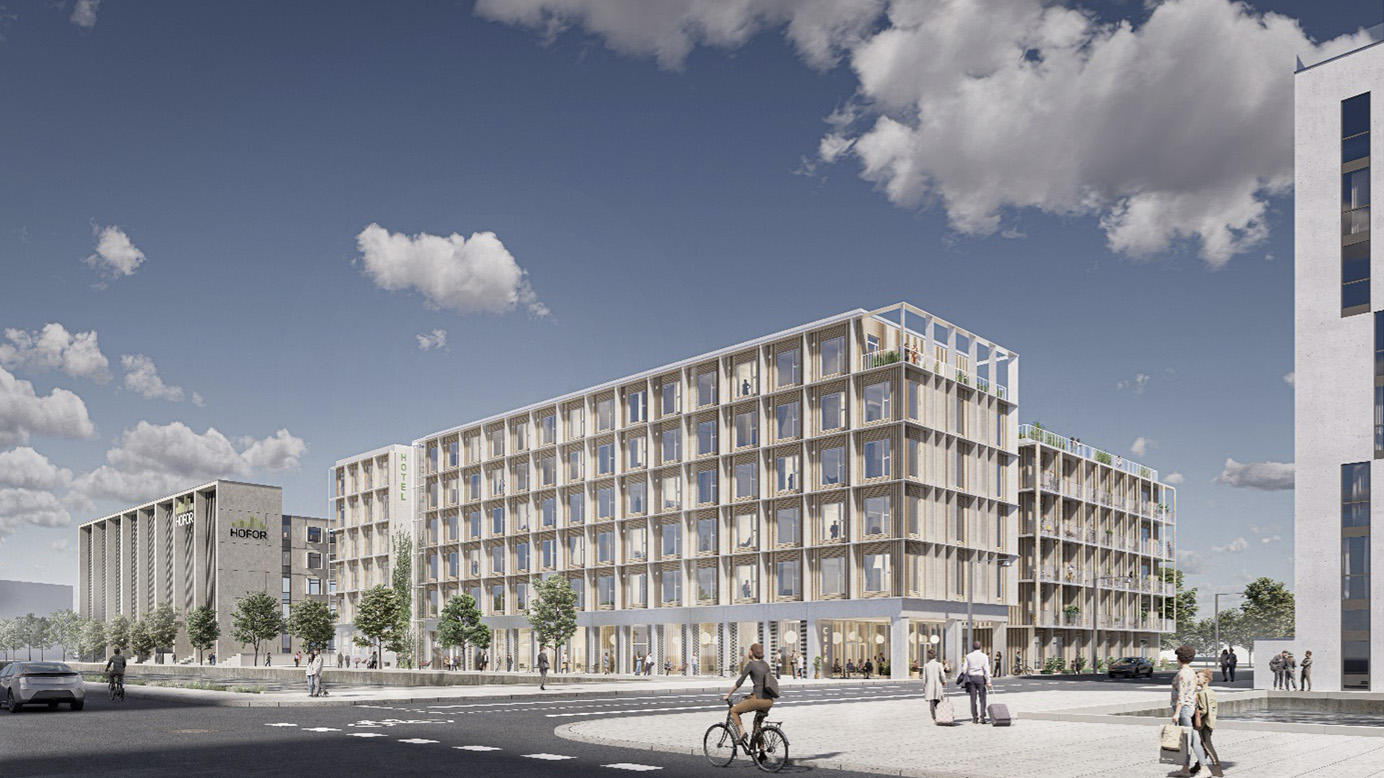
Based on the successful residential and hotel concept Noli, a 12,800 m2 timber building near Bella Center will offer both furnished and unfurnished apartments, as well as hotel apartments that can be tailored to individual needs. The new timber building will contain 217 residences and 124 hotel apartments, complemented by shared facilities such as a kitchen, meeting rooms, fitness centre, laundry, café and rooftop terrace, which tenants and hotel guests will share.
The entire residential section will be constructed using prefabricated timber modules, while the hotel section will also be built using prefabricated timber modules from the first floor and up. The hotel basement and ground floor will be made of concrete. All modules will be delivered with complete kitchen, bathroom and wardrobe solutions. The façades will be finished with timber cladding and steel to meet fire safety requirements. The project will include four stair towers for which the construction has not yet been fully determined. There will be a focus on minimising excess use of materials and decreasing the climate impact.
The project aims to attain the DGNB Gold certification and additionally, the project adheres to Skanska‘s own CO2 requirements which stipulate a maximum of 7.00 kgCO2-eq/m2/year. In alignment with NREP’s CO2 targets, the project sets specific benchmarks for emissions across different stages: for A1-A5, the goal is to limit CO2 emissions to 4 kgCO2-eq/m2/year, while for B6, the target is set at 3 kgCO2-eq/m2/year. Moreover, the project incorporates Skanska’s biodiversity strategy, focusing on improving on-site biodiversity compared to the initial conditions.
The clinic
Client | Skanska |
Type of client | Developer and contractor |
Facilitator | Rikke Schack (Sweco DK) Nicolaj Langkjær (Sweco DK) |
Participants | Project manager Sustainability manager Architect Contractor Engineer |
Preliminary discussions
Skanska has set its own CO2 limit values and developed an environmental programme for development projects. As parts of this, Skanska believes that certifications are a pathway to more sustainable solutions. In Denmark, Skanska primarily works with the certification system DGNB. Skanska projects will be certified to at least DGNB Gold. Furthermore, as part of the environmental programme, Skanska aims to develop projects that align with 7.1 for construction and 7.7 for ownership in the EU taxonomy.
The client provided a Life Cycle Assessment (LCA), which served as the foundational document for the workshop discussions. This calculation detailed the environmental impacts associated with various life-cycle stages of the project. The workshop facilitators conducted a hotspot analysis to identify key areas of concern and opportunities for improvement within the LCA. By utilising the Sweco LCA database, the project was benchmarked against industry standards. This benchmarking facilitated a comparative analysis at both the project and building component levels, offering insights into how the current project aligns with similar past projects. This information was crucial for identifying best practices and areas for enhancement. Given the project’s phase (detailed design), a segment of the workshop focused on implementing LCA requirements into the specifications for tenders, drawing on Sweco’s extensive experience.
Key workshop findings
One of the primary insights from the workshop was the client’s approach to working with a carbon limit value, which was born into the project from the Skanska’s own limit value and the investor’s (NREP) limit value for new buildings. The approach was based on early contractor involvement. The early involvement and research into different solutions showed that modular wooden constructions could deliver in terms of carbon limit value, time, quality and price constraints. Also, Sweco’s LCA database provided valuable insights into the environmental performance of various construction materials, highlighting significant variability in CO2 emissions between high and low-quality timber constructions, as well as concrete. The project team uses Real-Time LCA as a tool to ensure that CO2 remained a core focus throughout the project. Continuous LCA monitoring and adjustments were incorporated throughout the project‘s life cycle, rather than treating LCA as a one-time reporting requirement. This approach allowed the project team for ongoing optimisation and variant analysis based on updated data and project changes.
The LCA hotspot analysis, prepared by the workshop facilitators, showed the client some interesting results. Aluminium profiles and sheets used in the façade contributed significantly to the climate impact. The climate impact from alternative façade materials was presented and it was discussed whether any of these options could be applied.
Furthermore, the concrete used for the basement and ground floor also contributes significantly to the total emissions. This has been acknowledged by the project team from the early stages. The issue was a priority and constructions have been optimised to make them simpler, with less amounts of concrete and reinforcement, during the design phases. Low-carbon concrete was suggested as a solutions by the facilitators. This solution has also been considered. The client highlighted that working with low-carbon concrete requires a high level of detail early in the project for the engineer to calculate strengths and make comparisons. This has been a key learning from the project to the client.
Key workshop challenges
While there are many advantages by using modular wood constructions, building with this type of construction also presents challenges. One of the main challenges is that the material selection is locked due to constraints imposed by external fire testing requirements. There are limited options for switching manufacturer due to strict regulations that demands new tests even if just smaller adjustments are done. The modules have only been fire-tested and approved with a limited material palette, as this is both costly and time consuming. These constraints limit the flexibility to change materials within the modules, impacting the overall LCA outcomes.
LCA calculations require precise data on material quantities and specifications, which are often not available early in the project. This necessitates early engagement with advisors to provide preliminary estimates on material quantities, a process that can be resource-intensive and requires a shift in industry practices, as current practice and contractual commitments do not allow for delivery of estimates on material quantity and types early in the project.
Setting CO2 requirements at the material level in tenders can lead to unintended consequences, such as the need for larger quantities of a material with lower environmental impact to meet functional requirements. This highlights the importance of considering all parameters and functional units in material comparisons and decisions.
Another issue raised by Skanska is the lack of harmonisation in LCA methodologies across Nordic countries, making cross-border comparisons and collaborations difficult. As an international company, Skanska would benefit from harmonisation by making it possible to develop standardised cross-border methods, tools and strategies for working with decarbonisation.
Follow-up consultation
Regarding optimisation opportunities, the project team reflected on whether any suggestions from the workshop had been pursued or reconsidered in the project. While not necessarily implemented, the learnings from the workshop prompted additional discussions about potential improvements. They specifically challenged the use of aluminium in the façade, suggesting the exploration of other metals and a reassessment of the façade dimensions. This led to a distinction between design, functionality (such as fire safety) and requirements, aiming for further optimisation.
After the workshop, the client highlighted a significant focus on window design, leading to the optimisation of the façade to include only essential window areas. The workshop proved motivational in reconsidering window sizes. Additionally, the team revisited the design of the stair towers, which were originally clad in glass, and after the workshop they started to question the glass façade, resulting in the development of new design variants in response to the workshop discussions.