Stocks with management shortcomings from a Skagerrak perspective
As part of SAMSKAG, a Nordic Vision Project supported by the Nordic Ministers Council, we identified various species with significant current or potential value for human consumption fisheries in Skagerrak. We also described the management shortcomings for these stocks from the perspective of Skagerrak. For detailed description of each species, please refer to Fact Box 2 (see also Fact Box 3).
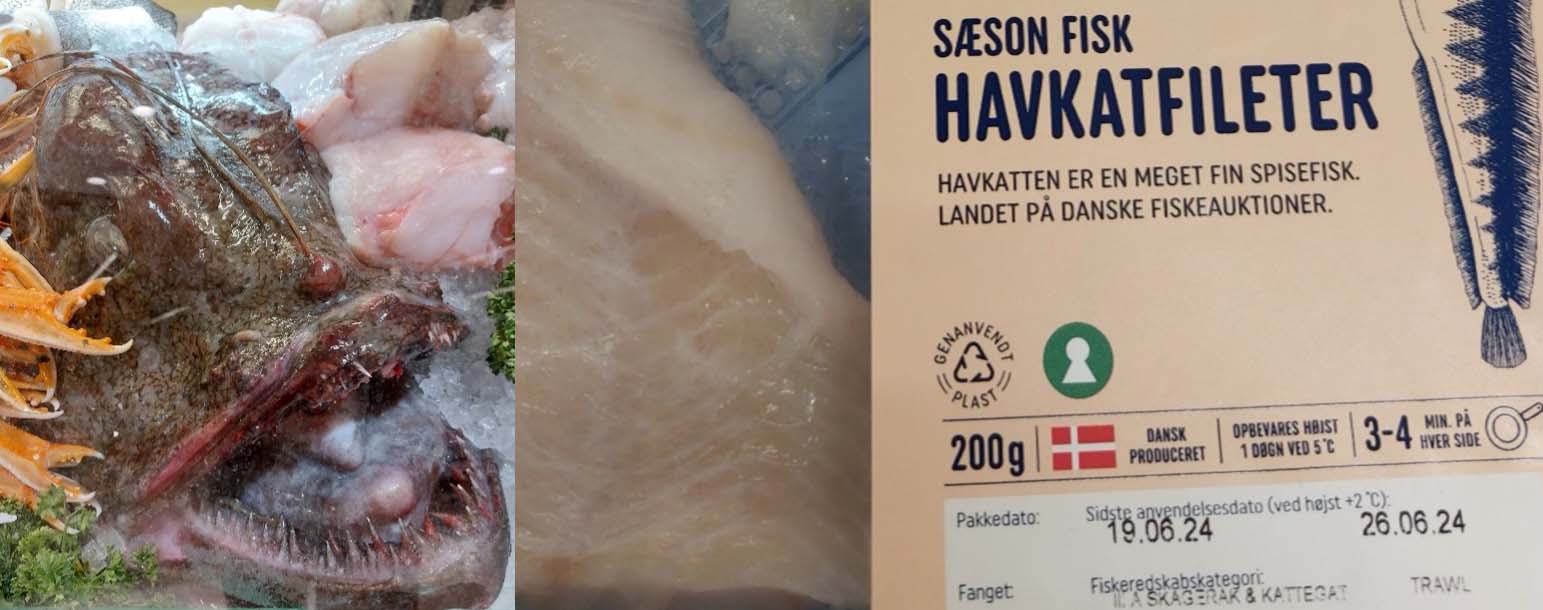
For halibut, wolffish, lumpsucker, and skates and rays, ICES do not provide scientific advice. Nevertheless, wolffish fillets from Skagerrak and Kattegat are now available in supermarket coolers (Figure 2), and the lumpsucker, which is harvested because of its highly priced roe, has recently received a lot of attention in the media following indications that this species may be in rapid decline.
For others, such as anglerfish, pollack, roundnose grenadier, tusk, ling, blue ling, and greater forkbeard, ICES include Skagerrak in the stock unit definitions but provide advice as a so-called category 3 or 5, which lack an analytical stock assessment (28 June 2024, anglerfish moved from a category 3 to a category 1 assessment and catch advice has tripled, see Fact Box 2). While this type of advice does align with ICES’s precautionary approach, it is suboptimal from the perspective of both fish and fisheries. Furthermore, for tusk, ling, blue ling, and greater forkbeard, the current stock units extend far beyond the Skagerrak region, covering the entire Northeast Atlantic, and the population structure and connectivity remain mostly unknown.
Lastly, we also included spiny dogfish (or spurdog), despite it having an analytical stock assessment. Following a benchmark assessment by ICES in 2022, advice changed from zero catch to allow for a targeted fishery. This advice applies to the entire North-East Atlantic and adjacent waters, while the population structure, in relation to e.g. Skagerrak, remains mostly unknown.
For more information about current stocks assessments and biological advice, see:
ICES adviceXplorer https://ices-taf.shinyapps.io/advicexplorer/
Fiskbarometern: https://fiskbarometern.se/rapport/2023