CASE 6
A touchless process for reporting VAT data
One of the main aims of the EU's ViDA legislation (VAT in the Digital Age) is to digitalise VAT for trade within the EU from 2030. This can simplify and automate VAT reporting in real-time, reducing fraud and administrative costs. By using their existing digital business systems, small and medium-sized enterprises (SMEs) can continue their operations as usual without the need to create new systems.
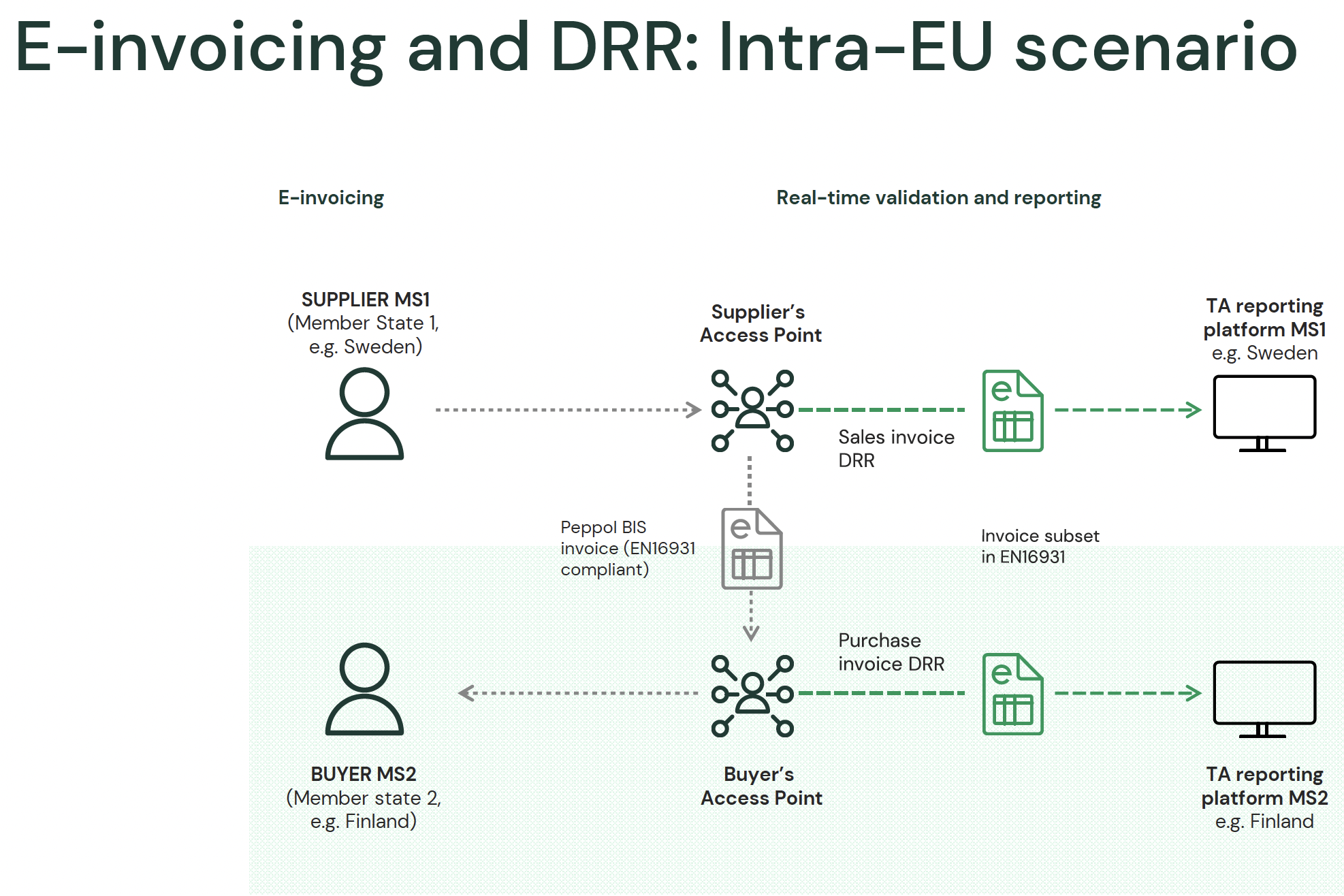
The NSG&B and PEPPOL model for a ViDA-report: Here a company in one country (Sweden) sends an eInvoice to a buyer in another country (Finland). The eInvoice goes via the corresponding Access Points and next, an extract of the relevant VAT data from the sales eInvoice is sent to the tax administration in Sweden, and at the same time the relevant VAT data from the purchase eInvoice is sent to the tax administration in Finland. Source: Pagero, 2024.
NSG&B’s work – a model for ViDA implementation
NSG&B has demonstrated how ViDA requirements can be implemented by tax administrations and system providers. Nazar Paradivskyy, Director of Regulatory Affairs at Thomson Reuters/Pagero, leader of Peppol’s Continuous Transaction Control (CTC) Community and representative in the GENA Public Policy and Compliance Working Group (PPCWG), explains: “The NSG&B pilots on ViDA were probably the first of their kind, showing how already existing frameworks, including Peppol specifications, can fulfill ViDA's requirements.”
The NSG&B pilots demonstrated that it’s possible to implement ViDA with limited impact on governments, software industry and foremost businesses, achieving a touchless real-time reporting of VAT data for cross-border trade as well as domestic trade.
Peppol – key to efficient eInvoicing
Peppol is a framework that combines governance, legal and fiscal standards that allow businesses to exchange electronic invoices and other supply chain documents. It was initially deployed for exchanging eInvoices with the public sector across the EU, but has expanded both into the private sector and beyond the EU. Nazar Paradivskyy highlights: “The technology and standards are in place already. There’s no need to create new frameworks and infrastructures when the existing ones can do the job.”
Automation and standardization for touchless VAT reporting
Using existing standards such as Peppol Interoperability Framework and the European Norm (EN 16931) for eInvoicing and digital reporting, combined with the Peppol CTC (5-corner model) architecture businesses will be able to achieve automated and touchless reporting of their VAT data from their business systems. This approach can simplify and ensure accurate real-time VAT reporting for both cross-border and domestic B2B transactions.
A collaborative effort for the future
The NSG&B pilots have gained significant attention, highlighting the need for a standards-based and collaborative approach to the work between tax authorities and system providers. Nazar Paradivskyy adds: “it was a very successful proof of concept in an open and collaborative multi-stakeholder environment, involving several governmental agencies (i.a. tax administrations, treasuries, digital agencies, statistical bureaus) and system providers."
Since the pilots were completed in Autumn 2023 and Spring 2024, the NSG&B pilots have sparked interest from additional European tax authorities. In Autumn 2024, Peppol launched a larger ViDA pilot to test Peppol CTC (5-corner model) with more countries, software providers and businesses.
With ViDA and the digitalisation of VAT reporting, businesses can have a simpler and more efficient way to manage cross-border and domestic trade without the need for entirely new systems or solutions. By leveraging existing frameworks, such as Peppol’s network, that build on a multi-stakeholder participation involving government agencies such as tax administrations, system providers, and business users, SMEs can benefit from a more streamlined and secure VAT reporting environment in the coming years.
Nazar Paradivskyy emphasizes that:
By definition, the implementation of a cross-border real-time reporting requirement for VAT cannot be done by each country in isolation developing their own solutions in silos. One needs to explore all kinds of use cases, situations and approaches with the participation of as many countries and other stakeholders as possible.Nazar Paradivskyy, Director of Regulatory Affairs at Thomson Reuters/Pagero and the CTC Community Leader of Peppol

Learn more about the NSG&B ViDA pilots here: https://nordicsmartgovernment.org/guidelines-and-specifications
See if you are connected to the Peppol Network & join the ViDA pilot here: www.peppol.com