CASE 5
A faster, safer way to open a bank account in another country
Opening a bank account for a company involves the Know-Your-Customer (KYC) process, which can be time-consuming, especially across borders. Companies must submit various documents, such as business registration extracts and financial plans, often in a PDF format. This manual handling can create inefficiencies and delays.
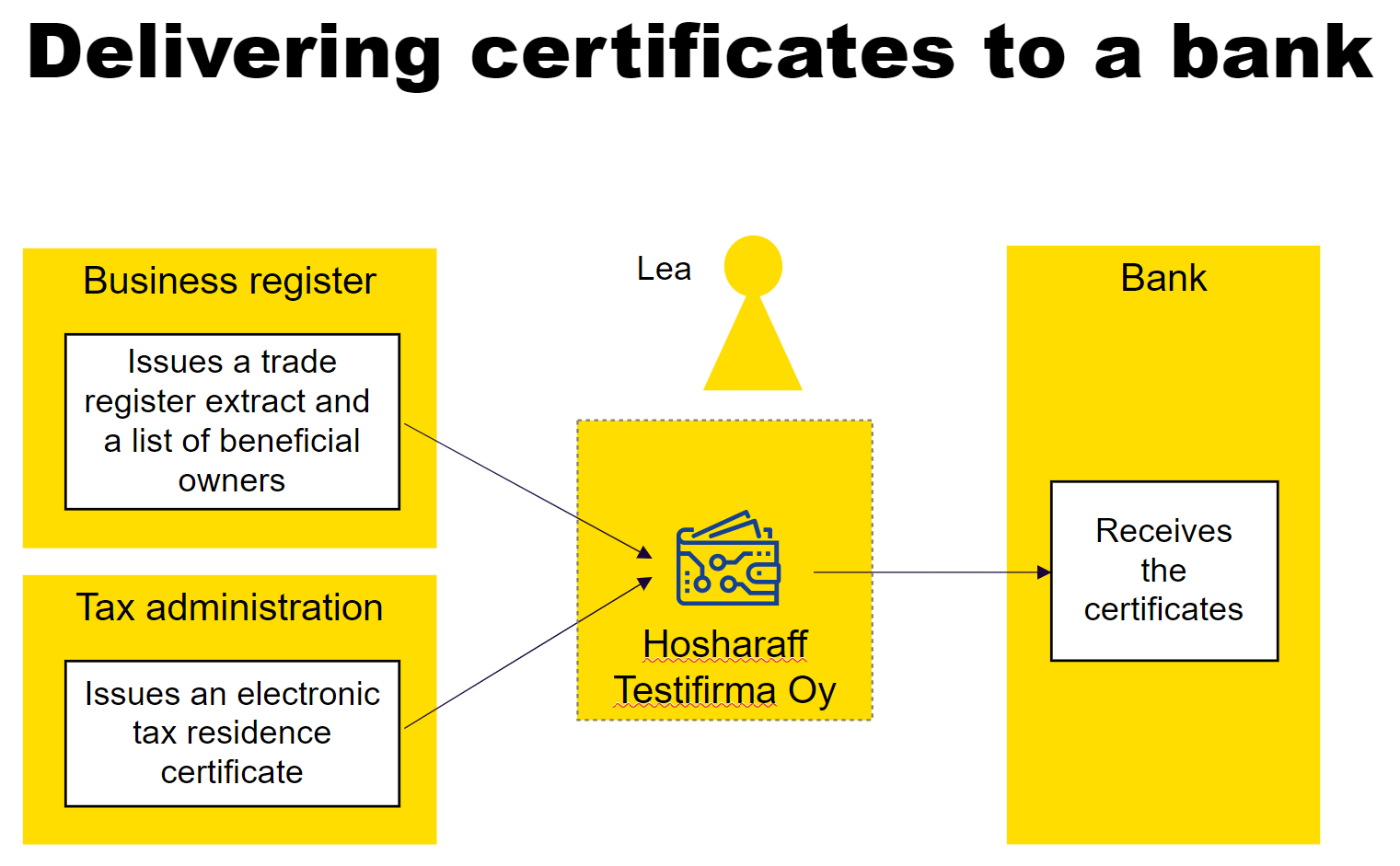
An example of a KYC process: In this example, the company Hosharaff wants to open an account in a new bank. Lea manages Hosharaff’s bank issues. The bank needs Hosharaff’s trade register extract, the list of their beneficial owners and the tax residence certificate. Lea downloads the certificates from the relevant authorities to Hosharaff’s digital wallet. Then she presents the certificates to the new bank, which automatically can verify the validity of the certificates.
Streamlining KYC across borders with digital solutions
In the Nordic countries, government business registries assign business registration numbers and are working to simplify KYC processes, both nationally and internationally. Mikael af Hällström, Development Specialist at the Finnish Tax Administration that has worked in the EWC Large Scale Pilot and the national Finnish Real-Time Economy programme explains that many banks already have direct access to national registries, reducing the need for companies to submit documents: “Many banks have direct access to the national business register, so they don’t need to ask the company to provide PDFs. They can access the business register directly, which is, of course, more secure."
However, cross-border access remains a challenge. Mikael af Hällström points out, “If the company is from another country, it’s unlikely that banks have access to all European registers. That’s where a digital wallet working across the Nordics and Europe can help. The principle is that you, as a company representative, go to the home country’s business register with your digital wallet, receive the business register extract to your wallet, and it’s digitally signed. Then you present the extract from the wallet to the bank, with your consent.”
Improving security and efficiency with digital wallets
A digital wallet not only saves time but also enhances security by allowing automatic uploads and document verification. The EU digital wallet aims to standardize business registry data across the EU, creating an EU Company Certificate that simplifies processes like opening bank accounts.
Overcoming legal differences in business data
Legal differences between countries can complicate cross-border data exchange. Mikael af Hällström notes, “The semantic model for different certificates is the most challenging aspect, as definitions and legal practices vary widely across countries even within the EU Single Market.” The Nordic countries, with their standardized business identifiers, are well-positioned to implement a digital wallet, building on a common vocabulary for business data developed in the NSG&B programme.
Standardizing data for seamless exchange
This common Nordic vocabulary allows machine-to-machine data exchange, enabling seamless access to Nordic business register data through an open API. This can be used for a range of domestic as well as cross-border use cases like the KYC process related to opening a bank account in another country.
Mandate for a digital wallet for cross-border use by the end of 2026
The EU regulation mandates that all Member States shall provide at least one European Digital Identity Wallet for cross-border use by the end of 2026. Most countries focus on implementing a digital wallet for citizens firstly, and for businesses secondly. The aim is that all natural and legal persons in the EU have secure, trusted and seamless cross-border access to public and private services, while having full controll over their data.
It’s unlikely that banks have access to all European registers to verify the company that wants to open a new account. That’s where a digital wallet with a company certificate working across the Nordics and Europe can help.Mikael af Hällström, Development Specialist at the Finnish Tax Administration
Learn more about the NSG&B work in the field here: https://nordicsmartgovernment.org/node/4133
Learn more about the work on KYC in the Finnish RTE project here: https://www.yrityksendigitalous.fi/en/blogs/digital-wallet-streamlines-opening-a-companys-bank-account/
Learn more about the findings from the Large Scale Pilot EWC pilot here: https://www.linkedin.com/pulse/eu-digital-wallet-simplifies-opening-business-account-hannula-m06pf