1. Introduction
Sustainable construction must respect planetary boundaries in terms of material extraction and geochemical cycles. Excessive greenhouse gas emissions from industrial processes and unsustainable land use come at a great cost to current and future generations. The construction industry is one of the largest emitters of greenhouse gases and must implement drastic emissions reductions in all phases of a building’s lifecycle. At present, a considerable proportion of emissions can be attributed to the transport of building materials and activities on the construction site. Measures to reduce these emissions are encompassed in the EFCS concept.
The concept of reducing and eventually eliminating carbon emissions from construction sites has gained significant momentum in recent years. As the construction industry continues to expand its knowledge and expertise in this area, the need for comprehensive guidelines has become clear.
These guidelines are designed to promote EFCS and assist stakeholders in implementing effective emission-reduction strategies. The report is structured around four main sections. The first section (chapter 2), planning and design, offers strategies for designers, architects, and urban planners to incorporate emission-free principles from the outset. The second section (chapter 3) focuses on procurement, providing guidance for project owners when tendering. The third section (chapter 4) covers implementation, detailing best practices for contractors and subcontractors during the construction phase to achieve emission-free operations. The final section (chapter 5), evaluation, presents methods for all stakeholders to assess and ensure compliance with emission-free objectives throughout the project lifecycle.
In conclusion, key points from each topic are summarised in the appendix, provided as printable sheets for easy reference. Stakeholders are encouraged to print the relevant sections and keep them to hand to reinforce their commitment to emission-free construction practices.
The guidelines build on the foundation laid by the earlier work of WP4, including the first report Emission-free construction sites: definitions, boundaries and terminology – current status in the Nordic countries
‘Emission-free construction sites: definitions, boundaries and terminology - current status in the Nordic countries’, 2023. [Online]. Available: https://www.nordicsustainableconstruction.com/knowledge/2023/march/report-on-emission-free-construction-sites
‘Emission-free Construction Sites: Knowledge Gaps and Research Needs’, 2024. [Online]. Available: https://www.nordicsustainableconstruction.com/knowledge/2024/january/emission-free-construction-sites-
The four sections of the guidelines are interconnected. Nothing substantial will happen without a plan and design. In large projects, procurement is a critical element, with tendering being a key stage in this process, especially in public-sector projects. Once a construction project has been planned, designed, and procurement has occurred, the construction process begins. It is at this stage that EFCS methods should be implemented.
Emissions during construction are evaluated during and after the process, which influences the entire construction process. The data gathered through this evaluation can be used in various ways to improve environmental performance, ensure regulatory compliance, and enhance sustainability practices. Maintaining dialogue between stakeholders is crucial for the effective sharing of information and use of data. A non-exhaustive list of stakeholders can be found below, along with a graphical representation of the division of the sections.
Figure 1.1 The four sections and stakeholders
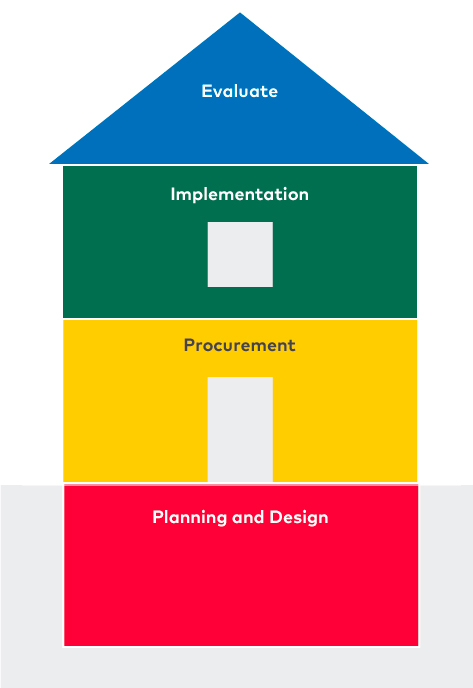
Evaluate Research Academia Everyone else | |
Implementation Contractors Subcontractors Workers Suppliers | Industry groups Utility providers Grid operators |
Procurement Owners Clients Procurement managers | |
Planning and Design Designers Urban planners Government Municipalities |
1.1. Scope of the guidelines
The focus of these guidelines is on climate change measured by the level of carbon emissions during the construction phase of buildings and other structures. Although building construction is the main theme, the methods can be applied to other structures, such as roads, railways, and utility systems. It specifically addresses embodied carbon emissions or, more specifically, the life cycle assessment (LCA) phases A4 – Transportation of materials, and A5 – Construction installation process. The definition of the activities included is based on the EN 15978 standard, which is widely used to define system boundaries for LCAs in the construction industry.
Phase A4 covers the transportation of building materials and equipment to the site.
A4 Transportation (EN 15978)
Transport of materials and products from the factory gate to the building site, including any transport, intermediate storage and distribution
Transport of construction equipment (cranes, scaffolding, etc.) to and from the site
All impacts and aspects related to losses due to transportation
The construction and installation process, A5, includes all activities required to complete the building or part of the building during the assessment (EN 15978).
A5 Construction (EN 15978)
Activities related to site emissions:
Groundworks and landscaping
Transport of materials, products, waste and equipment within the site
Onsite production and transformation of a product
Provision of heating, cooling, ventilation, humidity control etc.
Installation of the products into the building including ancillary materials
Waste management processes of other wastes generated on the construction site, including transportation from the building site
Production, transportation and waste management of products and materials lost during A5
In the expected update of the EN 15978 standard, the A5 module is divided into four sub-modules: pre-construction activities (A5.1), construction activities (A5.2), waste and waste management (A5.3), and transport of construction workers (A5.4).
Work package 1 (WP1) of Nordic Sustainable Construction has published a report on impact assessment methods – Recommendations for a Common Nordic Approach to Combat New Buildings’ Life Cycle Climate Impact,
‘Nordic view on data needs and scenario settings for full life cycle building environmental assessment’, Nordic Innovation, 2024. [Online]. Available: https://www.nordicsustainableconstruction.com/knowledge/2024/june/recommendations-for-a-common-nordic-lca-approach
In other contexts, module A5 has also been divided into two parts: A5.2 energy, and A5.3 waste. In this report, the energy component will be referred to as A5.E and the waste component as A5.W. These guidelines can also be used during deconstruction, with the elements of module A5.1 divided into A5.E and A5.W.
Table 1.1 Categories of emissions from the construction site.
Equipment and activities | Sources of emissions | ||
A4 | Transportation | Vehicles | Fossil fuels Renewable energy |
A5.E | Energy | Construction machinery Vehicles on site Power generation | Fossil fuels Renewable energy |
Heating and drying Lighting and appliances Electric tools and machines | Fossil fuels Renewable energy District heating | ||
A5.W | Waste | Production of waste materials Transport of waste materials Recycling Landfill | Raw materials and production Fossil fuels Renewable energy Waste processing Landfill emissions |
1.2 Legal framework for LCAs in the Nordics
The introduction of a legal framework for disclosing lifecycle greenhouse gas emissions, with or without limit values, in all the Nordic countries is planned by early 2025. Denmark was the first to issue limit values in 2023, with Sweden, Iceland, and Finland expected to follow in 2025. In June 2021, Norway proposed a comprehensive LCA scope and limit values for buildings, but these were rejected in January 2022. There are no plans for new limits. The current primary focus of the Norwegian government is to establish a climate partnership with the construction industry to cut emissions.
The Nordic countries are preparing to take the next step in exploiting the climate protection potential of the building sector and to drive innovation. Carbon emissions during the product stage (A1-A3) and construction stage (A4-A5) are often grouped and referred to as upfront embodied carbon emissions, as they are released before the building starts operating. Upfront emissions are the part of the lifecycle that can be confirmed with real values upon delivery of the building and calculated without making assumptions about the future. A focus on upfront embodied carbon emissions is about reducing emissions today, rather than in the distant future. Additionally, the ongoing transition of energy systems and industry towards low emissions suggests that future emissions will likely be comparatively low.
As of January 2024, Finland and Iceland include both A4 and A5 in the proposed limit value scope, and Iceland includes both in the proposed climate declaration scope. Norway includes A4 and the waste component of A5 in the climate declaration scope. Sweden includes both in the climate declaration scope from 2022 as well as in the proposal for limit value for 2025 and the proposed climate declaration for 2027.
From July 2025 climate impacts from A4 and A5 are included in the requirement of limit values in Denmark.
‘Ny aftale stiller ambitiøse klimakrav til nyt byggeri’. Accessed: Jun. 26, 2024. [Online]. Available: https://www.sm.dk/nyheder/nyhedsarkiv/2024/maj/ny-aftale-stiller-ambitioese-klimakrav-til-nyt-byggeri
1.3 Baseline emissions
Knowledge about actual emissions from construction sites is gradually increasing. Current emissions from phases A4 and A5 are being estimated across the Nordic region in preparation for the upcoming regulation of limit values. The activities included in the system boundary differ, and the definition of area and units is not standard. The harmonisation of standards and methods for the estimation and regulation of emissions is an important goal. Emissions from energy use are typically included as this is a well-known factor. Emerging research shows that waste is just as important when considering construction emissions.
K. Kanafani, J. Magnes, S. M. Lindhard, and M. Balouktsi, ‘Carbon Emissions during the Building Construction Phase: A Comprehensive Case Study of Construction Sites in Denmark’, Sustainability, vol. 15, no. 14, p. 10992, Jul. 2023, doi: 10.3390/su151410992.
K. Kanafani, J. Magnes, A. Garnow, S. M. Lindhard, and M. Balouktsi, ‘Ressourceforbrug på byggepladsen: Klimapåvirkning af bygningers udførelsesfase.’, Aalborg Universitet, Aalborg, 2023:14, 2023. [Online]. Available: https://vbn.aau.dk/ws/portalfiles/portal/611626468/BUILD-rapport_2023_14_Ressourceforbrug_p_byggepladsen.pdf
In this chapter, estimated emissions values for A4 and A5 have been collated from the Nordic countries. Although these numbers are intended to indicate current emissions levels, they are expected to change and improve as more accurate data becomes available.
Iceland
In March 2024, a harmonised methodology for the preparation of LCAs for buildings in Iceland was officially published. This also marked the beginning of an 18-month transition period for the introduction of LCAs. At the same time, generic values for the Icelandic market were published. These state A4 as 19.79 kg CO2e/m2 and A5 as 42.50 kg CO2e/m2.
‘Íslensk meðaltalsgildi | Húsnæðis- og mannvirkjastofnun’. Accessed: Jun. 27, 2024. [Online]. Available: https://hms.is/mannvirki/lifsferilsgreining/islensk-me%C3%B0altalsgildi-lca
Norway
Norwegian building regulations require an LCA pursuant to EN 15978 with the full inclusion of module A4, and only waste for module A5. Real values or indicative values for the amount of waste (cut and loss) provided in guidelines can be used. The emission values from the environmental product declaration (EPD) data should be used or trusted third-party databases, with 25% added on top of these values. With regard to transport, EPD data, standard values for transport distances, a transport calculator, or real transport distances and modes of transport can be used.
‘Byggteknisk forskrift (TEK17) med veiledning’, Direktoratet for byggkvalitet. Accessed: Jun. 30, 2024. [Online]. Available: https://www.dibk.no/regelverk/byggteknisk-forskrift-tek17
Sweden
In Sweden, KTH Royal Institute of Technology and the Swedish National Board of Housing, Building and Planning (Boverket) conducted a large study, which was updated in 2023. The average emissions for A4 and A5 was 44 kg CO2e/m2. Private homes had the least impact at 24 kg CO2e/m2, while office buildings and schools had an impact of 53 kg CO2e/m2. Although the balance between A4 and A5 was not specified, it appeared to be roughly equal. Although the system boundary included waste in module A5, not all groundwork activities were included.
T. Malmqvist, S. Borgström, J. Brismark, and M. Erlandsson, ‘Referensvärden för klimatpåverkan vid uppförande av byggnader Version 3’, KTH Royal Institute of Technology, Stockholm, 2023.
Denmark
In 2021, Denmark adopted a National Strategy for Sustainable Construction, which introduced limit values for construction emissions. Initially set at 12 kg CO2e/m²yr, these values will be gradually reined in. Ahead of the 2025 review, the Danish construction industry called for stricter CO2e regulations, asserting their readiness for ambitious changes. A separate limit of 1.5 kg CO2e/m²yr for the construction process will be implemented, which corresponds to lifetime emissions of 75 kg CO2e/m2 for a 50-year lifespan.[4]
That is above the value from the recent comprehensive case study of construction sites in Denmark that looked at 52 + 9 Danish construction sites in respect of their carbon emissions from transport in module A4 and the construction-installation process in module A5. The median result was 0.28 kg CO2e/m2yr for A4, and 1.00 kg CO2e/m2yr for A5. This translates to 14.00 kg CO2e/m2 and 50.00 kg CO2e/m2 over the standard 50-year lifespan.[5]
The new limit also lies above the values from the recent report that seeks to develop quantitative key figures and reporting criteria for the implementation of the building process stage in the whole-life carbon requirements of the Danish building regulations. Here, the resulting median is 0.4 kg CO2e/m2yr for module A4, and 1.0 kg CO2e/m2yr for module A5.[6]
However, it is likely that this report has influenced decision-making regarding the update of the LCA regulations and the accompanying limit values by providing a benchmark for allowable emissions, guiding policymakers in establishing more stringent and precise criteria.
Finland
The Ministry of the Environment in Finland has published a generic LCA database for construction [10]. This database is based on average values from various studies. Emissions in module A5 are set at 43 kg CO2e/m2 for residential buildings and 52 kg CO2e/m2 for other building types. Only energy use is considered and waste is omitted. Emissions for groundwork are set separately at 7 kg CO2e/m2. For module A4 the database has a generic value of 20.4 kg CO2e/m2.
Table 1.2. Estimated emissions values for A4 and A5 in the Nordic countries.
Finland: Generic values for LCAs
‘Emissions database for construction’, Emissions database for construction. Accessed: Jun. 30, 2024. [Online]. Available: https://co2data.fi/rakentaminen/#en
1.4. Action hierarchy
Activities and methods aimed at lesser environmental impacts can be categorised and ranked by their effectiveness.
Avoid, shift, improve
A commonly used hierarchy is “avoid, shift, improve”. Although this originally related to transport, it can be applied to A4 – transportation and A5.E – energy on site.
‘Sustainable Urban Transport: Avoid-Shift-Improve (A-S-I)’, SUTP. Accessed: Jun. 30, 2024. [Online]. Available: https://sutp.org/publications/sustainable-urban-transport-avoid-shift-improve-a-s-i/
K. Dhawan, J. E. Tookey, A. GhaffarianHoseini, and A. GhaffarianHoseini, ‘Greening Construction Transport as a Sustainability Enabler for New Zealand: A Research Framework’, Front. Built Environ., vol. 8, May 2022, doi: 10.3389/fbuil.2022.871958.
Avoid: Avoiding unnecessary transportation can be achieved by consolidating deliveries and sourcing materials locally. Avoiding new construction and thereby reducing energy use prevents significant emissions. This can be done through planning and design by opting to use existing buildings instead of demolishing and building new ones, as well as by sharing spaces and employing other innovative methods.
Shift: Shifting to more sustainable transport options, such as electric vehicles, can significantly reduce emissions. Shifting towards low-carbon fuel sources for machinery and equipment on site also reduces emissions.
Improve: Improving the efficiency of current transportation methods through the use of fuel-efficient vehicles and optimised logistics helps to lower environmental impacts. Enhancing the energy efficiency of on-site machinery further reduces emissions.
Applying this hierarchy helps to deliver EFCS by systematically reducing transportation-related emissions.
Table 1.3. The hierarchy of A4 and A5.E: avoid, shift, improve
A4 Transport | A5 Energy | ||
Avoid | System-wide | Avoid trips – reduce distance | Avoid new construction and the use of energy |
Shift | Individual mobility | Shift towards low-carbon modes of transport and fuel sources | Shift towards low-carbon fuel sources |
Improve | Vehicle efficiency | Improve fuel efficiency and load capacity of modes of transport | Improve energy efficiency of on-site machinery |
The 3Rs
In relation to the circular economy and waste, there are similar three principles – reduce, reuse, and recycle – also known as the 3Rs of waste management. More nuanced frameworks are proposed that describe each item in more detail. These are naturally termed 5R, 7R, and 10R.
Krzysztof Pikoń, Magdalena Bogacka, Marcin Landrat, and Katarzyna Piecha–Sobota, ‘A guide to circularity in construction’, Polish Green Building Council, 2023. [Online]. Available: https://circon.plgbc.org.pl/
Table 1.4. The hierarchy of A5.W: reduce, reuse, and recycle
3R | A5 Waste | |
Reduce | Use less building material | Avoid unnecessary material use Reduce size Design for less waste |
Reuse | Keep original function of material | Repurpose building Refurbish and repair building Reuse and repurpose materials in new construction |
Recycle | Raw materials from used components | Salvage high-value material streams Mine waste for materials Convert waste to energy |
Material use in the construction industry is depleting natural resources and is clearly not sustainable. The most effective way to reduce the environmental and economic burden is to build using less material. This directly translates into less waste.
When a building or a construction reaches the end of its useful life, its materials and components can be used in new construction. The building should preferably be reused without needing to dismantle it, or even be moved to a new location.
Finally, if reuse is not possible, the materials from a construction should be recycled with highest level of efficiency achievable. Incineration for energy recovery should be the last resort. Landfill is not considered to be an option.