3 Preconditions for Setting & Controlling Limit Values
This section provides more qualitative insights into the processes that lead to the adoption of LCA-based limit values in the Nordic countries, including the roles played by various stakeholder groups, pre-existing frameworks, supporting resources, as well as available tools and data to carry out the assessments. While parts of this section are supported by references, many of these insights are based on the experience of co-authors who have been involved in the reported activities processes, as well as input from experts from the Nordic countries.
3.1 Stakeholders Affected by Limit Values
Introducing the type of novel carbon regulation in question entails considerable challenges in the construction sector on many levels. Conventional construction activities with high carbon emissions are confronted with a new challenging performance indicator. This implies changes in building design, procurement, product development, marketing, collaboration, among many others. Before implementing new legislation, policymakers need to ensure that stakeholders are prepared and willing to follow the proposed path. This section provides an overview of the main actors concerned by the introduction of limit values, as well as important assets enabling LCA regulations, which are developed further in the rest of the chapter.
Stakeholders are affected differently depending on their engagement in buildings. Construction actors involved in the production of buildings on all levels manoeuvre in a regime where buildings are viewed as investment assets traded on a market. They are most likely to support decarbonisation policies when opportunities for decarbonisation are viewed greater than the related risks. Regarding the ongoing development of mandatory European climate declarations, supporting branch actors expect to benefit from a market advantage as frontrunners, especially for attracting international investment and delivering services abroad. For these actors, a harmonised method is crucial for achieving a market with fair competition about the most efficient low carbon solutions.
Developers are responsible for directing resources to different building projects. In recent years and with support from the EU Taxonomy, investors have started requiring a high environmental performance from projects in which they invest. Here, harmonised national requirements support common quality standards and allow transparent decision-making.
A third group of actors are clients. In the Nordic countries, they are mostly represented by branch organisations, social housing associations and public institutions. Public procurement often entails more ambitious requirements than the regular market. According to the revised EPBD proposal, only public buildings must be zero emission by 2027. Also, many state or municipal clients already set local sustainability requirements
Francart, N., Larsson, M., Malmqvist, T., Erlandsson, M., & Florell, J. (2019). Requirements set by Swedish municipalities to promote construction with low climate change impact. Journal of Cleaner Production, 208, 117–131. https://doi.org/10.1016/J.JCLEPRO.2018.10.053
Häkkinen, T. (2016). The role of municipalities in sustainable building – the Finnish experience.
Häkkinen, T. (2016). The role of municipalities in sustainable building – the Finnish experience.
In Denmark, a cost impact analysis has been performed in 2022 prior to the introduction of limit values in January 2023. The subsequent cost calculation for the 2025 revision has been published in the current limit values report
Torzan et al. (2023). Klimapåvirkning fra nybyggeri: Analytisk grundlag til fastlæggelse af ny LCA baseret grænseværdi for bygningers klimapåvirkning fra 2025. BUILD Rapport 2023:21
3.2 Acceptance, Readiness and Active Support from Stakeholders
Readiness and acceptance depend on each other, and on the relation between the current state of the national industry and the targeted ambition level of regulation. Regarding the acceptance of limit values by the industry, commercial actors thrive in fair market competition based on transparent and harmonised rules for all. However, harmonisation by a trustworthy independent third party or legislation provides clear performance criteria for clients, which supports the possibility of demanding low carbon industry services, especially for investors and public clients. Harmonisation entails agreement by stakeholders on the calculation method, which includes questions about environmental data, tools and reporting format. The greatest stakeholder acceptance is achieved when all elements are covered by harmonisation. The foundation for this complex endeavour is often seen laid by voluntary schemes. The ideal last step towards legally binding requirements is an independent, critical evaluation of practical experiences of the voluntary scheme, where arguments for and against methodological decisions and expected impacts are made accessible to public debate for informing political decisions.
Readiness, in turn, is dependent on the level of required resources and competences. In a regime with simplified and harmonised LCA methods, available and verified tools and data, the required level of competence is rather low compared with a more open situation, in which many risky decisions have to be made and resources have to be selected and acquired. In Denmark, Finland, Sweden and Norway, a harmonised LCA method and national environmental data or EPDs were accessible early in the process. Building LCA tools have also become available in these countries, through different approaches. The basic preconditions for minimising the readiness threshold follow a similar track as earlier measures dealing with operational energy efficiency.
However, readiness can be improved further, and acceptance increased by providing active capacity building in the industry in terms of education and competences. For instance, Sweden, Norway and Denmark have organisations specialised in capacity building in the building sector. Some of these organisations overlap with national authorities. In all countries, a Green Building Council hosts green certification schemes and provides learning material and training courses. The availability of appropriate assessment tools and data, voluntary sustainability schemes and supporting resources for capacity building is therefore essential to ensure both readiness and acceptance. These aspects are considered further in the rest of this chapter.
Beyond acceptance and readiness, building industry actors with a high level of LCA competence have sometimes actively supported the introduction of mandatory LCA declarations and limit values, through direct advocacy and/or the use of LCA in flagship sustainable projects. While this driving role of industry actors is sometimes difficult to demonstrate, it can be seen more explicitly through a few examples. The Swedish Construction Federation and the Swedish Construction Industry’s R&D fund (SBUF) supported and funded a particularly influential study on embodied carbon in buildings, which received considerable attention from public authorities and industry actors, and it contributed to a paradigm shift in the adoption of building LCA
IVA 2014 Klimatpåverkan från byggprocessen (Stockholm: IVA and Sveriges Byggindustrier)
Moncaster, A. M., & Malmqvist, T. (2020). Reducing embodied impacts of buildings – insights from a social power analysis of the UK and Sweden. IOP Conference Series: Earth and Environmental Science, 588, 032047. https://doi.org/10.1088/1755-1315/588/3/032047
In Denmark, prior to the introduction of the voluntary sustainability class, representatives from the construction industry have published a proposal for voluntary requirements in the building regulation
InnoByg (2018). Frivillig Bæredygtighedsklasse i Bygningsreglementet – Oplæg fra Byggebranchen. See: https://www.innobyg.dk/om-innobyg/publikationer/frivillig-baeredygtighedsklasse-i-bygningsreglementet/
3.3 Supporting Resources for Competence Building
Before introducing regulation, it must be ensured that resources are available to actively support the capacity building of the industry in terms of voluntary sustainability schemes, free online resources and databases, as well as that compliant tools are in place (Table 13).
The existence of voluntary sustainability schemes including LCA is often a way to build up LCA competence in the building industry before the introduction of a mandatory declaration. Such voluntary schemes are sometimes explicitly introduced to prepare for an upcoming regulation. This is for instance the case of the voluntary sustainability class introduced in Denmark in 2020 (and e.g. the E+C- label in France). The voluntary sustainability class, an initiative of the construction industry, which was officially introduced by the Danish Traffic, Building and Housing Authority, was used between May 2020 and November 2023 in order to gather experience and prepare the introduction of mandatory LCA regulations. The scope of the voluntary sustainability class was very much debated, and some organisations were concerned about additional consulting cost for reporting. The final scope, which was more comprehensive than the DGNB standard at the time, was only made possible due to the existence of the freely available LCAbyg tool.
In other cases, pre-existing certifications played an important role in paving the way for the introduction of a mandatory declaration. This is for instance the case of the DGNB certification, which pioneered LCA in the Danish building sector in 2012, and the BREEAM certification used in Norway, Sweden (nationally adapted versions) and Iceland (international version). The most common green building certification in Sweden is Miljöbyggnad. Miljöbyggnad was introduced in 2011 by the Swedish GBC
Miljöbyggnad is based on the system "Miljöklassad byggnad" which was introduced earlier than 2011. The system changed its name after being handed over to SGBC
The development of LCA competence in the industry is also supported by free resources developed by public authorities or industry actors. In Denmark, the Knowledge Centre for Building Climate Impacts
See: https://fmezen.no/
Table 13 Timeline of supporting resources for the limit values (non-exhaustive examples).
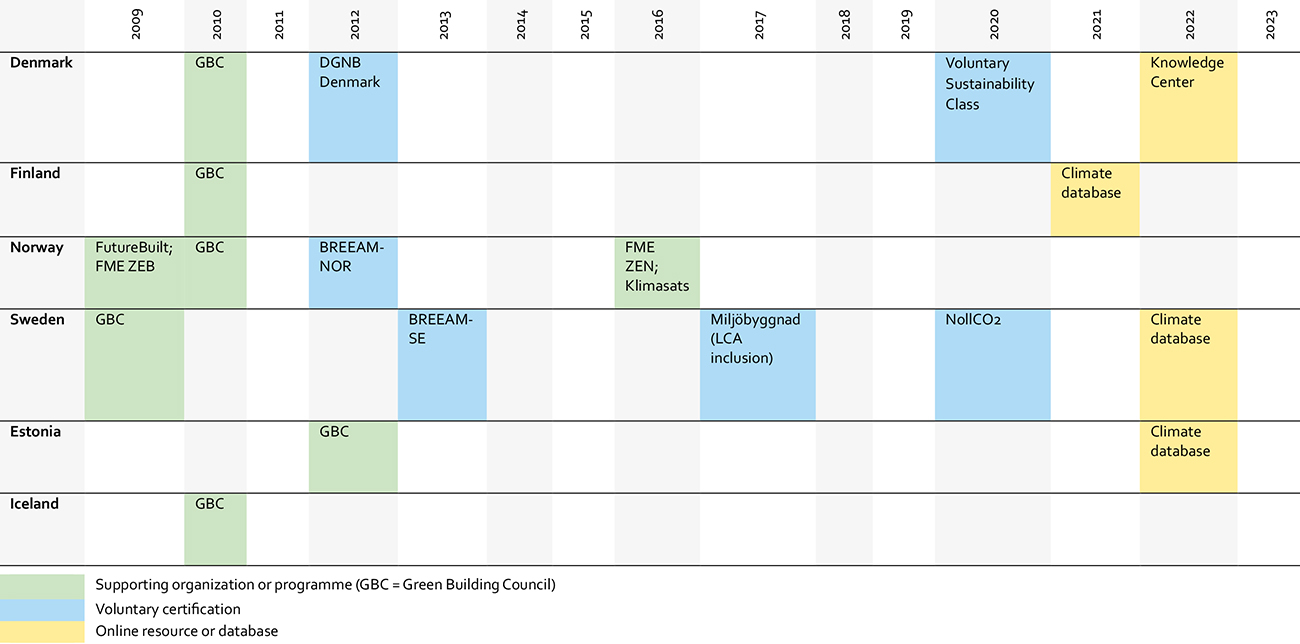
In all Nordic countries, the national Green Building Councils pioneered LCA in the building sector and have been providing resources, education and certification services. The Councils in Sweden, Denmark, Iceland, Norway and Finland were all founded around 2009-2010, while the Estonian Green Building Council was founded in 2012 (but is currently on standby).
As importantly, the development of LCA competence also is supported by the introduction of university education of building LCA in most Nordic countries in recent years (for example, since 2018 in Finland).
3.4 Data on Buildings, Components and Climate Impact
An important precondition for the introduction of limit values is the availability of data to carry out the assessment. In particular, practitioners need access to environmental product declarations (EPDs) or generic environmental data for all building products. Table 14 provides an overview of the generic and EPD data availability in each Nordic country as of second half of 2023.
Most Nordic countries are in the process of establishing or building up a national database of generic emission factors to use alongside the climate declaration. Publishing national average database can act as a lever for building product manufacturers to publish their EPDs.
In Denmark, the German Ökobaudat database has historically played an important role as it constitutes the base for most of the generic environmental data used in Denmark. This was not the case in other Nordic countries. However, Denmark recently developed its own generic emission factors for the most used 20-25 standard construction products in Danish new construction
Kragh, J., & Birgisdottir, H. (2023). Udvikling af dansk generisk LCA-data. (1 udg.). BUILD Report 2023:16
Sweden and Finland developed their generic emission factors databases jointly. In Sweden, IVL, an independent non-profit research centre focusing on environmental issues, was one of the first actors to develop an internal environmental database for construction products. IVL’s data is based on an analysis of existing EPDs on the Swedish market. This became the basis for most of the environmental data in the national database hosted by Boverket since 2022. IVL is also the parent organisation for EPD International, who administers and operates the international EPD system. While Norway, Denmark and Finland all have dedicated website reporting EPDs in the country, Swedish EPDs are usually reported on the international EPD website, or on other Nordic EPD websites.
The Finnish background environmental database was published in March 2021. The emission factors are based primarily on a review of EPDs from Finland, as well as other Nordic countries and Germany (including Ökobaudat data). All environmental data is digitalised and can be linked to common programmes used in the building sector. Predominantly using the Finnish generic data as a base, and in combination with the OneClickLCA localisation methodology, Estonia has developed a first version of generic data in 2022 and is now being updated so that a new version is provided as a package with the official climate declaration method in late 2023/early 2024.
Table 14 Climate emission factors data availability in the Nordic countries (as of January 2024).
Denmark | Estonia | Finland | Iceland | Norway | Sweden | ||
National generic data | Availability/ name(s) | √ generic data (Table 7 in Appendix 2 of BR18) | (√) generic national data published but not yet officially approved; updated version will accompany the national method | √ CO2data.fi | no national generic database for building products or other life cycle phases – under investigation | no national generic database for building products1 | √ Boverkets klimatdatabas |
Date of release | Current database: December 2022 Updated database valid from 2025: December 2023 | February 2022, update expected end of 2023/early 2024 | March 2021, updated many times | 2024/25 | N/A | January 2022, updated in May 2022 and January 2023 | |
Accessibility | Open | Open | Open | Open | N/A | Open | |
Conservative emission factors | Newdata: 75% percentile of values found in an EPD sample | 20% | 20% | 25% | 25% added only if not already included | 25%, but not for energy and fuels | |
Background data (for products) | Current generic data is based on Ökobaudat 2021 version and Danish branch EPD. National generic data is under development (on top of branch EPDs) | currently predominantly based on the Finnish national database (CO2data.fi) using OneClickLCA localisation methodology for Estonia; it will be updated and improved within the LifeIP project BuildEST. | predominantly based on databases such as RTS EPD, EPD Norge, Environdec, ÖkobauDat, IBU and ICE | under investigation | unknown if a generic database will be developed | based on studies from IVL Svenska miljöinstitutet (Swedish Environmental Research Institute). Values were derived by calculating mean values from existing EPDs on the Swedish market. | |
National EPD data | Registered number | ≈400 EPDs, a tenfold increase since 2019 | ≈ 50 EPDs | ≈ 350 EPDs | >5 EPDs and more underway | ≈ 2,600 EPDs from over 350 companies | There is no national EPD database for Sweden. EPD's for Swedish products and suppliers are registered in different databases, such as EPD Norway or EPD International; a number cannot be defined. |
Availability of EN15804+A2 data | ≈170 | unknown, since there is no national EPD system in place; estimate: around 85% of EPDs by various manufacturers. | yes, some | yes, some | ≈140 | unknown, since there is no national EPD system in place | |
Degree of digitalisation | Most EPDs in the Danish database are digitalised for use in the calculation programme LCAbyg. ≈ 140 Danish EPDs are available in Ecoplatform. | not yet, but planned | Everything is digitalised, and it is possible to link it to other programmes like Tekla. ≈ 160 Finnish EPDs are available in Ecoplatform | EPDs of Icelandic products thus far published at EPD Norge or The International EPD System, thus available in Ecoplatform | ≈ 1020 Norwegian EPDs are available in Ecoplatform | ≈ 387 Swedish EPDs are available in Ecoplatform | |
Norway currently has no national database of generic emission factors for construction in place. The climate declaration is supported by the great number of digitalised Norwegian EPDs available. To assist early design stages, the closest to a national generic database is the maximum recommended values for GHG emissions for generic products by the Norwegian GBC as part of a series of guidelines for selecting materials.
It is common practice to include conservative values in the database. This is for instance a way to incentivise the use of specific data rather than generic data. For instance, Swedish values for materials represent an average of EPDs found on the Swedish market for each type of product, plus a conservative factor of 25%. Finland and Estonia use a similar approach but with a 20% conservative factor. Conversely, the Danish environmental database under development is based on the 75% percentile of values found in an EPD sample, rather than a corrected average
Kragh, J., & Birgisdottir, H. (2023). Udvikling af dansk generisk LCA-data. (1 udg.). BUILD Report
Similarly, assumptions about the service lives of building components play an important role in climate declarations, but a systematic comparison of these assumptions between countries is difficult. Different countries have different ways of describing and classifying building components and different ways of attributing service lives. Sweden assigns a single technical service life for each product in the generic environmental database. The values are simple approximations (e.g. “> 50 years”, “< 40 years”, etc.), but it should be noted that service life values are not needed for the current climate declaration since replacement is not included. Boverket has suggested to expand the climate emission factors database with more information on maintenance and replacement, if the climate declaration is to be expanded to include these processes in 2027
Boverket (2023). Limit values for climate impact from buildings and an expanded climate declaration.
REPORT 2023:24. Swedish National Board of Housing, Building and Planning
3.5 Availability of Assessment Tools
Besides background environmental databases, the development of national building LCA tools has been critical to the adoption of LCA in the industry. In the Nordic countries, with regulation already in place, like Denmark, Norway and Sweden, any tool can be used to perform the LCA declaration as long as the calculations are carried out with climate emission factors compliant with the rules in the climate declaration and as long as all requested information is included in the declaration. In Denmark, the most commonly used tool so far has been LCAbyg, a freely available tool developed by Aalborg University’s Department of the Built Environment (BUILD) since 2015. LCAbyg is, by design, compliant with the national LCA regulation (the research group behind LCAbyg is also providing recommendations for the national LCA declaration and limit values). LCAbyg has been a pivotal asset enabling the adoption of building LCA through a harmonised package of a calculation tool, generic data, calculation and reporting methods, and trainings for professionals. Other new tools have entered the market in 2023 following the introduction of the mandatory declaration and limit values. An overview of available tools in Denmark is provided by the knowledge centre
In Sweden, IVL has developed a tool called Byggsektorns miljöberäkningsverktyg (BM – Building Sector Environmental Calculation Tool), which is compliant with the Swedish declaration. The tool is free, with paid licenses for advanced functionalities.
In Finland, the tool OneClickLCA has been very influential in the development and adoption of building LCA – both as a tool and as a private consulting company. OneClickLCA has been commissioned by the Finnish Ministry of the Environment to write reports e.g. on reference and limit values for building LCA. OneClickLCA is also very active in other countries, especially Nordic countries. For instance, OneClick LCA is one of the four tools mainly used in Norway
Overall, it is interesting to note that some viable building LCA tools have been developed in academia and publicly funded (LCAbyg, Reduzer), others in public-private partnerships (BM, developed by IVL, which is owned by a foundation jointly established by the Swedish Government and Swedish industry), and yet others by private, for-profit companies (OneClickLCA, Holte, ISY). Some of these private companies, in particular OneClickLCA, have been influential in shaping building LCA practice and policies in the Nordic countries.