1 Existing Pathways to Limit Values
This section provides a background and overview of the current state of building LCA declarations and limit values in Europe as a whole, with a focus on Nordic countries.
1.1 Building LCA in Europe
All over the European Union (EU), initiatives are taking form to push for a reduction of climate impact in the building sector. At the EU level, a Whole Life Carbon Roadmap for the reduction of the climate impact of buildings by 2050 is being developed as of 2023. The roadmap will consist of a series of milestones and targets, which are designed to guide the construction industry to achieve a net-zero carbon built environment. The roadmap will include specific targets for reducing the whole life carbon of buildings, encompassing in-use emissions caused by the operation of buildings and embodied emissions related to the production, construction, renovation and deconstruction of buildings. A technical study supporting this development has already been published, providing information on the strategies and technologies required to achieve the necessary reduction for staying on track of the EU targets. This study also shows how the European building sector pathways and strategies can be translated into building-level life cycle carbon values considering improving material efficiencies and implementation of technological solutions (Table 1).
Table 1. Estimated trajectory of building level upfront embodied carbon and renovation embodied carbon based on archetype modelling and considering the implementation of material efficiencies and technological solutions (so-called “TECH-Build scenario")
Year | 2020 | 2025 | 2030 | 2035 | 2040 | 2045 | 2050 |
Upfront embodied carbon (A1-5) (kgCO2e/m2 useful floor area) | |||||||
Average | 810.41 | 706.55 | 603.12 | 500.66 | 398.48 | 398.48 | 398.48 |
Best practice | 344.21 | 296.27 | 248.54 | 201.26 | 154.10 | 154.10 | 154.10 |
Renovation embodied carbon (kgCO2e/m2 useful floor area) | |||||||
Average | 273.81 | 260.30 | 246.60 | 233.62 | 222.06 | 222.06 | 222.06 |
Best practice | 46.81 | 44.51 | 41.93 | 39.49 | 37.32 | 37.32 | 37.32 |
Note: “average” represents the average value across archetypes for all regions and building types, “best practice” represents the lowest value observed in any individual archetype.
To support this harmonised effort tackling the environmental impacts of buildings, the methods used to calculate these impacts are becoming more and more consistent and standardised. The EN 15804+A2 norm, revised in 2019, governs LCA for construction products, while the EN 15978, under revision in 2023, standardises LCA at the building level. The Level(s) framework, expanding on the two EN norms, proposes a common method, indicators and reporting system for building life cycle assessment (LCA). Although its use is voluntary, more and more LCA-related tools and initiatives in the European building sector are designed to be consistent with Level(s). The most important of these initiatives is perhaps the EU Taxonomy for green activities, established to standardise the definition of what constitutes a sustainable investment. In order to fit the Taxonomy’s criteria, buildings erected after 2023 with a floor area of more than 5000 m2 must provide a calculation of global warming potential (GWP) based on EN 15978 and Level(s). Furthermore, on the regulatory side, the EU Energy Performance of Buildings Directive (EPBD) is currently under revision and a provisional agreement between the Council and the Parliament has been reached in December 2023
In addition to EU-wide initiatives, individual countries have also been pioneering LCA-based mandatory declarations and limit values for newly constructed buildings. The Netherlands have introduced LCA-based limit values as early as 2018, using a particular metric called MPG (Milieu Prestatie Gebouwen – Building Environmental Performance). The MPG is determined by first carrying out an LCA consistent with EN 15804+A2, including 11 different impact categories. These 11 results are then converted into a single metric expressed in €/(m2year) using a set of standardised weighting factors. In 2018, the MPG limit value was set to 1 €/(m2year) for all residential buildings and office buildings over 100 m2. As of July 1st 2021, the limit value for residential buildings was lowered to 0.8 €/(m2year). A reduction of the threshold and adaptation of the weighting is expected in 2025. However, no limit values particularly for the climate impact will be implemented in the short-term future.
In France, a voluntary sustainability label called “E+C-“ (Energy + Carbon -) was introduced in November 2016 by the Ministry of Housing with the explicit purpose of preparing the introduction of a mandatory declaration of climate impact. The label was a way of trying out an LCA methodology building up knowledge within the industry and public authorities and supporting a stakeholder consultation for the introduction of a mandatory declaration. Following this consultation, the method and indicators were revised and turned into a mandatory energy and climate declaration with limit values (RE2020). The RE2020 was adopted in 2021, took effect in 2022 and is planned to be updated every 3 years. The RE2020 requires a separate reporting of life cycle greenhouse gas (GHG) emissions linked to operational energy and emissions linked with materials and on-site activities. It uses dynamic emission factors, which implies that carbon emissions happening in the future have a lower importance (and that the temporary storage of carbon in biogenic products provides climate benefits). Limit values depend on the typology, area and location of a building. Overall, the assessment method and reporting requirements are rather complex.
In the Nordic countries, the beginning in mandating climate declarations was made by Sweden in 2022. The first carbon limit for large buildings was placed by Denmark in 2023, and the rest will soon follow as described in the next section.
1.2 Mandatory LCA-based Declarations in the Nordic Countries
The main aspects of the Nordic countries’ pathways towards decarbonisation are presented in Table 2. In all five Nordic countries and Estonia, mandatory climate declarations for new buildings have either been introduced or are currently under development. Current mandatory LCA declarations (Sweden and Denmark) do not include building renovations, except in Norway, where mandatory climate declarations include existing buildings undergoing major renovation. This aligns with the EPBD revision proposal, which includes LCA-based regulation of new buildings while at the same time strengthening current operational energy regulation for existing buildings. By the end of 2024, all Nordic countries are expected to have published a preliminary national calculation method for the climate impact of buildings, which is then used as a methodological foundation for regulation. As the industry’s competence with LCA will evolve in the new regime with climate declarations, the scope of the methods is expected to be adjusted to secure effective carbon mitigation. Implementing LCA on a building project basis needs very specific calculation rules and preconditions. Building professionals must have the possibility to perform assessments rapidly and at low cost. This differs from other LCA use cases, such as expert-led assessments in other industries’ large-scale serial production. The methods used throughout the Nordic countries therefore exceed the level of detail of the technical standard EN 15978, with more detailed national specifications as well as guidelines for interpreting them. This reduces complexity, makes assessments more straightforward and enables the use of project templates with a minimum reliance on expert judgement.
In all Nordic countries, mandatory climate declarations (with or without limit values) are planned to be introduced by the beginning of 2025, which is three years after the pioneering regulation in Sweden. The Swedish mandatory declarations have been introduced at the same time as the EU Taxonomy’s requirement of LCA-based declarations for large buildings at the end of 2021. The countries have adopted different timelines for testing the method prior to implementation. Sweden and Denmark have had short testing periods which have more the character of a transition period. However, the lack of time to evaluate as-built projects with the new method has been compensated by the existence of voluntary schemes in these countries (e.g. Miljöbyggnad, BREEAM-SE and DGNB-DK), which allowed them to evaluate rules and practice outside legal frameworks. The Swedish and Danish declarations were also implemented with a limited scope (ignoring certain life cycle stages, as well as most finishes and installations in the case of Sweden), with the intention to facilitate the initial implementation by focusing on the parts typically causing the greatest climate impact and complementing the scope later on.
Table 2. Timeline of climate declaration and limit values integration (as of January 2024).
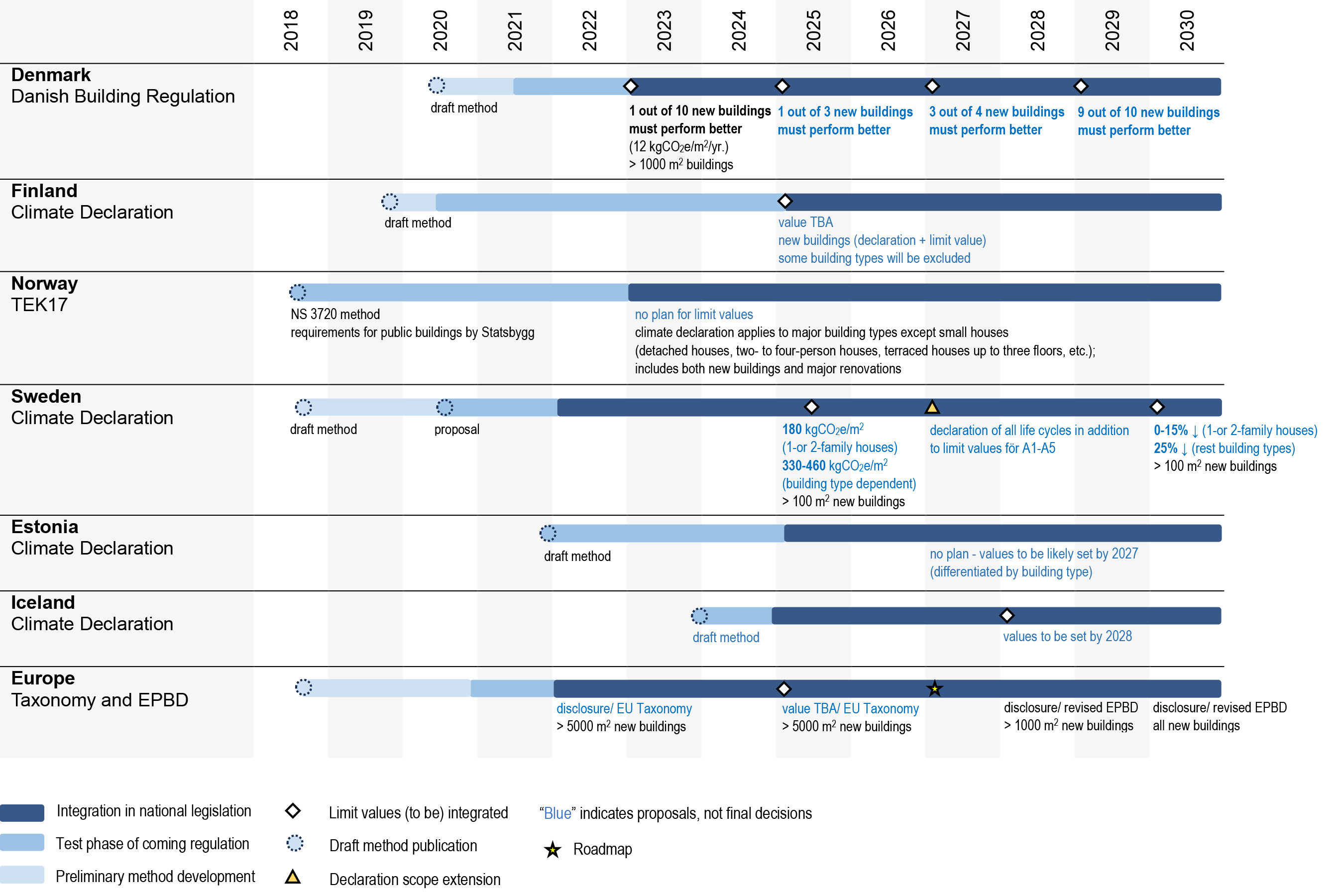
The process in Finland and Norway has included a longer transition period since the first draft methods published to evaluate projects and revise the method before it becomes mandatory. For example, in Norway, several reports have been published before introducing mandatory life cycle assessments in the Norwegian national building code (TEK)
Examples are: a study published by Enova in 2020 with proposed national reference values for embodied carbon for six building categories and two types of basements on the basis of building archetypes, as well as a report published by the Research Centre on Zero Emission Neighbourhoods in Smart Cities (ZEN) the same year investigating the empirical foundation for Norwegian limit values for buildings, on the basis of 130 Norwegian building case studies. The Norwegian Agency for Public and Financial Management (DFØ) has also been active with the provision of reference values since 2021, which values have been revised along the years to reflect changes in the climate declaration method and advancements in materials.
Mandatory declarations have proven a useful preparation and set the ground for binding carbon limit values. Denmark has combined the introduction of declarations with limit values as the first Nordic country in 2023. While the Danish limit values have been notably generous in 2023, the next revisions for tightening the limits will take effect in 2025, 2027 and 2029. In Sweden, the first version of the mandatory declaration does not include limit values, but Boverket has already proposed that specific values become mandatory by mid-2025, so the industry can prepare for this level. Finland has yet to announce the magnitude of the limits taking effect from 2025. At the same time, the EU Taxonomy will introduce mandatory limit values for large buildings (above 5000 m2). The Swedish approach can be regarded to be aligned with the European pathway, while the Danish appears to be slightly ahead. By the expected implementation of the revised EPBD with mandatory assessments for large buildings in 2028, all Nordic countries will have had at least two years of experience with mandatory national life-cycle regulation.
Unlike the Netherlands and France, the Nordic countries use a limited number of life cycle modules at implementation. This decision is a compromise between preparing industry and investors for the decarbonisation transition on the one hand and introducing an agreeable and manageable method at affordable cost on the other. At least Denmark and Sweden are preparing an extension of the current system boundary with more life cycle modules in order to end up with a more complete life cycle scope in the future, while Finland is planning to include the most relevant modules from the beginning. The provisional EPBD agreement on life cycle completeness according to the full scope of Level(s) as referred to in Annex III
1.3 Limit Value(s) Development and Basis
This section provides an overview of how various Nordic countries worked with establishing limit values for the climate impact of new construction, and what rationale they used to decide on the level of these values, if any (Table 3).
In Denmark, limit values were recommended by a stakeholder panel
The Climate Partnership for Construction has handed its recommendations to the government in on March 16th 2020. https://climatepartnerships2030.com/the-climate-partnerships/construction
In Estonia, no limit values have been defined yet, but a construction roadmap for 2040 (Green Tiger Construction Roadmap 2040) proposed setting limit values for 2027.
Iceland has established a Roadmap to Sustainable Construction which sets 74 actions and goals for 2030. Furthermore, Iceland expects to introduce limit values for climate impact of buildings in 2028. A base has not been defined yet.
In Finland, the definition of limit values is under development at the moment. A preliminary report developed reference values for various building types, as well as recommendations on the adoption of limit values
In Sweden, the limit values have been recommended by Boverket on the basis of a reference report with 68 case studies of buildings published in 2021 by The Royal Institute of Technology (KTH, commissioned by Boverket) and the method and background research defined in the report "Gränsvärde för byggnaders klimatpåverkan och en utökad klimatdeklaration"
See the report: Gränsvärde för byggnaders klimatpåverkan och en utökad klimatdeklaration - Boverket: https://www.boverket.se/sv/om-boverket/publicerat-av-boverket/publikationer/2023/gransvarde-klimatpaverkan/
In Norway, in June 2021, the Government suggested to include a comprehensive LCA scope regarding lifecycle modules and building elements, along with the establishment of limit values based on building LCA. However, the proposed voluntary limit values were rejected in January 2022, and no plans for extending the current scope or introducing limit values are in place. After that, a report was prepared with GHG calculations for reference buildings for single-family homes, four-family homes, apartment buildings and office buildings using three different calculation tools so that the Norwegian Building Authority (DiBK) could build a better knowledge base to assess whether there is a basis for regulating a level for embodied carbon emissions in TEK
This report concludes that ca. 20 % CO2-reduction has no cost and that the tools are calculating differently. See: https://www.dibk.no/om-oss/Kalender-DiBK/klimagassutslipp-fra-byggematerialer.
Table 3. Overview of development status (as of January 2024).
Denmark | Estonia | Finland | Iceland | Norway | Sweden | |||
BR18 | Proposed draft method for climate declaration (2021) | Proposed climate declaration (currently under revision) | Proposal under development (2023) | TEK17 | Climate declaration 2022 | Limit values 2025 (proposal) | Climate declaration 2027 (proposal) | |
Administered by | Danish Authority of Social Services and Housing | Ministry of Economic Affairs and Communications (later Ministry of Climate) | Ministry of the Environment | The Housing and Construction Authority | Directorate for Building Quality | Swedish National Board of Housing, Building and Planning | ||
Climate Declaration: Status | In use | Under development | Test phase | Under development | In use | In use | Proposed | Proposed |
Climate declaration: (Expected) year of introduction | January 2023 | 2025 | January 2025 | 2024 | January 2023 | January 2022 | July 2025 | 2027 |
Limit value(s): Status | In use | Under development | Under development | Under development | No plan yet | - | Proposed | |
Limit value(s): (Expected) year of introduction | January 2023 | Not decided yet, likely by 2027 | Likely to be introduced later than climate declaration, date not yet decided | likely by 2028 | No plan yet | No earlier than 2025 | 2025 | |
Limit value(s): Level | 12 kgCO2e/m2/year | Under development | Not yet decided | Under development | No plan yet | - | Proposed 2025 limit values in kgCO2e/m2, valid for five years: Office buildings: 385 Special housing: 385 Residential buildings: 375 Pre-schools: 330 Other educational buildings: 380 One or two-family home: 180 Other buildings: 460 | |
1.4 Limit Values for Various Building Types
An important point of difference between climate declarations and associated limit values in the various Nordic countries is the type of building concerned by the declaration. Table 4 specifies which buildings are covered by the declaration in each country.
In the Nordic countries, residential buildings make up the highest share of new construction (and are therefore the top priority when it comes to regulating climate impact). However, no building type can be said to fully dominate construction trends (agricultural, industrial and office buildings, for instance, represent significant shares as well). It is thus relevant to mitigate the impact caused by other building types as well. Buildings that do not have a standard form (e.g. concert halls, etc.) are also expected to have a great variation in the climate impact.
In terms of building types and sizes included (Table 4), the Danish regulation covers all buildings larger than 1000 m2 for which energy requirements apply. Meanwhile, Norway excludes some types such as detached homes and other small homes like semi-detached houses, town houses and small terraced houses. Sweden has quite detailed rules about which buildings are exempted from the declaration. For instance, buildings with a temporary construction permit, industrial and agricultural buildings, buildings constructed by private individuals without business purposes, as well as buildings necessary for safety and defence are excluded from the declaration.
Additionally, different building types might have different limit values or other special rules. In Sweden, limit values differ between one or two-family houses, other residential buildings, pre-schools, other educational buildings, office buildings and special housing, and other buildings. These differentiated limit values were proposed based on the analysis of 68 building case studies.
Boverket (2023). Limit values for climate impact from buildings and an expanded climate declaration. REPORT 2023:24. Swedish National Board of Housing, Building and Planning
Malmqvist, T., Borgström, S., Brismark, J., Erlandsson, M. (2023). Referensvärden för klimatpåverkan vid uppförande av byggnader. Version 3. KTH Skolan för Arkitektur och Samhällsbyggnad. ISBN: 978-91-8040-754-0
Table 4. Building uses and sizes covered by the current and proposed requirements (as of January 2024).
Building type | Denmark | Estonia | Finland | Iceland | Norway | Sweden | |
BR18 | Proposed climate declaration | Proposed climate declaration + limit value | Proposed climate declaration | TEK17 | Proposed limit values 2025 (likely in line with climate declaration 2022) | Climate declaration 2027 (Boverket’s proposal) | |
Single-family home | √ | - | - | √ | - | √1 | |
Other residential building | √ | √ | √ | √ | √ | √1 | |
Office | √ | √ | √ | √ | √ | √1 | |
Retail and restaurant | √ | √ | √ | √ | √ | √1 | |
School and daycare | √ | √ | √ | √ | √ | √1 | |
Laboratory | √ | √ | √ | √ | √ | √1 | |
Hospital and health | √ | √ | √ | √ | √ | √1 | |
Sports facilities | √ | √ | √ | √ | √ | √1 | |
Cultural and other public | √ | √ | √ | √ | √ | √1 (some public authorities are exempted) | |
Religious | √ | - | √ | √ | √ | √1 | |
Industrial | √ | - | - | √ | √ | - | - |
Holiday cottages4 | - | - | - | - | √3 | √1 | |
Other | √ | √ | - | √ | √ | √1 | |
Renovation projects | - | - | - | √2 | √ | - | √2 |
Size of buildings | 2023-2025: > 1000 m2 From 2025: under political negotiation | unspecified | no size requirement, just building type | unspecified, buildings under scope classes 2 and 3 in Building Regulation | no size requirement, just building type | > 100 m2 | - |
Limit value scope | √= included | ||||||
Climate declaration scope | |||||||
Proposed limit value scope | |||||||
Proposed climate declaration scope | |||||||
1 Sweden provides detailed requirements on which buildings are exempted from declarations and are independent of the building type, such as temporary building constructions, buildings built by private individuals and that do not take place within commercial activities, building for industrial or workshop purposes, etc. (https://www.boverket.se/sv/klimatdeklaration/vilka-byggnader/inte-deklareras). This means that any building included in the building types listed above could be excluded if they fulfill the indicated requirements.
2when building permit is needed according to definition in building regulation (and along additional exemption rules in the case of Sweden)
3 included when they are in blocks
4 called “leisure homes” in Norway
2when building permit is needed according to definition in building regulation (and along additional exemption rules in the case of Sweden)
3 included when they are in blocks
4 called “leisure homes” in Norway
In Finland, debates are ongoing regarding which buildings might be exempted from the climate declaration, as well as whether differentiated limit values will be introduced based on building type. A preliminary report was published with reference values differentiated for apartments, offices, service buildings, schools and commercial buildings, as well as proposed limit values for each building type
Carbon footprint limits for common building types. 2021. One Click LCA Oy Ltd.
In Estonia, ongoing discussions have partly concluded to align the inclusion of the building types with EPBD exemptions from the minimum energy for building energy performance. This means that Estonia most likely will not include carbon calculation requirement for industrial or religious buildings nor for holiday cottages. The setting of different limit values or calculation rules for different types of buildings remains open.
On the contrary, Denmark uses one single limit value for all buildings above 1000 m2. The Danish limit values were based on 60 building cases, and no significant difference was found across building types. There was a higher variance within each building type than among building types
Zimmermann, R. K., Andersen, C. M. E., Kanafani, K., & Birgisdottir, H. (2021). Whole Life Carbon Assessment of 60 buildings: Possibilities to develop benchmark values for LCA of buildings. BUILD Report No. 2021:12
Nielsen, L. H., Tozan, B., Birgisdottir, H., & Wittchen, K. B. (2022). CO2-krav og særlige bygningsforudsætninger: Udformning af model til beregning af overskridelse af grænseværdi ved øget klimapåvirkning grundet særlige bygningsforudsætninger. Institut for Byggeri, By og Miljø (BUILD), Aalborg Universitet. BUILD Rapport Bind 2022 Nr. 27 https://build.dk/Assets/CO_2-krav-og-saerligebygningsforudsaetninger/CO2-krav-og-saerlige-bygningsforudsaetninger.pdf
Tozan, B., Olsen, C. O., Sørensen, C. G., Kragh, J., & Rose, J. (2023). Klimapåvirkning fra nybyggeri -Analytisk grundlag til fastlæggelse af ny LCA baseret grænseværdi for bygningers klimapåvirkning fra 2025.
Similarly, in Norway, no differentiation of limit values based on building type is planned. A report from the Norwegian Research Centre on Zero Emission Neighbourhoods (ZEN) developed reference values for buildings based on an analysis of existing LCA case studies, and the report found no statistically significant difference in total impact between types
Wiik, M. R. K., Selvig, E., Fuglseth, M., Resch, E., Lausselet, C., Andresen, I., ... & Hahn, U. (2020). Klimagasskrav til materialbruk i bygninger. Utvikling av grunnlag for å sette absolutte krav til klimagassutslipp fra materialbruk i norske bygninger.
Interestingly, a greater interest in learning more about the climate impact associated with deep renovation
substantial renovation is defined differently in the various countries. Alias terms are: deep renovation, refurbishment and reconstruction
Lund, A. M., Zimmermann, R. K., Kragh, J., Rose, J., Aggerholm, S., & Birgisdottir, H. (2022). Klimapåvirkning fra renovering: Muligheder for udformning af grænseværdier til LCA for renovering. Institut for Byggeri, By og Miljø (BUILD), Aalborg Universitet. BUILD Rapport Nr. 33
1.5 Compliance Control Regime
The need for verification and possible sanctions depends on the chosen point of intervention (building permission phase or post-handover phase), how specific reporting requirements are and who is authorised to check them. Elements of reporting to be checked include inventory, scenarios, environmental data and calculation procedure. Error in reporting these elements can be reduced by using data from existing workflows or by narrowing methodological choices. Existing workflow data includes BIM files, tender lists or delivery notes, while methodological predefinitions may include default scenarios, generic data or verified LCA tools, which can secure correct calculation procedure to some extent.
In a legal perspective, clients pass the responsibility of compliance to a consultant or contractor through power of attorney. Since reporting includes data from several suppliers, the client/consultant transfers parts of the responsibility to any suppliers, who must provide data for reporting. This may include the contractor, sub-contractors, retailers, manufacturers, waste handlers and so on. Table 5 gives an overview on similarities and differences in control regimes for building carbon regulation in the Nordic countries.
Table 5. Compliance control regimes.
Denmark | Estonia (Proposed) | Finland (Proposed) | Iceland (Proposed) | Norway | Sweden | |
Technical compliance control | 10% of cases checked | No specific procedure yet decided | No specific procedure yet decided | No specific procedure yet decided | Yes | 10 % of cases checked |
External verification | No | Not decided yet | Not decided yet (possibly BIM file) | Not decided yet | No | No |
Reporting stage | As-built | Building permit | Building permit + As-built | Building permit + As-built | As-built | As-built |
Public building LCA register | No | Not decided yet | Not decided yet | Not decided yet | No | Yes |
LCA tool requirement | No | No | No | Not decided yet | No | No |
Market-based tools allowed | Yes | Yes | Yes | Yes | Yes | Yes |
1.5.1 Control and Verification
In all participating countries, control routines are about to be developed as the requirements are being implemented. Sweden has published information about their process for supervision. Since the building life cycle spans require data from different sources and actors, the balance between effective and feasible procedure will take several years to test and refine.
Countries with existing carbon regulation require post-completion reporting for achieving a permit for operation. Estonia, Finland and Iceland are additionally considering including carbon reporting at building permit level, which then has to be updated at operation permit. No country requires the use of a specific official tool.
In Sweden, the national authority responsible for the supervision of climate declarations is Boverket, which performs spot checks, control of 10 % of registered climate declarations at Boverket. In Norway and Denmark, the building authority is placed at municipal level. In Denmark and Norway, the municipalities do not control technical aspects of building or operation permits without specific cause. Instead, the owner is responsible for legal compliance of building projects. In Denmark, technical aspects are only spot checked in 10% of cases. Sanctions for infringement are legally possible.
In Sweden, the client must register a climate declaration at Boverket before final clearance can be given by the municipality, and then save documentation for five years in case they are selected for random control by Boverket. Boverket handles a template
Byggbranschens elektroniska affärsstandard, https://beast.se. Downloaded on 2 May 2023.
The possibility of limiting climate assessments to the building components or materials, which are the main contributors to climate impacts has also been discussed in Sweden as well as in Denmark. During the preparation of the climate regulation in Denmark, this possibility was discarded for several reasons. Firstly, material impact contribution may change over time and as a consequence of technological development. Secondly, the desired competition between different component and material options and related manufacturers and building design options would be disturbed. And lastly, the desired increase in simplicity and feasibility obtained by limiting the inventory is uncertain compared with a simpler approach of including all delivered materials without the need for selection.
1.5.2 Reporting Stage
In general, whole-life carbon assessments can only be controlled based on the built result, because the specific type and quantity of purchased materials cannot be predicted exactly. All Nordic countries therefore require documentation of the as-built stage. Finland and Estonia require additional assessments already at the building permit stage. In all cases, building owners may want to make sure to comply with carbon limits throughout all project stages to reduce the risk of infringement. Finland and Estonia formalise this need through their requirements, which may be viewed as a way to avoid problems, before construction has begun. On the other hand, building permits cannot guarantee compliance of the finished result and may send a false signal of safety. Besides national variation in legal practice, building permit reporting can be an additional scaffolding for implementing the novel carbon limits, which may help practitioners and clients to take assessments more seriously compared to the legally minimum of as-built reporting, when no changes can be made to the building fabric anymore.
1.5.3 Public Register
Building cadastres and address registers are as old as the first cities. Today, GIS-based databases are a valuable tool for research-based policy making and often accessible for the public. A public register of building carbon assessments can provide very valuable database for the development of carbon limits. Currently, only Sweden has a public register with climate declarations to be used for compliance control and the development of limit values. It is planned to be open when the quality is assured. It is available for researcher on request. A first set of simple statistics will be published in January 2024 in Boverket’s handbook for climate declarations. The statistics will be updated on a yearly basis. Conversely, Denmark has extensive data publicly available for any building in the country (the BBR database). However, this database does not include information from the climate declaration. Building permission files such as climate declarations will only be available in the public registry in a case-by-case manner. This question is related to the general availability of building stock data, which is relevant for policymaking in all societal areas, not only environmentally. However, the ongoing digitalisation of administrative and permission procedures as well as building archives is slow, and the quality control is difficult to achieve.
Carbon assessments will likely extend to include more indicators and life cycle stages. Most certainly, they will not only include environmental aspects, but also other types of information, because buildings are entangled in many affairs of public interest and regulation. Digitalisation offers other ways of public regulation, which are useful in the complex regulation of buildings. The development is driven by processes that already use digital workflows such as building design (digital twins), facility management or LCA, which are paving the way to a more holistic digital representation of building through time. This workflow can be utilised by public authorities. However, many open questions have to be solved on the way. Building passports or logbooks aim at establishing a database for structured digital building information, which reflects the current status of material, properties and environmental impacts and make them accessible from the outside without new assessments. They will also be valuable for facility management and later renovations and can serve as an enabler for urban mining and the reuse of building products. The building passport practical guideline by the Global Alliance for Buildings and Construction gathers current initiatives in one guideline
Energy Performance of Buildings Directive (2010/31/EU)
Being a keystone in climate declarations, the systematic reporting of the building fabric demands for a harmonised building classification system that would be beneficial for ensuring that impacts and quantities are assigned to building parts in a uniform manner. Today, all countries have different systems, while some use a variety of systems. The correct use of classification is a precondition to be able to perform control and related delivery notes and other product documentation to the model.
Ideally, building product data is provided by suppliers together with the products and stored in a digital building repository. This data can then be used to inform the material related LCA and be shared with the authorities for permissions and verification. This would bypass or reduce the role of consultants in this part of LCA and instead create a more direct reporting flow from manufacturer, supplier and contractor to the client and authorities. The ongoing development and successive implementation of the EU Construction Product Regulation (CPR) is expected to play a vital role for new ways of handling environmental data of building products throughout the construction value chain. In the future, all building products will have to declare their environmental performance by default and in a uniform structure, which will change building climate declarations considerably. A more thorough account on recent developments of the CPR and expected ramifications can be found in Task 2 “Data for LCA” in the Nordic Sustainable Construction Programme.
1.5.4 LCA Tools
LCA can be performed in a variety of workflows in the construction pipeline. Some tools integrate carbon assessments in tender calculation tools, others provide carbon screenings in geometric design tools (CAD, BIM), and some tools are stand alone and work with different kinds of data integration. Since regulation is based on the as-built status, we focus on tool functions for this stage. No country makes the use of tools as such or one national tool in particular mandatory. Given the availability of calculation methods and allowed environmental data, everybody can perform LCA without the use of any tool as a starting point.
When using publicly available or commercial tools, the question of compliance verification arises. Using a tool means delegating responsibility for parts of the assessment to the tool provider. As a minimum, tools should provide a complete declaration of calculation procedure and data sources. This should also include the status of user choices. This may require some degree of assessment, which places responsibility on the user, not the tool. As an alternative to a full functional declaration, national authorities may require tools to be verified. For example, a Norwegian study shows that using different tools in the market may lead to different results for the same building and scope, notably because the tools use different assumptions for the service lives of building products among others
See: https://www.dibk.no/om-oss/Kalender-DiBK/klimagassutslipp-fra-byggematerialer. There is no conclusion yet on all reasons behind why the tools give different results, this is still under investigation. Another main purpose of this report was to investigate how much one can reduce the GHG emissions without costs and with costs.
1.6 Reduction Roadmap
In some Nordic countries, the planning of the limit values is accompanied by a certain plan for their progressive tightening. In Denmark, there has been a policy decision that future reductions of the limit value will be based on a percentile value of a representative sample of Danish buildings. For instance, by 2025 the limit value will be set so that two thirds of a representative building sample would be able to reach it without improvements (the 2023 limit value is set so that 90% of a building sample would be able to reach it without improvements, and the building sample is not fully representative of new construction). The voluntary CO2 class
In Sweden, the suggested plan is to reduce the limit values by 25% in 2030 for all building types other than single-family homes, which are already more optimised, which deems a reduction of up to 15% sufficient. If this trajectory continues linearly, this means that from 2025 and up to 2045, which is when Sweden aims at a climate neutral building and construction, the limit values will be reduced by 60-100% depending on the building type.
The main rationale behind selecting a certain limit value pathway is to make it cost-effective. I.e. a pathway that ensures a stable marginal cost of reducing emissions over time, also considering that today’s costs are heavier than costs postponed to the future. This means lower emission requirements in the beginning and increasing requirements over time, as the emission cost increases with stricter emission requirements. In this endeavour, countries are trying to strike a balance between the need to push for faster climate impact reductions and the consideration of small and medium-sized stakeholders with fewer resources to build up expertise to work on reducing projects’ emissions as well as buy climate-improved construction products.
Another aspect is frequency of adjustments. Denmark applies two-year adjustments, while Sweden suggests a much longer adjustment time-step of five years. Sweden’s rationale is that less frequent adjustments allow time for evaluations and necessary regulatory amendments as well as reduce administrative costs. Furthermore, the plan to expand the scope is associated with update of the national database and development of standard values, which also considerably adds to administrative cost. On the other hand, a more frequent reduction interval facilitates a more gradual industry transition for all parts of the value chain and ensures that up-to-date environmental data is used.