3. Spatial Planning and Low-Carbon Infrastructure
3.1 Main findings
The Nordic region emphasizes spatial planning as a key strategy for achieving low-carbon urban development, integrating environmental considerations into urban planning to reduce emissions and improve quality of life. Key approaches include compact, mixed-use urban designs that promote sustainable mobility and improve public health, as exemplified by Bergen's smart mobility hubs
3.2 Opportunities and best practices
The Nordic region prioritizes spatial planning to achieve low-carbon urban development.
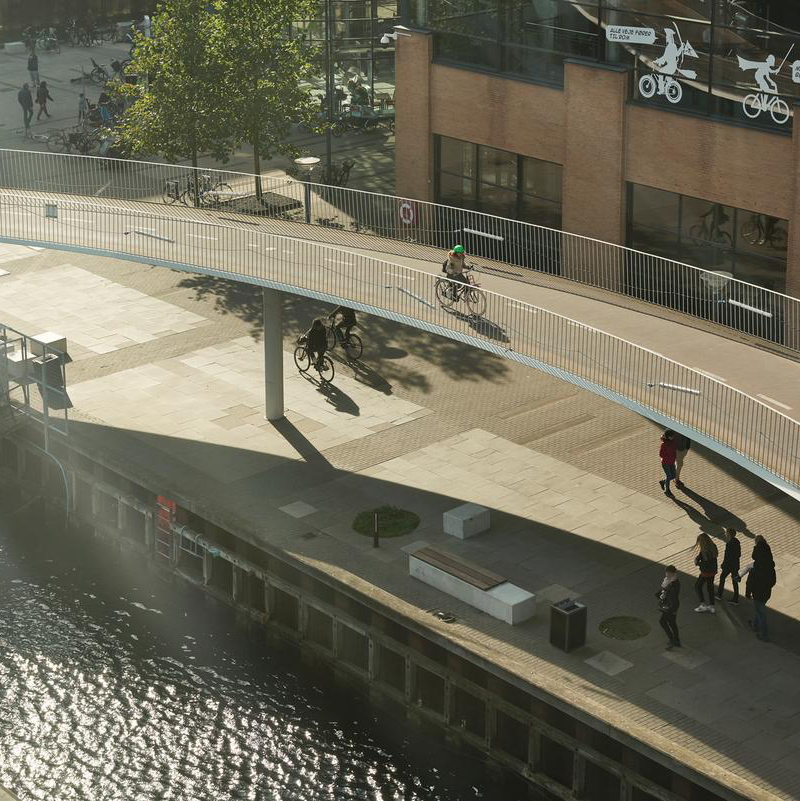
- Compact and Mixed-Use Development: Many Nordic cities focus on compact, mixed-use urban forms to reduce transportation needs and promote sustainable mobility options like cycling and walking. This approach enhances public health through increased physical activity, improves air quality by reducing vehicle emissions, lowers energy bills, and creates jobs in local businesses and services.Case study: Smart Mobility (Bergen, Norway)
Mobility hubs in Bergen integrate car-sharing stations with public transport, bike routes, bike parking, real-time transport info, and pedestrian access. The city opened its first hub in Møllendal in May 2018, marking the first of its kind in Norway. Currently, nine more hubs are being planned or implemented, each featuring car-sharing spaces, bike parking, pedestrian access, and proximity to public transport. The hubs are customized to fit local needs, such as including underground trash collection and rentable bike hangers in Møllenpris. - Public Transport and Active Mobility: Investment in reliable, low-emission public transport systems and pedestrian infrastructure has significantly cut urban transport emissions. These investments contribute to better public health by reducing air pollution, improve air quality in urban areas, decrease household energy bills by reducing expenses (such as reliance on private vehicles), and generate employment opportunities in the transport and infrastructure sectors.Case study: City of Oslo (Norway)
Oslo drives widespread electrification of public buses, trams, ferries, private delivery vehicles, and heavy-duty construction machinery through public procurement and incentives. The city has implemented variable congestion charges targeting diesel vehicles and incentivizes contractors to use electric machinery in municipal projects. Oslo also promotes sustainable transport by adding 100 kilometers of cycling lanes, leading to a 51% increase in cycling since 2016, while also reducing street-side parking, converting them into bike lanes. Street transformations have made walking and cycling safer, with significantly reduced pedestrian and cyclist deaths. Additionally, electric charging stations are widely available for private vehicles. - Smart Cities and Digitalization: The region invests in using digital tools for smart urban planning, optimizing energy use, and improving efficiency. This digitalization supports enhanced public health through improved environmental monitoring, better air quality from optimized energy systems, reduced energy bills due to efficient resource use, and job creation in the technology and data analytics sectors.Case study: Smart Kalasatma (Helsinki, Finland)
Kalasatama, a former brownfield district in Helsinki, was transformed into an experimental innovation platform from 2013, co-creating urban infrastructure and services with local stakeholders. The district actively promotes the sharing economy, with residents using digital applications to share cars and parking spaces. Smart locks in new buildings allow flexible use of various spaces for different activities. Kalasatama also features a smart grid that supports real-time smart metering, electric vehicle networks, and new electricity storage solutions. The area is powered by a solar plant and connected to an energy-efficient district heating and cooling grid. - Integrated Spatial Planning: Strategies such as high-density residential and job areas, mixed land use, and transit-oriented development (TOD) can reduce GHG emissions by more than 20% by 2050. These planning strategies improve public health by lowering pollution levels, enhance air quality, reduce energy bills, and create jobs in construction, urban planning, and local businesses.Case study: Västra Hamnen (Malmö, Sweden)
Västra Hamnen is a model for integrated spatial planning with high-density residential and job areas, mixed land use, and transit-oriented development (TOD). The district features a mix of residential, commercial, and office spaces, encouraging walking and cycling. It is well-served by public transport, reducing car dependency. These planning strategies improve public health, enhance air quality, lower energy bills, and create jobs in construction and local businesses. - Modular and Adaptable Buildings: Modular and adaptable buildings are key to reducing carbon footprints. By designing structures that can be relocated and reused, emissions can be cut by up to 60% compared to permanent buildings, with reuse potentially reducing footprints by 90–92%. This approach improves public health by decreasing construction-related pollution, enhances air quality, lowers energy bills through efficient use of materials, and generates jobs in modular construction and design.Case Study: Rikshospitalet (Oslo, Norway)
The company Adapteo provided a modular building floor on the roof of an existing hospital to allow for more office space. The retrofit can be relocated and reused, offer up to 60% lower carbon footprints compared to permanent structures. Reusing these modules can cut the footprint by 90–92%. - Low carbon buildings materials: Many Nordic cities are leading the way in adopting low-carbon building materials to advance sustainable construction practices. By using innovative, low-impact materials and techniques, these cities significantly reduce the climate impact of their buildings. This approach not only lowers the carbon footprint of construction but also enhances public health through reduced pollution, improves air quality, and cuts energy bills due to more efficient buildings. Additionally, it creates job opportunities in the sustainable building sector and supports the development of eco-friendly urban environments.Case Study: Gothenburg's Hoppet preschool (Gothenburg, Sweden)
Gothenburg's Hoppet preschool, Sweden's first nearly fossil-free building, exemplifies advancements in sustainable construction. Completed in 2021, it welcomes 144 children and reduces the climate impact of building materials by 70% compared to traditional methods. This was achieved through conscious material choices and careful planning. Supported by the EU’s Northern Connection project, 27 suppliers from five countries contributed innovative solutions. The building features low-carbon materials, reused products, and locally sourced wood, showcasing the potential of fossil-free construction without compromising quality.Case Study: Mjøstårnet (Brumunddal, Norway)
Mjøstårnet, completed in March 2019, is the world’s tallest timber building at 85.4 meters. Located in Brumunddal, near Oslo, this 18-storey tower symbolizes sustainable construction using local materials. It houses a hotel, apartments, offices, a restaurant, and a wooden swimming hall. Built with glulam and Cross Laminated Timber (CLT) by Moelven Limtre, Mjøstårnet holds a Guinness World Record and has received multiple awards, including the New York Design Awards and Council on Tall Buildings and Urban Habitat's (CTBUH) Award of Excellence.Case Study: Fyrstikkbakken 14 (Oslo, Norway)
Fyrstikkbakken 14 is built in CLT and low-carbon concrete and has an energy consumption in operation that corresponds to a minimum of near-zero energy. In total, the reduction of GHG is 53% compared to a business-as-usual reference building. The housing project experiments with new forms of housing, and is particularly known for the concept of dividing meters – square meters you share with others. - Progressive National building strategies: Nordic countries are advancing national building strategies to enhance sustainability and reduce carbon emissions in the construction sector. These strategies typically include stricter CO2e limits for new buildings, with progressive targets that tighten over time. By implementing rigorous standards and emission limits, these countries aim to significantly improve climate performance across a substantial portion of new constructions. This approach helps reduce construction-related emissions, improve air quality, lower energy bills through more efficient building practices, and create jobs in the green construction sector.Case Study: Denmark National Strategy for Sustainable Construction (Denmark)
Starting in July 2025, Denmark will enforce a stricter CO2e limit of 7.1 kg CO2e/m²/year on average for new buildings, exceeding the 2021 strategy targets. The agreement introduces varied limits for different building types and also includes limitation on emissions from the construction phase. For example, large single-family homes will face progressively tighter limits, reaching 5.4 kg CO2e/m²/year by 2029. This ensures that 85% of new constructions will achieve better climate performance than in 2021.
3.3 Main Barriers
Cities transitioning to low-carbon and sustainable infrastructure face considerable challenges in balancing urban growth with environmental protection. As urban areas expand, safeguarding natural landscapes while retrofitting existing infrastructure with low-carbon alternatives demands significant investment and coordination. Competing land uses often hinder the implementation of green and blue infrastructure, essential for enhancing urban ecosystems and carbon storage. Moreover, the long-term sustainability of these projects can be compromised by insufficient maintenance and a lack of community engagement, making it imperative for urban planners to prioritize these elements alongside infrastructure development.
3.4 Recommendations
- Facilitate National Knowledge Sharing Mechanisms
- Establish mechanisms for sharing best practices on climate policy implementation, with updates every two years.
- Translate guides and resources for broader accessibility.
- Organize national events for discussing challenges and successes in climate goals.
- Integrate Accountability and Monitoring into Climate Policy
- Develop guidelines for incorporating climate considerations into major policy documents.
- Create working groups to monitor climate-related targets in government initiatives.
- Utilize Data for Impact Assessments
- Allocate resources for gathering regional climate data to inform urban planning and decision-making.
- Support Climate-Responsive Infrastructure Planning
- Encourage climate-resilient infrastructure in local planning, aligning projects with national climate goals.
- Implement Compact, Mixed-Use Urban Development
- Focus on high-density, mixed-use urban areas to minimize transportation needs and promote sustainable mobility.