3. Implementation of coaching
Coaching schedule
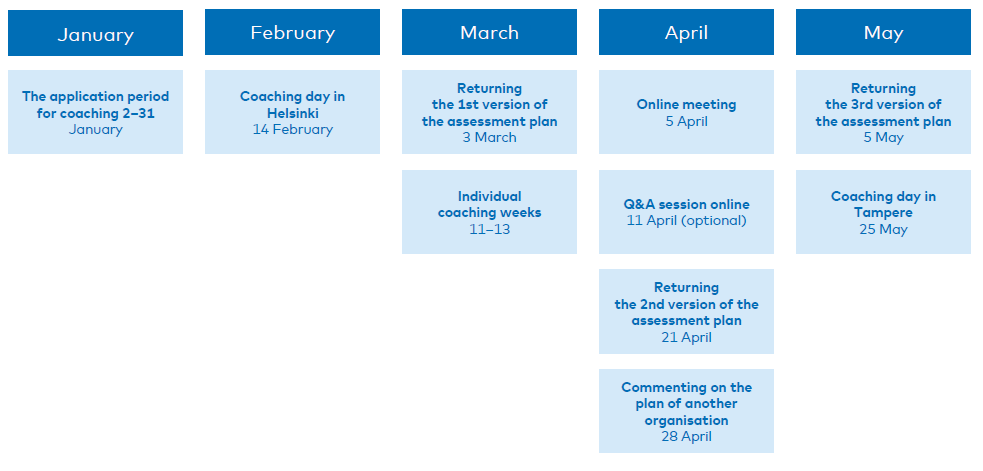
Application process and selection of participants
The application process for the pilot coaching was carried out in early 2023. In January–February, participants filled out an application asking them to assess the current state of their organisation on a scale of 1–4 (1 = strongly disagree, 2 = partially disagree, 3 = partially agree, 4 = fully agree) through three statements:
- We are good at setting goals and finding indicators.
- We manage the planning, coordination and management of assessment well.
- We know how to communicate the impacts of our operations.
In addition, the participants were asked to briefly answer the questions “Why do you want to be part of the programme?” and “Why would it benefit your organisation to be part of the programme?” The applicants were also asked to state how many people from their organisation would participate in the coaching if they were selected. The participation of two people was recommended in the call for applications.
Despite the short application period, 22 applications were received. Of these, ten organisations were selected. The maximum number of ten had already been agreed upon earlier, so that the coaching could be carried out in high quality, and so that the coaches could also provide organisation-specific support.
The selection of participants emphasised the national nature of the organisations, the scope of operations and the starting level. Organisations that had not yet carried out assessment were not selected for the pilot round.
The applicants were informed of the schedules of joint coaching events already at the application stage and told that the coaching requires a commitment to the schedule, such as to the coaching days organised in Helsinki and Tampere. This kind of coaching is a significant resourcing for the organisation. We believe that the provision of schedules already at the application stage influenced how well the selected participants committed to the coaching.
First coaching day
The first coaching day was organised as an on-site, all-day event. Remote participation was not possible. This forced the participants to stop for a day and really concentrate on the topics of the coaching.
Two objectives were set for the day:
- The participant is able to set goals and indicators for the operations of their own organisation
- The participant is able to build an assessment process for their own organisation
Structure and contents of the day:
9.30 a.m.–10 a.m. | Morning coffee and breakfast with informal discussion |
10 a.m.–10.30 a.m. | Introduction round where everyone tells who they are and where they come from, as well as what they want from the coaching. Introducing the organisers and the coaches’ backgrounds. Going through the programme of the day and the principles of a safe space. |
10.30 a.m.–11 a.m. | Joint discussion on what impacting is, why the coaching is organised and what terms we use. Presentation of the coaching package: objectives,..... |
11 a.m.–12 p.m. | Lecture section: Objectives and metrics: what they are, how objectives are defined and how they can be measured. |
12 p.m.–1 p.m. | Lunch break |
1 p.m.–2.20 p.m. | Presentation of the assessment process and the assessment plan |
2.20 p.m.–2.30 p.m. | Coffee break |
2.30 p.m.–3 p.m. | Setting the participants’ own goals, general discussion about coaching and answers to questions as well as collecting feedback on the first coaching day. |
During the day, the participants were also reminded of confidentiality, one of the coaching’s guiding principles. Matters discussed in the coaching could be discussed at a general level, but not on an individual- or organisation-specific level. It was also noted that the assessment plans created by the organisations during the coaching were intended only for the group in question to see.
During the day, the participants filled out a start-up survey, in which the aim was to map the participants’ impact competence at the beginning of the coaching. The participants answered 11 questions evaluating their own competence on a scale of “I have no competence / have very little competence”, “I have some competence”, “I have decent competence”, “I am very competent” and “I do not know.”
The evaluation areas of the survey were:
- Impacting as a social phenomenon
- Concepts of impacting
- Setting goals
- Selection and use of meters
- Managing impact work
- Communication about impacting
- Collecting assessment data
- Analysis of assessment data
- Utilisation of assessment data
- Assessment coordination and management
- Systematic assessment
Already after the first day, it was found that the coaching will respond to the existing need in a meaningful way. The participants were active, and there were no major differences in the starting level of the organisations. The participants expressed a desire for a networking event, which was realised in the form of an after-work event organised in connection with the last coaching day.
Online meeting
The online meeting was carried out as a two-hour remote meeting approximately halfway through the coaching.
The objectives of the online meeting were:
- The participant is able to describe and communicate the impact of their own activities
- The participant is able to utilise assessment skills in funding applications
Structure and content of the online meeting:
1 p.m.–1.15 p.m. | Start and icebreaker, presentation of the event’s programme |
1.15 p.m.–2.05 p.m. | Lecture and discussion: Communication about impacting
|
2.05 p.m.–2.10 p.m. | Break |
2.10 p.m.–2.50 p.m. | Lecture: Assessment in funding applications |
2.50 p.m.–3 p.m. | Closing words and going through the next steps of coaching |
Feedback on the online meeting was collected during the event using Zoom’s survey tool. Participants were asked to respond to two statements: “I got new information” and “I can use the information I got in my work” on a scale of “a lot”, “some” and “not at all”.
Q&A session
The Q&A session of the coaching was carried out as an online session during the daytime. The session was a voluntary part of the coaching, but even so, participants from four different organisations attended. In addition, two coaches were present to discuss and facilitate the event. The topics of the session’s discussion had not been agreed in advance, and there was plenty of time for asking questions and discussing matters together.
The discussion went smoothly, and the topics were brought up by the participants themselves. We discussed, for example, data analysis and heard about the development work of one of the participating organisations.
From the coaches’ point of view, the Q&A session was easy to implement and arrange. In practice, this did not require preparation in advance, apart from creating a link to the video call and providing information, but still offered participants the opportunity to ask questions and hear the experiences of others.
Individual coaching
Individual coaching for organisations was carried out over a period of three weeks. Each coach had three or four organisations with whom a two-hour slot for discussions was booked. In practice, the discussions took 1–2 hours, depending on the situation of the organisation. In practice, the participating organisations were at very different stages in the development of the assessment, some at the very beginning and some at a more advanced stage. This was also evident in the individual coaching sessions.
The coaches read the version of the assessment plan in advance and highlighted points that needed refinements, extension, changes, etc. Attention was paid to the following:
- Are the objectives, measures and indicators outlined correctly?
- Is the process fully described?
- Are responsibilities defined in concrete terms?
- Has the plan been limited to fit the coaching?
The aim of the coaching was to highlight both the successes of the organisation and their areas of development. In addition, the aim was to ensure that the organisation had concrete next steps to develop a plan for the next stage of coaching.
If the participating organisation so wanted or had advanced well in making the plan, the individual coaching sessions could also discuss certain questions and consider the challenges related to assessment on a more general level instead of carefully reviewing the assessment plan.
The individual coaching sessions received good feedback from the participants, and it was found that it is worth keeping them as part of the coaching in the future. Individual coaching takes up quite a lot of resources for both coaches and participants, but on the other hand, the benefits are great. The coaches were able to prepare more for some meetings, less for others, depending on the situation of the participants. On the other hand, the discussions could meander from the assessment plan to the development of operations and, for example, to funding applications.
Peer feedback
As part of the coaching, the participating organisations worked on their own organisation’s assessment plan and commented on the plans of the other participants. Guidance on creating the assessment plan was provided on the first coaching day.
Schedule of working on the assessment plan:
- Returning the first version by email to the coach 3 March
- Individual coaching sessions in weeks 11–13 (2 hrs / organisation)
- Returning the second version to the Slack platform 21 April
- Commenting on the assessment plan of another organisation on the Slack platform by 28 April
- Returning the third (and final) version to the Slack platform 5 May
- Presentation of the organisation’s own assessment plan and reflection on what has been learned in the coaching day in Tampere on 25 May
The timetable for peer feedback and working on the organisation’s own assessment plan was tight, which was acknowledged already at the planning stage of the coaching.
Last coaching day
The closing day was arranged as an on-site coaching day.
The goals for the last coaching day were:
- The participant can communicate about the assessment work of their own organisation
- The participant is able to reflect on the assessment work of their own organisation and to consider its development independently
Structure and contents of the last day:
9.30 a.m.–10 a.m. | Morning coffee |
10 a.m.–10.15 a.m. | Joint start, introductions once again and the day’s programme |
10.15 a.m.–12 p.m. | Presentations of the organisation’s assessments plans, 15 minutes per organisation |
11.30 a.m.–12.30 p.m. | Lunch |
12.30 p.m.–1.45 p.m. | Presentation continue |
1.30 p.m.–1.45 p.m | Coffee break |
2.30 p.m.–3 p.m. | Oral reflection on the coaching as a whole, answering the coaching feedback survey and the competence development survey (cf. first day survey) |
At the end of the last coaching day, an informal after-work event was organised for those who wanted to attend, and a location was announced where the discussion could be continued. There was no organised programme. More than half of the participants attended this informal meeting.
Evaluation of the coaching
The evaluation of the coaching was carried out in the following ways:
- On the first day of coaching:
- Start-up survey for the participants: how they feel about their own impact competence at the beginning of the coaching (multiple choice survey, more information about the questions in section 3)
- First day feedback inquiry, electronic survey at the end of the day. The questions concerned practical arrangements and the participants’ experience of the usefulness of the topics covered during the day.
- Zoom polls at the end of the online meeting. Two questions: 1) I learned new information during the event 2) I can use the new information in my own work
- On the last day of coaching:
- Closing survey for the participants to illustrate the development of competence at the end of the coaching, same survey as on the first day
- Feedback survey on the coaching as a whole, providing feedback on the last coaching day, coaching in general, individual coaching, peer feedback and the processing of the assessment plan
- Reflection discussion of the participants on the success of the coaching and the development of their own skills
- Coaches’ meeting, reflection on the coaching package