3. Policy recommendations
The Nordic Networks for Circular Construction project has worked intensively around the topic of circular construction for three years. Based on that work, research, studies, and various engagement activities, we have identified multiple ways with which the circular transition in the construction sector could be further advanced in the Nordics.
3.1. The Public Sector's crucial Role in transforming construction for a circular future
3.1.1. A New Blueprint for Building
Circular construction is not just about using recycled materials; it's about rethinking the entire lifecycle of buildings to create a sustainable, waste-minimising ecosystem. The public sector, wielding its influence as regulator, decision-maker, innovation enabler, and property manager, is pivotal in steering this monumental shift. A sub-project, Nordic Circularity Accelerator led by the Green Building Councils of Finland and Iceland, investigated these roles and identified policy recommendations in cooperation with stakeholders from each Nordic country.
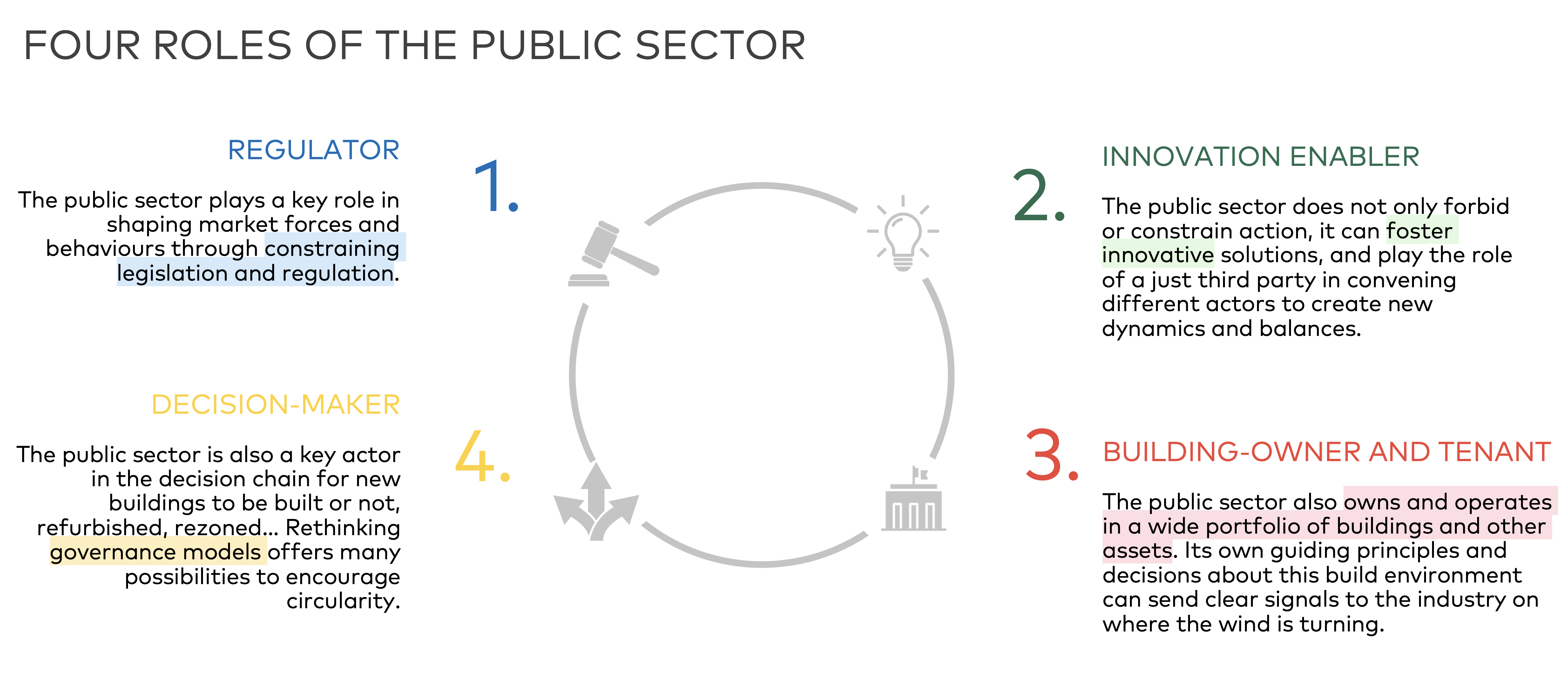
Role 1. The Public Sector as Regulator
Effective regulation is the cornerstone of widespread adoption of circular construction. In this context, the public sector's role extends beyond mere enforcement to shaping market forces and behaviours through insightful legislation that guarantees safety, reliability, and sustainability.
Quality Control through Certification
Imagine a world where every reused beam or panel in a building comes with a guarantee of safety and performance. Nordic countries are pioneering efforts to certify the quality of reused materials. Such certifications are more than just stamps of approval; they're crucial in building trust among consumers and investors, making the idea of living or working in a structure made of recycled components as normal as traditional construction.
Mandating Material Reuse
In an ambitious push, some Nordic countries are setting mandatory reuse targets for specific materials in major refurbishments and demolitions. These regulatory mandates are transforming the demolition landscape from waste-heavy operations into meticulous deconstruction missions aimed at salvaging materials for future use.
Policy Recommendations
- Introduce a resource tax on raw materials to include their environmental price.
- Introduce CO2 emissions limits for new construction and harmonise the method of calculating emissions among Nordics. Such harmonisation will allow designers and construction companies to extend their market to all Nordic countries.
- Implement requirements on circular design to the building code and ensure that they are being followed.
Role 2. The Public Sector as an Innovation Enabler
Beyond regulating and deciding, the public sector also thrives as a catalyst for innovation. By convening diverse stakeholders and facilitating the development of new technologies and practices, governments can spark significant advancements in circular construction.
Setting Standards for Reuse Insurance
One approach involves defining new standards for insuring reused materials. These standards help mitigate risks associated with recycled components, encouraging more builders and developers to choose them over new materials.
Auditing Tools for the Future
Another forward-thinking initiative is the development of advanced auditing tools that enhance the documentation and assessment of reusable materials. By standardising these tools, the public sector ensures that critical information is consistently collected and shared, making reuse practices more reliable and widespread.
Policy Recommendations
- Facilitate creating and managing a database with data from material passports and pre-demolition audits to improve the flow of information on available materials among stakeholders.
- Facilitate the preparation of guidelines on improving building design and navigating existing building codes when implementing circular practices.
Role 3. The Public Sector as Tenant and Owner
Perhaps the most direct influence the public sector can exert in promoting circular construction is through its role as a property owner. By applying circular principles to its building projects, the public sector not only sets standards but also demonstrates the practical benefits and feasibility of these practices.
Documenting Today for Tomorrow
A proactive approach involves requiring that all new materials used in public construction projects come with comprehensive documentation to facilitate future reuse. This practice ensures that when buildings reach the end of their current use phase, they can be easily and effectively integrated back into the construction cycle.
Learning by Doing: Piloting the Future
The Nordic public sector is also pioneering pilot projects that use recycled and reused materials. These projects are crucial for testing, refining, and ultimately proving the concepts of circular construction in real-world applications. Each project provides valuable lessons and data that can guide industry-wide practices and policies.
Policy Recommendations
- Introduce obligatory criteria on circularity in the procurement processes to lead and drive the transition to circular construction.
- Public authorities own and manage a considerable share of existing building stock. Therefore, focus on proper maintenance, efficient use, and adaptation to new needs of the existing building assets.
Role 4. The Public Sector as Decision-Maker
Public sector decision-makers are in a unique position to influence which buildings go up, come down, or get a green makeover. By embedding circular economy principles into governance models, they're not just encouraging but mandating a shift toward sustainability.
Revolutionising Demolition Permits
In the Nordics, the process of obtaining a demolition permit now often comes with a significant catch: a mandatory audit to assess the potential for material reuse. This isn't bureaucracy for the sake of it; it's about ensuring that every material is considered for reuse before the wrecking ball swings.
Policy Recommendations
- Introduce circular construction elements, emphasising practical aspects, into national curricula at different levels (e.g., vocational schools, universities).
- Introduce requirements on pre-demolition audits and material passports for all demolition projects and new buildings, respectively.
- Positive incentives are needed to enhance the expansion of circular practices. Lower VAT on reuse and recycling. Lower operational costs of circular buildings by lowering property and utility taxes.
3.2. Recommendations for the Nordic Council of Ministers
This section offers insights and initial inputs designed to inform the Nordic Council of Ministers (NCM) Strategy Process. It underscores the importance of adopting a holistic approach to circular construction, emphasising the need for a paradigm shift towards sustainable practices across the Nordic region. The recommendations outlined herein focus on strategic areas essential for facilitating this transition:
Research and Development Projects and Processes – We advocate for ongoing support of pioneering research and development projects that challenge traditional construction norms and promote sustainable, circular practices. These efforts are not only crucial for innovation but also for the integration of circular economy principles into the very fabric of the construction sector. Projects should not only address technological advancements but also explore economic incentives, the potential of public procurement, and effective collaboration models that can distribute risks and responsibilities equitably.Funding: From Research to Action – We emphasise the pivotal role of transforming innovative research into practical, scalable solutions. There are already plenty of excellent practices, which to emphasize and scale. But, despite the wealth of knowledge generated by initiatives like NNCC and Nordic Sustainable Construction, the real challenge lies in transitioning from theoretical insights to actionable practices that propel the circular construction movement forward. The Nordic Council of Ministers can catalyse this shift through targeted funding schemes that support both physical and policy-oriented pilot projects. These projects should involve a diverse array of stakeholders from both the private and public sectors, extending beyond conventional approaches to include elements such as insurance policies and value chains. Furthermore, enhancing national networks for knowledge exchange and developing comprehensive learning materials and programs are essential steps in equipping industry actors with the necessary skills for this transition.Pan-Nordic Collaboration – The strength of the Nordic region lies in its ability to collaborate across borders, pooling resources, knowledge, and expertise to tackle shared challenges. By standardising circularity indicators and harmonising methods and definitions, the Nordic countries can lead by example, setting the stage for EU-wide adoption of sustainable construction practices. This collaboration extends to the academic realm as well, encouraging pan-Nordic educational initiatives that prepare the next generation of industry leaders.Integration of Circularity Indicators – The development and integration of comprehensive circularity indicators are paramount for assessing progress and guiding future strategies. Through a meticulous process of reviewing and prioritising over 200 metrics, a set of essential indicators has been identified. Engaging key stakeholders, addressing data gaps, and harmonising circular criteria are critical steps in ensuring these indicators effectively capture the nuances of circular construction and support the ongoing development of standards and certification frameworks. One opportunity to integrate the circularity indicators is public procurement, especially at the local level.Sustaining the Monitoring Framework through Incentive Structures – To maintain the momentum of circular construction initiatives, it is imperative to establish a durable monitoring framework. By standardising definitions and creating a Nordic-wide agreement on circularity indicators, we can promote sustainability while adapting to the evolving needs of communities and industries. The establishment of a Nordic Steering Group would ensure continuous evaluation and policy recommendation, aligning closely with other harmonisation efforts, such as building codes. Engaging external stakeholders and developing a Nordic roadmap with clear benchmarks will further ensure the relevance and effectiveness of the monitoring framework, guiding the region towards its circular construction goals.
3.2.1. Research and development
Even though the NNCC project (and other previous projects) have produced a lot of knowledge and information, there is still more to discover. Based on the work done in NNCC we have identified at least the following topics for research and development.
Topics for research:
- Economic incentives for circular construction: How to build incentive systems, which are effective and equal.
- Possibilities of public procurement: Which kind of procurement policies are most effective to support circular construction.
- Collaboration and risk and responsibility allocations: How actors can increase collaboration and how they can define and share risks. Which actors are required to be involved in risk management.
- Vacancy rate and use of existing buildings: It is often forgotten that the primary focus in circular construction should be in utilising and preserving the existing building stock. There should be more research to identify the reasons for low vacancy rates and how to increase those.
Development projects:
- To foster the reuse of building materials, their availability should be ensured. Their collection and distribution practices require further development:
- Implement and define process and open data standards for pre-demolition material mapping.
- Databases and markets for reused construction products.
- Enhance knowledge of materials in existing buildings:
- E.g. There has been research on predicting hazardous substances in existing buildings using machine learning. Maybe these tools might be interesting to implement in other countries.
3.2.2. Funding: From research to action
Ongoing projects, such as NNCC and Nordic Sustainable Construction, have produced a lot of knowledge about circular construction. This information contains e.g. various barriers and possibilities in circular construction, metrics for circularity and various policy actions. Projects have also emphasised the urgency for circular transition in construction, so now it is time to foster the adaptation of circular practices. We believe Nordic Council of Ministers could have and important role in the transition and it could foster it with various funding schemes (also through Nordic Innovation).
This could mean e.g.
- Pilot projects: Funding both physical and policy pilots, which would include a wide range of actors from the private and public sectors.
- Piloting should extend the traditional piloting and cover e.g. insurance policies, value chains etc.
- Projects should produce publicly available practical guidelines on circular construction.
- Support national networks in knowledge exchange: Transitions require a lot of new knowledge and skills. It is very important that different actors move rather simultaneously to the rather similar direction, which increases the importance of knowledge exchange across the industry. Knowledge exchange also increases collaboration opportunities.
- Learning materials and programs: Transitions require re-skilling, which requires available learning materials and programs. Some materials are already being produced by e.g. the NEB academy and Nordic Sustainable Construction project. These give good examples of how materials could be.
- Materials could be even quite case-specific, e.g., how to reuse precast concrete slabs.
3.2.3. Pan-nordic collaboration
A key strength of Nordic collaboration has been in the aligning approaches in e.g. criterias and calculations. It is a way to make Nordics bigger than sum of each country alone. It is possible e.g. increase the size of markets and influence EU policies with common Nordic viewpoints. This could further strengthen in the context of circular construction.
- Strengthen the Nordic sector through harmonisation of methods and definitions. In order to collaborate efficiently between Nordic countries, there needs to be a collective understanding and language of the topic at hand. In circular construction, at least one of the key concepts, reuse, has not a clear definition
- Harmonisation in the field of qualification criteria of reused building products (different product categories)
- Standardise a circularity index.
- Support the integration of CC into existing certification frameworks.
- E.g. Including circular construction aspects in the Swan certification scheme.
Nordic collaboration can also take other forms. For example all kinds of pan-nordic collaboration for university students (design competitions, common courses, exchange) are very welcomed.
3.2.4. Integration of Circularity Indicators
The WP3 in the NNCC project has developed indicators for circular construction, mentioned already earlier. Besides the metrics, also a process of how to actualize and integrate the measures has been created:
- Consult Key Stakeholders: Engage with statistical officers, building permit officers, and other relevant stakeholders to ensure that new circularity indicators can be smoothly integrated into existing data collection systems.
- Address Data Gaps: Identify and strategize to mitigate data gaps, particularly for less widespread indicators like building utilisation rates.
- Develop Standards Timeline: Establish a timeline that aligns with the ongoing development of new circularity criteria and standards.
- Harmonise Circular Criteria: Perform a comparative assessment of circular criteria within certification schemes, standards, and frameworks to identify potential areas for harmonisation.
- Collect Sector Progress Statistics: Adopt alternative reporting approaches, such as conducting regional surveys at the organisational level, to provide in-depth sector progress snapshots.
It is good to notice that the metrics creation project consisted of reviewing over 200 metrics and prioritising them. As a result, 5 core indicators were chosen. It is good to note that each one is relatively extensive and might require some more research to support the description and identify the most suitable measurements and specific requirements. The suitability of the metrics could be tested first in one country and then be translated into other countries.
3.2.5. Sustaining the Monitoring Framework through Incentive Structures
In order to make the Monitoring Framework a living practice, it requires continuous work. WP3 suggests the following process:
- Standardise Definitions and Boundaries: Work towards Nordic-wide agreement on the definitions and scope/system boundaries of circularity indicators. Specifically, incorporating a common definition of reuse is crucial to harmonise efforts in reducing waste and promoting sustainability. Additionally, defining key terms related to the flexibility and multi-usability of spaces would further support innovative approaches, catering to the evolving needs of communities and industries.
- Establish a Nordic Steering Group: Create a steering group to continuously evaluate progress and propose policy recommendations. To ensure synergy with existing efforts, the steering group's formation and operation should be strategically linked to other Nordic initiatives, e.g. the steering group on harmonisation of building codes. Consideration of the appropriate level of integration — whether it be advisory, operational, or strategic — will be crucial to maximising impact and efficiency.
- Engage External Stakeholders: Utilise buy-in criteria and incentive structures to manage external stakeholder engagement, ensuring the monitoring framework remains relevant and responsive to sector needs.
- Develop a Nordic Roadmap: Outline ambitious yet voluntary benchmarks for 2025, 2030, 2035, and 2040, using the framework's indicators as a guide.