2. Nordic funding: Nordic Culture Point and the Nordic Culture Fund
Erik Vestin
2.1 Introduction
The overarching question of this anthology is how Nordic and national support systems for individual artists and art organisations are related to each other. One aspect of these relationship is the extent to which the funding systems overlap or whether they are parallel worlds.
Taking up the baton from chapter 1, this chapter contributes a description of the main funding bodies in the Nordic support system, Nordic Culture Point (NCP) and the Nordic Culture Fund (NCF).
The author would like to thank NCP and the NCF for generously providing access to their application systems, and André Valleskog for excellent research assistance.
In 2022, the NCP and the NCF together distributed €9 million in grants. They did so through many different programmes with different purposes and target groups, and with somewhat different ideas about how to achieve Nordic collaborations. The empirical results show that among the applications to NCP and the NCF, the programmes that require co-funding typically have Nordic funding as their main source of revenue for the project. About 55 percent of the projects have public funding only from the Nordic system. Roughly 40 percent also has public funding from one of the national systems. The share of applications that mention European public funding in their application is only about 3 percent.
The chapter starts with a brief theoretical discussion that provides the foundation for the empirical analysis. Then I describe the empirical sources and the construction of the dataset on application budgets. After that, I give a background on Nordic Culture Point and the Nordic Culture Fund, their general budgets, and the principles behind their funding programmes. The fourth section provides the empirical analysis of the applications. Finally, the chapter closes out with a summary and a general discussion of the results.
2.2 Points of departure
The general interest in this anthology is the relations between Nordic and national support schemes for individual artists and art organisations. This chapter illuminates one aspect of these relations, namely the extent to which applications to NCP and the NCF also have funding from the national systems. This can be considered a first step towards assessing basic relations of overlap between the different funding systems.
The analysis is based on the activities of NCP and the NCF, i.e. the Nordic system, for the year 2022. The analysis involves both the rules and instructions for the applications, as well as analysis of the applications themselves, specifically their budgets. The chapter also provides a general description of these applications in terms of their country of origin
It can be noted, though, that for many programs, the applications often also have co-applicants from other countries. In fact, as we will see, many programs require co-applicants from other Nordic countries.
The limitations of these data should be emphasised from the start. As the data are limited to 2022, it is a somewhat open question if some of the patterns observed here were special for that year, or to what extent they are recurring. According to employees at the organisations, the NCF had the impression that 2022 was not a generally unusual year. While they received more applications than ever before, that record was beaten again in 2023. NCP, on the other hand, conceives of 2022 as the last pandemic year. Some grants that were decided the years before were returned and paid out again in 2022. Following this, 2023 was the first ‘normal’ post-pandemic year for NCP, though the impact of the programmes on this was difficult to describe in brief. In addition, applications for a single year do not contain all artistic actors that can be said to be involved with the Nordic systems at a given time point. At the very least, some of the grants span multiple years. In addition, a full assessment of the size of each population and the degree of overlap, as outlined in Figure 2.1, requires data for each country/self-governing area. This chapter thus only makes claims about the circle of artistic actors in the Nordic systems, and the extent of its overlap with other systems. The following national chapters provide more information about the national systems, and about the overlap between the Nordic and their specific national system.
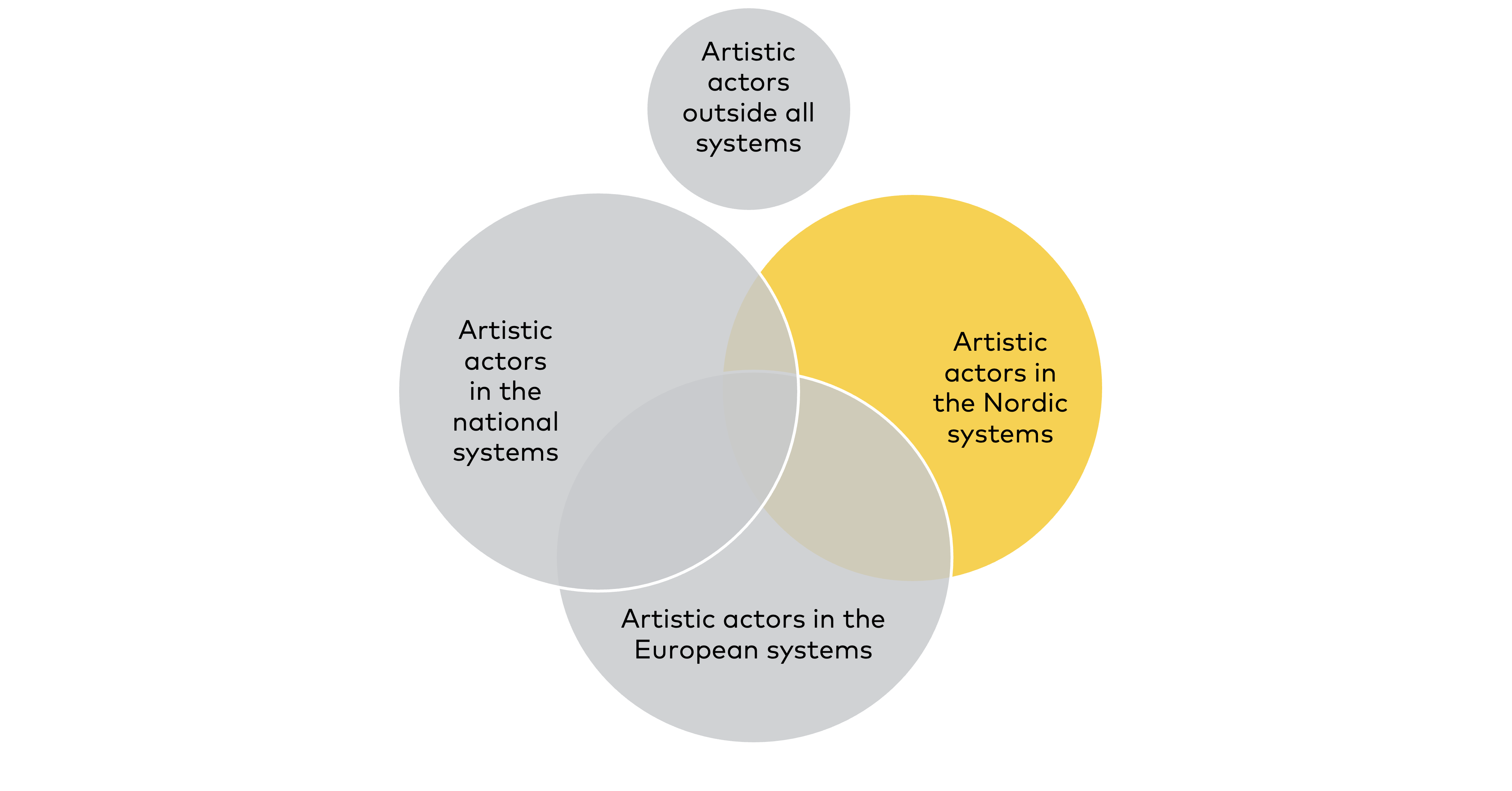
Figure 2.1. Possible positions that artistic actors can assume in relation to the systems
It should be noted that while many questions of interest in this matter revolve around the artistic actors, the empirical analysis in this chapter will have project applications as the unit of analysis. This means that carefulness is called for when drawing conclusions from the data. Aspects such as the actors’ strategies and prioritising between the systems is better investigated with methods that put the actor and their full spectrum of activities at the centre, rather than just one of their applications. What we have information about here is mainly how the applications to the Nordic system overlap with applications to the national and European systems.
2.3 Data
The empirical analysis in this chapter is based on data on applications to NCP and the NCF. Some of the statistics are aggregate numbers (e.g., total number of applications, approval ratings, the total amount of money that was granted, etc.) cited directly from the annual reports of NCP/NCF. Other analyses are based on data on applications, and especially their project budgets.
For some of the analyses below, we used data for all applications downloaded directly from the application systems of NCP and NCF. For some analyses, however, we compiled a special dataset from the project budgets attached to the applications. As our interest was in describing the degree of co-financing, only funding schemes that require co-financing, and a project budget, were included in the dataset. In the first step, every item of project revenue from every application budget was copied into a spreadsheet (one budget item per line). These items were then classified according to type of funding source/financier, as seen in the schema displayed in Table 2.1. The coding was conducted by the author and a research assistant.
Table 2.1. Classification schema for budget items
1. Public financiers | ||
a. National financiers in the Nordic countries | i. National financiers (state-level) ii. Regional financiers iii. Municipal financiers | |
b. National financiers outside of the Nordic countries | i. National financiers (state-level) ii. Regional financiers iii. Municipal financiers | |
c. International financiers | i. Nordic financiers | 1. NKF 2. NKK 3. Other |
ii. European | 1. Creative Europe 2. European Structural and Investment Fund 3. Erasmus 4. Other | |
iii. Outside Europe | ||
2. Non-public financiers | ||
a. Nordic financiers | i. Foundations/Funds ii. Business iii. Other | |
b. Non-Nordic financiers | i. Foundations/Funds ii. Business iii. Other | |
c. Private citizens | ||
3. Their own money | ||
4. Participation fees/Ticket sale | ||
5. Uncategorisable |
In a second step, the budget data were transformed into a dataset with one project per line, and variables that showed the amounts in the budget from each type of financier. The dataset was then merged with more variables from the application systems, such as project partners, the home countries of the artistic actors involved, and if the application was approved. In total, the project budget dataset included 569 applications and 1,808 budget items for NCP, and 1,450 applications and 6,772 budget items for the NCF.
The coding of the dataset involved some problems with identifying and categorising all financiers, especially for those countries where the language barrier was higher for the author and the research assistant. In that instance, the local knowledge of the other authors in this anthology was of great help, especially regarding Iceland. It was also not always obvious in the budget documents whether an item listed in the budget was from a project partner (and should be put in category 3) or an external financier (and should be put somewhere in category 1 or 2). In most of those instances, additional information in the application could be used to clarify things.
Still, a non-negligible share of all budget items could not be categorised (and thus put in category 5). For NCP, this share was 10 percent (353 items), and for NCF it was 6 percent (389 items). For NCP, 34 percent of all applications included a budget item that could not be categorised. For the NCF, this share was 18 percent. For applications that had at least one item of revenue that could not be categorised, the median share of revenue that could not be categorised was 13 and 14 percent for NCP and the NCF, respectively.
Some additional analyses found that there was no concentration of non-classifiable items among rejected applications. There was some concentration in applications with a main applicant from certain countries, especially the self-governing areas, but those applications were also very few in the dataset as a whole. There was also some concentration of applications with non-classifiable items in certain programmes. However, all countries and all larger programmes still had share applications with non-classifiable items well above 10 percent.
A cursory look at the unclassifiable items in the dataset suggests that many of them were unclear due to vagueness (many item labels involving the word ‘other’), rather than mentioning financiers that we were not able to identify. A second problem was that some items had several types of financiers mentioned without any indication of how much money that came from each. Third, some of the items had labels that described expenditures rather than sources of revenue (though still listed as revenue in the budget document).
In the analysis, we have included the non-classifiable items as their own category, and as part of the total project budget. To the extent that these items include Nordic or national funding, they may somewhat bias the analysis towards underestimation of the share of Nordic and national funding, and thus towards underestimation of the overlap between national and Nordic systems.
In the analysis, we show the distribution of the applications across the different countries, and across different art forms. The country variable is in most instances the country of the main applicant (though see footnote 2). This means that the applicant, whether an individual, group or organisation, is located in the country on a more permanent basis. As far as the applicant is an individual, it does not necessarily mean that the applicant is a citizen of said country.
The art form classification has been created from the variables available in the NCP and NCF application systems. For the purposes of comparability and brevity, the classification has been simplified.
It appears that at least for NCP, different typologies had been used for different funding programmes. It thus felt plausible to construct a typology for our own. For NCP, it was also clear that many of the free text responses in the ‘Other’ category could very well be sorted into larger categories as well. For NCP, the categories were merged as follows: ‘Circus’, ‘Dance’, ‘Theatre’, and all free text responses that mention some kind of performing art (including e.g., tumbling, gymnastics, LARP and performance art) have been merged into ‘Performing arts’. ‘Visual arts’, ‘Design’, ‘Crafts’, and all free text responses that mention some kind of visual art (e.g., textile art, photography, jewellery, street art) have been merged into ‘Visual arts’. ‘Film’ and ‘Film and media’ have been merged into ‘Film’, and ‘Literature’ has been merged with all free text answers that mention storytelling into ‘Literature’. ‘Music’ has been merged with all free text answers that mention some kind of musical genre into ‘Music’, whereas ‘Multidisciplinary’ has been merged with all free text answers that mention some combination of art forms into ‘Multidisciplinary’. Finally, ‘Media’, ‘Architecture’ as well all the other free text responses (e.g., publishing, management or cultural policy) have been merged as ‘Other’. For the NCF, the different categories were merged as follows: ‘Billedkunst’, ‘Visuel kultur’, ‘Kunsthåndværk og design’ were merged as ‘Visual arts’; ‘Dans’, ’Scenekunst’ and ’Teater’ were merged as ‘Performing arts’; ‘Filmkultur’ was renamed to ‘Film’; ‘Kulturarv’ and ‘Museumsarbeje’ were merged as ‘Cultural heritage’; ‘Litteratur / spoken art’ was renamed as ‘Literature’; ‘Medie- og lydkonst’ and ‘Musik og opera’ were merged as ‘Music’; and ‘Arkitektur’, ‘Andet’, ‘Konceptuel kunst’, ‘Kunst og kulturpolitik’, ‘Kunstkritik’, ‘Kuratering’ and ‘Steds- og tidsspecifik kunst’ were merged as ‘Other’. The typologies constructed for this chapter are thus almost the same for NCP and the NCF. The only difference is the category ‘Multidisciplinary’, which only exists for NCP. See the section Applications by art form for further discussion.
Finally, NCP and the NCF use different currencies, euro and Danish krone (DKK), respectively. In the results section below, the NCF data has been changed into Euros to facilitate comparisons. The exchange rate between the euro and DKK has been stable over the last 15 years (Danmarks nationalbank 2024), due to the fixed exchange rate policy in the European Exchange Rate Mechanism (ERM II). The conversion was made according to the rate specified within ERM II, that is DKK 7.46038 for €1.
2.4 The cases: Nordic Culture Point and the Nordic Culture Fund
In this section, I give a brief background of the two funding organisations. This includes a description of their general governing principles, the different programmes within the organisations, their scope, and their basic rules regarding grant sizes, eligibility, and requirements for Nordic cooperation.
2.4.1 Nordic Culture Point (NCP)
Nordic Culture Point (NCP) has a history that goes back to 1978 in the form of various kinds of Nordic cultural cooperation that all have been located at Sveaborg, an old military facility outside of Helsinki. It was only in 2007, however, that the organisation was given administrative responsibility for the Nordic Council of Ministers’ (NCM) programmes for cultural project grants, which are the subject of this chapter (Möller 2021).
NCP is formally a part of the NCM organisation, in that the NCM both has decided on their statutes and provides its budget (Nordic Culture Point 2023: p. 20). The function as secretariat for the funding programmes is specified in the statutes (Nordic Culture Point 2016). The basic character of the funding programmes themselves is also decided by the NCM.
NCP is governed by a board and an institutional leader. The former is appointed by the NCM, and the latter by the NCM’s general secretary. The board has an advisory role, while the institutional leader is responsible for the daily operations. The board currently has five members – mainly high-level administrators from the cultural sectors of different Nordic countries.
NCP had five programmes in 2022: the Culture and Arts Programme, the Nordic-Baltic Mobility Programme for Culture, Volt, Norden 0-30 and Demos. The Nordic-Baltic Mobility Programme for Culture consists of three modules: Mobility Funding, Network Funding (long- and short-term) and Funding for Artist Residencies. They also administered an additional round of Funding for Artist Residencies aimed at Ukrainian artists and the pilot-programme Mentorship. In total, these are ten different funding schemes. Basic information about them is given in Table 2a. The assessment of applications to each programme is conducted by expert groups with members from the Nordic countries, and in mobility programme also the Baltic countries. The groups are also supposed to reflect diversity regarding the various art forms that the programmes support. For most programmes, the members are nominated by the different ministries of culture. The group for Norden 0-30, however, is governed by NORDBUK, the Nordic Children and Youth Committee (Nordic Culture Point 2023). The groups assess the applications in accordance with criteria set by the NCM in their instructions for the programmes, such as Nordic added value and cooperation, quality, NMC policy for sustainable development and gender equality, etc. (Nordic Culture Point 2023: p. 41) These instructions are further specified in a handbook for each program. The status of these assessments is maintained in the statutes, which states that the administration of the programmes should be conducted with respect for the arm’s length principle and gives the application assessments as an example of this (Nordic Culture Point 2016).
Table 2.2a. Programmes in NCP
Program/Module | Content | Grant size and co-financing | Nordic cooperation | Eligible applicants |
Culture and Art | General support for projects in all art forms (except for film- and TV production, book publishing and video game production), in all stages of production. | The demand for co-financing is dependent on the size of the project: Up to €7,000: No co-financing is necessary. Up to €40,000: At least 30% co-financing. Up to €100,000: At least 50% co-financing. | The project must include partners from at least three countries, and at least two of them must be Nordic. Country affiliation is assessed by location, rather than nationality. | All active in an artistic and cultural field. |
Demos | Support for facilitating networks between civil society organisations in the Nordic countries. | Maximum amount is €20,000. At least 15% if the project revenue must come from other sources. | Promoting Nordic co-operation should be part of the organisation’s core mission. No mention of need for partners from different countries. | Civil society organisations registered and established with ordinary operations in the Nordic countries. Partners from other countries can also be part of the projects. |
Short-term Network Funding | Support for facilitating networks between professional artists and culture workers (kulturarbetare) in the Nordic and Baltic countries. | Maximum amount is €20,000 over one year. At least 30% of the project revenue must come from other sources. | The network should consist of partners from at least three Nordic or Baltic countries. Applicants must be living in the Nordic or Baltic countries but does not have to have citizenship there. Organisations must be registered in one of these countries. | Professional artists and culture workers. The latter category includes e.g. curators, producers, translators, cultural editors, or scholars. ‘Professional’ means having documented experience or education in the field. The artists have to live in the Nordic or the Baltic countries to be eligible, but do not have to be a Nordic or Baltic citizen. |
Long-term Network Funding | Support for facilitating meetings and exchange of ideas between professional artists and culture workers (kulturarbetare) in the Nordic and Baltic countries. | Maximum amount is €100,000 over three years. At least 50% of the project revenue must come from other sources. | The network should consist of partners from at least three Nordic or Baltic countries. Applicants must be living in the Nordic or Baltic countries but does not have to have citizenship there. Organisations must be registered in one of these countries. | Groups of at least three professional artists and/or culture workers. The latter category includes e.g. curators, producers, translators, cultural editors, or scholars. ‘Professional’ means having documented experience or education in the field. The artists have to live in the Nordic or the Baltic countries to be eligible, but do not have to be a Nordic or Baltic citizen. |
Mobility Funding | Travel funding for professional artists and culture workers to travel to the Nordic and Baltic Counties, in support of increasing contact and exchange of knowledge. | The grant may cover travel and cost of living up to 14 days. The exact amount varies depending, among other things, on the place of destination. | See rules for eligibility. | Professional artists and culture workers. ‘Professional’ means having documented experience or education in the field. The artist does not have to be a Nordic or Baltic citizen but must live in the Nordic or the Baltic countries to be eligible. |
Artist Residencies | Support for Nordic and Baltic residency centres to invite artists from other Nordic and Baltic countries. | Maximum amount is €50,000 of which at maximum 15% can be used for administrative costs. | The residency centre must be located in one of the Nordic and Baltic states. The invited artists should have a permanent address in one of these countries. | Established residence centres or organisations, institutions, and groups. |
Additional support for artist's residencies in support of Ukraine. | Support for Nordic and Baltic residency centres to invite artists from Ukraine. | Maximum amount is €50,000 of which at maximum 15% can be used for administrative costs. | The residency centre must be located in one of the Nordic and Baltic states. The invited artists should have a permanent address in one of these countries. | Established residence centres or organisations, institutions, and groups with at least one year of experience in organising artistic residencies. |
Volt | Support for projects oriented towards children and adolescents as artistic creators. | Grants are between €7,000 and €70,000. At least 30% of the revenue must be co-financed. | The project must include partners from at least three countries, and at least two of them must be Nordic. The project can have partners from outside of Europe, but NCP does not fund them. | Individuals, groups, organisations, associations, and institutions. Applicants must be permanently living in a Nordic country but need not have Nordic citizenship. |
Norden 0–30 | Support for Nordic projects on culture, social issues, or politics, oriented towards children and adolescents 0–30 years old. | An application with two countries can apply for up to €10,000. With three countries, the maximum amount is €50,000. | The project must involve co-operation between two or three Nordic countries. If it is only two, then one of them must be Iceland, Åland, Greenland or the Faroe Islands. | Organisations, groups, municipalities, institutions, associations, and networks. The applicant must be living in the Nordic countries. The applicant does not have to be young themselves, but must represent an operation that consists of, or has experience of involving young people. Individuals and sports associations are not eligible. |
Mentorship | A pilot programme where younger artists were matched with experienced mentors, including both individual and joint activities for the group as a whole. | No specified amounts. The grant seems to have covered mostly travel expenses for the activities involved. | See rules for eligibility | Both mentors and mentees apply to the programme as individuals. The applicants have to live in the Nordic or the Baltic countries to be eligible, but do not have to be a Nordic or Baltic citizen. |
Program/Module | Content | Grant size and co-financing | Nordic cooperation | Eligible applicants |
Culture and Art | General support for projects in all art forms (except for film- and TV production, book publishing and video game production), in all stages of production. | The demand for co-financing is dependent on the size of the project: Up to €7,000: No co-financing is necessary. Up to €40,000: At least 30% co-financing. Up to €100,000: At least 50% co-financing. | The project must include partners from at least three countries, and at least two of them must be Nordic. Country affiliation is assessed by location, rather than nationality. | All active in an artistic and cultural field. |
Demos | Support for facilitating networks between civil society organisations in the Nordic countries. | Maximum amount is €20,000. At least 15% if the project revenue must come from other sources. | Promoting Nordic co-operation should be part of the organisation’s core mission. No mention of need for partners from different countries. | Civil society organisations registered and established with ordinary operations in the Nordic countries. Partners from other countries can also be part of the projects. |
Short-term Network Funding | Support for facilitating networks between professional artists and culture workers (kulturarbetare) in the Nordic and Baltic countries. | Maximum amount is €20,000 over one year. At least 30% of the project revenue must come from other sources. | The network should consist of partners from at least three Nordic or Baltic countries. Applicants must be living in the Nordic or Baltic countries but does not have to have citizenship there. Organisations must be registered in one of these countries. | Professional artists and culture workers. The latter category includes e.g. curators, producers, translators, cultural editors, or scholars. ‘Professional’ means having documented experience or education in the field. The artists have to live in the Nordic or the Baltic countries to be eligible, but do not have to be a Nordic or Baltic citizen. |
Long-term Network Funding | Support for facilitating meetings and exchange of ideas between professional artists and culture workers (kulturarbetare) in the Nordic and Baltic countries. | Maximum amount is €100,000 over three years. At least 50% of the project revenue must come from other sources. | The network should consist of partners from at least three Nordic or Baltic countries. Applicants must be living in the Nordic or Baltic countries but does not have to have citizenship there. Organisations must be registered in one of these countries. | Groups of at least three professional artists and/or culture workers. The latter category includes e.g. curators, producers, translators, cultural editors, or scholars. ‘Professional’ means having documented experience or education in the field. The artists have to live in the Nordic or the Baltic countries to be eligible, but do not have to be a Nordic or Baltic citizen. |
Mobility Funding | Travel funding for professional artists and culture workers to travel to the Nordic and Baltic Counties, in support of increasing contact and exchange of knowledge. | The grant may cover travel and cost of living up to 14 days. The exact amount varies depending, among other things, on the place of destination. | See rules for eligibility. | Professional artists and culture workers. ‘Professional’ means having documented experience or education in the field. The artist does not have to be a Nordic or Baltic citizen but must live in the Nordic or the Baltic countries to be eligible. |
Artist Residencies | Support for Nordic and Baltic residency centres to invite artists from other Nordic and Baltic countries. | Maximum amount is €50,000 of which at maximum 15% can be used for administrative costs. | The residency centre must be located in one of the Nordic and Baltic states. The invited artists should have a permanent address in one of these countries. | Established residence centres or organisations, institutions, and groups. |
Additional support for artist's residencies in support of Ukraine. | Support for Nordic and Baltic residency centres to invite artists from Ukraine. | Maximum amount is €50,000 of which at maximum 15% can be used for administrative costs. | The residency centre must be located in one of the Nordic and Baltic states. The invited artists should have a permanent address in one of these countries. | Established residence centres or organisations, institutions, and groups with at least one year of experience in organising artistic residencies. |
Volt | Support for projects oriented towards children and adolescents as artistic creators. | Grants are between €7,000 and €70,000. At least 30% of the revenue must be co-financed. | The project must include partners from at least three countries, and at least two of them must be Nordic. The project can have partners from outside of Europe, but NCP does not fund them. | Individuals, groups, organisations, associations, and institutions. Applicants must be permanently living in a Nordic country but need not have Nordic citizenship. |
Norden 0–30 | Support for Nordic projects on culture, social issues, or politics, oriented towards children and adolescents 0–30 years old. | An application with two countries can apply for up to €10,000. With three countries, the maximum amount is €50,000. | The project must involve co-operation between two or three Nordic countries. If it is only two, then one of them must be Iceland, Åland, Greenland or the Faroe Islands. | Organisations, groups, municipalities, institutions, associations, and networks. The applicant must be living in the Nordic countries. The applicant does not have to be young themselves, but must represent an operation that consists of, or has experience of involving young people. Individuals and sports associations are not eligible. |
Mentorship | A pilot programme where younger artists were matched with experienced mentors, including both individual and joint activities for the group as a whole. | No specified amounts. The grant seems to have covered mostly travel expenses for the activities involved. | See rules for eligibility | Both mentors and mentees apply to the programme as individuals. The applicants have to live in the Nordic or the Baltic countries to be eligible, but do not have to be a Nordic or Baltic citizen. |
2.4.2 The Nordic Culture Fund (NCF)
Nordic Culture Fund was founded in 1966, through an agreement between the Nordic countries. The fund has judicial autonomy from the NCM and the Nordic Council, though the organisations have close ties (Nordic Culture Fund 2021), especially as NCM provides the lion’s share of the budget for NCF, which is currently circa €4.8 million (DKK 36 million). The NCF is governed by a board appointed by the NCM and the Nordic Council. It consists mostly of members of parliament from the countries involved and high-level institutional leaders and administrators from the cultural sectors (Nordic Culture Fund 2024). The daily activities are conducted by a secretariat of eight persons, led by a director appointed by the board.
The evaluation of applications is conducted by a panel of experts from different cultural fields. These experts come from all Nordic countries. They are nominated by national cultural organisations and government agencies in the cultural sector and appointed by the director. This order seems to have been stable over time.
The main activity of NCF seems to always have been project funding. The exact forms for this, however, appear to have developed over time. In their latest strategy document, the NCF describes an ambition to develop new forms for their funding to reach new groups and to work more strategically to develop networks and relationships for the longer term. This is contrasted to an approach of assessing all applications as individual projects (Nordic Culture Fund 2021: p. 6). The programs and their different requirements are thus supposed to reflect different aspect of the overarching goal of supporting Nordic arts and cultural life.
The NCF’s programmes are thus under development, and from their annual reports, it appears that they quite often undergo minor changes in their names, rules, and programmatic statements. For 2022, the annual report (Nordic Culture Fund 2023) mentions five different grants, which are listed in Table 2.2b, along with information about their orientation.
Table 2.2b. Programmes in NCF
Programme | Content | Grant size and co-financing | Rules about Nordic cooperation | Eligible applicants |
Project Funding | The main programme for open project funding. The most general programme for supporting development of arts and culture in the Nordic countries and for the strengthening of ties between Nordic actors. | Applications must have at least 50% co-financing, and maximum 85% of funding from the official Nordic co-operation. Maximum amount in 2022 was DKK 500,000. NCF emphasises that grants on more than DKK 300,000 is very unusual. | Must include actors from two countries, though not necessarily Nordic ones. | Cultural actors, artistic actors, public and private organisations, associations. The applicants do not have to be Nordic. |
Opstart | Start-up support for cultural projects between actors from at least two Nordic countries. Supports only projects that are in a developmental phase. | Maximum amount to apply for is DKK 25,000. No requirements about co-financing. | At least two actors from two different Nordic countries must confirm their participation in the project. If there is participation only from two Nordic countries, one of the project goals must be to expand Nordic cooperation. | Individuals, groups, institutions, associations, and businesses, both public and private. Partners from countries outside of the Nordic region are also welcome to participate. |
Development Funding | Support for development of new Nordic partnerships that do not fit within the framework of the other programs. | No set rules, but generally follows Project Funding. | No strict rules about Nordic cooperation, though the project must be relevant for the NCF’s strategy for the Nordic cultural sector, or its thematic initiatives. | This grant is not open to application but is the result of closer cooperation over a longer period. |
Globus Call | Support for artistic and cultural cooperation that aims to dissolve cultural, social, historical, geographical, or disciplinary borders. | Maximum amount to apply for is DKK 700,000. No requirement of co-financing. | No criteria for collaboration between Nordic countries. The project must have a link to the Nordic region ‘in terms of partners, themes or activities’, but must not be conducted only there. | Individuals, groups, institutions, civil society organisations, and public and private businesses. |
Globus Opstart | A version of the Opstart programme within the Globus framework. | Maximum amount to apply for is DKK 50,000. | The project must have a Nordic connection, but there should also be essential contributions from other parts of the world. | Individuals, groups, institutions, civil society organisations, and public and private businesses. |
2.5 Statistical results
This section reports on the economic scope of the Nordic system, in terms of how much money it distributes, the number of applications, as well as the size of the typical application. It also reports on which art forms are the most common, the country of the main applicants, and the project budgets regarding the full funding of the projects, especially the degree in which the applications involve national or European funding.
It should be noted that in the last parts of the section, about sources of funding and the degree of overlap between different types of financiers, the analysis is restricted to those programmes that involve demands for some kind of co-financing.
2.5.1 The economic scope
Both NCP and the NCF has several different programmes that vary in their economic scope. Figure 2.2a and 2.2b show the amount granted to projects by NCP and the NCF from 2018–2022. This gives a first sense of which programmes and modules are the largest.
For NCP (Figure 2.2a), the total amount granted was €5 million per year during 2018–2021. For 2022, it was €6 million (see the remark above about 2022 as ‘the last pandemic year’ for NCP). The largest programme is Culture and Art, which granted €2.2 million per year from 2018–2021, and €2.5 million in 2022. The three modules of the Nordic-Baltic Mobility Programme (Mobility Funding, Network Funding and Artist Residencies) granted about €1.8 million per year between 2018–2021. In 2022, the total grant sum for this programme was €2.3 million. Norden 0-30 used to grant about €0.6 million per year. In 2022, however, it granted almost €1 million. In 2022, also had two new and special modules/pilot programmes: Additional funding for Ukrainian artists, which granted €230,000, and a Mentorship program, which granted in total €41,160.
Figure 2.2a. Total amount granted by Nordic Culture Point 2018–2022, EUR
Figure 2.2b. Total amount granted by Nordic Culture Fund 2018–2022, EUR
For the NCF (Figure 2.2b), the total amount was more stable, at circa €4 million every year, with a slight dip to €3.7 million in 2021. The largest programme was by far Project Funding, with grants at almost €3 million in the beginning of the period, then declining somewhat to circa €2.5 million in 2022. The second largest program was Puls, at €0.5–0.6million per year. This programme, however, expired in 2021. In addition, the different Opstart programmes, Development funding and Globus Call had a total grant sum of almost €1.4 million.
2.5.2 Applications by programme
A second important indicator for the character of a grant programme is the number of applications it receives and grants. Tables 2.3a and 2.3b show the number of applications to each programme and the number of grants, along with the share of granted applications.
For NCP (Table 2.3a), the largest programme or module in terms of applications is Mobility Funding, which received 1 088 applications in 2022. It is also the programme that awards the most grants, namely 297. In a distant second place, Culture and Art received 296 applications and awarded 79 grants. The third largest programme in terms of applications was Short-term Network Funding, which received 111 applications and awarded 29 grants. These three programmes had about the same rate of approved applications: slightly over 25 percent. Other programmes have fewer applications but stand out in their higher rate of approved applications. Volt approved 58 percent of their applications in 2022, Mentorship 47 percent and Norden 0-30 36 percent. Other smaller programmes stand out due to their low rate of approved applications, such as 14 percent for the support programme for Ukrainian artists, and 15 percent for Demos.
For NCF (Table 2.3b), the largest programme is Project Funding, which received 624 applications and awarded 119 grants – the rate of approved applications was thus 19 percent. Globus Call, Globus Opstart and Opstart were all similar in size with between 2–300 applications. The rate of approved applications, however, was quite different. Whereas Opstart approved 24 percent of applications, and Globus Call 15 percent, Globus Call only approved 6 percent of the applications. Development Funding, lastly, had only eight applications but approved seven of them, or 88 percent. The last numbers were explained by an NCF employee as a result of the programme not having an open application process. Instead, the applications and the decision are worked out in dialogue with the NCF. The programme is a part of an ambition to work more strategically (see above).
Table 2.3a. Nordic Culture Point: Applications and grants, 2022, number and percent.
Program | Applications | Grants | % approved applications |
Culture and Art | 296 | 79 | 27 |
Demos | 46 | 7 | 15 |
Short-term Network Funding | 111 | 29 | 26 |
Long-term Network Funding | 20 | 4 | 20 |
Mobility Funding | 1,088 | 297 | 27 |
Artist Residencies | 76 | 14 | 18 |
Volt | 12 | 7 | 58 |
Norden 0-30 | 84 | 30 | 36 |
Additional funding for artist residencies to support Ukrainian Artists | 46 | 6 | 13 |
Mentorship | 43 | 20 | 47 |
Total | 1,822 | 493 | 27 |
Table 2.3b. Nordic Culture Fund: Applications and grants, 2022, number and percent.
Program | Applications | Grants | % approved applications |
Globus Call | 220 | 14 | 6 |
Globus Opstart | 258 | 39 | 15 |
Opstart | 293 | 69 | 24 |
Project Funding | 624 | 119 | 19 |
Development Funding | 8 | 7 | 88 |
Total | 1,403 | 248 | 18 |
2.5.3 Applications by country of main applicant
Tables 2.4a and 2.4b show the distribution of applications and grants for all programmes in total, by country of the main applicant. As mentioned above, for many programmes, the country of the main applicant is determined not by their citizenship but by their location.
For NCP (Table 2.4a), Finland has the largest share of applications at 23 percent. Denmark and Sweden are in second and third place with 18 and 17 percent, respectively. In fourth place, Norway had 11 percent of the applications. Iceland and especially the self-governing areas all had much smaller shares. For the NCF (Table 2.4b), the country with the largest share of applications is Denmark, at 29 percent. Sweden comes second at 23 percent. Finland and Norway share third place at 14 percent each. Iceland and the self-governing areas once again have much smaller shares.
For both NCP and the NCF, there is also a sizable share of applications with a main application from a non-Nordic country. For NCP, many of these are artistic actors from the Baltic countries who are eligible for many of their programmes (see above). In addition, while many programmes have rules that the application must include actors that are located in the Nordic countries, it is far from always mandatory for the main applicant to be located there.
For both NCP and the NCF, the distribution of applications is similar to the distribution of grants. At least in the case of NCP, this to some extent reflects conscious considerations in the expert groups of a fair distribution between the countries.
It is worth noting that not all these shares are proportional to country size. Most prominently, Sweden has almost twice the population of Denmark, Norway, and Finland, but their share of applications is about as large. The reasons behind such differences could be interesting to explore further in future research.
All applications | % | Granted applications | % | |
Denmark | 336 | 18 | 96 | 19 |
Faroe Islands | 31 | 2 | 8 | 2 |
Finland | 426 | 23 | 121 | 25 |
Greenland | 15 | 1 | 4 | 1 |
Iceland | 108 | 6 | 22 | 4 |
Norway | 209 | 11 | 61 | 12 |
Sweden | 316 | 17 | 71 | 14 |
Åland | 9 | 0 | 1 | 0 |
Other | 372 | 20 | 109 | 22 |
Total | 1,450 | 100 | 384 | 100 |
Table 2.4a. Nordic Culture Point: All and granted applications by country of main applicant 2022, number and percent.
All applications | % | Granted applications | % | |
Denmark | 404 | 29 | 78 | 31 |
Faroe Islands | 0 | 0 | 0 | 0 |
Finland | 190 | 14 | 34 | 14 |
Greenland | 0 | 0 | 0 | 0 |
Iceland | 46 | 3 | 11 | 4 |
Norway | 202 | 14 | 44 | 18 |
Sweden | 325 | 23 | 47 | 19 |
Åland | 2 | 0 | 0 | 0 |
Other | 237 | 17 | 34 | 14 |
Total | 1,169 | 100 | 214 | 100 |
Table 2.4b. Nordic Culture Fund: All and granted applications by country of main applicant 2022, number and percent.
2.5.4 Applications by art form
Tables 2.5a and 2.5b show the distribution of all applications by art forms.
For NCP (Table 2.5a), the by far largest category is Multidisciplinary at 36 percent. Music, Performing arts and Visual arts all have a share of 19 percent. Cultural heritage, Film, Literature, and Other all have significantly smaller shares, at 1 or 2 percent each.
For NCF (Table 2.5b), the largest category is Music at 23 percent, followed by Other at 22 percent, Visual arts at 20 percent and Performing arts at 18 percent. The categories Cultural heritage, Literature and Film have smaller shares, at 5 or 6 percent each. These are still larger shares than these categories had at for NCP, however.
Comparing NCP and NCF, it is remarkable how similar the shares for Music, Performing arts and Visual arts are, at about 20 percent. The most striking difference between the NCF and NCP is related to the category Multidisciplinary, which is present in the NCP form, but absent for NCF. The latter, in turn, has a much larger share in the Other category. This was true even before the recoding (see the Data section). In addition, the categories Cultural Heritage, Film and Literature have larger shares for the NCF – 5 or 6 percent, rather than 1 or 2 percent as for NCP. It is natural to consider the possibility that the Multidisciplinary category is used by many applicants with ambiguous cases that would otherwise have been put into a more singular category, or in Other. It has not been possible, however, to estimate how strong this effect is.
Table 2.5a. Nordic Culture Point: Applications by artform 2022, number and percent.
Number of applications | Percent | |
Cultural heritage | 23 | 1 |
Film | 31 | 2 |
Literature | 27 | 2 |
Multidisciplinary | 612 | 36 |
Music | 328 | 19 |
Performing arts | 320 | 19 |
Visual arts | 325 | 19 |
Other | 21 | 1 |
Total | 1,666 | 100 |
Table 2.5b. Nordic Culture Fund: Applications by artform 2022, number and percent.
Number of applications | Percent | |
Cultural heritage | 42 | 5 |
Film | 58 | 6 |
Literature | 51 | 6 |
Music | 210 | 23 |
Performing arts | 166 | 18 |
Visual arts | 180 | 20 |
Other | 202 | 22 |
Total | 707 | 100 |
2.5.5 The size of projects and grants
It is also relevant to report the average sizes of the applications, and the amounts that were eventually granted. The programmes often have rules about maximum amounts that can be applied for, and often rules about the maximum share of the project budget. Figure 2.3a and 2.3b depict the average project revenue as budgeted in the application, along with the average amount of money that the artistic actors applied for. It also shows the average granted amount for those applications that were approved.
It may be more appropriate to use the median and/or some kind of max/min values to show more of the distribution. The median project budget is considerably lower than the average for Culture and Art (NCP) and Globus Call (NCF). The median applied amount is considerably lower for Project Funding and Development funding (NCF).
For NCP (Figure 2.3a), the largest applications and grants come from the Long-term Network Funding module (a module with few grants and thus a small total grant sum). The average application budget there is circa €200,000, and the average applied amount is circa €76,000. The average granted amount is circa €47,000. In second place, the median application to the Culture and Art programme has a budget of almost €70,000 and applies for circa €26,000. The median grant is somewhat higher, circa €31,000. Volt and Norden 0-30 both have median budgets of circa €60,000. The median applied amount is about €30,000. For Norden 0-30, this is also about the size of the median grant. Volt has an even higher median grant, at circa €40,000. Short-term network funding has somewhat smaller applications, monetarily speaking, with a median budget of €30,000 and an applied and granted amount at about €20,000.
For NCF (Figure 2.3b), the programme with the largest applications was Globus Call, with a €94,000 median budget, €64,000 median applied amount, and €44,000 median grant. Project Funding and Development Funding also had relatively large median budgets, €71,000 and €37,000, respectively. While applications to Project Funding had a larger median budget, those to Development Funding applied for larger sums (€20,000 and €37,000, respectively), and those that received grants received more money (€20,000 and €36,000, respectively). The applications to Opstart were considerably smaller, at about €3,600 in median budget and circa €3,300 in applied and granted amounts.
A lot of this variation in project and grant sizes is of course explained by their rules regarding maximum amount for the grant, and requirements of co-financing. See table 2.2a and 2.2b.
Figure 2.3a. Median project revenue, applied and granted amount, for applications to NCP, EUR
Figure 2.3b. Median project budget, applied and granted amount, for applications to NCF, EUR
2.5.6 The overlap between the Nordic, national and European system
Figure 2.4a and 2.4b gives an overview of the extent to which the applications involve funding from Nordic (empirically only NCP and the NCF), various national, and European public financiers.
In this analysis, the data show that five applications did not include any Nordic public funding. As this should be impossible, this was deemed to be due to coding errors. Those applications were excluded from this analysis and the ones below. This does not influence the results in any significant way.
The share of applications that involve national funding is below 50 percent for almost all programmes. There is some variation, though. For NCP (Figure 2.4a), the share in Demos is only 15 percent, but for Culture and Art it is 55 percent. For most other programmes, the share is circa 30 percent. For all applications in total, the share is 41 percent. For NCF (Figure 2.4b), the programme with the highest share of applications mentioning national funding is Project Funding, with 64 percent. For the other programs, the share varies between 21 and 36 percent. The share for all applications together is 43 percent.
Figure 2.4a. Share of applications to NCP with Nordic, national and European financiers
Figure 2.4b. Share of applications to NCF with Nordic, national and European financiers
2.5.7 The share of revenue from different sources
In Figures 2.5a and 2.5b, we can see the average share of revenue from different types of sources for the different programmes. Almost all programmes for both NCP and the NCF have application budgets where the average share of public funding is more than 50 percent. In fact, for most programmes, the share is above 60 percent, and for NCF many are close to 80 percent. The average share of public funding for all applications is 66 percent for NCP and 68 percent for NCF.
For NCP (Figure 2.5a), the programmes have a relatively similar distribution of funding. The second largest source of funding for all programmes is ticket sales or participation fees, with an average share across all programmes of 14 percent. The corresponding share for private funding is nine percent, and for own funding it is 4 percent. Here, the programme Volt has an unusually high average share at 12 percent. The average share of funding whose source could not be identified was 7 percent (not shown).
For the NCF (Figure 2.5b), private funding tends to play a slightly larger role, mostly at the expense of tickets/participation fees. In particular, Project Funding had a notably high share of private funding at 18 percent. Public funding is often an even higher share here than for NCP. The other programmes had an average share of circa 10 percent. The average share of funding whose source could not be identified was 4 percent (not shown).
Figure 2.5a. Mean share of revenue in applications to NCP per programme and type, percent
Figure 2.5b. Mean share of revenue in applications to NCF per programme and type, percent
As the share of revenue from public funding is so dominant, I also show the average share of public funding from different systems in Figure 2.6a and 2.6b. For each system (National/Nordic/European), we only include the applications that have at least some amount of funding from that system mentioned in their budget. For both NCP (Figure 2.6a) and NCF (Figure 2.6b), the funding from Nordic sources has an average share of over 50 percent of the total revenue in the budget overall. This is also the case for most programmes, except for Volt and Long-term Network Funding for NCP, and Project Funding for NCF. However, even in these cases, the average share of Nordic public funding is still about 40 percent.
The average share of national funding for applications that mention any such funding is about 20 percent for all NCP programmes. For the NCF, there is generally higher shares at about 30 percent overall, and more variation, with almost 40 percent for Opstart, and 5 percent for Development Funding. The share of European funding for applications that mention such funding is overall 24 and 23 percent in total for NCP and the NCF, respectively. However, there is variation between programmes. For NCP, it is only 8 percent for Short-term Network Funding and 16 percent for Culture and Art. For the NCF, Opstart applications with European funding only have 14 percent, whereas for Globus Opstart the share is 41 percent. It should be noted, as can be seen in Figures 2.4a and 2.4b, that the share of applications that have any European funding is often quite small.
It should be noted if we consider all applications that the average share of national and European funding is considerably lower. The overall national share is 11 and 14 percent for NCP and the NCF, respectively, and the overall European share is about 1 percent. This reflects the low share of applications that have any European funding at all, as can be seen in Figure 2.4a and 2.4b.
Figure 2.6a. Mean share of revenue in applications to NCP per programme, only public funding and only applications with at least some funding of that type, percent
Figure 2.6b. Mean share of revenue in applications to the NCF per programme, only public funding and only applications with at least some funding of that type, percent
2.6 Summary and discussion
In 2022, the NCP and the NCF together distributed €9 million in grants. Both organisations have several different programmes. The applications and grants from these programmes can vary considerably in size. For NCP, Long-term Network Funding has the largest projects. The applications have a median budget of about €198,000, and the median grant for the programme is €47,000. Meanwhile, they also have smaller programmes like Mentorship and Mobility Funding, where the median grant is less than €2,000. Their largest programme, Culture and Art, has a budget of €70,000 in their median application, and the median grant is €31,000. For the NCF, the median budget for an application is the largest for Globus Call at €93,000. Globus Call also has the largest median grant at €43,000. The programme Opstart, on the other hand, has applications and grants between €3–4,000.
A main interest for this project is to assess the overlap between the different public systems on the Nordic, national and European level. Thus, the programmes that require additional funding for the projects was of particular interest.
The degree of overlap is very similar for NCP and the NCF. For both, more than half of all applications mentioned only Nordic public funding in their budgets. A considerable share included national funding – about 43 percent of all applications. The share of applications that included European funding was about 3 percent. The average share of public funding for an application was above 60 percent in total and for most programmes. For the NCF, this share was even above 70 percent for some programmes. The lion’s share of this was Nordic funding. The average share of Nordic funding in the application budgets was almost always well above 50 percent.
This points towards the conclusion that for these projects, the Nordic system is their main source of funding. It could be of interest to study if this pattern also emerges in the national systems. In that case, it suggests that the creation of new projects is highly endogenous to the funding system, and that these systems have an effect not only on which projects receive funding, but also which projects are conceived of.
As mentioned earlier, the study has a problem in that while many of the questions motivating it are about the artistic actors, the actual unit of analysis in the data is applications. One should be careful to draw conclusions about the population of actors from an analysis of applications, as applications most often involve multiple actors, and actors can be involved in multiple applications, indeed also active in other systems. This means that this research design has some bias towards underestimating of the overlap between the Nordic and other systems. Some artistic actors may show up in national or the European systems in relation to projects other than those for which they applied to the Nordic system. Even correctly estimated, the share of applications that overlap the Nordic and the national is probably smaller than the share of actors that do.
There are many questions about the relationship between the Nordic, national and European systems that remain to be answered. The application data from NCP and the NCF could further be used to assess the population of actors in the Nordic systems, at least for identifying them. Data on applications from more years could serve to answer questions on the regularity of the overlap between Nordic, national and European funding systems, as well as the degree of permanence of the population of artistic actors in the Nordic system. However, many relevant questions about the relationship between the systems are more actor-centric and would require an approach that put them as the unit of analysis, such as surveys of said artistic actors.
References
Danmarks nationalbank. (2024, September 9th). Exchange rates Retrieved from: https://www.nationalbanken.dk/en/what-we-do/stable-prices-monetary-policy-and-the-danish-economy/exchange-rates
Möller, M. (2021). Konst, kultur och kullerstenar: Kort historik över nordiskt kultursamarbete och kulturinstitutionerna på Sveaborg sedan 1978. Nordisk kulturkontakt: Helsinki. Retrieved from: https://www.nkk.org/nkk-publicerar-historik-over-de-nordiska-kulturinstitutionerna-pa-sveaborg/
Nordic Culture Fund. (2021). “Nordisk kulturfonds strategi 2019–2025”. Retrieved from: https://d2typry64h97y6.cloudfront.net/wp-content/uploads/2023/02/10113955/Fondens-strategi-2019-2025.pdf
Nordic Culture Fund. (2022). “Nordisk kulturfond Årsberetning 2022”. Retrieved from: https://d2typry64h97y6.cloudfront.net/wp-content/uploads/2023/06/09104422/Nordisk-Kulturfonds-arsberetning-2022.pdf
Nordic Culture Fund. (2024). “Organisation”. Retrieved from: https://nordiskkulturfond.org/sv/organisation
Nordic Culture Point. (2016). ”Stadgar”. Retrieved from: https://www.nkk.org/wp-content/uploads/2023/12/Nya-stadgar-Kulturkontakt-Nord-Nordisk-kulturkontakt-2017.pdf
Nordic Culture Point. (2023). “Årsrapport 2022”. Retrieved from: https://www.nkk.org/wp-content/uploads/2023/03/NKK_arsrapport_2022.pdf
Nordic Culture Point. (2024). “Stödprogrammens experter”. Retrieved from: https://www.nkk.org/om-oss/stodprogrammens-experter/