
The structure of Work Package 1: Nordic Harmonisation of LCA


Task 1
Analysis of Nordic LCA Practices
Task 2
Data for LCA
Task 3
BIM for LCA - Calculating the Climate Impact of Buildings Through Digitalisation
Task 4
Limit Values and Monitoring the Decarbonisation of the Nordic Building Stock
Task 5
Acceleration Programme - Knowledge Sharing Clinics and Best Practise Catalogues

The outcomes of Work Package 1 set up bases to harmonise the climate regulations concerning new constructions in Nordic countries and in Estonia. The work gives a comprehensive analysis of different LCA methods used in the Nordic countries and a roadmap for harmonising LCA methodologies across the region. The reports also provide profound information about details of LCA calculations, data needs and guidance for the BIM-based building LCA process. This work in itself has made it possible for the Nordic authorities to cooperate more closely and learn from each other, which I find extremely important.Maria Tiainen, senior specialist at the Ministry of the Environment in Finland, Leader of Work Package 1
Knowledge Foundation for Developing Regulation
The Nordic countries, alongside the EU, are actively developing new regulations aimed at promoting sustainable construction practices. To minimise the environmental and climate impact of new buildings, regulations including CO2-eq limit values, climate declarations, digital tools, and strategic roadmaps are being implemented.
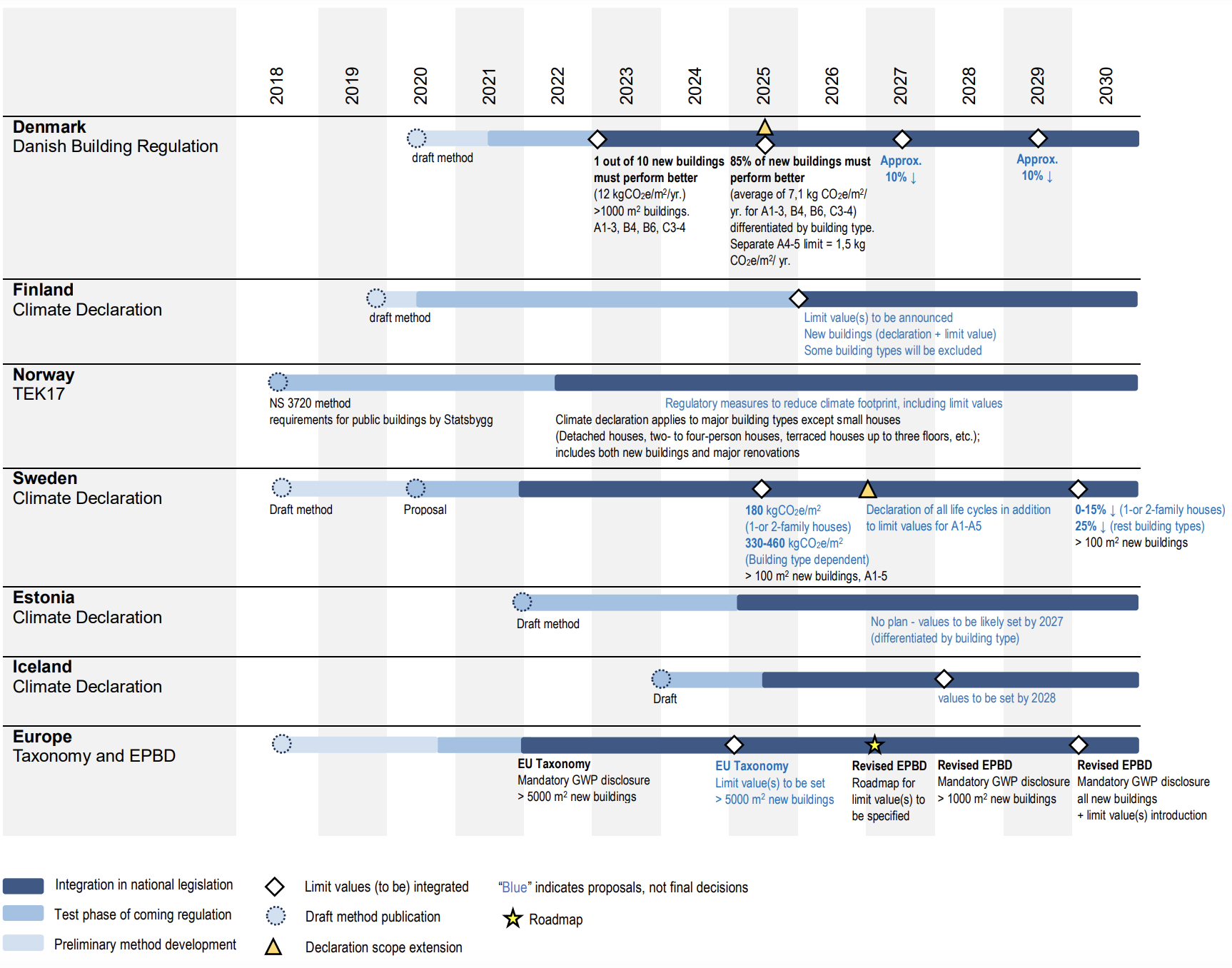
Timeline of climate declaration and limit values integration as of October 2024.
Within this framework, the importance of accurate Life Cycle Assessment (LCA) calculations and a robust data foundation has become increasingly evident.
The construction sector is one of the industries with a heavy environmental and climate footprint, but a transition is underway. Beyond the economic costs, carbon emissions are now, to an increasing extent, being treated as a critical metric - almost like a currency - that influences the evaluation of construction tenders. At the same time, LCA calculations are being used to measure if the building is within the regulatory demands in the countries where limit values are applicable. In this context, LCA calculations have emerged as an essential tool enabling meaningful comparisons and informed decision-making.
Nordic Harmonisation of LCA Methods
The Nordic countries are widely recognised as global leaders in implementing regulations aimed at reducing emissions from the construction sector. The region is also at the forefront of data collection efforts related to building performance and the use of LCA as a method to set and enforce regulatory limit values. Throughout the process of enforcing regulatory limit values, Nordic countries have actively collaborated, sharing insights and experiences, and overcoming barriers together. Work Package 1 has provided a comprehensive overview and mapping by identifying specific focus areas that the Nordic and Estonian LCA authorities need to prioritise for further work.
Collaboration with leading researchers and input from the industry has generated a significant knowledge foundation, which each country can utilise in the process of making new regulations and initiatives.
A Digital Foundation – Quality and Accessibility of Data
Another significant focus of Work Package 1 has been the development of digital infrastructures designed to support the increasingly intricate and data-intensive processes required for effective LCAs in construction. Recognising that the accuracy and efficiency of LCA calculations are heavily dependent on the quality and accessibility of data, Work Package 1 has worked towards creating a digital foundation that enhances both. One of the key outcomes has been the development of advanced Building Information Modelling (BIM) tools and models. These tools are tailored to integrate LCA data into the design and planning stages of construction projects. For instance, the BIM-based LCA models allow for real-time environmental impact assessments during the design phase, enabling stakeholders to make informed decisions early in the project lifecycle. This integration of BIM and LCA not only improves the precision of environmental assessments but also streamlines the process, making it more user-friendly and accessible to practitioners across the Nordic region.
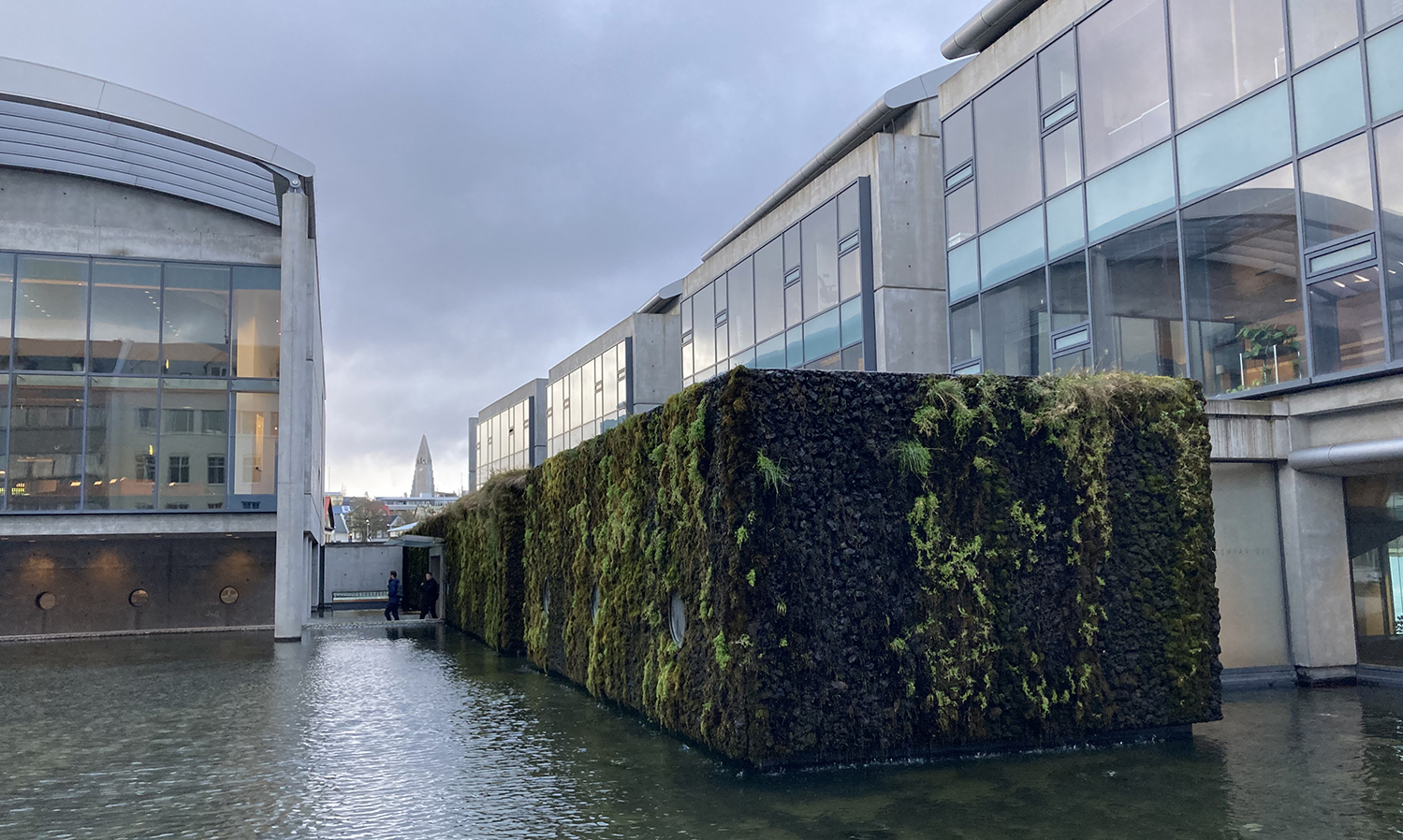
Photo: Nordic Sustainable Construction, Reykjavík City Hall, Iceland 2023
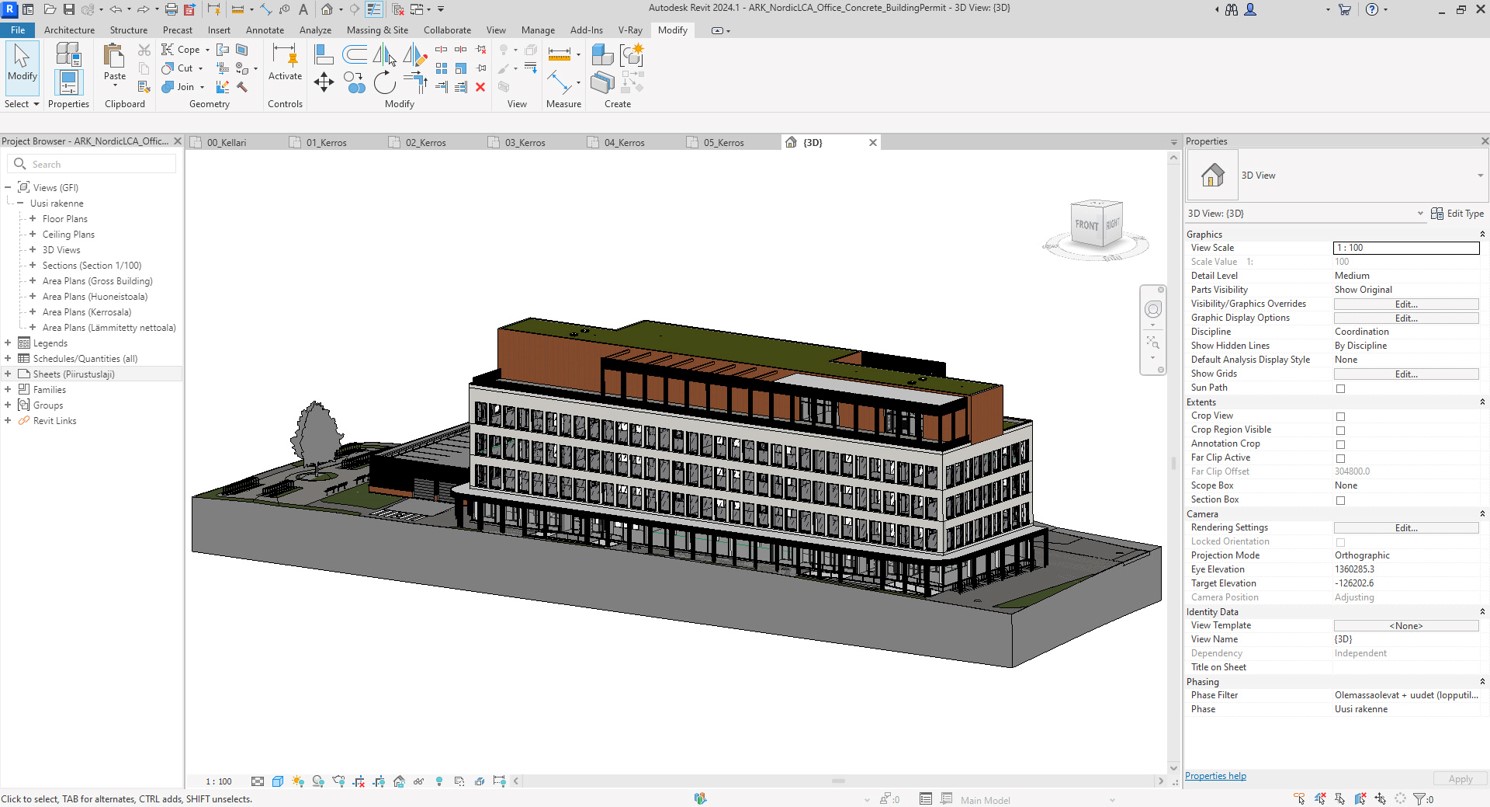
Screenshot of BIM model: Revit model, Office Concrete Building, 2024
However, having these models in itself does not change the way we build. Therefore, disseminating knowledge and best practices related to digital LCA processes has been an important task as well. Work package 1 has thus delivered educational materials to support the use of digital tools. These materials include detailed guidelines on the use of digital tools for LCA, case studies that illustrate the practical application of these tools in real-world projects, and training modules designed to build competency among professionals in the construction sector. Equipping stakeholders with the necessary skills and knowledge is a way to help bridge the gap between complex LCA methodologies and their practical implementation in day-to-day construction activities.
The Calculation of LCA Global Warming Potential
Discussions about the LCA methodology are taking place not only in the Nordics but also across the EU, focusing on what to include in calculations of a building’s climate impact throughout its life cycle. An important area where Work Package 1 has acted as a testbed for regulation is the vast overview and knowledge of how the countries have implemented the LCA Global Warming Regulation so far. The experiences shared during webinars, forums and in detailed reports prove to be useful for various aspects of the EU’s revised Energy Performance of Buildings Directive. That includes the roadmap each EU member state has to submit by January 2027 and for the delegated act that the EU Commission is expected to publish in 2025. This will help clarify how LCA Global Warming Potential should be calculated and what is included in the regulation. This delegated act is a key component of the broader EU regulatory framework aimed at promoting sustainable construction practices. Work Package 1 has provided detailed recommendations on how LCA calculations could be structured and what is needed to specify when turning it into regulation. The Work Package has aggregated the most important lessons the Nordics and Estonia have harvested so far regarding what is needed to initiate the regulation.
8 key recommendations to initiate the regulation:
1. Build up competence
Learning resources adapted to national contexts
Certification schemes to foster competition
2. Secure stakeholder involvement
Balance current readiness with future requirements
Monitoring and revisiting regulation
3. Ensure access to generic data and standard values
Phasing out of the conservativity factor in generic data
Use of standard component values for as-built reporting
Alignment of structure and content of databases.
4. Improve availability and digitalisation of EPDs
Subsidies or automated tools designed to generate EPDs
5. Create a case basis and structure for the limit values
Real cases sample for feasible limit values (archetypes for potentials)
Need for differentiation of limit values
6. Determine the initial LCA scope and method
Start with a limited scope (size and type, modules, building model)
Need to highlight upfront carbon reduction (several options)
7. Establish a suggested limit value pathway
Incremental implementation of methods and limit value levels (long-term roadmap)
Impact assessments to support gradual expansion (scope/projects)
8. Consider how to improve the existing building stock
How to improve the use of the m2 we already have?
Skills
In the report “Recommendations for a Common Nordic Approach to Combat New Buildings Life Cycle Climate Impact”, one central conclusion is the need for quality data.
Moreover, Work Package 1’s input into the delegated act has stressed the importance of incorporating, both, operational and embodied carbon into LCA calculations. By doing so, the assessment reflects not only the emissions associated with the construction and materials used but also the long-term energy use and maintenance of the building. This comprehensive approach is crucial for setting realistic and effective CO2-eq limit values and ensuring that the construction sector contributes meaningfully to broader climate goals.
The Nordic LCA Authority Group
The results and outputs from Work Package 1 have also informed the discussions in the Nordic LCA Authority Group.
What is the Nordic LCA Authority Group?
The Nordic LCA Authority Group is a collaborative network of LCA experts from the following countries’ governments: Denmark, Finland, Iceland, Norway, Sweden, and Estonia focused on advancing the use of Life Cycle Assessments (LCA) in the construction sector. This group plays a crucial role in promoting the harmonisation of LCA methodologies across the region, enabling more consistent and comparable assessments of the environmental impacts of buildings and construction activities.
One of the primary objectives of the Nordic LCA Authority Group is to address the challenges and opportunities related to regulating embodied carbon in construction, such as differences in national regulations, data availability, and methodological approaches.
The group's activities include developing guidelines, publishing reports, creating digital tools like BIM-integrated LCA models, and providing input into regulatory processes at both the Nordic and European levels.
Overview of Deliveries
Work Package 1
Task 1: Analysis of Nordic LCA-practices
Roadmap for Harmonising Nordic LCA Regulations
Task 2: Data for LCA
Report: Nordic View on Data Needs and Scenario Settings for Full Life Cycle Building Environmental Assessment
Webinar: Nordic View on Data Needs and Scenario Settings for Building LCA
Task 3: BIM for LCA – Calculating the Climate Impact of Buildings Through Digitalisation
Report: The Operating Environment of Building LCA and BIM in the Nordics and Estonia
Report: BIM for Building LCA – Enhancing Nordic Sustainable Construction through Digitalisation
Webinar: BIM-Based Building LCA
Task 4: Limit Values and Monitoring the Decarbonisation of the Nordic Building Stock
Report: Harmonised Carbon Limit Values for Buildings in Nordic Countries
Report: Decarbonisation of the Building Stock
Webinar: Decarbonisation of the Nordic Building Stock and Setting Limit Values
Webinar: Harmonised CO2-eq Limit Values for Buildings and Monitoring Decarbonisation of the Building Stock
Task 5: Acceleration Programme: Knowledge Sharing Clinics and Best Practice Catalogues
Webinar: Presenting Low Carbon Clinics to Support New Construction Projects
Report and catalogue will be published in 2025
Who Contributed to this Work Package?
Martin Erlandsson, Frida Görman, Åsa Thrysin, Tarja Häkkinen, Klas Eckerberg, Janne Pesu, Malin Dalborg, Johan Asplund, Sirje Vares, Jarmo Linjama, Ashraful Alam, Per Erik Karlsson, Eskil Mattsson, Heli Miettinen, Miia Mänttäri, Frans Silvenius and Eeva-Maria Tuhkanen, Tommi Kaartinen, Allan Schiøtz, Trine Dyrstad Pettersen, Maria Balouktsi, Nicola Francart, Kai Kanafani, Anni Oviir, Anne Rønning, Ólafur Ögmundarson, Rita Lavikka, Tiina Vainio-Kaila, Markku Kiviniemi, Paula Ala-Kotila, Mikko Kouhia, Charlotte Nyholm, Jan Karlshoej, Oddbjørn Dahlstrøm Andvik, Alexander Borg, Iselin Idunn Østvedt, Charlotta Malmén, Maximilian Von Bahr,Tomi Henttinen, Tero Järvinen, Minna Salonsaari, Anna-Riitta Kallinen, Katja Maununaho, Tytti Bruce-Hyrkäs, Harpa Birgisdottir, Endrit Hoxha, Morten Ryberg, Christine Collin, Nicolaj Hostrup Langkjær, Anna Joelsson, Inga Sjöberg, Alexandra Kjeld, Karin Sjöstrand, Isabel Segura, Satu Kangas, Kari Nöjd, Kristina Einarsson, Maria Rydberg, Matti Kuittinen, Luzie Rück, Hannamary Seli, Þóra Margrét Þorgeirsdóttir, Inger Grethe England, Elín Þórólfsdóttir, Morten Buus, Kikki Lambrecht Ipsen, Rikke Schack, Elina Virolainen, Ahti Kooskora.
Photo: Nordic Sustainable Construction, Oslo 2022