Appendix A
Adding trade and production data to the model
To evaluate the status of the UNITAR draft plastic model in the Nordic context Sweco set out to collect the necessary data from each respective Nordic country. To calculate (1) plastic Put-on-Market (POM) and (2) plastic waste generated using the UNITAR model a two-step process is needed:
- Insert trade and production data into the Plastic Embedded POM-Calculation Tool
- This tool estimates the volume of plastic entering the market (POM) based on product-level trade and production statistics combined with assumed plastic content fractions.
- Transfer the POM outputs to the Plastic Waste Generated Tool
- This tool applies lifetime assumptions to model annual plastic waste generation across product categories.
Trade data and HS code access
The UNITAR model uses HS codes (Harmonised System) to identify relevant traded goods.
Sweco retrieved trade data from:
- Eurostat’s open access API for the members of the European Union: Sweden, Denmark, and Finland.
- Statistics Norway’s (SSB) API for Norwegian trade data.
The project relied on HS6-level codes, which are globally standardised and form the core of both UN and EU trade classification systems. The figure below illustrates how CN codes used in the EU system map back to the required HS codes for the model.
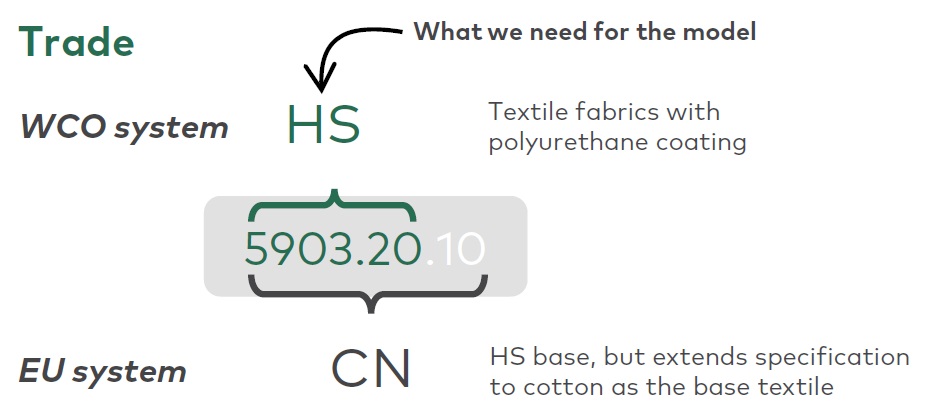
Figure 13 UN Harmonised system (HS) trade codes are collected directly from Eurostat.
For trade codes the UNITAR model uses HS codes which are already available from Eurostat – which allows us to access them directly
Production data and code mapping
The UNITAR model uses CPC codes (Central Product Classification) to classify production data.
As EU countries report production using the PRODCOM system, a two-stage code conversion was required:
- Step 1: PRODCOM → CPA (the first 6 digits of PRODCOM correspond to CPA)
- Step 2: CPA → CPC using official correspondence tables
This mapping ensured compatibility with the UNITAR model, which expects inputs in CPC format. See Figure 2 for an illustration of the conversion chain from PRODCOM to CPC.
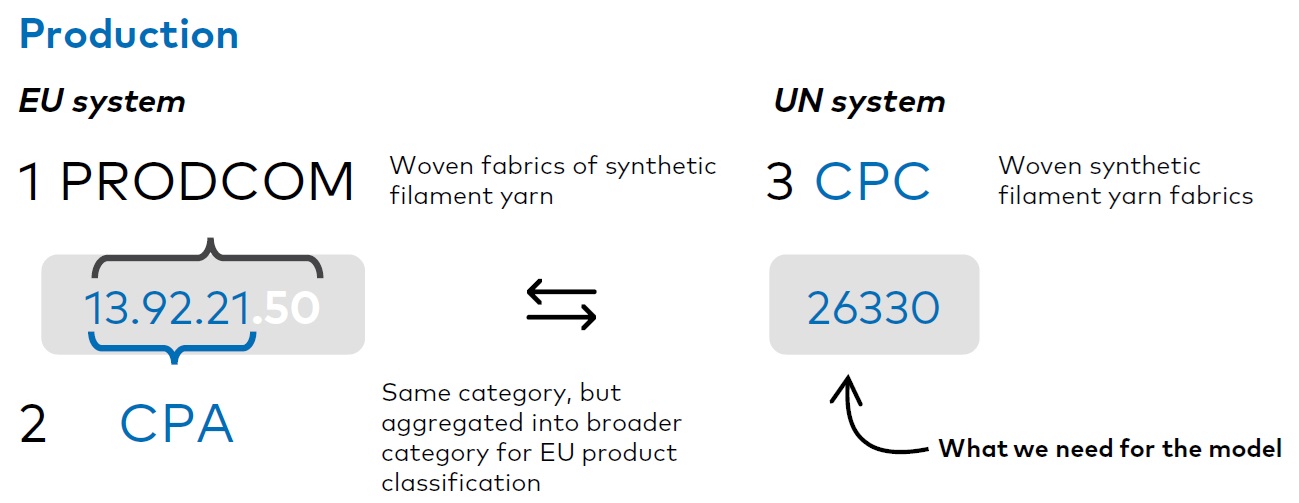
Figure 14 Production PRODCOM codes need to first be aggregated to CPA codes and then secondly converted to the UN CPC production codes to insert the values into the UNITAR models.
For production codes the UNITAR model uses CPC codes.
- PRODCOM codes are most widely used in EU.
- They first are aggregated to CPA codes
- Then converted to CPC codes using official correspondence tables.