Key Sustainability Themes in Nordic Cultural Policies
The UN (2015) underscores how the concepts of sustainability and sustainable development consist of three interconnected and mutually dependent dimensions—economic, social and environmental sustainability. The national cultural policies of the Nordic governments contain ambitions and initiatives relating to all three dimensions of sustainability. These dimensions are often connected to key elements of cultural policy, such as artistic creation, access to culture for all, the preservation of cultural heritage, and the development of cultural infrastructure (see Kulturanalys Norden, 2018). It is also common for the different sustainability dimensions to be approached in an integrated way.
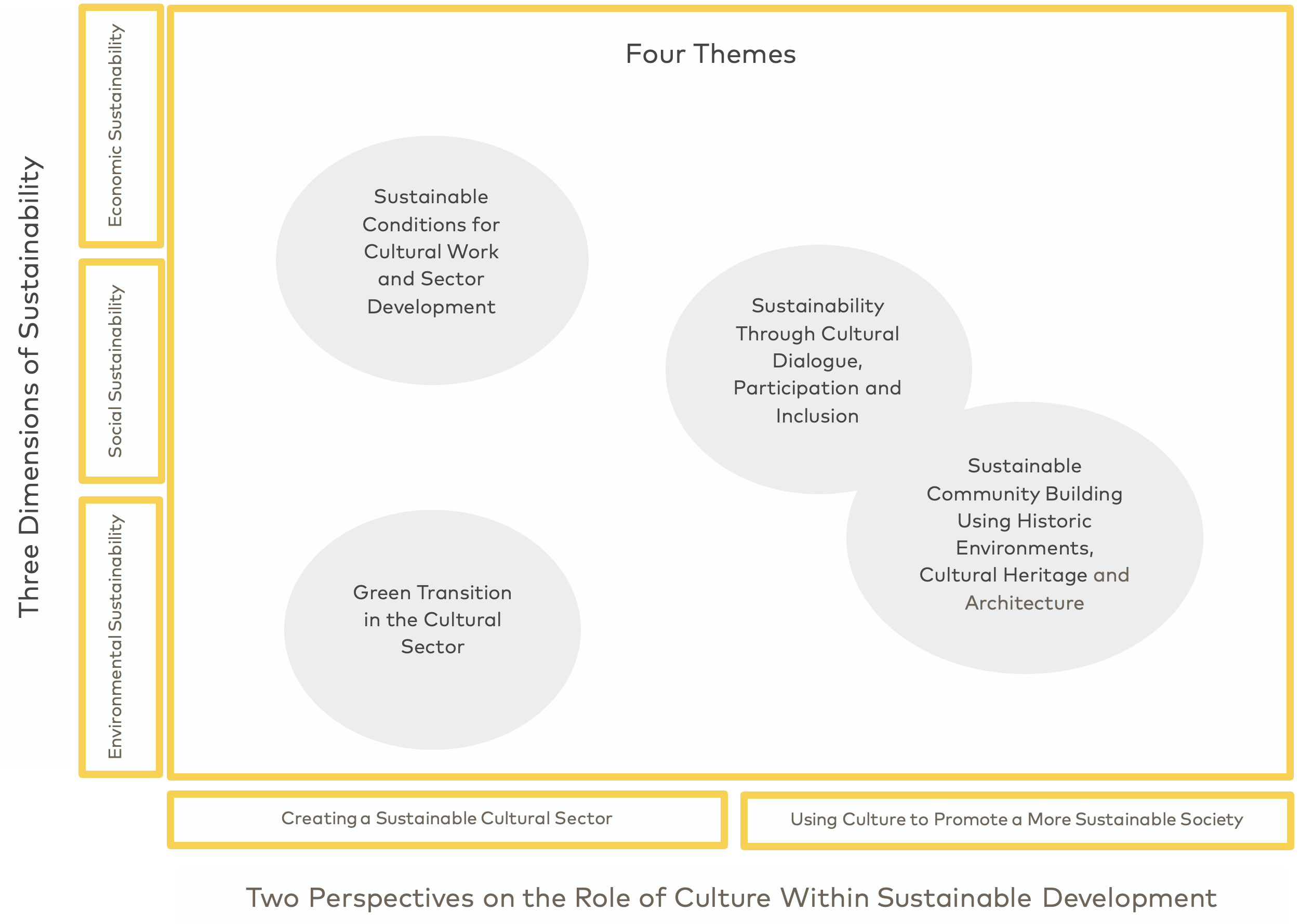
Working with this policy brief, we identified four themes as particularly central to the political work on culture and sustainability of the Nordic governments:
The policy brief focuses on these four themes. However, some governments also link sustainability to their work on cultural tourism (Finnish Undervisnings- och kulturministeriet, 2023) and international cultural cooperation (Norwegian Kultur- og likestillingsdepartementet, 2025; Finnish Undervisnings- och kulturministeriet, 2024; Danish Kulturministeriets departement, 2023).
The initiatives related to the four central themes are connected to the three dimensions of sustainability in different ways. They also reflect two overarching perspectives on the role of culture in the sustainable transition. One of them revolves around the idea of culture as an instrumental tool for promoting sustainability at the societal level. The other perspective focuses on making the cultural sector itself more sustainable—for example, by improving working conditions and strengthening cultural sub-sectors.
Sustainable Conditions for Cultural Work and Sector Development
The visual arts will become a competitive and sustainable industry that creates value and job opportunities throughout the country.(own translation from Icelandic, Menningar- og viðskiptaráðuneyti, 2023, p. 17)
A recurring theme in the cultural sustainability work of the Nordic governments is the desire to foster sustainable working conditions within the cultural sector. In its cultural policy report, the Danish government, for example, stresses the need for artistic education programmes to better promote the well-being of students and a sustainable working life (Kulturministeriets departement, 2023). Likewise, the Finnish government states in its cultural policy report their ambition to implement clear, sustainable, and flexible funding criteria to reduce financial insecurity among arts and culture practitioners (Undervisnings- och kulturministeriet, 2024). Several Nordic governments have also developed political strategies with similar objectives. In these policies, perspectives regarding working conditions are often intertwined with goals for the sustainable growth and business development of the cultural sector. For instance, the cultural policy strategy of the provincial government of Åland contains several measures to improve the economic conditions among professionals in arts and culture. These include legislating on grants and subsidies as part of a comprehensive cultural legislation (Ålands landskapsregering, 2024). Furthermore, the Swedish Ministry of Culture has put forward a strategy for businesses in the cultural and creative industries, aiming to nurture sustainable growth and competitive business development across the entire sector. The strategy is particularly focused on creating support for entrepreneurs in the cultural sector, for example, through guidance and social safety nets (Kulturdepartementet, 2023/24:111).
Some of the Nordic governments have developed policies for specific cultural areas containing similar sustainability themes. The Icelandic Ministry of Culture and Business Affairs has presented a visual arts strategy, where one of the main objectives is to make the visual arts sector competitive, sustainable, and capable of generating jobs nationwide. The strategy includes proposals such as new remuneration and incentive schemes, designing economic indicators for the sector, and a review of current copyright and tax legislation (Menningar- og viðskiptaráðuneyti, 2023).
The Ministry of Education and Culture in Iceland has also developed a national film policy, focusing on creating more sustainable, equal, and family-friendly working environments for film workers, as well as on strengthening the competitive position of Icelandic film (Mennta- og menningarmálaráðuneytið, 2020). Likewise, sustainability is a guiding principle in Swedish film policy. In the bill on film adopted by the Swedish government (prop. 2015/16:132), the focus is, however, on establishing long-term, sustainable, and predictable financial support for film productions.
Sustainability Through Cultural Dialogue, Participation and Inclusion
Throughout life, everyone has access to quality education, arts, culture and other forms of learning that promote the flourishing of each and all of us together.(own translation from Swedish (Åland), Bärkraft.ax, 2023, p. 16)
Among several of the Nordic governments, inclusion and broadened participation in cultural activities remain key concerns within cultural policies related to sustainability. To some extent, these aspects are highlighted within efforts to reach out and raise public awareness of sustainability issues. For example, the Finnish sustainability strategy is underlining the role of art and culture consumption in strengthening eco-social education (Finlands kommission för hållbar utveckling, 2022). The Icelandic Museums Council has furthermore developed a policy for museum work, emphasising the social responsibilities of museums in the sustainable transition. Icelandic museums are expected to actively engage diverse social groups in their activities and use exhibitions and outreach efforts to raise awareness and encourage dialogue about the UN Sustainable Development Goals (Safnaráð, 2021).
In many cases, cultural participation is seen not only as a tool to raise awareness, but also as a direct contributor to social sustainability, cohesion, and well-being at a societal level. The Norwegian Ministry of Culture and Equality, for example, has developed a strategy to support voluntary cultural engagement. The focus of the strategy is to improve the conditions for cultural volunteering, ensure access to appropriate facilities across the country, diversify participation in cultural life, and strengthen collaboration between professional and voluntary actors. By doing so, the ministry is arguing that the strategy supports the achievement of the Sustainable Development Goals related to good health and well-being, reduced inequalities, and sustainable cities and communities (Kultur- og likestillingsdepartementet, 2023). The Cultural Policy Strategy for 2025, issued by the Finnish Ministry of Education and Culture, in turn, reflects on the importance of engaging social groups with low participation in cultural activities and ensuring that participation in arts and culture remains affordable, to foster a more sustainable cultural life (Undervisnings- och kulturministeriet, 2017). In the most recent state budgets, the Finnish government also describes their collective cultural policy measures as means of achieving a more sustainable development by promoting human well-being, participation, and equal access to cultural rights (Statsbudgeten, 2023; 2024; 2025).
The idea of cultural participation promoting social sustainability is also present in Swedish and Ålandic policies. The National Strategy for Sustainable Regional Development put forward by the Swedish Ministry of Enterprise and Innovation recognises participation in cultural and leisure activities as central to sustainability (Näringsdepartementet, skr. 2020/21:133). Similarly, the Ålandic Development and Sustainability Agenda stresses that everyone should have access to high quality education, arts, and culture that “promote the flourishing of each and all of us together” (Bärkraft.ax, 2023, p. 16). In its budget proposal, the provincial government of Åland then outlines plans to develop a library programme that anchors the Development and Sustainability Agenda (Bärkraft.ax, 2023) in library services (Ålands landskapsregering, 2023). Similarly, the Swedish Ministry of Culture has developed a library strategy, reinforcing the role of public libraries for supporting social sustainability through increased reading, language development, democratic engagement, and community participation (Kulturdepartementet, 2022). The Swedish Government’s (skr. 2024/25:66) report on their contribution to the 2030 Agenda argues that their introduction of a leisure card for children and youth can help support the Sustainable Development Goal of good and equal health by improving access to leisure activities, for example within arts and culture. A similar rationale underpins the Ålandic initiative ÅL-IN Fritid, which aims to provide more children and young people with meaningful, sustainable leisure opportunities within sports, culture, and civic associations (Ålands landskapsregering, 2024).
Finally, the Finnish government has initiated an effort to make the cultural sector more socially sustainable and inclusive by commissioning a working group to develop a proposal of how to increase diversity and the inclusion of individuals with a foreign background in arts and culture. The working group recommends developing tools to help cultural organisations assess cultural diversity and sustainability, and to adapt their work accordingly. It also points out the need to identify, acknowledge and address discriminating structures and recruitment practices within cultural institutions (Ministry of Education and Culture, 2021).
Sustainable Community Building Using Historic Environments, Cultural Heritage and Architecture
Cultural heritage and historic environments form a cornerstone of sustainable community building. We all depend on, and participate in, the creation of the environment we live in.
(own translation from Swedish, Prop. 2012/13:96, p. 36)
Across the Nordic region, multiple governments declare that cultural heritage, historic environments, and architecture are key resources for achieving both environmental and social sustainability. In Finland, the Ministry of Education and Culture has a Cultural Heritage Strategy, aiming to make cultural heritage a more prominent societal asset by 2030. The strategy envisions cultural heritage as a platform for bringing people together and a driver of a more sustainable future. It includes policy goals such as promoting low-carbon conservation methods, securing public funding for the policy area, and using cultural heritage as a tool for human well-being (Undervisnings- och kulturministeriet, 2022). Similarly, the provincial government of Åland emphasises both environmental and social values in its goals to make the cultural heritage sector more sustainable. In its Cultural Policy Strategy, the government puts forward an aim to channel sustainable development using cultural heritage resources by increasing the visibility of historic environments and reviving traditional craftsmanship (Ålands landskapsregering, 2024). Furthermore, the 2025 budget proposal sets out a goal to ensure that the cultural heritage and its significance for the identity of Ålandic residents is communicated, preserved, and developed in a sustainable way. This motivates efforts to review legislation for cultural heritage, strengthen the knowledge base on historic environments, and provide restoration support for buildings of cultural and historical value (Ålands landskapsregering, 2025).
In Sweden, the National Cultural Policy Bill (prop. 2009/10:3) articulates the need for an integrated perspective on nature and culture, encouraging greater alignment between cultural and environmental policy through work on historic environments. The national objectives for the historic environments of the Swedish government (prop. 2012/13:96) also contain various aims related to participation and community to ensure that historic environments are managed in a socially sustainable manner. In Norway, sustainability initiatives within the field of historic environments mainly refer to environmental aspects. The Norwegian Ministry of Climate and Environment introduced historic environments as a new policy area, aiming to strengthen the link between cultural and environmental policy by supporting a more sustainable development through holistic community planning (Klima- og miljødepartementet, 2020). The Norwegian government has also initiated a commission to develop a legislation for historic environments, which includes proposals to embed sustainability goals for long-term management of natural resources into the new legislation (NOU 2025:3). To support these ambitions, the Ministry of Climate and Environment has developed two strategies to preserve agricultural and coastal historic environments, aiming to contribute to environmental sustainability (Klima- og miljødepartementet, 2025a; 2025b).
Architecture and design policies across the Nordic countries recognise the importance of built environments in the sustainable development, pertaining to both social and environmental values. In the Cultural Policy Report of the Danish government, the potential of architecture to foster a more sustainable and cohesive society is emphasised (Kulturministeriets departement, 2023). Furthermore, the Danish government has tasked a commission with developing recommendations on how this can be achieved. The commission report stresses the need to update architectural quality principles to properly handle the sustainability challenges of today. It also notes a strong connection between architectural aesthetics and sustainability, pointing to how aesthetically pleasing environments are often better cared for (Ekspertgruppen for national arkitekturpolitik, 2024). Comparably, the Swedish policy goals for architecture and design contain an overarching vision of the field contributing to a sustainable, equal and less segregated society with carefully designed living environments. The policy also underscores that sustainability and design quality must not be compromised by short-term economic interests (prop. 2017/18:110). Similarly, the Finnish Government has developed an architectural policy programme, placing ecological, social, economic, and cultural sustainability at the centre of the built environment (Undervisnings- och kulturministeriet, Miljöministeriet & Arbets- och näringsministeriet, 2022), while in Iceland, the Ministry of Culture and Business Affairs has presented a design and architecture strategy, aiming to make the area more responsive to sustainability and public health (Menningar- og viðskiptaráðuneyti, 2021)
Green Transition in the Cultural Sector
It is important that the cultural sector also works actively to achieve the government's climate goals.(own translation from Norwegian, Kultur- og likestillingsdepartementet, 2023, p. 39)
Several Nordic governments address the role of the cultural sector for enabling an environmentally sustainable transition. The Finish Ministry of Education and Culture, for example, acknowledges the importance of culture in “rethinking values, practices and societal models required by the ecological transition”. This as cultural practice largely revolves around intangible production and thus enables the sector to support both economic growth and sustainability (Undervisnings- och kulturministeriet, 2022, p. 8). The Icelandic Ministry of Education and Culture proposes in its film strategy the establishment of a working group to draft a declaration for sustainable filmmaking. This initiative would allow companies in the film industry to sign a sustainability statement regarding both environmental and social dimensions, and to report on their goals and progress (Mennta- og menningarmálaráðuneytið, 2020). In its strategy for the arts sector, the Norwegian Ministry of Culture and Equality declares that art and artists play an important part in the green transition. The Ministry also highlights the strong commitment to climate and sustainability issues present within the arts and culture sector, and brings attention to recent field initiatives aimed at reducing the sector’s climate footprint (Kultur- og likestillingsdepartementet, 2023).
Furthermore, the Norwegian government has tasked the agency Arts and Culture Norway with developing a climate and environment programme for the cultural sector. The programme is designed to provide skills training, introduce environmental requirements for recipients of public cultural funding, and develop a programme for green transition within the sector (Kulturdirektoratet, 2025). For 2025, Arts and Culture Norway has been allocated NOK 1 million to support this work (Kultur- og likestillingsdepartementet, 2024). In Denmark, the government has established a new Centre for Sustainability in the Cultural Sector, housed within Kulturens Analyseinstitut. The centre is intended to stimulate public debate and generate practical solutions for integrating sustainability into the cultural sector (Kulturministeriet, 2023).