3. Guiding Principles
There are occasional stories about organisations that have managed to reduce their FLW by astonishing figures. In a deeper look into the measures used to reduced waste, actions such as donations or food being repurposed into new products (e.g. old bread used to make beer) are being described. Naturally, donations and a second life are better than food being thrown away; however, one might ask whether these are the best solutions. They provide rapid statistical reductions for the actors implementing them, but there is a risk that some of the food going to donations is being discarded if it has gone bad,
A Swedish study estimated the food loss of donations to 22%. Sundin N. 2024. Sustainability of food waste prevention through food consumption. PHD thesis, Swedish University of Agricultural Sciences. Uppsala. Sweden. https://pub.epsilon.slu.se/34408/1/sundin-n-20240612.pdf
For every planned measure to reduce FLW, one should ask whether there is an even better measure. Generally, the waste hierarchy in Figure 1 should be followed.
V. Pasarín and T. Viinikainen. 2022. Enabling a legal environment for the prevention and reduction of food loss and waste. Food and Agriculture Organization of the United Nations. https://openknowledge.fao.org/server/api/core/bitstreams/d00567a4-e47e-4814-bca7-75123709bbf2/content (2024-08-14)
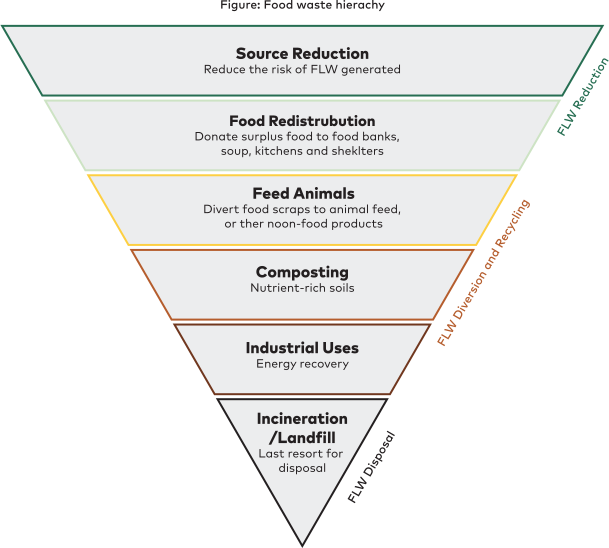
Figure 1: To reduce environmental impacts as much as possible, solutions should be sought as high up the hierarchy as possible.
According to this, measures should primarily be directed towards reducing waste where it occurs: in agriculture, the food industry, shops, and so on. For example, when there are problems with surplus bread in a shop, one should first look for measures that can reduce the surplus. The remaining surplus can, as the next best alternative, be donated, which is an important social contribution.
F. Galli, A. Cavicchi, and G. Brunori. 2019. Food waste reduction and food poverty alleviation: a system dynamics conceptual model. Agriculture and Human Values, Vol. 36: 289–300. https://doi.org/10.1007/s10460-019-09919-0
Crumbs Beer. https://www.crumbs.beer/home-english/ (2024-06-10).
Nofima, Every Minute, 200 loaves of bread are wasted in Norway. 2023. https://nofima.com/press-release/every-minute-200-loaves-of-bread-are-wasted-in-norway-now-research-that-will-halve-that-number-begins/ (2024-06-10).
The Local. 2021. Denmark to repurpose unsold bread as pasta. https://www.thelocal.dk/20210917/denmark-to-repurpose-unsold-bread-as-pasta (2024-06-10).
As a last resort, the food should go towards energy production in the form of biogas or biofuel. For example, ethanol is produced from bread residues in Finland.
Bioenergy International. 2018. Finnish Breadcrumbs to become Swedish ethanol. https://bioenergyinternational.com/finnish-breadcrumbs-to-become-swedish-ethanol/ (2024-06-10).
From a political standpoint, it is important to keep track of this hierarchy when considering measures. Above all, it is important that economic and legal policy instruments do not counteract the hierarchy so that it does not, for example, become economically more advantageous to provide food for biogas production than for donations or animal feed.
Finally, one should note that FLW should not only be counted in tonnes. One kilogram of meat can cause 300 times more climate impact than one kilogram of onions. This means that the climate impact is further reduced if meat waste can be reduced by 1 gram compared to if onion waste is reduced by 250 grams.
RISE. Öppna listan. https://www.ri.se/sites/default/files/2024-01/RISE%20Öppna%20listan%202.2%202023.pdf (2024-08-18)
Similarly, it is more important to reduce waste in later parts of the value chain because of the cumulative environmental impact. When frozen pizza lands on the plate, it would have undergone a long and environmentally impactful journey involving processing and preparation in a factory; it would have been frozen and transported in freezer trucks and freezer displays; it would have been transported home and ended up in yet another freezer before the final energy-demanding preparation in the oven. The total environmental impact of an uneaten piece of pizza is, of course, infinitely greater than if the raw materials had been discarded earlier in the value chain. This underscores the importance of prioritising measures that reduce waste among consumers and in households and various types of restaurants.