National meetings and consultations
This appendix describes the process that took place in each country in connection with the meeting or consultation process for the tax report. Four countries have had physical meetings organised by the respective country's representative in the Freedom of Movement Council (Norway, Finland, Sweden and Denmark). Iceland, Åland and Greenland have had written consultations. In the Faroe Islands, it has not been possible to carry out a consultation process.
The project group wanted to ensure that each country was broadly represented on both the employer and employee sides, so that it was possible to confirm whether the issues raised in the report are accurate and also to confirm that the proposed solutions will make it easier to work remotely in the Nordic Region.
The written consultations have been carried out by the national representative of the Freedom of Movement Council, who circulated the report to relevant stakeholders and received feedback, which has been passed on to the project team.
The national members of the Freedom of Movement Council have identified relevant meeting participants and invited them to the meetings. The member also facilitated the meeting with the help of the project team, which presented issues and solutions in a draft report, which were then discussed.
Below, you can see who has participated in meetings and consultations, as well as in any subsequent written dialogue in each country.
Pan-Nordic issues
Following the national dialogues, YS (Confederation of Vocational Unions) and NFS (Council of Nordic Trade Unions) have raised some issues (via letter and email) that are pan-Nordic and are therefore dealt with on behalf of all the Nordic countries. Some of these issues centre around the risk that citizens and companies may avoid paying taxes when implementing the new solutions. Others include concerns concerning social security and working conditions for hybrid and remote work. Both questions and answers for the pan-Nordic questions can be read in detail in this appendix.
Overall, the project team's response denies that there is more opportunity to avoid paying tax if the new simplifications are implemented than there is with the current rules.
Regarding the social security area and working conditions for hybrid and remote work, the project group's mission is only to analyse tax problems and solutions. Therefore, these issues are outside the scope of the project group.
NORWAY
The dialogue meeting was held at NHO in Oslo on 19 December 2022. The Norwegian representative of the Freedom of Movement Council, Vibeke Hammer Madsen, chaired the dialogue meeting. Good and constructive dialogue took place at the meeting. The issues in the report were found to be accurate and the proposed solutions were found to be a good way to simplify the area.
The project team subsequently received pan-Nordic comments from YS and NFS. You can read more about this at the end of this appendix.
Meeting participants
- Ellen Mulstad, NHO (The Norwegian Confederation of Business)
- Anne-Lise Rolland, LO (LO Norway)
- Kjetil Staalesen, LO (LO Norway)
- Bengt Holmen, The Federation of Norwegian Professional Associations
- Jon Olav Bjergene, Unio (The Confederation of Unions for Professionals)
- Morten Skauge, Virke (The Federation of Norwegian Enterprise)
- Tore Eugen Kvalheim, Spekter (Norway's leading employers' organisation for private and publicly owned companies)
- Jakob Rasborg, Resonans Nordic
- Fredrik Lundgren, KPMG Denmark
- Håkon Rakkenes, KPMG Norway
- Sandra Forsén, Nordic Council of Ministers
Written feedback from LO
Thanks for a great meeting before Christmas! And it's true that we agreed on the areas that are perceived as obstacles and the suggestions for simplifying the rules. However, with one exception: we have not commented on where the tax liability should fall when you have a home office in one country and your employer in another country.
Obviously, the rules should be clear and there should be as little administration as possible. The examples given in the report and at the meeting clearly showed that there is a lot of unnecessary duplication and uncertainty associated with working and living in different countries.
However, neither Kjetil nor I had the necessary background to be able to speak on behalf of LO about the proposed solution: taxation in the employer's country.
Kind regards,
Anne-Lise H. Rolland
LO Norway legal department
LO Norway
Torggata 12, 0181 Oslo, Norway
The LO lawyers' Facebook group
Anne-Lise H. Rolland
LO Norway legal department
LO Norway
Torggata 12, 0181 Oslo, Norway
The LO lawyers' Facebook group

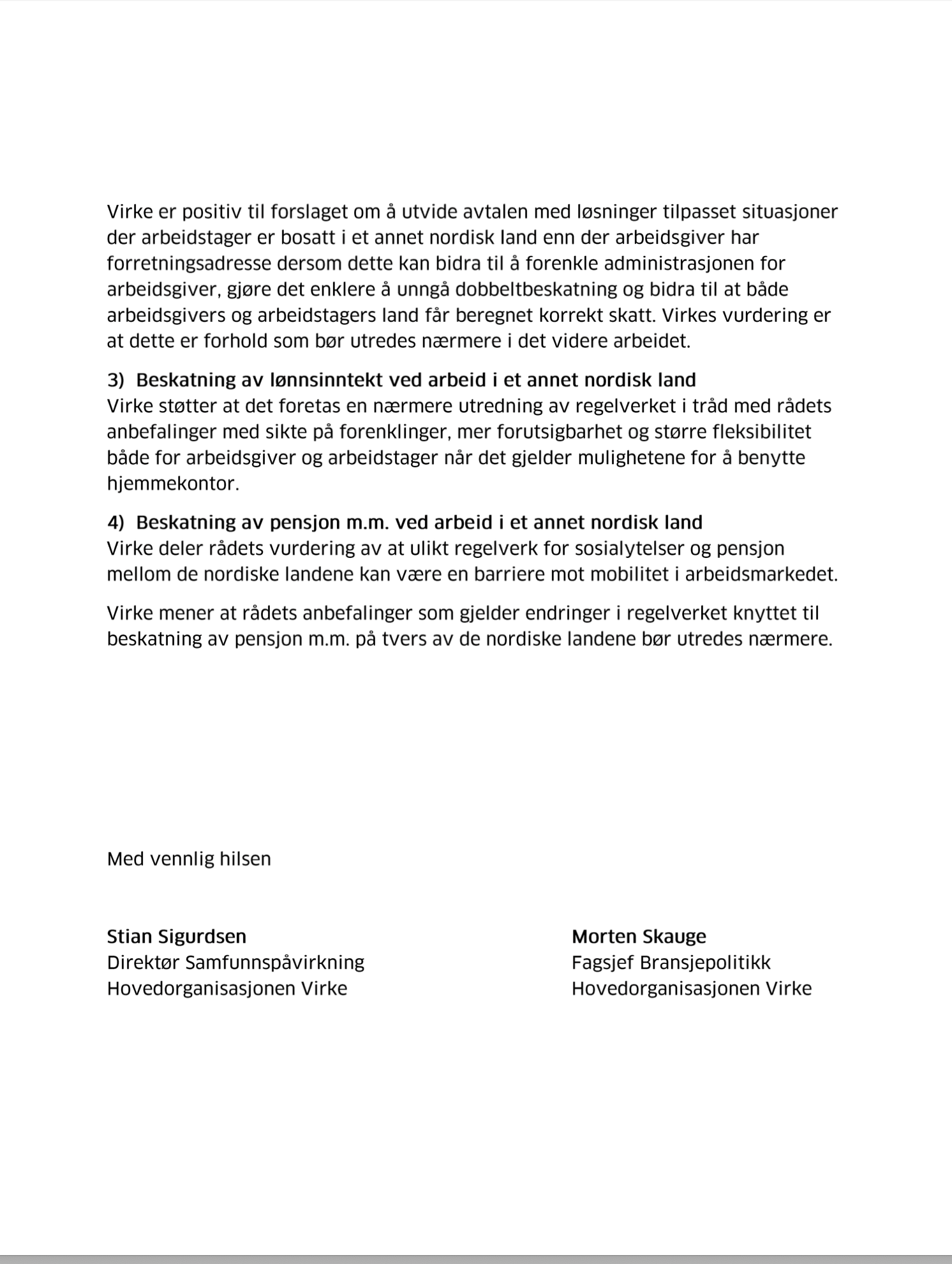
Feedback from VIRKE

SWEDEN
The dialogue meeting was held at the Ministry for Foreign Affairs in Stockholm on 14 February 2023. The Swedish representative of the Freedom of Movement Council, Sven-Erik Bucht, chaired the dialogue meeting. Good and constructive dialogue took place at the meeting. The issues in the report were found to be accurate and the proposed solutions were found to be a good way to simplify the area.
The project team subsequently received pan-Nordic comments from YS and NFS. You can read more about this at the end of this appendix.
Meeting attendees:
- Sven-Erik Bucht, Freedom of Movement Council
- Carina Mårtensson, Ministry of Foreign Affairs Sweden
- Ellen Dahl, Chamber of Commerce and Industry of Southern Sweden
- Pål M. Jebsen, Norwegian-Swedish Chamber of Commerce Stockholm
- Claes Hammarstedt, Confederation of Swedish Enterprise
- Sabrina Suikki, Norrbotten Chamber of Commerce
- Jenny Rydstedt, Saco (Swedish Academics)
- Fredrik Lundgren, KPMG Denmark
- Johan Rova, KPMG Sweden
- Petri Suopanki, Nordic Council of Ministers
DENMARK
The dialogue meeting was held in the Danish Parliament in Copenhagen on 2 March 2023. The Danish representative of the Freedom of Movement Council, Annette Lind, chaired the dialogue meeting. Good and constructive dialogue took place at the meeting. The issues in the report were found to be accurate and the proposed solutions were found to be a good way to simplify the area.
DI wanted to consult their membership for comments on the report, which were subsequently sent to the project team by email.
The comments relate to labour mobility being hampered, problems with short-term assignments in another Nordic country (hybrid work), shadow payroll being resource-intensive, ambiguities in the interpretation of permanent establishment, and problems with lending employees for short stays within a company’s own Group. The comments can be read in detail below.
Meeting attendees:
- Annette Lind, Freedom of Movement Council and Member of Parliament
- Søren Kjærsggard Høfler, Confederation of Danish Industry
- Lene Nielsen, Confederation of Danish Industry
- Jens Heinrich, Freedom of Movement Council and Greenland's Representation in Copenhagen
- Stina Saxbøl, Dansk Metal
- Jacob Ravn, Danish Chamber of Commerce
- Birgitte Nymark, Confederation of Danish Employers
- Tobias Vestergaard Christensen, The Danish Trade Union Confederation
- Jakob Rasborg, Resonans Nordic
- Fredrik Lundgren, KPMG Denmark
- Petri Suopanki, Nordic Council of Ministers
Feedback from the Confederation of Danish Industry
Thank you for a great meeting on the second of this month. On the post-Covid labour market linked to the Nordic Tax Treaty. Your efforts to address, inter alia, the tax obstacles to working across borders in the Nordic Region are greatly appreciated.
As promised at the meeting, DI has asked its members if they have any comments on the excellent draft report.
The feedback on the report has been positive. Two companies have made specific comments based on their current situation. These comments are listed below:
One company states that the report on "Needs and opportunities for updating the Nordic tax treaty with a focus on labour mobility" seems to focus mostly on commuters, which is obviously relevant.
However, the company also has a large number of employees who are sent on short-term assignments/trips to countries such as Norway and Sweden. Typical labour hire. It would therefore be highly relevant if a simplification of the rules (e.g. on tax settlement) would also apply to such situations, including inter alia, that ongoing reporting and settlement may not be required other than in the home country.
The company spends a lot of resources on running shadow payroll in Norway and Sweden, including obtaining tax numbers and ensuring correct tax payments according to annual tax returns. The company has a very precise split of salary data in Denmark, which is also shared with the Danish Tax Agency. It would therefore be ideal if the obligation to regularly report and withhold in Norway and Sweden could be replaced by only reporting and withholding in Denmark (with the Danish tax rate), where information on the salary split between Denmark/Norway and Denmark/Sweden is then naturally submitted.
If a common Nordic calendar is being worked on, the company finds that it may also be relevant to consider whether to give employers/employees the option to upload data from their own systems. Many people have either time tracking or a calendar in other contexts, so automatic uploading/synchronisation is worth looking into.
Another company states that it generally experiences the same challenges as mentioned in the report and supports a simplification towards a more common set of rules in terms of
- when a permanent establishment is established,
- fewer registrations in the countries where work is performed
- only taxing the employee in the country of employment, and
- tax rate equalisation between the authorities in the respective countries.
The specific comments of the companies on the main obstacles in relation to employees working across borders in the Nordic countries are:
Permanent establishment risk
It is very complex to analyse the risk of establishing a permanent establishment when employees work remotely in another country. Even if an external advisor is involved, it is not always clear when a permanent establishment is considered to be established. This is particularly difficult to assess in relation to Norway and Finland.
Multi-country registration
If the company has employees working in other Scandinavian countries for a few days ("seconded" or "remote" work), it is necessary to register the foreign company in the country where the work is performed.
Registering in other countries is expensive and involves a lot of administration for the company. In Norway, it is mandatory to register the foreign company if employees from the Danish company work in Norway. Sweden has implemented similar rules, where it is now mandatory to register the foreign company if invoices are issued to a Swedish subsidiary or to a customer in Sweden. This is true even if employees are not liable for tax.
Taxing an employee from day one in Norway and after 45 days in Sweden results in a lot of administration and extra costs for the company:
- The company must withhold personal income tax on the same income monthly in both the home country and the country of work.
- The company must create a "shadow payroll" in the host country:
a. if the list is drawn up internally in the company, it is associated with a lot of administration
b. if the list is drawn up by an external provider, an additional cost is incurred. - This affects the employee's liquidity or, alternatively, the company must pay foreign tax on behalf of the employee and get the amount refunded in connection with the tax return.
- Tax return assistance is required in both home and work countries to ensure compliance with all regulations and tax equalisation.
Taxation of income earned in another Nordic country
Most of the company's employees working in other Nordic countries are Danish employees working in Norway or Sweden. For these employees, the total salary is taxable in Denmark, and only income earned in Sweden and Norway is taxable in Sweden and Norway. Tax relief is granted in Denmark for taxes paid in Sweden and Norway. Taxation in both the home and host country is mostly an administrative burden, as stated above under the heading "Multi-country registration".
For those employees who live in one Nordic country and work in another Nordic country, there are several complex sets of rules related to the taxation of the individual, such as bilateral agreements, different ways to avoid double taxation and the impact of where the employee is covered by social security. The company in question has found that the very complex set of rules within the Nordic countries has led to some people turning down job offers (transfer from Sweden to Denmark) as it was too difficult to get a full overview of the financial consequences.
Pension taxation
Pension is a general problem in terms of deductions for foreign pension contributions and taxation of the foreign pension when paid out. Recognising the pension schemes of the other Nordic countries can be a good way to solve the problem.
In addition, I can inform you that, today in an article in Berlingske, the Danish daily newspaper, DI's industry director for DI Transport, Karsten Lauritzen, focuses on the fact that the deduction for crossing the Øresund Bridge should be adjusted (1st section, page 6; in order not to infringe copyrights, I am not attaching the article). Adjusting the deduction could also help increase labour mobility in the Nordic Region – at least in the Øresund region. As the rules stand today, the deduction is not adjusted.
Please let me know if you have any questions about the above or if I can help you in any other way. DI is very interested in making the Nordic labour market work better.
Sincerely yours
Lene Nielsen
Senior Consultant
Lene Nielsen
Senior Consultant
Response to Denmark (DI) from the project team
Dear Lene Nielsen,
Thank you very much for your detailed comments on the report. We understand from the comments that you generally agree with the report's solutions. The report's solutions address the vast majority of the problems you outline. We agree that a greater focus on "short-term trips to Sweden and Norway" and “the option of employer/employees to upload data from their own systems in connection with a shared calendar system" will help ease the administrative burden for companies in the Nordic Region.
FINLAND
The dialogue meeting was held at KPMG in Helsinki on 1 February 2023.
The Finnish representative of the Freedom of Movement Council, Kimmo Sasi, chaired the dialogue meeting. Good and constructive dialogue took place at the meeting. The issues in the report were found to be accurate and the proposed solutions were generally recognised as a good way to simplify the area. However, some concern was expressed about how tax revenues will be distributed between countries after the reform.
Meeting attendees:
- Niko Pankka, SAK (The Central Organisation of Finnish Trade Unions)
- Elena Gorschkow, STTK (The Finnish Confederation of Professionals)
- Pasi Sorjonen, Akava (Confederation of Unions for Professional and Managerial Staff)
- Lauri Lehmusoja, EK (Confederation of Finnish Industries)
- Jukka-Pekka Hellman, SY (Entrepreneurs of Finland)
- Emmiliina Kujanpää, EVA (Finnish Business and Policy Forum)
- Minna Ojala, Ministry of Finance
- Ann-Sofie Stude, Ministry for Foreign Affairs
- Anna-Leena Rautajuuri, VH (Tax authorities)
- Paula Holmström, KPMG Finland
- Fredrik Lundgren, KPMG Denmark
- Petri Suopanki, Nordic Council of Ministers
ICELAND
The Icelandic representative of the Freedom of Movement Council, Siv Friåleifsdottir, has been in charge of the consultation process. She sent the report mid-February with a deadline of 10 March to the employers' organisation Confederation of Icelandic Enterprise (SA) and the workers' organisations Alþyåusamband Islands (ASI) and BSRB, Bandalag haskolamanna BHM and Kennarasamband Islands KI.
The feedback is that the issues have been identified accurately and the proposed solutions were generally perceived as a good way to simplify the area.
Feedback from Iceland (teachers' union):
(machine translated from Icelandic)
(machine translated from Icelandic)
Below are our answers and general justifications.
a) Do you agree that the situation described there has or could have a negative effect on your members/organisation? Yes
b) Are the proposals suitable for improving your members'/companies' freedom of movement and/or working environment? Yes
c) Do you have any other suggestions? No, not at this time
Other comments (machine translated from Icelandic):
- Individuals and/or families choose to live in two or more countries and/or move between countries for long or short periods of time. Therefore, for example, teachers may have gone on study leave and to study in other countries and their spouses in some cases moved with them and worked remotely while the teachers were studying, or the person has maintained two homes, one in the country of study and the other in Iceland. In some cases, spouses work in two or more countries. If the tax environment is too complicated in the country where the teacher intends to pursue further education, this may lead to the spouse's employer not agreeing to the spouse working remotely, for example because of the increased costs associated with the purchasing of payroll processing services and the risk to the employer that such work could lead to the establishment of a permanent establishment for the employer abroad. If the spouse's employer does not accept remote work due to the complex tax environment and the resulting increased costs, it can lead to the teacher in question opting out of studying abroad.
- There are also examples where teachers' spouses have chosen to study abroad and the respective teachers have chosen to move abroad with them and engage in distance teaching, e.g. for upper secondary education, temporarily, while the spouse is studying. This could be good for the employer (Icelandic school), as the teacher in question would improve their proficiency in a new language and get to know a new culture, which could benefit the school community. If the tax environment is complex and the school needs to purchase payroll processing services abroad, this may prevent the authorisation of such remote work/distance teaching.
- A complex multinational tax environment discourages employees, their families and employers from moving and studying between countries and defeats the purpose of the EEA Agreement.
- It is important to encourage teachers, principals and others to seek further education in other countries, e.g. to increase the diversity of education and background of employees in Iceland. The opportunities for students' spouses to work remotely can make a difference in the feasibility of studying abroad.
- The benefits of increasing the flow of labour, such as school administrators, teachers and students, between countries include increasing the diversity of employees and students in workplaces including schools. Increased diversity brings together people from different backgrounds, including different education and experience. This can lead to more diverse, new and even more thoughtful ideas and decisions, as they can be examined from many different angles and therefore lead to better solutions. It can be assumed that increased diversity can lead to increased innovation and competitiveness for the benefit of society as a whole.
- To this we can add that by simplifying the tax environment, it can make it easier for Icelandic companies to sell goods and services abroad and incentivise foreign companies to start operations in Iceland. A complex tax environment can also lead to tax evasion and tax being reported in the wrong country, as it becomes too complicated for employers and employees to declare income, pay withholding taxes and payroll-related fees in the right country.
Reply to Iceland
Thank you very much for your reflections and feedback in relation to teachers. We are convinced that this area represents similar issues in other professional areas. We can see that you agree with our problems and solutions. Thank you for the feedback.
GREENLAND
The Greenlandic representative of the Freedom of Movement Council, Jens Heinrich, has been in charge of the consultation process. A draft of the report was sent out mid-February 2023 with a response deadline of 10 March 2023. The report has been sent to the Tax Agency in Greenland and the trade unions SIK (Greenland Labour Union), ASG (Academics’ Union) and IMAK (Teachers’ Union).
Feedback from Greenland:
Here is a summary of feedback on the presentation of the tax report from the tax agency in Nuuk by Kim Neumann, manager, and Morten Selvejer, legal adviser:
- Problem area 1 – permanent establishment when working from home:
- also increase in the amount of work performed from home, but this is not very prevalent in Greenland since there are few employees from the other Nordic countries
- many of the people from other Nordic countries are employed on trawlers, in the mining industry and large construction projects – as well as consultants in the construction industry
- the expectation is that more work from home will cost tax revenue - Problem area 2 – Employer registration requirements in multiple countries:
- there is already an agreement with Denmark, which is where most people come from
- expectation that it is difficult to succeed, as there will be cases where you fall between two stools - Problem area 3 – taxation of salary income from work in another Nordic country:
- in practice, the system is not set up for salaries to be paid to someone without a Danish national ID number. This will make things difficult with Nordic employees
- some kind of additional ID number will need to be created. For employees
- expectation that Greenland will lose money
- tax treaties are therefore needed with the other Nordic countries (there are no agreements with Sweden and Finland) - Problem area 4 – taxation of pensions etc. when working in another Nordic country
- Greenland has had a pension agreement with Denmark since 2017
- the current scheme works for Greenland, where the payment is taxed
- Greenland will lose tax revenue if it is taxed at payout
Reply to Greenland
Dear Kim Neumann and Morten Selvejer,
Thank you for providing your feedback on the report and solutions.
Regarding problem area 1 in relation to tax revenue, we propose that the allocation of tax should basically be distributed as it is today, cf. Article 15 of the Nordic Double Taxation Agreement, based on where the work is performed; but there may certainly be other factors that should be weighted in an equalisation scheme.
Regarding the remaining problem areas, we recommend that Denmark acts on your behalf with regard to resolving tax issues related to remote working. Your comments are therefore included in the report.
ÅLAND
Max Andersson, representative of the Freedom of Movement Council, has been in charge of the consultation process. The report was sent out mid-February with a consultation deadline of 15 March. The report has been sent to selected individuals in the Åland Provincial Government. As well as trade unions, business associations as well as directly to the largest companies and the university.
Feedback from Mathias Brink, Provincial Government of Åland
- For those who have Sweden as their country of residence and Finland as their country of employment through their work on Åland, it is important to achieve two separate simplifications of the regulation.
- One solution is that working from home in the country of residence should be equated with work in the employer's country. This is a very important proposal that would have great practical significance for individuals who work in Åland but have Sweden as their country of residence.
- The second solution is that, regardless of whether you are a private or public sector employee, the exemption method is applied to the service income. This could make the Åland labour market more attractive, as Åland's tax level is significantly lower than Sweden's.
Feedback from Sofia Higson, Provincial Government of Åland
- My general observation is that the proposal in the report contributes to a more manageable tax system for taxpayers and is thus in line with the provincial government's budget goal of making it easy to work remotely from Åland. When it comes to the impact on tax revenue, we would probably need to analyse the actual effects that the proposals would have. At the moment, I have not had time to do such an analysis.
- In general, I believe the report is focused and based on the border situation in Øresund. This is a natural effect of the fact that most cross-border commuters are located there, but it makes it a little more difficult to analyse the consequences for our Sweden-Finland border situation.
- Problem areas 2 and 3 propose solutions to implement a common electronic calendar and a compensation system for workers who opt for taxation in the country of work. Such solutions may require system changes or the creation of new cross-border systems. It can be time-consuming and costly and should be a consequence for the Nordic countries, but it is not mentioned under each problem area.
Reply to Åland
Dear Sofia and Mathias,
Thank you for your positive response to the report. We are glad that the report hits on some relevant issues and that you see the solutions as relevant. However, we would like to point out that the solutions are conceived as joint Nordic issues with a focus on all countries and Nordic borders. Not with a specific focus on individual border regions.
FAROE ISLANDS
It has not been possible to organise a consultation in the Faroe Islands.
Pan-Nordic issues
NFS (Nordic Professional Association)
Feedback from NFS
To the Freedom of Movement Council – Nordic Council of Ministers
Dear Nordic colleagues,
First of all, I would like to thank you for the constructive and rewarding dialogue meeting in Stockholm on 14 February on Nordic tax treaties related to work in a cross-border perspective. It was a very productive conversation and dialogue, and we received a good presentation on the challenges as well as the possible solutions that the consultants point out.
At the meeting, we agreed on the possibility of providing additional input for the finalisation of the assignment. As the NFS has emphasised on several occasions, we generally look positively on increasing mobility and integration in the common Nordic labour market. It is important that regulations do not hamper mobility.
At the same time, we have also pointed out that regulations and possible simplifications of existing regulations and procedures must not be changed or simplified to such an extent that they no longer apply or become less strict in other countries, or such that establishments, operating centres and tax advantages are chosen in order to circumvent existing regulations or take advantage of a simplified regulatory framework that leads to unhealthy competitive advantages or undermines defined conditions and/or social protection.
We have now discussed these aspects in more detail with some of the member organisations in NFS, and would like to add that it is also important that both the report and the proposals for possible solutions identify these challenges more clearly than before, such that new proposals will not result in unintended consequences. Meanwhile, we, of course, continue to share the ambition to make it easier for both employees and serious companies to deal with these issues. To highlight this and provide some specific examples of challenges and issues that should be captured and highlighted, we attach this report prepared by our colleagues at Norwegian YS.
We are of course available for further dialogue and discussion on these issues.
Kind regards,
Magnus Gissler
Generalsekreterare / General Secretary
Magnus Gissler
Generalsekreterare / General Secretary
Reply to NFS (Magnus Gissler)
We refer to the same answer we have given to YS below.
YS
(Norwegian Confederation of Vocational Unions)
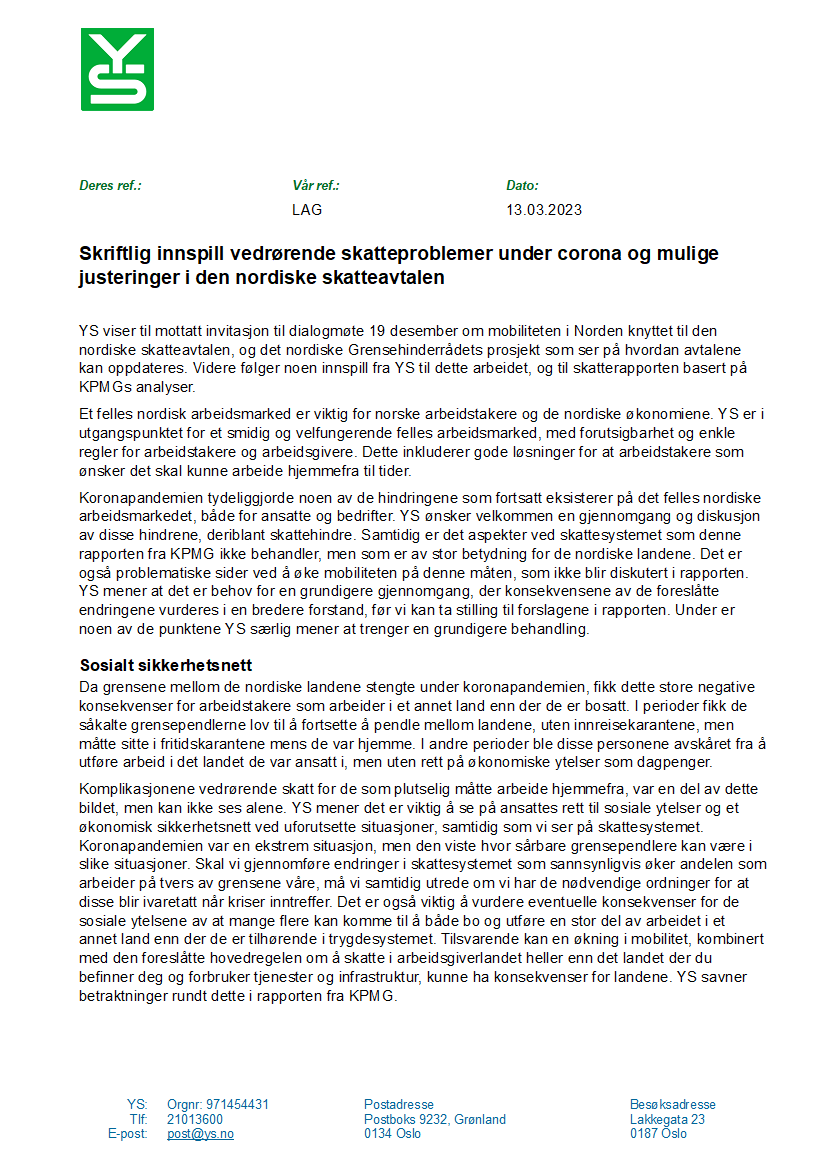
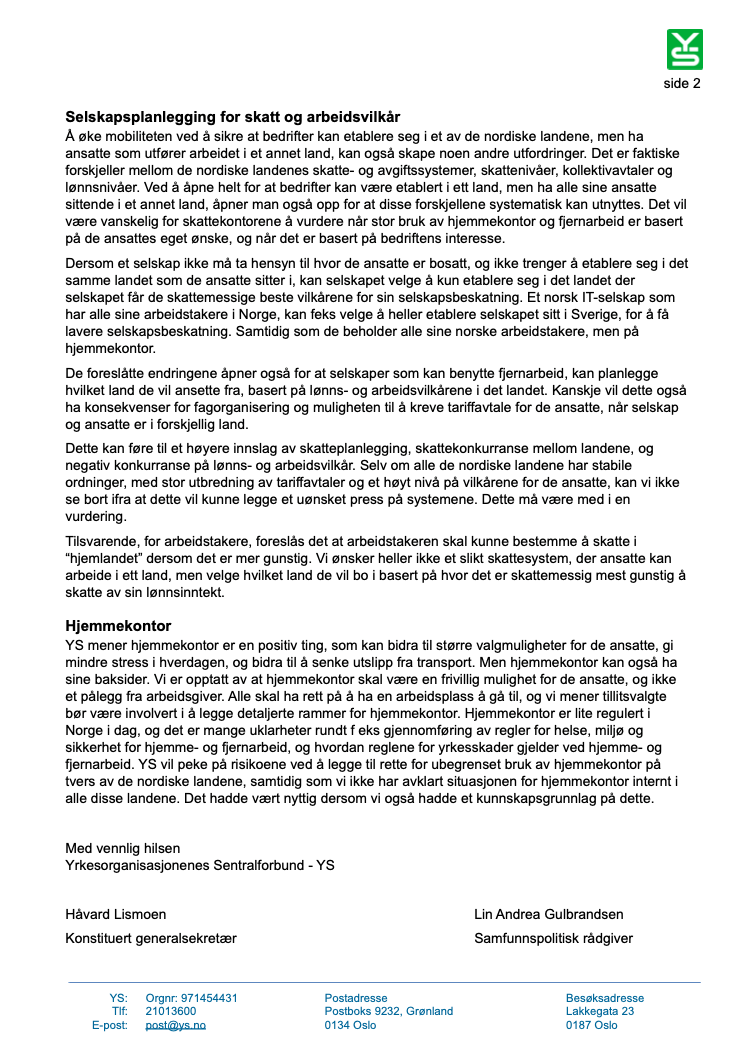
Feedback from YS
Answers to pan-Nordic questions from NFS and YS
The project group is grateful for the positive and welcoming dialogue we had at the meeting. We are pleased that YS and NFS also believe that tax problems should be solved for those who work remotely across borders, so that employees and companies experience fewer problems and less administrative hassle.
YS and NFS address three main problem areas
- The social safety net
- Home office
- Corporate planning for tax and labour conditions
Points 1 and 2 relate to working conditions and entitlement to social benefits in hybrid and remote work and are outside the scope of this report. Therefore, it is not up to the project team to answer the questions.
Point 3 deals with the risk that a company or an employee could take advantage of the proposed rules to obtain a lower level of tax by registering in another country. For convenience, we have included the YS example in the answer
YS example of possible utilisation of tax rules:
- "If a company does not have to take into account where its employees reside and does not have to establish itself in the same country as its employees, the company can choose to establish itself only in the country where it has the best tax conditions in terms of corporate taxation. For example, a Norwegian IT company that has all its employees in Norway may choose to establish its business in Sweden to achieve lower corporate taxation. At the same time, they keep all their Norwegian employees, but in home offices."
Reply to YS and NFS:
The above example is not a risk with the proposed set-up for solutions in the tax analysis.
Firstly, employees will be taxed in the country of residence if the work is performed exclusively there. Secondly, the distribution of tax will be divided between the country of work and the country of residence according to the same principle as today, based on where the work is performed.
What is new in the project group's proposal is that tax revenue between the countries is between the countries' tax authorities and not, as today, based on the individual employee's tax return. This will reduce the hassle and administration of filing taxes in two countries and will also reduce the risk of errors.
We see no risk of a company establishing itself in the country with the best tax conditions, cf. your example where a company establishes itself in Sweden but has its employees working remotely from Norway.
In this case, the company would have to request confirmation from the tax authority in Norway that it is not a permanent establishment in Norway (from a tax perspective), which the Norwegian tax authority would refuse. Therefore, the activity that the Swedish company carries out in Norway becomes subject to corporate income tax according to the same principles that apply to Norwegian companies and permanent establishments.
As the corporate tax rate in the Nordic countries only varies between 20-22%, any profit from trying to take advantage of this will be very small.