

- Frontpage
- Table of contents
- The cookbook in two minutes
- Entering a radical change mindset
- Glossary
- ACT I – Food: an essential ingredient for sustainable development
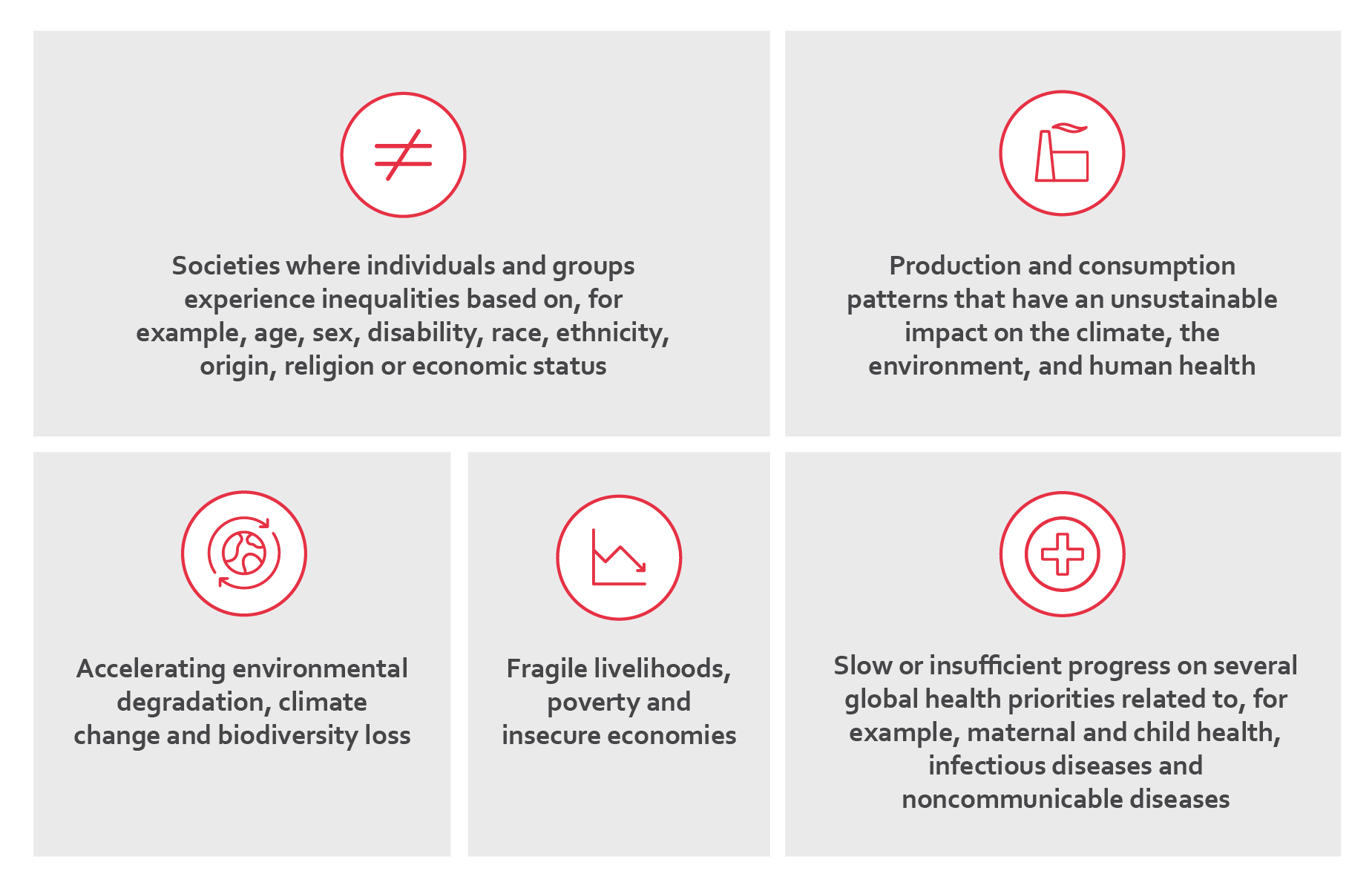
- Grand challenges faced by world societies
- How food systems fuel societal challenges
- Food systems as entry points for tackling grand challenges
- From entry points to missions
- ACT II – We’re on a mission
- Missions to tackle societal challenges
- How do we design food system missions to help tackle our grand challenges?
- Defining Nordic food system missions
- Where next?
- ACT III – Demonstrating transformation
- Experimentation is key to achieving a mission
- What are demonstrators?
- Rewriting the recipe for meals in school
- What next?
- ACT IV – Bringing the cookbook to life
- Meet the authors
- Acknowledgements
- Are you pressed for time? Read the Executive Summary
- About this publication
MENU
Contents
We can and must work with the strategic innovation of food systems to solve some of our greatest societal challenges.
Tasting Menu: A bite-sized overview of your journey through the cookbook
ACT I – Food: an essential ingredient for sustainable development
This chapter gives you the chance to explore some of the grand challenges that societies around the world, including the Nordics, are now facing. We will introduce you to entry points, the places where we can intervene to make strategic changes that can address grand challenges.
► Read more

ACT II – We are on a mission
In this chapter we show how to move from grand challenges to more concrete actions and interventions. With a long list of potential entry points and limited resources – how can you choose which entry points to pursue? We dig deeper into the “mission-based approach” to societal innovation, understanding how missions can help us zoom in on a challenge and set goals for food system transformation in particular contexts. This will provide you with a foundation to start designing your own mission.
► Read more

ACT III – Demonstrating transformation
This chapter gives you a taste of how missions are implemented on the ground. It describes how to orchestrate demonstrator experiments and the steps involved in designing and implementing them. The power of demonstrators stems from their ability to identify interdependencies and unlock synergies in the system. We walk you through the concept of a demonstrator using meals in schools in Oslo as an example, bringing you closer to what implementing a mission might look like in practice.
► Read more

ACT IV – Bringing the cookbook to life
This chapter describes how Acts I, II and III fit together, helping you pave the road to the future. After reading through this cookbook you are now ready to define grand challenges and entry points, develop a bold mission, plan demonstrators and start strategically orchestrating actions across networks of people and organisations. We can’t wait to see what you come up with!
► Read more

Entering a radical change mindset
It is seven in the morning on 18 May 2030 in a Nordic capital city. Line Mwangi is lying awake in bed, excited about the day ahead. The aroma of her fresh mushroom coffee lingers in the air as her husband helps get their son Erik ready for school. They take some groceries that are about to go off and put them in his backpack so he can take them to school.
Line showers, dries her hair and slips on her blue seaweed-fibre dress and her favourite fish-leather shoes. On Erik’s bike ride to school, he stops off at the garden plot so he can water the plants and check on their cricket farm. When he reaches the school entrance, he checks the hologram display to see what they will be making in food education class – locally raised snails with garlic, and red beet salad with Nordic hazelnuts, his favourite! He takes the groceries from his backpack and drops them off in the school kitchen.
Line walks to her office at the Ministry of Food Systems. Today, a delegation from the USA is visiting via photorealistic conference call to learn about how her government has brought an end to childhood obesity. Just as she and her colleagues have sat down in the conference room, a video message pops up on their screens. It’s the prime minister, congratulating everyone once again for meeting all of the targets for the UN Sustainable Development Goals.
At lunchtime, Line scans her fingerprint in the canteen and finds her personalised meal ready for pick-up. Mushroom and barley risotto, North Atlantic seaweed salad and a side of sautéed arctic lupin – cooked just the ways she likes it! The canteen message board lights up and announces that her meal scores high in animal welfare, biodiversity protection and nutritional quality and low in greenhouse gas emissions and natural resource use. As she walks towards the lunchroom tables, she runs into her colleagues from the Choice Architecture taskforce. They have just finished reviewing the insights they have acquired from a decade of action on sustainable food delivery.
On her way home from work, Line receives two notifications. Her neighbourhood maritime co-operative has just finished harvesting mussels so she can collect her order, and at school her son has turned their surplus groceries into a side dish of roasted cauliflower that will go well with the mussels and horseradish cream. What a perfect treat for celebrating Nordic Sustainable Gastronomy Day!
Over dinner, Line’s family makes plans for a weekend outing. They decide to take the high-speed electric train and visit the Nordic Flora and Fauna Agrobiodiversity Park.
As Line reads her youngest son a book before bed, he tells her that he wants to be a regenerative agriculture technologist when he grows up. She smiles, smooths his hair and kisses him goodnight.
Does this really have to be fiction?
The thing is, we really do need an all-hands-on-deck approach if we want to thrive in the future. The history of human innovation shows us that we can turn things around dramatically when we put our minds to it. That doesn’t mean it will be easy.
It’s tempting to think of innovation as something radical and futuristic that has never been seen before. You can always find innovations that fit this description – like lab-grown meat and driverless delivery vehicles. But innovation doesn’t have to be flashy and “out there”. The term “innovation” means doing something differently and deliberately in order to achieve certain objectives.[1]Koch, P. and Hauknes, J., 2005. On innovation in the public sector – today and beyond. Publin Report No. D20, Second revised edition. When we combine the knowledge, capabilities and resources we already have in a new way to achieve something specific – that’s innovation![2]Edler, J. and Fagerberg, J., 2017. Innovation policy: what, why, and how. Oxford Review of Economic Policy, 33(1), pp. 2-23. And because innovation is contextual, what’s already established in one place can be an innovation when it’s introduced somewhere else. Implementing innovation and an innovative mindset can lead to anything from a single technical fix to a widespread change in behaviour.
To have a more desirable future, we have to actively choose to do some things differently. This is where the research and innovation agencies come in. In the Nordics, we’re lucky to have multiple national agencies and two regional agencies that support research and innovation. While these agencies differ slightly in scope, they do have one mission in common – improving society by making it easier to do things differently. This increasingly means starting with a desirable societal outcome, and then working our way backwards in order to support the solutions with the greatest chance of achieving that outcome. Sometimes the most powerful innovations come from recombining already existing solutions into a new system that is more efficient and has a greater impact than the sum of its parts.
Throughout the pages of this cookbook of strategies, we will make the case for why one of the most important societal missions of our time is the transition to more sustainable food systems – and why a strong public innovation ecosystem is key to the timely occurrence of that transition.
Who is this cookbook for and what can it do for you?
This cookbook is intended primarily for national and regional innovation agencies, as the government has both a mandate and more authority than any other entity to lead the change needed to achieve sustainable food systems. However, because innovation ecosystems include a variety of different actors, this cookbook also provides valuable insights into the roles that entrepreneurs and civil society and research organisations can play to cultivate change from the bottom-up.
Throughout the pages of this cookbook, we will be setting out a method for deliberate food system transformation that can support people, planet and society. But we aren’t just going to talk you through the reasons why food systems are such a powerful lever of change. The cookbook will provide you with ingredients – templates for developing interventions, guides for how to get started and examples of cross-cutting projects – that you can use to create your own recipe for change. And although we would love you to read this cookbook of strategies for change from cover to cover, time is not always on our side. With your precious time in mind, we’ve designed the cookbook so that you can choose the sections that best suit your needs.
This cookbook is also a call to action. While the method that we propose in this strategy cookbook has been used in a variety of smaller, more localised contexts in the Nordics, this is the first time it has been proposed at the pan-Nordic level. There is nothing stopping us from trying. And we will really need to try, because the challenges that we face – like the impact of climate change, inequality and poor health – affect us all. There is no way around it: we will need to work together.
It’s easy to get carried away when thinking about transformation and imagine that every part of a food system needs to change.
Footnotes
- ^ Koch, P. and Hauknes, J., 2005. On innovation in the public sector – today and beyond. Publin Report No. D20, Second revised edition.
- ^ Edler, J. and Fagerberg, J., 2017. Innovation policy: what, why, and how. Oxford Review of Economic Policy, 33(1), pp. 2-23.
- ^ HLPE, 2017. Nutrition and food systems. A report by the High Level Panel of Experts on Food Security and Nutrition of the Committee on World Food Security. Rome: High Level Panel of Experts
- ^ FAO, 2018. Sustainable food systems: concept and framework. Rome: Food and Agriculture Organization of the United Nations.
- ^ Tendall, D.M., et al., 2015. Food system resilience: defining the concept. Global Food Security, 6, pp. 17-23. DOI: 10.1016/j.gfs.2015.08.001
Glossary
Get to know your ABCs:
Mission approach:
Portfolio approach:
Footnotes
- ^ https://dictionary.cambridge.org/dictionary/english/insight
ACT I – Food: an essential ingredient for sustainable development
-
Stay in Act I if you want to explore some of the great challenges that societies around the world, including the Nordics, are now facing and learn how food systems can provide entry points for tackling these grand challenges.
-
Skip to Act II if you want to hear more about how to link high-level challenges with more concrete formulations of what to do.
-
And if you just want to dig into specific demonstrators, a way of showing how to tackle some of the major challenges in the food system, flip to Act III.
Footnotes
- ^ FAO. Once neglected, these traditional crops are our new rising stars. http://www.fao.org/fao-stories/article/en/c/1154584/
1.1 Grand challenges faced by world societies
Footnotes
That doesn’t mean it will be easy.
Footnotes
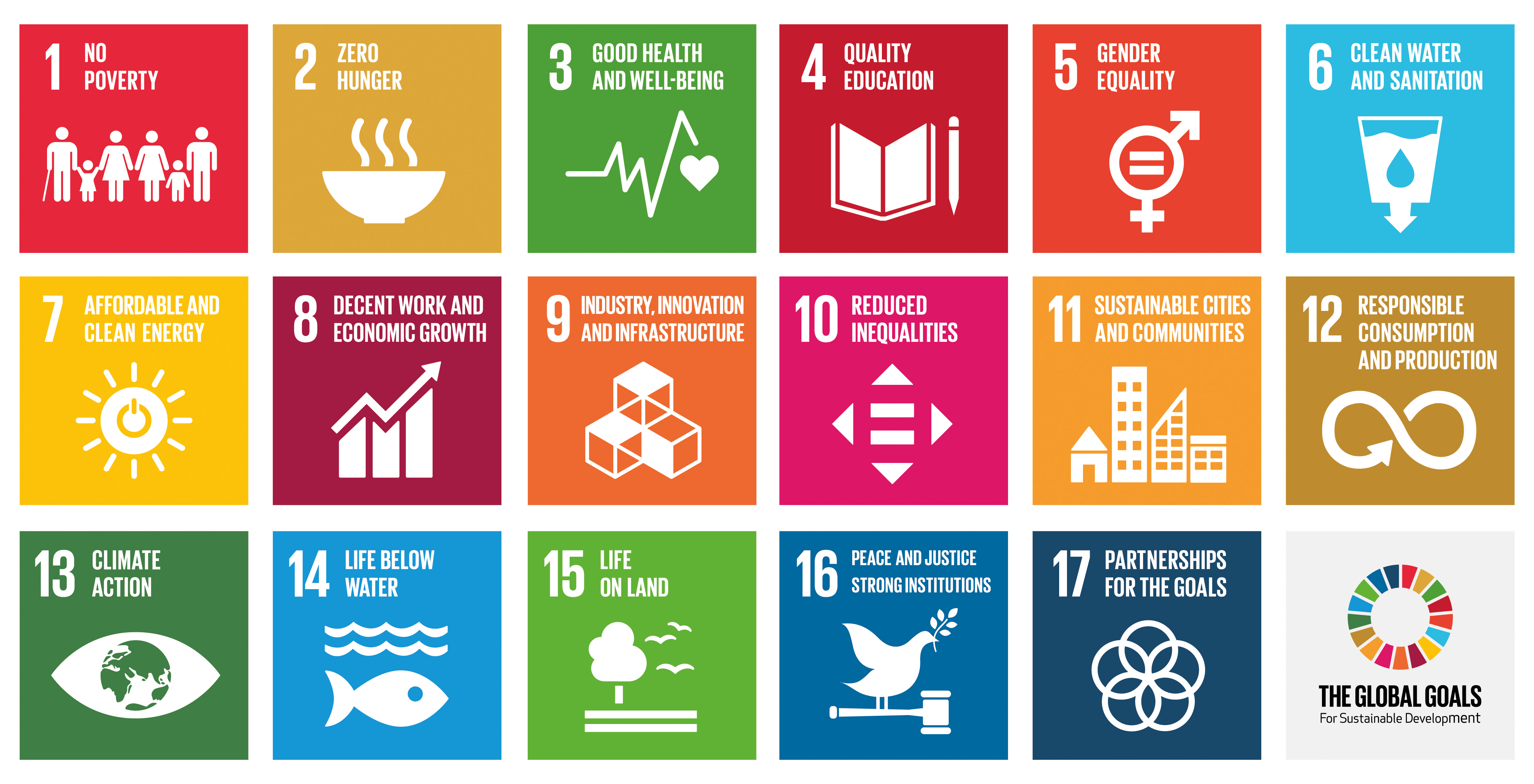
- ^ United Nations. The Sustainable Development Goals. https://sdgs.un.org/
1.2 How food systems fuel societal challenges
Footnotes
- ^ United Nations. Food Systems Summit 2021. https://www.un.org/en/food-systems-summit
| GRAND CHALLENGE | FOOD SYSTEM CONTRIBUTION ON A GLOBAL SCALE | FOOD SYSTEM CONTRIBUTION ON A NORDIC SCALE |
Accelerating environmental degradation, climate change and biodiversity loss  | Global food systems are the single largest driver of environmental decline.12 On a global scale, food production disrupts nutrient flows and pollutes waterways, and its greenhouse gas emission levels are unsustainable. The sixth mass extinction is underway: human destruction of nature has caused a 68% drop in species population size since 1970. Food systems are a primary driver of biodiversity loss through unsustainable food production methods and habitat loss and fragmentation resulting from extending food production onto more land.13 | Current Nordic food demand claims twice as much cropland around the world and results in two and a half times as much greenhouse gas emissions as what is considered sustainable when global food system targets are translated into the Nordic context.14 Agriculture contributes a significant proportion of the greenhouse emissions in the Nordic countries, ranging from 13% of national emissions in Finland to 26% in Denmark.15 Agricultural run-off is one of the main culprits of oxygen depletion (eutrophication) in the Baltic Sea, causing excessive algal growth and suffocating the species that live there.16 |
Unsustainable production and consumption patterns  | Globally, about one third of all food produced is wasted.17 Food waste is responsible for about 8% of all greenhouse gas emissions produced by humans.18 Overconsumption of food puts unnecessary pressure on the environment by using additional resources and simultaneously contributes to a range of health issues. | Nordic populations waste roughly 3.5 million tonnes of food each year.19 A Finnish study estimated that annual household food waste in Finland had as much climate impact as the annual carbon emissions from 100,000 cars.20 Overconsumption of food, combined with low levels of physical activity, contributes to nearly half of Nordic adults and 1 in 7 children being overweight.21 |
Persistent challenges securing good health and wellbeing for all  | Malnutrition is a challenge for nearly all countries. Globally, about 1 in 9 individuals go to bed hungry or without proper nutrients, while 1 in 3 eat too much.22 Poor diets claimed the lives of approximately 8 million people globally (14% of total deaths) in 2019.23 | Unhealthy diets are one of the leading risk factors for poor health across the Nordic region.24 In 2019, poor diets were responsible for 36,000 deaths in the Nordic countries.25 Approximately one third of deaths from cardiovascular disease in the Nordic countries were attributable to unhealthy diets in 2019.26 |
Societies where individuals and groups experience inequalities  | Power imbalances in food systems are a major driver of dietary and nutrition inequities. One consequence is restricted access to nutritious, affordable food.27 | Diet- and health-related inequalities exist across the Nordics and are related to income, level of education or region of residence, making it difficult for some to achieve a balanced, healthy diet.28, 29 |
Fragile livelihoods, poverty and insecure economies  | 80% of the world’s poor live in rural areas and are highly dependent on agriculture.30 Smallholders’ livelihoods are increasingly threatened by climate change and natural disasters. The growing presence of food industries (e.g. retailers, privatised entities) has resulted in consolidation and the risk of marginalising small-scale producers in the market.31, 32 | In 2017, 2.4% of the Nordic working population was employed in the agriculture, forestry and fisheries sectors.33 These sectors find it difficult to recruit local workers – especially younger people – for agricultural jobs, due in part to the physical labour, low wages, low levels of profitability and long hours involved. In Sweden, approximately one third of the employees in the food service sector are employed on a temporary basis34 and many food service workers earn salaries lower than the national average.35 Migrant workers in the Nordics are a vital part of the agricultural workforce, yet these workers can face worse conditions or lower pay than local workers.36 |
Notes: [1]Willett, W., et al., 2019. Food in the Anthropocene: the EAT–Lancet Commission on healthy diets from sustainable food systems. The Lancet, 393(10170), pp. 447-492. [2]WWF, 2020. Living Planet Report. https://livingplanet.panda.org/ [3]Wood, A. et al., 2019. Nordic food systems for improved health and sustainability. https://www.stockholmresilience.org/research/research-news/2019-04-03-within-reach.html [4]FAO. FAOSTAT statistics database. 20120. URL http://www.fao.org/faostat/en/#data [5]Baltic Eye, 2016. Nutrient recycling in agriculture for a cleaner Baltic Sea. https://balticeye.org/en/eutrophication/policy-brief-nutrient-recycling-in-agriculture/ [6]FAO, 2011. Global food losses and food waste – extent, causes and prevention. Rome: FAO. [7]FAO. Food wastage footprint and climate change. http://www.fao.org/3/a-bb144e.pdf [8]Nordic Council of Ministers, 2017. Policy brief: preventing food waste – better use of resources. http://norden.diva-portal.org/smash/record.jsf?pid=diva2%3A1115667&dswid=-2021 [9]Silvennoinen, K., et al., 2015. Food waste volume and origin: Case studies in the Finnish food service sector. Waste Management, 46, pp. 140-145. [10]Wood, A. et al., 2019. Nordic food systems for improved health and sustainability. https://www.stockholmresilience.org/research/research-news/2019-04-03-within-reach.html [11]2020 Global Nutrition Report: Action on equity to end malnutrition. Bristol, UK: Development Initiatives. [12]Murray, C. J., et al., 2020. Global burden of 87 risk factors in 204 countries and territories, 1990–2019: a systematic analysis for the Global Burden of Disease Study 2019. The Lancet, 396(10258), pp. 1223-1249. [13]IHME, 2020. Country profiles. http://www.healthdata.org/results/country-profiles [14]Murray, C. J., et al., 2020. Global burden of 87 risk factors in 204 countries and territories, 1990–2019: a systematic analysis for the Global Burden of Disease Study 2019. The Lancet, 396(10258), pp. 1223-1249. [15]Murray, C. J., et al., 2020. Global burden of 87 risk factors in 204 countries and territories, 1990–2019: a systematic analysis for the Global Burden of Disease Study 2019. The Lancet, 396(10258), pp. 1223-1249. [16]2020 Global Nutrition Report: Action on equity to end malnutrition. Development Initiatives: Bristol, UK. [17]NCM, 2006. Health, food and physical activity: Nordic Plan of Action on better health and quality of life through diet and physical activity. Copenhagen: Nordic Council of Ministers. [18]Fismen, A. S., et al., 2016. Trends in food habits and their relation to socioeconomic status among Nordic adolescents 2001/2002-2009/2010. PLoS One, 11(2), p.e0148541. [19]FAO, 2017. Food and agriculture: driving action across the 2030 Agenda for sustainable development. Rome: Food and Agriculture Organization of the United Nations. [20]Weatherspoon, D., Reardon, T, 2003. The rise of supermarkets in Africa: implications for agrifood systems and the rural poor. Development Policy Review, 21(3), pp. 333-355. [21]Humphrey J., 2007. The supermarket revolution in developing countries: tidal wave or tough competitive struggle? Journal of Economic Geography, 7(4), pp. 433-450. [22]Grunfelder et al., 2020. State of the Nordic region 2020. Denmark: Nordic Council of Ministers. https://pub.norden.org/nord2020-001/nord2020-001.pdf [23]Larsen and Ilsøe, 2019. Atypical labour markets in the Nordics: Troubled waters under the still surface? https://faos.ku.dknord2020-048.pdffaktaark/Nfow-brief4.pdf [24]From national statistics databases. [25]Friberg, J. H., and Eldring, L., 2013. Labour migrants from Central and Eastern Europe in the Nordic countries. Copenhagen: Nordic Council of Ministers.
Footnotes
- ^ Willett, W., et al., 2019. Food in the Anthropocene: the EAT–Lancet Commission on healthy diets from sustainable food systems. The Lancet, 393(10170), pp. 447-492.
- ^ WWF, 2020. Living Planet Report. https://livingplanet.panda.org/
- ^ Wood, A. et al., 2019. Nordic food systems for improved health and sustainability. https://www.stockholmresilience.org/research/research-news/2019-04-03-within-reach.html
- ^ FAO. FAOSTAT statistics database. 20120. URL http://www.fao.org/faostat/en/#data
- ^ Baltic Eye, 2016. Nutrient recycling in agriculture for a cleaner Baltic Sea. https://balticeye.org/en/eutrophication/policy-brief-nutrient-recycling-in-agriculture/
- ^ FAO, 2011. Global food losses and food waste – extent, causes and prevention. Rome: FAO.
- ^ FAO. Food wastage footprint and climate change. http://www.fao.org/3/a-bb144e.pdf
- ^ Nordic Council of Ministers, 2017. Policy brief: preventing food waste – better use of resources. http://norden.diva-portal.org/smash/record.jsf?pid=diva2%3A1115667&dswid=-2021
- ^ Silvennoinen, K., et al., 2015. Food waste volume and origin: Case studies in the Finnish food service sector. Waste Management, 46, pp. 140-145.
- ^ Wood, A. et al., 2019. Nordic food systems for improved health and sustainability. https://www.stockholmresilience.org/research/research-news/2019-04-03-within-reach.html
- ^ 2020 Global Nutrition Report: Action on equity to end malnutrition. Bristol, UK: Development Initiatives.
- ^ Murray, C. J., et al., 2020. Global burden of 87 risk factors in 204 countries and territories, 1990–2019: a systematic analysis for the Global Burden of Disease Study 2019. The Lancet, 396(10258), pp. 1223-1249.
- ^ IHME, 2020. Country profiles. http://www.healthdata.org/results/country-profiles
- ^ Murray, C. J., et al., 2020. Global burden of 87 risk factors in 204 countries and territories, 1990–2019: a systematic analysis for the Global Burden of Disease Study 2019. The Lancet, 396(10258), pp. 1223-1249.
- ^ Murray, C. J., et al., 2020. Global burden of 87 risk factors in 204 countries and territories, 1990–2019: a systematic analysis for the Global Burden of Disease Study 2019. The Lancet, 396(10258), pp. 1223-1249.
- ^ 2020 Global Nutrition Report: Action on equity to end malnutrition. Development Initiatives: Bristol, UK.
- ^ NCM, 2006. Health, food and physical activity: Nordic Plan of Action on better health and quality of life through diet and physical activity. Copenhagen: Nordic Council of Ministers.
- ^ Fismen, A. S., et al., 2016. Trends in food habits and their relation to socioeconomic status among Nordic adolescents 2001/2002-2009/2010. PLoS One, 11(2), p.e0148541.
- ^ FAO, 2017. Food and agriculture: driving action across the 2030 Agenda for sustainable development. Rome: Food and Agriculture Organization of the United Nations.
- ^ Weatherspoon, D., Reardon, T, 2003. The rise of supermarkets in Africa: implications for agrifood systems and the rural poor. Development Policy Review, 21(3), pp. 333-355.
- ^ Humphrey J., 2007. The supermarket revolution in developing countries: tidal wave or tough competitive struggle? Journal of Economic Geography, 7(4), pp. 433-450.
- ^ Grunfelder et al., 2020. State of the Nordic region 2020. Denmark: Nordic Council of Ministers. https://pub.norden.org/nord2020-001/nord2020-001.pdf
- ^ Larsen and Ilsøe, 2019. Atypical labour markets in the Nordics: Troubled waters under the still surface? https://faos.ku.dknord2020-048.pdffaktaark/Nfow-brief4.pdf
- ^ From national statistics databases.
- ^ Friberg, J. H., and Eldring, L., 2013. Labour migrants from Central and Eastern Europe in the Nordic countries. Copenhagen: Nordic Council of Ministers.
1.2.1 Is food really the issue?
Footnotes
- ^ ILO, 2020. Agriculture; plantations; other rural sectors. https://www.ilo.org/global/industries-and-sectors/agriculture-plantations-other-rural-sectors/lang--en/index.htm
- ^ European Commission. Food and drink industry. https://ec.europa.eu/growth/sectors/food_en
"The choice is ours. Are we going to use food as a means of destroying the foundations of healthy lives and prosperous societies, or are we going to use it as an ingredient to support a sustainable future for all?"
| Food production | Consumption | |
| Farmers have made progress in reducing nitrogen losses and increasing environmentally friendly production practices, with support from government subsidies and regulations and from farmers associations.39, 40 The Nordics have achieved a very low level of agricultural antibiotic use. In Norwegian salmon farming, antibiotic use has nearly been eliminated thanks to the development of vaccines.41 This contributes to the strict animal health and welfare practices observed in the region.42, 43 There are programmes in place to promote and conserve the genetic diversity of animals and plants that are important to Nordic agriculture.44 The Nordic countries promote agricultural practices that use few or no chemicals. One study in Sweden found that the majority of the chemical footprint of food consumed in Sweden came from food grown outside of the country.45 | All national food authorities have established clear, food-based dietary guidelines based on the Nordic Nutrition Recommendations (NNR),49 a joint effort by hundreds of scientists, officials and experts across the region to assess the evidence for healthy foods and diets. The next revision of the NNR – scheduled for release in 2022 – will embed environmental sustainability in its analysis. The food-based dietary guidelines of Finland and Sweden already incorporate environmental sustainability considerations into their recommendations. In 2021, Denmark will be the next Nordic country to have sustainable food-based dietary guidelines. A growing number of Nordic citizens are open to changing what they eat so as to be more sustainable. About 34% of respondents to a 2015 survey indicated that they planned to include more vegetarian food in their diet.50, 51 | |
| Food waste | Food security | |
| In Denmark, food waste generated in apartments fell by 24% between 2011 and 2017.46 In Norway, household and retail waste fell by 10% and 25% respectively between 2010 and 2016. The Swedish National Food Agency indicates that food waste is declining in Sweden as well.47, 48 Initiatives ranging from household interventions (like organic recycling programmes for food waste) to digital platforms (like the Too Good To Go and Karma food apps) have helped to reduce or reuse food waste. | Food insecurity – measured in terms of availability, access, utilisation and stability of the food supply – in the Nordic region is considered to be low.52 Total household expenditure on food is generally only 11%-13%53, 54, 55, 56, 57 in contrast to an average of 19.4% in the neighbouring Baltic countries of Estonia, Latvia and Lithuania58 or 56% in Nigeria.59 |
Note: [1]Antman, A., et al., 2015. Nordic agriculture air and climate: Baseline and system analysis report. Copenhagen: Nordic Council of Ministers. [2]Hellsten, S., et al., 2019. Abating N in Nordic agriculture - Policy, measures and way forward. Journal of environmental management, 236, pp. 674-686. [3]WHO, 2015. Vaccinating salmon: How Norway avoids antibiotics in fish farming. https://www.who.int/features/2015/antibiotics-norway/en/ [4]Danish Agriculture & Food Council, 2010. Danish pig producers and animal welfare. Copenhagen: Danish Agriculture & Food Council. [5]European Surveillance of Veterinary Antimicrobial Consumption (ESVAC), 2017. Sales of veterinary antimicrobial agents in 30 European countries in 2015. London: European Medicines Agency. [6]NordGen. The Nordic Genetic Resource Center. https://www.nordgen.org/en/ [7]Cederberg, C., et al., 2019. Beyond the borders – burdens of Swedish food consumption due to agrochemicals, greenhouse gases and land-use change. Journal of Cleaner Production, 214, pp. 644-652. [8]Danish Envrionment Protection Agency, 2018. Kortlægning af sammensætningen af dagrenovation og kildesorteret organisk affald fra husholdninger. https://mst.dk/service/publikationer/publikationsarkiv/2018/apr/kortlaegning-af-sammensaetningen-af-dagrenovation-og-kildesorteret-organisk-affald-fra-husholdninger/#:~:text=Kortl%C3%A6gning%20af%20sammens%C3%A6tningen%20af%20dagrenovation%20og%20kildesorteret%20organisk%20affald%20fra%20husholdninger,-18%2D04%2D2018&text=Den%20samlede%20m%C3%A6ngde%20dagrenovation%20udg%C3%B8r,12%2C4%20%25%20er%20plastaffald. [9]Bauer, B., et al., 2018. Sustainable Consumption and Production: An Analysis of Nordic Progress towards SDG12, and the way ahead. Denmark: Nordic Council of Ministers. [10]Swedish National Food Agency, 2016. Report Summaries from the Swedish Food Waste Reduction Project 2013-2015. [11]NCM, 2012. Nordic Nutrition Recommendations 2012: Integrating nutrition and physical activity, 5th edition. Copenhagen: Nordic Council of Ministers. [12]Niva, M., et al., 2014. Eating sustainably? Practices and background factors of ecological food consumption in four Nordic countries. Journal of Consumer Policy, 37(4), pp. 465-484. [13]EY, 2015. Nordic food survey 2015: Consumer Trends. https://images.template.net/wp-content/uploads/2016/08/01062905/Nordic-Food-Survey-Template.pdf [14]FAO, IFAD, UNICEF, WFP and WHO, 2020. The State of Food Security and Nutrition in the World (SOFI). http://www.fao.org/3/ca9692en/CA9692EN.pdf [15]SCB Sweden. Type of household – share of total consumption per household during 2012 in SEK. https://www.scb.se/en/finding-statistics/statistics-by-subject-area/household-finances/household-expenditures/household-budget-survey-hbs/pong/tables-and-graphs/2012/type-of-household--share-of-total-consumption-per-household-during-2012-in-sek/ [16]Statistics Norway, 2013. Survey of consumer expenditure, 2012. https://www.ssb.no/en/inntekt-og-forbruk/statistikker/fbu/aar/2013-12-17 [17]Statistics Finland. PxWeb Database. http://pxnet2.stat.fi/PXWeb/pxweb/en/StatFin/ [18]Statistics Iceland, 2018. Household expenditures remain steady in years 2011–2016 according to the household expenditure survey. https://statice.is/publications/news-archive/prices/household-expenditure-survey/ [19]Denmark – Eurostat, 2018. How much are households spending on food? https://ec.europa.eu/eurostatproducts-eurostat-news/-/DDN-20181204-1?inheritRedirect=true%20 [20]Eurostat, 2020. Final consumption expenditure of households by consumption purpose. https://appsso.eurostat.ec.europa.eu/nui/show.do?query=BOOKMARK_DS-423035_QID_7B5FFDBA_UID_-3F171EB0&layout=UNIT,L,X,0;GEO,L,Y,0;COICOP,L,Z,0;TIME,C,Z,1;INDICATORS,C,Z,2;&zSelection=DS-423035INDICATORS,OBS_FLAG;DS-423035TIME,2018;DS-423035COICOP,CP01;&rankName1=INDICATORS_1_2_-1_2&rankName2=COICOP_1_2_0_0&rankName3=TIME_1_0_1_0&rankName4=UNIT_1_2_0_0&rankName5=GEO_1_2_0_1&rStp=&cStp=&rDCh=&cDCh=&rDM=true&cDM=true&footnes=false&empty=false&wai=false&time_mode=ROLLING&time_most_recent=true&lang=EN&cfo=%23%23%23%2C%23%23%23.%23%23%23 [21]World Economic Forum, 2016. Which countries spend the most on food? This map will show you. https://www.weforum.org/agenda/2016/12/this-map-shows-how-much-each-country-spends-on-food/
Footnotes
- ^ Antman, A., et al., 2015. Nordic agriculture air and climate: Baseline and system analysis report. Copenhagen: Nordic Council of Ministers.
- ^ Hellsten, S., et al., 2019. Abating N in Nordic agriculture - Policy, measures and way forward. Journal of environmental management, 236, pp. 674-686.
- ^ WHO, 2015. Vaccinating salmon: How Norway avoids antibiotics in fish farming. https://www.who.int/features/2015/antibiotics-norway/en/
- ^ Danish Agriculture & Food Council, 2010. Danish pig producers and animal welfare. Copenhagen: Danish Agriculture & Food Council.
- ^ European Surveillance of Veterinary Antimicrobial Consumption (ESVAC), 2017. Sales of veterinary antimicrobial agents in 30 European countries in 2015. London: European Medicines Agency.
- ^ NordGen. The Nordic Genetic Resource Center. https://www.nordgen.org/en/
- ^ Cederberg, C., et al., 2019. Beyond the borders – burdens of Swedish food consumption due to agrochemicals, greenhouse gases and land-use change. Journal of Cleaner Production, 214, pp. 644-652.
- ^ Danish Envrionment Protection Agency, 2018. Kortlægning af sammensætningen af dagrenovation og kildesorteret organisk affald fra husholdninger. https://mst.dk/service/publikationer/publikationsarkiv/2018/apr/kortlaegning-af-sammensaetningen-af-dagrenovation-og-kildesorteret-organisk-affald-fra-husholdninger/#:~:text=Kortl%C3%A6gning%20af%20sammens%C3%A6tningen%20af%20dagrenovation%20og%20kildesorteret%20organisk%20affald%20fra%20husholdninger,-18%2D04%2D2018&text=Den%20samlede%20m%C3%A6ngde%20dagrenovation%20udg%C3%B8r,12%2C4%20%25%20er%20plastaffald.
- ^ Bauer, B., et al., 2018. Sustainable Consumption and Production: An Analysis of Nordic Progress towards SDG12, and the way ahead. Denmark: Nordic Council of Ministers.
- ^ Swedish National Food Agency, 2016. Report Summaries from the Swedish Food Waste Reduction Project 2013-2015.
- ^ NCM, 2012. Nordic Nutrition Recommendations 2012: Integrating nutrition and physical activity, 5th edition. Copenhagen: Nordic Council of Ministers.
- ^ Niva, M., et al., 2014. Eating sustainably? Practices and background factors of ecological food consumption in four Nordic countries. Journal of Consumer Policy, 37(4), pp. 465-484.
- ^ EY, 2015. Nordic food survey 2015: Consumer Trends. https://images.template.net/wp-content/uploads/2016/08/01062905/Nordic-Food-Survey-Template.pdf
- ^ FAO, IFAD, UNICEF, WFP and WHO, 2020. The State of Food Security and Nutrition in the World (SOFI). http://www.fao.org/3/ca9692en/CA9692EN.pdf
- ^ SCB Sweden. Type of household – share of total consumption per household during 2012 in SEK. https://www.scb.se/en/finding-statistics/statistics-by-subject-area/household-finances/household-expenditures/household-budget-survey-hbs/pong/tables-and-graphs/2012/type-of-household--share-of-total-consumption-per-household-during-2012-in-sek/
- ^ Statistics Norway, 2013. Survey of consumer expenditure, 2012. https://www.ssb.no/en/inntekt-og-forbruk/statistikker/fbu/aar/2013-12-17
- ^ Statistics Finland. PxWeb Database. http://pxnet2.stat.fi/PXWeb/pxweb/en/StatFin/
- ^ Statistics Iceland, 2018. Household expenditures remain steady in years 2011–2016 according to the household expenditure survey. https://statice.is/publications/news-archive/prices/household-expenditure-survey/
- ^ Denmark – Eurostat, 2018. How much are households spending on food? https://ec.europa.eu/eurostatproducts-eurostat-news/-/DDN-20181204-1?inheritRedirect=true%20
- ^ Eurostat, 2020. Final consumption expenditure of households by consumption purpose. https://appsso.eurostat.ec.europa.eu/nui/show.do?query=BOOKMARK_DS-423035_QID_7B5FFDBA_UID_-3F171EB0&layout=UNIT,L,X,0;GEO,L,Y,0;COICOP,L,Z,0;TIME,C,Z,1;INDICATORS,C,Z,2;&zSelection=DS-423035INDICATORS,OBS_FLAG;DS-423035TIME,2018;DS-423035COICOP,CP01;&rankName1=INDICATORS_1_2_-1_2&rankName2=COICOP_1_2_0_0&rankName3=TIME_1_0_1_0&rankName4=UNIT_1_2_0_0&rankName5=GEO_1_2_0_1&rStp=&cStp=&rDCh=&cDCh=&rDM=true&cDM=true&footnes=false&empty=false&wai=false&time_mode=ROLLING&time_most_recent=true&lang=EN&cfo=%23%23%23%2C%23%23%23.%23%23%23
- ^ World Economic Forum, 2016. Which countries spend the most on food? This map will show you. https://www.weforum.org/agenda/2016/12/this-map-shows-how-much-each-country-spends-on-food/
Footnotes
- ^ FAO, IFAD, UNICEF, WFP, and WHO, 2020. The State of Food Security and Nutrition in the World (SOFI). http://www.fao.org/3/ca9692en/CA9692EN.pdf
- ^ FAO, 2013. Monitoring food loss and waste essential to hunger fight. http://www.fao.org/news/story/en/item/203149/icode/
- ^ FAO, 2013. Monitoring food loss and waste essential to hunger fight. http://www.fao.org/news/story/en/item/203149/icode/
"While 20th-century changes to food systems have brought gains in nutrition and new opportunities in agriculture, they have also posed new challenges to realising sustainable food futures."
1.3 Food systems as entry points for tackling grand challenges
1.3.1 Identifying food system entry points
Footnotes
- ^ Willett, W., et al., 2019. Food in the Anthropocene: the EAT–Lancet Commission on healthy diets from sustainable food systems. The Lancet, 393(10170), pp. 447-492.
- ^ Swinburn, B., et al., 2013. Monitoring and benchmarking government policies and actions to improve the healthiness of food environments: a proposed Government Healthy Food Environment Policy Index. Obesity Reviews, 14, pp. 24-37.
- ^ https://www.nourishlife.orgnord2020-048.pdfNourish_Food_System_Map_11x14.pdf
- ^ See an example here and at http://matdugnaden.no/
- ^ Vinnova, forthcoming. Designing Missions Playbook. https://www.vinnova.se/en/m/missions/
- ^ Vinnova, forthcoming. Designing Missions Playbook. https://www.vinnova.se/en/m/missions/
- ^ Vinnova, forthcoming. Designing Missions Playbook. https://www.vinnova.se/en/m/missions/
Sector analysis (roadmaps and research): existing analysis from food-related sectors may help frame or identify entry points. Systems analysis: moving beyond siloed sector analysis, systems analysis looks across the various aspects or “ecosystems” within a food system, such as all things related to school meals. Stakeholder meetings: meetings were held between Vinnova and several hundred food system actors, which contributed to a greater understanding of entry points. Local field research: new place-based research can contribute to a greater understanding of entry points in a local context. Stakeholder workshops: diverse stakeholders from the public, private and social sectors are brought together to co-create a systems map and identify key intervention points (entry points) in that system.
Footnotes
- ^ Vinnova, forthcoming. Designing Missions Playbook. https://www.vinnova.se/en/m/missions/
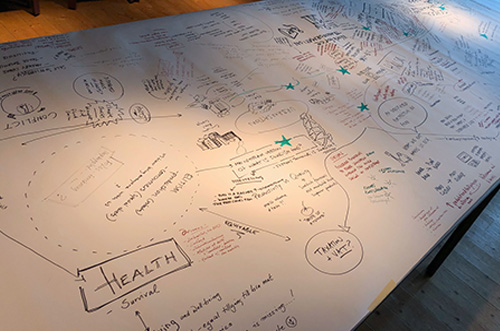
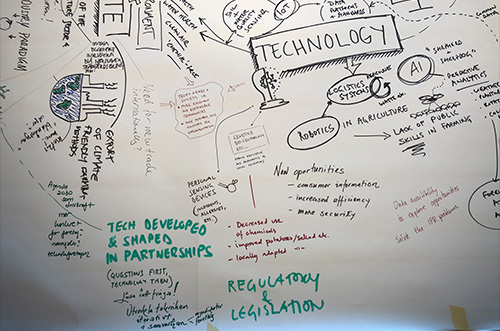
Picture 1
The systems maps created through a participatory process facilitated by Vinnova. The maps provide a macro view of the challenges and opportunities within Swedish food systems, while also highlighting important nuances that characterise the system. Pictures used with permission from the Swedish innovation agency, Vinnova
1.3.2 Nordic entry points
| SOURCE OF ENTRY POINTS | GEOGRAPHICAL REGION | WHO WAS INVOLVED? WHAT WAS THE FOCUS? | RESULTING ENTRY POINTS AND INSIGHTS |
| Participatory process to prototype a mission-oriented innovation process in Sweden led by Vinnova’s food team71 | Sweden | Front-line actors from the public, private and civic sectors were asked to develop and refine different entry points and missions for transforming Swedish food systems. | Entry points for change in Swedish food systems: 1. School food 2. New food 3. Healthy resilient farming 4. Traceable trusted produce 5. Modern Swedish food culture 6. Circular zero-waste system 7. Peri-urban and urban farming |
| Nordic food system transformation dialogues led by the Stockholm Resilience Centre on behalf of the Nordic Council of Ministers72 | Nordic | Across the Nordics, 115 food system actors participated in dialogue to explore different food scenarios, resulting in eight opportunities for Nordic collaboration on food system challenges. These opportunities are entry points for solving grand challenges. Actors represented the public and private sectors, civil society, research, producer organisations, consumers, youth and funders. | Eight opportunities for Nordic collaboration on food: 1. Define sustainable Nordic diet 2. Expedite a social movement for sustainable food 3. Assess the trade-offs and benefits of different production systems 4. Boost the food and agricultural workforce 5. Ensure thriving countryside and urban-rural connections 6. Build an equitable and just transformation 7. Address the outsourced impact of food systems 8. Rethink a competitive export market |
| Food Dugnad (Matdugnaden), co-led by the Norwegian Institute of Public Health and EAT73 | Norway | Over 100 stakeholders from more than 70 different organisations across Norway were consulted in 35 interviews and 4 workshops, yielding several entry points and solutions and the first comprehensive gigamap of a national food system. | Entry points for change in Norwegian food systems: 1. Co-create sustainable food products, production and services 2. Use public institutions as drivers of radical innovation 3. Make sustainable food the default option 4. Highlight short- and long-term benefits of sustainable food 5. Focus on food for children and youth 6. Promote healthy competition in retail 7. Make it easy to do the right thing 8. Optimise the use of agricultural land 9. Influence demand through public meals |
| Deep Demonstration, co-led by EAT and the Nordic Food Policy Lab | Norway, Nordic | Dialogue with the leadership of national agricultural co-ops and unions and with national civic organisations yielded a set of common principles for defining what “sustainability” means in the context of the Norwegian food system. These dialogues were complemented by multiple interviews and workshops at the local (Oslo) to regional (Nordic Council of Ministers) levels. | Four principles of sustainable food systems in Norway: 1. National dietary guidelines define healthy food 2. Every country has a responsibility to optimise areas for food production 3. A sustainable food system takes multiple considerations into account without sacrificing one at the expense of another 4. Farmers, fisherfolk and chefs must be rewarded for the full societal benefits they provide |
| Review of the scientific evidence on food systems and sustainability in the Nordics, led by the authors of this cookbook | Denmark, Finland, Iceland, Norway and Sweden | A brief overview of the research was conducted to better understand how global challenges were linked to Nordic food systems. This is a small-scale research approach for identifying entry points that could be greatly expanded upon with more resources and researchers. | See Table 1 in Act I for a taste of this analysis. |
Note: [1]Vinnova, forthcoming. Designing Missions Playbook. https://www.vinnova.se/en/m/missions/ [2]Wood A., et al., 2020. Insight paper #2 of the Nordic food system transformation series: Eight opportunities for Nordic collaboration on food system challenges. Stockholm Resilience Centre: Stockholm. [3]
Footnotes
- ^ Vinnova, forthcoming. Designing Missions Playbook. https://www.vinnova.se/en/m/missions/
- ^ Wood A., et al., 2020. Insight paper #2 of the Nordic food system transformation series: Eight opportunities for Nordic collaboration on food system challenges. Stockholm Resilience Centre: Stockholm.
- ^ Matdugnad, 2020. http://matdugnaden.no/
Looking at the scientific evidence and practitioner knowledge laid out in Table 2,
Food environments are the physical, digital and social environments where we make decisions about food.[1]Swinburn, B., et al., 2013. Monitoring and benchmarking government policies and actions to improve the healthiness of food environments: a proposed Government Healthy Food Environment Policy Index. Obesity Reviews, 14, pp. 24-37.,[2]Downs, S.M., et al., 2020. Food environment typology: Advancing an expanded definition, framework, and methodological approach for improved characterization of wild, cultivated, and built food environments toward sustainable diets. Foods, 9(4), p. 532. These environments are peppered with policy, economic and sociocultural signals that influence us to choose certain foods. Examples of these signals include advertising and price promotions in a (physical or online) grocery store and the Nordic norms around foraging for food. Food environments are a powerful lever for change because they influence what we eat, and we know that current diets are a major driver behind several grand challenges.
Circularity means reducing waste in the food system. Reducing food waste is a big part of circularity, but utilising “by-products” that would otherwise get thrown away when food is produced or processed and nutrient recycling (of our own human waste and animal waste, for example) are also key to circularity.[3]Jurgilevich, A., et al., 2016. Transition towards circular economy in the food system. Sustainability, 8(1), p. 69.
Food culture is a rich stew of preferences, norms and practices that influence how we produce, consume and waste food. Creating a food culture that celebrates sustainable, modern Nordic food can be key to unlocking changes in different parts of the supply chain that support short- and long-term benefits to people, our planet and our society.
The science is clear that we must change our diet for many sustainability reasons. Changing the meals on our plates is a very tangible entry point – we all eat! Yet shifting to sustainable meals can seem daunting since there are so many parts of the food system between farm and fork that impact the meals we choose. We can start exploring this entry point by mapping the different places where we consume meals – at home, in school, in restaurants, even on the go! – and then identifying who has the power to influence what meals are served in those settings.
Traceability in supply chains generally focuses on ensuring food safety rather than sustainability. There are, of course, exceptions, as illustrated by certification schemes that ensure ethically produced or fairly traded food products.[4]Marine Stewardship Council. What does the blue MSC label mean? https://www.msc.org/what-we-are-doing/our-approach/what-does-the-blue-msc-label-mean; https://rspo.org/certification Improved transparency and traceability in supply chains would make it easier for us to see exactly where our outsourced impact is in terms of natural resource use and who in the supply chain has the power to reduce this impact.
There are particular opportunities with regard to new, or indeed old, locations for food production, and new technologies can enable more sustainable production methods. However, defining “sustainable production” isn’t easy, and actions to explore this entry point need to balance the different dimensions of social, environmental, and economic sustainability and consider the trade-offs across these dimensions. For example, land use optimised for a producer might not be optimal for the environment.
Food producers are the stewards of our lands and seas and thus they have great promise as an entry point for tackling several grand challenges. Yet there is a need for support to equip these producers with the tools to seize the opportunities offered by a Nordic food systems transformation. Food production livelihoods need to be attractive, sustainable and respected.
Cities are home to most of the world’s population, including the Nordic population. This means that municipal governments and urban places are uniquely positioned to transform the fight against non-communicable diseases such as obesity and diabetes. Although cities occupy only 2% of the world’s total land, they are significant entry points because they account for over 80% of the global economy (in gross domestic product), 70% of greenhouse gas emissions, and 70% of global waste.[5]World Bank, 2020. Urban Development. https://www.worldbank.org/en/topic/urbandevelopment
1.3.3 Prioritising food system entry points
Footnotes
- ^ Swinburn, B., et al., 2013. Monitoring and benchmarking government policies and actions to improve the healthiness of food environments: a proposed Government Healthy Food Environment Policy Index. Obesity Reviews, 14, pp. 24-37.
- ^ Downs, S.M., et al., 2020. Food environment typology: Advancing an expanded definition, framework, and methodological approach for improved characterization of wild, cultivated, and built food environments toward sustainable diets. Foods, 9(4), p. 532.
- ^ Jurgilevich, A., et al., 2016. Transition towards circular economy in the food system. Sustainability, 8(1), p. 69.
- ^ Marine Stewardship Council. What does the blue MSC label mean? https://www.msc.org/what-we-are-doing/our-approach/what-does-the-blue-msc-label-mean; https://rspo.org/certification
- ^ World Bank, 2020. Urban Development. https://www.worldbank.org/en/topic/urbandevelopment
- ^ Our World in Data. Food production is responsible for one-quarter of the world’s greenhouse gas emissions. https://ourworldindata.org/food-ghg-emissions
"We must remember that fixing our food systems isn’t a silver bullet – it’s a necessary, but in itself insufficient, area of action."
Footnotes
- ^ Vinnova, forthcoming. Designing Missions Playbook. https://www.vinnova.se/en/m/missions/
Examples of emerging activity within Nordic society that could be directed towards future strategic Nordic priorities and ambitions, locally and globally An issue or topic that generates momentum, attracts attention, and leads to transformative societal outcomes A “coalition of the willing” or, in other words, of those who are also interested in this pull Scalable activities that have the potential to enable systemic change and which may require a “push” in the form of infrastructural support or policy or regulatory refinement Activities that will connect with society, broadly speaking, as well as with private, public and civil society and with the political process, in order to build new consensus
1.4 From entry points to missions
ACT II – We’re on a mission
2.1 Missions to tackle societal challenges
But the idea of a mission is changing, in part because the challenges we face have evolved.
Footnotes
- ^ Mazzucato, M., 2017. Mission-oriented innovation policy: Challenges and opportunities. UCL Institute for Innovation and Public Purpose Working Paper.
- ^ Wanzenböck, I., et al., 2019. A framework for mission-oriented innovation policy: Alternative pathways through the problem-solution space.
- ^ Koch, Per & Hauknes, Johan On innovation in the public sector – today and beyond (Second revised edition, 2005), Publin Report No. D20. Accessed here: http://www.aviana.com/step/publin/reports/d20-innovation.pdf
- ^ Wanzenböck, I., et al., 2019. A framework for mission-oriented innovation policy: Alternative pathways through the problem-solution space.
- ^ Mazzucato, M., 2018. Mission-oriented research and innovation in the European Union. https://ec.europa.eu/info/sites/info/files/mazzucato_report_2018.pdf
- ^ Vinnova, forthcoming. Designing Missions Playbook. https://www.vinnova.se/en/m/missions/
- ^ EIT Climate-KIC, 2019. Deep Demonstration Design Process – Process Guide.
"Missions are not about addressing low-hanging fruit, which requires technical solutions and single solutions. Missions aim to bring about change across a system in a way that benefits society by addressing the complex, systemic and urgent problems that affect our lives."
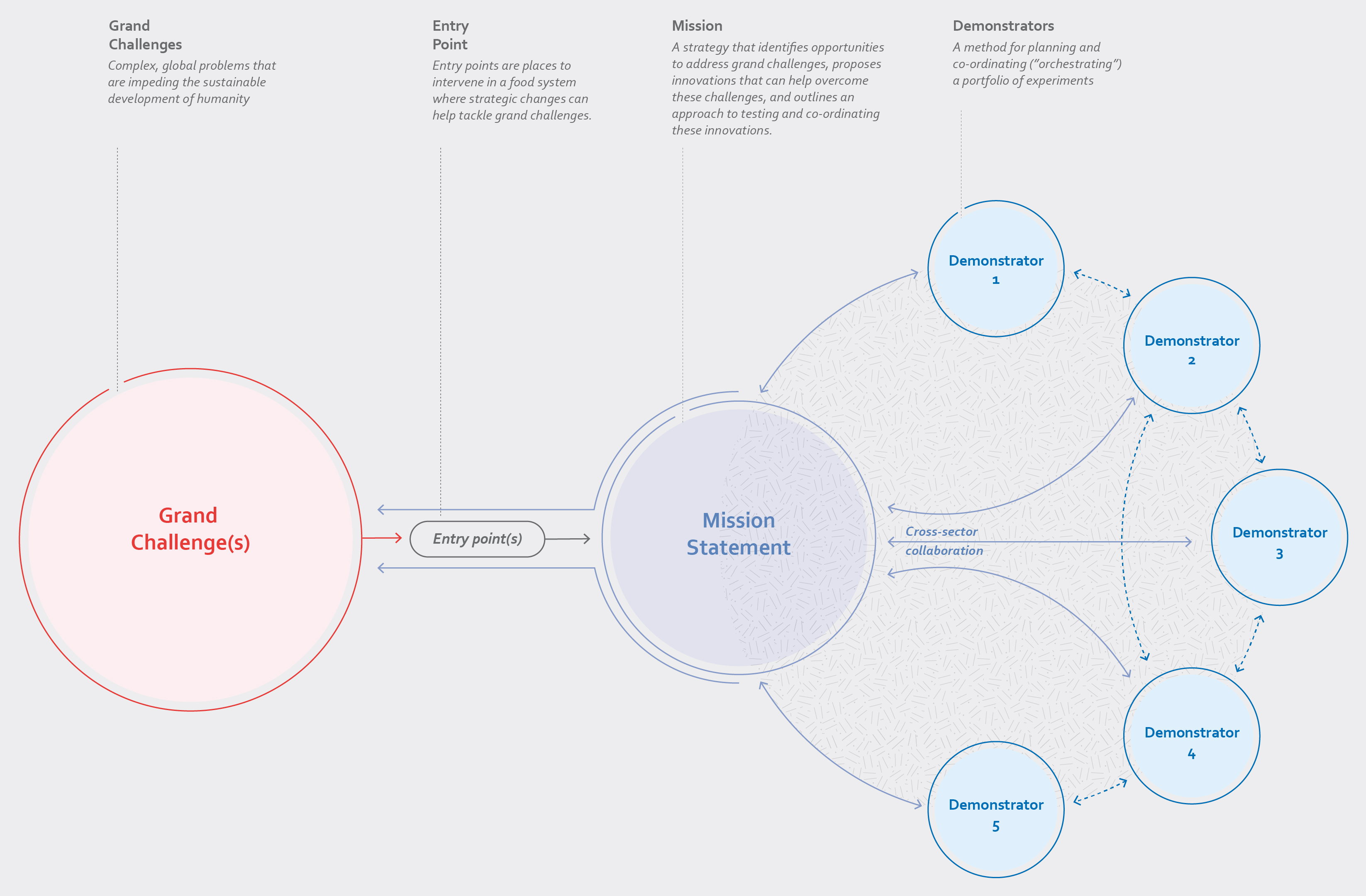
You may have seen other figures representing a ‘mission approach’. For example, the European Commission has adopted a figure designed by Mariana Mazzucato[1]Mazzucato, M., 2018. Mission-oriented research and innovation in the European Union. https://ec.europa.eu/info/sites/info/files/mazzucato_report_2018.pdf, and the Swedish innovation agency Vinnova has also developed a figure to represent their mission-based approach.[2]Vinnova, forthcoming. Designing Missions Playbook. https://www.vinnova.se/en/m/missions/ While all of these figures may look visually different, they are all based on the same underlying principle: a mission is a way to build alignment around grand challenges and connect these challenges to concrete experiments. The differences in the figures reflect the flexibility of the approach. In other words, there is no one-size-fits-all mission process.
2.1.1 Five criteria for selecting missions
Footnotes
- ^ Mazzucato, M., 2018. Mission-oriented research and innovation in the European Union. https://ec.europa.eu/info/sites/info/files/mazzucato_report_2018.pdf
- ^ Vinnova, forthcoming. Designing Missions Playbook. https://www.vinnova.se/en/m/missions/
- ^ Mazzucato, M., 2018. Mission-oriented research and innovation in the European Union. https://ec.europa.eu/info/sites/info/files/mazzucato_report_2018.pdf
- ^ Klerkx, L. and Begemann, S., 2020. Supporting food systems transformation: The what, why, who, where and how of mission-oriented agricultural innovation systems. Agricultural Systems, 184, p. 102901.
- ^ Janssen, M., et al., 2020. Position paper: ‘Mission-oriented innovation policy observatory’. https://www.uu.nl/en/research/copernicus-institute-of-sustainable-development/mission-oriented-innovation-policy-observatory
- ^ Wanzenböck, I., et al., 2019. A framework for mission-oriented innovation policy: Alternative pathways through the problem-solution space.
- ^ Wanzenböck, et al., 2020. A framework for mission-oriented innovation policy: Alternative pathways through the problem–solution space.
- ^ Vinnova, forthcoming. Designing Missions Playbook. https://www.vinnova.se/en/m/missions/
- ^ Vinnova, forthcoming. Designing Missions Playbook. https://www.vinnova.se/en/m/missions/
- ^ Borrás, S., and Edler, J., 2020. The roles of the state in the governance of socio-technical systems’ transformation. Research Policy, 49(5), p. 103971.
- ^ Musiolik, J., et al., 2012. Networks and network resources in technological innovation systems: Towards a conceptual framework for system building. Technological Forecasting and Social Change, 79(6), pp. 1032-1048.
- ^ Borrás, S., and Edler, J., 2020. The roles of the state in the governance of socio-technical systems’ transformation. Research Policy, 49(5), p.103971.
- ^ Wanzenböck, et al., 2020. A framework for mission-oriented innovation policy: Alternative pathways through the problem–solution space.
- ^ Mazzucato, M., 2018. Mission-oriented research and innovation in the European Union. https://ec.europa.eu/info/sites/info/files/mazzucato_report_2018.pdf
- ^ Klerkx, L., and Begemann, S., 2020. Supporting food systems transformation: The what, why, who, where and how of mission-oriented agricultural innovation systems. Agricultural Systems, 184, p. 102901.
- ^ Mazzucato, M., 2016. From market fixing to market-creating: a new framework for innovation policy. Industry and Innovation, 23(2), pp. 140-156.
- ^ Mazzucato, M., 2018. Mission-oriented research and innovation in the European Union. https://ec.europa.eu/info/sites/info/files/mazzucato_report_2018.pdf
- ^ Wanzenböck, I., et al., 2019. A framework for mission-oriented innovation policy: Alternative pathways through the problem-solution space.
"Challenges come in all shapes and sizes, and every approach needs to be tailored to the problem at hand."
Individuals will need to be equipped with a range of new capacities and skills to face our grand challenges. Systems thinking is just one important muscle that we need to exe
Footnotes
- ^ Hawkes, C., 2020. Five steps towards a global reset: lessons from COVID-19. Global Sustainability, 3.
2.1.2 Sounds great! Give me the recipe for a Nordic mission!
- To have a clear goal, you need to know which grand challenge(s) you want to address. Still deciding which challenge you want to focus on? Flip to Section 1.1 to see a few grand challenges that affect our societies and our planet.
- To find our starting points for tackling a challenge, entry points need to be identified. Go to section 1.3.2 to see which entry points are key in the Nordic context.
- To provide clear direction for action, a mission needs to be defined. Below, we outline two potential Nordic food system missions that exploit two different entry points for action.
- To learn more about developing a demonstrator and the different experiments that aim to accomplish a mission, skip ahead to Act III.
Footnotes
- ^ Mazzucato, M., 2018. Mission-oriented research and innovation in the European Union. https://ec.europa.eu/info/sites/info/files/mazzucato_report_2018.pdf
- ^ Janssen, M., et al., 2020. Position paper: ‘Mission-oriented innovation policy observatory’. https://www.uu.nl/en/research/copernicus-institute-of-sustainable-development/mission-oriented-innovation-policy-observatory
2.2 How do we design food system missions to help tackle our grand challenges?
Footnotes
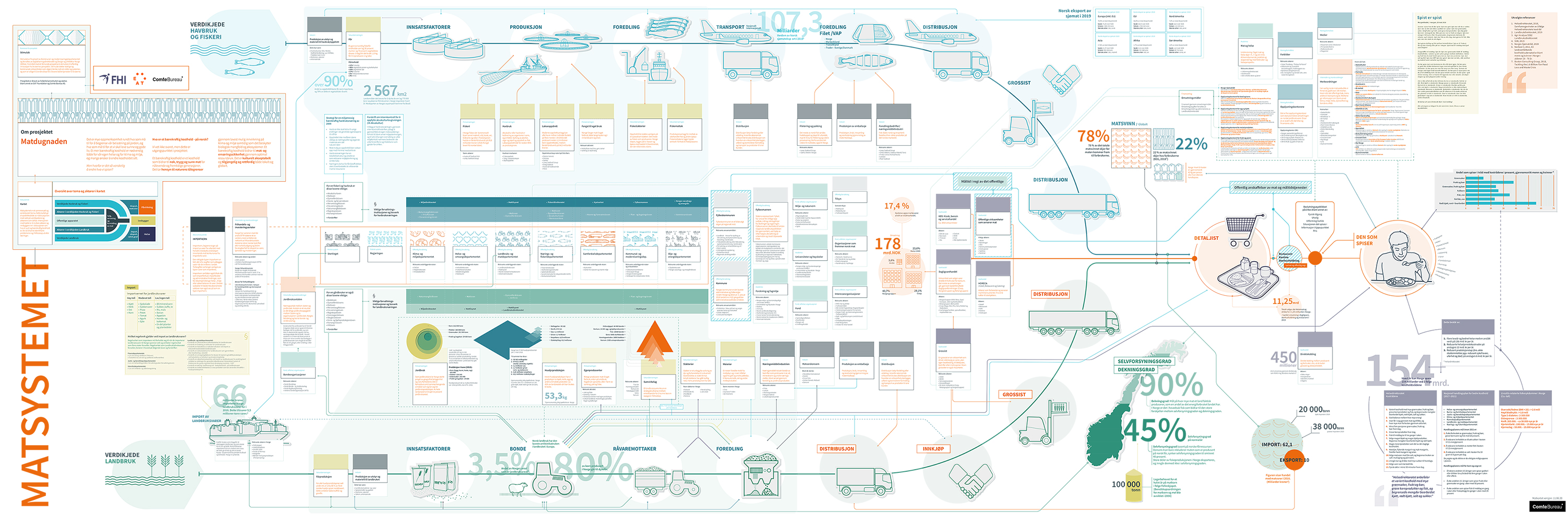
- ^ Gigamapping is super extensive mapping across many sections, layers and scales with the goal of investigating relations between seemingly separate things, categories, and silos. Gigamapping is part of the Systems Oriented Design (SOD) framework.
- ^ The map was developed by Comte Bureau, in a Stimulab-funded project co-led by the Norwegian Institute of Public Health and EAT.
Footnotes
- ^ FAO, 2017. The future of food and agriculture: Trends and challenges. Rome: FAO. http://www.fao.org/3/a-i6583e.pdf
- ^ Clapp, J. 2020. Food, 3rd edition. Wiley
Panel 1. Drivers of unsustainable food systems
Here, we provide an overview of a few global drivers that have moulded food systems around the world.[1]Béné, C., et al., 2020. Global drivers of food system (un) sustainability: A multi-country correlation analysis. PloS one, 15(4), p.e0231071. This is just a taste – a comprehensive list would be far too long to discuss here!
Footnotes
- ^ Béné, C., et al., 2020. Global drivers of food system (un) sustainability: A multi-country correlation analysis. PloS one, 15(4), p.e0231071.
| Changing demographics | Climate change | |
| Populations are changing! Generally speaking, they’re growing bigger, getting older (in the Nordics, across Europe and in several other regions), and increasingly living in urban areas. 113, 114 What does this matter in the context of food? In short, it means that, first, there are more mouths to feed than ever before. The past provides successful examples of dramatic production increases being secured. The Green Revolution in the 1950s and 1960s succeeded in producing more food at lower prices. Yet, the productionist paradigm of the time – which valued quantity over quality – came at a high cost to the environment as soils were degraded, synthetic fertilisers were over-applied and water resources were depleted. At the same time, more people got enough calories in their diet, but many lacked the nutritional quality to live healthy lives.115 As cities grew, more people could earn higher urban incomes and adopt fast-paced lives. This in turn fed demand for ready-made and fast food.116 The food retail boom was partly a response to calls for cheap and convenient food. For some, modern retail made a diverse diet more available and accessible. For other, marginalised, populations, a high-quality diet became more difficult to come by. Modern food retail also encourages consumers to eat more food, food that is oftentimes more energy-dense, nutrient-poor and highly processed.117 Coupled with many other factors such as marketing and advertising and the low prices of many unhealthy foods, this has left us with a legacy of diet-related chronic disease. | Climate change is a two-way street. Food production drives and is driven by climate change. We have already seen severe weather events destroy food crops, such as the fires in Sweden 2018. Rising temperatures can make it more difficult to grow certain foods and thus reduce crop yields.118 For example, hotter weather can dry out soils, climate change can change rainfall patterns and new pests and insects can proliferate at warmer temperatures. According to one prediction, for every degree Celsius rise in temperature there may be a 5%-15% drop in crop yields.119 While climate change is also predicted to have positive effects on production in some regions,120 the net impact will be negative. Ocean acidification is expected to change the composition of species in many waterways, including the Baltic Sea. Under such altered conditions in the Baltic, economically significant fish species such as herring and cod will suffer, while jellyfish and certain species of algae will thrive.121 Unfortunately, we don’t think that we have felt the full impact of the changing climate, since the earth has been able to “buffer” much of the impact of climate change. | |
| Technological innovation, intensification and homogenisation of food production | The concentration of power in supply chains | |
| The application of innovation is neither neutral nor equal. Innovation in the agricultural sector and intensification of food production were key factors in the productionist era that led to huge increases in food production, freeing many from hunger. Yet there were several unforeseen consequences of intensification, one of which was its negative environmental impact. For example, as technologies increased crop yields, farmers in some world regions started using even more land resources for production.122 In addition, producers invested in machinery and other production systems to compete in a specific market. This investment locked these farmers into that specific equipment, leaving them poorly placed to shift production.123, 124 In other words, it’s not as simple as a producer having the will to change production and then making the shift. They need help to overcome the economic and structural barriers of shifting their production. Historically, research and development and public policies (including subsidies) were used to support the production of only a handful of staple crops. Wheat, maize and rice have received by far the most attention.125 This meant, first, that these staple crops became plentiful and relatively inexpensive, while crops that did not benefit from such support, such as fruit, vegetables and beans, faced relative price increases.126 Some highly nutritious traditional crops were abandoned in favour of the more economically valuable staple crops.127 | Power dynamics play out at all levels of the food system. In our current food systems, companies have merged and consolidated to the point that just a few companies have control over huge portions of the market share. When these companies fail to put sustainability at the top of their agenda – and that includes the sustainability of the planet, of its suppliers and of healthy populations – it can cause damage. As the International Panel of Experts on Sustainable Food Systems concluded, “Dominant agri-food firms have become too big to feed humanity sustainably, too big to operate on equitable terms with other food system actors, and too big to drive the types of innovation we need.”128 | |
Notes: [1]Béné, C., et al., 2020. Global drivers of food system (un) sustainability: A multi-country correlation analysis. PloS one, 15(4), p.e0231071. [2]FAO, 2017. The future of food and agriculture: Trends and challenges. Rome: FAO. http://www.fao.org/3/a-i6583e.pdf [3]Béné, C., et al., 2020. Global drivers of food system (un) sustainability: A multi-country correlation analysis. PloS one, 15(4), p.e0231071. [4]Pingali, P. L., 2012. Green revolution: impacts, limits, and the path ahead. Proceedings of the National Academy of Sciences, 109(31), pp. 12302-12308. [5]FAO, 2017. The future of food and agriculture: Trends and challenges. Rome: FAO. http://www.fao.org/3/a-i6583e.pdf. [6]Hawkes, C., 2008. Dietary implications of supermarket development: a global perspective. Development Policy Review, 26(6), pp. 657-692. [7]Zhao, C., et al., 2017. Temperature increase reduces global yields of major crops in four independent estimates. Proceedings of the National Academy of Sciences, 114(35), pp. 9326-9331. [8]National Research Council, et al. 2011. Climate Stabilization Targets: Emissions, Concentrations, and Impacts over Decades to Millennia. National Academies Press: Washington, DC. [9]Wiréhn, L., 2018. Nordic agriculture under climate change: A systematic review of challenges, opportunities and adaptation strategies for crop production. Land Use Policy, 77, pp. 63-74. [10]Baltic Sea Centre, 2020. Emerging ocean acidification threatens Baltic sea ecosystems. https://balticeye.org/en/policy-briefs/emerging-ocean-acidification-threatens-baltic-sea-ecosystems/ [11]Pellegrini, P., and Fernández, R. J., 2018. Crop intensification, land use, and on-farm energy-use efficiency during the worldwide spread of the green revolution. Proceedings of the National Academy of Sciences, 115(10), pp. 2335-2340. [12]Frison, E. Path Dependence and Carbon Lock-In in the Agriculture Sector. https://files.wri.org/expert-perspective-frison.pdf [13]Chhetri, N. B., Easterling, W. E., Terando, A., and Mearns, L., 2010. Modeling path dependence in agricultural adaptation to climate variability and change. Annals of the Association of American Geographers, 100(4), pp. 894-907. [14]Pingali, P., 2015. Agricultural policy and nutrition outcomes – getting beyond the preoccupation with staple grains. Food Security, 7(3), pp. 583-591. [15]Gómez, M. I., et al., 2013. Post-green revolution food systems and the triple burden of malnutrition. Food Policy, 42, pp. 129-138. [16]Pingali, P., 2015. Agricultural policy and nutrition outcomes – getting beyond the preoccupation with staple grains. Food Security, 7(3), pp. 583-591. [17]Mooney, P., 2017. Too big to feed: exploring the impacts of mega-mergers, consolidation and concentration of power in the agri-food sector. http://www.ipes-food.org/_img/upload/files/Concentration_FullReport.pdf
Footnotes
- ^ Béné, C., et al., 2020. Global drivers of food system (un) sustainability: A multi-country correlation analysis. PloS one, 15(4), p.e0231071.
- ^ FAO, 2017. The future of food and agriculture: Trends and challenges. Rome: FAO. http://www.fao.org/3/a-i6583e.pdf
- ^ Béné, C., et al., 2020. Global drivers of food system (un) sustainability: A multi-country correlation analysis. PloS one, 15(4), p.e0231071.
- ^ Pingali, P. L., 2012. Green revolution: impacts, limits, and the path ahead. Proceedings of the National Academy of Sciences, 109(31), pp. 12302-12308.
- ^ FAO, 2017. The future of food and agriculture: Trends and challenges. Rome: FAO. http://www.fao.org/3/a-i6583e.pdf.
- ^ Hawkes, C., 2008. Dietary implications of supermarket development: a global perspective. Development Policy Review, 26(6), pp. 657-692.
- ^ Zhao, C., et al., 2017. Temperature increase reduces global yields of major crops in four independent estimates. Proceedings of the National Academy of Sciences, 114(35), pp. 9326-9331.
- ^ National Research Council, et al. 2011. Climate Stabilization Targets: Emissions, Concentrations, and Impacts over Decades to Millennia. National Academies Press: Washington, DC.
- ^ Wiréhn, L., 2018. Nordic agriculture under climate change: A systematic review of challenges, opportunities and adaptation strategies for crop production. Land Use Policy, 77, pp. 63-74.
- ^ Baltic Sea Centre, 2020. Emerging ocean acidification threatens Baltic sea ecosystems. https://balticeye.org/en/policy-briefs/emerging-ocean-acidification-threatens-baltic-sea-ecosystems/
- ^ Pellegrini, P., and Fernández, R. J., 2018. Crop intensification, land use, and on-farm energy-use efficiency during the worldwide spread of the green revolution. Proceedings of the National Academy of Sciences, 115(10), pp. 2335-2340.
- ^ Frison, E. Path Dependence and Carbon Lock-In in the Agriculture Sector. https://files.wri.org/expert-perspective-frison.pdf
- ^ Chhetri, N. B., Easterling, W. E., Terando, A., and Mearns, L., 2010. Modeling path dependence in agricultural adaptation to climate variability and change. Annals of the Association of American Geographers, 100(4), pp. 894-907.
- ^ Pingali, P., 2015. Agricultural policy and nutrition outcomes – getting beyond the preoccupation with staple grains. Food Security, 7(3), pp. 583-591.
- ^ Gómez, M. I., et al., 2013. Post-green revolution food systems and the triple burden of malnutrition. Food Policy, 42, pp. 129-138.
- ^ Pingali, P., 2015. Agricultural policy and nutrition outcomes – getting beyond the preoccupation with staple grains. Food Security, 7(3), pp. 583-591.
- ^ Mooney, P., 2017. Too big to feed: exploring the impacts of mega-mergers, consolidation and concentration of power in the agri-food sector. http://www.ipes-food.org/_img/upload/files/Concentration_FullReport.pdf
2.3 Defining Nordic food system missions
Box 6. Recap of the defining characteristics of a mission
The mission is bold, inspirational and tackles a challenge of great societal relevance. The mission is ambitious yet can be broken down into concrete actions with targets that are clear, measurable and time-bound. The mission uses innovation and innovation policy to set ambitious but realistic goals. The approach draws on cross-disciplinary, cross-sectoral and multi-actor innovation, investments and engagement. A portfolio of projects is needed to complete the mission, with each project reinforcing the other.
- They represent different entry points, illustrating that there are many angles that we can (and must!) take to tackle a grand challenge.
- They demonstrate the level of ambition needed. As you’ll see below, neither mission is going to be a walk in the park!
- They match trends seen across the Nordics in terms of which entry points might be significant levers of change. For example, public meals have been seen as a strong lever for change both in research analysis[1]Röös, E., et al., 2020. Styrmedel för hållbar matkonsumtion – en kunskapsöversikt och vägar framåt. Sveriges lantbruksuniversitet, forskningsplattformen SLU Future Food. https://www.slu.se/globalassets/ew/org/centrb/fu-food/nyheter/2020/slu-futurefood_rapport13_styrmedelforhallbarmatkonsumtion.pdf and in practice in the Nordics. In Sweden, Vinnova and Livsmedelsverket started to build a mission aiming for sustainable school meals after consultation with stakeholders and in-depth research identified this as an important mission.[2]Vinnova, forthcoming. Designing Missions Playbook. https://www.vinnova.se/en/m/missions/
2.3.1 Mission 1 – Ensure that, by 2025, all public meals consumed in the Nordics are sustainable and tasty
Footnotes
- ^ Röös, E., et al., 2020. Styrmedel för hållbar matkonsumtion – en kunskapsöversikt och vägar framåt. Sveriges lantbruksuniversitet, forskningsplattformen SLU Future Food. https://www.slu.se/globalassets/ew/org/centrb/fu-food/nyheter/2020/slu-futurefood_rapport13_styrmedelforhallbarmatkonsumtion.pdf
- ^ Vinnova, forthcoming. Designing Missions Playbook. https://www.vinnova.se/en/m/missions/
- ^ Halloran, A., et al., 2018. Solutions Menu – A Nordic guide to sustainable food policy. Denmark: Nordic Council of Ministers. https://norden.diva-portal.org/smash/get/diva2:1214792/FULLTEXT01.pdf
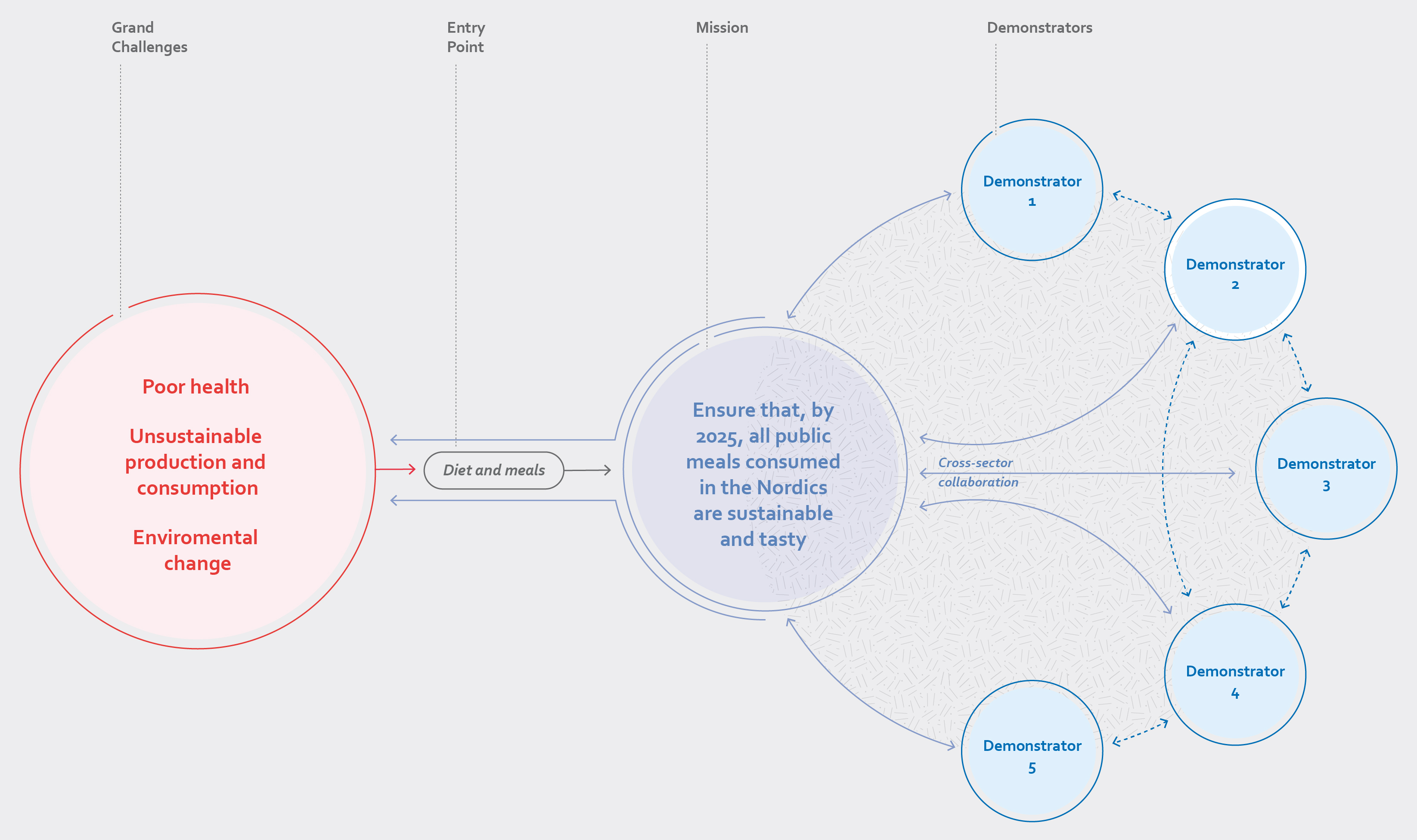
Below we illustrate how the five defining criteria of missions were used to develop a mission on sustainable and tasty public meals.
Bold, inspirational action to tackle grand challenges – A mission on sustainable and tasty public meals will demonstrate a bold commitment to food system transformation. Although it will represent only a small proportion of total meals in the Nordic region, this mission can inspire others by showing them that it is possible to redesign the value chain and our policies in order to make sustainable, tasty meals a reality. And if this mission is successful, it can signal progress on several grand challenges: the environmental impact of what we eat would be reduced and meals would be made healthier. And the benefits won’t stop there – this mission can promote sustainable food production, support producer livelihoods and ensure that every child has access to a sustainable, tasty school meal, thus improving equality.
Targets that are clear, measurable and time-bound - The target “all public meals should be sustainable and tasty by 2025” is clear and time-bound. But to be measurable, we need to set some criteria for what makes a meal “sustainable” and “tasty”. This will require the engagement of multiple actors. To define “sustainable diet”, for instance, national food authorities, national agricultural boards, researchers and others will need to jointly develop indicators. To ensure that meals are tasty, it will be important to engage with those who consume the meals.
Using innovation to reach ambitious goals – Innovation can play a role in creating tasty new meals or in differentiating the presentation of sustainable and unsustainable meals. Innovation can also be used to write contract procurements so that they favour sustainability. And producers and suppliers will need to innovate to meet new procurement demands.
Cross-sectoral and multi-actor in nature – The public sector cannot achieve this mission on its own. Changes are needed across the value chain to enable the production, processing and supply of sustainable foods. Open data will be crucial for giving everyone access to the data they need to sustainably change their operations and services. Structural changes and programmes for upskilling food service workers will also be needed in public kitchens so that tasty meals can be attractively prepared and presented. Suppliers, producers, food service workers and those in charge of public kitchens are just a few of the stakeholders who will be key to the success of this mission.
Supports a portfolio of more targeted projects – Changing more than 5 million meals a day is no easy feat! No one project could tackle this mission on its own. That’s where demonstrators come in. Again, demonstrators are a method for planning and co-ordinating (“orchestrating”) a portfolio of experiments. Don’t worry – we’ll dig into demonstrators more in Act III. For the purposes of this mission, demonstrators will need to cover a range of public sector institutions such as schools, kindergartens, hospitals, elderly care and government offices. Demonstrators should be tested in a variety of locations, given that not all public meals are centrally controlled. Read on to Act III to see what a portfolio of different demonstrators might look like that collectively helps to achieve the mission.
2.3.2 Mission 2 – By 2030, the sustainable food in all major food retail outlets – including both physical and online stores – should be the easiest and most attractive options for consumers to choose.
Below we illustrate how the five defining characteristics of missions were used to develop a mission on sustainable food choices in food retail outlets:
Bold, inspirational action to tackle urgent grand challenges – It’s clear that a mission to overhaul one of the most frequented food environments of all is a bold move! As previously mentioned, getting one or more of the biggest retailers to change their in-store and online environments can quickly provide inspiration and pull the rest of the sector along in the same direction. If successful, this mission can reduce the environmental impact of what we eat and support better health and wellbeing. This mission can also promote equality by providing accessible, affordable and sustainable food for all.
Targets that are clear, measurable and time-bound – The focus of the mission is clear and time-bound. But several aspects of the mission need to be defined if it is to succeed. For example, what is considered to be a sustainable food choice? How do we judge whether a food environment has achieved the goal of making the most sustainable choice the easiest and most attractive one? Does every item need to be sustainable, or should a threshold be set – such as requiring that 90% of all food items are sustainable – to determine a proportion of sustainable food choices? Should sustainable choices be evaluated within the context of diet as a whole or within a narrow product category? For example, when looking at the whole diet, a piece of meat is likely to be less sustainable than legumes. Within the “meat” product category, however, chicken is typically a more sustainable option than beef – a small proportion of meat can fit into a sustainable diet. The process of defining clear and measurable targets is challenging, but it is crucial to the success of the mission.
Using innovation to reach ambitious goals – Innovation in food retail environments may include selling reformulated products that have reduced salt, sugar or saturated fat content or a reduced environmental impact. It may also mean developing new kinds of packaging to reduce food waste or to find new ways of regulating the price of unhealthy and unsustainable foods. And it will probably involve changing the choice architecture of supermarkets to make tasty and sustainable food the default option.
Cross-sectoral and multi-actor in nature – Retailers cannot change by themselves. Engagement is needed from both supply-side and demand-side actors. For example, producers, processors, distributors and suppliers need to work together to innovate across the value chain. Policy-makers, advertisers within food companies, NGOs, certification bodies and consumer councils can collaborate on innovations to shift demand. Retailers can also collaborate with researchers and policy-makers to share sales data, which is crucial to understanding whether interventions are having an impact on individuals’ food choices. And the general public, which may see some big changes in its local supermarkets, needs to be involved in this journey.
Supports a portfolio of more targeted projects – What works in one food retail environment in southern Finland may not work in another store in Iceland. Retailers in rural and urban settings may take different approaches. And different retailers may try different experiments. Again, multiple demonstrators in different contexts and with different innovation networks are needed to achieve this mission.
Footnotes
- ^ Nordic Cooperation, 2018. Children and young people in the Nordic Region must have better food. https://www.norden.org/en/news/children-and-young-people-nordic-region-must-have-better-food#:~:text=5.5%20million%20public%2Dsector%20meals,more%20than%20just%20an%20expense
- ^ Röös, E., et al., 2020. Styrmedel för hållbar matkonsumtion – en kunskapsöversikt och vägar framåt. Sveriges lantbruksuniversitet, forskningsplattformen SLU Future Food. https://www.slu.se/globalassets/ew/org/centrb/fu-food/nyheter/2020/slu-futurefood_rapport13_styrmedelforhallbarmatkonsumtion.pdf
- ^ C40. The Good Food Cities Declaration. https://www.c40.org/other/good-food-cities
- ^ Downs, S. M., et al., 2020. Food environment typology: Advancing an expanded definition, framework, and methodological approach for improved characterization of wild, cultivated, and built food environments toward sustainable diets. Foods, 9(4), p. 532.
- ^ DLF, Delfi, HUI Research, 2018. Dagligvarukartan 2018.
"Food systems are the result of complex dynamics – many, many things have come together and combined to shape current food systems. Many of these drivers are deeply rooted in history and economics."
2.4 Where next?
The mission is starting to take shape, but it’s still not specific enough for action. To help you understand the next steps in the mission approach, Act III will explore Mission 2 – Sustainable and tasty public meals – in more detail. If you’re ready to tackle the questions in Box 7 and jump in at the deep end, then you can move right on to Act III and learn more about demonstrators – orchestrated, on-the-ground experiments that try to tackle bold ambitions!
| WHAT? Is the focus on all public meals? Or public meals in a certain venue, such as school meals? What does a sustainable meal really mean? What are the criteria for sustainable meals? | WHO? Who is ‘ensuring’ that this is achieved? Who are the individuals, sectors and groups that need to be involved to change school meals? Who will fund this mission? Who will initiate, lead and guide the innovation network working on this mission? | |
| WHEN? How soon can action start? What milestones need to be reached in order to achieve this mission by 2030? | WHERE? What specific locations - i.e. towns, stores, schools - will the mission demonstrators take in? Where are the greatest barriers to achieving this mission, and how can they be turned into leverage points? | HOW? What are the specific parts of the food system that need to change to ensure success of this mission? How can innovation mindsets help solve this challenge? |
ACT III – Demonstrating transformation
3.1 Experimentation is key to achieving a mission
Footnotes
- ^ https://academic.oup.com/spp/article-abstract/38/9/681/1629269?redirectedFrom=PDF
- ^ https://academic.oup.com/spp/article-abstract/38/9/681/1629269?redirectedFrom=PDF
- ^ https://academic.oup.com/spp/article-abstract/38/9/681/1629269?redirectedFrom=PDF
- ^ https://academic.oup.com/spp/article-abstract/38/9/681/1629269?redirectedFrom=PDF
"Taking a portfolio approach to experimentation means selecting a varied set of experiments based on their potential impact and mission alignment as well as their ability to generate new knowledge."
3.2. What are demonstrators?
Footnotes
- ^ EIT Climate-KIC, 2019. Deep Demonstration Design Process – Process Guide.
- ^ Vinnova, forthcoming. Designing Missions Playbook. https://www.vinnova.se/en/m/missions/
| CRITERIA | DESCRIPTION | |
Mission-oriented  | Human beings need inspiration. Demonstrators translate the bold ambition and direction set by a societal mission into concrete, on-the-ground actions to provide proof that inclusive, fast and large-scale change is possible across a system. Demonstrators are connected to national policy labs to better address possible legislative barriers that impede achievement of the mission. | |
Demand-led  | Demonstrators start with a demand-led approach, working with organisations willing to take on responsibility for problems and become “problem owners” – city authorities, regional bodies, community organisations, government and industry leaders that are committed to the overall mission.142 In practice, this means taking care to connect the demonstrator to existing relevant policy processes and strategies so as to ensure relevance and momentum for the problem owner. | |
Place-based  | Taking places as a starting point allows us to view the system through a local lens and understand what makes it unique, such as its culture, policy, law and economy. Starting with a place does not mean that all parts of the system are bound to a specific geographical location, but place does indicate what types of actors, structures and interactions we should be paying attention to within the wider system. A clearly defined place establishes boundaries within the system, allowing us to work with the local level in the foreground while also acknowledging all the other levels in the background. In other words, it is more feasible to work with a demonstrator within clear boundaries than to zoom all the way out and try to understand a complex challenge within a national context. | |
Iterative  | Demonstrators progress in tightly designed, iterative processes. Demonstrators should mix innovation from the top down and the bottom up and combine mature projects with more experimental interventions. While that may sound obvious, it means taking a greater risk by running experiments that are more likely to fail. A good portfolio balances those risks, understanding that “radical failure” can bring new insight that can improve on less risky solutions. When it comes to demonstrators, it’s okay to fail – as long as something is learnt along the way. | |
Holistic  | Demonstrators understand the parts of the system as being intimately interconnected and explicable only by reference to the whole. Experiments are not conducted in isolation from one another; multiple experiments are run in parallel to identify the types of interdependencies and synergies needed for transformation. Each one contributes to the success of the demonstrator. Thus, if one experiment fails (or succeeds), it can easily impact the success or failure of the other experiments within the demonstrator. Understanding why and how that is can provide critical insight into how the mission can be achieved. | |
Grounded in citizen perspective  | To successfully address social complexity, demonstrators are wise to acknowledge the perspectives and desired outcomes of citizens when designing experiments. Citizens should be framed as agents of change, not mere subjects of change, meaning they should be actively engaged in the design and implementation of some of the experiments, as both producers and consumers of certain solutions. | |
Footnotes
- ^ The research was conducted independently by EAT, and does not necessarily reflect the views of the Municipality of Oslo.
3.3 Rewriting the recipe for meals in school
Footnotes
- ^ Matdugnaden [“the Food Dugnad”] was co-led by the Norwegian Institute of Public Health and EAT, with support from Comte Bureau and Deloitte, and funded by Stimulab, a Norwegian public sector innovation mechanism. See http://matdugnaden.no/ for more information (only in Norwegian). The original map has been adapted to fit the visual layout of this cookbook
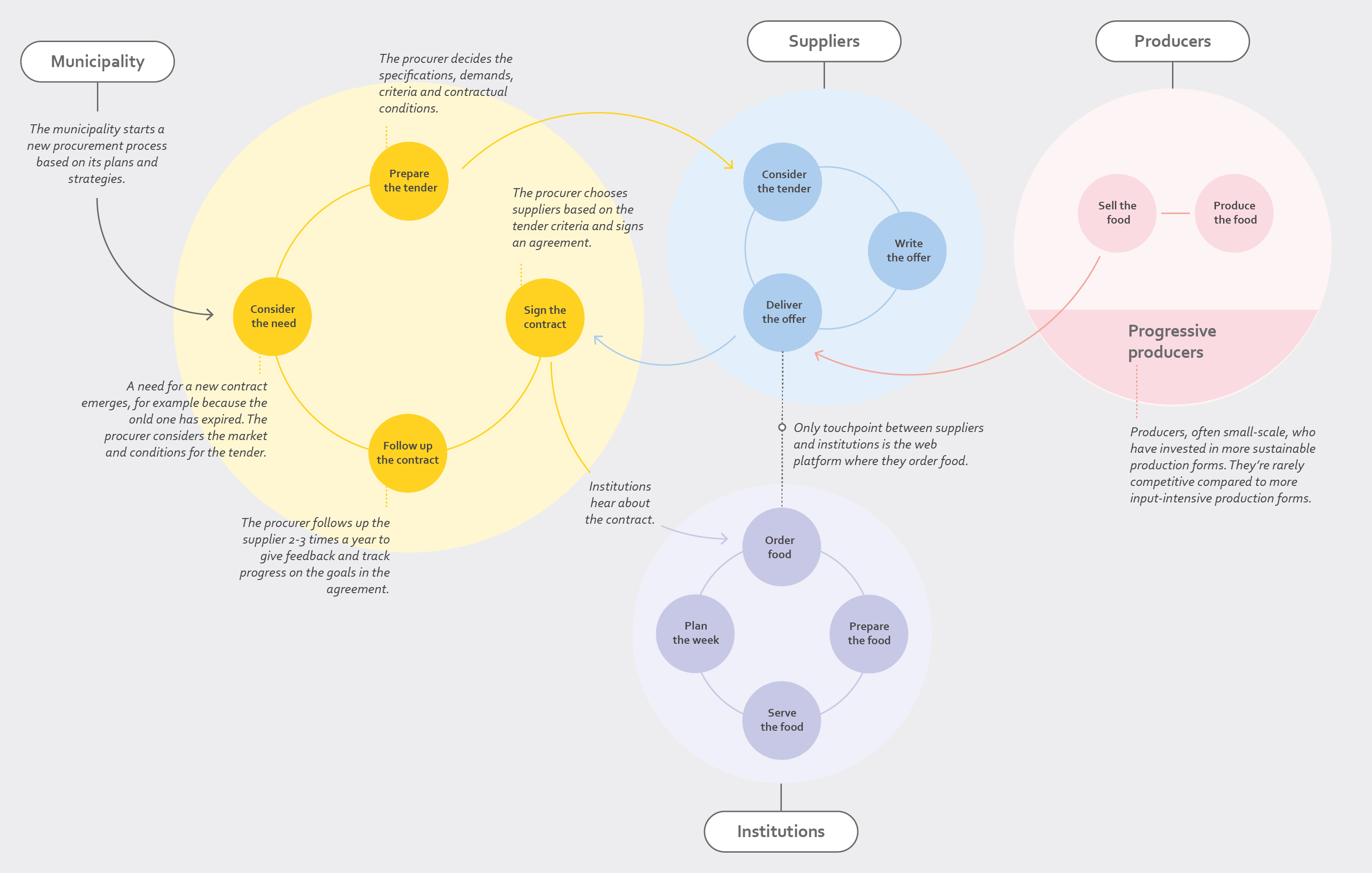
3.3.1 Reframing meals in public institutions
When people within this system talk to each other, two additional issues appear. First of all, decision-making processes are dominated by misconceptions about what you can and cannot do according to procurement law (e.g. rigid dialogue with the market and the preference for a single wholesaler). Second, public organisations lack the tools to define what a sustainable meal means for them.
The sum of these findings helps explain why so little healthy and sustainable food is served in Norwegian public institutions today.
3.3.2 Why Oslo?
- Aligning their food procurement to the Planetary Health Diet, ideally sourced from organic agriculture[2]Here organic is used as a proxy for sustainable production in the absence of more precise indicators.
- Supporting an overall increase in healthy plant-based food consumption in their cities by shifting away from unsustainable, unhealthy diets
- Reducing food loss and waste by 50% compared against a 2015 baseline
- Within two years of endorsing this declaration, working with citizens, businesses, public institutions and other organisations to develop a joint strategy for implementing these measures and achieving these goals inclusively and equitably, and incorporating this strategy into [the signatories] Climate Action Plan[3]C40 Cities. Good Food Cities Declaration. https://www.c40.org/other/good-food-cities
3.3.3 Why meals in school?
Demonstrators aim to inspire large-scale change. We chose to focus on meals in school instead of meals for the elderly for several interconnected reasons:
School food is an underutilized lever for systems change. In most Nordic countries, the current school food system is well-established and well-functioning, but optimized for outcomes such as low cost and food safety. In setting a different strategic direction, the existing system and budget can begin to deliver on wider outcomes such as sustainability, health promotion and local economic resilience. Thus, the new way of working with school food becomes a way to change connected systems such as agriculture, logistics, education and community.There’s a portfolio synergy. Sweden’s innovation agency, Vinnova, and the Swedish food agency, Livsmedelsverket, have jointly identified school meals as a key mission area for that country, based on a similar analysis as our own. Focusing on a similar part of the public meal system but taking very different approaches facilitates a better learning exchange among demonstrators.It’s an unconventional system poised for change. Unlike Sweden, which has a long-standing tradition of serving meals in school, Norway’s packed lunch culture means that most children bring their own food to school and eat it cold. These are not school meals but meals in school.There’s political interest. Oslo has proposed introducing free hot school meals across the city. The costs associated with the Covid-19 pandemic response has put that proposal on hold for now, and one can expect the city to be more focused on finding cost-effective solutions. Reimagining today’s cold meals (packed lunches) could provide a more affordable alternative, with potential spill-over effects to the other Nordic countries, including Sweden.There’s greater impact potential. Changing what is served to the elderly in institutions will have an impact on Oslo’s supply chain, but the spill-over effects are likely to be limited. There is evidence that dietary habits are established in the early years of life, and that adolescence is a key time period when significant changes in dietary patterns occur.[4]Mikkilä, V., et al., 2005. Consistent dietary patterns identified from childhood to adulthood: The Cardiovascular Risk in Young Finns Study. British Journal of Nutrition, 93(6), pp. 923-931.,[5]Micha, R., et al., 2018. Effectiveness of school food environment policies on children’s dietary behaviors: A systematic review and meta-analysis. PloS one, 13(3), p.e0194555. Children are also taught about food and cooking in school, and there is untapped potential in connecting what is taught with what is eaten.There’s potential to shift diets more broadly. There is a link between what children enjoy eating and what parents choose to cook. In general, parents’ eating preferences tend to impact what their children eat. There is limited evidence that the influence also goes the other way and that children’s eating patterns influence what parents eat. What remains largely untested (and is therefore suitable for a demonstrator) are the different ways that meals in school can engage parents, increasing the chance that interventions influence more people. As children’s food preferences evolve, their preferences may have an impact on the dietary pattern of the whole family.[6]Birch, L. L., and Davison, K. K., 2001. Family environmental factors influencing the developing behavioral controls of food intake and childhood overweight. Pediatric Clinics, 48(4), pp. 893-907.A demonstrator for meals in school could provide an inspiring example of how municipalities can support an overall increase in healthy food consumption among its citizens.
3.3.4 Mapping our system
Footnotes
"Experiments must be run in a specific, local and live context to see how different solutions interact with one another and with the system at large."
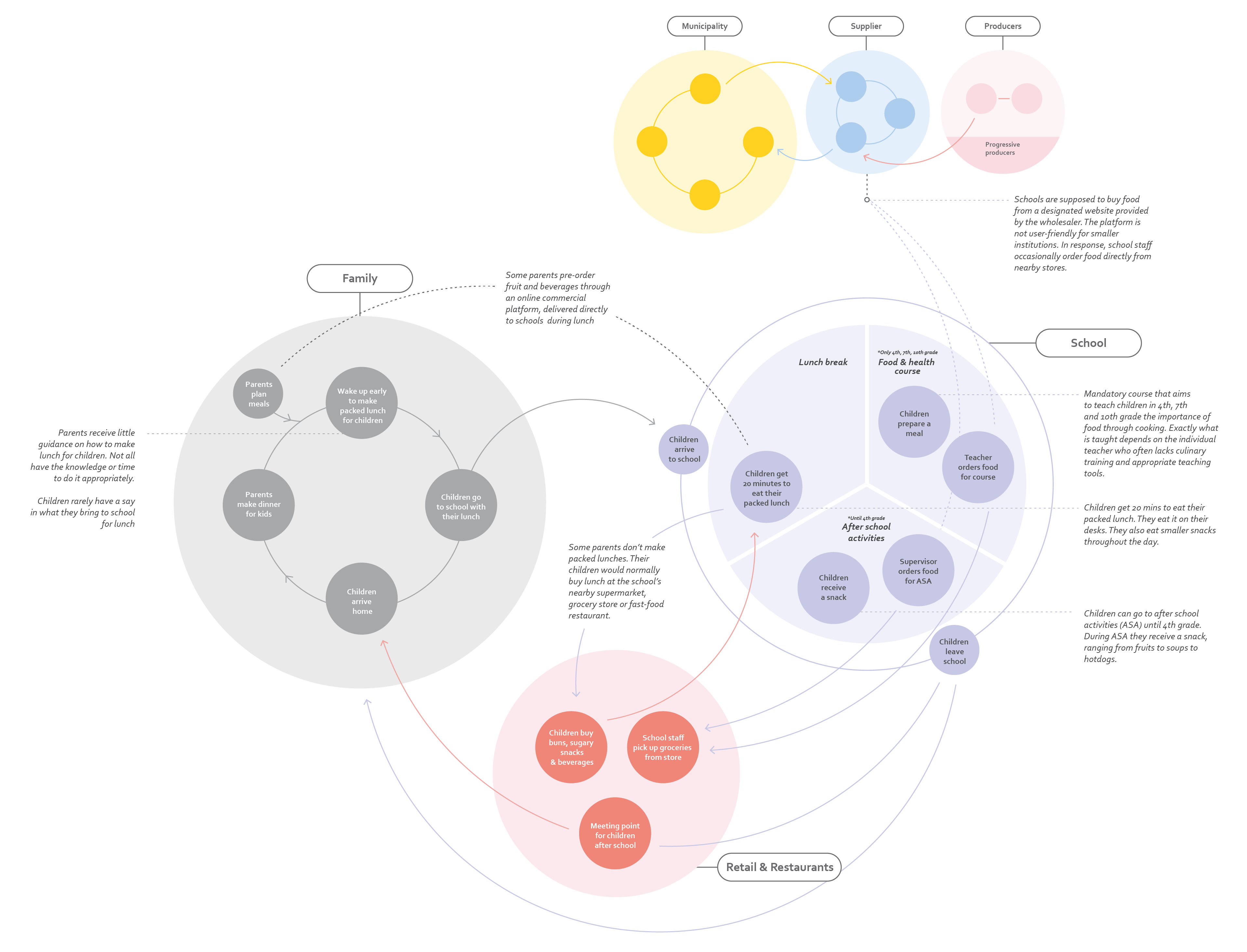
3.3.5 Grounding experiments in citizen perspectives
Footnotes
- ^ Mazzucato, M., 2018. Mission-oriented research and innovation in the European Union. https://ec.europa.eu/info/sites/info/files/mazzucato_report_2018.pdf
| STAKEHOLDERS | INSIGHTS | QUOTE |
| School children | Food is a way to fit in. Children don’t want to stand out because of the food they bring for lunch. | “If I do something too sophisticated, my son will just bring it back home. I think he is embarrassed by eating something different than his classmates.” - Parent of a 10-year-old boy |
| The “packed lunch” does not suit everyone. Children from different cultures have very diverse culinary customs, which cannot always fit into a cold box. | “In Singapore I used to eat warm noodles for lunch every day. I really miss that.” - 11-year-old girl, who, when asked later to draw her matpakke, drew a bowl of hot noodle soup. That was her favourite. | |
| Children use their pocket money to buy sugary snacks and treats from nearby grocery stores. | “For us, school children are important customers. Sales to students comprise up to 10% of our total turnover.” - Manager at Prix | |
| Parents | The school doesn’t understand the value of a good lunch. It’s just another chore. | “The only time the school has talked to me about children’s food has been to ask me to make simpler lunches. Children get 15-20 minutes to eat, and if it’s too complicated, they just won’t eat it.” - Parent of two boys |
| Parents feel extremely responsible for feeding their kids appropriately and think not everyone has the right tools to do it. | “Sometimes my son does not have the energy to go to football practice, and I know it’s because the lunch I made him was not enough. It’s extremely frustrating and I feel a big responsibility.” - Parent of two boys | |
| Parents from a poorer socio-economic background have a bigger challenge making lunch for their children. Not everyone has the resources or the time to make something healthy. | “I try to understand why they bring a cinnamon roll for their lunch… I think it is because some of them are home alone before they come to school, because mom and dad have gone to work, and they pack their own lunch without any control from their parents." “A lot of children, sadly, are overweight and have a poor diet... I think it's very sad, and it's not their fault, because this is the way it is in Norway. The healthy stuff costs more. You can buy soda cheaply, but you have to pay a lot more for the vegetables.” - Food and health teacher from the east side of Oslo | |
| Norway does not seem to be ready for a transition to healthy and sustainable eating. All the efforts by parents are undone by popular food choices. | “I really make an effort to make healthy lunches for my girls, but at school they just fill themselves up with knekkebrød, and during after-school activities they give them hot dogs and ice cream. It’s extremely frustrating for me.” - Mother of two girls. | |
| Co-creation is a great way to engage children in food preparation. | “Involving the children in cooking and talking about food is the best way to motivate them to eat better and different things.” - Parent of a child in school | |
| Teachers | Being in the kitchen is exciting for children. We need to take advantage of that. | “I take advantage of it when I have time with the kids in the kitchen. They are so excited to learn that I try to mix my cooking classes with other subjects as well.” - Food and health teacher |
| Cooking can be used to teach children about much more than food. | “I asked for permission to get a full day of cooking, with the argument that I would also teach other subjects. I taught them Norwegian with the recipe, maths to calculate quantities, and culture and environment with the origin of the ingredients.” - Food and health teacher | |
| Teachers lack the tools to teach the food and health course; they don’t necessarily know how to make something that is healthy, sustainable and tasty at the same time. | “Around 60%-70% of food and health teachers in Norway don’t have the background for this course, so they just teach what they can with the tools that they have.” - Food and health teacher | |
| Public authorities | The municipality has the power to decide what schools can order from the supplier. | “We restricted the supplier’s platform so that schools can order only organic and sugar-free dairy products. Even if the supplier can offer something else, we are the ones who decide if schools should buy it or not.” - Employee of Oslo Municipality |
| ...But the municipality does not have the power to compel schools to use poorly designed solutions. | “The food supplier platform that schools’ use to order food is not user-friendly. They end up ordering from stores that are more convenient or closer to them.” - Employee of Oslo Municipality | |
| Procurement can only do so much. There needs to be a multi-faceted approach to food. | “There are very high expectations of what procurement can do, but it's difficult. A lot of the changes also need to be made in co-ordination with other measures.” - Employee of Oslo Municipality | |
| Procurement contracts are made for four years, making them inflexible if there's a need to change suppliers. | “It frustrates me that the public sector, especially the municipality of Oslo, has such long time horizons for agreements (4 years).” - Founder of a food start-up | |
| Small scale farmers | Farmers want to meet their customers. They feel pride in their work and want to communicate that. There is an emotional value for them in selling directly to customers. | “When you sell directly to customers, you get a face, you get a connection, and also the customers usually come back and buy more things the next week.” - Farmer selling at Oslo’s REKO Ring |
| They see their work as a way of offering different produce and options to customers. | “The benefit for the customers is that they can get anything they want, I have 15 types of potatoes, and in the shops you have stuff from Israel and France. So this is a market to get rid of the monopolism, in a shop where the consumer can get what they want. So hopefully in shops you can get what you want.” - Farmer selling at Oslo’s REKO Ring | |
| It’s hard for them to work directly with institutions because either it’s a very small market or the scale is too large. | “We have a few kindergartens, but they consume so little that it's actually more work than profit.” - Farmer selling at Oslo’s REKO Ring | |
| Local chefs | Canteens can be seen as an opportunity for extending a chef’s career lifespan. They offer a stable income and steady working hours. | “It’s also a question of how can you stay in the business longer, and here I think things like that and canteens could be a good option... I think chefs have dreaded working in canteens because there’s so much pre-made stuff. I think if you can work in a canteen and still be proud of what you do and go home between 4 and 5 in the afternoon, you have the best of both worlds.” - Chef from Oslo |
| Canteen chefs need to be empowered and have ownership in menu engineering. No more reheated food. | “They’ve introduced pride in their work... There are so many canteens where they just open tins and reheat stuff.” - Chef from Oslo | |
| There is an urgent need to rethink the chef’s role in society in order to ensure job security in the future. | “Right now, the chef’s biggest frustration is job security. If we were having this conversation last year, I would have had a different answer.” - Food expert and former chef | |
| Bring kitchens closer to where the food is served, to the people. | “They could bring the kitchens closer to the people, so that the people cooking can see who they’re making the food for and more easily make changes for people, and also be more inspired to make something different.” - Chef from Oslo | |
| Food menus need to be adapted to specific schools. Different socio-economic backgrounds have different food needs. | “If you are in the state school sector, you will have a very different set of students than in low-income areas. The menus will go over very differently in those two settings.” - Food expert and former chef |
| To turn insights into ideas for experiments, we first synthesised these perspectives into a few overarching themes to help unite different parts of the system conceptually. The themes allowed us to quickly verify whether potential experiments address citizens’ real concerns or not. In no particular order, the themes that emerged were: | ||
 | Food as culture, community and inclusion: Food is part of, and a way to express, one’s identity. As societies become more multicultural, meals are more inclusive when they embrace diversity. | |
 | Engagement through co-creation: Being in the kitchen is exciting for children, and it’s important to take advantage of that. | |
 | Food as a market: Public procurement of food, if streamlined, constitutes a large and attractive market that can influence how and where food is produced. | |
 | The value of a face behind food: There is an independent value in interacting with the people who produce and prepare the food that you eat. | |
 | Food illiteracy: In general, parents, teachers and procurement officers lack the tools to compensate for their limited knowledge of what healthy and sustainable food is and how to cook it for maximum taste. | |
 | Empowering all actors in the value chain: It matters where the food is produced and by whom. Public procurement can reward sustainable producers. | |
 | Food as education: Students can learn about health, sustainability, culture, science, math, and other subjects through food. | |
3.3.6 A menu of experiments
- The Marketplace (where food transactions are made)
- The Kitchen (where the food is prepared)
- The Table (where the eating experience takes place)
- The Contract (where agreements are made between parties)
Our choice of places, or what Vinnova calls “concepts” in their cookbook, overlap with Vinnova’s design model for school food. This shows, again, that we’re working with similar thinking and practice. It also means that we can connect across the Nordics, using those same places or concepts as translation points. For example, how does the Oslo Kitchen shape up when compared to the Helsinki one? Or how does the Oslo Contract differ from the Gothenburg one?
"A good way of thinking about demonstrators is as an intentional creation of a local innovation ecosystem which, on the one hand, helps connect multiple projects in a given location, and, on the other, helps communicate the importance of those projects in connection with a grand societal challenge."
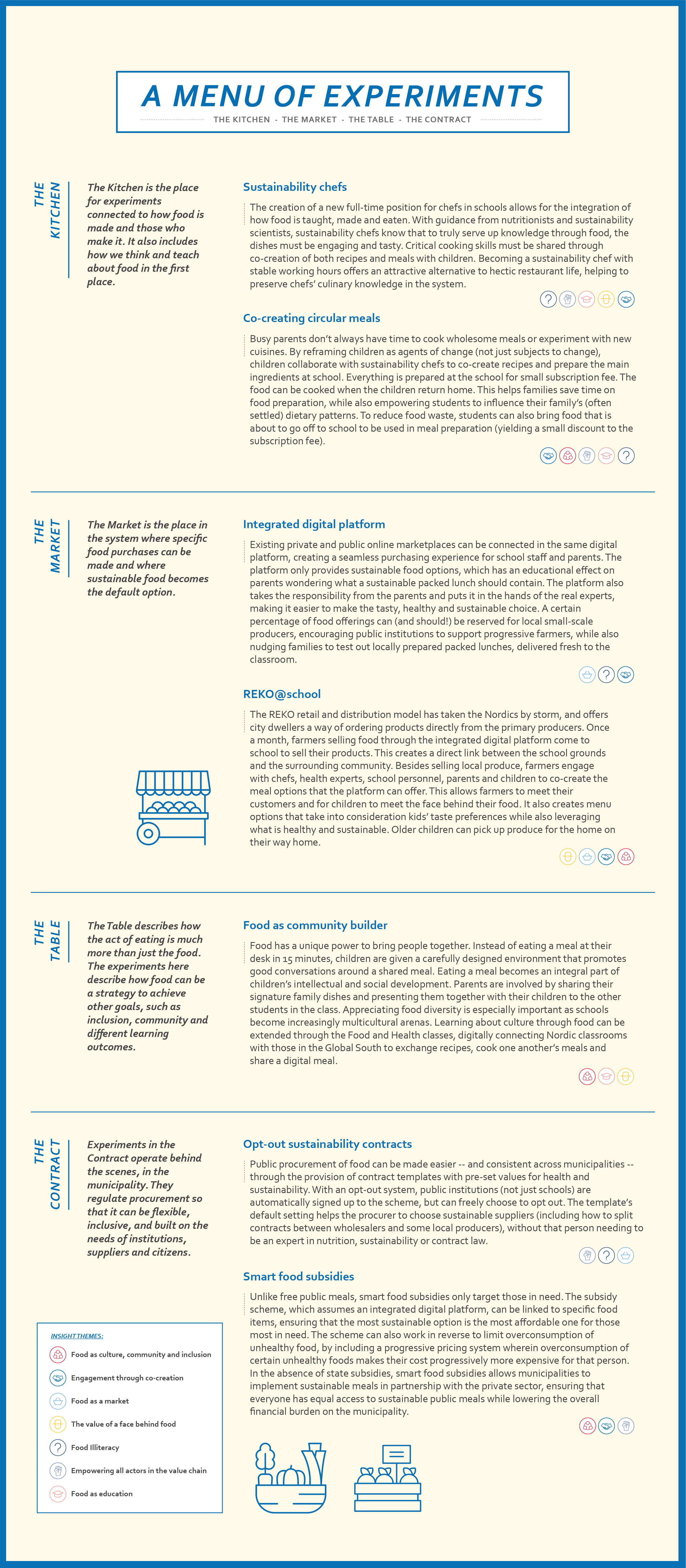
3.3.7 Bringing it all together
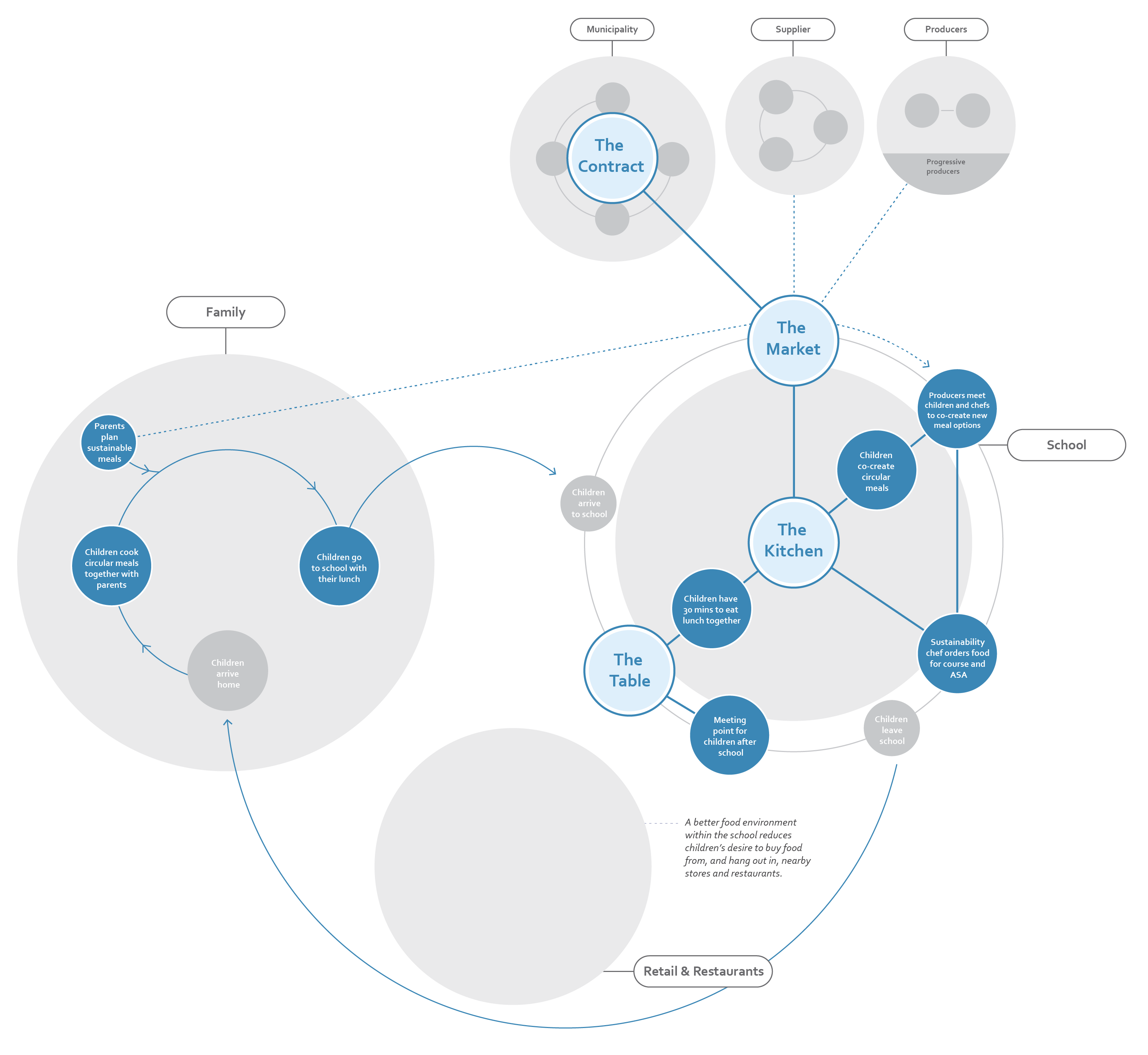
Footnotes
- ^ Research by Silje Elisabeth Skuland, documented in SIFO Report 13-2020: http://hdl.handle.net/20.500.12199/645
"Sometimes, it’s the synergies themselves rather than the specific solutions that can contribute most to systems change."
3.4. What next?
ACT IV – Bringing the cookbook to life

- Choose the challenges that you want to work with (Act I)
- Find your entry points (Act I)
- Develop your mission (Act II)
- Design your portfolio of demonstrators (Act III)
- Evaluate what you have learnt from the successes and failures of the process and continue to iterate, iterate and iterate
"Momentum is building among policy-makers for the adoption of more experimental approaches."
There are many great “chefs” out there who are constantly trying to improve the recipes for how we interact with the innovation processes that can change society. We encourage you to keep exercising your systems thinking and your innovation muscles by reading further. Here are a few other “cookbooks” from our bookshelf:
Meet the authors
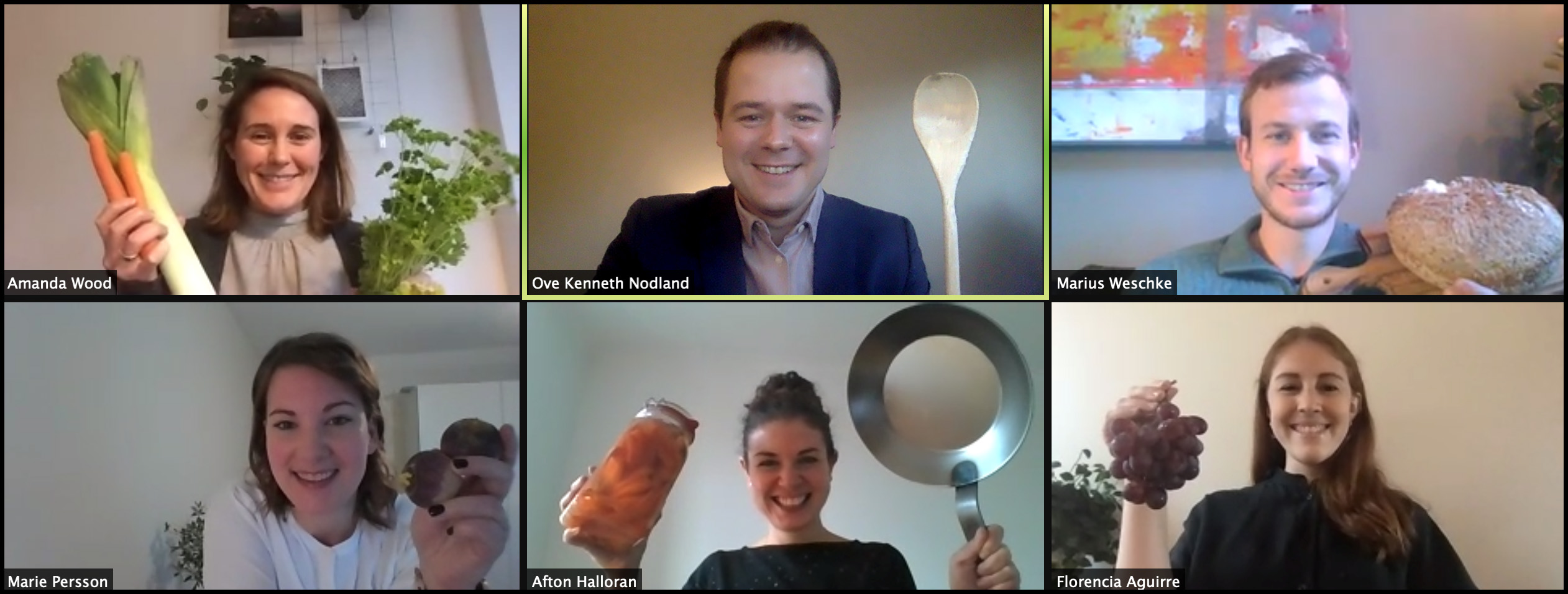
Afton Halloran (editor and author)
Halloran A, Wood A, Aguirre F, Persson M, Weschke M, Nodland O K. 2020. Cookbook for systems change – Nordic innovation strategies for sustainable food systems. Nordic Council of Ministers, Copenhagen.
Acknowledgements
Funding: This cookbook is funded by EIT Climate-KIC as a part of the Deep Demonstrations on Resilient Food Systems and Diets (EIT_2.1.6_201017_P461_1B).
The authors would like to acknowledge the following people for their contributions to this cookbook:
- Expert insights: Anders Liebe Delsett, Andreas Svanekil, Dagfinn Hessen Paust, Gaute Vindegg, Ina Roll Spinnangr, Ingrid Kleiva Møller, Julie Baud, Karianne Espeset, Katarina Rina, Line Tveiten, Mariann Karlstad, Marius Johansen, Marthe Norderhaug, Mette Hanneborg, Per Finne, Pontus Hagman, Ragnhild Slettner, Robbin Lantz, Signe A. Odden, Theis H. Omdahl, Will Nicholson, Øistein Christoffersen.
- Design: Angela Morelli, Hye Min An, María Jesús Contreras, Mette Agger Tang and Tom Gabriel Johansen
- Reviewers: Benedicte Wildhagen, Dan Hill, Jenny Sjöblom, Maija Kale, Rebecka Milestad and Elisabet Skylare.
We are thankful for the active participation by Nordic mission alliance members:
Pernille Martiny-Modvig, Henrik Søndergaard and Anne Marie Damgaard – EIT Climate-KIC
Dan Hill, Jenny Sjöblom and Joanna Franzén – Vinnova
Sigridur Thormodsdottir – Innovation Norway
Benedicte Wildhagen – Design and Architecture Norway
Trond Einar Pedersen – Research Council Norway
Svein Berg and Niina Aagaard – Nordic Innovation
As well as for insights from an extended group of Nordic and EU innovation actors:
Barbaros Corekoglu and Marja-Liisa Meurice – EIT Food
Christian Bason, Sune Knudsen and Julie Hjort – Danish Design Center
Hörður G. Kristinsson, Sæmundur Sveinsson, Guðjón Þorkelsson, Anna Kristín Daníelsdóttir – Matís
Johanna van Schaik Dernfalk – Formas – Swedish Research Council for Sustainable Development
Tuuli Hietaniemi – Sitra

Executive Summary
Cookbook for systems change – Nordic innovation strategies for sustainable food systems
This is the fundamental proposal of the book, Cookbook for systems change – Nordic innovation strategies for sustainable food systems. In essence, this cookbook for systems change is about the role that a strong public innovation system can play alongside the pathways towards sustainable food systems. The book lays out a method for deliberate food system transformation – a mission approach – that can support people, planet and society. This systems change cookbook will provide the ingredients – templates for developing interventions, guides for how to get started and examples of cross-cutting projects – that you can use to create your own recipes for change.
Food systems lie at the heart of grand challenges in health and nutrition, prosperous, livelihoods, climate change and environment. Sustainable and well-functioning food systems are also essential for building resilient and just societies.
Food systems have been driving societal progress for millennia. Yet, some societal progress has come at a high cost to human health and the environment. Urgent action is needed if we are to address grand challenges like inequality, unsustainable consumption and production patterns, environmental degradation, fragile livelihoods and poor health. Food systems are powerful because they can be used to address multiple grand challenge action fronts.
The Nordics are ripe for food system transformations. Eight broad entry points – core areas of change – can get us started: Food environments, circularity, food culture and identity, diets and meals, food supply chains, resilient food production systems, food producers and cities.
Transformation of the food system will take an “all hands on deck” approach, and systemic changes will be needed to tackle these complex and multi-faceted grand challenges. Governments, particularly public innovation agencies, can play a key leadership role in co-ordinating this action.
Societal missions are emerging as mechanisms to direct multi-stakeholder innovation towards a common understanding of how best to solve our urgent grand challenges. A mission approach aims to create transformative change by breaking down high-level grand challenges into more granular components until concrete actions can be developed. This is done by identifying opportunities to address grand challenges, proposing innovations that can help overcome these challenges and outlining an approach to test and co-ordinate these innovations.
Societal missions should be bold, inspirational and ambitious while at the same time offering multiple solutions to get the job done. Such missions should also provide clear direction for action by setting measurable and time-bound goals and use innovation and innovation policy to achieve ambitious but realistic change. Societal missions should bring people together to work in new ways, involving multiple sectors, actors and disciplines.
There is no recipe for a Nordic mission on sustainable food systems but we can design one together. Based on the possible entry points to food systems transformation, this cookbook of strategies explores in detail the example of one specific mission: ensure that, by 2025, all public meals consumed in the Nordics are sustainable and tasty. That said, the possibilities are endless. By pooling existing knowledge and testing new approaches to mission design, the Nordics are in a very good position to collaborate on a shared mission for food system transformation in the Nordics. The Nordic region is an ideal place to demonstrate the types of collaborative systems change needed to meet the existential challenges we are currently faced with.
An example of how missions tackle grand challenges by exploiting entry points and breaking challenges down into more concrete, actionable interventions, clustered into different demonstrators.
Trying to change the whole food system all at once is simply too complex. Full-fledged research and development projects require a lot of money and other resources to carry out, and they are best deployed when you already know what you’re fixing and why. Experiments, on the other hand, are a low-cost, low-risk way of learning how a mission can be achieved.
The complexity and dynamism of social systems mean that their transformation requires interventions at multiple levels at the same time. By orchestrating a portfolio of experiments that act on multiple levels of the system at once, demonstrators allow you to work with, rather than against, this dynamism.
Demonstrators aim to inspire large-scale change. The six essential qualities of a successful demonstrator are: mission-oriented, demand-led, place-based, iterative, holistic and grounded in citizen perspectives.
Systems change is not only about changing the nodes of a system; it’s also about changing the relationship between them. Sometimes, it’s the synergies themselves rather than the specific solutions that can contribute most to systems change. Demonstrators can help connect the dots.
As we encounter unprecedented 21st-century challenges, it’s easy to get lost in the complexity. This is why we need to have a set of different utensils close to hand. A mission approach can help form a new way of thinking, not just about the people, action and orchestration needed to achieve a desirable future, but also about how to collectively imagine a new food future.
A mission approach can be implemented within the Nordic public innovation ecosystem either by fitting it into existing infrastructure or by creating new infrastructure to accommodate it. Research- and innovation agencies in the Nordics can achieve greater impact more effectively by pooling resources, unlocking synergies across current project portfolios, avoiding duplication of efforts, and systematically sharing lessons learned and establishing best practice for how to approach and collaborate on missions
A large-scale Nordic mission on sustainable food systems led by government has never been carried out before… but there are signs that it can be done. Perhaps the Nordic countries’ most important global contribution to achieving the Paris Agreement and the SDGs will not be any specific technology, business model or policy innovation, but rather to demonstrate how a strong public innovation ecosystem is the missing link to overcome the complex societal challenges defining our times.
About this publication
Cookbook for systems change
– Nordic innovation strategies for sustainable food systems
Nord 2020:048
ISBN 978-92-893-6740-0 (PDF)
ISBN 978-92-893-6741-7 (ONLINE)
http://dx.doi.org/10.6027/nord2020-048
Layout: Mette Agger Tang
© Nordic Council of Ministers 2020
Nordic co-operation
Nordic co-operation is one of the world’s most extensive forms of regional collaboration, involving Denmark, Finland, Iceland, Norway, Sweden, and the Faroe Islands, Greenland and Åland.
Nordic co-operation has firm traditions in politics, economics and culture and plays an important role in European and international forums. The Nordic community strives for a strong Nordic Region in a strong Europe.
Nordic co-operation promotes regional interests and values in a global world. The values shared by the Nordic countries help make the region one of the most innovative and competitive in the world.
The Nordic Council of Ministers
Nordens Hus
Ved Stranden 18
DK-1061 Copenhagen
pub@norden.org
Read more Nordic publications on www.norden.org/publications