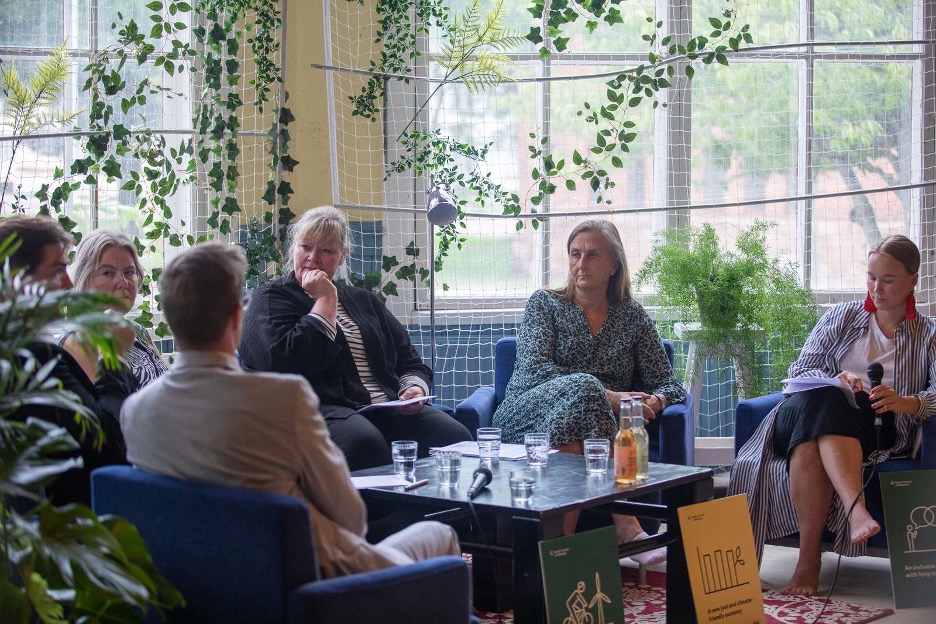
Events highlighting the connection between gender and climate
The green transition will cover every part of society, requiring leadership that ensures gender equality in every area, from agriculture to higher education, and from transport to fishery.
Since 2022, the Nordic Council of Ministers has invited to debate this topic at various international events, such as CSW66, COP27 and COP28. A series of seminars, on the launch of a report on the implementation of the UNFCCC Gender Action Plan in the Nordics is also available.
The report can be found here :
A review of the Nordic implementation of the UNFCCC Gender Action Plan
A review of the Nordic implementation of the UNFCCC Gender Action Plan
“We must talk about gender equality when we talk about the climate crisis.”
WATCH YOUTUBE →
WEBINAR IN DANISH
I dette webinar præsenteres resultaterne af rapporten "En undersøgelse af den nordiske implementering af FN’s Klimakonventions handleplan for ligestilling (UNFCCC GAP)" i en dansk kontekst.
WEBINAR IN FINNISH
I dette webinar præsenteres resultaterne af rapporten "En undersøgelse af den nordiske implementering af FN’s Klimakonventions handleplan for ligestilling (UNFCCC GAP)" i en dansk kontekst.
WEBINAR IN NORWEIGAN
Et webinar om integrering av kjønn og likestillingsperspektiver i norsk klimapolitikk. Webinaret presenterer resultatene fra rapporten "En gjennomgang av den nordiske gjennomføringen av UNFCCC Gender Action Plan i klimapolitikken", samt deler kunnskap om aktuelle initiativer, erfaringer, utfordringer og beste praksis i Norge.
WEBINAR IN SWEDISH
I det här webbinariet presenteras resultaten från rapporten “A review of the Nordic implementation of the UNFCCC Gender Action Plan” med fokus på svensk klimatpolitik. Webbinariet framlägger de fem fokusområden som finns utpekade under FN:s klimatkonventions åtgärdsplan för jämställdhet och klimat och hur dessa har implementerats i Sverige.
WEBINAR IN ENGLISH
In this webinar, the findings of the report "A Review of the Nordic Implementation of the UNFCCC GAP" is presented. The efforts and examples of mainstreaming work in climate policies from Denmark, Finland, Iceland, Norway and Sweden is examined in relation to the GAP's five priority areas: A: Capacity-building, knowledge management and communication; B: Gender balance, participation and women’s leadership, C: Coherence’, D: Gender-responsive implementation and means of implementation and E: Monitoring and reporting. There are considerable differences in the extent of gender mainstreaming in climate policies across the countries.