Young Voices for Climate Justice
Recommendations to COP30 from the Youth Climate Workshop at Roskilde Festival
The meeting between youth delegates and climate actors at Roskilde Festival, as well as the presentation of the youth recommendations at COP30, has been made possible through a collaboration between the Nordic Council of Ministers and Roskilde Festival. The content and recommendations in this paper reflect exclusively the views and perspectives of the youth delegates.
This is mutirão
When running a marathon
A time comes
Where you wish for nothing more
Than to stop
Where the pain feels hopeless
The body screams
And the mind pleads
Searching for escape
A faked injury, a cheated turn
Anything to leave this world
And return unchallenged
You have to lift yourself up
And focus on moving
One step
One leg
One second at a time
The climate crisis is our marathon
And the pain of our struggle is collective
We are hurting
We are searching
And we are battered
But we cannot afford to give up hope
Every one of us here contributes
To the integrity of our voice
To the beacon of light we are sharing with the world
Against the cold dark of outdated systems,
Continued inaction,
And an unknown future
Remember that we are many
And we are growing
And soon the light will show the way
Not only to some
But to all
This is community
This is resilience
This is solidarity
This is movement
This is mutirão
— Paul Jenkinson
Preamble
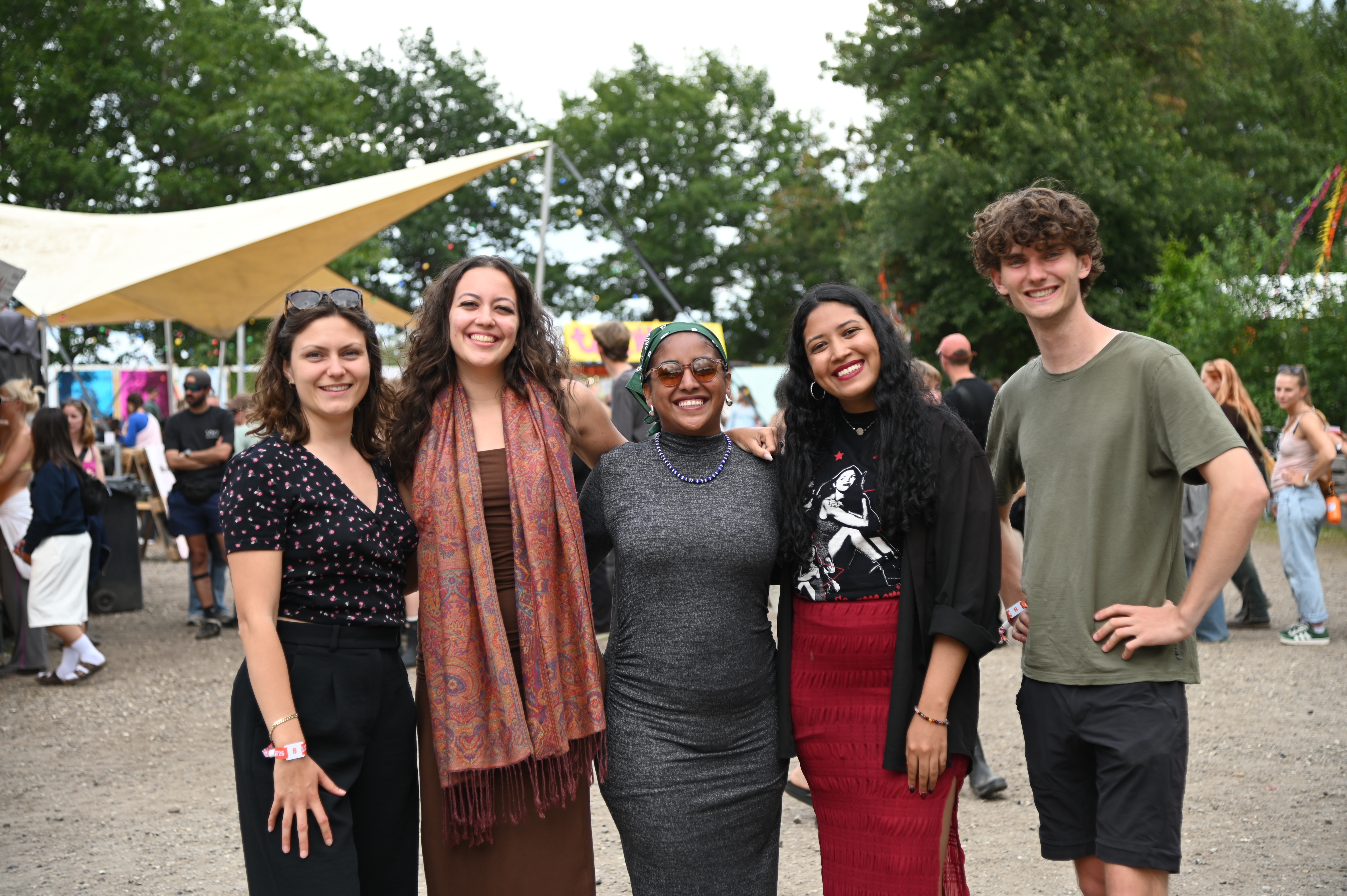
We, young changemakers from across geographies, disciplines, and lived experiences, gathered at Roskilde Festival in July 2025 to unite our voices in response to the global climate crisis. Brought together by the Nordic Council of Ministers and Roskilde Festival, we engaged in an innovative workshop where art, grassroot activities, and political dialogue merged to form a collective vision for climate action. This document outlines our recommendations for COP30 in Brazil and is grounded in diverse perspectives, with a shared commitment to a just green transition.
Priority Recommendations from UN Youth Delegates to COP30
1. Integrate Adaptation Indicators on Children and Youth
In the discussions of the Global Goal on Adaptation, the selected indicators must reflect the specific vulnerabilities and capacities of young people. We call for indicators that include disaggregation by age, gender, location, and disability and the prioritization of thematic indicators specifically focused on children and teenagers. We also call for ongoing consultation of youth in the development and implementation of the GGA metrics and the recognition of the Knowledge of Indigenous Peoples, local, and traditional knowledge.
We recommend
- Embedding children and youth-specific indicators in national and global adaptation strategies.
- Recognizing children and youth as distinct rights-holders in climate resilience planning.
- Ensuring children and youth are both protected by and active in implementing adaptation solutions.
2. “Phase Out Fossil Fuels” in the COP30 Agreement
Words are not enough – emissions must fall. COP30 must deliver a clear and binding commitment. So far, progress on this issue has been limited. The only COP decision that explicitly mentions fossil fuels is the UAE Consensus, adopted at COP28. While it was an important breakthrough in acknowledging the need to “transition away from fossil fuels,” the language used was weak, non-binding, and left ample room for interpretation. This ambiguity undermines the urgency required to address the root cause of the climate crisis.
We cannot ignore the fact that fossil fuels remain the single largest source of greenhouse gas emissions. Continuing to rely on coal, oil, and gas while expecting to meet global climate goals is a contradiction. To ensure real progress, COP30 must go beyond vague pledges and deliver a concrete pathway for the phase-out of fossil fuels, supported by clear timelines, accountability mechanisms, and a just transition framework that prioritizes workers, communities, and countries most affected.
We recommend
- A full and fair phase-out of fossil fuels, guided by best available science
- A global moratorium on new fossil fuel exploration and infrastructure.
- Legal and economic instruments to ensure a just transition for fossil fuel-dependent communities.
3. Decide Pathways to Deliver the New Collective Quantified Goal (NCQG)
Climate finance must be fair, sufficient, and accessible - particularly to frontline communities.
Youth are already leading climate action at the local level, often dealing with the lack of financial support. From restoring ecosystems and advancing renewable energy projects to promoting climate education and defending their territories. Yet, these initiatives rarely receive direct funding or recognition, limiting their impact and scale.
At the same time, countries in the Global South, which have contributed the least to the climate crisis but are facing its most severe consequences, continue to struggle with inadequate resources to adapt. Access to finance is often blocked by bureaucratic, slow, and conditional systems that exclude those who need it most.
COP30 must ensure that climate finance mechanisms prioritize frontline communities, including youth, Indigenous peoples, and marginalized groups. Funding must flow directly to local initiatives and be designed in a way that empowers, rather than burdens, the Global South. A fair and accessible climate finance architecture is essential to enable just and effective climate action worldwide.
We recommend
- Transparent pathways for delivering the NCQG, with youth and Global South stakeholders engaged throughout.
- A public-finance-first principle in global climate finance, avoiding over-reliance on private capital.
- Dedicated funds for youth-led climate action and intergenerational equity projects.
Supporting Recommendations from the first workshop
4. Youth in Decision-Making
Institutionalize youth mandates in climate negotiations and policy implementation bodies.
5. Long-Term Thinking and Intergenerational Justice
Hold governments accountable for decisions impacting future generations by requiring long-term climate impact assessments.
6. Transformative and Inclusive Climate Action
Center Indigenous, gender equality, and traditional knowledge perspectives in climate frameworks and financing.
7. Radical Communication and Festival-Based Education
Launch a youth-led Mutirão (collective mobilization) to spread climate awareness through art, music, and festivals.
8. Transform Values: Redefine Progress
Create new global development indicators based on well-being, ecological sustainability, and justice.
Conclusion
COP30 must be a turning point. It must deliver not just negotiations, but implementation. Not just representation, but transformation. Youth are not the leaders of tomorrow—we are also the leaders of today. It is time for decision-makers to match our urgency with action.
The Recommendation Paper is led by
Sigurd Krabbe
Denmark’s Youth Delegate to the UN for Climate and Environment
Marcele Oliveira
Presidency Youth Climate Champion, Brazil
And is based on valuable insights and contributions from
Beatriz Triani
Youth delegate from Brazil (International Advisor to the COP30 PYCC)
Youth delegate from Brazil (International Advisor to the COP30 PYCC)
Thalia Silva
Youth delegate from Brazil (Communications Advisor to the COP30 PYCC)
Youth delegate from Brazil (Communications Advisor to the COP30 PYCC)
Kathrine Strange
The Danish Youth Climate Council
The Danish Youth Climate Council
Elise Sydendal
The Green Youth Movement & Nordic Climate Justice Coalition
The Green Youth Movement & Nordic Climate Justice Coalition
Selma de Montgomery
The Green Youth Movement & Nordic Climate Justice Coalition
The Green Youth Movement & Nordic Climate Justice Coalition
Jonas Kittelsen
Extinction Rebellion Norway and Nordic Climate Justice Coalition
Extinction Rebellion Norway and Nordic Climate Justice Coalition
Mette Lundgaard
Denmark’s former Youth Delegate to the UN for Climate and Environment
Denmark’s former Youth Delegate to the UN for Climate and Environment
Douglas Malm Rath
Climate Live
Climate Live
Naram-Sin Poli
LiveGreen/Climate Live
LiveGreen/Climate Live
Louise Lindén
LiveGreen
LiveGreen
Andreas Magnusson
LiveGreen/Climate Live
LiveGreen/Climate Live