

- Frontpage
- Indholdsfortegnelse
- Preface
- Executive Summary
- Introduction
- Megatrends affecting Nordic-Baltic Food Systems
- MEGATREND 1
- MEGATREND 1 – Technology will penetrate all areas of social life
- MEGATREND 2
- MEGATREND 2 – Food systems will be redesigned with a new set of goals
- MEGATREND 3
- MEGATREND 3 – Digitalisation is opening new horizons
- MEGATREND 4
- MEGATREND 4 – Society will become increasingly polarised
- MEGATREND 5
- MEGATREND 5 – Products will be valued based on the amount of waste they produce
- MEGATREND 6
- MEGATREND 6 – A new appreciation for the environment will develop
- MEGATREND 7
- MEGATREND 7 – Anxiety and fear will become pervasive in our society
- MEGATREND 8
- MEGATREND 8 – New lifestyles will emerge and redefine our value systems
- Megatrend 9 – Build your own
- Summing up
- Autors
- References
- About this publication
MENU
Preface
The opportunity to think about the future, imagine what’s ahead and place our individual actions within its scope is provided by democracies operating on the basis of trust and future consciousness.
In the context of climate change, future-oriented thinking is more important than ever before. While the histories of the Nordic and Baltic regions differ, their future in terms of bio-based economies, value chains and caring for biodiversity is the same. Therefore, joint exercises in imagining a shared regional future are of the utmost importance in increasing the wider Nordic and Baltic region’s level of integration.
The Future Trends of Food in the Nordic-Baltic Region project was based on this rationale of a jointly imagined future of food for the Nordic and Baltic region. Instead of concentrating on regional differences, this project aimed to find common ground for a future based on inclusivity, transparency, co-creation and society’s ability to shape a sustainable future together.
The project, consists of three parts: a hackathon for startups (futureoffood.eu), several Nordic-Baltic research projects (Megatrends and survey on Covid-19’s impact on consumers) and a publicity campaign to share the results. Its aim is to benefit entrepreneurial minds in the Nordic-Baltic region and serve as a baseline for discussions among policy makers and in broader society.
Thinking about the future essentially means thinking about sustainability.
Mikelis Grivins
Afton Halloran
Maija Kale
Riga and Copenhagen, 2020
Executive Summary
This book uses megatrends as a way to reflect on the future of food in the Nordic-Baltic region.
Here, futures thinking is understood as an informed reflection on the major changes that will occur in the coming decades in all areas of society. While megatrends are just one of many tools in the future consciousness toolkit, this method proves valid when determining the general direction of the future of food. It consists of several phenomena or a wide-ranging process of change and includes understanding tensions, weak signals and how the trend is formed. The methodology used in this study is based on work developed by Sitra, the Finnish Innovation Fund, which is a leading voice in the megatrends space in the Nordic-Baltic region.
Eight specific megatrends influencing and influenced by Nordic-Baltic food systems are developed and discussed in depth here. A short summary of each is provided below.
Technology will penetrate all areas of social life
We’re living in the fourth industrial revolution — Industry 4.0 — where practices will be intimately connected with knowledge, and knowledge will create practices.
New technologies combined with digital innovations will make it possible to engage with longstanding societal, environmental and economic issues. Furthermore, our personal access to technology, as well as any limits to its access, will continue to influence our relationship with food.
In a context in which data is the new gold, collected from satellites, drones, equipment and machines such as those used by the primary sector and the food industry, nature-based solutions will provide a counter-balance to the “tech-can-fix-it” paradigm.
Food systems will be redesigned with a new set of goals
The 21st century is creating further turmoil in food systems. The present challenges associated with food security, new dietary patterns and the increasing perception of food as a lifestyle commodity will result in growing numbers of conflicting ideas regarding how to produce, distribute, sell and consume food. Climate change, loss of biodiversity and environmental degradation will become even larger threats to the Nordic-Baltic region and the world.
The agri-food industry will become a key player in reversing many environmental issues. The major challenge will be ensuring diets that support human and planetary health, while striking a balance between promoting international trade in food and agriculture and protecting local food systems.
Digitalisation is opening new horizons
New digital technologies, like artificial intelligence (AI), blockchains, digital twinning, internet of things (IoT) and cloud computing, will present new opportunities and challenges for the food system. Digitalisation will ensure the decisions we make are more informed than ever before.
The world will become more connected, and digital services more available and sophisticated, but the digital divide will also become more pronounced.
By adapting inclusive policies, digitalisation will support the development of small and medium-sized businesses in rural areas and mitigate challenges faced by rural areas in general by decreasing the distance between town and country.
Society will become increasingly polarised
While the long-term effects and indirect consequences of the processes related to globalisation are debatable, it’s clear that transparency, human rights and welfare have improved on a global level. However, it’s also apparent that current global structural arrangements do not benefit everyone equally.
Marginal groups will continue to struggle to benefit from the changes surrounding them. A clear indication of this and major paradox is that people working in food systems across the globe continue to be among the most food insecure.
The effects of polarisation will manifest through various social processes — differing possibilities, extremely different opinions, social distancing of groups and lack of empathy. This will have an impact on trust and, therefore, on any attempts to introduce change.
Products will be valued based on the amount of waste they produce
Decoupling economic growth and waste generation will remain one of the most significant and challenging tasks of our time. Implementing a circular economy that promotes the recursive movement of goods and materials through remanufacture, retake, reuse, repair and recycle will be crucial in order to move away from a throw-away culture. Packaging will be reconsidered and single-use items will be phased out.
Food waste reduction will be addressed on multiple fronts. Here, cities will play a significant role, while at the farm level, entrepreneurs in the region will attempt to improve on-farm nutrient cycling.
Both high-tech and nature-based solutions will facilitate behaviour change towards a circular paradigm.
A new appreciation for the environment will develop
Nature is and will be an important common and individual resource. Its role in securing collective wellbeing will become ever more prominent. Therefore, environmental challenges related to climate change, loss of biodiversity, waste and pollution will be central to any decision-making process, with the central aim of promoting sustainability and resilience.
Environmental regulations will become stricter. Following implementation of these regulations, monitoring institutions will also be strengthened. With this, new non-governmental and commercial players supporting those looking to improve their environmental performance will emerge.
New identities combining traditional and modern ways of engaging with environmental issues will also develop. The role nature plays in ensuring emotional wellbeing will facilitate the emergence of new services and products.
Anxiety and fear will become pervasive in our society
We’re living our everyday lives in a world full of new individual and collective risks. The possibility of these risks materialising as well as the impact of these risks have grown constantly over the past few decades. This has generated anxiety that is now affecting our choices, attitudes and behaviours and, our ability to engage with the future.
Climate anxiety will grow. Meanwhile, people will have to face many of the issues that frighten them. For some, fear and paralysed change will trigger the desire to stay fit and healthy.
Eventually, trust building will become increasingly important in a context in which lack of trust is interfering with a sense of control over personal wellbeing and that of the planet.
New lifestyles will emerge and redefine our value systems
Lifestyles — the combined interests, opinions, behaviours, and behavioural orientations of an individual, group or culture — will rapidly change in the Nordic-Baltic region. Collective and individual identities will redefine themselves in parallel to value systems. Dietary shifts will lead to a healthier and more environmentally sustainable Nordic-Baltic region.
The marketing budgets of large food production enterprises will grow. Self-proclaimed food experts and influencers will also gain more power and influence over the personal lifestyle choices of citizens.
Cooking will increase as a hobby rather than a life skill. Furthermore, it will continue to transition from a social practice to an individual experience.
Introduction
What are the slowly developing yet major trends influencing Nordic-Baltic food systems? You’ll soon find out. In the following pages, you’ll learn more about the importance of discussing the future, what megatrends are, why they matter and how they’re relevant to the region. You’ll then be introduced to eight megatrends that have likely already been encountered in your everyday, and perhaps even professional, life. At the end of this research paper, you’ll have the opportunity to develop your own megatrend.
But before jumping into the future, let’s make sure we’re all on the same page. When you come across the term food systems in this paper, we’re talking about “the interconnected system of everything and everybody that influences, and is influenced by, the activities involved in bringing food from farm to fork and beyond”.[1]
Footnotes
- ^ Centre for Food Policy (2019): Rethinking Food Policy: A Fresh Approach to Policy and Practice. https://www.city.ac.uk/__dataassets/pdf_file/0008/471599/7643_Brief-2_What-is-the-food-system-A-food-policy-perspective_WEB_SP.pdf
Why take the time to discuss the future of food systems?
Look around you. Maybe you’ve noticed something different today — a new urban garden plot by your apartment or a sustainable option on the menu of your favourite restaurant. If these signals of change occur multiple times, they form patterns. As new patterns take shape, we start to gain insight into where we may be headed in the future. If these patterns repeat over a long enough period of time, we call them trends. And if trends play out over time, they can transform society.
History reminds us that the future is multi-directional. There is no single path towards the future. But if we wish to improve the future, it’s important to understand the possible directions it may take and how we can influence them. The conflict between various paths can cause tension. You might compare it to sitting down at a dinner table where everyone wants to eat something drastically different.
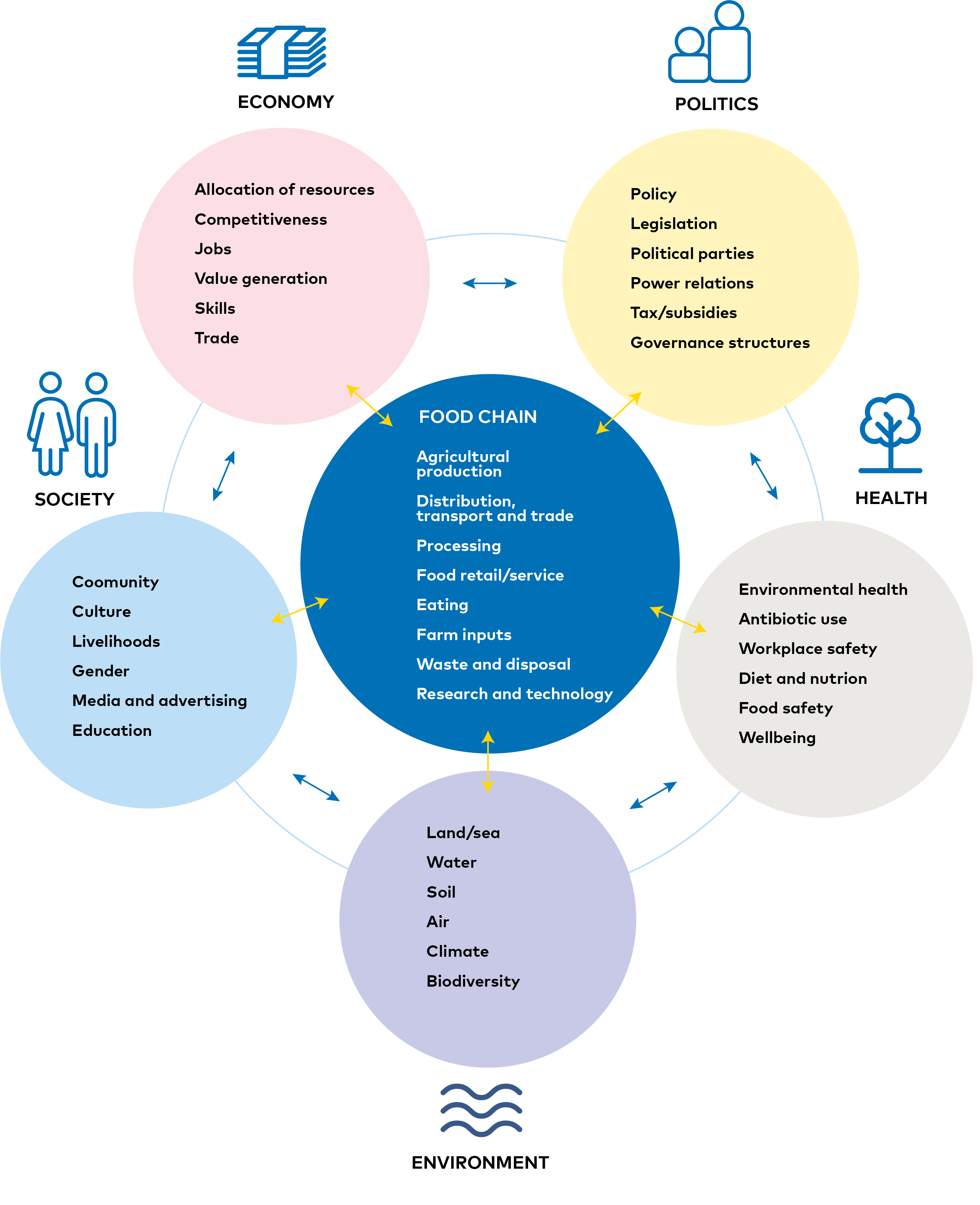
A depiction of interactions in the food system
Adapted from Centre for Food Policy, City, University of London, 2019[1]
Footnotes
- ^ Centre for Food Policy (2019): Rethinking Food Policy: A Fresh Approach to Policy and Practice. https://www.city.ac.uk/__dataassets/pdf_file/0008/471599/7643_Brief-2_What-is-the-food-system-A-food-policy-perspective_WEB_SP.pdf
The food future is all around you
Stop and reflect on how the food system is transforming:
- Have you noticed any food-related signals of change today? Can you name one?
- What new patterns do you see forming around you?
- Can you give an example of a pattern you once saw forming that now has a major influence on the food system?
Futures thinking is a method for informed reflection on the major changes that will occur in the coming decades in all areas of society. To become future-oriented thinkers, we must exercise our future consciousness muscles, a set of psychological capacities that include foresight, planning, goal setting and purposeful behaviour. These capacities enable us to communicate, participate in and lead transformation processes in practical and effective ways.[1]Sharpe, B. (2013): Three Horizons: The Patterning of Hope. https://www.triarchypress.net/three-horizons.html Megatrends, the topic we discuss in length throughout the coming pages, are just one of many tools in the future consciousness toolkit.
Future consciousness offsets the short-term thinking pervasive in the public and private sectors. It moves beyond thinking about the next election or annual key performance indicators, shifting away from the immediate future to a long-term perspective. By doing this, we’re able to make deeply informed decisions with a sustainable balance between short- and long-term goals, and perhaps even smooth the bumpy paths of major societal transitions.
What is a megatrend?
In essence, a megatrend is a general direction of development, consisting of several phenomena, or a wide-ranging process of change. Megatrends illuminate familiar aspects of life. These are the changes we already see around us that are likely to continue happening tomorrow. Examining megatrends is just one of many anticipatory thinking and foresight tools.
In this paper, we also focus on the multiple potential impacts and outcomes of these megatrends. In addition, we describe some of the tensions that occur as the food system navigates and negotiates new paths.
Footnotes
- ^ Sharpe, B. (2013): Three Horizons: The Patterning of Hope. https://www.triarchypress.net/three-horizons.html
Why are megatrends useful?
Megatrends provide a 360° view on future-related change. These broad trends can be narrowed down by focussing on more detailed trends, weak signals (past or current developments and issues with ambiguous interpretations regarding their origin, meaning and/or implications) and analysing tensions in the system.
Megatrends offer us the possibility to engage with the future — to think about the realities that will emerge from shifts caused by society’s reshaping.
Why a focus on the future of food in the Nordic-Baltic region?
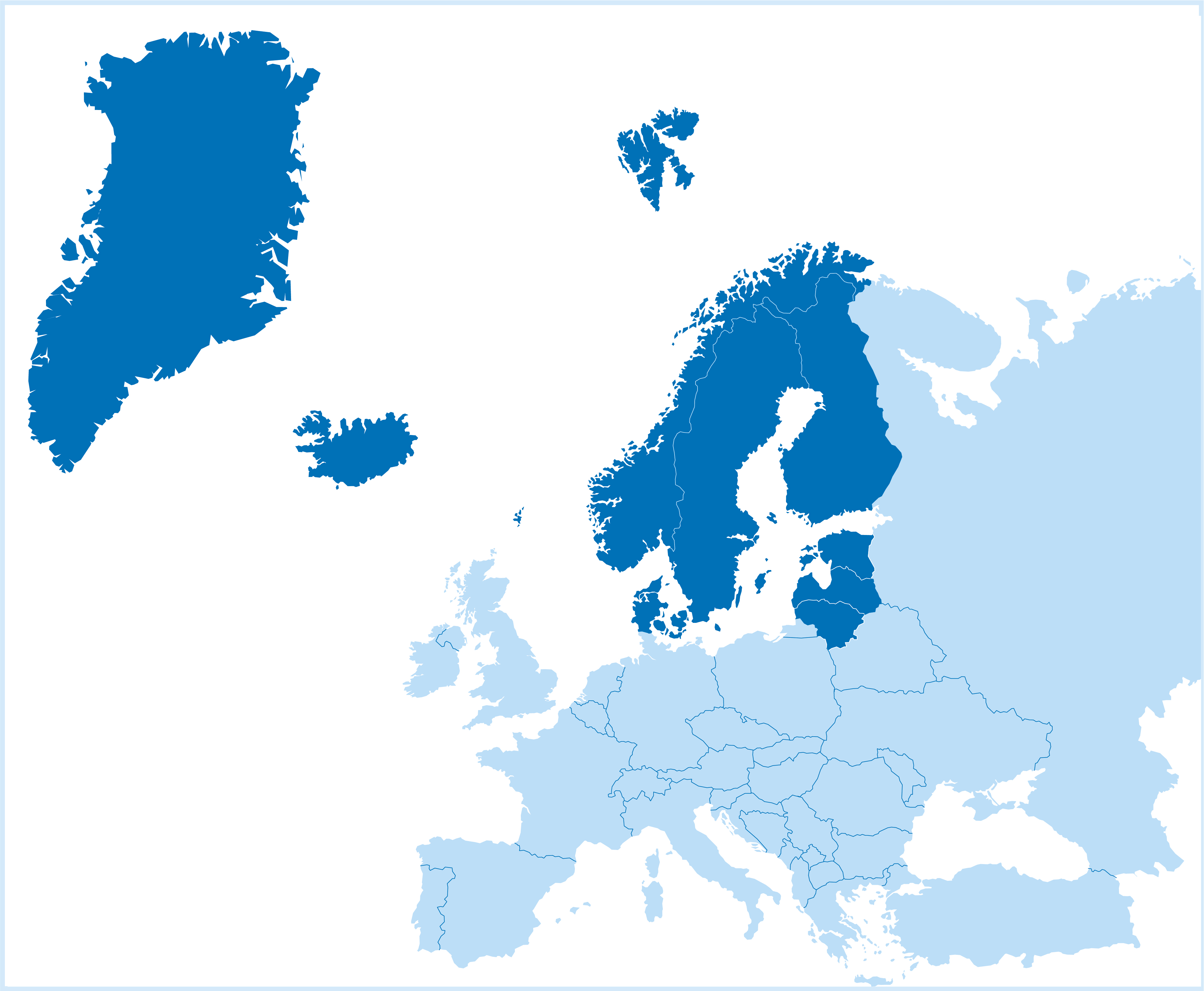
The Nordic-Baltic region encompasses Denmark, Estonia, Finland, Iceland, Latvia, Lithuania, Norway, and Sweden, as well as the autonomous regions of Greenland, Åland and the Faroe Islands. Historically, these countries have been interlinked and have interacted with one another for centuries. Mutual trade has been the decisive factor facilitating this interaction. In recent decades, the Nordic and Baltic countries have grown closer, collaborating on issues like circular economic models, regional security and digital transformation.
Today’s actions are impacted by our perceptions of what the future will bring — both in terms of opportunities and challenges. Various think tanks are identifying megatrends, and these are being discussed in diverse contexts depending on complexity and the issues at stake. There are many projects and programmes covering different areas such as Nordic food policy, Baltic agricultural systems and future foresight. To date, however, no entity has looked into the megatrends influencing the Nordic-Baltic region and its food systems. As a result, there are still knowledge and awareness gaps when it comes to the future of food, nutrition, health and sustainability.
Despite our differences, the Nordic and Baltic countries have a lot in common. It’s clear that processes such as climate change and circular resource flows will, to a large extent, impact Nordic and Baltic countries in a similar way, and solutions will originate outside national borders, making regional cooperation crucially important. It’s also important to link scientific research with practical business planning and implementation. The Future Trends of Food in the Nordic-Baltic Region project aims to create and present future trends for food in the Nordic-Baltic region in an easy-to-understand format that’s useful for policy makers, startups and the agri-food sector in general.
The Future Trends of Food in the Nordic-Baltic Region project is led by the Nordic Council of Ministers’ Office in Latvia and includes partners from the Nordic Council of Ministers secretariat, EIT Food, the Baltic Studies Centre (LV), Sitra (FI), Matis (IS), BIOR (LV), TFTAK (EST), Nordic Food Tech (DK), and LitMEA (LT).
Do you want to learn more about megatrends?
Sitra, the Finnish Innovation Fund, is a leading voice in the megatrends space. They publish articles and reports that shed light on megatrends, as well as phenomena related to them and the links between these phenomena.
Sitra’s megatrend materials, including their megatrend cards, are resources used in a wide range of activities, including education, strategy work, scenario processes and general discussions about the future. Their materials are open source and can be used by anyone.
How were the megatrends in this research paper selected?
The megatrends discussed and elaborated in this publication were determined over the course of a number of interactions with project and external stakeholders:
- In February 2020, the project team took part in the 24-hour Hackathon on Future Food in Riga, Latvia. The hackathon provided a platform to connect students, food innovators, startup founders and leading industry experts to brainstorm, build and validate new ideas that could potentially transform the food sector. Hackathon participants developed project ideas within the following four sectors: food waste, circular shift, new food, and digitalisation. At the end of the event, the project team listened to the different groups pitch their final project ideas. Approximately 100 people attended the hackathon, mainly from Nordic and Baltic countries.
- Following the hackathon, the project team met for one day at the Nordic Council of Ministers’ Office in Riga to generate more ideas for megatrends. The first part of the workshop focussed on coming up with megatrends influencing the Nordic-Baltic region. From this list, each participant was asked to choose and rank what they felt were the top three megatrends. The second part of the workshop used Sitra’s 2020 megatrends update as a conversation starter to explore how these relate to the future of the Nordic-Baltic food system. The five megatrends are:
– Ecological reconstruction is a matter of urgency
– Relational power is strengthening
– The population is ageing and becoming increasingly diverse
– The economy is seeking direction
– Technology is becoming embedded in everything
- A review of the current literature on the emerging themes generated during the hackathon and workshop helped to create eight distinct megatrends.
- After completing these steps, Afton Halloran (Independent Consultant at Sustainable Food Systems Transitions), Mikelis Grivins (Baltic Studies Centre) and Maija Kale (Nordic Council of Ministers’ Office in Latvia) developed the megatrend descriptions. Project members and external experts were invited to comment on the megatrends and suggest improvements. The megatrends were also presented at the Lampa conversation festival (LV), the EU Strategy for the Baltic Sea Region Forum (online) and the GreenEST Summit (EST).
Megatrends affecting Nordic-Baltic Systems
In this section, you’ll learn about eight specific megatrends influencing and influenced by Nordic-Baltic food systems. These megatrends are as follows:
-
Technology will penetrate all areas of social life.
-
Food systems will be redesigned with a new set of goals.
-
Digitalisation is opening new horizons.
-
Society will become increasingly polarised.
-
Products will be valued based on the amount of waste they produce.
-
A new appreciation for the environment will develop.
-
People will become more anxious and fearful.
-
New lifestyles will emerge and redefine our value systems.

1
MEGATREND 1
Technology will penetrate all areas of social life
Technological development is picking up speed, and new technological possibilities are finding their way into all spheres of social life, changing the ways we traditionally behave. These rapid shifts are causing an unprecedented improvement in quality of life. Technological developments are creating space for social innovations resulting in solutions that allow us to engage with a number of long-standing issues. However, the long-term impacts these shifts might have on the social fabric are not fully understood. And while most of the attention is focussed on shiny new technologies, what we really should be looking at is how these technologies affect society.
What is this megatrend?
We’re living in the fourth industrial revolution — Industry 4.0.[1]EIT Digital (2019): Digital Transformation of European Industry: A Policy Perspective. https://www.eitdigital.eu/fileadmin/files/2019/report/Digital-Transformation-of-European-Industry-Summary.pdf As a concept, Industry 4.0 describes a time when people are using digital computing potential to link digitised solutions into data-driven systems. This makes people and organisations more efficient. And of course, it has a substantial impact on society at all levels: global, local, organisational and personal. And while it’s often claimed that these processes are changing society, the real depth of this change is rarely discussed. For example, we can ask ourselves how geographic information systems (GIS) have changed the way people travel or perceive unknown spaces, or, how GIS have shifted the way we interpret the characteristics of land in general. This is exemplified by a 50-year-old forager:
“I always recharge my phone before foraging so I can constantly check my location in the forest. It’s so much easier when you don’t have to worry you’ll get lost in the forest. I’m exploring much larger areas now.”
It would be naive to say that new technologies have no impact on our perception of the realities surrounding us. Practices are intimately connected with knowledge, and knowledge creates practices. Having Google Maps or a similar app on our phones allows us to develop new ways of interacting with space, communicate characteristics of our surroundings in new ways and share spatial experiences with others.
History teaches us that it isn’t the technologies we should be looking at when assessing innovations but rather their social implications. For example, the domestication of wild plant and animal species was a crucial innovation mainly because of its social consequences. This technological development allowed us to shift away from hunting and gathering, and towards agricultural societies. Cities have also been highly influenced by technology. In her book, Hungry City, Carolyn Steel[2]Steel, C. (2008). Hungry City: How food shapes our lives. Vintage books, London.elegantly illustrates how the discovery of cold chains allowed cities to grow and disentangle themselves from food production. Meanwhile, a case study on shipping containers illustrates how the ability to agree on technological standards can change global markets and consequently, the way people engage with products.[3]Levinson, M. (2016). The Box: How the Shipping Container Made the World Smaller and the World Economy Bigger. Princeton, USA. This rather technical agreement made it possible to link various means of transport and increase transportation speed, thereby simplifying logistics, among other benefits. Just by agreeing on the size and properties of the container box, the transport industry substantially increased its efficiency.
The adoption of technological innovations isn’t a straightforward process. Instead, it tends to be unstructured, complicated and difficult to predict. We have to acknowledge that behind the neatly presented public face of new technologies lies a messy reality with potentially much broader implications than those anticipated. Consider, for example, the power relations associated with the ability to set market standards.
Technology not only reshapes practices at an individual level but also organisations and the way public and private sectors operate. For example, it used to be that a good farmer was someone who knew the properties of the soil, understood the plants or animals they worked with and had developed a sixth sense regarding farming-related issues. Nowadays, a combination of GIS, drones, satellites, AI and well-connected databases can replace the farmer’s knowledge and is probably more efficient in many ways. So where does this restructuring leave farmers? With most agricultural and technological support work outsourced to service providers, farmers more closely resemble managers than stewards of the land.
Countless other examples illustrate how new applications of technologies have caused unintended impacts and domino effects across all social realities. Enterprises and initiatives like Uber, Airbnb and non-banking financial apps have managed to initiate change in retail prices, urban geographies and even laws. These “new normals” reveal that the legal frameworks supposedly regulating these activities are poorly equipped to deal with newly emerging entrepreneurial models and their side effects. New technologies are appearing at a faster rate than ever and regulators are often left to react to these changes, while people jump at the chance to benefit from emerging offers. It’s hard to predict what these processes might mean for food systems. However, again, history hints at their potential impact. The 20th century illustrated that, for a large segment of society, the introduction of technologies in food production facilitated a loss of connection to the process of producing food. They became detached. Technological innovation leading to more processed food has facilitated the loss of food-related knowledge. We can speculate that detachment combined with a loss of knowledge results in loss of interest. If we don’t engage with technological development, the gap between society and the processes taking place in food systems will continue to broaden.
The technological transformation we’re witnessing has facilitated unprecedented improvements in quality of life. New technologies combined with digital possibilities have the potential to engage with some longstanding societal, environmental and economic issues. However, we need to maintain a critical eye regarding these developments. Consider, for example, the rapid spread of food delivery apps like Wolt, Bolt Food and Foodora — while they have increased convenience, they have simultaneously increased access to unhealthy foods. These processes should urge us to question who are the winners and losers in these shifts in practice caused by technologies. We should also raise questions regarding society’s ability to control these processes and to maintain at least some sort of ownership over the direction development takes. Further, we should ask how the pace of change impacts people’s ability to maintain a sense of reality.
Footnotes
- ^ EIT Digital (2019): Digital Transformation of European Industry: A Policy Perspective. https://www.eitdigital.eu/fileadmin/files/2019/report/Digital-Transformation-of-European-Industry-Summary.pdf
- ^ Steel, C. (2008). Hungry City: How food shapes our lives. Vintage books, London.
- ^ Levinson, M. (2016). The Box: How the Shipping Container Made the World Smaller and the World Economy Bigger. Princeton, USA.
What are the potential outcomes?
- Technological advancements will continue to accelerate. Social reality is where we will see the real impacts of this acceleration. While we are currently still very much inclined to describe our reality from the perspective of its static aspects, in the accelerated future, dynamics will play a much more prominent role. This might have a long-term impact on where people perceive value — while innovation is currently considered preferable, in the future that value preference might be given to the ability to ensure stability.
- Technologies will support digitalisation. Data is the new gold. Data is constantly being collected from satellites, drones, equipment and machines such as those used by farmers and the food industry. However, only a relatively small proportion of those collected data is actually used. Getting the most out of data will require cooperation and transparency. The predominant regimes are “data for profit” and “data for control”, but there is potential for the Nordic-Baltic region to establish a third alternative that represents commonly held values. There is a space where data can become a common pool resource.
- There will be an ongoing struggle to structure and regulate possible technological developments before they’ve had an impact on social reality. This will cause multiple effects. Expertise and forecasting tools will rise in popularity. In order to address possible technological and digital challenges, governance models with much greater flexibility will be developed. Regulators will have to react quickly, often without the opportunity to fully assess the details of the field to be regulated. Thus, regulators will sometimes get it wrong — at times, attempts to regulate innovation will have much more pronounced effects than the innovation itself. During these future decades, policymakers will learn to react to weak signals for which they’ll have more data to base their regulations upon.
- Nature-based solutions will provide a counter-balance to the “tech-can-fix-it” paradigm. Technological fixes like drones, sensors, apps, smart wearable devices and appliances and online food delivery platforms often garner the most attention from investors. Nature-based solutions like agroecology — an integrated approach that simultaneously applies ecological and social concepts and principles to the design and management of agricultural systems — remain underfunded despite their promise to address highly interconnected issues such as nutrient depletion, biodiversity and natural resource use. Studies from Sweden indicate that it’s a combination of technical advances, dietary shifts, waste reduction and resource efficiency that can reduce greenhouse gas emissions from farms.[1]Jordbruksverket (2012): Ett klimatvänligt jordbruk 2050. http://www2.jordbruksverket.se/webdav/files/SJV/trycksaker/Pdf_rapporter/ra12_35.pdf[2]Bryngelsson, D. et al. (2016): How can the EU climate targets be met? A combined analysis of technological and demand-side changes in food and agriculture. https://www.sciencedirect.com/science/article/pii/S0306919216000129Novel technical solutions alone will not do the trick — we’ll need an all-hands-on-deck approach.
- Our relationship with food will continue to be influenced by our personal access to technology. Just consider, for example, how your social media network can help you identify edible mushroom species[3][1] Svanberg, I. and Lindth, H. (2019): Mushroom hunting and consumption in twenty-first century post-industrial Sweden. https://www.ncbi.nlm.nih.gov/pmc/articles/PMC6700795/or influence what you cook for dinner. But there are downsides to this trend. For instance, a 2019 Norwegian study found that children and young people are subjected to subtle marketing content in social media.[4]Forbrukerrådet (2019): Young and exposed to unhealthy marketing. Digital food marketing using influencers. https://fil.forbrukerradet.no/wp-content/uploads/2019/02/young-and-exposed-to-unhealthy-marketing-digital-food-marketing-using-influencers-report-february-2019.pdf It also found that the food industry uses Norwegian influencers to promote unhealthy food products in highly sophisticated ways.
- There is a race to develop institutionalised solutions that provide a constant output of technological innovations. Food and agri-tech digital hubs, innovation clusters and accelerators are also gaining traction in the Nordic-Baltic region, and they will definitely play a major role in the future. For example, Swedish Foodtech works to promote Swedish startups in and outside the country, and the City of Stockholm has developed a strategy to become a world-leading foodtech hub. Unfortunately, these players are unevenly distributed in different regions, and most are emerging in urban centres.
Footnotes
- ^ Jordbruksverket (2012): Ett klimatvänligt jordbruk 2050. http://www2.jordbruksverket.se/webdav/files/SJV/trycksaker/Pdf_rapporter/ra12_35.pdf
- ^ Bryngelsson, D. et al. (2016): How can the EU climate targets be met? A combined analysis of technological and demand-side changes in food and agriculture. https://www.sciencedirect.com/science/article/pii/S0306919216000129
- ^ [1] Svanberg, I. and Lindth, H. (2019): Mushroom hunting and consumption in twenty-first century post-industrial Sweden. https://www.ncbi.nlm.nih.gov/pmc/articles/PMC6700795/
- ^ Forbrukerrådet (2019): Young and exposed to unhealthy marketing. Digital food marketing using influencers. https://fil.forbrukerradet.no/wp-content/uploads/2019/02/young-and-exposed-to-unhealthy-marketing-digital-food-marketing-using-influencers-report-february-2019.pdf
What are the tensions linked to this megatrend?
- Low-tech vs. high-tech
- Digital vs. analogue
- Nature-based solutions vs. technological solutions
- Open source vs. closed source
Now it’s your turn. What other tensions do you think are linked to this megatrend?
2
MEGATREND 2
Food systems will be redesigned with a new set of goals
From the mid-20th century onwards, feeding a growing global population has been a collective societal interest, and the industrialisation of food systems has been the dominant paradigm. A concerted focus on growth parameters such as volume and quantity allowed our society to ignore problems related to the exploitation of natural resources. Many forms of food production have become synonymous with mass deforestation, biodiversity loss, large-scale freshwater extraction, pollution and significant greenhouse gas emissions. As our scientific and societal understanding of these challenges increases, the development of a new paradigm is underway.
What is this megatrend?
When it comes to food systems, our paradigms are in a state of constant flux. At the end of the 18th century, the influential economist Thomas Malthus theorised that future generations would face food shortages. Luckily for future generations, Malthus didn’t take into account factors like technological advancements that have helped people produce ever increasing amounts of food. Yet, two centuries later, the debate is ongoing, and we’re still asking, “Will it be possible to feed 9 billion people by 2050?”
The focus on increasing production volumes has largely justified the intensification of food systems. However, the current debate on the future of food systems isn’t just about evading hunger. It’s now evident that the very specific quantitative focus on intensification has overlooked as well as caused a long list and wide range of issues now associated with contemporary food systems. The list is so diverse that literally everyone will have something to be concerned about — food is associated with health, environmental, social, economic, political and ethical challenges.
Food systems face a wide variety of challenges. The problems faced by food systems aren’t new. In fact, armies of researchers, activists, entrepreneurs and policymakers have addressed them for decades. Yet, despite this joint effort, success has been limited. For example, food-related non-communicable diseases like overweight and obesity are more widespread than before[1] and hunger remains an issue.[2] At the same time, food systems are continuously centralising, creating asymmetric power relations as a consequence.[3] A long list of environmental issues prevails, including ongoing biodiversity loss, overfishing, deforestation and land degradation.[4]
So why is progress in overcoming these issues so slow? The answer is likely manifold. It’s because food is an economically lucrative sector and as such, might be reluctant to change; however, it’s also because stakeholders often fail to see food as locked-in systems and therefore challenges are often perceived as separate, standalone issues (rather than part of a complex, intertwined web of issues). Also, the paradigms used to discuss food systems are deeply rooted and therefore strongly tied to the way we think about the issues these systems have. Furthermore, governmental policies and consumer pressure on food systems to change remains limited. Despite recent trends towards healthier and sustainable diets in some subsets of the Nordic-Baltic population, many citizens are not eating in accordance with nutrition and environmental recommendations. For example, the average Swedish diet exceeds global boundaries for greenhouse gas emissions, cropland use and application of nutrients by two- to more than four-fold when the boundaries are scaled to per capita level. With regard to biodiversity, the impacts caused by the Swedish diet exceeded the boundary by six-fold.[5]
The Baltic countries face a very particular situation with its own set of problems. Three decades ago, these countries witnessed a rapid shift from planned to market economy. During this shift, intensification was heavily favoured, the preferred development route; producing more and cheaper was the approach favoured by many decision-makers. This vision and the heritage of kolkhozes (a form of collective farm in the Soviet Union) allowed large farms and food producers to emerge. On the one hand, there is a clear trend towards intensification in the Baltics. On the other, the Soviet system has left these countries with a large number of small-scale subsistence and semi-subsistence farms, foraging traditions, strong rural-urban interlinkages and a tradition of food sharing.[6] This heritage now presents a valuable resource for developing future food systems.
The 21st century is creating further turmoil in food systems. The present challenges associated with food, new dietary patterns and the fact that food is increasingly perceived as a lifestyle commodity has resulted in increasing numbers of conflicting ideas regarding how to produce, distribute, sell and consume food in our complex and interconnected world. At the same time, instability and uncertainty abound. Shocks, such as the Covid-19 pandemic, climate change and recessions, expose vulnerabilities in the food system.[7] Imbalance can be felt at all levels, in terms of power, resource use, nutrition and accessibility. Pressure to change will come from all directions — policy, enterprises, consumers and NGOs, to name a few. Throughout the food system these players will face the same difficult question: what are the new goals of the food system? In this context, most are looking for the next one-size-fits-all food system model. However, it’s becoming increasingly evident that properly functioning and resilient food systems will need to be built as a set of diverse and interconnected clusters.
New supranational policies envision a better future for European food systems. In 2019, the European Green Deal was presented as a new growth strategy that transforms the Union into a modern, resource-efficient and competitive economy. Social, economic and environmental sustainability are the main focus of the Green Deal, with the overarching goal of reducing greenhouse gas emissions to zero net by 2050, decoupling economic growth from resource use and leaving no person or place behind. This transformation will only be possible with the inclusion of the food system. In a collective attempt to pivot towards a new food systems paradigm, the EU Farm to Fork strategy was released as a cornerstone of the EU Green Deal. It focusses on a healthier, more sustainable and just food system.[8] As Farm to Fork suggests:
“The EU’s goals are to reduce the environmental and climate footprint of the EU food system and strengthen its resilience, ensure food security in the face of climate change and biodiversity loss and lead a global transition towards competitive sustainability from farm to fork and tapping into new opportunities.”
Footnotes
- ^ For example, the WHO reports that obesity has nearly tripled since 1975. For more information see the WHO report on obesity and overweight (https://www.who.int/news-room/fact-sheets/detail/obesity-and-overweight).
- ^ IPPC (2019): Climate Change and Land: Special Report. https://www.ipcc.ch/reports/
FAO, IFAD, UNICEF, WFP and WHO (2020): The State of Food Security and Nutrition in the World 2020. Transforming food systems for affordable healthy diets. Rome, FAO. http://www.fao.org/3/ca9692en/CA9692EN.pdf - ^ Clapp, J. (2019): The Rise of Financial Investment and Common Ownership in Global Agri-Food Firms. Review of International Political Economy, 26(4): pp. 604-629.
- ^ Dury, S., Bendjebbar, P., Hainzelin, E., Giordano, Th. and Bricas, N. (Eds) (2019): FOOD SYSTEMS AT RISK: New Trends and Challenges. Rome, Montpellier, Brussels, FAO, CIRAD and European Commission.
IPPC (2018): Global Warming of 1,5oC. https://www.ipcc.ch/reports/ - ^ Moberg, E. et al. (2020): Benchmarking the Swedish Diet Relative to Global and National Environmental Targets – Identification of Indicator Limitations and Data Gaps. https://www.mdpi.com/2071-1050/12/4/1407/htm
- ^ Jehlička, P., Grīviņš, M., Visser, O. and B. Balazs. (2020): Thinking food like an East European: A critical reflection on the framing of food systems. Journal of Rural Studies. 76: 286-295.
- ^ Halloran, A. et al. (2020): What can the COVID-19 pandemic teach us about resilient Nordic food systems? Nordic Council of Ministers. http://norden.diva-portal.org/smash/get/diva2:1450471/FULLTEXT01.pdf
- ^ European Commission (2020): A Farm to Fork Strategy: For a fair, healthy and environmentally friendly food system. https://ec.europa.eu/food/sites/food/files/safety/docs/f2f_action-plan_2020_strategy-info_en.pdf
What are the potential outcomes?
- Food systems will be forced to get in line with the United Nations Sustainable Development Goals (SDGs). Climate change and environmental degradation are an existential threat to the Nordic-Baltic region and the world. The agri-food industry is a key player in the reversal of many environmental issues (for example, while the overall input of nutrients into the Baltic Sea has been decreasing, what remains is associated with agricultural activity[1]HELCOM (2018): HELCOM Thematic assessment of eutrophication 2011-2016. Baltic Sea Environment Proceedings No. 156). No doubt, examples of agri-food systems pursuing solutions to environmental challenges exist. However, currently, Nordic region food systems fall short of meeting the Sustainable Development Goals, particularly sustainable nitrogen management (SDG2), responsible consumption and production (SDG12), climate action (SDG13), life below water (SDG14), and life on land (SDG15).[2]Wood, A. et al. (2020): Nordic food systems for improved health and sustainability. https://www.stockholmresilience.org/download/18.8620dc61698d96b1904a2/1554132043883/SRC_Report%20Nordic%20Food%20Systems.pdf There is growing motivation to significantly change and restructure dietary behaviour, agricultural production, fisheries and food processing methods in order to keep the food system within planetary boundaries
- Shifts in food systems will be characterised by necessary trade-offs. Charting a new direction does not, however, mean that the food system will be free of challenges. One major challenge is ensuring diets that support both human and planetary health. Another significant issue is how to strike a balance between promoting international trade in food and agriculture and the need to promote and protect local food systems, short food supply chains — those with no or few intermediaries between producers and consumers —, and small-scale food producers.[3]Wood, A., Halloran, A., and Gordon (2020): unpublishedOne potential solution is to be more active in benefiting from EU protected designation of origin (PDO) and protected geographical indication (PGI) labels.[4]European Commission EU quality food and drink. (accessed November, 2020) https://ec.europa.eu/info/food-farming-fisheries/food-safety-and-quality/certification/quality-labels/eu-quality-food-and-drink_en In fact, the concept of terroir in the Nordic-Baltic region is relatively new[5]Tholstrup Hermansen, M.E. (2012): Creating Terroir. An Anthropological Perspective on New Nordic Cuisine as an Expression of Nordic Identity. https://journals.openedition.org/aof/7249, especially when compared with other European regions like France and Italy.
- A “food systems approach” will be the new mantra. The 2021 UN Food Systems Summit will be the first major global convention to address this multidimensionality.[6]UN Food Systems Summit 2021 (accessed November, 2020) https://www.un.org/sustainabledevelopment/food-systems-summit-2021/ The Farm to Fork strategy is the first supranational strategy to address food, fisheries and agriculture in a systemic way. Since 2017, the Nordic Food Policy Lab of the Nordic Council of Ministers has promoted the role of policy in addressing sustainable development. Food systems approaches are also being integrated into education and research. For example, the Skylab FoodLab of the Technical University of Denmark (DTU) is training the next generation of engineers to address food systems in a sustainable and systematic way by building connections across food system actors.[7]DTU Skylab FoodLab (accessed November, 2020) https://www.skylabfoodlab.com/about The DTU Skylab FoodLab provides free access to world-class prototyping facilities, technical knowledge, interdisciplinary programmes and mentorship.
- Technological solutions that aid the transformation of Nordic-Baltic food systems abound. Many of these high-tech solutions demonstrate “copycatism” and devotion to a Silicon Valley-like model of innovation. Often, these tech fixes sell an ideal or a silver bullet approach to solving complex food systems challenges such as climate change, loss of biodiversity and changes in land use. There are signs that a “third way” is also being developed, with attention given to the region’s cultural, political, ecological and social needs.[8]SIRI Commission (2019): AI, datadeling og fødevareteknologi. https://ida.dk/media/5446/foodtech-2019-endelig.pdf However, these approaches are multifaceted and, subsequently, less investor and media-friendly.
- Broad concepts of sustainable and healthy food systems will be tailored to Nordic-Baltic contexts. According to the Food and Agriculture Organisation of the United Nations, “A sustainable food system is one that delivers food security and nutrition for all in such a way that the economic, social and environmental bases to generate food security and nutrition for future generations is not compromised.” But what does this actually mean in practice? While there are strong political and social indications that change must occur, for many people, the end goal or desirable scenario still lacks the required level of specificity. An analysis attempting to apply the findings of the EAT-Lancet Commission on Healthy Diets from Sustainable Food Systems to a Nordic context was published in 2019. The analysis, Nordic food systems for improved health and sustainability, found that Nordic food production systems were not coherent with the dietary patterns we should be shifting towards. However, the paths towards transforming food systems still need to be understood. The Towards sustainable Nordic food systems project has initiated a series of dialogues in Denmark, Finland, Iceland, Norway and Sweden to understand the path that can lead to improving human and planetary health in the region. Much work still lies ahead.
Footnotes
- ^ HELCOM (2018): HELCOM Thematic assessment of eutrophication 2011-2016. Baltic Sea Environment Proceedings No. 156
- ^ Wood, A. et al. (2020): Nordic food systems for improved health and sustainability. https://www.stockholmresilience.org/download/18.8620dc61698d96b1904a2/1554132043883/SRC_Report%20Nordic%20Food%20Systems.pdf
- ^ Wood, A., Halloran, A., and Gordon (2020): unpublished
- ^ European Commission EU quality food and drink. (accessed November, 2020) https://ec.europa.eu/info/food-farming-fisheries/food-safety-and-quality/certification/quality-labels/eu-quality-food-and-drink_en
- ^ Tholstrup Hermansen, M.E. (2012): Creating Terroir. An Anthropological Perspective on New Nordic Cuisine as an Expression of Nordic Identity. https://journals.openedition.org/aof/7249
- ^ UN Food Systems Summit 2021 (accessed November, 2020) https://www.un.org/sustainabledevelopment/food-systems-summit-2021/
- ^ DTU Skylab FoodLab (accessed November, 2020) https://www.skylabfoodlab.com/about
- ^ SIRI Commission (2019): AI, datadeling og fødevareteknologi. https://ida.dk/media/5446/foodtech-2019-endelig.pdf
What are the tensions linked to this megatrend?
- Large-scale vs. small-scale
- Quantity vs. quality
- Economy vs. environment
- Business as usual vs. whatever it takes
- Local food systems vs. international trade
- Inclusive vs. exclusive
Now it’s your turn. What other tensions do you think are linked to this megatrend?

3
MEGATREND 3
Digitalisation is opening new horizons
Digitisation of the entire food value chain is happening right before our eyes. New digital technologies, like artificial intelligence (AI), blockchains, digital twinning, internet of things (IoT) and cloud computing, present new opportunities and challenges for the food system. Digitalisation is making our decisions more informed than ever before. However, it’s also evident that not everyone will benefit equally from the digital transition.
What is this megatrend?
Digitalisation is often presented in a way that suggests it will have a widespread and equal impact on all groups — actors representing the product (such as producers, processors and retailers), consumption (consumers) and those overseeing the process (such as governments). In this way, it appears as though everyone provides the same amount of information and is equally responsible for pushing the digitalisation process forward.
Digitalisation is rightfully associated with high expectations. For example, it’s expected that AI could substantially change farming and blockchains could help improve food traceability[1]. Digital twins could be used to replicate processes in the food system or test new technologies. Cloud computing could support global efforts to improve food safety. AI and big data could help us collect and analyse massive data sets, enabling us to better understand complex processes. And finally, the internet connection itself brings producers and consumers closer, often creating new supply chain arrangements. Just think of how consumers and producers exchange information using email lists, simple web pages or social media. This direct connection linking producer and consumer makes it possible to restructure the logistics needed between them. A shop, for example, can be replaced with novel solutions that support small-scale parcel delivery.
Digitalisation is also affecting the contexts in which food systems are embedded. Consider the Baltic region’s rural territories: economic stagnation and demographic decline have been permanent features of these areas during the past three decades. A population that is ageing and comprised in large part of unskilled labourers has inhibited the development of knowledge-intensive enterprises to support innovative and technical startups. The process of "inner peripheralisation" has led to a growing gap between rural and urban areas as well as depopulation of the countryside.[2] Meanwhile, low population densities in rural areas have led to increased relative costs for ensuring high quality infrastructure and social services. As a result, many rural territories are trapped in a negative feedback loop of people leaving to improve their quality of life while the quality of life in rural areas cannot improve due to low population density. Poor transport infrastructure, lack of housing, low level of education of the rural population and poor access to social services are often cited as reasons why skilled workers aren’t attracted to rural areas. Inclusive digitisation is perceived as an important means to overcome practically all of the issues mentioned above. Furthermore, digitalisation could support the development of small and medium-sized businesses in rural areas of the Baltic countries and mitigate challenges faced by rural areas in general. We’ve already seen small-scale producers using digital platforms like Facebook to sell their goods and then either cooperating to deliver the products sold or using novel parcel delivery systems emerging in the countryside (also enabled by digital tools).
Digital inclusiveness takes on different meanings in the three Baltic countries. In Latvia, the share of households, urban and rural, with access to high capacity networks is among the highest in Europe. Both in Lithuania and Estonia, access to high capacity networks is lower than in Latvia and significantly lower if rural areas are compared.[3] The roles are reversed when comparing digital skills — here Estonia is among the leaders in the EU, while Latvia has one of the lowest scores in the EU.[4] A European Investment Bank Investment Survey concludes that Estonia’s digitalisation index is strong, while Latvia and Lithuania score only “modest” on this index.[5]
Like all societal transformations, the digital transition will create winners and losers. These differences, in terms of how efficiently countries and groups of stakeholders benefit from digital solutions, illustrate the potential threats associated with digitalisation. For example, it’s already apparent that in the agri-food industry there’s a race for ownership over agricultural data which will most likely play a crucial role in any future business model. It’s also becoming more evident that those better equipped to use digital means have more opportunities and can be more efficient in contemporary markets. In other words, structural lines between groups have started to emerge, creating discrepancies in terms of who can access what digital services. This digital divide, if left unaddressed, will only continue to grow.
Despite the incoming challenges, it’s clear that digitalisation’s presence will only grow stronger. Collaboration on digitalisation in the Nordic and Baltic countries has been a priority area since 2017. The goal is to turn the Nordic-Baltic region into a coherent and integrated digital region. Working together benefits citizens, businesses and public sectors in the Nordic and Baltic countries.[6] Digitalisation is also one of the EU’s priorities. And now, due to temporary (and in some cases permanent) closures of bricks and mortar businesses, the coronavirus pandemic is expected to turbocharge the digitalisation trend in the food industry.[7]
Footnotes
- ^ McEntire, J. and Kennedy, A.W. (eds.) (2019): Food Traceability: From Binders to Blockchain. Springer, USA.
- ^ Vasilevska, D. and Rivza, B. (2019): Interaction Between Digitization and Small Business in Rural Territories of Baltic States. https://www.sgem.org/index.php/elibrary?view=publication&task=show&id=5370
- ^ European Commission (2020): Digital Economy and Society Index Report 2020 – Connectivity. https://ec.europa.eu/digital-single-market/en/connectivity
- ^ European Commission (2020): Digital Economy and Society Index Report 2020 – Human Capital. https://ec.europa.eu/digital-single-market/en/human-capital
- ^ European Investment Bank (2020): Who is prepared for the new digital age? Evidence from the EIB Investment Survey. https://www.eib.org/attachments/efs/eibis_2019_report_on_digitalisation_en.pdf
- ^ Nordic Council of Ministers: Digitalisation (accessed November, 2020): https://www.norden.org/en/digitalisation
- ^ Halloran, A. et al. (2020): What can the COVID-19 pandemic teach us about resilient Nordic food systems? Nordic Council of Ministers. http://norden.diva-portal.org/smash/get/diva2:1450471/FULLTEXT01.pdf
What are the potential outcomes?
- The world will become more connected. This means that the future will bring better connections at an individual level. However, we will also observe collaboration on establishing 5G networks[1]Government Offices of Sweden (2018): New Nordic cooperation on 5G. https://www.government.se/press-releases/2018/05/new-nordic-cooperation-on-5g/ which will be aimed at ensuring connection speed needed to unleash the potential of IoT.
- Digital services will become more available and more sophisticated. The potential benefits of digitalisation consist of improving almost all traditional processes within the food system by using information and communications technology.[2]Raheem, D. et al. (2019): Food System Digitalization as a Means to Promote Food and Nutrition Security in the Barents Region. https://www.mdpi.com/2077-0472/9/8/168/htm Restructuring the food system is another potential outcome. Industry 4.0 — the digital transformation of manufacturing, production, related industries and value creation processes — focusses on the shift from hierarchical organisations to more horizontal ones.
- Digitalisation is also decreasing the distance between town and country. Facilitated by online social media platforms, the popularity of agrotourism appears to be increasing in the Nordic region. Place branding the activities of rural tourism destinations and re-inventing the regional ”terroir” qualities of local foods are becoming important strategies used by governmental, private and civil society stakeholders alike.[3]Manniche, J. and Sæther, B. (2017): Emerging Nordic food approaches. https://www.tandfonline.com/doi/full/10.1080/09654313.2017.1327036The COVID-19 pandemic has demonstrated that many jobs can be done remotely, making it possible for people who wish to relocate to the countryside to do so.
- High connectivity is enabling new infrastructure. On-demand food delivery services have become more popular in the region, and competition is growing. Ghost kitchens — centralised kitchens where food is prepared and collected for distribution — are expected to become commonplace, posing a realistic threat to small food businesses. Meanwhile, new parcel delivery systems enable small food businesses to establish new connections with consumers, liberating them from dependency on retailers. E-commerce for groceries is also expected to become the low-cost alternative for retail distribution.[4]EY (2018): Future of Nordic Retail: How data and digitalization are shaping the future of Nordic retail. https://mb.cision.com/Public/1179/2607331/9a48e009f3b65c04.pdf Even countries that have been lagging behind in this trend are catching up. According to the Central Statistical Bureau of Latvia, 53.8% of the Latvian population uses the internet to purchase goods and services. The largest segment of e-commerce users is between the ages of 16 and 34. Fresh food is the most popular product to purchase.[5]Latvian Public Broadcasting (2020): E-commerce attempts to crack Latvian grocery market. https://eng.lsm.lv/article/economy/business/e-commerce-attempts-to-crack-latvian-grocery-market.a345440/Meanwhile, the three Baltic countries lag significantly behind when it comes to using the internet to sell goods.[6]European Commission (2020): Digital Economy and Society Index Report 2020 – Use of Internet Services. https://ec.europa.eu/digital-single-market/en/use-internet-and-online-activitiesOnline marketplaces may help to diversify the types of food products on offer compared to bricks-and-mortar retail stores.
- Digitalisation allows new structural relationships and arrangements to emerge. The platform economy, also known as the gig economy, is often described as an innovative and dynamic service sector offering new sources of income and opportunities for entrepreneurship and flexible work. To remain competitive, an increasing number of businesses are adopting the platform business model and its digital strategies.[7]Deloitte (2018): The rise of the platform economy. https://www2.deloitte.com/content/dam/Deloitte/nl/Documents/humancapital/deloitte-nl-hc-reshaping-work-conference.pdf Flexibility is an important asset of the platform economy. As a courier for a food delivery company, you can choose to “deliver in the evenings, for a few hours during lunches — or whenever you feel like it”.[8]Wolt (accessed November, 2020): https://wolt.com/en/couriers It’s hard to imagine that just a few years ago, there were no bike couriers whizzing around Nordic and Baltic cities with their brightly coloured food-transporting backpacks. However, this way of working has its disadvantages. The platform economy treats human resources as dispensable. Most jobs are temporary, freelance or based on short-term contracts, which offer little job security.[9]TemaNord 2020:513: https://pub.norden.org/temanord2020-513/ This economic model has also presented new challenges to food safety authorities. One thing is clear: many of the types of jobs yet to be created in this decade will not have existed today.
- The digital divide will become an increasingly prominent issue. A discussion about digitalisation is incomplete without bringing up the data question. As more and more data are created, it will be important to explore the creation of win-win situations across stakeholder groups where all players who participate in the data collection benefit from it on equal terms.[10]SIRI Commission (2019): AI, datadeling og fødevareteknologi. https://ida.dk/media/5446/foodtech-2019-endelig.pdf
- Digitalisation will offer new opportunities for education. Digital tools will be key in pushing towards a shift in food systems. Online sources will educate people regarding healthy and sustainable diets, while virtual reality will be used to support farmers in the transition to more sustainable farming models. High-quality digital services can enhance access to information, transparency and openness, and higher levels of service.
Footnotes
- ^ Government Offices of Sweden (2018): New Nordic cooperation on 5G. https://www.government.se/press-releases/2018/05/new-nordic-cooperation-on-5g/
- ^ Raheem, D. et al. (2019): Food System Digitalization as a Means to Promote Food and Nutrition Security in the Barents Region. https://www.mdpi.com/2077-0472/9/8/168/htm
- ^ Manniche, J. and Sæther, B. (2017): Emerging Nordic food approaches. https://www.tandfonline.com/doi/full/10.1080/09654313.2017.1327036
- ^ EY (2018): Future of Nordic Retail: How data and digitalization are shaping the future of Nordic retail. https://mb.cision.com/Public/1179/2607331/9a48e009f3b65c04.pdf
- ^ Latvian Public Broadcasting (2020): E-commerce attempts to crack Latvian grocery market. https://eng.lsm.lv/article/economy/business/e-commerce-attempts-to-crack-latvian-grocery-market.a345440/
- ^ European Commission (2020): Digital Economy and Society Index Report 2020 – Use of Internet Services. https://ec.europa.eu/digital-single-market/en/use-internet-and-online-activities
- ^ Deloitte (2018): The rise of the platform economy. https://www2.deloitte.com/content/dam/Deloitte/nl/Documents/humancapital/deloitte-nl-hc-reshaping-work-conference.pdf
- ^ Wolt (accessed November, 2020): https://wolt.com/en/couriers
- ^ TemaNord 2020:513: https://pub.norden.org/temanord2020-513/
- ^ SIRI Commission (2019): AI, datadeling og fødevareteknologi. https://ida.dk/media/5446/foodtech-2019-endelig.pdf
What are the tensions linked to this megatrend?
- Horizontal organisational structures vs. vertical organisational structures
- Online vs. offline
- Job security vs. job flexibility
- High-skilled workers vs. low-skilled workers
Now it’s your turn. What other tensions do you think are linked to this megatrend?

4
MEGATREND 4
Society will become increasingly polarised
Due to globalisation, in today’s world, the most efficient technological and socio-structural solutions are used simultaneously worldwide. However, not everyone benefits equally from these solutions. Instead we see structural, social and geographical limitations, creating inequality and putting strain on tears already existing in the social fabric. These processes cause polarisation.
What is this megatrend?
Historically, complete unification was the dystopian threat associated with technological and social modernisation: everyone wearing the same clothes, eating the same food and following the same customs. Extreme globalisation in this context promised a future where people encountered the same of everything everywhere they went. The ability to remain unique was perceived as a luxury in this scenario.
When it comes to food, in today’s world, the most efficient technological and socio-structural solutions are applied around the globe. Just consider the proliferation of Italian and Chinese restaurants, sushi bars, and McDonald’s restaurants. The latter have become a symbol of familiarity when in an otherwise unknown place. Or think about the processed and highly processed foods sold at your local retail chain store — how many of these products could you buy at a shopping mall in another part of Europe? Finally, think of the solutions proposed to strengthen emerging alternatives to conventional food supply chains. Most likely, tools like cooperation, public procurement and farmers markets come to mind. Even in this regard we see unification. For example, Arla, a European dairy cooperative founded by Danish and Swedish farmers in the 1880’s, has now expanded to five other countries.[1]Arla (accessed November, 2020): https://mea.arla.com/company/cooperative/#:~:text=The%20cooperative%20philosophy&text=Our%2013%2C500%20current%20owners%20are,vote%20in%20the%20cooperative%20democracy At the same time, recent advancements in adapting solutions to various contextual requirements have become much more efficient. Society’s growing technological sophistication is ensuring that such adapted solutions are more widely available than ever before.
The effects of globalisation are unevenly distributed. While the long-term effects and indirect consequences of the processes related to globalisation are debatable, it’s clear that transparency, human rights and welfare have improved on a global level. However, while the contemporary world’s global nature is obvious, it’s also clear that not everyone benefits equally from the current global structural arrangements. The first and most obvious reason for this is illustrated by Manuel Castells in his book, The Rise of the Network Society.[2]Castells, M. (2011): The Rise of the Network Society. Second Edition. Wiley-Blackwell. He writes how globalisation is felt differently in various parts of the world: global urban centres become strongly connected, while peripheries mainly remain distant. The same is true when digital connectivity, or the possibility to benefit from global economic, cultural or even political processes, is assessed. What we see is that not everyone benefits to the same extent from technologies or opportunities, not everyone can benefit to the same degree from support instruments or political decisions. This creates distrust and unease surrounding some areas of change and polarises society. OpenDemocracy, an independent global media platform, summarises this sentiment as follows:
“...[O]ur politics and societies seem more divided than ever. The Middle East totters on further instability, climate change creates extremes, Brexit puts up yet more barriers to travel and work, and populism destabilises long-established political regimes. As a result, our societies seem more polarised than ever.”[3]McNeil Willison, R. (2020): What will 2020 bring? Finding our way in a more polarised world. https://www.opendemocracy.net/en/global-extremes/what-will-2020-bring-finding-our-way-more-polarised-world/
Globalisation has exposed new and old fault lines in our society. The problem isn’t that people don’t share the same opinions. Diversity is normal in a democracy. The problem is that it’s usually the same marginal groups struggling to benefit from the changes around them. An example is the major paradox that people working in food systems across the globe continue to be among the most food insecure. The structure and norms prevalent in conventional food systems support employment practices unfavourable to employees.[4]Jayaraman, S. (2012): The hands that feed us: Challenges and opportunities for workers along the food chain. http://foodchainworkers.org/wp-content/uploads/2012/06/Hands-That-Feed-Us-Report.pdf This sameness is characterised by structural, social and geographical discrepancies, creating inequality and putting strain on tears already existing in the social fabric. Furthermore, the acceleration caused by digitalisation and technologisation (Megatrends 1 and 3) have led to what could be described as real-time decision making. Consequently, there is increasingly less time to discuss the novelties introduced or to assess the structural gaps and voids created. And, there are actors consciously using the change to spread misinformation and fear.
While globalisation has created opportunities, it has done so by leaving structural gaps that cause inequalities. This is facilitating a growing detachment between social groups. There are groups actively envisioning the future and consciously steering development and those that are sceptical and/or lagging behind. This detachment begs the question: whose reality is being built? For many, this reality might be unrecognisable. These processes provide fruitful soil for radical opinions and polarisation. Twenty-first century digital connectivity makes it easy to normalise these opinions. Technologies allow marginal groups to mobilise and link their members, ensuring physical distance has little effect on their ability to develop group attitudes towards the processes taking place. These micro- and meso-level processes are causing substantial macro-level turmoil, consequently affecting structural stability.
In the Baltics, the context for the described processes to take place is favourable. The Baltic countries have high rates of relative poverty risk and income inequality[5]Novick, J. (2017): Factors of the income inequality in the Baltics: Income, policy, demography. EUROMOD Working Paper, No. EM11/17, University of Essex, Institute for Social and Economic Research (ISER), Colchester, some groups have substantially less opportunities than others[6]Krasnopjorovs, O. (2019): Discussion paper: Anatomy of labour reserves in the Baltic countries: a snapshot 15 years after the EU accession. https://datnes.latvijasbanka.lv/papers/discussion/dp_2_2019-en.pdf and there are considerable regional disparities in terms of opportunities, access to services and quality of life. These factors, combined with geopolitical turmoil in the region, suggest that the growing inequalities will be significant in the three countries, and national governments will make countering them a priority. Although the starting point was exceptionally low, income inequality has increased more in the Nordic countries than in most OECD countries since the early 1990’s.[7]Grunfelder, J. et al. (2020): State of the Nordic Region 2020. Nordic Council of Ministers. https://pub.norden.org/nord2020-001/nord2020-001.pdf
Footnotes
- ^ Arla (accessed November, 2020): https://mea.arla.com/company/cooperative/#:~:text=The%20cooperative%20philosophy&text=Our%2013%2C500%20current%20owners%20are,vote%20in%20the%20cooperative%20democracy
- ^ Castells, M. (2011): The Rise of the Network Society. Second Edition. Wiley-Blackwell.
- ^ McNeil Willison, R. (2020): What will 2020 bring? Finding our way in a more polarised world. https://www.opendemocracy.net/en/global-extremes/what-will-2020-bring-finding-our-way-more-polarised-world/
- ^ Jayaraman, S. (2012): The hands that feed us: Challenges and opportunities for workers along the food chain. http://foodchainworkers.org/wp-content/uploads/2012/06/Hands-That-Feed-Us-Report.pdf
- ^ Novick, J. (2017): Factors of the income inequality in the Baltics: Income, policy, demography. EUROMOD Working Paper, No. EM11/17, University of Essex, Institute for Social and Economic Research (ISER), Colchester
- ^ Krasnopjorovs, O. (2019): Discussion paper: Anatomy of labour reserves in the Baltic countries: a snapshot 15 years after the EU accession. https://datnes.latvijasbanka.lv/papers/discussion/dp_2_2019-en.pdf
- ^ Grunfelder, J. et al. (2020): State of the Nordic Region 2020. Nordic Council of Ministers. https://pub.norden.org/nord2020-001/nord2020-001.pdf
What are the potential outcomes?
- Digital tools will be used to mitigate polarisation. Many of the underlying issues related to polarisation can be resolved by smart government and investments, for example, by aligning urban and rural opportunities or restricting the spread of misinformation. These areas will witness substantial challenges during the following decades.
- If not addressed, the consequences of polarisation will become more evident. The effects of polarisation will manifest through various social processes — different possibilities, extremely different opinions, social distancing of groups and lack of empathy. This will have an impact on any attempts to introduce change. An example from Denmark demonstrates the friction this can create. In 2016, the immigration debate took on a new front when a town council voted to keep pork-based dishes on the menus of public day care centres and kindergartens.[1]Bilefsky, D. (2016): Denmark’s New Front in Debate Over Immigrants: Children’s Lunches. https://www.nytimes.com/2016/01/21/world/europe/randers-denmark-pork.htmlThe decision was intended to preserve cultural identity but was interpreted by others as a way to stigmatise Muslim immigrants.
- Digital education projects will become increasingly prominent. This is partly due to the fact that these projects will help counteract polarisation. However, they will also be increasingly perceived as a marketing opportunity for a particular digital solution to gain a foothold in the market. Consequently, in the lifelong learning area new public-private partnerships will emerge. These projects will counter new challenges — instead of simply transmitting knowledge, they will aim to transmit empathy and social relations.
- A stronger focus on rural areas will ensure access to resources and services needed to advance the region’s development. This interest will also manifest as continuous infrastructure projects in rural areas and continuous attempts to develop digital solutions to ensure access to services.
Footnotes
- ^ Bilefsky, D. (2016): Denmark’s New Front in Debate Over Immigrants: Children’s Lunches. https://www.nytimes.com/2016/01/21/world/europe/randers-denmark-pork.html
What are the tensions linked to this megatrend?
- Global interests vs. interests of local communities
- Rapid decision making vs. in-depth understanding of impacts
- Rural vs. urban
- Long-termism vs. short-termism
- Local food systems vs. global food systems
Now it’s your turn. What other tensions do you think are linked to this megatrend?
5
MEGATREND 5
Products will be valued based on the amount of waste they produce
Decoupling economic growth and waste generation constitutes one of the most significant challenges of our time. Existing infrastructure incentivises a throw-away culture. This is a holdover from another time, a time when resources were often treated as infinite. A circular economy, on the other hand, promotes the recursive movement of goods and materials through remanufacture, retake, reuse, repair and recycle.
What is this megatrend?
Prior to the industrialisation of food systems, local economies were mainly circular. With greater economic growth after WWII, the take-make-consume-dispose model became the norm. This paradigm also coincided with the growth of globalisation and technological advances (see Megatrends 1 and 4). It meant greater resource volatility, limited gains in productivity, and huge losses of potential value through waste.[1] One of the most shocking outcomes of the linear economy has been food waste.
Linear systems have disrupted nutrient cycles. Humans have radically changed the cycles of important plant nutrients like nitrogen, potassium and phosphorus as a result of industrial and agricultural processes.[2] Better use of these finite resources is imperative to the future of food production. Industrial agriculture can deplete soil nutrients, which must then be replaced by fertilisers to maintain productivity. If applied incorrectly, these fertilisers make their way into the Baltic Sea through groundwater and rivers, causing eutrophication.
Citizens, industry, civil society and government are calling for a shift from linear to circular production and consumption models. The core principles of the circular paradigm include the preferred use of recycled materials or renewable sources over raw materials, highly energy and resource efficient production, longer lifespans and responsible consumption. In many ways, this isn’t new. The bioeconomy is another popular approach to circularity and the efficient use of resources. Bioeconomy, the production of renewable biological resources and the conversion of these resources and waste streams into value-added products, is being integrated into the EU Strategy for the Baltic Sea Region.[3] The Baltic Sea region could potentially become one of the world's leading regions in green growth and sustainable development. Well-developed infrastructure, technological and environmental knowledge, a large concentration of biomass, as well as a cooperative mindset, are instrumental to making this happen. Furthermore, possibilities associated with digitalisation and Industry 4.0 have served as a new impetus for concepts like circular economies.
Footnotes
- ^ Ellen MacArthur Foundation: Expanding the understanding of the circular economy concept, and demonstrating circular innovation across the region. (accessed November, 2020) https://www.ellenmacarthurfoundation.org/our-work/regions/europe
- ^ Steffan, W. et al. (2015): Planetary boundaries: Guiding human development on a changing planet. https://science.sciencemag.org/content/347/6223/1259855
- ^ Nordic Council of Ministers: Bioeconomy in the Baltic Sea Region (accessed November, 2020): http://bsrbioeconomy.net/
What are the potential outcomes?
- Food waste reduction will be addressed on multiple fronts. On 29 September 2020, Denmark launched National Food Waste Day to coincide with the UN’s International Day of Awareness of Food Loss and Waste. The intention is to raise even more awareness about the significant amount of food waste generated by households, amounting to 250,000 tons annually.[1]Danish Ministry of Environment and Food (2020): Mogens Jensen lancerer ny national madspildsdag. https://mfvm.dk/nyheder/nyhed/nyhed/mogens-jensen-lancerer-ny-national-madspildsdag/ In Estonia, the VALORTECH project focusses on developing zero-waste technologies for the agri-food sector as well as new ways of creating value for by-products of plant and animal origin.[2]Estonian University of Life Sciences: Project Valortech (accessed November, 2020). https://www.emu.ee/en/research/project-valortech/ In Norway, the government’s Negotiated Agreement on Food Waste Reduction has been signed by over 100 food companies.[3]Matsentralen (2020): Food waste reduction in Norway 2019. https://www.matsentralen.no/post/food-waste-reduction-in-norway-2019
- Behaviour change towards a circular paradigm will be facilitated by both high-tech and low-tech solutions. For example, Brøl, a Danish startup with a Lithuanian founder, crafts beverages from unsold sourdough bread, rye bread, spent coffee grains, fruit and veggie pulps, rice, and pastries. Finland has become a frontrunner in the field of circular dining. The idea behind Ravintola Nolla, a restaurant, is to set new standards by making zero waste normal and not the exception in the food service sector.[4]Restaurant Nolla (accessed November, 2020) https://www.restaurantnolla.com/ Anti-food waste apps like Karma and OLIO are also growing in popularity throughout the region, enabling neighbours to connect with each other and local food service outlets to prevent food ending up in the bin.[5]OLIO (accessed November, 2020): https://olioex.com/about/ It’s important to note, however, that although food waste is avoided, this doesn’t always mean the food is healthy, as many fast food restaurants participate in these kinds of initiatives.
- Entrepreneurs in the region are also attempting to improve on-farm nutrient cycling. Gårdsfisk, a Swedish company, is a closed fish farming system. It controls water quality and energy use and addresses eutrophication — an excess of nutrients in a body of water that causes algal blooms and depletes oxygen levels. Cultivation takes place on land in large pools, where the residual nutrient-rich water can be reused as fertiliser on the fields.[6]Gårdsfisk (accessed November, 2020): www.gardsfisk.se Ragn-sells, a Swedish waste and recycling company, mines waste for urban nutrients like phosphorus, nitrogen and potassium.[7]Food Planet Prize (accessed November, 2020): https://www.easymining.se/newsroom/articles-news/food-planet-nomination The company’s methods are based on closing the loop to secure agricultural productivity and reduce water pollution. One of the main challenges ahead will be scaling these ideas so that they shift the economy towards a new paradigm.
- Cities will have a significant role to play in the circular economy. Realising the difficulty of transforming an entire economy, cities have become a main target for experimenting with circularity (see figure below). In June 2020, the Copenhagen City Council approved Doughnut City, the realisation of world-renowned economist Kate Raworth’s vision for a circular and fair economy operating within planetary boundaries. Food reduction has become a part of the solution. In 2019, 14 cities, including Stockholm, Oslo and Copenhagen, pledged to reduce food loss and waste by 50% from 2015 figures[8]C40: 14 Cities Commit to Sustainable Food Policies That Will Address the Global Climate Emergency (accessed November, 2020) https://www.c40.org/press_releases/good-food-cities#:~:text=To%20celebrate%20the%20commitment%20of,of%20transforming%20urban%20food%20systems. A city-region approach is another concept that aims to foster development of resilient and sustainable food systems within urban centres, peri-urban and rural areas surrounding cities by strengthening rural-urban linkages.[9]Dubbeling, M. et al. (2017): Assessing and planning sustainable city region food systems: Insights from two Latin American cities, Sustainability, 9 (8), p. 1455
- Packaging will be reconsidered and single-use items phased out. While plastic packaging can serve an important role in prolonging shelf life and preventing food waste, it has also led to serious environmental problems. Solutions will need to come from various segments of the food system. For example, Tetra Pak, a major food packaging company founded in Sweden, is focussing on shifting their production to fully renewable and recyclable packaging.[10]Tetra Pak: A joined-up approach to circularity (accessed November, 2020). https://assets.tetrapak.com/static/documents/sustainability/circularity2020.pdf At the European level, the ban on single-use plastics, including plastic cutlery and food containers, will come into force by 2021 in all EU member states.[11]European Parliament (2019): Parliament seals ban on throwaway plastics by 2021. https://www.europarl.europa.eu/news/en/press-room/20190321IPR32111/parliament-seals-ban-on-throwaway-plastics-by-2021 Other businesses and designers across the Nordic-Baltic region are taking the shift to more sustainable packaging even further and creating zero-waste stores[12]Zero Waste Shops: Find Zero Waste Shops (accessed November, 2020) https://zerowasteshops.lt/ and edible packaging.[13]World Design Organization: Zero Waste Food Packaging (accessed November, 2020) https://wdo.org/zero-waste-food-packaging/
Footnotes
- ^ Danish Ministry of Environment and Food (2020): Mogens Jensen lancerer ny national madspildsdag. https://mfvm.dk/nyheder/nyhed/nyhed/mogens-jensen-lancerer-ny-national-madspildsdag/
- ^ Estonian University of Life Sciences: Project Valortech (accessed November, 2020). https://www.emu.ee/en/research/project-valortech/
- ^ Matsentralen (2020): Food waste reduction in Norway 2019. https://www.matsentralen.no/post/food-waste-reduction-in-norway-2019
- ^ Restaurant Nolla (accessed November, 2020) https://www.restaurantnolla.com/
- ^ OLIO (accessed November, 2020): https://olioex.com/about/
- ^ Gårdsfisk (accessed November, 2020): www.gardsfisk.se
- ^ Food Planet Prize (accessed November, 2020): https://www.easymining.se/newsroom/articles-news/food-planet-nomination
- ^ C40: 14 Cities Commit to Sustainable Food Policies That Will Address the Global Climate Emergency (accessed November, 2020) https://www.c40.org/press_releases/good-food-cities#:~:text=To%20celebrate%20the%20commitment%20of,of%20transforming%20urban%20food%20systems
- ^ Dubbeling, M. et al. (2017): Assessing and planning sustainable city region food systems: Insights from two Latin American cities, Sustainability, 9 (8), p. 1455
- ^ Tetra Pak: A joined-up approach to circularity (accessed November, 2020). https://assets.tetrapak.com/static/documents/sustainability/circularity2020.pdf
- ^ European Parliament (2019): Parliament seals ban on throwaway plastics by 2021. https://www.europarl.europa.eu/news/en/press-room/20190321IPR32111/parliament-seals-ban-on-throwaway-plastics-by-2021
- ^ Zero Waste Shops: Find Zero Waste Shops (accessed November, 2020) https://zerowasteshops.lt/
- ^ World Design Organization: Zero Waste Food Packaging (accessed November, 2020) https://wdo.org/zero-waste-food-packaging/
What are the tensions linked to this megatrend?
- Linear vs. circular
- Waste product vs. co-product
- Raw materials vs. recycled materials
- Single-use vs. zero-waste
Now it’s your turn. What other tensions do you think are linked to this
6
MEGATREND 6
A new appreciation for the environment will develop
Nature is and will continue to be an important common and individual resource. Its role in securing collective wellbeing will become increasingly prominent. However, biodiversity, a vital component of the ecosystem, is threatened, and we are currently approaching the sixth wave of extinction of flora and fauna. Further, our food systems are operating outside the planet’s boundaries; currently, almost half of global food production exceeds Earth’s environmental boundaries. Too much land is appropriated for crops and livestock, too much fertiliser is used and irrigation overuses water resources. Thus, environmental challenges, sustainability and resilience will be central to any decision-making process. Nature will increasingly be valued for its part in ensuring individual wellbeing. This will facilitate the emergence of new social trends and new commercial sectors.
What is this megatrend?
Human history is a history of the way humans conceptualise nature. There has been a gradual shift from living in harmony with nature to overcoming and controlling nature. The domestication of wild plants is one of the most significant innovations in human history. It has allowed people to settle down, store food and focus on issues that allow them to further improve their lives. This shift served as a basis on which further modernisation was built. Meanwhile, later modernisation continued to strengthen the concept of man’s ability to withstand nature. The classical work of Karl Polanyi, The Great Transformation, suggests that this process has caused substantial shifts in societal structure and reshaped human-nature relations[1]— the idea that we must adapt to nature has given way to the idea that nature presents a potential risk and therefore requires management. Two engagement loops can be used to explain the relationships people build with their surroundings: metaphorically speaking, one loop is built around the notion of fear while the other is built around the notion of love.[2] Fear is responsible for relationships based on control, alienation and abstraction. Modernisation has successfully pushed nature into this relational loop.
Recent decades have shown that this fixation on controlling nature is the cause of environmental, social and economic problems. And we’re only just starting to grasp the scale of this predicament. The grim conclusions of these explorations are summed up by the climate crisis, environmental degradation and the sixth mass extinction[3]. Even without additional explanation these concepts manage to clearly communicate the bleak nature of the current situation. As a result, we’ve seen growing support for alternative visions that rethink human-nature relations — a move towards love associated with participation, diversity and belonging. On an individual level, growing environmental concerns are generating support for rewilding programmes and biodiversity initiatives. This concern is also encouraging people to pay more for products whose producers can prove that they meet high production standards. Shifts in trendy lifestyles are reintroducing individual interaction with nature as a valuable way for people to spend their time.
The changes already taking place foreshadow substantially broader structural shifts resulting in new human-nature relations. The bio-cultural dynamics approach[4] suggests that culture and environment are intimately linked — any shifts in one will be reflected in the other. Thus, any impacts of the new environmental realities will reach all aspects of social life, resulting in new societal structures and new ways of life. On the political level, the same support for environmentally responsible practices has been expressed by the European Green Deal and the Farm to Fork strategy[5], particularly in the assertion that the most sustainable food should also be the most affordable and accessible.
There is growing awareness of the need for new lifestyles and the need to adapt in order to counter challenges posed by the environment and climate change. However, the strain that these changes will put on individual needs and sense of identity is rarely discussed. The biophilia hypothesis suggests that connecting with nature is beneficial for mental health.[6] There is an undeniable link between clean and healthy nature and the physical health of people living in close proximity to that nature. Nature also provides opportunities for recreation and the space to pursue hobbies. It is likewise a place to rest and a place to feel a sense of safety, calm and other sensations. In a rapidly changing world, nature gives us a powerful feeling of rootedness — while everything else moves at a pace that might be hard to follow, nature provides recognisable experiences. There is an emotional well-being aspect to nature.
In the Baltic and Nordic countries, contact with nature takes on a particular form. With the exception of Denmark and Iceland, the countries in the region have a higher percentage of forest cover than the European average.[7] Low population density (with the exception of Denmark) and strong urban-rural relations ensure that people feel much closer to nature. These feelings are strongly related to the traditional cultural role played by the landscape. This manifests in a prevalence towards food self-provisioning, foraging and building identities related to the land. However, it also translates into a belief that the environment can be taken for granted.
Baltic populations, however, have been slow to support the local environment with their wallet. Though these countries are among those with the highest share of organically certified land in the EU[8], consumer willingness to pay for products grown on certified land is low[9]. This relates to the fact that these countries are likewise among those that spend the highest share of total household expenditures on food in Europe[10]; consequently, consumer choice is heavily influenced by price. Most likely, people are also less willing to pay for high quality products because informal food networks ensure that high quality home-grown food circulates among friends and relatives. In broader terms, this means that while traditions related to environmental identity are widespread in the region, contemporary support for nature is less so. Contemporary lifestyle-related identities are associated with ethical thinking regarding nature, the willingness to become more knowledgeable about nature and the willingness to invest time and money to resolve environmental issues. In the Baltic context, local enterprises have been rather relaxed in their approach toward global environmental concerns.
Footnotes
- ^ Polanyi, K. (2001): The Great Transformation: The Political and Economic Origins of Our Time. Beacon Press, Boston.
- ^ Leicester, G. (2016): Transformative Innovation. A Guide to Practice and Policy. Triarchy Press, England.
- ^ Ceballos, G., et al. (2017): Biological annihilation via the ongoing sixth mass extinction signaled by vertebrate population losses and declines. PNAS, 114(30). https://doi.org/10.1073/pnas.1704949114
- ^ Wiersum, K.F. (2017): New Interest in Wild Forest Products in Europe as an Expression of Biocultural Dynamics. Hum Ecol, 45: 787–794. https://doi.org/10.1007/s10745-017-9949-7
- ^ European Commission (2020): A Farm to Fork Strategy: For a fair, healthy and environmentally friendly food system. https://ec.europa.eu/food/sites/food/files/safety/docs/f2f_action-plan_2020_strategy-info_en.pdf
- ^ Wilson, E. O. (1984): Biophilia. Cambridge, MA: Harvard University Press. ISBN 0-674-07442-4.
- ^ Eurostat (2020): Forests, forestry and logging. https://ec.europa.eu/eurostat/statistics-explained/index.php/Forests,_forestry_and_logging
- ^ Eurostat (2019): Agriculture, forestry and fishery statistics. 2019 edition. https://ec.europa.eu/eurostat/documents/3217494/10317767/KS-FK-19-001-EN-N.pdf/742d3fd2-961e-68c1-47d0-11cf30b11489
- ^ European Commission (2019): Organic farming in the EU. A fast-growing sector. https://ec.europa.eu/info/sites/info/files/food-farming-fisheries/farming/documents/market-brief-organic-farming-in-the-eu_mar2019_en.pdf
- ^ Eurostat (2018): How much are households spending on food? https://ec.europa.eu/eurostatproducts-eurostat-news/-/DDN-20181204-1
What are the potential outcomes?
- Environmental regulations will become stricter. Monitoring institutions that ensure regulations are implemented will be strengthened. With this will emerge new non-governmental and commercial actors supporting those looking to improve environmental performance. It will also facilitate the emergence of new business models that seek to benefit from concepts and processes such as multifunctionality, circularity and public procurement. Meanwhile, governing actors will look for ways to ensure product prices reflect all production-related costs.
- Conventional producers will start to lose their competitive advantage. The Baltic countries are located next to Russia and Ukraine. These countries could easily outcompete key agricultural products produced in the Baltics. Consequently, they will play an increasingly prominent role in shaping processes in the region. Enterprises located in the Baltics (for example, grain producers) will have to find a new competitive edge. Producing products with higher value will be the most common answer. This is a process that might push many large producers to shift to organic farming.
-
New identities will emerge that combine traditional and modern ways of addressing environmental issues. These identities unique to the region will merge longstanding traditional knowledge with the politicised engagement common in Western Europe. They will be oriented towards finding solutions that address environmental challenges yet maintain common access and protect common pool resources. A woman we interviewed about her foraging skills describes the relationship between nature and people as follows:
“Of course, picking is expensive. Just getting to our spot — it takes fuel, it takes time. And sometimes all you find is a small basket of mushrooms. But you also get joy from being in the forest, leaving the beaten path, and encountering butterflies. It’s an aesthetic pleasure. It can’t be measured.”
- The role nature plays in ensuring emotional wellbeing will facilitate the emergence of new services and products. These include weekend getaways to rural agrotourism destinations, “open” farm days and gourmet outdoor experiences. Forest walks and time spent in nature will be prescribed treatment for work-related stress. Recreational fishing and hunting will grow in popularity. Overall, there will be greater opportunities for nature-based and agricultural tourism.
What are the tensions linked to this megatrend?
- Profit-generating interests vs. planetary health
- Need to establish permanent structures vs. need to adapt to novel discoveries
- Heterogeneity vs. homogeneity
- Human-centred vs. ecosystem-centred
Now it’s your turn. What other tensions do you think are linked to this megatrend?

7
MEGATREND 7
Anxiety and fear will become pervasive in our society
We live our everyday lives in a world full of new individual and collective risks. Over the past few decades, the possibility that these risks will materialise and the impacts of these risks have constantly grown. This has generated anxiety that now affects our choices, attitudes and behaviour and — our ability to engage with the future.
What is this megatrend?
Fear and anxiety have crept into our lives. We all know the headlines: “2020 the hottest year on record”, “Fish stocks continue to fall as oceans warm”, “Farmers take to the streets to demand a just transition”… the list goes on and on. A 2019 poll found that Europeans are more afraid of climate change than terrorism, unemployment and migration.[1] Worry is a well-known mental state for the contemporary human being — feeling anxious has become universal. The feeling has spread, but that’s not all — the nature of what is causing anxiety has also changed.[2] While historically the main perceived threats were local and linked to quality of life, they are now global in nature and entrenched in our self-perception and lifestyle. Sources of anxiety can be both external and internal human experiences. Anxiety and fear force people to look for greater control, distance themselves from others and adopt an impersonal relationship to their surroundings. This model of engaging reality hampers change.[3]
Our relationship with risk is changing. Decades ago, researchers discussed the notion of risk in society, saying that in modern societies a great deal of energy is given to risk management.[4] However, with time, these risks have become very real challenges that most people, though exposed to them, are unable to understand and cannot influence. Many of these risks used to exist far from our immediate reality — brought to us by the media or movies depicting the future, taking place somewhere most of us will never go. But now, these risks are on our doorsteps, transformed into very real threats. Biodiversity loss, wildfires, the digital divide, new diseases and global terrorism are issues with very real effects. We have experienced and we will experience the effects of these threats throughout our lifetimes. However, instead of preparing to face these threats, fear forces people to distance themselves from them.
Large-scale migration to Europe has made people afraid of losing their identity. The environmental crisis has led to the idea that there is no tomorrow. And now COVID-19 is making people afraid for their loved ones and their livelihoods. The drivers of change causing these fears are very real, and many of these global issues serving as drivers cannot be resolved by small groups of people or, by one country acting alone. We used to believe that one person had the power to change the world. Now it seems the actions of individual people have little impact. This makes the challenges seem imminent and unresolvable. Interpretations are also affected by the fact that even the best experts only partially understand how these drivers function and what their impacts are and will be. Consequently, these drivers offer fruitful soil for misinformation and untested assumptions. Furthermore, fear, uncertainty and doubt fuel disinformation and create an environment conducive to distrust. In order to build a better society people will have to learn to embrace uncertainty.[5]
Under Soviet occupation, Baltic societies were only marginally exposed to many global issues. However, this changed following the collapse of the Soviet Union. In a short period of time, societies went from state socialism, to perestroika, to full-on capitalism. The change also came with a crash course in global risks and soon after, global threats. Having less experience with cultural diversity outside of the Soviet Union, these countries tend to be more sensitive towards global cultural flows. Thus, global terrorism and global migration score high among perceived risks.
However, it’s likely that every historical generation feels it’s the one facing doom. The age of post-truth stretches far back into the history of human civilisation. We have to give credit where credit is due — the time we are living in is also associated with the highest individual quality of life in history. At least in the Global West, unprecedented human rights exist, and at least some Nordic countries report a high level of citizen happiness. Although, as the OECD suggests, this might be related to “a feeling of personal safety in a troubled world”.[6] What makes this era different is the speed at which ideas, experiences and knowledge are exchanged.
Footnotes
- ^ European Investment Bank (2020): The EIB Climate Survey 2019-2020. How Citizens are Confronting the Climate Crisis and What Actions They Expect from Policy Makers and Businesses. https://www.eib.org/attachments/thematic/the_eib_climate_survey_2019_2020_en.pdf
- ^ Ruscio, A.M., Hallion, L.S., Lim, C.C.W. et al. (2017): Cross-sectional Comparison of the Epidemiology of DSM-5 Generalized Anxiety Disorder Across the Globe. https://jamanetwork.com/journals/jamapsychiatry/fullarticle/2608757
- ^ Leicester, G. (2016): Transformative Innovation. A Guide to Practice and Policy. Triarchy Press, England.
- ^ Beck, U. (1992): Risk Society: Towards a New Modernity. Sage Publications.
- ^ Sharpe, B. (2013). Three Horizons. The Patterning of Hope. https://www.triarchypress.net/three-horizons.html
- ^ World Economic Forum (2019): Finland is the world’s happiest country – again. https://www.weforum.org/agenda/2019/03/finland-is-the-world-s-happiest-country-again/
What are the potential outcomes?
- Trust building will become increasingly more important. One of the consequences of growing distrust is that trust becomes crucial to any relationship, such as that between consumer and provider of goods. Just imagine any recent scandal associated with food safety. Consumers respond by changing their purchasing behaviour, choosing a food supply chain they trust. However, even without a shock in the relationship, trust alleviates anxiety. The search for the safest choice is characterised by people being slow to change their choices, and so they rely on what’s been tested and proven safe. For years, a key factor shaping consumer choice in Latvia has been whether or not a product was locally produced. However, once we start analysing what the term “local” means to consumers, we find that it isn’t an anonymous notion but rather that it refers to very specific local brands. Many of these are not particularly small nor local — they simply represent the mental images of previous experiences. However, trust (and safety) can also be built through, for example, transparency and openness and communicating in an easily understood way.
- Lack of trust is also affecting people’s sense of control. After a centuries long period of modernisation aimed at strengthening the grip humans have over nature, losing control will most definitely come as a shock, causing important shifts in thinking. Consider the extreme weather changes brought about by climate change. These aren’t something we can just mitigate with new technological fixes. Instead, we need to embrace them through adaptation as well as the creation of future designs and practices that are different. On the one hand, this might lead to a search for new, resilient solutions that aim not to control but rather to live with the threats. On the other hand, we can expect groups to gather in real and virtual communities, creating controlled environments — places where they believe they still maintain a strong grip over their environment.
- Climate anxiety will grow. Understanding the “mental” in “environmental” is an area of study receiving increasing attention. According to a safety survey conducted by the city of Helsinki and State Youth Council, climate change is the biggest cause of worry among young people between the ages of 15 and 29.[1]Hokkanen, S. (2019): Understading the mental in environmental. Helsinki Institute of Sustainability Science. https://www.helsinki.fi/en/news/sustainability-news/understanding-the-mental-in-environmental And it’s not just young people. Another study revealed that 25% of Finns experience feelings of climate anxiety.[2]Autere, S. (2019): Sustainable lifestyles help with climate anxiety. Sitra. https://www.sitra.fi/en/news/sustainable-lifestyles-help-with-climate-anxiety/ Similar sentiments are felt throughout the Nordic region.
- People will have to learn to think about the issues they’re afraid of. The large societal challenges causing anxiety need to be resolved. However, anxiety and fear as a mental state limits people’s ability to engage with these problems. The capacity to shape the future is a skill that can be acquired. Fear, to any degree and in any form, is not a desirable context in which to make rational decisions about the future.
- Fear and paralysis in the face of change will trigger the desire in some to stay fit and healthy. As people find that there are major issues outside their sphere of control, they tend to focus on what they can control. What we eat is one example. This need for control is likely to drive the demand for high quality or premium foods that are nutritious and support good health. Consuming specific kinds of foods to encourage the growth of beneficial microorganisms living in the human digestive system will lead to dietary schemes intended for personalised dietary treatment. The emphasis on fermented foods and personalised nutrition will continue to increase
Footnotes
- ^ Hokkanen, S. (2019): Understading the mental in environmental. Helsinki Institute of Sustainability Science. https://www.helsinki.fi/en/news/sustainability-news/understanding-the-mental-in-environmental
- ^ Autere, S. (2019): Sustainable lifestyles help with climate anxiety. Sitra. https://www.sitra.fi/en/news/sustainable-lifestyles-help-with-climate-anxiety/
What are the tensions linked to this megatrend?
- Inclusion vs. exclusion
- Status quo vs. disruption
- Populism vs. progressivism
- Despair vs. resilience
- Polarisation vs. co-existence
Now it’s your turn. What other tensions do you think are linked to this megatrend?
8
MEGATREND 8
New lifestyles will emerge and redefine our value systems
Lifestyles — the combination of interests, opinions, behaviours, and behavioural orientations of an individual, group, or culture — are rapidly changing in the Nordic-Baltic region. Collective and individual identities are being redefined in parallel to our value systems. Multiple factors such as dietary preferences and consumption patterns simultaneously threaten and enhance quality of life in the 21st century. The old adage “you are what we eat” is truer than ever.
What is this megatrend?
Food and culture go hand in hand. Our customs, celebrations, and personal restrictions shape and are shaped by shared values. It’s been like this for centuries — just think of the dietary restrictions associated with religious practices or cultural celebrations. However, these values are not static. Rather, they evolve over time. In recent years in the Nordic-Baltic region, interest has grown in shifting to diets less focussed on animal products and more focussed on foods derived from plants. For example, a 2019 unrepresentative survey found that 23%-41% of Finns, Swedes, Danes and Norwegians are interested in plant-based proteins to protect the environment.[1] Fazer Food Services: Future food. Trend report 2019. http://mb.cision.com/Public/964/2626950/be9af2be37c41b88.pdf Yet, what people eat isn’t based solely on what they believe. It’s also affected by what is available and what people can afford.
Unhealthy diets prevail. The possibility to choose from a rich variety of products, the low cost of available products, lifestyles that are more sedentary, and, most likely, limited knowledge about healthy diets, has resulted in more than half the European population being overweight.[2]Eurostat (2019): Overweight and obesity – BMI statistics. Thus, health remains the main lens through which to interpret the choices consumers make. However, alongside the health-based interpretation there is also a perspective associated with values, interests and opinions. This perspective transforms food from a functional necessity to an extension of self — a way to show who you are, what you believe in and what you need.
Consumption-related values are evolving, especially amongst young people. Nordic millennials are said to be the most diverse and highly educated generation in history.[3]Nordea (2019): Podcast: Managing millennials. https://www.nordea.com/en/press-and-news/news-and-press-releases/2019-07-08-podcast-managing-millennials.html They are also the most individualistic.[4]Deloitte (2018): Gen Y. The rise of the individual. Nordics Millennial Study ages 18-37. https://www2.deloitte.com/content/dam/Deloitte/se/Documents/technology-media-telecommunications/Deloitte-Millennial-Nordic-Report.pdf At the same time, an unrepresentative study of young people in the Nordic region shows that they are deeply concerned about global challenges such as climate change, ocean plastic, loss of biodiversity and overconsumption of natural resources.[5]Ravnbøl, K. and Neergaard, I. (2019): Nordic Youth As Sustainable Changemakers. In the Transition to Sustainable Consumption and Production. Nordic Council of Ministers. https://www.diva-portal.org/smash/get/diva2:1331807/FULLTEXT01.pdf This unique mix makes purchasing behaviour very different from previous generations, especially in terms of decision making around consumable products like food. Young people in the Nordic region lack adult role models to tell them about sustainable and healthy lifestyles. Instead, young people are taking matters into their own hands and getting inspired by other young people such as bloggers, influencers, entrepreneurs and activists.[6]Ibid.
Adapting food to individual needs — also known as personalised or precision nutrition — has become increasingly popular. Differences in genetic makeup, lifestyle and environment mean that everyone responds differently to what they put in their mouth. In a demographically diversifying region, much of the Nordic-Baltic population is no longer eating what previous generations ate 20, 50 or even 100 years ago. At the same time, dietary-related diseases such as diabetes and obesity are the biggest health challenge facing all countries in the European Region.[7]World Health Organization (2019): Towards healthy and sustainable food systems in the Baltic Sea region – a country workshop. https://www.euro.who.int/en/media-centre/events/events/2019/03/towards-healthy-and-sustainable-food-systems-in-the-baltic-sea-region-a-country-workshop
Urbanisation and a disconnect with food production systems is leading to a renaissance within the food system. In the Nordic region, it’s becoming increasingly more possible to make a living from small-scale agriculture as restaurants and consumers demand more local and seasonal produce. Artisanal production, such as cheesemaking, is also experiencing a revival as middle- and upper-class consumers choose to spend their disposable income on high-quality foods and beverages.
Footnotes
- ^ Fazer Food Services: Future food. Trend report 2019. http://mb.cision.com/Public/964/2626950/be9af2be37c41b88.pdf
- ^ Eurostat (2019): Overweight and obesity – BMI statistics.
- ^ Nordea (2019): Podcast: Managing millennials. https://www.nordea.com/en/press-and-news/news-and-press-releases/2019-07-08-podcast-managing-millennials.html
- ^ Deloitte (2018): Gen Y. The rise of the individual. Nordics Millennial Study ages 18-37. https://www2.deloitte.com/content/dam/Deloitte/se/Documents/technology-media-telecommunications/Deloitte-Millennial-Nordic-Report.pdf
- ^ Ravnbøl, K. and Neergaard, I. (2019): Nordic Youth As Sustainable Changemakers. In the Transition to Sustainable Consumption and Production. Nordic Council of Ministers. https://www.diva-portal.org/smash/get/diva2:1331807/FULLTEXT01.pdf
- ^ Ibid.
- ^ World Health Organization (2019): Towards healthy and sustainable food systems in the Baltic Sea region – a country workshop. https://www.euro.who.int/en/media-centre/events/events/2019/03/towards-healthy-and-sustainable-food-systems-in-the-baltic-sea-region-a-country-workshop
What are the potential outcomes?
- Dietary shifts can lead to a healthier and more environmentally sustainable Nordic-Baltic region. However, this would require an increase in fruits and vegetables, nuts and legumes and reduction in red meat, full-fat dairy and sugary foods — dietary patterns that aren’t commonplace today. In the short term, a “flexitarian” diet — less strict than vegetarianism — seems more plausible as people get used to incorporating new foods into their diets. However, most of the foods we should be eating more aren’t those we’re specialised in producing regionally.
- Dietary choices are not without politics. As more and more people begin to reduce their consumption of animal products, it can be expected that a sort of “dietary extremism” will arise, connecting meat and dairy consumption with nationalism, identity and lifestyle.
- The marketing budgets of large food production enterprises will grow. These large producers and their vision of the food systems will have a major say in how various products are presented. Marketing will shift its focus from separate products to selling products through lifestyle management.
- The market for mass-produced products will be increasingly prone to listen to the ideas of self-proclaimed food experts and influencers. Social media stars already have a firm hold over the choices of many — presenting model lifestyles, their social media accounts serve as a lifestyle guidebook for their followers. Furthermore, the search for sensationalism and novelty will be a driver to develop new products. There is no policing of advice given in the digital sphere.
- Cooking will increase as a hobby rather than a life skill. As lifestyles become increasingly busier, out-of-home meals — any food or drink purchased for immediate consumption outside the home, including takeaway or home-delivered food — will become more common. In this way, cooking will transition into something done for fun rather than a necessity. And, as gender roles change, the question of who is cooking dinner will become more ambiguous. Over recent decades, male celebrity chefs have received significant attention not only as lifestyle gurus, but also as male role models and political figures. These chefs personify the good life and ”good” masculinity.[1]Leer, J. (2016): What’s Cooking, Man? Masculinity in European Cooking Shows after ’The Naked Chef’. https://journals.sagepub.com/doi/full/10.1057/s41305-016-0012-0
- Digital connectedness and new infrastructure projects will be adapted to suit the needs of regional small producers. This will allow new supply chains to develop and establish new ways for rural farmers to reach urban consumers. It will allow local small-scale producers to benefit from lifestyle-driven consumption habits.
- Technological innovations will have an impact on food behaviours, including how we choose the products we eat and how we eat them. Spending more time online might facilitate a transition from associating eating with pleasure to considering it a purely functional need. Furthermore, eating will continue to transition from a social practice to an individual experience.
Footnotes
- ^ Leer, J. (2016): What’s Cooking, Man? Masculinity in European Cooking Shows after ’The Naked Chef’. https://journals.sagepub.com/doi/full/10.1057/s41305-016-0012-0
What are the tensions linked to this megatrend?
- Tradition vs. innovation
- Individualism vs. collectivism
- Artisanal vs. industrial
- Millennials vs. Baby Boomers
- Plant-eaters vs. meat-eaters
- Ethical vs. unethical
Now it’s your turn. What other tensions do you think are linked to this megatrend?
MEGATREND 9
Build your own
- What is this megatrend?
- What are the potential outcomes?
- What are the tensions linked to this megatrend?
Summing up
Congratulations! You’ve made it this far. Now, it’s time to reflect. How do you feel about the future of food in the Nordic-Baltic region? Are you hopeful? Concerned? Or maybe even ready to make a difference?
The multiple scenarios laid out in the pages of this paper demonstrate how each megatrend may play out. By understanding the possible avenues to the future, we can help shape that future. We all have an influence, from citizen to producer, retailer, policymaker and researcher. After all, the need to eat is something we all have in common.
As this analysis shows, all eight megatrends are highly interconnected. And as you may have also realised by now, some of the potential outcomes are negative, while others positive or even neutral in nature. As a society, we must do our best to ensure we minimise the number of people left behind in the wake of change.
So, let’s raise a glass of beer, oat milk or whatever your favourite drink may be and say, Cheers! To the future!
Dr Mikelis Grivins - Senior researcher at the Baltic Studies Centre, a research institute focussed on studying sustainable rural and regional development, agri-food systems, farming and innovations.
Dr Afton Halloran - Independent consultant in sustainable food systems transitions, external consultant to the Nordic Food Policy Lab of the Nordic Council of Ministers and host of the Nordic Talks podcast. Afton also holds a research position at the University of Copenhagen.
Maija Kale - Adviser on Digitalisation and Sustainability at the Nordic Council of Ministers’ Office in Latvia, project lead and initiator of the Future Trends of Food in the Nordic-Baltic Region project.
A special thanks to everyone who reviewed this paper and contributed to developing the megatrends:
Dele Raheem (Arctic Centre, University of Lapland, Finland), Jenna Lähdemäki-Pekkinen (Finnish Innovation Fund Sitra), Kätrin Karu (Center of Food and Fermentation Technologies Tallinna Tehnikaülikool), Dace Resele (Northern Dimension Partnership on Culture), Michel Wettstein (Nature Foods SIA), Nesli Sözer (VTT Technical Research Centre of Finland)
And a big thanks to the Future Trends of Food in the Nordic-Baltic Region project participants who set the direction for the trends in Riga on 15 February 2020:
Aivars Bērziņš (Institute of Food Safety, Animal Health and Environment "BIOR")
Inese Siksna (Institute of Food Safety, Animal Health and Environment "BIOR")
Liene Briede (EIT Food Latvia, Riga Technical University Design Factory)
Kätrin Karu (Center of Food and Fermentation Technologies Tallinna Tehnikaülikool)
Giedrius Bagusinskas (Lithuanian Food Exporters Association)
Agnė Buraitytė (Nordic Council of Ministers’ Office in Lithuania)
Analisa Winther (Nordic FoodTech Podcast www.nordicfoodtech.io)
Dace Resele (Northern Dimension Partnership on Culture)
Ieva Hermansone (Nordic Council of Ministers’ Office in Latvia)
Stefan Eriksson (Nordic Council of Ministers’ Office in Latvia)
Thanks to Sitra for being an inspiration to this project’s methodology and providing an online lecture on 15 January 2020: Jenna Lähdemäki-Pekkinen and Tuuli Hietaniemi
Thanks to EIT Food — the springboard for agri-food entrepreneurs — for their vision to become the leading European initiative that empowers innovators and entrepreneurs to develop world-class solutions to societal challenges, create growth and skilled jobs. EIT Food Business Creation’s world-class programmes are supporting this vision by becoming a springboard for innovative agri-food entrepreneurs with the vision and drive to transform our food system.
Benefits for entrepreneurs joining EIT Food Business Creation programmes:
- Access to infrastructure, labs and technologies
- Access to financing and help with fundraising
- Access to markets and customers
- Brand promotion and media exposure
- Access to world-class mentors and experts
- Access to a thriving network
- A vast pool of knowledge and inspiration to draw upon
- Support throughout their journeys
More information available at: https://www.eitfood.eu/eit-food-projects/category/entrepreneurship
Suggested citation: Grivins M, Halloran, A and Kale, M. Eight megatrends in Nordic-Baltic Food Systems. 2020. Nordic Council of Ministers’ Office Latvia, Riga.
References
Arla (accessed November, 2020): https://mea.arla.com/company/cooperative/#:~:text=The%20cooperative%20philosophy&text=Our%2013%2C500%20current%20owners%20are,vote%20in%20the%20cooperative%20democracy
Autere, S. (2019): Sustainable lifestyles help with climate anxiety. Sitra. https://www.sitra.fi/en/news/sustainable-lifestyles-help-with-climate-anxiety/
Beck, U. (1992): Risk Society: Towards a New Modernity. Sage Publications.
Bilefsky, D. (2016): Denmark’s New Front in Debate Over Immigrants: Children’s Lunches. https://www.nytimes.com/2016/01/21/world/europe/randers-denmark-pork.html
Bryngelsson, D. et al. (2016): How can the EU climate targets be met? A combined analysis of technological and demand-side changes in food and agriculture. https://www.sciencedirect.com/science/article/pii/S0306919216000129
Castells, M. (2011): The Rise of the Network Society. Second Edition. Wiley-Blackwell.
Ceballos, G., et al. (2017): Biological annihilation via the ongoing sixth mass extinction signaled by vertebrate population losses and declines. PNAS, 114(30). https://doi.org/10.1073/pnas.1704949114
Centre for Food Policy (2019): Rethinking Food Policy: A Fresh Approach to Policy and Practice. https://www.city.ac.uk/__dataassets/pdf_file/0008/471599/7643_Brief-2_What-is-the-food-system-A-food-policy-perspective_WEB_SP.pdf
Clapp, J. (2019): The Rise of Financial Investment and Common Ownership in Global Agri-Food Firms. Review of International Political Economy, 26(4): pp. 604-629.
C40: 14 Cities Commit to Sustainable Food Policies That Will Address the Global Climate Emergency (accessed November, 2020) https://www.c40.org/press_releases/good-food-cities#:~:text=To%20celebrate%20the%20commitment%20of,of%20transforming%20urban%20food%20systems
Danish Ministry of Environment and Food (2020): Mogens Jensen lancerer ny national madspildsdag. https://mfvm.dk/nyheder/nyhed/nyhed/mogens-jensen-lancerer-ny-national-madspildsdag/
Deloitte (2018): Gen Y. The rise of the individual. Nordics Millennial Study ages 18-37. https://www2.deloitte.com/content/dam/Deloitte/se/Documents/technology-media-telecommunications/Deloitte-Millennial-Nordic-Report.pdf
Deloitte (2018): The rise of the platform economy. https://www2.deloitte.com/content/dam/Deloitte/nl/Documents/humancapital/deloitte-nl-hc-reshaping-work-conference.pdf
DTU Skylab FoodLab (accessed November, 2020) https://www.skylabfoodlab.com/about
Dubbeling, M. et al. (2017): Assessing and planning sustainable city region food systems: Insights from two Latin American cities, Sustainability, 9 (8), p. 1455
Dury, S., Bendjebbar, P., Hainzelin, E., Giordano, Th. and Bricas, N. (Eds) (2019): FOOD SYSTEMS AT RISK: New Trends and Challenges. Rome, Montpellier, Brussels, FAO, CIRAD and European Commission.
EIT Digital (2019): Digital Transformation of European Industry: A Policy Perspective. https://www.eitdigital.eu/fileadmin/files/2019/report/Digital-Transformation-of-European-Industry-Summary.pdf
Ellen MacArthur Foundation: Expanding the understanding of the circular economy concept, and demonstrating circular innovation across the region. (accessed November, 2020) https://www.ellenmacarthurfoundation.org/our-work/regions/europe
Estonian University of Life Sciences: Project Valortech (accessed November, 2020). https://www.emu.ee/en/research/project-valortech/
European Commission (2019): Organic farming in the EU. A fast-growing sector. https://ec.europa.eu/info/sites/info/files/food-farming-fisheries/farming/documents/market-brief-organic-farming-in-the-eu_mar2019_en.pdf
European Commission (2020): A Farm to Fork Strategy: For a fair, healthy and environmentally friendly food system. https://ec.europa.eu/food/sites/food/files/safety/docs/f2f_action-plan_2020_strategy-info_en.pdf
European Commission (2020): Digital Economy and Society Index Report 2020 – Connectivity. https://ec.europa.eu/digital-single-market/en/connectivity
European Commission (2020): Digital Economy and Society Index Report 2020 – Human Capital. https://ec.europa.eu/digital-single-market/en/human-capital
European Commission (2020): Digital Economy and Society Index Report 2020 – Use of Internet Services. https://ec.europa.eu/digital-single-market/en/use-internet-and-online-activities
European Commission: EU quality food and drink. (accessed November, 2020) https://ec.europa.eu/info/food-farming-fisheries/food-safety-and-quality/certification/quality-labels/eu-quality-food-and-drink_en
European Investment Bank (2020): The EIB Climate Survey 2019-2020. How Citizens are Confronting the Climate Crisis and What Actions They Expect from Policy Makers and Businesses. https://www.eib.org/attachments/thematic/the_eib_climate_survey_2019_2020_en.pdf
European Investment Bank (2020): Who is prepared for the new digital age? Evidence from the EIB Investment Survey. https://www.eib.org/attachments/efs/eibis_2019_report_on_digitalisation_en.pdf
European Parliament (2019): Parliament seals ban on throwaway plastics by 2021. https://www.europarl.europa.eu/news/en/press-room/20190321IPR32111/parliament-seals-ban-on-throwaway-plastics-by-2021
Eurostat (2018): How much are households spending on food? https://ec.europa.eu/eurostatproducts-eurostat-news/-/DDN-20181204-1
Eurostat (2019): Agriculture, forestry and fishery statistics. 2019 edition. https://ec.europa.eu/eurostat/documents/3217494/10317767/KS-FK-19-001-EN-N.pdf/742d3fd2-961e-68c1-47d0-11cf30b11489
Eurostat (2019): Overweight and obesity – BMI statistics.
Eurostat (2020): Forests, forestry and logging. https://ec.europa.eu/eurostat/statistics-explained/index.php/Forests,_forestry_and_logging
EY (2018): Future of Nordic Retail: How data and digitalization are shaping the future of Nordic retail. https://mb.cision.com/Public/1179/2607331/9a48e009f3b65c04.pdf
FAO, IFAD, UNICEF, WFP and WHO (2020): The State of Food Security and Nutrition in the World 2020. Transforming food systems for affordable healthy diets. Rome, FAO http://www.fao.org/3/ca9692en/CA9692EN.pdf
Fazer Food Services: Future food. Trend report 2019. http://mb.cision.com/Public/964/2626950/be9af2be37c41b88.pdf
Government Offices of Sweden (2018): New Nordic cooperation on 5G. https://www.government.se/press-releases/2018/05/new-nordic-cooperation-on-5g/
Grunfelder, J. et al. (2020): State of the Nordic Region 2020. Nordic Council of Ministers. https://pub.norden.org/nord2020-001/nord2020-001.pdf
Food Planet Prize (accessed November, 2020): https://www.easymining.se/newsroom/articles-news/food-planet-nomination
Forbrukerrådet (2019): Young and exposed to unhealthy marketing. Digital food marketing using influencers. https://fil.forbrukerradet.no/wp-content/uploads/2019/02/young-and-exposed-to-unhealthy-marketing-digital-food-marketing-using-influencers-report-february-2019.pdf
Gårdsfisk (accessed November, 2020): www.gardsfisk.se
Halloran, A. et al. (2020): What can the COVID-19 pandemic teach us about resilient Nordic food systems? Nordic Council of Ministers. http://norden.diva-portal.org/smash/get/diva2:1450471/FULLTEXT01.pdf
HELCOM (2018): HELCOM Thematic assessment of eutrophication 2011-2016. Baltic Sea Environment Proceedings No. 156
Hokkanen, S. (2019): Understading the mental in environmental. Helsinki Institute of Sustainability Science. https://www.helsinki.fi/en/news/sustainability-news/understanding-the-mental-in-environmental
IPPC (2018): Global Warming of 1,5oC. https://www.ipcc.ch/reports/
IPPC (2019): Climate Change and Land: Special Report. https://www.ipcc.ch/reports/
Jayaraman, S. (2012): The hands that feed us: Challenges and opportunities for workers along the food chain. http://foodchainworkers.org/wp-content/uploads/2012/06/Hands-That-Feed-Us-Report.pdf
Jehlička, P., Grīviņš, M., Visser, O. and B. Balazs. (2020): Thinking food like an East European: A critical reflection on the framing of food systems. Journal of Rural Studies. 76: 286-295.
Jordbruksverket (2012): Ett klimatvänligt jordbruk 2050. http://www2.jordbruksverket.se/webdav/files/SJV/trycksaker/Pdf_rapporter/ra12_35.pdf
Krasnopjorovs, O. (2019): Discussion paper: Anatomy of labour reserves in the Baltic countries: a snapshot 15 years after the EU accession. https://datnes.latvijasbanka.lv/papers/discussion/dp_2_2019-en.pdf
Latvian Public Broadcasting (2020): E-commerce attempts to crack Latvian grocery market. https://eng.lsm.lv/article/economy/business/e-commerce-attempts-to-crack-latvian-grocery-market.a345440/
Leer, J. (2016): What’s Cooking, Man? Masculinity in European Cooking Shows after ’The Naked Chef’. https://journals.sagepub.com/doi/full/10.1057/s41305-016-0012-0
Leicester, G. (2016): Transformative Innovation. A Guide to Practice and Policy. Triarchy Press, England.
Levinson, M. (2016). The Box: How the Shipping Container Made the World Smaller and the World Economy Bigger. Princeton, USA.
Manniche, J. and Sæther, B. (2017): Emerging Nordic food approaches. https://www.tandfonline.com/doi/full/10.1080/09654313.2017.1327036
Matsentralen (2020): Food waste reduction in Norway 2019. https://www.matsentralen.no/post/food-waste-reduction-in-norway-2019
McEntire, J. and Kennedy, A.W. (eds.) (2019): Food Traceability: From Binders to Blockchain. Springer, USA.
McNeil Willison, R. (2020): What will 2020 bring? Finding our way in a more polarised world. https://www.opendemocracy.net/en/global-extremes/what-will-2020-bring-finding-our-way-more-polarised-world/
Moberg, E. et al. (2020): Benchmarking the Swedish Diet Relative to Global and National Environmental Targets – Identification of Indicator Limitations and Data Gaps. https://www.mdpi.com/2071-1050/12/4/1407/htm
Nordea (2019): Podcast: Managing millennials. https://www.nordea.com/en/press-and-news/news-and-press-releases/2019-07-08-podcast-managing-millennials.html
Nordic Council of Ministers: Bioeconomy in the Baltic Sea Region (accessed November, 2020): http://bsrbioeconomy.net/
Nordic Council of Ministers: Digitalisation (accessed November, 2020): https://www.norden.org/en/digitalisation
Novick, J. (2017): Factors of the income inequality in the Baltics: Income, policy, demography. EUROMOD Working Paper, No. EM11/17, University of Essex, Institute for Social and Economic Research (ISER), Colchester
OLIO (accessed November, 2020): https://olioex.com/about/
Polanyi, K. (2001): The Great Transformation: The Political and Economic Origins of Our Time. Beacon Press, Boston.
Raheem, D. et al. (2019): Food System Digitalization as a Means to Promote Food and Nutrition Security in the Barents Region. https://www.mdpi.com/2077-0472/9/8/168/htm
Ravnbøl, K. and Neergaard, I. (2019): Nordic Youth As Sustainable Changemakers. In the Transition to Sustainable Consumption and Production. Nordic Council of Ministers. https://www.diva-portal.org/smash/get/diva2:1331807/FULLTEXT01.pdf
Restaurant Nolla (accessed November, 2020) https://www.restaurantnolla.com/
Ruscio, A.M., Hallion, L.S., Lim, C.C.W. et al. (2017): Cross-sectional Comparison of the Epidemiology of DSM-5 Generalized Anxiety Disorder Across the Globe. https://jamanetwork.com/journals/jamapsychiatry/fullarticle/2608757
Sharpe, B. (2013): Three Horizons: The Patterning of Hope. https://www.triarchypress.net/three-horizons.html
SIRI Commission (2019): AI, datadeling og fødevareteknologi. https://ida.dk/media/5446/foodtech-2019-endelig.pdf
Steel, C. (2008). Hungry City: How food shapes our lives. Vintage books, London.
Steffan, W. et al. (2015): Planetary boundaries: Guiding human development on a changing planet. https://science.sciencemag.org/content/347/6223/1259855
Svanberg, I. and Lindth, H. (2019): Mushroom hunting and consumption in twenty-first century post-industrial Sweden. https://www.ncbi.nlm.nih.gov/pmc/articles/PMC6700795/
TemaNord 2020:513: https://pub.norden.org/temanord2020-513/
Tetra Pak: A joined-up approach to circularity (accessed November, 2020). https://assets.tetrapak.com/static/documents/sustainability/circularity2020.pdf
Tholstrup Hermansen, M.E. (2012): Creating Terroir. An Anthropological Perspective on New Nordic Cuisine as an Expression of Nordic Identity. https://journals.openedition.org/aof/7249
UN Food Systems Summit 2021 (accessed November, 2020) https://www.un.org/sustainabledevelopment/food-systems-summit-2021/
Vasilevska, D. and Rivza, B. (2019): Interaction Between Digitization and Small Business in Rural Territories of Baltic States. https://www.sgem.org/index.php/elibrary?view=publication&task=show&id=5370
WHO report on obesity and overweight: https://www.who.int/news-room/fact-sheets/detail/obesity-and-overweight
Wiersum, K.F. (2017): New Interest in Wild Forest Products in Europe as an Expression of Biocultural Dynamics. Hum Ecol, 45: 787–794. https://doi.org/10.1007/s10745-017-9949-7
Wilson, E. O. (1984): Biophilia. Cambridge, MA: Harvard University Press. ISBN 0-674-07442-4.
Wolt (accessed November, 2020): https://wolt.com/en/couriers
Wood, A. et al. (2020): Nordic food systems for improved health and sustainability. https://www.stockholmresilience.org/download/18.8620dc61698d96b1904a2/1554132043883/SRC_Report%20Nordic%20Food%20Systems.pdf
Wood, A., Halloran, A., and Gordon (2020): unpublished
World Design Organization: Zero Waste Food Packaging (accessed November, 2020) https://wdo.org/zero-waste-food-packaging/
World Economic Forum (2019): Finland is the world’s happiest country – again. https://www.weforum.org/agenda/2019/03/finland-is-the-world-s-happiest-country-again/
World Health Organization (2019): Towards healthy and sustainable food systems in the Baltic Sea region – a country workshop. https://www.euro.who.int/en/media-centre/events/events/2019/03/towards-healthy-and-sustainable-food-systems-in-the-baltic-sea-region-a-country-workshop
Zero Waste Shops: Find Zero Waste Shops (accessed November, 2020) https://zerowasteshops.lt/
About this publication
Eight megatrends in Nordic-Baltic food systems
Mikelis Grivins, Afton Halloran, Maija Kale
US 2020:453
© Nordisk Ministerråd 2020
Layout: Gitte Wejnold
Text editing: Kimberlija Anna Laurina & Marika Gintere
Illustrator: Liene Lesina
Illustration concept: Elina Kolate
Nordic co-operation
Nordic co-operation is one of the world’s most extensive forms of regional collaboration, involving Denmark, Finland, Iceland, Norway, Sweden, the Faroe Islands, Greenland, and Åland.
Nordic co-operation has firm traditions in politics, the economy, and culture. It plays an important role in European and international collaboration, and aims at creating a strong Nordic community in a strong Europe.
Nordic co-operation seeks to safeguard Nordic and regional interests and principles in the global community. Shared Nordic values help the region solidify its position as one of the world’s most innovative and competitive.
Nordic Council of Ministers
Nordens Hus
Ved Stranden 18
DK-1061 Copenhagen
www.norden.org
Read more Nordic publications: www.norden.org/publications