

- Full page image w/ text
- Table of contents
- Summary
- Sammendrag på nordisk
- 1 Introduction and background
- 2 Goal and deliverables from the project
- 3 How the project has been carried out
- 4 Monitoring of food waste – methods, definitions and motivations
- 4.1 Monitoring systems – quantification, data collection and validation, up-scaling, reporting
- 4.2 Motivation for food waste monitoring in companies and municipalities – top/down and bottom-up approaches
- 5 Regulatory framework for food waste monitoring in the EU and globally (SDG)
- 5.1 EU regulations
- 5.2 Reporting according to the Waste Framework Directive
- 5.3 Reporting according to SDG12.3
- 5.3.1 Reporting terms and definitions
- 5.3.2 Indicators for SDG12.3
- 5.4 Comparing the new EU-legalisation and FLI and FWI
- 6 Survey of food waste monitoring in the Nordic countries
- 6.1 Introduction
- 6.2 Identifying definitions, terminologies and boundary conditions applied in the Nordic countries
- 6.2.1 Overview of defintions and future perspectives.
- 6.3 Similarities and difference in the Nordic countries considering national reporting
- 6.4 Survey on methodologies for food waste monitoring in the Nordic countries
- 6.4.1 Cross national survey of food waste monitoring systems
- 6.4.2 Denmark
- 6.4.3 Finland
- 6.4.4 Norway
- 6.4.5 Sweden
- 6.5 Gap analyses between present systems for food waste monitoring and reporting and new EU regulations
- 6.6 Monitoring costs (measurements, data gathering, upscaling, reporting)
- 6.7 Discussion
- 7 Measures to prevent food waste in the retail sector and in households
- 7.1 Survey approach
- 7.2 Policy instruments
- 7.3 Changing social norms
- 7.4 Nudging and changing practices
- 7.5 Intelligent technologies and new products & business models
- 7.6 Reflections
- 8 Expert workshop
- 8.1 Workshop set-up
- 8.2 Discussions related to on-going and already implemented measures
- 8.3 Discussions related to future measures in terms of effectiveness and resource intensity
- 9 Recommendations and proposals for further Nordic collaboration
- References
- 11 Appendix 1
- 12 Appendix 2
- About this publication
MENU
Contents
Summary in English
Background and approach
The background for the project is that EU Commission has introduced new regulations and policies for food waste prevention and monitoring. The new regulations are part of the revised Waste Framework Directive (WFD). The WFD is the legal framework for requesting all member countries in the EU (and EEA, including Norway and Iceland) to report data on amount of waste being generated in each country.
In our systematic overview of methodologies for food waste quantification in general and the methods that have been used in the Nordic countries up to September 2020, we have narrowed down our approach to description of methods that are relevant for quantifying food waste according to the new EU regulations. We have separated methodologies in two main categories, covering both methods to quantify data about food waste and loss at the lowest level (primary data from business units, households, primary producers etc.) as well as methods and approaches for upscaling of primary data to national statistics. We have discussed similarities and dissimilarities between the different national monitoring systems in a systematic way.
In the tables presenting the findings from each part of the food chain, we focus on how data on food waste and edible food waste are gathered and reported in the latest available reports from each country up to September 2020. While Environmental authorities and national statistics organisations are responsible for the organic waste statistics, statistics and reporting of food waste or edible food waste (matsvinn) varies more between countries and has changed over time.
For prevention of food waste it is important to have available data of all food that is lost and not being used to feed humans. Prevention and reduction measures should focus on the upper part of the waste hierarchy which means that there is a need for quite detailed data on which types of food which is lost at each stage of the food chain. There should also ideally be connections between detailed food waste monitoring and analyses of root causes for why food is wasted, as an important source of ideas for solutions to be evaluated and implemented.
Main findings – system boundaries and definitions
The report illustrates current best practice up to 2020 in each country considering definitions and boundaries and to bring clarity into the definitions and boundary conditions used in the national reporting in the Nordic regions. The survey covers the national reporting as well as the voluntary reporting carried out based on negotiated agreements, which are independent initiatives from the national reporting.
From the assessment it can be concluded that until now Finland and Norway have adopted a more pronounced bottom up-approach than Sweden and Denmark. Sweden and Denmark link their reporting closely to the waste framework directive (WFD) while Finland and Norway base most data collection on voluntary reporting in close collaboration with stakeholders. The different perspectives explain why Norway and Finland report on a much more detailed level than Sweden and Denmark and consider a broader scope of losses than required by the WFD. The more detailed level of reporting makes it possible to estimate impacts like costs and GHG-emissions.
Other major differences are linked to edible parts of Food where Norway and Finland as well as Denmark differentiate between edible and non-edible parts of food in the supply chain while Sweden currently only does for households. Considering product categories Norway and Finland distinguish between product categories in all step of the supply chain and Denmark distinguishes between product categories for retail, food service and households. Food losses used as feed or being valorized to other products are included in the food waste assessment in Norway (although not quantified separately so far) and Finland. Sweden has collected some information regarding feed while Denmark has not addressed feed nor valorisation. Only Finland has so far systematically collected data on food left on field without harvesting. Although not food waste, donations are captured in the reporting from the negotiated agreement in Norway. Data are also at hand in Finland and Denmark (reported individually by stakeholders), while Sweden does not address donations.
Main findings – monitoring methods
The main findings in the report show how the countries differ in their approach to data collection, and whether the data picks up edible parts of food, various product categories, food waste to the drain, food used as feed, valorization of food losses, food left ready to harvest, financial loss and donations.
The methods that are in use in the Nordic countries to quantify food waste data are in line with methods being recommended in the manuals and guidelines that have been published by EU, WRI etc. As mass of food waste is the unit that is required to quantify and report food waste statistics, it is recommended to weigh food being wasted either before it is wasted or after being collected in waste bins. In some stages in the food chain, food waste is measured in other units, either as economic value (retail and wholesale), as numbers (primary production) or in volumes (primary production, hospitality sector etc), as it is most efficient to get access to reliable and detailed enough data (bottom-up approach in retail and wholesale). In those cases, it is important to have proper factors to transform data to mass-based units, e.g. economic factors, specific weights etc.
All Nordic countries have necessary detail in data that are measured to fulfil the requirements set by the purpose of food waste monitoring program, regarding amount of food ending up for final treatment. The new EU regulation is based in a minimum requirement to report on total amount of food waste from the whole food chain, separated for each stage, but excluding food being used as ingredients for animal feed and as raw materials in new non-food products. Only Norway and Finland have taken a real bottom-up approach and are collecting data with a detail that is necessary to identify where in the food chain and for which types of products, the potential for prevention is highest.
There are not always representative number of sampling points (households, canteens/restaurants, retail shops etc) to give a reasonable basis for upscaling to national statistics based in “waste factors” for each sampling point. There is generally a lack of data from small and medium sized companies in most sectors and countries, resulting often in good economic representativeness (high share of total turnover), but lower statistical representativeness (biased and too small sample of population).
Reporting of food waste to Eurostat according the EU regulations means that the amounts of food waste must be separated from other types of waste and split into different steps in the food chain as previously described. It can be concluded that the Nordic countries considering current reporting frameworks and definitions should be well equipped in order to develop accurate formal national reporting frameworks aligned with the new EU regulation when taking the practice developed for voluntary reporting into consideration. However, data are rather scattered. In particularly for primary production the data gaps are severe.
In the Nordic region Sweden and Denmark are mainly driven by the work by the authorities applying the top-down approach while the work in Finland and Norway has evolved making use of the bottom-up perspective. Both approaches have pros and cons. The top-down approaches are generally commissioned by the authorities to collect national data on food waste, where the main aim is to produce aggregated data. The bottom up approaches are used by the negotiated agreement like in Norway and national projects like the Finish project being assessed.
The project has shown that the there is a potential for further collaboration in developing and implementing frameworks for collecting data, although the systems must be developed according to each country’s ambitions. Having good experience from both top-down approaches (Sweden, Denmark) and bottom-up approaches (Finland, Norway) there is a potential for mutual learning between the Nordic countries to further accelerate data collection and follow upon food waste on national level as well as from stakeholder driven projects.
Our survey has not been able to evaluate in-depth costs between different monitoring systems. Most of the costs will be at the stage where primary data are generated, i.e. among waste generators in companies and municipalities, which is not easy to estimate. Here we also find the most important difference between the detailed bottom-up approach and the top-down approach. Data gathering and upscaling to national statistics will not be as influenced by the different approaches taken by the waste generators. However, on the other hand it is it the waste generators who have the most benefits from waste reduction and bottom-up monitoring.
Main findings – prevention measures in households and retail
Halving food waste by 2030 calls for radical changes in the food chain. These radical changes require four dimensions: technology push, societal pull (meaning driven), market pull (market driven), and regulatory push. Based on these four dimensions, we have classified measures to reduce food waste into four topics:
- Policy instruments (regulatory push),
- Changing social norms (societal pull),
- Nudging and changing practices (technology push & societal pull), and
- Intelligent technology and new products & business models (strong technology push and market pull).
The four topics are again divided into 16 subtopics to help identify different kind of measures to reduce food waste. To effectively reduce food waste, different measures need to be combined, and therefore the aim is to find measures for all four main topics. For each topic we have described both: 1) Past/ongoing measures to reduce food waste and 2) future recommended measures to reduce food waste.
The main force in Policy instruments is the regulatory push. Based on the responses from each country, we divided the topic further into three subtopics: Political acts, Voluntary Agreements and Steering instruments.
The main forces in Changing social norms -dimension is the Societal pull. Based on the responses from each country, we divided the topic further into four subtopics: Information steering, Education, Social and cultural norm, and Branding food waste. The changing of social norms is vital in order to get the society on board with a need for change.
The main forces in Nudging and changing practises -dimension are technological push and societal pull. Based on the responses from each country, we divided the topic further into four subtopics: smart packaging, technology assistance, pricing, and product environment.
The main forces of technology and new products & business models -theme are strong technological development and market pull. Based on the responses from each country, we divided the topic further into five subtopics: food waste management tools, product development, package innovation, improved ordering system, and new businesses around food waste.
It is difficult to evaluate the effectiveness (to reduce food waste) of the existing measures, not to talk about pointing out which are the most effective measures. This is because there are a very few existing studies that quantify or even evaluate the potential of a measure to reduce food waste.
Recommendations
A set of recommendations from the project is presented in the last chapter of the report, focusing on what can be improved in food waste monitoring in the region as well as how the Nordic countries can continue to strengthen their collaboration in the area. We recommend that
- The Nordic countries cooperate in developing reporting frameworks with common system boundaries, definitions and methodologies that makes it possible to share and compare data on food waste in total and per capita over the whole food chain.
- Follow up a leading position in developing and implementing monitoring systems that are based in bottom-up approach with more detailed data on food waste than required by EU regulations as a measure to prevent food waste.
- Further develop, harmonize and make available guidelines for methods to quantify food waste at the point of generation, both to make measurements as comparable as possible and to make the measurements valid and efficient.
- Collaborate in developing common food waste factors as a basis for developing national statistics as well as comparing changes in amount of food waste over time.
- Prove effectiveness of measures to prevent food waste by taking lead on long-term systematic monitoring of detailed food waste levels.
- Establish, share and further develop national food waste reduction road maps, where all countries continue listing the existing and future food waste reduction measures and start following the overall impact of the measures to the food waste level
- Set up a Nordic network and system for information sharing and learning, in order to use the strengths of national work with food waste monitoring
Sammendrag på nordisk
Bakgrunn og tilnærming
Bakgrunnen for prosjektet er at EU-kommisjonen har innført nye forskrifter og retningslinjer for forebygging og overvåking av matavfall. Det nye regelverket er en del av det reviderte rammedirektivet for avfall (WFD). WFD er det juridiske rammeverket for å be alle medlemsland i EU (og EØS, inkludert Norge og Island) rapportere data om mengden avfall som genereres i hvert land.
I vår systematiske oversikt over metoder for kvantifisering av matavfall generelt og metodene som er brukt i Norden, har vi innskrenket vår tilnærming til beskrivelse av metoder som er relevante for å kvantifisere matsvinn i henhold til det nye EU-regelverket. Vi har skilt ut metoder i to hovedkategorier, som dekker begge metodene for å kvantifisere data om matsvinn og tap på laveste nivå (primærdata fra forretningsenheter, husholdninger, primærprodusenter osv.), Samt metoder og tilnærminger for oppskalering av primærdata til nasjonale statistikk. Vi har diskutert likheter og ulikheter mellom de forskjellige nasjonale overvåkingssystemene på en systematisk måte.
I tabellene som presenterer funnene fra hver del av næringskjeden, fokuserer vi på hvordan data om matsvinn og spiselig matsvinn samles inn og rapporteres i de siste tilgjengelige rapportene fra hvert land. Mens miljømyndigheter og nasjonale statistikkorganisasjoner er ansvarlige for statistikken for organisk avfall, varierer statistikken og rapporteringen av matavfall eller matsvinn (matsvinn) mer mellom land og har endret seg over tid.
For å forebygge matsvinn er det viktig å ha tilgjengelige data om all mat som går tapt og ikke brukes til å mate mennesker. Forebygging og reduksjonstiltak bør fokusere på den øvre delen av avfallshierarkiet, noe som betyr at det er behov for ganske detaljerte data om hvilke typer matvarer som går tapt i hvert trinn i næringskjeden. Det bør også ideelt sett være sammenhenger mellom detaljert overvåking av matsvinn og analyser av årsaker til hvorfor mat blir kastet bort, som en viktig kilde til ideer for løsninger som skal evalueres og implementeres.
Hovedfunn - systemgrenser og definisjoner
Rapporten illustrerer dagens beste praksis i hvert land med tanke på definisjoner og grenser og for å bringe klarhet i definisjonene og grenseforholdene som brukes i nasjonal rapportering i Norden. Undersøkelsen dekker nasjonal rapportering samt frivillig rapportering utført basert på forhandlede avtaler, som er uavhengige tiltak fra nasjonal rapportering.
Fra vurderingen kan det konkluderes med at Finland og Norge til nå har benyttet seg av en mer uttalt bottom up-tilnærming enn Sverige og Danmark. Sverige og Danmark knytter rapporteringen sin nært til avfallsrammedirektivet (WFD), mens Finland og Norge baserer mest datainnsamling på frivillig rapportering i tett samarbeid med interessenter. De forskjellige perspektivene forklarer hvorfor Norge og Finland rapporterer på et mye mer detaljert nivå enn Sverige og Danmark, og vurderer et bredere omfang av tap enn WFD krever. Det mer detaljerte rapporteringsnivået gjør det mulig å estimere effekter som kostnader og klimagassutslipp.
Andre store forskjeller er knyttet til spiselige deler av mat hvor Norge og Finland samt Danmark samler inn data om spiselige deler av mat for alle trinn i forsyningskjeden, mens Sverige bare gjør for husholdninger. Tatt i betraktning produktkategorier Norge og Finland skiller mellom produktkategorier i alle trinn i forsyningskjeden, og Danmark skiller mellom produktkategorier for detaljhandel, matservering og husholdninger. Mat tap som brukes som fôr eller blir vurdert til andre produkter, er inkludert i matavfallsvurderingen i Norge (men ikke så langt kvantifisert så langt) og Finland. Sverige har samlet inn noen opplysninger om fôr mens Danmark ikke har adressert fôr eller valorisering. Bare Finland har hittil systematisk samlet inn data om mat som er igjen på marken uten høsting. Selv om det ikke er matsvinn, blir donasjoner fanget opp i rapporteringen fra den forhandlede avtalen i Norge. Data er også tilgjengelig i Finland og Danmark (rapportert individuelt av interessenter), mens Sverige ikke adresserer donasjoner.
Hovedfunn - overvåkingsmetoder
Resultatene fra kartleggingen av metoder og tilnærminger til matovervåkingsovervåking er beskrevet i rapporten og mer detaljert i tabellene i vedlegg 2, sektor for sektor. For hvert land og trinn i næringskjeden har vi beskrevet hvordan overvåking utføres i praksis. Metodene som er i bruk i de nordiske landene for å kvantifisere data om matsvinn er i tråd med metoder som er anbefalt i håndbøkene og retningslinjene som er publisert av EU, WRI etc. Da masse matsvinn er den enheten som er nødvendig og rapporterer statistikk over matsvinn, anbefales det å veie mat som blir kastet bort før den blir kastet bort eller etter at den er samlet inn i søppelkasser. I noen ledd i næringskjeden måles matsvinn i andre enheter, enten som økonomisk verdi (detaljhandel og engros), som antall (primærproduksjon) eller i volumer (primærproduksjon, hotellsektor osv.), Da det er mest effektivt å få tilgang til pålitelige og detaljerte nok data (bottom-up-tilnærming i detaljhandel og engros). I disse tilfellene er det viktig å ha riktige faktorer for å transformere data til massebaserte enheter, f.eks. økonomiske faktorer, spesifikke vekter etc.
Alle nordiske land har nødvendige detaljer i data som måles for å oppfylle kravene som er satt av formålet med overvåkingsprogrammet for matsvinn, angående mengden mat som ender for sluttbehandling. EU-reguleringen er basert på et minimumskrav for å rapportere om den totale mengden matavfall fra hele næringskjeden, atskilt for hvert trinn, men unntatt mat som brukes som ingredienser til dyrefôr og som råvarer i nye ikke-matvarer. Bare Norge og Finland har benyttet seg av en real bottom-up-tilnærming og samler inn data med en detalj som er nødvendig for å identifisere hvor i næringskjeden og for hvilke typer produkter potensialet for forebygging er høyest. Det er ikke alltid et representativt antall prøvetakingssteder (husholdninger, kantiner / restauranter, butikker osv.) For å gi et rimelig grunnlag for oppskalering til nasjonal statistikk basert på "avfallsfaktorer" for hvert prøvetakingspunkt. Det mangler generelt data fra små og mellomstore selskaper i de fleste sektorer og land, noe som ofte resulterer i god økonomisk representativitet (høy andel av total omsetning), men lavere statistisk representativitet (partisk og for lite utvalg av befolkningen).
Rapportering av matavfall til Eurostat i henhold til EU-regelverket betyr at mengden matavfall må skilles fra andre typer avfall og deles opp i forskjellige trinn i næringskjeden som tidligere beskrevet. Det kan konkluderes med at de nordiske landene som vurderer gjeldende rapporteringsrammer og definisjoner, bør være godt rustet for å utvikle nøyaktige formelle nasjonale rapporteringsrammer i tråd med den nye EU-forskriften når de tar hensyn til praksis utviklet for frivillig rapportering. Imidlertid er data ganske spredt. Spesielt for primærproduksjon er datahullene alvorlige.
I Norden drives Sverige og Danmark hovedsakelig av myndighetsarbeidet fra top-down-tilnærmingen, mens arbeidet i Finland og Norge har utviklet seg ved å benytte perspektivet nedenfra og opp. Begge tilnærmingene har fordeler og ulemper. Top-down-tilnærmingene er vanligvis gitt i oppdrag fra myndighetene å samle nasjonale data om matsvinn, hvor hovedmålet er å produsere aggregerte data. Bunn-opp-tilnærmingene brukes av den forhandlede avtalen som i Norge og nasjonale prosjekter som det endelige prosjektet som blir vurdert.
Prosjektet har vist at det er et potensial for videre samarbeid om å utvikle og implementere rammer for innsamling av data, selv om systemene må utvikles i henhold til hvert lands ambisjoner. Med god erfaring fra både top-down-tilnærminger (Sverige, Danmark) og bottom-up-tilnærminger (Finland, Norge) er det et potensial for gjensidig læring mellom de nordiske landene for å fremskynde datainnsamlingen ytterligere og følge opp matsvinn på nasjonalt nivå også som fra interessentdrevne prosjekter.
Undersøkelsen vår har ikke vært i stand til å evaluere grundige kostnader mellom forskjellige overvåkingssystemer. De fleste kostnadene vil være på det tidspunktet primærdata genereres, dvs. blant avfallsgeneratorer i selskaper og kommuner, noe som ikke er lett å estimere. Her finner vi også den viktigste forskjellen mellom detaljert bottom-up-tilnærming og top-down-tilnærming. Datainnsamling og oppskalering til nasjonal statistikk vil ikke være like påvirket av de ulike tilnærmingene. Det er også avfallsgeneratorene som har størst fordeler av avfallsreduksjon, noe som kan være ganske betydelig ved å være involvert i bunn-opp-overvåking.
Hovedfunn - forebyggende tiltak i husholdninger og detaljhandel
Halvering av matsvinn innen 2030 krever radikale endringer i næringskjeden. Disse radikale endringene krever fire dimensjoner: teknologipush, samfunnstrekk (meningsdrevet), markedstrekk (markedsdrevet) og regulatorisk push. Basert på disse fire dimensjonene har vi klassifisert tiltak for å redusere matsvinn i fire temaer:
- Politiske virkemidler (regulatorisk push),
- Endring av sosiale normer (samfunnsstrekk),
- Nudging og endring av praksis (teknologi push & samfunnsdrag), og
- Intelligent teknologi og nye produkter og forretningsmodeller (sterk teknologipush og market pull).
De fire emnene er igjen delt inn i 16 underemner for å identifisere ulike slags tiltak for å redusere matsvinn. For å effektivt redusere matsvinn må ulike tiltak kombineres, og målet er derfor å finne tiltak for alle de fire hovedtemaene. For hvert tema har vi beskrevet begge: 1) Tidligere / pågående tiltak for å redusere matsvinn og 2) fremtidige anbefalte tiltak for å redusere matsvinn.
Hovedkraften i virkemiddelapparatet er regulatorisk press. Basert på svarene fra hvert land, delte vi temaet videre inn i tre delemner: Politiske handlinger, frivillige avtaler og styringsinstrumenter.
Hovedkreftene i å endre sosiale normer - dimensjon er samfunnets trekk. Basert på svarene fra hvert land, delte vi temaet videre i fire underemner: Informasjonsstyring, Utdanning, Sosial og kulturell norm, og merkevareavfall. Endring av sosiale normer er viktig for å få samfunnet om bord med behov for endring.
Hovedkreftene i Nudging og endring av praksis - dimensjon er teknologisk push og samfunnsdrag. Basert på svarene fra hvert land, delte vi emnet videre inn i fire underemner: smart emballasje, teknologihjelp, priser og produktmiljø.
De viktigste kreftene innen teknologi og nye produkter og forretningsmodeller - tema er sterk teknologisk utvikling og markedstrekk. Basert på svarene fra hvert land, delte vi temaet videre inn i fem delemner: verktøy for håndtering av matavfall, produktutvikling, pakkeinnovasjon, forbedret bestillingssystem og nye virksomheter rundt matsvinn.
Det er vanskelig å evaluere effektiviteten (for å redusere matsvinn) til de eksisterende tiltakene, og ikke snakke om å påpeke hvilke som er de mest effektive. Dette er fordi det er svært få eksisterende studier som kvantifiserer eller til og med vurderer potensialet i et tiltak for å redusere matsvinn.
Anbefalinger
Et sett med anbefalinger fra prosjektet presenteres i siste kapittel av rapporten, med fokus på hva som kan forbedres i matovervåkingsovervåking i regionen, samt hvordan de nordiske landene kan fortsette å styrke sitt samarbeid i området. Vi anbefaler at de nordiske landene:
- Samarbeider om å utvikle rapporteringsrammer med felles systemgrenser, definisjoner og metoder som gjør det mulig å dele og sammenligne data om matsvinn totalt og per innbygger over hele næringskjeden.
- Følger opp en ledende posisjon i å utvikle og implementere overvåkingssystemer som er basert på en bottom-up-tilnærming med mer detaljerte data om matsvinn enn det som kreves av EU-regelverket som et tiltak for å forhindre matsvinn.
- Videreutvikler, harmoniserer og gjør tilgjengelige retningslinjer for metoder for å kvantifisere matsvinn ved generasjonspunktet, både for å gjøre målinger så sammenlignbare som mulig og for å gjøre målingene gyldige og effektive.
- Samarbeider om å utvikle vanlige matvarefaktorer som grunnlag for å utvikle nasjonal statistikk, samt sammenligne endringer i mengden matsvinn over tid.
- Dokumenterer effektiviteten av tiltak for å forhindre matsvinn
- Etablerer, deler og videreutvikler nasjonale veikart for reduksjon av matsvinn, der alle land fortsetter å liste opp eksisterende og fremtidige tiltak for å redusere matsvinn og følger den samlede effekten av tiltakene til matsvinn
- Setter opp et nordisk nettverk og system for informasjonsdeling og læring for å kunne bruke styrkene i det nasjonale arbeidet med matovervåkingsovervåking
1 Introduction and background
The background for the project is that EU Commission has introduced new regulations and policies for food waste prevention and monitoring 31 March 2019, with quite specific requirements to how food waste is defined and should be quantified. The new regulations are part of the revised Waste Framework Directive (WFD). The WFD is the legal framework for requesting all member countries in the EU (and EEA, including Norway and Iceland) to report data on amount of waste being generated in each country.
All Nordic countries have collected data, developed national statistics for and reported to Eurostat on those waste categories over the past 20–30 years. However, as shown in Table 1 below, each country has selected different classification systems for national waste statistics, although all countries have had to report data to Eurostat in the EW classification systems defined. Finland and Sweden have used the European classification system also for national statistics, whereas Denmark and Norway have used different systems nationally, making it necessary to transform data when reporting to Eurostat.
| Country | Waste categories for national statistics organic waste types | Year started |
| Denmark | Biodegrable waste, food waste; municipal waste | 1992 |
| Finland | Animal waste; vegetable waste; municipal and similar waste types | 1996 |
| Norway | Wet organic waste; municipal waste | 1995 |
| Sweden | Animal waste; vegetable waste; food waste, municipal and similar waste types | 2004 |
Table 1 Waste categories used in national statistics related to organic waste types and year when monitoring started
All Nordic countries were quite early to start focusing on food waste generation in the society and on how to prevent food waste, and in most countries the first reports on food waste statistics for parts of the food chain were published around 2010. In most countries this started as national pilot projects, either initiated by the environmental authorities, by the food sector or through the interest from R&D institutes. Whereas waste statistics reported to EU and Eurostat first of all is based in the need to see how much waste is generated of different types, from which sources and how it is treated, food waste statistics were initiated to understand how food waste could be prevented in the society. It was thus necessary to understand how much food waste that was generated at different stages in the food chain and which types of food, but with a higher focus on how food waste could be prevented. It was thus a focus in many countries on edible food waste vs total food waste, to distinguish between food that could or should have been eaten, and inedible parts as peal, bones and skins etc.
In our systematic overview of methodologies for food waste quantification in general and the methods that have been used in the Nordic countries, we have narrowed down our approach to description of methods that are relevant for quantifying food waste according to the new EU regulations. We have thus not focused on methodologies for how present statistics for “organic type waste” have been and is carried out, but focused on how food waste monitoring and reporting have been carried out in the Nordic countries, with special focus on the latest available report in each country.
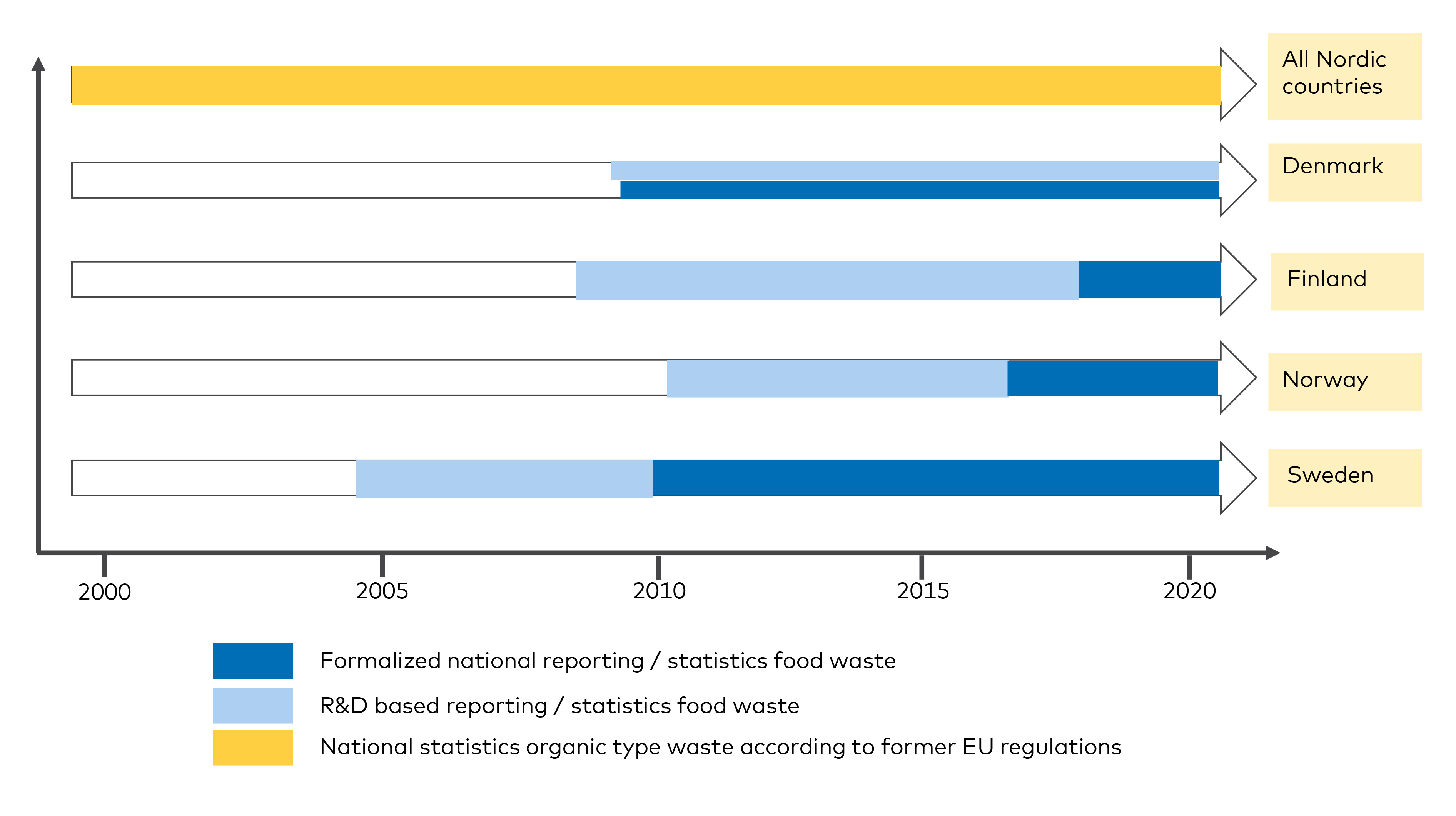
Figure 1 Overview of processes to monitor organic types of waste and food waste in the four Nordic countries included in this study
The two types of surveys on food waste and waste statistics have been carried out in parallel in the Nordic countries since 2010, with national statistics for “organic types of waste” according to European Waste classification as part of national waste accounting and statistics, and food waste statistics as parallel surveys organized differently in each country (see Chapter 8.3). From 2020, the New EU regulations on food waste statistics makes it mandatory both to sort out food waste from other waste fraction for separate collection, as well as to report on food waste statistics nationally from all stages in the food chain. The first report shall be sent to Eurostat by 1 July 2022, based on statistics from 2020.
It is thus necessary to develop new and more comprehensive and formal national systems for data gathering, systemizing and upscaling of data to national statistics on food waste from all Nordic countries from 2020. This will change the way statistics for “organic types of waste” is dealt with today, and will make it necessary to formalize the type of food waste statistics which so far has been done more on a voluntary and experimental basis in most of the Nordic countries.
This is the background for this project initiated by the Nordic Council of Ministers, to identify how food waste surveys and reporting has been carried out in the Nordic countries and the potential gaps between present methodologies for data gathering, definitions and system boundaries as well as upscaling methods and the new EU regulations. We have thus in the project focused most on the way food waste surveys and reporting has been carried out in each country, and not so much on national statistics for “organic types waste” which has been carried out over time according to earlier regulations and classification systems. We have used the latest available report from each country of food waste surveys and reporting as a basis for our systematic review of methodologies, definitions and system boundaries, and used this as a basis for the gap analyses compared to new regulations from 2020 on food waste statistics.
2 Goal and deliverables from the project
The goal of the project has been defined in the intention set up from the Nordic Council of Ministers in their tender document:
According to the request from Nordic Council of Ministers, we have focused on the following deliverables from the project:
- A report describing the main outcome of the project, as well as the outcome of the workshop described below. The report will be written in English with a short summary in each of the Nordic languages and will be published in TemaNord.
- Planning and organization of a Nordic workshop for experts in the field of food waste monitoring, covering representatives from authorities, business sectors and academia. This workshop was carried out through a webinar 22th September with one open part to present the main results from the study of definitions and methods in food waste monitoring, and a smaller workshop with invited participants to discuss prevention measures in households and retail. There were about 70 participants in the first part of the workshop, representing all Nordic countries, and about 30 participants in the second part, representing relevant organizations in Denmark, Finland, Norway and Sweden.
- An oral presentation of the main results from the project for the members of NMR Circular Economy group, and with a power point presentation that can be used by NMR representatives after the project period.
3 How the project has been carried out
The project has been carried out according to the tender document from March 2020 and the project plan that was approved by the Nordic Council of Ministers in their contract with NORSUS.
The main methodological approach applied in the project work has been to identify relevant documents in the form of written reports, papers and presentations from each of the Nordic countries covering definitions of food waste and loss used in the different countries, and also considering latest European Commission C(2019) 3211 requirements as well as describing methodologies that have been used to quantify and monitor food waste and loss and what is required by the EU Commission. We have used as a background the available data and statistics for food waste and loss from the Nordic countries as presented by Hanssen et al. (2016) and updated with new figures from the latest available statistics. We have gone through national reports to identify and systematize information about which definitions and methods that have been used as a basis for the food waste monitoring and statistics. We have separated methodologies in two main categories, covering both methods to quantify data about food waste and loss at the lowest level (primary data from business units, households, primary producers etc.) as well as methods and approaches for upscaling of primary data to national statistics. We have discussed similarities and dissimilarities between the different national monitoring systems in a systematic way, and through this approach identified if the differences between Nordic countries can be explained by methodological differences or if the differences are due to differences in wasting behavior. We have used the reports from the FUSIONS project (Møller et al 2013 a, b), WRI Food Waste Protocol and C (2019) 3211 as a basis to categorize the methods applied in each country. Those who want a more detailed description of how the different methods can be applied for food waste monitoring should go to the reports mentioned beyond.
We have developed a common framework to make a systematic evaluation of documents, combined with input by each partner based in his/her experiences from and knowledge about food waste monitoring and prevention in each country. Input has also been received from national authorities and experts in all countries being involved in the work.
The project has consisted of the following activities:
- Systemized present practice and definitions in the light of the new EU-regulations and the reporting of food loss and waste in relation to Agenda 2030 and SDG12.3. The aim is to create a common understanding to be used in the Nordic countries for comparing national datasets for food waste and loss (matavfall, matsvinn og sekundærressurser)
- Systemized present methodologies used in the Nordic countries for monitoring food waste and loss along the food chain, and propose a common, cost-efficient methodology for monitoring and reporting to be used in all countries in a way that it meets the Commission requirements as well.
- Planned and organized an expert workshop with key persons from the Nordic region, covering authorities, businesses, consultancies and academia.
- Investigated how the Nordic countries could support and strengthen the pace of food waste reduction at the retail and household level.
- Developed a final report from the project to be published in TemaNord and make an oral presentation for the NMR group.
- Project management and coordination
Due to the present Corona-restrictions for meetings both nationally and internationally, the whole project, including the expert workshop, has been done through Teams-communication between partners, the Steering Committee and the workshop participants. This has been an efficient, but not ideal way to carry out the project, probably with a broader representation in the workshop if it had been organized as a physical meeting.
4 Monitoring of food waste – methods, definitions and motivations
4.1 Monitoring systems – quantification, data collection and validation, up-scaling, reporting
Food waste monitoring can be done on different levels in the society, in companies, in business sectors and at the national level. Food waste monitoring will include the following key elements:
- Quantifying food waste at the point of generation, i.e. in farms, in the dairies and slaughterers, retail shops, households etc. This is the key element in monitoring, to quantify mass of food being wasted over a period of time on a certain level of detailedness or to estimate mass of food waste as good as possible, as primary data.
- Data gathering and systematization. Once data are available as primary data, it is necessary to get access to the data in a systematic and efficient way, presently through web-based portals, questionnaires, etc. Data should be gathered from as many data points as possible, to have representative data sets for further use in up-scaling and reporting. Data that has to be gathered are mass of food waste (eg economic value) generated over a certain time period, combined with data on production or turnover, to estimate waste factors (kg food waste per tonne of production).
- Upscaling to national statistics, based in food waste factors and production or sales statistics for sectors or subsectors. Upscaling should be done with basis in food waste factors from representative samples (economic or statistical) and within as homogenous samples as possible.
- Reporting which can be done annually on company level, sector level or on national level of food waste statistics through national official statistics and to Eurostat/EU. Reporting nationally and to EU should be based in the same data sets and be similar on aggregated levels but can be structured differently based in national and EU requirements.
In this report we have focused on quantifying food waste to be used in national monitoring of food waste with the aim to develop national statistics and for reporting to Eurostat.
The methodological description and analyses of food waste monitoring practise in the Nordic countries are based on earlier reports being carried out through the FUSIONS project (Møller et al. 2013, 2014, Tostivint 2015), the Food Waste and Loss protocols and reporting manuals from World Resource Institute and UNEP[1]https://www.wri.org/publication/food-loss-and-waste-accounting-and-reporting-standard, the EU monitoring regulations from 31 March 2019[2]COMMISSION DELEGATED DECISION (EU) 2019/1597 of 3 May 2019 supplementing Directive 2008/98/EC of the European Parliament and of the Council as regards a common methodology and minimum quality requirements for the uniform measurement of levels of food waste.
In the tables presenting the findings from each part of the food chain, we focus on how data on food waste and edible food waste are gathered and reported in the latest available reports from each country. While Environmental authorities and national statistics organisations are responsible for the organic waste statistics, statistics and reporting of food waste or edible food waste (matsvinn) varies more between countries and has changed over time, as shown in the tables below.
Food waste can be measured and quantified principally with three main approaches:
- Measuring food that will be wasted before it ends up in the waste bin or waste collector
- Measuring food waste after being wasted, through analyses of waste that has been generated.
- Indirect estimates of food waste
For all approaches, there are a number of different methodologies available to do the practical measuring, as described comprehensively by Møller et al. (2013, 2014) based in the work in the FUSIONS project. Which methods to use in different situations (e.g. stage in the food chain) are discussed and described more in detail in the manual from FUSIONS (Tostivint 2015) and FLW protocol[3]https://www.wri.org/publication/food-loss-and-waste-accounting-and-reporting-standard.
It should be noted that all methods are based on quantifying food waste as far as possible in mass flows, giving the numbers in tonnes or kilogram of food waste. In cases where it is difficult to measure food waste in mass directly, transformation factors are used for instance from economic values (e.g. retail sector), volumes (e.g. agriculture and fisheries, packing or storing houses) or land use (e.g. agriculture). All masses are given in fresh weight, i.e. with a normal water content of the food waste. This makes it important to store food waste to be weighted in a cool and humid environment before being studied in waste composition analyses (e.g. Hanssen et al. 2015).
Detailed data about which types of food that is wasted at each stage in the food chain is also a necessary basis to calculate environmental impacts (especially Greenhouse Gas (GHG) -emissions) and economy value of food being wasted. Reporting on GHG-emissions and economic value of food waste have been implemented in the Norwegian and the Finnish food waste monitoring system, based in availability of detailed quantitative data on food waste.
One important output from food waste quantification is food waste factors (kg food waste per ton of production or per unit of turnover). Waste factors are important element as a basis for national food waste statistics, when scaling up from a sample of companies or municipalities/households being analysed, to national levels. Waste factors should be generated based in representative samples of waste generating units (companies, public services, municipalities etc), with both mean values as well as with standard deviations, to assess if the sample sizes are satisfying. Waste factors can thus also be used as proxy factors to estimate food waste from other organisations. Hanssen et al (2013) proposed to use the same approach for estimating food waste that is used in GHG accounting, with so-called Tier 1 to Tier 3 factors. Tier 1 can be used as a proxy on a “global” level, e.g. food waste factors for the food industry In the Nordic region. Tier 2 is national proxy factors which are relevant for specific sectors on a national level and Tier 3 is specific food waste factors at a company or municipality level.
The most relevant methodologies to be used in the three approaches are briefly described in the following. Those who want more details about the methodologies should go to the reports referred to above.
The most relevant and applied methods are
- Scanning of food that is no longer possible to sell in ordinary channels, e.g. in retail companies, whole-sellers, food industry etc. This is a widely used method in the retail sector to have track on inventories of the stores, and to keep focus on economic loss from non-sold products. Staff in the retail companies scan all products that have to be wasted, and the records are gathered in big internal data bases in companies and used to evaluate which products that are not sold in big enough volumes. As scanning first of all measure economic loss directly, it is important to include a set of categories of losses, to distinguish between economic loss (e.g. donations) and food waste (food that is sorted out for final waste treatment).
- Weighing or measuring volumes of food or food scraps that is not used/sorted away before throwing it into the waste bin/collector. Such weighing is used by many companies and facilities in the hospitality sector, where there are technologies to directly register mass of food being wasted in data systems. Weighing or estimating mass of food waste from volumes being wasted is also used in production, processing and packing of fruits, vegetables and potatoes in primary production.
- Food waste diaries, where people are recording which products are wasted in households, in canteens and restaurants before throwing food and food rests in the bin is used mostly in shorter tests and experiments to increase motivation for food waste reduction. Diaries is also often used over a certain time period (2-4 weeks) to estimate amount of food waste being generated in a control period, to upscale to total amounts per year. In the hospitality sector, an increasing number of organisations are using smart scales or kitchen scales where food that is wasted can be quantified and with smart scales registered directly.
- Estimate amount of non-harvested secondary resources[4]Vegetables, fruits, cereals wasted before harvesting (side flows) from agriculture production, especially from production of fruits and vegetables, potatoes, cereals etc. In such cases estimates are done about how much non-harvested secondary resources are left per m2 or per unit of control areas, to upscale to total amount from production in a farm or production unit.
- Other pre-waste methods used in the food sector, e.g. counting of units or measuring volumes of food that is collected for waste treatment, combined with factors for specific weight per unit or per volume.
Footnotes
- ^ https://www.wri.org/publication/food-loss-and-waste-accounting-and-reporting-standard
- ^ COMMISSION DELEGATED DECISION (EU) 2019/1597 of 3 May 2019 supplementing Directive 2008/98/EC of the European Parliament and of the Council as regards a common methodology and minimum quality requirements for the uniform measurement of levels of food waste
- ^ https://www.wri.org/publication/food-loss-and-waste-accounting-and-reporting-standard
- ^ Vegetables, fruits, cereals wasted before harvesting (side flows)
- Weighing mass of total waste or mass of organic waste and then estimate the proportion of food waste, is clearly the most common method to register mass of food being wasted. Mass of food waste is normally measured by waste contractors or by the waste handling operators in municipalities when waste is collected. Waste contractors register normally/often mass of waste individually per collection site, as a basis for invoicing companies per ton of waste collected. In some cases, volumes are registered based in size of containers and degree of filling and must then be multiplied with specific weight of the type of waste being collected.
- Waste composition analyses, by picking representative samples of larger volumes or populations, both to measure amount of food waste in total, share of food waste from other waste types in mixed waste collection, share of edible and non-edible food stuffs and proportion of food types being wasted (see Hanssen et al. 2016 etc for description of methodology).
- Other relevant post-bin methods.
- Mass balance approach, where the amount of food waste is estimated based in quantification of food stuffs entering a process or a facility and the amount of food products being produced and sold. The difference between the two will in line with the mass conservation principles be an estimate of food being wasted. This can typically be used in the food industry, the retail sector, food service companies.
- Estimates based in waste factors, from earlier studies, from sector reports etc, showing amount of food waste being generated per tonne of product being produced, per area of production of vegetables, per m3 of milk being produced in a farm etc. Those commonly used factors are used for up-scaling but can also be a first approach to estimate food waste from a given production. Waste factors can be seen in parallel to Tier 1 or Tier 2 factors in GWP-estimates in climate accounting.
- Factors showing edible fraction of different food types. Some countries follow the traditional segregation in edible and non-edible food waste, to have a specific focus on food stuff which most easily can be prevented from being wasted. In Norway, Food authorities has published a food table, showing average values for edible parts of about 1600 different types of food (Matvaretabellen 2020).
4.2 Motivation for food waste monitoring in companies and municipalities – top/down and bottom-up approaches
Monitoring food waste can be done for different purposes, but the three main reasons for why organizations should quantify regularly (at least once a year) food waste are:
- To use data in own organisation to identify where and how measures should be taken to prevent and reduce food waste internally and to measure effects of reduction over time, as well as to share data with other organisations in the food chain for the same reasons.
- To make data available for national statistics and reporting of status and trends in food waste generation, to see if the country achieves national and international goals for food waste reduction, e.g. 50% reduction before 2030 as defined by United Nations and EU.
- To improve quality of data, through continuous learning and improving the methods for data gathering both by those who generate the data and by those who gather data and systemize and analyse data towards national statistics.
It is often given most emphasize on the second point in this context, and guidelines and regulatory acts are often established first of all to get access to data as a basis for national statistics. It is however a well-known fact, that prevention and reduction is realised in each organisation, that organisations need those data to manage their food waste and that data used as a basis for national statistics not have the best quality, if organisations that generate the primary data do not see the value of the data for themselves. To have data available as a basis for prevention it is important to have available data of all food that is lost and not being used to feed humans. Prevention and reduction measures should focus on the upper part of the waste hierarchy which means that there is a need for quite detailed data on which types of food which is lost at each stage of the food chain. There should also ideally be connections between detailed food waste monitoring and analyses of root causes for why food is wasted, as an important source of ideas for solutions to be evaluated and implemented.

Figure 2 Bottom-up and top-down approaches to food waste monitoring
This have been the idea behind the Norwegian food waste prevention work from the very beginning in 2010 with the ForMat-project, followed up by the Negotiated agreement in 2017, to involve companies directly in the work. Companies have been followed up with results and statistics, both for their own business as well as for their sectors, and many companies use their data first of all for internal work with prevention measures and actions. The same has been the case in Finland since 2010, where LUKE has been the main actor in promoting the waste hierarchy.
The top down perspective is aimed for understanding and follow up on policy measures and how politics is implemented in member states. In contrast, the bottom-up approaches are aimed for change management on stakeholder level. The choice of methodology and choice of boundary conditions approach will be determined by the aim of the monitoring initiative (Figure 3).
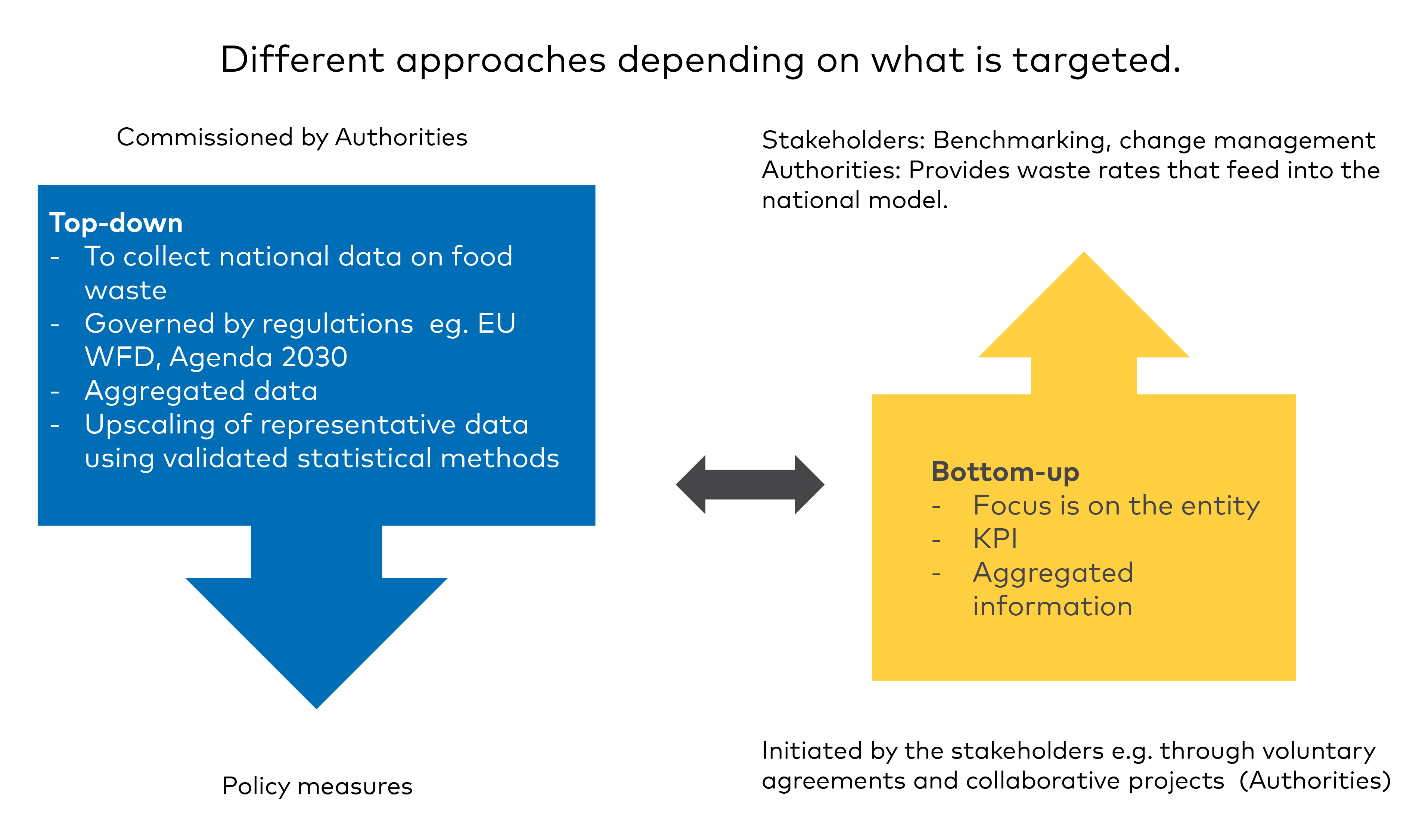
Figure 3 Top-down approach and bottom-up approach for collecting food waste statics
5 Regulatory framework for food waste monitoring in the EU and globally (SDG)
5.1 EU regulations
From 2020 the EU countries are obliged to report food waste data according to the new waste framework directive. Through the Paris Agreement and Agenda2030 the Nordic countries have agreed to work towards the 17 Sustainability goals which also address food waste reduction though SDG12.3 stating[1]sustainabledevelopment.un.org/sdg12:
To follow up on SDG12.3 indicators have been developed. To support food waste reporting large efforts have been made to align the EU-reporting and the reporting towards SDG12.3 as much as possible to avoid unnecessary double work.
This chapter aims to bring clarity into the definitions and boundary conditions used in the national reporting in the Nordic regions also covering the voluntary agreement/national projects on food waste monitoring.
Footnotes
5.2 Reporting according to the Waste Framework Directive
Understanding of the scope of the EU Waste Framework Directive (WFD) is crucial for understanding the new reporting obligations. In this section a short review of the scope of WFD (linked to food waste) is provided to create an understanding on the legal obligations of reporting. The methodologies used are further explained in Chapter 5.
According to the WFD[1]Directive 2008/98/EC on waste (Waste Framework Directive) https://eur-lex.europa.eu/legal-content/EN/ALL/?uri=CELEX%3A32008L0098 all EU countries and countries linked to the EEA agreement are obliged to report to EU on waste statistics. The guidance document[2]https://ec.europa.eu/eurostat/documents/342366/351811/Guidance+on+food+waste+reporting/5581b0a2-b09e-adc0-4e0a-b20062dfe564 provided by Eurostat provides a comprehensive overview of what to report (according to the WFD which is the legal basis for national reporting
According to the waste framework directive:
Further on, by-product is defined in the waste framework directive as:
The EU legislation[3]COMMISSION DELEGATED DECISION (EU) 2019/1597 of 3 May 2019 supplementing Directive 2008/98/EC of the European Parliament and of the Council as regards a common methodology and minimum quality requirements for the uniform measurement of levels of food waste,[4]COMMISSION IMPLEMENTING DECISION (EU) 2019/2000 of 28 November 2019 laying down a format for reporting of data on food waste and for submission of the quality check report in accordance with Directive 2008/98/EC of the European Parliament and of the Council is based on the definition of Food according to the European Food law (EC) No 178/2002) as provided in section 4.1 and the definition of waste according to the WFD as described in Figure 4. In the light of this the concept of food and food waste is explained by the commission according to:
Footnotes
- ^ Directive 2008/98/EC on waste (Waste Framework Directive) https://eur-lex.europa.eu/legal-content/EN/ALL/?uri=CELEX%3A32008L0098
- ^ https://ec.europa.eu/eurostat/documents/342366/351811/Guidance+on+food+waste+reporting/5581b0a2-b09e-adc0-4e0a-b20062dfe564
- ^ COMMISSION DELEGATED DECISION (EU) 2019/1597 of 3 May 2019 supplementing Directive 2008/98/EC of the European Parliament and of the Council as regards a common methodology and minimum quality requirements for the uniform measurement of levels of food waste
- ^ COMMISSION IMPLEMENTING DECISION (EU) 2019/2000 of 28 November 2019 laying down a format for reporting of data on food waste and for submission of the quality check report in accordance with Directive 2008/98/EC of the European Parliament and of the Council
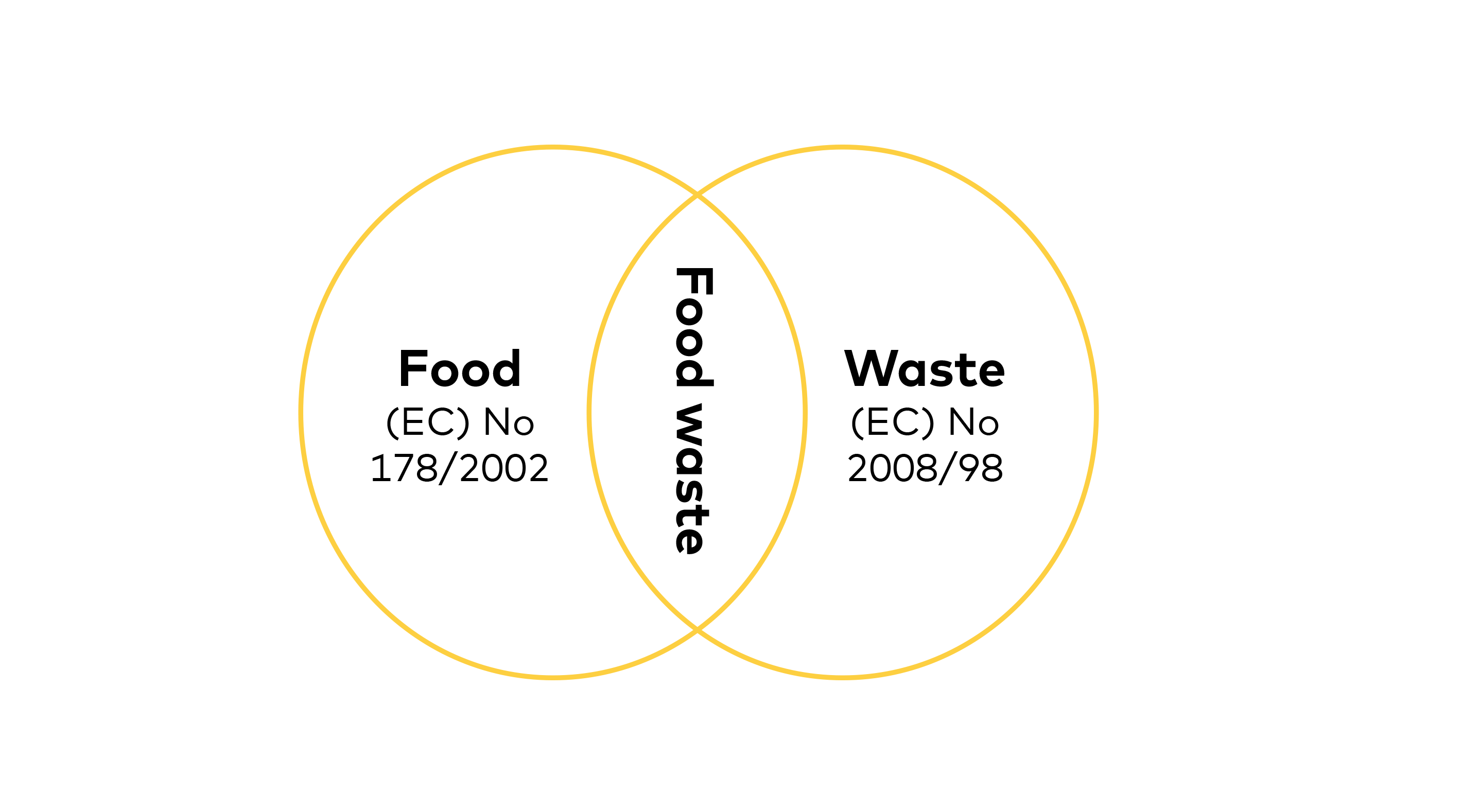
Figure 4 Food waste to be reported to EU in relation to the WFD and the European food law
Further, according to the definition in the food law the following fractions are excluded since they are not considered as food or are very small:
- By-products and animal by- products including food placed on the market for transformation into feed (not considered as food)
- material that has not become food yet e.g. raw material before harvest and slaughter (not considered as food).
- Food waste fractions in side-flows where you do not expect food waste
- Street waste
The EU Commission has also asked the member states to on a voluntary basis report
- Parts of food intended to be ingested by humans ("Edible parts")
- Food waste drained as or with wastewater
- Surplus food (not waste):
- Food redistributed for human consumption (not waste)
- Food placed on the market for transformation into feed
-
Former food stuff[1]https://www.effpa.eu/what-are-former-foodstuffs/
The total food waste as defined by the WFD considering the expectations above and the voluntary amounts as described above are to be reported for each step in the supply chain:
- Primary Production
- Processing and manufacturing
- Retail and other distribution of food
- Restaurants and food services
- Households
The reporting shall be done on an annual basis. The member states shall measure the amount of food waste in metric tonnes of fresh mass generated. Further in-depth measurement for a given stage of the food waste using one of the prescribes in depth methods should be carried out at least once every fourth year, meaning that the data reported must not be older than 4 years.
For the first reporting period (jan-dec 2020) in-depth methods must be used for all stages in the supply chain. Data sets used must not be older than from 2017.
Figure 5 provides an overview of material, boundaries, and destinations relevant for food waste reporting as covered by the WFD and delegated act as described above.
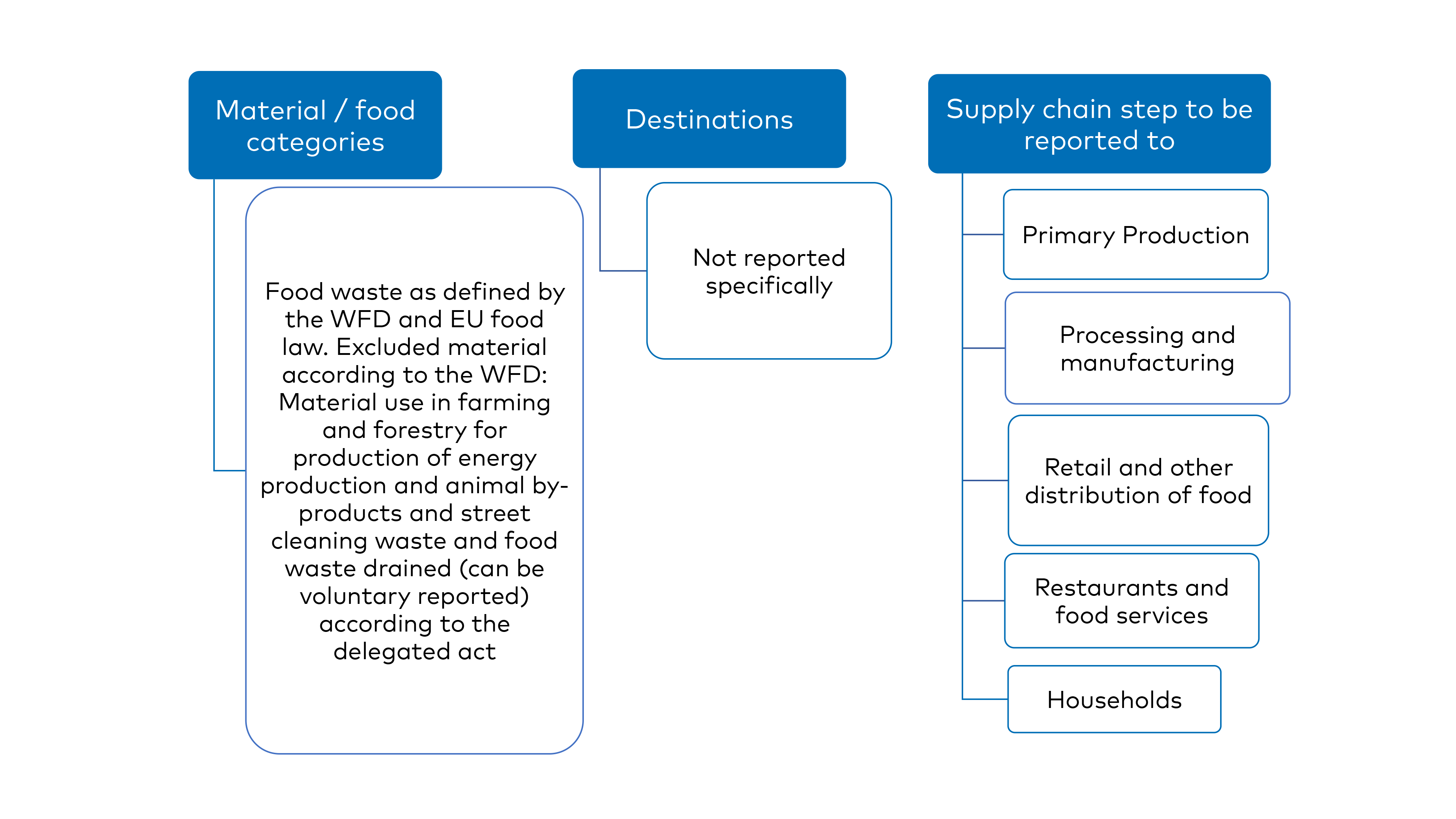
Figure 5 Overview of food related material flows and boundaries covered by the European Waste Framework Directive
5.3 Reporting according to SDG12.3
5.3.1 Reporting terms and definitions
FAO distinguishes between Food loss and Food waste as well as material losses and qualitative losses[1]FAO. 2019. The State of Food and Agriculture 2019. Moving forward on food loss and waste reduction. Rome. Licence: CC BY-NC-SA 3.0 IGO where
Food losses is the decrease in the quantity or quality of food resulting from decisions and actions by food suppliers in the chain, excluding retailers, food service providers and consumers
and
Food waste refers to the decrease in the quantity or quality of food resulting from decisions and actions by retailers, food service providers and consumers.
Since it is difficult to objectively distinguish between Food Loss and Food Waste in all situation a pragmatic approach has been taken when developing the two indicators Food Loss Index (FLI) and Food Waste Index (FWI)[2]FAO. 2019. The State of Food and Agriculture 2019. Moving forward on food loss and waste reduction. Rome. Licence: CC BY-NC-SA 3.0 IGO. FLI refers to the Food Loss and Waste (FLW) on the on the supply side of the food chain (Green in Figure 6.) and FWI cover refer to the demand side of the supply chain from retail to consumption (Yellow in Figure 6).
The definition of FWI is linked to the 50% reduction target (SDG12.3) and FLI is not linked to the second part of the SDG12.3 goal being that food losses shall be reduced all along the food chain. The Indicators do not reflect qualitative losses. It is however recommended (if possible) to collect information on prices and destinations, that is how the FLW handled, in order to extract information on the qualitative loss in the future[3]FAO. 2019. The State of Food and Agriculture 2019. Moving forward on food loss and waste reduction. Rome. Licence: CC BY-NC-SA 3.0 IGO.
Footnotes
- ^ FAO. 2019. The State of Food and Agriculture 2019. Moving forward on food loss and waste reduction. Rome. Licence: CC BY-NC-SA 3.0 IGO
- ^ FAO. 2019. The State of Food and Agriculture 2019. Moving forward on food loss and waste reduction. Rome. Licence: CC BY-NC-SA 3.0 IGO
- ^ FAO. 2019. The State of Food and Agriculture 2019. Moving forward on food loss and waste reduction. Rome. Licence: CC BY-NC-SA 3.0 IGO
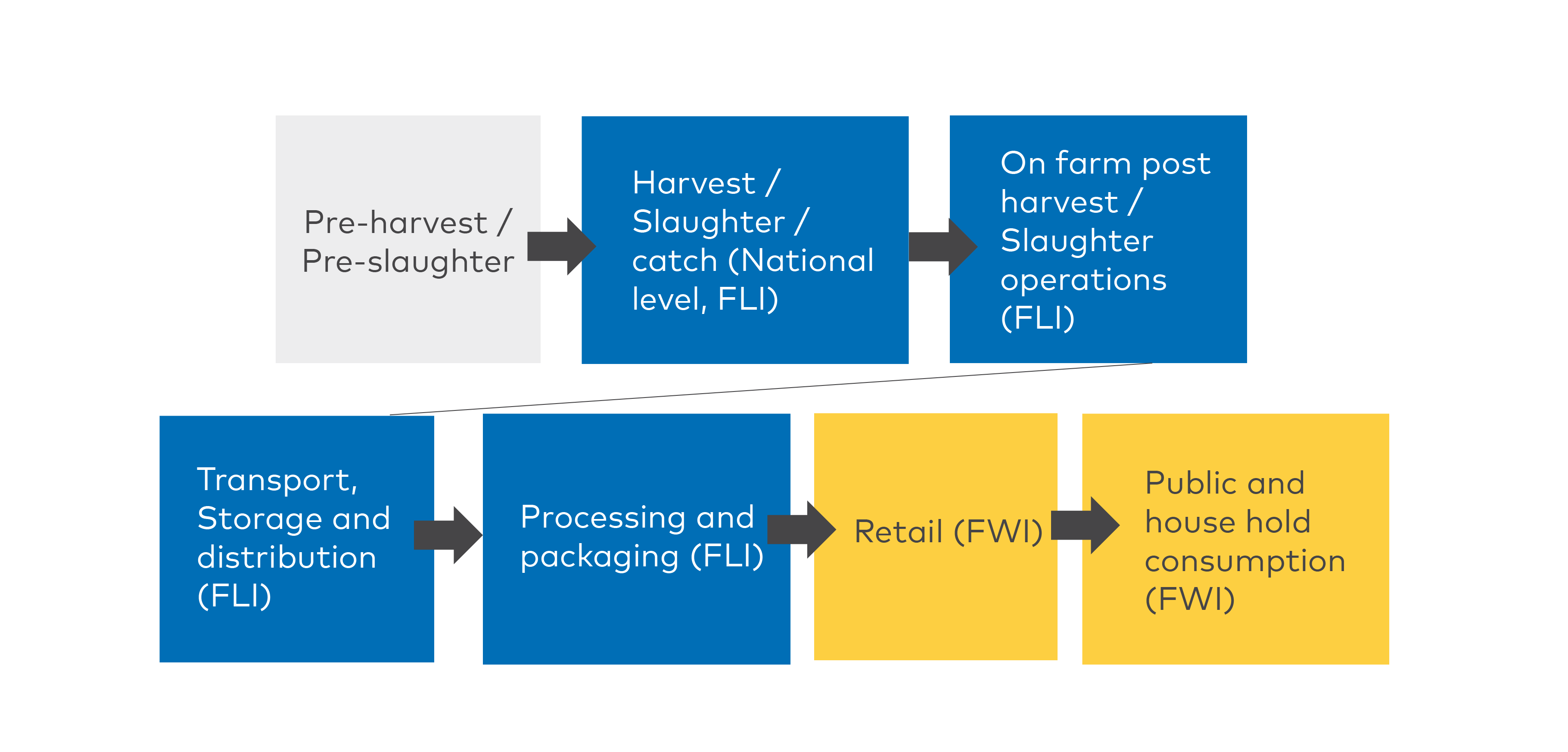
Figure 6 Definition of boundaries for FLI (green) and FWI(yellow) with respect to the food supply chain[1]FAO. 2019. The State of Food and Agriculture 2019. Moving forward on food loss and waste reduction. Rome. Licence: CC BY-NC-SA 3.0 IGO
Footnotes
- ^ FAO. 2019. The State of Food and Agriculture 2019. Moving forward on food loss and waste reduction. Rome. Licence: CC BY-NC-SA 3.0 IGO
5.3.2 Indicators for SDG12.3
The indicators used by FAO are relative, that is they compare the relative FLW percentage based on mass to the FLW percentage under a defined period (base year) on a global/regional basis. Considering national data countries are free to choose base year. (National indicators are not reported to FAO)
As for the EU definition of food waste the indicators cover all side flows (edible and inedible parts of food) going for waste management (including anaerobic digestions). Seed, feed and industrial use are not included.
Food Loss index (FLI)
The FLI is developed by FAO and the methodology is well described[1]https://unstats.un.org/sdgs/metadata/files/Metadata-12-03-01A.pdf.
Food loss is defined as
FLI is based on the ten most important raw material based on FAOs statics within the following product categories
- Cereal and pulses
- Fruits and vegetables
- Root, tubes and oil-bearing crops
- Animal products
- Fish and Fish products
Each country is free to choose which products to follow-up on.
For the global calculations and time being FAO will not collect data on harvest and slaughter/catch (light green in Figure 6) however for the national data FAO recommend to collect these data. The FLI will be calculated based on the data collected though FAO’s annual Agriculture Production Questionnaire in April every year[3]https://unstats.un.org/sdgs/metadata/files/Metadata-12-03-01A.pdf.
Food waste Index
FWI is still under development by UNECE. The definition that can be found is[4]https://unstats.un.org/sdgs/metadata/files/Metadata-12-03-01A.pdf:
Food waste are all food that completely exits the food chain from retail level, including consumption stages of the food supply chain
According to the information given so far, the discussion on the FWI is an overlap between the scope covered by the EU legislation for retail up to consumption and the scope of FWI[5]https://unstats.un.org/sdgs/metadata/files/Metadata-12-03-01A.pdf[6]https://webcast.ec.europa.eu/webinar-on-food-waste-measurement, final discussion.. No common base year has been agreed upon[7]Personal communication Tom Quested, WRAP, May 2020 The reporting cycle is every two years and starts 2020. A questionnaire will be sent to countries every 2 years by UNSD/UNEP requesting annual data[8]https://webcast.ec.europa.eu/webinar-on-food-waste-measurement, final discussion..
Footnotes
- ^ https://unstats.un.org/sdgs/metadata/files/Metadata-12-03-01A.pdf
- ^ Industrial use “ includes biofuels, fibres for packaging material, creating bioplastics (e.g. polylactic acid), making traditional materials such as leather or feathers (e.g. for pillows) and rendering fat, oil or grease into a raw material to make soaps, biodiesel or cosmetics are not considered as FLW nor is use as such as fertilizer and ground cover”.
- ^ https://unstats.un.org/sdgs/metadata/files/Metadata-12-03-01A.pdf
- ^ https://unstats.un.org/sdgs/metadata/files/Metadata-12-03-01A.pdf
- ^ https://unstats.un.org/sdgs/metadata/files/Metadata-12-03-01A.pdf
- ^ https://webcast.ec.europa.eu/webinar-on-food-waste-measurement, final discussion.
- ^ Personal communication Tom Quested, WRAP, May 2020
- ^ https://webcast.ec.europa.eu/webinar-on-food-waste-measurement, final discussion.
5.4 Comparing the new EU-legalisation and FLI and FWI
Table 2 provides an overview of what is included as obligatory and voluntary respectively in the EU-legislation and for the reporting on SDG12.3 using FLI and FWI. It can be concluded that the frameworks are relative coherent.
The major differences are that the food chain stages Household and Restaurants are combined in the SDG framework and that in the EU-framework Wholesale and retail and transport are combined while for reporting according to the SDG12.3 retail becomes a apart of FWI and Wholesale and Logistic is a part of the FLI. An important difference is that FLI requires that a set of specific products are followed up rather than the waste percentage for a whole sector (e.g. for EU requires reporting on “Primary production” “Processing and manufacturing” and “Retail and Distribution”) Further FAO has chosen to not include “Primary production” as obligatory of practical reasons. there is a lack of data globally and the information cannot be extracted from the FAO food balance sheets being the major source for calculating FLI on a global scale[1]Fabi C (2020) https://vimeo.com/402112586.
Only the destinations for side flows included in the current reporting are provided in Table 2. The destinations for the EU-reporting and reporting against Agenda 2030 (SDG12.3) are coherent, besides for primary production, where the FWD is more restrictive[2]Exluded from thteh WFD is (1) Straw and other natural non-hazardous agricultural or forestry material used in farming, forestry or for the production of energy from such biomass through processes or methods which do not harm the environment or endanger human health” (2) Wastes that are internally recycled (e.g. disposal of by-catches and fish guttings from fishery at sea, however any disposal operation, such as the disposal of waste at a company’s own landfill; energy recovery operations should be included).(3) animal carcasses and animal by-products covered by Regulation (EC) No 1069/2009. The destinations are not specifically reported in either framework but serve as important boundary conditions on what to include or not as the different steps in the in the food chain. However, destinations are an obligatory element in the Global food loss and waste accounting and reporting standard which forms the bases for the collections of data by stakeholders[3]https://flwprotocol.org/flw-standard/.
Footnotes
- ^ Fabi C (2020) https://vimeo.com/402112586
- ^ Exluded from thteh WFD is (1) Straw and other natural non-hazardous agricultural or forestry material used in farming, forestry or for the production of energy from such biomass through processes or methods which do not harm the environment or endanger human health” (2) Wastes that are internally recycled (e.g. disposal of by-catches and fish guttings from fishery at sea, however any disposal operation, such as the disposal of waste at a company’s own landfill; energy recovery operations should be included).(3) animal carcasses and animal by-products covered by Regulation (EC) No 1069/2009
- ^ https://flwprotocol.org/flw-standard/
Table 2 Overview of the of similarities and differences between what to report according to the new EU-law on reporting food waste and the SDG12.3Indicators FLI and FWI.
| EU Households | EU Food service and restaurants | Wholesale, storage and transport (up to retail) (SDG) | Processing and manufacturing | Primary production | ||||||||
| SDG Consumption | EU Retail and distribution | |||||||||||
| Total food waste | Edible parts of food | Total food waste | Edible parts of food | Total food waste | Edible parts of food | Total food waste | Edible parts of food | Total food waste | Edible parts of food | Total food waste | Edible parts of food | |
| Specifically, for FLI, 10 product categories to be monitored | Not relevant | FLI –obligatory 10 products | FLI voluntary | |||||||||
| Food waste drained as or with waste- water | EU- voluntary. (Edible parts of food are not specifically reported for drained food waste), Not included in FWI. Included in FLI if relevant | |||||||||||
| Food redistributed for human consumption | EU- voluntary (not food waste, edible parts are not reported) Not included in FWI | |||||||||||
| Food placed on the market for transformation into feed | EU voluntary (not food waste, edible parts are not reported) Not included in FWI | |||||||||||
| Former food stuff | EU voluntary (not food waste, edible parts are not reported) Not included in FWI | |||||||||||
| Animal By products | Not relevant | FLI obligatory | ||||||||||
| Waste management (Waste framework directive and UN defines FLI and FWI defines waste management coherently) | EU obliga|tory and FWI obliga|tary | EU-volun|tary | EU obliga|tory and FLI obliga|tary | EU obliga|tory and FLI volun|tary | ||||||||
| Harvest/ Slaughter/ Catch losses not covered by the WFD. | FLI volun|tary | |||||||||||
6 Survey of food waste monitoring in the Nordic countries
6.1 Introduction
The purpose of this overview is to illustrate current best practice in each country considering definitions and boundaries and to bring clarity into the definitions and boundary conditions used in the national reporting in the Nordic regions. The survey covers the national reporting as well as the voluntary reporting carried out based on negotiated agreements, which are independent initiatives from the national reporting. The voluntary reporting contributes however to the national reporting in the Nordic countries and is therefore relevant and an important source for data and may contribute to the national reporting though established frameworks for reporting.
In our assessment we have chosen to cover all destinations irrespective of what is formally defined as food waste. An overview of all destinations is crucial from a stakeholder perspective to take appropriate actions to reduce food waste and at the same time take care of any food waste as resource efficient as possible.
It should be stressed that this survey provides an overview of the frameworks used rather than actual data being at hand.
6.2 Identifying definitions, terminologies and boundary conditions applied in the Nordic countries
The reports forming the base for the survey are provided in Table 3. Those reports were considered as the most comprehensive national reports at hand in each of the countries and thus reflects best practice in the Nordic region. The reports are a mix of National reports from negotiated agreements (Norway) as well as national reports based on collaborative projects (Finland) with the authorities and national reports based on the work by authorities (Sweden and Denmark).
The scope of the reporting in each country is assessed according to:
Material: Information is collected on which type of material that is assessed. Specifically, if edible parts of food are reported separately or alternatively inedible part of food are reported together.
Destinations: Information is collected on how a side-flow /food waste flow is taken care of. Also, destinations not defined as food waste are covered e.g. donations. Donation is a voluntary destination to report according to the new EU-reporting requirements. To have an overview of all destinations is crucial from a stakeholder perspective to take appropriate actions.
Supply chain steps: Provides information on from which steps in the supply chain that are distinguished between in the reporting of the material being assessed.
Level of detail: Which level of detail are the data reported on in the different Nordic countries
Additional indicators: Besides the amount of material are other indicators linked to the amount of food waste reported
Additional information that was assessed were time frame for the reporting and if any particular side flow is excluded, for example waste leaving through the drain or the material collected is limited to what is defined as waste according to the waste framework directive. The principles for allocating waste to a certain step of the food supply chain were also compared. The two approaches that can be used are that the amount of waste is allocated based on (i) the owner of the mass or (ii) by where the waste physically appears.
It should be noted that although the definitions and boundaries are in place it does not mean that complete datasets are available. That assessment is out of scope in this project
The detailed assessments on a country base are provided in Appendix 1. Definitions and Future perspectives are provided in chapter 8.1.1 below.
| Country | Report and publication year | Year for collecting the data |
| Denmark | Kortlægning af sammensætningen af dagrenovation og kildesorteret organisk affald fra husholdninger (Lerche et.al. 2018) | 2017 |
| Kortlægning af madaffald i servicesektoren (Petersen et.al 2014) | 2014 | |
| Kortlægning af madaffald i detailhandelen og anden fødevaredistribution - Forslag til afgrænsning og metode (Kjær og Werge 2020) | 2018 | |
| Affaldsstatistik 2018 (Miljøstyrelsen 2020) | 2018 | |
| Finland | From measurement to management: Food waste in the Finnish food chain (Hartikainen et al. 2020). Final detailed description of the method and monitoring principles will be published 2020 by Luke (https://www.luke.fi/ruokahavikkiseuranta/en/) | Data will refer 2018, 2019 and 2020. |
| Norway | Food waste in Norway – report on key figures 2015-18 (Stensgård et al. 2019) | 2018 |
| KuttMatsvinn2020 – Forskning (Møller & Callewaert 2020 in prep). | 2017-2019 | |
| Kartlegging av mengder av og årsaker til matsvinn i sjømatnæringen (Carajal et al. 2020). | 2018-19 | |
| Sweden | Uppföljning av etappmålet för ökad resurshushållning i livsmedelskedjan (Andersson et. al, 2020). Commissioned by SEPA Matavfall I Sverige Uppkomst och behandling 2018, published 2020 (SEPA, Andersson and Stålhandske, 2020) |
Table 3 Reports forming the base for the current assessment
6.2.1 Overview of defintions and future perspectives.
Denmark
The Danish definition for food waste is consistent with the EU defintion of waste being: Food waste = Inedble parts of food and edible parts of food wasted. Edible parts of food will be estimated for all parts of the value chain from farm to fork.
Future perspectives: In Denmark the Ministry of Environement and Food has established a Thinktank on food waste called ONE\THIRD. ONE\THIRD has established a voluntary agreement on food waste reduction targets and data reporting.
Finland
The Finnish definition for food waste applied is based on a recent Finnish research project led by Luke (head funder is Ministry of Agriculture and Forestry of Finland, 2018-2020). In the project Luke has arranged national discussions between different actors of the food chain to discuss definitions, food waste data collection methodologies, and measures to reduce food waste. The project is also based on Luke’s past research studies and international collaboration. In the project Luke has published the definition for food waste, has tested and further developed food waste quantification methodologies and reported the results, and is going to publish the first version of the national food waste reduction road map by the end of 2020. The key driver behind definitions is to monitor, reduce and report food waste (both nationally and to EU and UN). The data collection is more detailed than what Commission and UN require. The Finnish definition is:
Future perspectives: In future Luke is pursuing that data collection is reported and more open. Luke will also calculate and report the financial loss and environmental impacts of food waste which will require further data collection on financial figures and higher data resolution.
Norway
The Norwegian data set assessed is based on the work of the Norwegian negotiated agreement (Bransjeavtalen om reduksjon av matsvinn). The definition for food waste (matsvinn) according to the voluntary agreement is:
The rationale behind the very detailed and comprehensive Norwegian registration and reporting system for edible food waste (“matsvinn”) is to have a good basis for actions to prevent food being wasted or not used for its primary intention, as human feed. A deep involvement from business actors and the public sector (includes both municipalities for household waste and public sector as food provider to own employees as well as users) along the whole food chain from the food industry via retail and wholesale to the food service sector results in detailed data, which is used both internally and by the signatories of the Negotiated Agreement to follow trends over time. Involvement of NORSUS from the very beginning (and from SINTEF in fishery and aquaculture sector) has been important for development of methodologies for measuring, upscaling and transforming data into mass flows, economic values and GHG-values.
Future perspectives: The present system which is now well integrated in the Negotiated Agreement will be the basis for further development of the system into national statistics and official reporting of data on food waste to Eurostat, according to new EU regulations.
Sweden
The Swedish dataset assessed is based on the work by SMED (Swedish MiljöEmissionsData) on behalf of the Swedish EPA. The definition for food waste (livsmedelsavfall) is consistent with the EU definition of waste being. Further, losses not covered by the WFD is suggested to be referred to as “livsmedelsförluster”. Donations are neither but seen as an economic loss.
It should be noted that Sweden has collected data also beyond what is required in related to resource efficiency and food loss and waste. These are included in Figure 7 even though they are not linked to the official reporting of food waste 2018 since they are at hand.
Future perspectives: In Sweden linked to the Swedish environmental objectives and the milestone target on reducing food waste (as defined by EU) with 20% /capita from 2020 to 2025 it is further stated that an increased amount of food produced shall reach retail and consumer by 2025. To follow up this Sweden is currently developing methods for following up lost and wasted food from farm (harvest losses) up to retail as an additional part of the national statics. The VA “Samarbetet för minskat matsvinn” (SAMS) will collect data from its member that the SEPA and Swedish Board of Agriculture will have access to for national statistics. The Swedish Food Agency are also making surveys in public kitchens this can hopefully be used in the national statistics in the years to come[1]Linstow et al. 2021.
Footnotes
- ^ Linstow et al. 2021
6.3 Similarities and difference in the Nordic countries considering national reporting
An overview of the current frameworks used for reporting is provided in Figure 7 where white means that this is common for all and grey means that there are differences in the different countries. Each grey box is further coded based on which countries that do address the content in the grey box, bold means that the country generally address the content while not bold means it is approached to some extent.
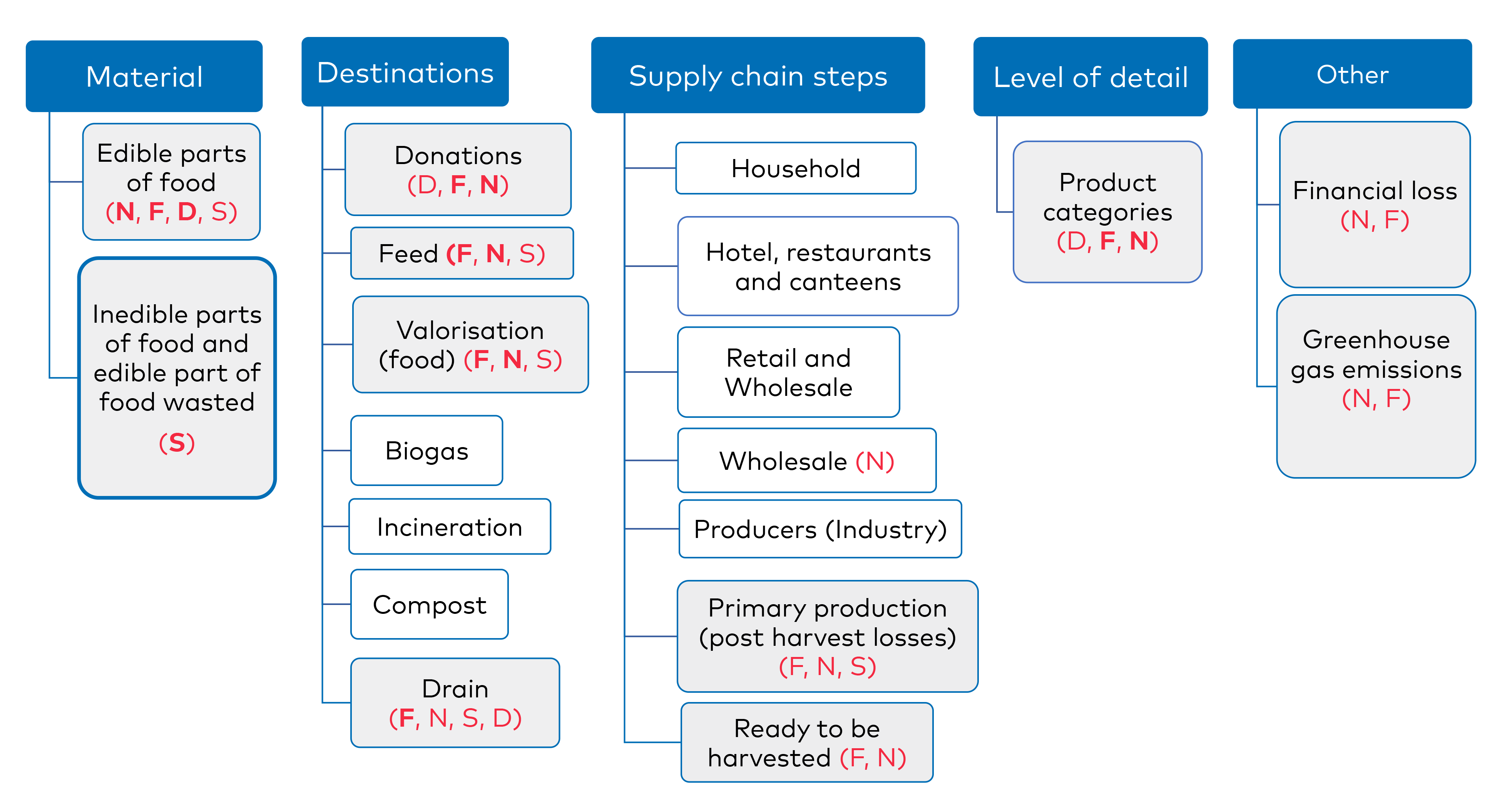
Figure 7 A comparison of the reporting in Denmark, Finland Norway and Sweden. Grey means that there are differences. D= Denmark (reporting commissioned by the authorities), N=Norway (Bransjeavtalet), F=Finland (collaborative research project) and S= Sweden (reporting commissioned by the authorities). Bold means that the material and destination is reported for most supply chain steps.
Specifically, we can see that
- Bottom-up vs. top-down: Until now Finland and Norway have adopted a more pronounced bottom up-approach than Sweden and Denmark.
- Edible parts of Food. Norway and Finland as well as Denmark collect data on edible parts of food for all steps in the supply chain while Sweden only does for households.
- Product categories: Norway, Finland, and Denmark (for retail, food service and household food waste) distinguish between product categories.
- Drain: Food waste that goes to the drain has been addressed in Norway (food industry and hospitality sector partly), Finland (households), Sweden (households and some industry) and Denmark (households).
- Feed: Data on Food used as feed are included in food waste statistics in Norway (although not quantified separately so far) and Finland, and Sweden has in a different project commissioned by the authorities and based on current information, made some estimates. Denmark has not addressed Food lost as feed.
- Valorization: Norway includes food losses being valorized to other products, but without any specific quantification. Finland is quantifying food losses going to valorization. Sweden has some data sets and Denmark does not address valorization.
- Ready to harvest: Only Norway and Finland have so far addressed this fraction, but only Finland has so far collected data on food left on field without harvesting.
- Financial Loss: Norway and Finland have estimated financial losses due to food loss and waste.
- Donations: Although not food waste, donations are captured in the reporting from the negotiated agreement in Norway. Data are also at hand in Finland and Denmark (reported individually by stakeholders), while Sweden does not address donations.
Based on the assessed frameworks, being based on what has been considered as best practice in each country, we can see that Sweden and Denmark link their reporting closely to the waste framework directive while Finland and Norway base their most data collection on voluntary reporting in close collaboration with stakeholders. This explains why Norway and Finland report on a much more detailed level and have enough detailed data to estimate impact like costs and GHG-emissions.
Who is going to report the waste needs to be clarified under certain circumstances to avoid that waste is double counted or not counted at all? Logically the owner of the waste when disposed should be responsible for the reporting. It is however not always done, rather the waste is reported by the entity disposing it (= point of generation). For example, a dairy takes care of milk not sold by the retailer as a service or the wholesaler dispose vegetables that cannot be distributed due to that they at arrival do not fulfil the requirements in quality agreed upon. The Norwegian “Bransjeavtalen” has the ambition to use the ownership of the waste as reference while in Sweden, Denmark and Finland the reference is defined by point of generation.
6.4 Survey on methodologies for food waste monitoring in the Nordic countries
6.4.1 Cross national survey of food waste monitoring systems
The results from the survey of food waste monitoring methods and approaches are described in Table 5 and in more detail in the tables in Appendix 2, sector by sector as given below.
| Stage of food chain | |
| Primary production | This stage in the food chain includes all type of primary production and catching wild fish and wild animals, picking of wild berries and fruits etc. According to the definition of food waste, it is first when the food has been harvested or slaughtered that it is included in the definition of food waste (see Chapter 7). Compared to the food industry and retail/wholesale sector, primary production has many more production sites and with much higher variation in yield and food waste. |
| Food industry | Food industry includes all types of processing of food after being received from primary production, i.e. slaughtering and further processing of meat and fish, processing of milk into dairy products, etc, baking of bread and bakery products, etc. |
| Retail and wholesale | Retail and wholesale include most of the distribution and sales chain of food from the food industry towards the final user, including transport and logistics, storing and selling. The retail and wholesale sector is well integrated business supply chains operated by quite a few actors in most Nordic countries. A varying degree of food types are not distributed through wholesale companies, especially fresh food as fish, meat, fruits and vegetables, bread, milk etc. |
| Food service and hospitality sector | Food service and hospitality sector include in this context both public and private canteens, restaurants and hotels, public serving in schools, elderly institutions, hospitals etc., as well as take-away kitchens, fuel stations and street kitchens. |
| Households | Households includes in this context private households of all kinds, from small flats, student accommodations, etc, to family houses. Also included are summer houses and cottages of all kinds. In contrast to former EU regulations including household-like waste types from other sectors, those waste types are not included in the discussions of household food waste in this context. |
Table 4 Description of the stages in the food chain that is included in the survey
For each country and stage in the food chain, we have described how monitoring are carried out with focus on the following main elements:
- Starting and frequency of monitoring
- Responsibility and involvement
- Internal use of food waste monitoring in managing and preventing food waste
- Representative samples
- Type of measuring method
- Unit of monitoring
- Other impacts reported?
- Type of food products being monitored
- Validation and control
- Upscaling methodology and data basis for national statistics
- Gap analyses between present methodologies and the new EU regulation on food waste monitoring
We have systemized existing information about the methodological framework for each step in the food chain and for each country in the following sections, with a discussion at the end about similarities and dissimilarities identified.
6.4.2 Denmark
Food waste quantification in Denmark is led by the EPA. The primary approach is top-down (except for the retail sector), with a variation of methods chosen and often combined in each of the sectors. In 2020 a voluntary agreement was launched in Denmark under the thinktank ONE/THIRD, where members from the valuechain will report in bottom up data to an independent third party, however these data will not be published, but solely used to monitor progress towards the voluntary reduction target in 2030.
Data gathering and upscaling
There are various methodologies applied in the collection of food waste data in Denmark (Table 5). For all parts of the value chain datasets on separately collected organic waste are present in the national waste data system (ADS). These data are qualified by various means dependent on the organisation and data presence of the value chain. In primary production ADS data is supplemented by expert interviews and statistics on biogas production and production volumes. In food industry Data is collected though questionnaires and targeted interviews to the largest producers. Food waste data from the retail sector is reported by more than 2/3 of the sector, based on scanning and weighing of separately sorted food waste. Food waste data from the hospitality sector and households are supplemented by data collected though waste composition analysis.
National statistics and reporting
The first detailed data on food waste in Denmark was published in 2011, prior to this publication food waste data were collected as part of the municipal waste stream with the first reports dating back to 1979. Data is collected and reported by the Danish EPA. Data collection for 2020 meets the commission requirement for food waste data. 2020 will be the first year where data will be reported from all of the steps in the value chain. The datasets for households and retail have a good representation and data reporting are continuously improving in the rest of the sectors.
6.4.3 Finland
Finland started food waste quantification in 2008. The primary approach in Finland is bottom-up approach to collect specific enough data to both quantify food waste, but also to gain better understanding on destination of food waste and reasons for food waste. Luke in close collaboration with the food industry has set up a food waste quantification system (covering the whole food chain) and is continuously improving and automatizing food waste data collection. Food waste data collection is voluntary in Finland, but the amount of food waste data reporting has been increasing over the past years.
Food waste quantification
There are various methodologies to collect food waste data in Finland (Table 5). In primary production data is based on questionnaires (farmers’ own estimates) and statistics. In food industry and retail sector the actors follow their food waste and report waste amounts in concentrated questionnaires. Food waste data is collected from hospitality sector using food waste diaries (including food waste weighting). Food waste data in households is quantified using food waste diaries, and waste composition analysis. In addition, questionnaires and interviews are used to gather qualitative data from all steps of the food chain.
Data gathering and upscaling
Food waste data is collected and analysed by Luke. Data collection has become more systematic and automized during the past years and is continuously developed by Luke. Data is upscaled based on different indicators (Table 5).
National statistics and reporting
Food waste quantification and reporting started in Finland in 2008. Data is collected and reported by Luke. Data collection meets the commission requirement for food waste data. However, data collection does not meet the requirements to establish national food waste statistics, because statistics have high standards regarding sample sizes and data representativeness. In future the aim is to increase sample sizes and continuously systemize data collection to better meet the requirements for statistical data.
6.4.4 Norway
Norway has typically taken a bottom-up approach to food waste monitoring from the very beginning in 2010, starting through the ForMat project (Stensgård & Hanssen 2016), with detailed data from a number of product groups available from most of the food chain. Food waste monitoring is connected to the negotiated agreement between the food sector and the Government from 23 June 2017, with associated signatories from more than 100 food companies who will both deliver data to monitoring and work systematically to prevent food waste according to the national goals. Food waste monitoring has been done annually since 2010 but included the food service and hospitality sector first from 2018.
Food waste quantification
Quantification of food waste is a combination of measuring food waste before being wasted through scanning (retail and wholesale) and by weighing with scales manually or electronically in food service and hospitality, with weighing of waste being generated combined with waste composition analyses (Table 5). As shown in Table 5 and Appendix 2, food waste monitoring has not yet started systematically in the primary sector, but pilot projects have been carried out both in the fishery sector (Carajal et al. 2020) and in the horticulture sector (Hanssen & Stensgård 2018). Methods to do systematic monitoring in the agriculture sector have been described in a report from Landbruksdirektoratet and are used in monitoring of food waste in 2020. The food industry has been involved in food waste monitoring since 2010, with methods being described in the guidelines from Matvett and NORSUS (Stensgård et al. 2020). Methods for quantification are a mix of quantifying food before being wasted, scanning and weighing food waste in collectors. The retail and wholesale sectors have also long experience with food waste quantification, first of all through scanning of food that are not sold, but ends up being donated, used in own canteens or wasted. Scanning is thus combined with classifying the destination of food, used to quantify what is really being wasted. Food waste quantification in the food service and hospitality sector started in 2017, and the number of facilities that measure and report food waste has increased to more than 650 facilities in 2019, first of all hotel kitchens and canteens. The dominant method to quantify food waste is to weigh food before being wasted, with either electronic or manual registration. Weighing of food waste combined with waste composition analyses have also been important methods. In households, weighing of waste being collected by waste collection cars is the dominant method, combined with waste composition analyses on different degree of detail (Table 5, Appendix 2).
Quantification takes place in companies and municipalities being involved in the reporting, either through the negotiated agreement or through national statistics. Data are thus available from companies covering a high share of the economic turnover in each sector, but are to less extent statistical representative, as smaller companies and municipalities are underrepresented. Data from private companies are controlled and to some extent validated by NORSUS.
Data gathering and upscaling
Food waste data are gathered by NORSUS on behalf of Matvett, from the food industry, retail and wholesale companies and the food service and hospitality sector, based in systems that have been developed over many years. Data from municipalities on organic waste are gathered by Statistics Norway through the national waste accounting system and has been used to estimate food waste based in waste composition analyses data from a number of municipalities. Data gathering from primary production has not been carried out and reported in full scale and is still on the research approach but will be done systematic from 2020.
National statistics and reporting
National statistics on food waste has been reported back to 2010, based in data from the ForMat-project (2010-15) and from the negotiated agreement since 2016 (interim agreement). National statistics cover both total mass of food waste in tonnes as well as kg/capita in Norway, and is split in data for each step in the food chain and in a number of food types. Based in data on mass of food waste and the detailed data sets on food waste composition, NORSUS estimates both greenhouse gas emissions and economic value of food being wasted.
6.4.5 Sweden
Sweden started food waste quantification in 2004. The primary approach is top down, several methods are used for the different sectors. In 2020 a voluntary agreement was launched in Sweden and thus there is a possibility to get some more bottom down data in the years to come.
Food waste quantification
There are various methodologies to collect food waste data in Sweden (Table 5). In primary production data is based on an old survey and new methods are required. In food industry data is mainly collected through environmental reports and some questioners for segments not covered by environmental reports. From the retail sector food waste data was voluntary given by the main large retailers in Sweden. Food waste data is collected from hospitality sector using various methods such as, a detailed study from 5 municipalities that weigh the food waste and residual waste. There is also waste picking analysis in order to determine the amount of food waste in the residual waste. Food waste data in households is quantified using data from the Swedish Waste Management Association where municipalities voluntarily leave data. Waste composition analysis are also used. For liquid waste a Down the drain study have been made and the results have been reused from that study.
Data gathering and upscaling
Food waste data is collected and analysed by SMED, it is IVL and SCB (Statistics Sweden) that does this together and thus incorporate waste know how with statistical knowledge. Data collection has become more systematic during the past years and is continuously developed by SMED. Data is upscaled based on different indicators (Table 5).
National statistics and reporting
Food waste quantification and reporting started in Sweden in 2004 but has been more systematic and less research based since 2010. Data is collected and reported by SMED on behalf of the Swedish EPA. Data collection meets the commission requirement for food waste data. However, data collection does have some gaps in the national food waste statistics, for example for 2018 when the method for data was changed and gathered from retailers directly there was a larger amount than previously thought. Data from wholesales and hotels are missing. In future the aim is to fill the gaps and to keep on improving the methods used.
Table 5 Most typical used methods to quantify food waste in different sectors in the Nordic countries with reference to 2019 as a basis year.
| Denmark | Finland | Norway | Sweden | |
| Primary production | Data are compiled from both expert estimates and national statistics on production volumes, biogas-production and waste from fisheries. | Data is partly based on statistics and farmer’s voluntary reporting: 1) Questionnaires: cereals, vegetables, milk, cultivated fish. Field losses mainly based on producer’s own estimates and postharvest based on producer’s own estimates or weighting/counting. Storage losses are based on inventory data. 2) Statistics: meat, eggs, fishing | Started for the fisheries sector in 2018 and in the agriculture sector in 2020 – combination of weighing, counting and estimating volumes of food being wasted, in some cases scanning from storing after packing | Research based from an older report. Update ongoing. |
| Food industry | Data is collected though questionnaires and targeted interviews to the largest producers. This will be combined with waste reporting to the national waste system | Scanning, weighting and mass-flow analyses (food industry execute). Data is collected through questionnaires. | Weighing, counting or measuring volumes of food being wasted, and in some cases scanning of data. Web-based data gathering | Environmental reports and questionnaires |
| Retail and wholesale | Scanning and weighing of food waste from 60% of retail chains in Denmark. Previously waste composition analyses were used from a limited number of retail shops. | Scanning, weighing and comparison to total sales (retail stores execute). Data is collected using questionnaires. | Scanning combined with weighing of waste from non-packed products, combined with information about destination of unsold products | Scanning and weighing of waste. No data from wholesale available |
| Hospitality | Weighing of food waste and residual waste as well as waste composition analysis. | Online diaries where data is collected using electronic kitchen scales (weighting), scanning, and calculating the amounts of units (crates etc.). Qualitative data: online questionnaires. | Combination of direct weighing of food being wasted by electronic or manual scales, diaries and weighing of waste/waste composition analyses. Web based data gathering | Weighing of food waste and residual waste as well as waste composition analysis |
| Households | Weighing of sorted food waste and residual waste combined with waste composition analyses | Quantitative data: online diaries, waste composition analyses. Qualitative data: online questionnaires. | Weighing of sorted food waste and residual waste combined with waste composition analyses | Weighing of food waste and residual waste combined with waste composition analysis |
6.5 Gap analyses between present systems for food waste monitoring and reporting and new EU regulations
The main elements identified in the gap analyses as shown in Table 6 are that the Nordic countries in general have clear and consistent definitions and system boundaries for what to include and not include in the monitoring system, e.g. where to set system boundaries for food waste in primary production and including or not non-edible food waste and food being used as ingredient in animal feed. As the reporting to Eurostat must be done according to the definitions given by the Waste Framework Directive and EU regulations from 31 March 2019, all Nordic countries must report statistics of food waste according to the definitions shown up in Chapter7. Norway must do some recalculations in transforming data to EU-regulations, whereas the other Nordic countries are more or less in line with EU-regulations. Transformation need some extra data gathering regarding how much food that is used as animal feed or as input to new non-food products, as those flows have to be withdrawn from present statistics for edible food waste.
The methods that are in use in the Nordic countries to quantify food waste data are in line with methods being recommended in the manuals and guidelines that have been published by EU, WRI etc. As mass of food waste is the unit that is required to quantify and report food waste statistics, it is recommended to weigh food being wasted either before it is wasted or after being collected in waste bins. In some stages in the food chain, food waste is measured in other units, either as economic value (retail and wholesale), as numbers (primary production) or in volumes (primary production, hospitality sector etc), as it is most efficient to get access to reliable and detailed enough data (bottom-up approach in retail and wholesale). In those cases, it is important to have proper factors to transform data to mass-based units, e.g. economic factors, specific weights etc. Such factors have been developed both in Norway and Finland to have access to detailed data on food types being wasted, and can also be found in official guidelines to distinguish between edible and non-edible fractions of food (www.matvaretabellen.no ).
All Nordic countries have necessary detail in data that are measured to fulfil the requirements set by the purpose of food waste monitoring program, regarding amount of food ending up for final treatment. The EU regulation is based in a minimum requirement to report on total amount of food waste from the whole food chain, separated for each stage, but excluding food being used as ingredients for animal feed and as raw materials in new non-food products. Only Norway and Finland have taken a real bottom-up approach and are collecting data with a detail that is necessary to identify where in the food chain and for which types of products, the potential for prevention is highest.
There is as shown in Table 7 not always representative number of sampling points (households, canteens/restaurants, retail shops etc) to give a reasonable basis for upscaling to national statistics based in “waste factors” for each sampling point. There is generally a lack of data from small and medium sized companies in most sectors and countries, resulting often in good economic representativeness (high share of total turnover), but lower statistical representativeness (biased and too small sample of population). Each country and stage in the food chain should make studies of variations and means of food waste factors based in primary data for mass of site specific waste flows and waste composition analyses, to estimate the need for representative sample size for up-scaling to national food waste statistics.
Table 6 Summarizing the gap analyses of present food waste monitoring systems and obligatory requirements in new EU regulations with reference to 2019 as a basis year.
| Denmark | Finland | Norway | Sweden | |
| Primary production | No problems to fulfil requirements based in present methodologies | No problems to fulfil requirements based in present methodologies | Definition not including animal feed/by-products and non-edible parts Non-edible parts – need supplementary data for EU reporting (?!) Not yet started in full scale before 2020 | No problems to fulfil requirements based in present methodologies |
| Food industry | No problems to fulfil requirements based in present methodologies | No problems to fulfil requirements based in present methodologies | Definition not including animal feed/by-products and non-edible parts Non-edible parts – need supplementary data for EU reporting (?!) | No problems to fulfil requirements based in present methodologies |
| Retail and wholesale | No problems to fulfil requirements based in present methodologies | No problems to fulfil requirements based in present methodologies | No problems to fulfil requirements based in present methodologies | No problems to fulfil requirements based in present methodologies |
| Hospitality | No problems to fulfil requirements based in present methodologies | No problems to fulfil requirements based in present methodologies | Definition not a problem with regard to animal feed and by-products Non-edible parts – need supplementary data for EU reporting | No problems to fulfil requirements based in present methodologies |
| Households | No problems to fulfil requirements based in present methodologies | No problems to fulfil requirements based in present methodologies | No problems to fulfil requirements based in present methodologies | No problems to fulfil requirements based in present methodologies |
Table 7 Summarizing the gap analyses of present food waste monitoring systems replace improvements to meet the country specific targets in the voluntary parts of the new EU regulations and National food waste quantification. The identified gaps are based on each countrys’ own analyses and ambition level with reference to 2019 as a basis year, and therefore cannot be compared.
| Denmark | Finland | Norway | Sweden | |
| Primary production | Definition do not include animal feed or food used as input for other productions. Experiences from the first systematic monitoring carried out in 2020 in the agriculture sector must be evaluated before concluding | Questionnaires: cereals, vegetables: Farmers do not measure food left in field but estimate the amount (questionnaires). Reporting is voluntary. | Definition do not include food being used as ingredient in animal feed Experiences from first systematic monitoring in the agriculture sector must be evaluated before concluding | New methods need to be developed. Definition not including animal feed/by-products and non-edible parts |
| Food industry | Risk of unwillingness to provide data in questionnaires and interviews and Low participation of SMEs | Low representation of SMEs | Definitions and system boundaries not always correct. Low representation SME companies | Unclear if all types of food waste is included, definitions of biproducts can be tricky Increase representation from SME companies |
| Retail and wholesale | Data on the non-specialised retail sectors covers more than 2/3s of the total sector. But datagabs are identified when looking to the specialised retail sector, the wholesale and online sales. | Definition not including animal feed/by-products and non-edible parts – need supplementary data for EU reporting | Collection of data from wholesale is needed Retail providing data voluntary and also retail members of the VA | |
| Hospitality | Representativeness of the sample size in the waste composition analyses is limited and do not include seasonal variations. | Need more food serving places (representing all types of serving places) to have complete data for food waste Currently the main problem is the sample size (under 100 food serving places per sample), not representativeness Also problem: reporting is voluntary which skews results | Need more waste composition analyses to have complete data for food waste Low representation of SME companies, public sector and “Grab and go” sector | Need for more waste composition analyses to have complete data for food waste Low representation with data from only 5 municipalities this should be extended for better representativeness A review of factors used for other segments Data from hotels and grab and go are missing |
| Households | Methods applied provide for a good representativeness of households divided in both single households and multi household dwellings and collected in various municipalities with a prober geographical spread. | Food waste diary: Need bigger sample sizes (now 300) to reliably detect changes in food waste amounts Waste composition analysis: Need to perform in different municipalities. Now data from Southern Finland. | More systematic approach with representative samples of municipalities that are doing waste composition analyses Monitoring of food waste in drainage | The distribution between household and non-household waste need to be overlooked. Especially looking to the details of breakdown of non-household waste as stated in the appendixes from the EU |
In general, present statistics for “organic type waste” from the Nordic countries are based in the present definition of waste, which means that neither food being used as ingredients for animal feed nor as by-product for non-food production is included in the national statistics, whereas in-edible parts are included. The big gap regarding this statistic is that normally only sorted and separately collected food waste is included in the national statistics, whereas all food still being part of residual waste being treated by incineration, anaerobic digestion or composting, is not included.
6.6 Monitoring costs (measurements, data gathering, upscaling, reporting)
It is difficult to estimate total costs of food waste monitoring, at least because costs are highly dependent on:
- Chosen quantification methodologies
- Existing investments on systematic food waste quantification, both in companies and municipalities as well as in organizations being responsible for data gathering, data management, upscaling and reporting
- Detailedness of data
- The number of companies and municipalities being necessary to have representative samples
- Effectiveness of data gathering and data management systems and personnel involved
- Effectiveness of upscaling and reporting
In this project we chosed not to collect specific costs for national monitoring systems from each country, because costs are not easily available. Some cost estimates are available from Norway and Finland related to data collection, systematization, upscaling and reporting, but these costs are not complete costs. For instance, costs related to quantification and measuring done by those who generate the waste are not readily available.
It is an important lesson that costs will decrease to a certain level over time, due to the fact that the whole system with data gathering, systematization, analyses and up-scaling is improving over time, and thus becomes more efficient. All countries and sectors starting up new food waste monitoring systems will thus experience high costs in the first years although the number of participating companies and municipalities can be rather low. Over time, number of data points with quantitative data will increase while total costs will decline.
Our survey has thus not been able to evaluate in-depth costs between different monitoring systems. Most of the costs will be at the stage where primary data are generated, i.e. among waste generators in companies and municipalities, which is not easy to estimate. Here we also find the most important difference between the detailed bottom-up approach and the top-down approach. Data gathering and upscaling to national statistics will not be as influenced by the different approaches. It is also the waste generators who have the most benefits from waste reduction, which can be quite substantial by being involved in bottom-up monitoring.
Food waste quantification
Food waste quantification is normally done in companies and municipalities through use of internal resources and highly integrated with other activities, as inventory management, waste management, waste composition analyses for other purposes etc. Most of the costs connected to those quite time-consuming activities are thus internal costs in companies and municipalities, that are not easy to estimate. Costs depends on how detailed quantification that is done in the first hand in companies and municipalities. Detailed waste composition analyses are more time consuming than analyses of food waste or edible food waste, but the extra cost for detailed analyses are not necessarily extensive compared to the cost of waste composition analyses as such.
Data gathering and upscaling
Costs related to data gathering, data management and upscaling are typically costs that have to be covered by organizations that are responsible for food waste statistics and monitoring nationally. Costs are closely related to how many companies and municipalities that must be involved to get representative samples of sectors or more homogenous sub-sectors. The workload and costs for both quantification and data gathering increase with the number of food generation points being involved. On the other hand, effective systems for data gathering and data management with good routines and effective systems for management of data (electronic questionnaires, web portals etc) will keep costs at a lower level. This are typically costs that are covered by those who are responsible for national monitoring. Both Norway and Finland have developed good systems for data collection, management and upscaling over many years, with relatively lower costs now than in the initial phase. In Norway, the costs for collection, management and analyses of data from food industry, retail and wholesale and food service and hospitality sectors is about 0,7 mill NOK per year, including a consumer survey.
National statistics and reporting
Costs related to developing national official statistics and reporting are normally taken care of by institutions who are responsible for reporting to Eurostat and publishing national waste statistics (Statistics Norway, Sweden, Finland and Denmark). Costs related to those organisations are thus part of their normal budgets for waste statistics and reporting and is not easy to sort out.
Reporting on food waste monitoring in Norway through Matvett is an integrated part of the work NORSUS are doing each year based in data from the food industry, retail and wholesale and food service sector, and is thus part of the total cost for doing the work with data gathering, systematization and up-scaling.
Potential economic benefits from food waste monitoring and prevention
Although there clearly is an increase in costs when going from a minimum requirement to food waste monitoring based in the top-down approach, to a bottom-up approach that involves waste generators more deeply with a more detailed monitoring system, the benefits are also much higher if food waste in the society is reduced. In Norway, the alternative sale value of food being wasted is estimated to about 20 billion NOK per year (2 billion Euro; Stensgård et al 2018), and a 15% reduction that has been reported between 2015 and 2018 has a potential value of about 3 billion NOK, not taking the reduced costs of waste treatment into consideration (at least 600 NOK per tonne). This is a high payback for a cost of about 0,7 mill NOK per year for the very detailed monitoring system that has been developed in Norway.
6.7 Discussion
Reporting of food waste to Eurostat according the EU regulations means that the amounts of food waste must be separated from other types of waste and split into different steps in the food chain as previously described. It can be concluded that the Nordic countries considering current reporting frameworks and definitions should be well equipped in order to develop accurate formal national reporting frameworks aligned with the new EU regulation when taking the practice developed for voluntary reporting into consideration. However, data are rather scattered. In particularly for primary production the data gaps are severe.
It can also be concluded that although different countries measure differently, the assessed frameworks from, Denmark, Finland, Norway and Sweden can be superimposed (Figure 7) opening up opportunities for future collaboration and exchange of methodology between the Nordic countries.
In the Nordic region Sweden and Denmark are mainly driven by the work by the authorities applying the top-down approach while the work in Finland and Norway has evolved making use of the bottom-up perspective (Figure 3). Both approaches have pros and cons. The top-down approaches are generally commissioned by the authorities to collect national data on food waste. They are driven by the need to follow up on regulations as in our case the EU Delegated Act and national targets. The main interest is to produce aggregated data. Methodologies are usually based in various statics and upscaling of more local studies. Results are aimed for understanding and follow up on policy measures. In contrast, the bottom-up approaches are aimed for change management on stakeholder level. The bottom up approaches focus on the entity. Aggregated data are collected among the engaged stakeholder for benchmarking and to develop common strategies for collaboration. The bottom up approaches are used by the negotiated agreement like in Norway and national projects like the Finish project being assessed.
The results from the bottom-up project are generally used by the authorities as one of the sources for collecting food waste statistics. Thus, the exchange of data is crucial and by collaboration the data quality may be considerable improved.
In summary, this project has shown that the there is a potential for further collaboration in developing and implementing frameworks for collecting data, although the systems must be developed according to each country’s ambitions. Having good experience from both top-down approaches (Sweden, Denmark) and bottom-up approaches (Finland, Norway) there is a potential for mutual learning between the Nordic countries to further accelerate data collection and follow upon food waste on national level as well as from stakeholder driven projects.
As is shown in this survey and discussed by Corrado et al. (2019) in their review of methods to monitor and report food waste, what is a satisfactory level of detail and which methods that should be used, depend very much on the scope of the work to be done. From a methodological point of view, food waste monitoring can focus on three different levels of detail:
- Food waste in general, including all types of edible and non-edible food, which is in accordance with the requirement for reporting according to the EU regulation.
- Edible food waste vs total food waste, separating between food waste that is considered as edible for “normal eating”. In Norway, NORSUS use information from “Matvaretabellen” developed by the Food authorities, showing edible fractions of more than 1600 types of food (www.matvaretabellen.no) to distinguish edible fractions from the food industry, from retail and wholesale, hospitality sector etc.
- Detailed information about a number of food types, following classifications in main groups and sub-groups as developed by the food sector in Europe.
The first level is reasonable if the scope and aim of the work is to fulfil reporting requirements to Eurostat according to EU regulations. If the scope is to identify opportunities for food waste prevention and to report on effects of measures to prevent food waste by different sectors along the food chain, more detailed data in line with level III is necessary.
Sweden and Denmark follow the requirements to detail as given in the EU regulations. Denmark distinguish between edible and non-edible food waste from all sectors except primary production. Sweden is reporting only total food waste from most stages in the food chain, except for households where edible food waste is reported separately from total food waste.
Norway and Finland have very detailed system for data gathering and monitoring, distinguishing between more than 10 different food types, between edible and non-edible and including also food being used as ingredients in animal feed.
As the reporting in the Nordic Countries goes much further than the definition of food waste in the EU regulations, the term “matsvinn (NO), madspild (DK), are used to make a clear distinction to food waste. The reason behind this detailed food monitoring system is to be found in the waste hierarchy (pyramid) model of food waste, with the following ranking of measure to prevent, reduce and treat waste by the food sector as described by Matvett (2017) (can also with some exceptions be applied to households):
- Sell food to normal prices to be used for human eating
- Sell food to reduced prices to be used for human eating
- Donate or give away food to be used for human eating
- Use food as ingredients in producing new food
- Use sorted food (non-animal) as ingredients in animal feed
- Use food was raw material to produce non-food products or materials
- Treat food waste in anaerobic digestion
- Treat food waste by composting
- Treat food waste by incineration and energy recovery.
To be able to identify potential for managing food resources on the highest possible level in this hierarchy, it is necessary to have data available for how much food that is available for preventative actions, i.e. priorities 1-3 in the rank of priorities. Data should also be as detailed as possible with regards to type of food being wasted, to see where the highest potential is for food waste reduction in different stages of the food chain.
On the other hand, the present framework for food waste monitoring according to new EU regulations is a necessary minimum monitoring system to get an overview of total amounts of food waste to be sent to waste treatment, i.e. anaerobic digestion, composting or incineration. By not separating between edible and nonedible and food being used according to primarily intention as food for human beings or not, it is difficult to identify where the biggest potential for food waste prevention is in the food system. It can be argued that present EU regulations do not have high incentives to develop measures high up in the waste hierarchy, because there are not detailed enough data available.
7 Measures to prevent food waste in the retail sector and in households
7.1 Survey approach
The EU Commission and United Nations (UN) have set a target to reduce food waste, “By 2030, halve per capita global food waste at the retail and consumer levels and reduce food losses along production and supply chains, including post-harvest losses”. In order to fulfil this target, measures need to be implemented. In this chapter measures being used in the Nordic countries are presented in the tables below (SDG 12.3)
Halving food waste by 2030 calls for radical changes in the food chain. These radical changes require four dimensions: technology push, societal pull (meaning driven), market pull (market driven), and regulatory push (Norman & Verganti 2014). Based on these four dimensions, we have classified measures to reduce food waste into four topics:
- Policy instruments (regulatory push),
- Changing social norms (societal pull),
- Nudging and changing practices (technology push & societal pull), and
- Intelligent technology and new products & business models (strong technology push and market pull).
Figure 8 demonstrates the relationship between the four topics in a XY-diagram, where X is socio-cultural change and Y is technological change. Measures that belong to ‘intelligent technology and new products & business models’ -topic are closer to y-axis, whereas measures from ‘changing social norms’ -topic are close to X-axis. Measures from ‘nudging and changing practices’ -topic are somewhere in between, because they require both technological and socio-cultural change. Measures that belong to ‘policy instruments’ -topic are not defined in the same XY-diagram, but they work as the pulling force for other measures to meet the target to cut food waste into half by 2030.
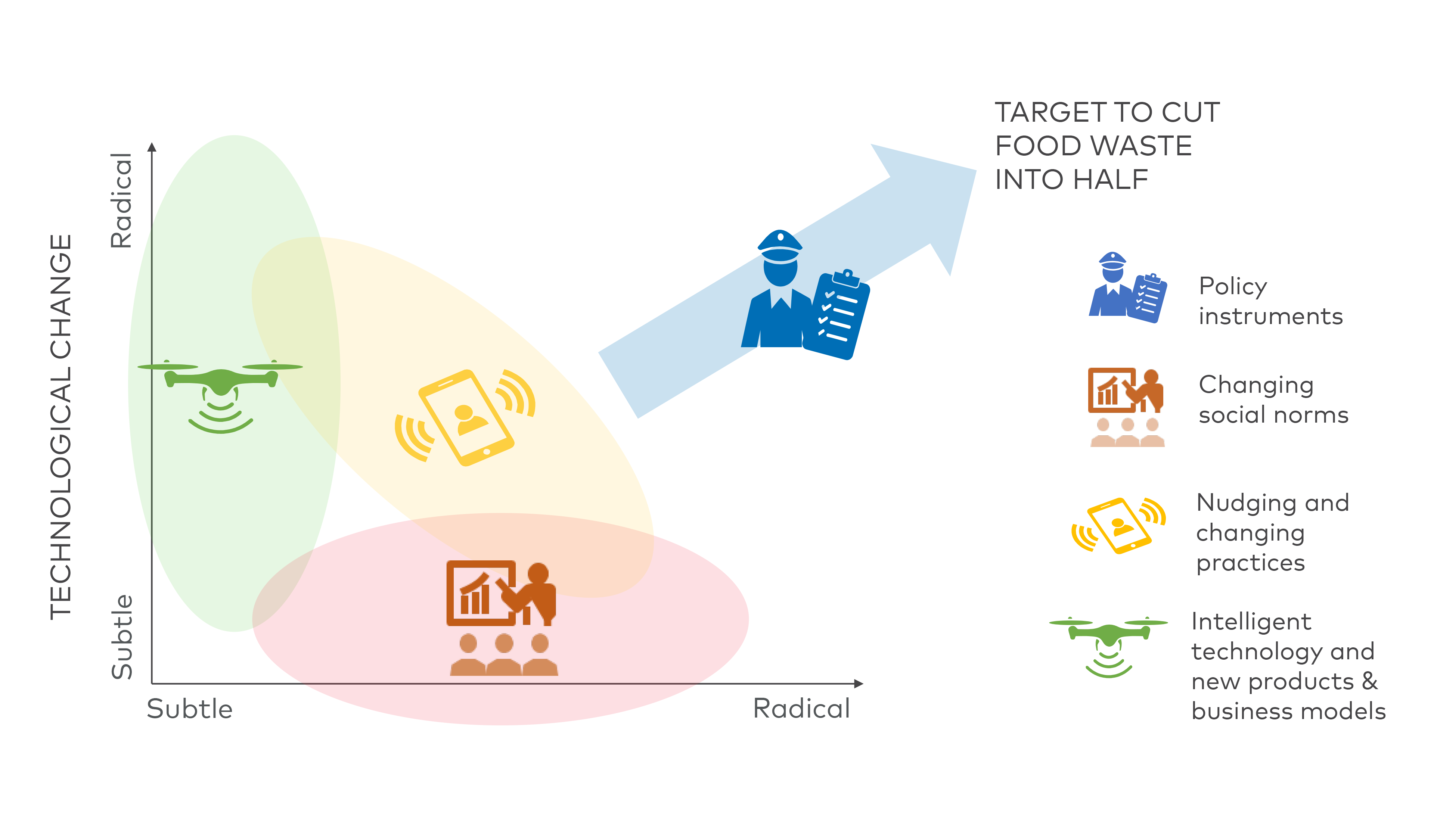
Figure 8 Relationship between the four food waste reduction topics (©Hanna Hartikainen 2020)
These four topics are divided into 16 subtopics in Tables 8 to Table 15, to help identify different kind of measures to reduce food waste. To effectively reduce food waste, different measures need to be combined, and therefore the aim is to find measures for all four main topics.
Each topic has two tables: 1) Past/ongoing measures to reduce food waste and 2) future recommended measures to reduce food waste. Past/ongoing measures include selected measures that have been or are currently implemented in the country. Future recommended measures can be past/ongoing or totally new that have not been tested in the country or elsewhere but seem highly potential. Additionally, future measures can be modified and improved versions of old measures.
There is no exhaustive list of existing measures, and thus, the very first step was to start identifying existing measure. For that purpose, we established the method where each country has identified existing measures with the help of four main topics and 16 subtopics. In the process of identifying existing measures, each country, has made a review and/or used the existing knowledge of identifying a select example of existing food waste reduction measures. The research group has also suggested some future measures that they consider having potential to effectively reduce food waste (including the feedback from workshops). However, similarly to the existing measures, the list of future measures is not exhaustive either, and therefore in future, the list of future measures requires elaboration within each country.
While the aim was to identify the best kind of measures to reduce food waste, this was not viable due to lack of data on the effectiveness of existing food waste reduction measures. However, we argue that the approach to identify measures in all of the four topics will increase the effectiveness of the identified measures, because there is positive synergy between different type of measures (Figure 8).
Additionally, while the scope of the measures is to focus on retail and households, we also include production, food industry and food service sector, especially when they concern the consumer interface (e.g. package design). We acknowledge that some measures could include all steps of the food chain, such as, national food waste monitoring protocol.
7.2 Policy instruments
The main force in Policy instruments is the regulatory push. Based on the responses from each country, we divided the topic further into three subtopics: Political acts, Voluntary Agreements and Steering instruments. The regulatory push can make advances occur faster through legislation as food waste reporting being mandatory, and for example in France with the obligation to donate food surplus. It can also be used as an incentive with tax relief to encourage certain food saving behaviours in companies.
Table 8 Past/ongoing measures to reduce food waste, Policy instruments topic
| Denmark | Finland | Norway | Sweden | |
| Political acts | National waste act (e.g. In Finland 2011/646) Waste act reform (book-keeping duty of food waste) Target: Whole food chain National government programme Target: Whole food chain | Negotiated agreement between government and food sector. 12 trade/professional organisations and 5 ministries wrote an agreement. Target: Industry, wholesale, retail Measurements in the businesses in the agreement, food waste monitoring and annual reports. About 110 companies have signed the affiliation agreement connected to the negotiated agreement. Target: Industry, wholesale, retail | National waste act Target: Whole food chain Environmental goal for the reduction of food waste Recently decided goals for the reduction of food waste Target: Different focus in the goals but on a whole the entire value chain Action plan for the reduction of food waste and loss Action plan “Fler gör mer” for the reduction of food waste in Sweden Target: Whole food chain | |
| Voluntary agreements | Thinktank Thinktank ONE/THIRD have formulated VA’s on food waste reduction and a commitment to half food waste by 2030 Target: Whole food chain | Material efficiency commitment (as a part of agenda 2030 action plan) Food waste monitoring protocol and road map Target: Industry and retail | Industry collaboration for measuring food waste in service sector KuttMatsvinn2020 - Mandatory semi-annual food waste reporting in addition to a forum to share experiences and best practices. Target: Service and hospitality | Negotiated agreement Industry collaboration for measuring food waste and loss as well as spreading and identifying hotspots for work Samarbete för minskat matsvinn, where measuring of food waste will occur as well as an annual report and seminars Target: Whole food chain |
| Steering instruments | VAT return on food donations Steering document from TAX authorities allowing food donations to have zero value leading to VAT return Target: Primary, Retail and Wholesale Removement of hindering regulations A special rule (2/3 reglen) are removed making donations of non-meat products easier | Tax-relief on donations As of January 2020, also sugar-tax-relief on donated products high in sugar. Target: Industry, wholesale, retail | Public procurement with food that has a shorter shelf life In Halmstad and Gothenburg they have made public procurement adding the possibility of buying food with shorter shelf life |
Table 9 Future recommended measures to reduce food waste, Policy instruments topic
| Denmark | Finland | Norway | Sweden | |
| Political acts | Prolonged product life Allowing freezing of products in retail in order to donate Target: retail N National waste act Including the sorting of food waste in the private sector + standard sorting criteria regarding food waste Target: whole food chain Food waste in the national climate action plans Mandatory targets on food waste reduction. | Implementation of prevention of food waste in national climate actions Target: Whole food chain Unfair trading practises Target: Primary, Industry and retail Incorporation of food waste in the hygiene controls (at restaurants etc) Target: Hospitality | National waste act The need and basis for such an act is under evaluation by the authorities. A National food waste act should reinforce the existing voluntary agreement. Target: Industry, retail, service and hospitality Obligatory with food donations Like in France Target: Retail | Unfair trading practises Target: Primary, Industry and retail (is being incorporated) |
| Voluntary agreements | Actors from each step of the food chain volunteer to provide their food waste data and make them publicly available. Target: Whole food chain Interrim Reduction targets leading to 50% reduction in 2030 Target: Industry, Hospitality, Retail | Actors from each step of the food chain volunteer to provide their food waste data. ----Target: Whole food chain | KuttMatsvinn2030 targeting the hospitality sector will from now on be a part of the negotiated agreement between government and the food sector, inviting hospitality and service companies to sign the affiliation agreement described in Table 6.1.1. Target: Whole food chain M | Increasing the members in the voluntary agreement |
| Steering instruments | Donation guidelines for food donation Target: Whole food chain | Allow freezing of products in retail The products need to be frozen before use by date and best before date. It should also be defined how long they can be frozen. Do not compromise on food safety Target: Retail and hospitality Pricing of waste Price unsorted waste as the most expensive and sorted waste as the cheapest. Target: Whole food chain | Forbid the return of bread Target: Retail Make it mandatory to receive fruit and vegetables at the whole sale level Target: wholesale, primary production | Clear guides on how food can be donated Target: Whole food chain |
7.3 Changing social norms
The main forces in Changing social norms -dimension is the Societal pull. Based on the responses from each country, we divided the topic further into four subtopics: Information steering, Education, Social and cultural norm, and Branding food waste. The changing of social norms is vital in order to get the society on board with a need for change. However, it is vital to also have the drivers below from chapter 9.4 and 9.5 to have a system where a shift in social norms also can lead to a change in actual behaviour.
Table 10 Past/ongoing measures to reduce food waste, Changing social norms topic
| Denmark | Finland | Norway | Sweden | |
| Information steering | Best-before /”use by” campaign Nationwide campaign (Tjek datoen) to improve the understanding of differences between “best-before" and “use-by” Target: Consumer Campaigning Stop Spild af Mad and other actors campaigning on social media, and in collaboration with private companies, politicians and volunteer/environmental organisations, such as promoting class II vegetables and left-over recipes Target: Consumers National food waste day Every year 29. September is food waste day where events and media focus is turn to food waste. | Information campaigns Several campaigns about food waste concerning whole food chain National food waste week Every year in autumn there is a food waste week when there is events and media releases around food waste. | Campaigning Matvett and other actors campaigning on social media, and in collaboration with municipalities and volunteer/environmental organisations, such as promoting the additional labelling (best before - often good after) and message “Look, smell, taste”. Target: Consumers Informational Authorities provide information on how the date labels “use by” and “best before” must be understood (Matportalen) Target: Consumers Media coverage Informational TV-programs such as “Matsjokket” and “Redd høna” (NRK) Target: Consumers Guidelines for methods in reducing food waste Guidelines for safe reuse of food in service sector, with practical tips and advice. Target: Service and hospitality Guidelines for monitoring of food waste in the food industry and hospitality sector Target: Industry, hospitality | Preparing food from raw materials that may become waste including nudging and follow up on food waste in restaurants Several Swedish restaurants have a very high-profile considering food waste. Target: Restaurants For examples by - Developing collaboration between retailers and restaurants - Developing ICT systems facilitating the trade of surplus food - Nudging customers at the restaurants – e.g. we have seen that the amounts of food waste depend on who is serving the food in one of the restaurant we collaborate with! By innovative technologies for measuring and follow up on food waste Information campaigns Several from retail sector. NGOs Swedish food agency Svinniska Target: Consumer New guidelines with clarification on how food can be saved for the next day in public kitchens SKL have revised their guidelines regarding saving food from the canteen for the next service Target: Public kitchens Handbook for the reduction of food waste Swedish food agency has published a handbook Target: Public kitchens Media coverage Informational TV-programs such as Maträddarna Target: Consumers |
| Education | In-service training Food Waste “hunters” and educational programme for kitchen professionals primarily in public kitchens Target: Hospitality School material Food waste oriented educational materials for middle-school Target: Consumers | Information campaigns and competitions for school children For example: Hävikkibattle project and competition for schools by Motiva and food waste reduction competition by Continental Foods Finland National education programme Food waste and control of everyday life are raised in bigger role in education Target: Consumer Daily school mealtimes – together The provision of Finnish daily school meals is a shared responsibility, with structured roles. The National Authorities, ministries and agencies co-operate with national and local organisations, associations, projects and companies as well as local schools and municipalities. Finnish National Agency for Education is responsible for so called school meal forum. Co-operation around the school meal system represents an ecosystem, which promotes well-being and learning in sustainable way. Food related education. Food related education in Finnish schools can be said to be under a reform, as the updated national core curriculum (2014) as well as National school meal recommendations (2017) have taken effect locally Home economics Task of the school subject (Basic education) The task of the subject of home economics is to develop the knowledge, skills, attitudes, and readiness required to master everyday life and to adopt a sustainable way of living that promotes well-being. Teaching and learning of home economics promote manual skills and creativity as well as the ability to make sustainable choices and act sustainably in the daily life at home. | National education programme Sustainability as a part of the national education plans in schools from 2020. Matvett, LOOP and NRK skole have developed a teaching program to reduce food waste in accordance with the new national education plans (secondary and upper secondary school). Target: Consumers Training programme E-learning programme for employees in service and hospitality. Target: Service and hospitality | Information and competition for school children In the project Resterkocken school children got to compete with the best leftover recipe this was done in combination with education In the classroom Target: Consumer Information and education material to inform on how to reduce waste in store and how to educate consumers Was implemented at stores in the Western part of Sweden (education movies, signs to be used in store can freely be download from the website run by the Region) |
| Social and cultural norms | Best-before campaign Companies like Arla, Carlsberg, Toms etc. have supplemented the “best before” date with a “often still good after” on consumer products Target: Industry, Retail and Consumer Pay due respect to the food Representatives from all steps of the food value chain join forces in a campaign focusing on the resources and work put in to each food product from farm to fork –pledging consumers to pay their respect to this by not wasting the food. Target: Consumer | Improving the understanding of social norms that now undermind food waste reduction. For example reducing the stigma around red-labeled products i.e. products nearing best before date and are sold with a reduced price. | From commitment to norm Enterprises are committed in the reduction of food waste Target: Whole food chain Social media persons Spreading the message to their followers not to waste food such as Ekotipset Target: Consumers Best before Arla has for an example introduced best before often good after on packages. Target: Consumers Social media The consumers are motivating each other by showing what they do at home to reduce the food waste. Look at: @spisoppmaten or@fattigstudent Positive impact from the influencers are important to reduce the food waste at home. | |
| Branding food waste | Food waste products Stop Wasting Food Movement have labelled class-two vegetables and products produced by surplus greens Target: Primary and Consumers Food waste shelves Retailers presenting near to expiration date products at discounted prices Target: Retail and consumer Food boxes targeting overproduced or ugly greens GRIM is solely targeting the “not-marketed” greens but several food box producers present consumers “food waste boxes” | Food waste products get uniform identity Food waste use and/or prevention of food waste is seen as a value. Those products are easily identified. Target: Industry and retail 2nd class products S-group (retail stores) sells 2nd class wonky cucumbers and different kind of tomatoes. Lidl sells boxes of weaker quality fruits and vegetables with reduced prices. Target: Retail | Companies advertising, information campaigning Retail companies with TV ads announcing the measures they have implemented to reduce their own and their consumers’ food waste (i.e. stopped using “buy 2 get one free” offers). Hotels informing their guests about their measures to reduce food waste (smaller plates, reuse of food etc) and how much food waste they reduced the day before (in kg) Target: Whole food chain Retail measures Retail focus on selling yesterday's fruit&veg and bread to lower price. Single bananas, weird fruit and Vegs, berries for making jam (NO) | A new product based on ugly fruits and veg A juice company that rescue ugly and or fruit and vegs that are about to be thrown away and make juice out of it and sell it as a product Target: Consumer Selling more ugly fruits for a cheaper price Target: Consumer and retail Selling of fruits and veg to a reduced price in order to avoid food waste. E-commerce selling 2nd class veg |
Table 11 Future measures to reduce food waste, Changing social norms topic (E=existing, M=modified, N=new)
| Denmark | Finland | Norway | Sweden | |
| Information steering | Public campaigns with focus on the economic gain of reducing food waste in households Convincing consumers that reducing food waste is a low hanging fruit to reduce their GHG emissions Target: Consumers | Public campaigns with focus on the economic gain of reducing food waste in households Convincing consumers that reducing food waste is a low hanging fruit to reduce their GHG emissions Target: Consumers Communication in retail and eating places about measures taken If we as consumers know why, we are more likely to contribute | The government and other public organisations should do more information and more communication, so that consumers learn, that it is not ok to throw out food Common campaigns, where all retailers, producers, NGO's and government focus on food waste with information about how consumers can help reducing food waste (don't take the milk with longest date, if you are going to use it today e.g..) | |
| Education | National education programme Food waste and control of everyday life are raised in bigger role in education Target: Consumers | National education programme Food waste and control of everyday life are raised in bigger role in education Target: Consumers Consumer education at core curriculum "Applied optional subjects may promote cooperation between the subjects, for example in the studies of artistic and practical subjects, information and communication technology, consumer and financial education, global education or drama studies." Hands-on cooking classes to cook from leftovers Or from the usual ingredients that are wasted at households. | National education programme Food waste and control of everyday life are raised in bigger and more concrete role in education Target: Consumers Educational programme should engage the households as well to make behavioural changes on a larger scale. The new curriculum that we have developed in Norway focus on involving the home and we hope to be able to evaluate that in an upcoming research project (NO) Buy smart Communicate with consumers to buy local and in season to help the environment and lower their footprints Portion size There must be more focus on portioning, both in eating places, online shopping and cooking meals at home. Cooking shows on TV should emphasize this also Teaching children about food waste should be mandatory in schools - what are the consequences concerning climate, raw materials etc. And what one can do to prevent it. | National education programme Highlighting the food waste part of education in everyday life. Target: Consumers |
| Social and cultural norms | 2nd class greens Introduction of 2nd class greens in retail Target: retail | Improving the understanding of social norms that now undermined food waste reduction | Change bread buying behaviour in retail To reduce bread waste the norms on how to buy bread need to change as well as the business model Target: Consumer, Industry and retail Make room for 2ndsorting of fruits and veg Consumers, Industry, Retail, Wholesale, Primary production | |
| Branding food waste | Food saving as a convenience product: in-store sales of salads and greens produced from close to expire, unsellable or damaged products. | Food waste products get uniform identity Food waste use and/or prevention of food waste is seen as a value. Those products are easily identified. Target: Industry, retail | Make a new brand of the «ugly vegetables». The kids love them and will eat more vegetables. |
7.4 Nudging and changing practices
The main forces in Nudging and changing practises-dimension are technological push and societal pull. Based on the responses from each country, we divided the topic further into four subtopics: smart packaging, technology assistance, pricing, and product environment. The approaches of this topic are more subtle and require understanding of peoples’ motives and behaviour, and how to change the current practises by changing the product environment, food serving, and pricing. Additionally, technology can assist the desired behaviour and break the current routines.
Table 12 Past/ongoing measures to reduce food waste, Nudging and changing practices topic
| Denmark | Finland | Norway | Sweden | |
| Smart packaging | Two-in-one and re-sealable packaging Retailers have introduced meat-product packaging that contains two separate boxes to prolong life-time of products Target: Industry, Retail and Consumer Reduced packaging sizes serving the growing single-household segment Several retailers have introduced bread and meats in single-packs or reduced sizes Target: Retail, consumer | Food package design Smaller packages, modular packages, re-sealable packages Target: Industry Home ordering food boxes that contain just enough ingredients for the meal for the predeterminate number of people. Target: households | More choices within packaging size More products in smaller packages to meet the demand of people in small households etc. Target: Consumers | Food package design A study shows that larger packages gives more food waste a problem in a country with many single household Target: Industry |
| Technology assistance | Apps for Left-over utilization ForResten and Plantjammer have introduced apps that help consumers utilize what is left in the fridge and left-overs from previous meals.-----Target: Consumers | Food waste applications Applications for households to monitor food purchases and food waste, tips to reduce food waste | Technological tools for better collaboration regarding logistics and less food waste Platforms for selling and buying food from overproduction, such as Too Good to Go. Target: Retail, service and hospitality, consumers | IT-tools for better collaboration regarding logistics and less food waste Platforms for selling and buying overproduced food. |
| Pricing | End of bulk discounts Rema1000 stopped selling buy 1 get 1 free and other bulk offers. Target: Retail and consumer | Adjusted pricing Buying food products which are nearing or past their best before dates at online retail (for example in Finland fiksuruoka.fi, in UK cheapfood.co.uk etc.) Or at retail shops (30%-60% off stickers) Target: Retail | Adjusted pricing Reducing the food products which are close to, or past their expiry dates at online retail, or in physcal retail (both in stores like Holdbart.no and Verdimat who sell over-produced / near expired products, or in other stores by the use of 20%-60% off stickers). Also use of apps such as Throw no more – where retailers can announce the products they have at a reduced price due to expiry date. Target: Retail, consumers Labelling Additional labelling for best before products helps consumers to reduce their food waste (60% of the respondents regard this as helpful) Limiting range of products at a reduced price Selling fresh products at a reduced price right before closing time. Or fruits and veggies that have an abnormal appearance sold at a reduced price. Posters to promote single bananas, yesterday’s bread for half price. Target: Retail, consumers | Adjusting prices For products nearing use by date Target: Retail and consumer |
| Product environment | Changes in physical environment Removing trays and reducing plate sizes in lunch buffets Leftovers Customers are taking left-overs from restaurants Target: restaurants Improved storing options e.g. see-through storing boxes. Also, fruits and vegetables should be more visible. Target: Households | Changes in the physical environment In municipal old-age homes: Reduction of portion size. 24 cm plates were replaced with 21 cm plates at lunch and dinner. Smaller cutlery made it easier for the elderly to eat their food. Target: Municipal institutions Flexible ordering Preparing less food for meetings and events, informing that you can ask for more food if wanted. Target: Service and hospitality, public institutions | Eat me box in fridge By having a box in the fridge with food near expiration date households will waste less food Auctioning of food A retailer in Öland that has auctions in his store with food that is closing the best before/sell by date Target: Retail, consumers |
Table 13 Future recommended measures to reduce food waste, Nudging and changing practices topic (E=existing, M=modified, N=new)
| Denmark | Finland | Norway | Sweden | |
| Smart packaging | Alternative way to show the edibility of food instead of (or in addition to) dates E.g. traffic lights, showing either red, yellow or green. These labels change depending on how well the product has been stocked (e.g. temperature). | |||
| Technology assistance | Automatic shelfs Automatic Price reductions following expiry dates M Clever fridges Notifications on expiry dates and content in fridges M | More tools for consumers to help them reduce food waste M Mobile application to manage food stocks in households What items are expiring soon? What do I already have? Can be checked when visiting a store. | Sector-wide programme Introduction of labels with dynamic information such as shelf life/expiration date Target: whole food chain N Clever fridges Notifications on expiry dates and content in fridges. Target: consumers. N Technology as tools Including the expiry date in the data bar on packaging will give consumers new tools to control their fridge and shelf life of products Let the mobile talk! App to tell a person that there is food in fridge that needs to be eaten, and also suggests some recipes. | Clever fridges Fridges that will inform of food that needs to be eaten and what you need to buy. N |
| Pricing | Pricing according to weigh not number Selling fruits and vegetables according to weight could loosen retailers demands for even sized vegetables and would provide incentives consumers to take the produce suitable for their household | Food pricing (when close to expire) is adjusted to prevent food waste. M Using pricing as a tool to indicate that a product is valuable. E.g. instead of reducing the price of 2nd class vegetables, the price could be the same. The only difference is that the product just look a bit different. | Adjust pricing of food in order to reduce food waste | |
| Product environment | Food serving and placement is adjusted to prevent food waste. M More clever ways to design storing (fridge, shelfs) at households to help the household members to SEE what they have instead of relying on memory. | Food waste reduction programme in hotels and stores based on the consumers’ behaviours and needs. Target: Retail, service and hospitality, consumer N | Type of service in restaurants Studies from Brazil shows that the setting in which food is given to the consumer is important. Restaurants that had pay by pound buffets had less food waste. Adjust placement of food in order to reduce food waste Making a system, where retailers can register products, that is for donation, and the places for people who need help, they can have it Downsizing in general, so that the product size fits to the need at the consumer |
7.5 Intelligent technologies and new products & business models
The main forces of technology and new products & business models -theme are strong technological development and market pull. Based on the responses from each country, we divided the topic further into five subtopics: food waste management tools, product development, package innovation, improved ordering system, and new businesses around food waste. The main difference between this topic and Nudging and changing practices -topic, is that in this topic the main drivers are new innovations, whereas, in Nudging and changing practices the main driver is to understand peoples’ motives and behaviour, and how to change the current practises using all kinds of tools.
Table 14 Past/ongoing measures to reduce food waste, Intelligent technology and new products & business models topic
| Denmark | Finland | Norway | Sweden | |
| Food waste management tools | Scanning of wasted products retail To get an idea and overview of the amounts wasted and report back to the organisation. Target: Retail Utilizing existing data generated Point of Sales companies can include data on waste production to the POS hence automatically generating waste data and coupling it to sales and procurement Target: restaurants | Scanning of wasted products retail To get an idea and overview of the amounts wasted and report back to the organisation. Target: Retail Lean Management – production management Improve the production planning by using key performance indicators on waste for the entire process. Target: Industry, retail | Weighing methods with automatic registration KuttMatsvinn2020 was a project that helped the actors in the service and hospitality sector to implement such weighing methods and systems. Target: Service and hospitality Scanning of wasted products retail To get an idea and overview of the amounts wasted and report back to the organisation.Target: Retail Lean Management – production management Improve the production planning by using key performance indicators on waste for the entire process. These are followed up at monthly management meetings, to keep a high focus on this issue Value of the waste is calculated as financial loss (Q-meieriene) Target: Industry | Change management models for municipal kitchens aimed for reducing food waste The city of Goteborg reduced their food waste in municipal kitchens by 50% in two years by working according to Göteborgsmodellen. This model has now become a national model Target: Municipal kitchens Clever scales Scales that give input to consumer about how much they throw away or that give input to the system directly Target: Municipal kitchens App for restaurants Companies like Generation Waste that has developed an app for restaurants which will show them how much money they throw away Target: Restaurants |
| Product development | Processing of surplus vegetables and fruits that cannot be sold due to overproduction /not fulfilling esthetical requirements to new products) Juice producers utilizing surplus food and food producers (e.g. beer breweries and producers of meat substitutes) utilizing surplus greens and pulp ---- Target: Industry, hospitality | Food waste in products Waste material is used in new products Target: Industry, retail | Use of abnormal products in new ways Development of new products based on products/materials that are normally wasted, such as fruits and vegetables with abnormal size and/or shape. Target: Industry Reuse of leftover food Hotels using leftovers from yesterday’s dinner serving in today’s breakfast or lunch buffet. Target: Service and hospitality | Processing of vegetables that cannot be sold due to overproduction /not fulfilling esthetical requirements to new products) Vegetable producer in Southern Sweden sell cut vegetables to canteens Target: industry |
| Packaging innovation | Smart/innovative packaging solutions. Shelf life indicator (such as KeepIt). Changes in packaging gas for longer shelf life (Norfersk minced meat) Target: Industry, retail, consumers | Packages like Micvac that makes the shelf life for fresh food considerable longer without preservatives Target: Industry | ||
| Improved ordering systems | Intelligent ordering Retail uses intelligent ordering system that makes orders based on sales forecasts Target: retail | Enable seasonal products to bypass the normal logistics/ordering system. Folkets sommerfavoritter – enabled faster logistics process of popular summer products allowing it to arrive at retail store faster, making a more fit ordering system, easily adjusted to the weather conditions etc. Target: Industry, retail Changing the logistics system to reduce number of days the food stays in storage and, in turn, give the consumers more of the products’ shelf life. Target: Industry, retail | Apps for deciding meals Projects in hospitals and schools have shown that being given a choice on what to eat will make you more likely to eat it Target: Consumers | |
| New businesses around food waste | Food donation Food donation organizations collect leftover raw-materials and food from retail and industry and donate them Target: retail, industry Apps for re-selling of surplus food Too Good To Go and Your Local provides a platform for selling food nearing expiration dates Target: Retail and Hospitality sector Food waste restaurants A chain of restaurants (Madklubben) have opened a dedicated branch utilizing surplus and small batches from the other restaurants. Target: Hospitality | Food waste retail store Retail stores (Fiksuruoka, Madsmart) are selling food with expired date/close to expire, and foods that would otherwise go to waste Target: retail, industry Food waste restaurants Loop-restaurant is only using leftover raw-materials from retail and industry to produce meals Target: retail, industry Apps for re-selling of surplus food Foodresq is providing a platform for restaurants to sell leftover food Target: Restaurants Food donation Food donation organizations collect leftover raw-materials and food from retail and industry and donate them Target: retail, industry | Food waste retail store Retail and wholesale (Holdbart.no, verdimat) selling food with expired date/close to expiration and foods that would otherwise go to waste (such as overproduced products) Target: retail, industry Food donation Food donation organizations collect leftover raw-materials and food from retail and industry and donate them Target: retail, industry Apps for re-selling of surplus food Too Good To Go provides a platform for selling food getting close to expiration dates Target: Retail and Hospitality sector Food waste restaurants and caterers Restaurants such as Rest exist but not at scale Target; Consumer, Hospitality New solutions reducing waste in the value chain At an early stage, companies helping retailers to reduce food waste by using their data | Food donation Food donation organizations collect leftover raw-materials and food from retail and industry and donate them Target: retail, industry Food waste restaurants and caterers With the business idea to utilize surplus food and thus preventing waste Target: Consumer, Hospitality Food waste apps To sell surplus food from restaurants etc.1 |
Table 15 Future recommended measures to reduce food waste, Intelligent technology and new products & business models topic (E=existing, M=modified, N=new)
| Denmark | Finland | Norway | Sweden | |
| Food waste management tools | Offering products on the “close-to-expire" list in whole sales to public kitchens | Convert surplus bread, pastries and dough to syrups etc. for bakery industry use. M Target: Industry | High-tech tools Fridge cam, Smart food waste bin Target: Consumers N | Alternative markets Finding alternative market/buyers of vegetables, potatoes, fruits, eggs etc M Target: whole food chain |
| Product development | ||||
| Packaging innovation | Covert lignocellulosic agricultural loss to packaging, to replace wood fibre N Target: Industry | Innovative package ideas In order to reduce food waste, the packaging is important. Take this in consideration when replacing packages. In NZ a system is used with water keeping vegetables fresh in retail. Target: Whole food chain M | ||
| Improved ordering systems | Public procurement of food Further collaboration on ordering procedures leading to acceptance of e.g. shorter shelf-life and aesthetic standards. Target: Wholesale and Hospitality N | Unification of ordering and forecast/prediction system to one platform in the whole food chain Target: Whole food chain N | Further development and implementation of technology. Unification of ordering and forecast/prediction system to one platform in the whole food chain Technology that gives the retail and storage better overview of the products already in the shops/storage, and their expiry date. Target: Whole food chain N | More clever ordering systems Many public actors have found that by optimizing orders and having a good overview of stock and how much they need to order large improvement can be done. Target: Hospitality M Improved feed logistics Feed logistics/connecting food industry with farmers. Food becoming feed is often due to contacts already made. Is there in the future possible to create a market place for feed coming from the food chain, or including feed in the re-distribution/donation systems Target: whole food chain but households N |
| New businesses around food waste | Reducing planned overproduction In applying procurement agreements with primary producers, large scale procures can agree to buy whatever amount that will be produced in the field, removing the producers need for planned overproduction to meet minimum delivery amounts in procurement deals. |
7.6 Reflections
As mentioned, it is difficult to evaluate the effectiveness (to reduce food waste) of the existing measures, not to talk about pointing out which are the most effective measures. This is because there are very few existing studies that have tried to or even evaluate the potential of a measure to reduce food waste. The problem has been widely acknowledged, and order to address this problem, there are existing initiatives to establish evaluation-schemes. For instance, in order to address part of this problem the Swedish Food Agency will launch a behaviour intervention study (that aim to make it easier for households to reduce their food waste) where the assessing of effect of measures is a vital part of the study. Additionally, Luke has set a target to evaluate and quantify the effectiveness of food waste reduction measures that are identified as part of the Finnish food waste reduction road map.
In the future, there is need for a systematic approach where each country starts supplementing the list of existing measures and evaluates their impact. The four main topics (Figure 8) identified in this chapter have a key role in this. Measures can be evaluated based on their effectiveness: how exhaustive is the socio-cultural change, how radical is the technological change, how market-driven the action is (and how easily adopted), and/or is the measure based on political or legal activities. The most important thing, however, is that the synergy between the four topics is acknowledged, and all the four topics are equally promoted. Also, even measures that have relatively small impact to food waste amount can become more meaningful when there are many other small measures that support each other, and thus, increase the synergy.
8 Expert workshop
8.1 Workshop set-up
The aim of the workshop was to qualify the discussion of the identified implemented measures in the Nordic Countries to prevent food waste in retail and households and to provide input on future measures to prevent food waste. Results from the workshop are implemented in chapter 6. This chapter will present the setup of the workshop and the main outcomes. The workshop was held on the 22. September 2020 back-to-back with an online conference presenting the preliminary findings of the project with about 70 participants from all over the Nordic region. Approximately 30 participants from Sweden, Finland, Norway and Denmark participated in a following-up workshop to discuss measures to prevent food waste. Participants represented NGO’s, academia, private companies and authorities with expert knowledge on food waste reduction in households and the retail sector. The workshop was organised as an online workshop in Teams. The facilitation tool Stormz were used to collect written input to the already identified measures and provide the participant the opportunity to rate future measures according to their expected effect and the resource intensity of implementing it. The participant was divided in to four groups focussing on each of the dimensions used in the project to identify measures to reduce food waste:
- policy instruments (regulatory push),
- changing social norms (societal pull),
- nudging and changing practices (technology push & societal pull), and
- intelligent technology and new products & business models (strong technology push and market pull).
8.2 Discussions related to on-going and already implemented measures
Policy instruments
Discussion of policy instruments to reduce food waste. Additional policy instruments suggested in the workshop is included in Chapter 9.
| Sub-topic | Discussion and comments |
| Political acts | Binding mandatory food waste monitoring is not implemented in Denmark and Norway. If the Voluntary agreements fail to deliver sufficient progress towards the reduction target, further regulation will be implemented. |
| Voluntary agreement | Voluntary agreements play an important role in putting food waste on the agenda and will incentivise the businesses to pursue the low hanging fruits, however what measures being implemented in the retailers seems a bit arbitrary and could need stronger steering from a political level. Moreover, the importance of monitoring progress and interim goals on the road to the 50% reduction is stressed. Furthermore, it is noted that assuring a sufficient data reporting and quality is difficult task. |
| Steering instrument | Tax-relief programmes to stimulate food donations, should take into account not to incentivise producers to overproduce (especially production of food stuff produce more |
Changing social norms
Discussion of identified past/ongoing measures to reduce food waste through changing social norms. Additional measures for changing social norms, suggested in the workshop is included in Chapter 9.
| Sub-topic | Discussion and comments |
| Information Steering | Materials targeting public kitchens should be presented to Private kitchens as well |
| Education | Programmes educating food professionals in public kitchens should also educate private kitchens and additional programmes should be developed towards the retail sector. A healthy food culture can be stimulated in the schools by eating together in school. Furthermore, education in home economics will also create a focus on the economic effects of food waste. |
| Social and cultural norms | More information and public campaigns should focus on education of private households. Basic skills like tasting/smelling/looking to identify if products are still eatable, should be nursed. |
| Branding food waste | Highlighting the potential in selling class II vegetables and dedicating shelves for “close to expire” products |
Nudging and changing practices
Discussion of identified past/ongoing measures to reduce food waste through nudging and changing practices. Additional measures for nudging and changing practices, suggested in the workshop is included in Chapter 9.
| Sub-topic | Discussion and comments |
| Smart packaging | Special emphasis should be given to educate consumers on the importance of packaging in reducing food waste, and the relative low CO2 impact from packaging vs food waste. In discussing single household packaging sizes both pricing structure and increased use of plastic in order to offer smaller packages are important areas. If the pricing of reduced packaging sizes is much higher than for a bigger package, this might be a barrier for consumers, as single households are often students or elderly people who might be more price conscious. |
| Technology assistance | Apps for utilization of left-overs and selling surplus food from industry and retail is important measures, but further campaigns are needed to widen the adaptation. Further, influencers and social media in general have great potential at motivating consumers to reduce food waste. |
| Product environment | Reduced plate sizes should be stimulated in both public and private kitchens. Furthermore, all of the Nordic countries need to normalize “Doggy bags” for leftover utilization from restaurants. Local fruits and vegetables in season should be further promoted in retail to minimize transportation and the risk of damaged foods and food waste during transportation. |
| Pricing |
Intelligent technology, new products and business models
Discussion of identified past/ongoing measures to reduce food waste through Intelligent technology, new products and business models. Additional measures for Intelligent technology, new products and business models, suggested in the workshop is included in Chapter 9.
| Sub-topic | Discussion and comments |
| Food waste management tools | Retailers should develop warning systems for future waste, including introducing the shelf life in the scanning code to enable exact warning on products with short remaining shelf life or surplus volumes compared to projected sales. Warning systems must be an integrated part of the ordering system. |
| Product development | Special emphasis on removing “return policies” from the retailers towards suppliers of bread. Focus on utilizing surplus for production of new food products (over animal feed or biogas) however, processing machines are a limiting factor. Further, waste from individual stores are hard to reprocess due to relatively low daily amounts and the short lifespan left in the stores. |
| Package Innovation | Smart packaging is not sufficiently promoted and not present in DK. |
| Improved ordering system | Ordering systems, providing shorter transport for perishable produce in season, is seen as a key measure. |
| New businesses around food waste | TooGoodToGo is the biggest platform selling surplus food to consumers in both retail and restaurants. TGTG is active in No, Se and DK. Furthermore, there is a range of new start-ups helping consumers identify shops with products close to expiry date (Throw No and Savvie) or retailers utilizing data to reduce food (TotalCtr and Crips) |
8.3 Discussions related to future measures in terms of effectiveness and resource intensity
The workshop participants ranked the identified measures in terms of effectiveness to reduce food waste and resource intensity in implementation. The list below summarizes the top scores in each of the four dimensions: policy instruments, changing social norms, nudging and technology /new business models.
| Dimension | Highest ranked future measures | Discussion of resource intensity |
| Policy instruments | The three highest ranked in terms of effectiveness: 1. Donation guidelines for food donation 2. Forbid free return of bread 3. Prolonged product life through allowing freezing of products in retail | The three most effective measures are all ranked as being easy to implement in terms of resource consumption. The measures ranked as least resource intensive to implement is interim reduction targets (towards 50% reduction in 2030) and voluntary supplementation of data from the value chain. |
| Changing social norms | The three highest ranked in terms of effectiveness: 1. Public campaigns with focus on the economic gain of reducing food waste in households 2. National education programmes focusing on food waste 3. Campaigns focusing on portion sizes | Emphasising a focus on portion sizes is assessed to require limited resources, whereas both public campaigns on the economic pains and stimulation of the national educational programmes are assed to be resource intensive to implement. The measures ranked as least resource intensive to implement is changing bread procurement policies towards accepting empty shelves at closing time for the retail stores and in-store communication material of already implemented measures in retail. |
| Nudging and changing practices | The three highest ranked in terms of effectiveness: 1. Automatic/smart shelves with information on expiry dates 2. Price reduction when close to expire 3. School education material focusing on food waste consequences for climate, raw materials | Price reductions when expiry approaches are assed to be easily implemented, whereas both automatic/smart shelves and education material is resource intensive. The measures ranked as least resource intensive to implement is focus on left-over utilization in cooking classes and strengthening the culture for doggy bags at restaurants. |
| Intelligent technology, new products and business models | The three highest ranked in terms of effectiveness: 1. Intelligent ordering systems based on sales forecasts 2. Public procurement of food accepting shorter shelf-life and aesthetic standards in public kitchens 3. Shorter value chains to stimulate local produce | The three highest ranked measures in terms of effect are all assed to be resource intensive to implement. In general measures in the dimension of new technology and business models are ranked high on resource intensity, but the measure ranked as easiest to implement is product development for turning surplus bread in to new food product. |
9 Recommendations and proposals for further Nordic collaboration
Based on the surveys of definitions and system boundaries, methodologies and experiences with measures for prevention of food waste reported in Chapter 8 and 9, we will make the following recommendations to the Nordic Council of Ministers as following up of the project.
We will recommend that
- The Nordic countries cooperate in developing reporting frameworks with common system boundaries, definitions and methodologies that makes it possible to share and compare data on food waste in total and per capita over the whole food chain. The Nordic countries are in front of development and implementation of methodologies for food waste monitoring and reporting in Europe. All countries can however benefit from further collaboration in the process with implementing monitoring systems to reporting food waste as required by EU regulations (top down approach). This does not imply that national based monitoring systems must be completely similar in their basic nature, but that data must be transformed to a common reporting format before being reported to Eurostat.
- Follow up a leading position in developing and implementing monitoring systems that are based in bottom-up approach with more detailed data on food waste than required by EU regulations as a measure to prevent food waste. This implies a higher level of involvement from both business actors, municipalities and other public sectors to quantify food waste on a more detailed level than required by EU regulations. The Norwegian and Finnish systems for monitoring and reporting can be models in this development, not expecting that all parts of the food chain will be highly represented in this work in all countries. Calculating GHG-emissions, economic value and other relevant sustainability impacts of food waste based in monitoring data as is done in Finland and Norway do also depend on access to detailed data about food waste on the level of product types, combined with GHG impact factors for each product type. Development of and sharing of such impact factors for different types of food can benefit from Nordic collaboration.
- Further develop, harmonize and make available guidelines for methods to quantify food waste at the point of generation, both to make measurements as comparable as possible and to make the measurements valid and efficient. This is especially the case with more detailed data on food types from retail and wholesale, food service and hospitality sector and households, where food waste is a mixture of different types of food. Methods to connect wasting of food to the root causes for wasting food in an organization or in a value chain is important as a basis for implementing measures to prevent and reduce food waste.
- Collaborate in developing common food waste factors as a basis for developing national statistics as well as comparing changes in amount of food waste over time. Food waste factors are necessary to make upscaling from samples of total population of actors at each stage in the food chain to national statistics and are in common use in all types of waste statistics. Waste statistics are often based in waste factors from primary data collected once per 3-5 years or even more seldom, where waste factors are multiplied with production or economic statistics as a basis for national waste statistics (maximum 4 years intervals according to new regulations). To document real reduction in food waste at a stage or in a sector of the food chain, it is necessary to develop a data bank with food waste Tier 1, 2 and 3.
- Prove effectiveness of measures to prevent food waste by taking lead on long-term systematic monitoring of detailed food waste levels. Since the work with food waste prevention started systematically in 2010, only a few studies have quantified or evaluated the effectiveness of different food waste reduction measures. This is an essential step to identify the most effective measures to meet the national and EU-targets to halve food waste by 2030, and to promote the best measures in different sectors and countries. While there is limited understanding of the effectiveness of the measures, we argue that when there are several measures under each topic, it creates a positive synergy between the measures, and consequently food waste reduction is more effective. Furthermore, the topics create a systematic catalogue for food waste reduction strategies, and the whole approach can be seen as a solid basis for further development.
- Establish, share and further develop national food waste reduction road maps, where all countries continue listing the existing and future food waste reduction measures and start following the overall impact of the measures to the food waste level. It is important that the measures are concretized: hence weblinks and/or contact information is always provided. The key principle in the national food waste reduction road maps is “More together”, which means that all food chain actors and stakeholders need to work together to efficiently reduce food waste.
- Set up a Nordic network and system for information sharing and learning, in order to use the strengths of national work with food waste monitoring. Here things like effective methods for the measuring of food waste could be shared, as well as food waste data and food waste factors. And also to share examples of effective food waste prevention measures that works and can be adapted to work in other Nordic countries.
10 References
Andersson T, Stålhandske S, 2020 Matavfall i Sverige -Uppkomst och behandling 2018. ISBN: 978-91-620-8861-3.
Andersson T, Bhasin A, Viklund L, Stålhandske S, Uppföljning av etappmålet för ökad resurshushållning i livsmedelskedjan: Data för år 2018. ISSN 1653-8102.
Carvajal, A., Myhre, M.S., Shraddha, M., Dyrstad, J.S., Remme, J.F. 2020. Kartlegging av mengder og årsaker til matsvinn I sjømatnæringen. SINTEF Ocean Report 2020: 00536. Trondheim. ISBN: 978-82-14-06509-1.
Corrado S., Caldeira C., Eriksson, M., Hanssen, O.J., Hauser, H.-E.,Holsteijn, F. Hadewych van, Liu, G., Östergren K., Parry A. , Secondi L., Stenmarck Å. & Sala S. 2019. Food waste accounting methodologies: Challenges, opportunities, and further advancements. Global Food Security 20, 93-104.
Hanssen, O. J., Stenmarck Å., Dekhtyar, P., O`Connor, C., Östergren, K. (2013). Food Waste Statistics in Europe. Evaluation of Eurostats Waste Statistics. Report from FUSIONS.
Hanssen, O.J., Syversen, F. & Sto, E. 2016. Edible food waste from Norwegian households – Detailed food waste composition analyses from two different regions in Norway. Resources, Conservation and Recycling 109, 146-154.
Hanssen, O.J. & Stensgård, A.E. 2018. Methods and systems for quantifying food waste from primary production in Norway. Report from a pilot project for Ministry of Food and Agriculture. Ostfold Research OR.12.18, Fredrikstad. 35 pp.
Hartikainen, H., Riipi, I., Katajajuuri, J-M., Silvennoinen, K. (2020) From measurement to management: Food waste in the Finnish food chain, Food Waste Management: Solving the Wicked Problem, Palgrave 2020.
Lerche, F., Petersen, C., Tønning, K. 2018. Kortlægning af sammensætningen af dagrenovation og kildesorteret organisk affald fra husholdninger. Miljøstyrelsen, København. ISBN 978-87-93614-78-9
Lindow, K. et al. (2021) Livsmedelsförluster i Sverige Metoder för ökad kunskap om livsmedelsproduktionens förluster och resurser, Rapport 2021:2 https://www2.jordbruksverket.se/download/18.2a4b211817814f136ad1ec8b/1615317572968/ra21_2.pdf
Matvett 2017. Rapport anbefalinger tiltak mot matsvinn. Fra ”Arbeidsgruppe for tiltak” under intensjonsavtalen om reduksjon av matsvinn. Matvett, Oslo 2017.
Møller, H., Hanssen, O. J., Gustavsson, J., Östergren, K., Stenmarck, Å., Dekhtyar, P., 2013. D1.3 Report on review of (food) waste reporting methodology and practice. Report D1.3 from FUSIONS project
Møller, Hanne; Hanssen, Ole Jørgen; Svanes, Erik; Hartikainen, Hanna; Silvennoinen, Kirsi; Gustavsson, Jenny; Östergren, Karin; Schneider, Felicitas; Soethoudt, Hans; Canali, Massimo; Politano, Alessandro; Gaiani, Silvia; Redlingshöfer, Barbara; Moates, Graham; Waldron, Keith; Stenmarck, Åsa, 2014 Standard approach on quantitative techniques to be used to estimate food waste levels, Fusions Report. Østfoldforskning OR.21.14. 108 p
Norman, A.D., Verganti, R. (2014) Incremental and Radical Innovation: Design Research vs. Technology and Meaning Change, Article in Design Issues, January 2014.
Petersen, C., Kaysen, O., Manokaran, S., Tønning, K., Hansen, T. 2014. Kortlægning af madaffald i servicesektoren. Miljøstyrelsen, København. ISBN 978-87-93178-75-5
Stensgård, A. & Hanssen, O.J. 2016. Matsvinn I Norge 2010-15. Sluttrapport fra ForMat-prosjektet. Østfoldforskning, OR.17.16, Fredrikstad.
Stensgård, A., Prestrud, K., Hanssen, O.J., Callewaert, P. 2019. Food Waste in Norway. Report on key figures 2015-18. Østfoldforskning. OR.32.19. Fredrikstad. 978-82-7520-814-7
Stensgård, A., Hanssen, O.J., Møller, H. 2020. Veileder for kartlegging av matsvinn i matindustrien. Versjon 2.0 2020. Østfoldforskning OR.10.18. ISBN 978-82-7520-777-5.
Tostevint, C., Östergren, K., Quested, T., Soethoudt, H., Stenmarck, Å., Svanes, E., O’Connor, C. 2016. Food waste quantification manual to monitor food waste amounts and progression. BIO by Deloitte, Paris. FUSIONS -project. (http://www.eu-fusions.org/phocadownload/Publications/Food%20waste%20quantification%20manual%20to%20monitor%20food%20waste%20amounts%20and%20progression.pdf)
11 Appendix 1
Overview of system boundaries and definitions applied in food waste monitoring in the Nordic countries
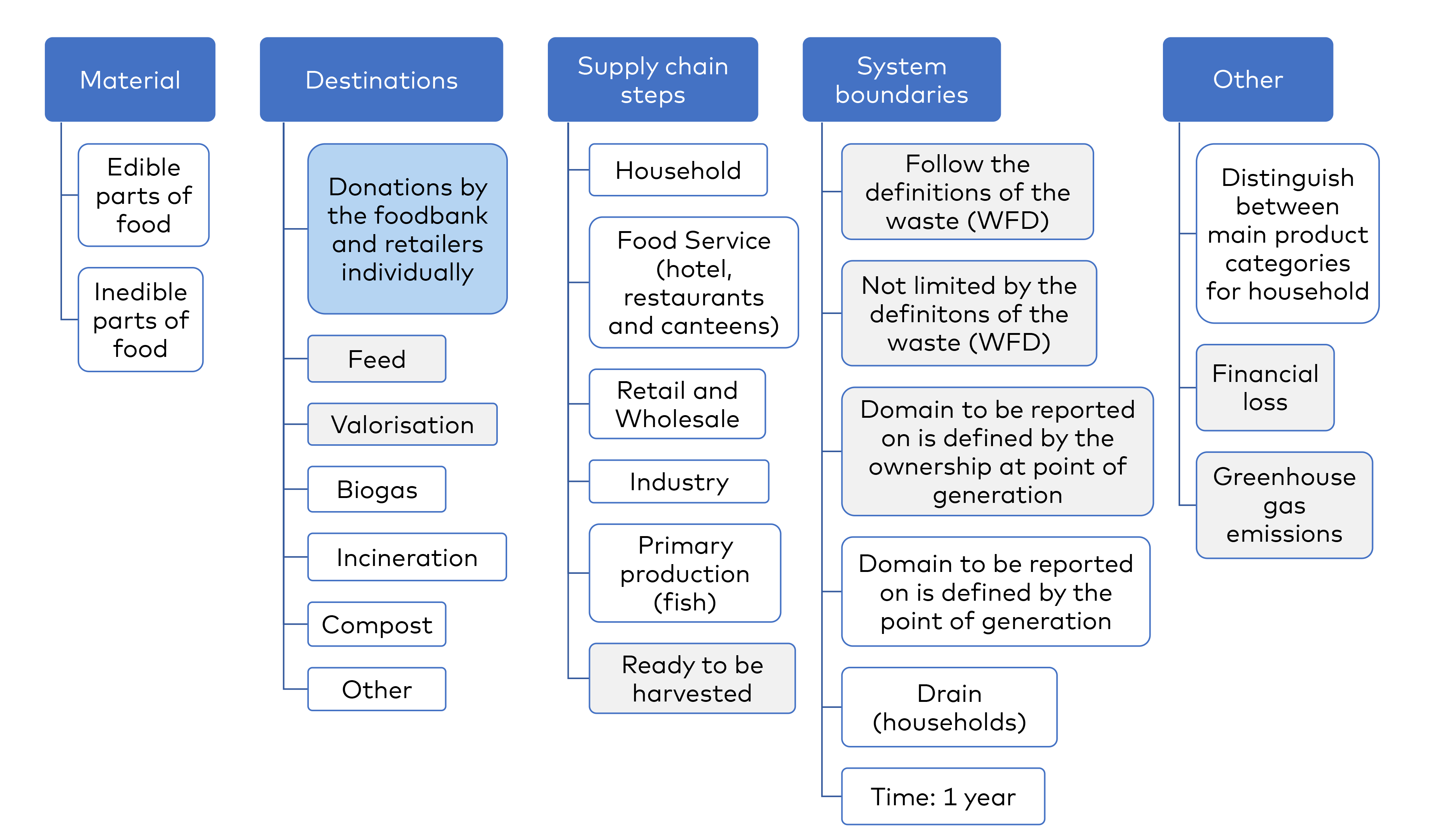
Figure 9 Food waste reporting in Denmark. Grey means that this material destination or supply-chain step or boundary condition is not relevant, and blue refers to that data are collected but not officially published. Note that donations are not defined as food waste.
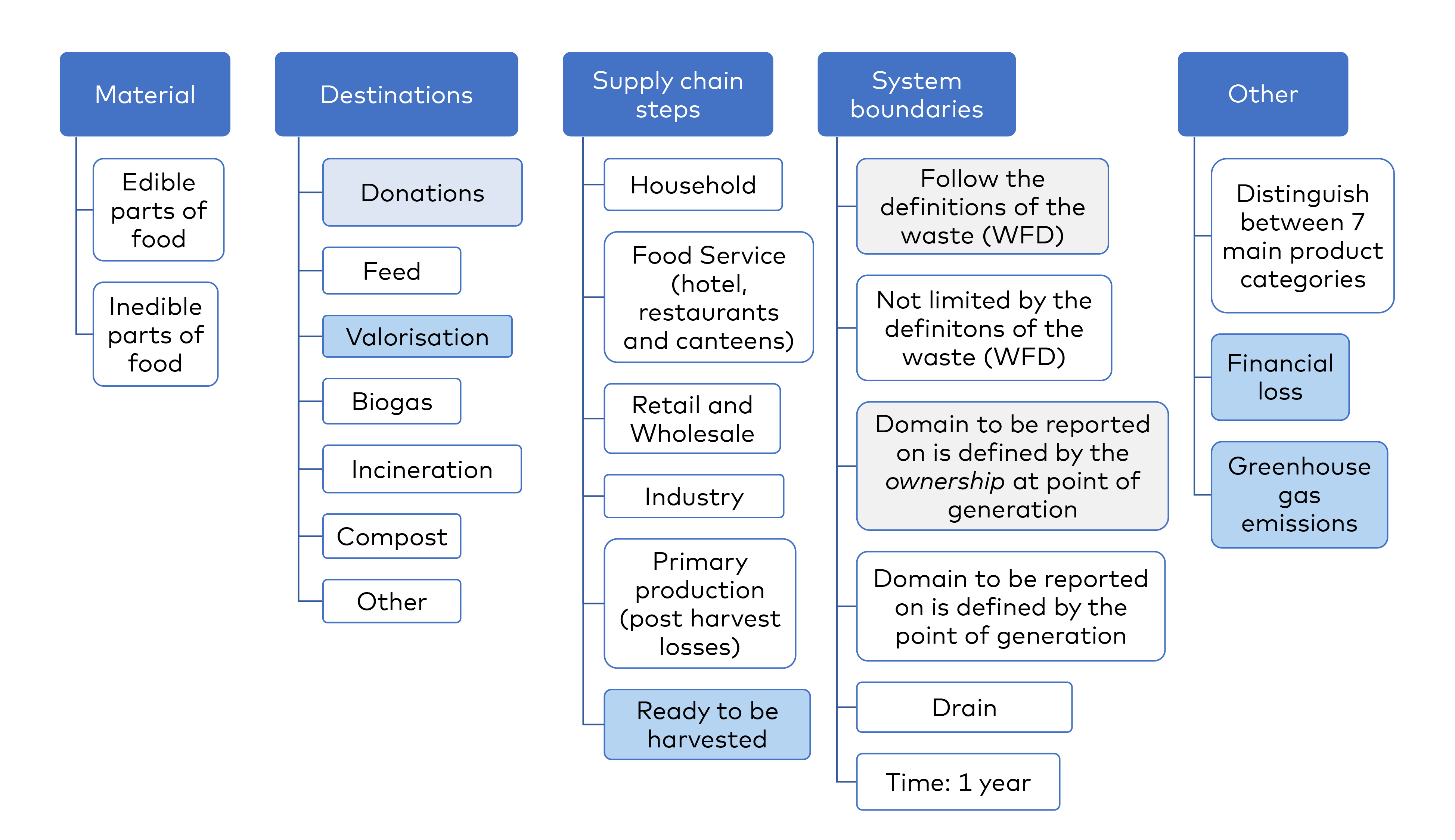
Figure 10 Reporting in Finland. Grey means that this material destination or supply chain step or boundary condition is not relevant and blue refers to that data are collected but not officially reported. Note that donations are not defined as food waste.
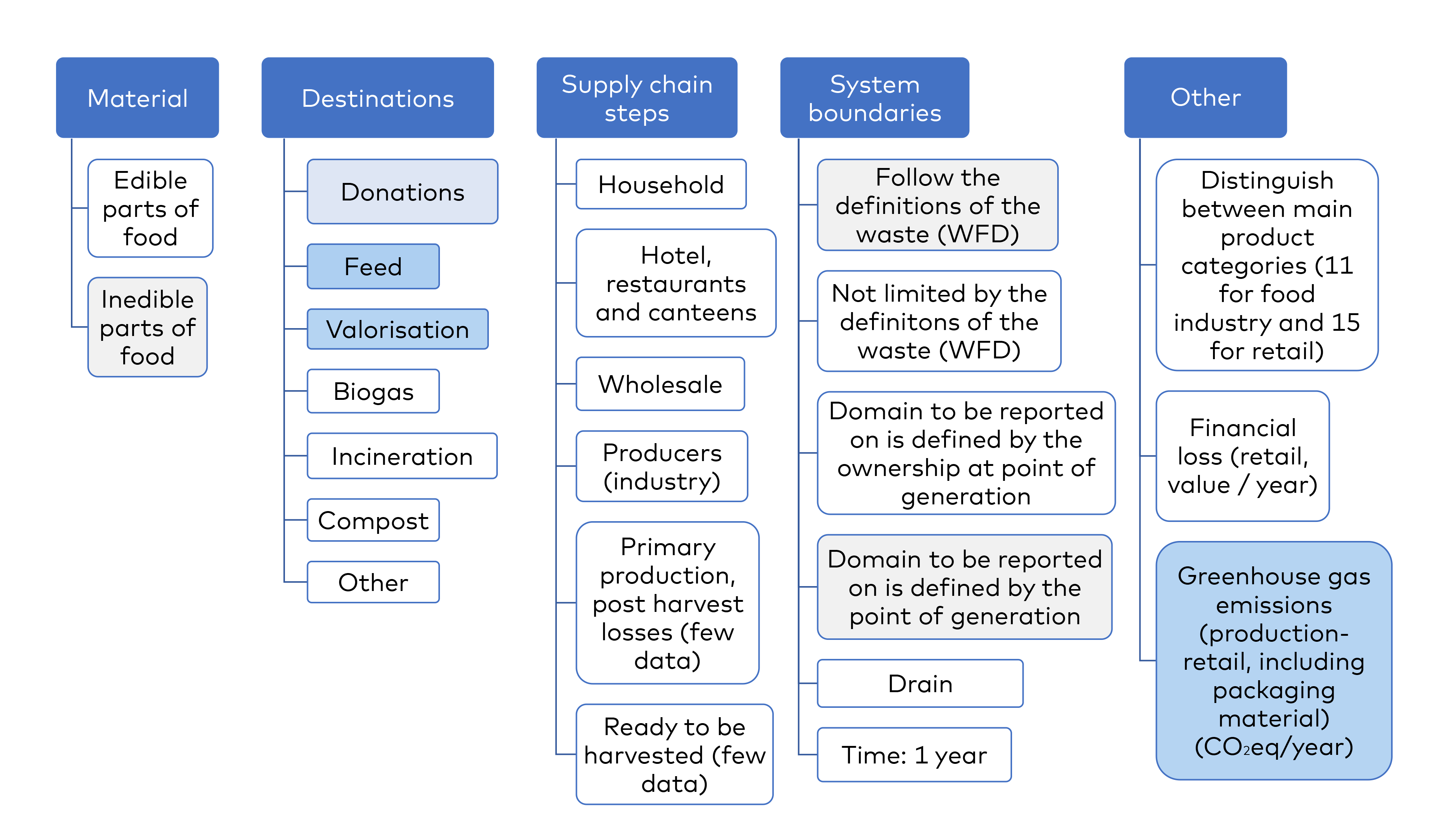
Figure 11 Reporting in Norway according to Bransjeavtalen. Grey means that this material destination or supply chain step or boundary conditions is not currently relevant for reporting and blue refers to that data are collected but not officially reported. Note that donations are not defined as food waste but is followed up on but not reported officially.
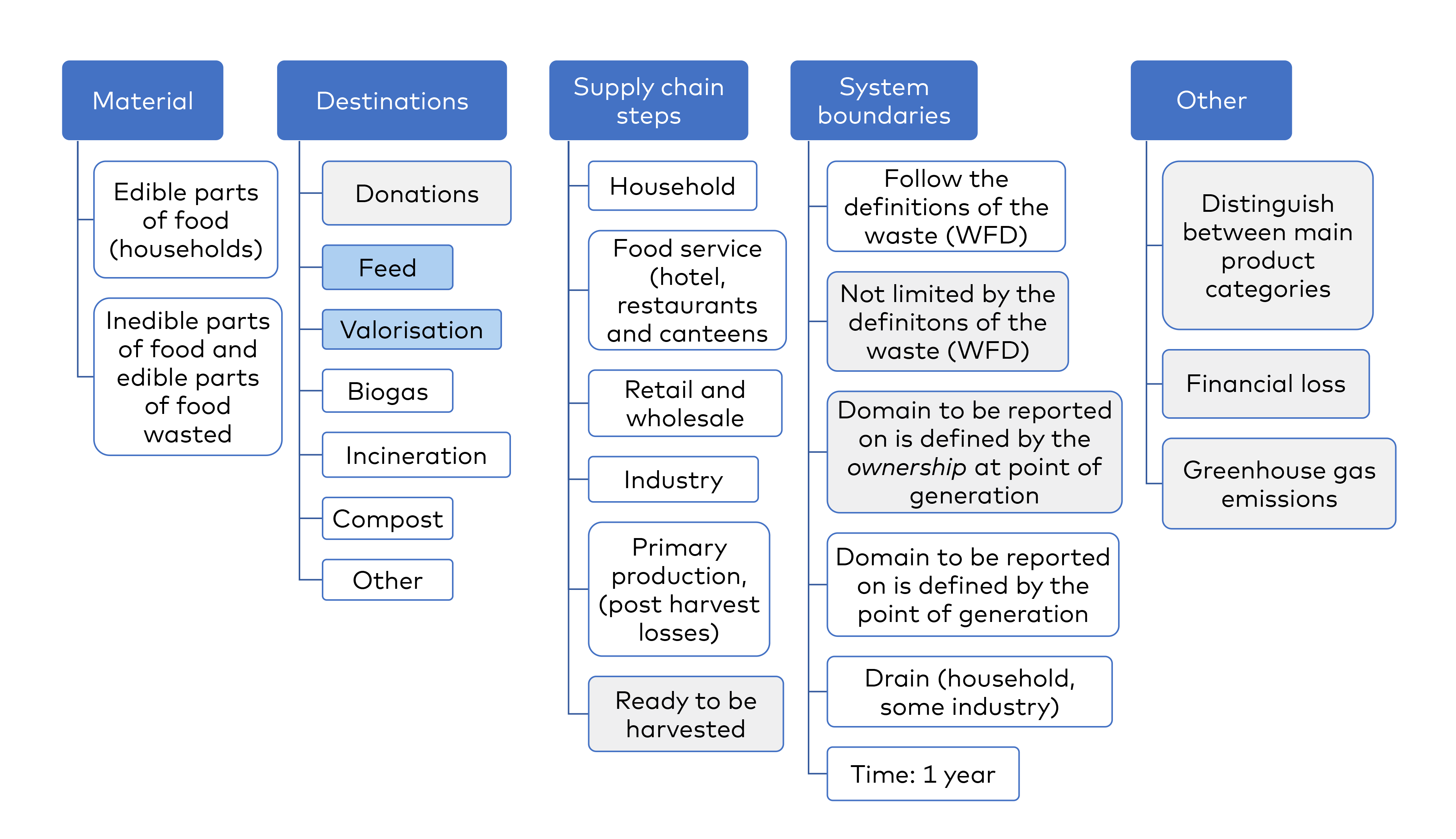
Figure 12 Food waste reporting in Sweden. Grey means that this material destination or supply-chain step or boundary condition is not relevant, and blue refers to that data are collected but not officially published in the National reports on food waste reported.
12 Appendix 2
Methodological approaches for food waste monitoring applied in the Nordic countries
Table 16 Food waste monitoring methodologies used in fisheries and agriculture
| Denmark | Finland | Norway | Sweden | |
| Starting of and frequency of monitoring | Only fisheries have relevant data sets from before 2020, however a monitoring programme is being implemented in 2020 monitoring food waste for primary production in general. | Research work concerning food waste in primary production started in 2011 (by Luke). In 2018 Luke started a project `Food waste monitoring and road map` which aim is to find best tools and measures to evaluate food waste also in primary production. Also, in Eurostat project (2016-2017) and Nordic primary production projects (2013-2017) have contributed to food waste monitoring. The methodologies have been chosen with close cooperation with Luke Statistical services and the first round of data collection was 2018-2019. The work is continuing, and the new data collection period will be in 2020-2021. | Started as a R&D project in 2017 for fisheries, reported in 2020 with statistics from 2018-19) and will be reported for the first time in 2021 for the agriculture sector, with data from 2020. | Research on food waste in primary production was carried out in the Nordic project (2014 -2016, Franke et al, 2017, diva2:1076202 ) This report served as the basis for the Swedish reporting on 2018 waste levels. For 2020 Sweden will hopefully be able collect data from the waste treatment plants as an estimate Further, the Swedish board of Agriculture is developing methods for measuring food loos and waste to follow up on the Swedish mile stone linked to the environmental objectives that more food should reach the consumer |
| Responsibility and involvement | EPA is the responsible body. Data are gathered by the national statistics office and Fiskeristyrelsen (fischery agency). | Luke has gathered the data at the first round but in the future Luke researches and Statistical service unit will gather the data in collaboration. | SINTEF gather data and develop statistics on behalf of the Seafood sector. Landbruksdirektoratat is responsible for data gathering and developing statistics, which will be done by Statistics Norway. No reports are available so far, as the first year of monitoring will be 2020. | Swedish EPA responsible for data and statistics. The consortium SMED- Svenska MiljöEmissionsData (IVL, SMHI, SCB och SLU) have been the ones collecting and analysing data. For waste it is IVL and SCB working in collaboration. The Swedish board of agriculture are also working on this but mainly on food losses. |
| Internal use of food waste monitoring to manage and prevent food waste | ||||
| Representative samples | Data is based on national statistics on production volumes combined with expert interviews on food waste levels in each sub-sector of primary production. For Fisheries existing data sets will be used. All fish caught on fish quotas shall be brought to shore. Fish not intended for human consumption or endangered fish will not be landed and monitored. | The past studies gave sample sizes around 10-30 percent of production. In present and future studies sample sizes need to be at least 30% of production. We also consider other aspects to evaluate the representativeness: e.g. size of the farm. | Will use national agriculture statistic which in future will include data on food waste, and as far as possible, data on secondary resources from primary production. | New methods are under development |
| Type of measuring method | Interviews with key experts Fish: Weighing upon landing | Questionnaires: cereals, vegetables, milk, cultivated fish Statistics: meat, eggs, fishing | Weighing of food being wasted from sorting, storing and packing either directly or based in counting or volumes of waste. | |
| Unit of measuring | Tonnes of food waste | Tonnes/kilos of food waste | Tonnes of food waste | Tonnes of food waste |
| Other impacts reported, e.g.. GWP and economic value | ||||
| Type of food products being monitored and reported | All main types of staple foods will be included from the different sectors. | Wheat, barley, rye, oat, potato, sugar beet, tomato, cucumber, carrot, strawberry, Beef, pork, poultry, chicken, egg, milk production, fishing and fish cultivation. | All main types of staple foods will be included from the different sectors. | Currently methods are developed for 8 product categories being: carrot strawberry wheat, milk, potatoes, meat (pork and beef), fish (herring); will be developed |
| Validation and control | Validation through expert interviews | Luke checks the data. | ||
| Upscaling methodology | Based in national production data. | Food production statistics | Based in national production data. | |
| Gap analyses | Currently the only dataset is related to fisheries. In 2020 the collected data from the rest of the primary production will be based on a limited number (25 interviews) with branch representatives and key experts. Data will be extrapolated with production statistics and fulfil the minimum requirements for EU-reporting. | Questionnaires: cereals, vegetables: Farmers do not measure food left in field but estimate the amount (questionnaires). Reporting is voluntary. | As there are so far no good statistics available, it is not yet possible to evaluate potential gaps between present statistics and future EU reporting. The methodologies proposed and the systems for data gathering indicate that the national statistics will fulfil the needs. There is however a need to include data on food being used as ingredients for animal feed. | New method from the board of agriculture under development, unclear if it will only cover losses and/or food loss. Looking into how to fill this gap since the report in use will be outdated. |
Table 17 Food waste monitoring methods applied in the food industry sector
| Denmark | Finland | Norway | Sweden | |
| Starting of and frequency of monitoring | Monitoring of food waste from food industry sector was carried out in 1994 (published by the EPA in 1998) and was updated (upscaling based on the original monitoring) in 2014, however there is no through investigation of whether processing practices have changed and to what extent those 1994/2014 data are representative. Organic waste separately collected from the food industry sector are reported every year to the EPAs waste statistics | Research work also concerning food waste in food industry sector started in 2008 (by Luke). In 2018 Luke started a project `Food waste monitoring and road map` which aim is to find best tools and measures to evaluate food waste also in food industry sector. The measures have been chosen in close cooperation with food industry companies and the first round of data collection was between 2019-2020. The work is continuing, and the new data collection period will be in 2021. No official time series of food waste exist | Started in 2010 with a small number of companies. At present about 40 large companies involved in data gathering in 2020 following the guideline developed by NORSUS for Matvett on how to understand the definition of edible food waste and to measure edible food waste in the food industry. | Starting year (2009) 2012 |
| Responsibility and involvement | Danish EPA responsible for data and statistics. Basis in national waste statistics. | Finnish Food and Drink Industries´ Federation gathers the data and Luke will analyse the results. Luke has developed measures and tools to measure food waste in industry sector. | NORSUS gathers data and develop statistics on behalf of Matvett. Companies do data gathering based in guidelines from Matvett and NORSUS, and by filling in a web-based registration scheme with quite specific data requested. | Swedish EPA responsible for data and statistics. The consortium SMED- Svenska MiljöEmissionsData (IVL, SMHI, SCB och SLU) have been the ones collecting and analysing data. For waste it is IVL and SCB working in collaboration. |
| Internal use of food waste monitoring to manage and prevent food waste | Data are used by the food industry companies to minimize food waste. | More and more food industries use their data on food waste to identify opportunities for food waste prevention and to follow trends in food waste from own company. Statistics are also used in own Environmental reporting. | Data is collected through environmental reports | |
| Representative samples | In the national waste statistics, all waste management facilities are obliged to report amounts of organic waste from food industry sector every year. These data will be supplemented with data from questionnaires and interviews with the largest producers in the food industry. By targeting the largest producers an expected 90% of the production will be covered. | At the first round (2019-2020) the sample size was 31 companies from different food industry branches. The current plan is that in the future (2021) the sample size will be 30% of turn over at the industry sector. Thus, the sample size will be increased and also data from SMS will be collected. | A large share (about 50%) of the food industry is covered based in economic value, but mainly with large food producers. Smaller and medium sized companies less involved | Environmental reports from food industry in combination with surveys for industries not obliged to give environmental reports. For the environmental reports the quality is difficult to access |
| Type of measuring method | Weighing of separately collected organic waste in various forms such as animal tissue and soft-parts, organic waste not suitable for human consumption, etc. | Questionnaire survey (online), Companies monitor their material flows closely using material flow charts and using weighting/scanning etc. | Mostly weighing of food before being wasted, combined with counting of packed units or estimating volumes of food waste in containers. Data from waste entrepreneurs are also used by some companies. | Data from environmental report, what method companies have used is unknown. Questionnaires |
| Type of food products being monitored and reported | Main categories monitored:
| Monitored:
| All types of food industries are involved in food waste monitoring, with economic representativeness in most sectors. 10 different main types of food reported, with data gathering covering 46 different subgroups of food. | All types of food industries are involved, looking into what they report in their environmental reports regarding waste. Data is reported for food waste and edible food waste. |
| Unit of measuring | Tonnes of organic waste and related waste organic waste streams. | Food Production volumes (kg) - Amount of raw materials, semi-processed food and/or end products, which company is not going to use (kg and dry solids content) - Amount of non-edible by-products in production (kg and dry solids content) | Tonnes of food waste Tonnes food waste/tonne production. Most companies do also report main causes for food being wasted, measures taken to prevent food waste as well as how it is treated (donations, animal feed, final waste treatment). | Tonnes if m3 is used a factor is used to convert to tonne |
| Other impacts reported, e.g.. GWP and economic value | CO2-eqv and economic value of food being wasted is calculated by NORSUS | |||
| Validation and control | Validation by the EPA. Significant deviations in the self-reporting from waste management companies are investigated in order to minimize errors in the waste statistics. | Data is checked by Luke. Significant deviations are checked out. | Data are checked by NORSUS against earlier years statistics and other companies in the sector. | Data program to see if significant changes from previous years. Manual checks of the highlighted data that sticks out. There is an added difficulty with the categorisation of waste/ bi products which have led to a lower reporting of waste. |
| Upscaling methodology | Turnover | Turnover (euros) | National production statistics per sub-sector of the food industry (tonnes) multiplied with food waste factors kg food waste per tonnes of production). | Where needed upscaling by number of employees for each subsector of food industry |
| Gap analyses | There are some inconsistencies in the reporting of data to National waste system. These require quality assurance by the EPA. Further, the collection of data directly from the industry is based on interviews with the biggest producers, hence lacking responses from SME’s and in general lacking representativeness and volume. Although some of the bigger production companies from the food industry is part of the VA “Danmark mod madspild”, it is not possible for the EPA to access the self-reported data on food waste quantities' | The sample represents only the big companies. There is need to get responses from SME’s. Missing responses from sugar production and fish product production. It is demanding to evaluate all different waste streams and side-flows and decide which is food waste and which is not. E.g. are all animal by-products excluded? How to calculate waste streams with high water quantity? There are many specific questions that still need elaborating and detailed instructions for different type of food production sectors. | Companies involved represent a large share (50%) of the food industry based in economic value. As there are many SME companies in the food industry, the present sample is though not representative for the whole sector. Food being used as ingredients for animal feed and as by-products in non-food production need to be removed from present statistics, before reporting to EU. | There are indications from businesses that the present data does not cover the industry’s food waste. Some of the industry is part of the VA Samarbete för minskat matsvinn and data can be gathered from there. |
Table 18 Methods used for food waste monitoring in retail and wholesale sector
| Denmark | Finland | Norway | Sweden | |
| Starting of and frequency of monitoring | Monitoring of food waste from retail sector started in 2002. A detailed study on food waste from retail with a division in edible and non-edible parts were published by the EPA in 2014. In 2020 a new monitoring based on voluntarily reported data from the largest retailers were utilized. Organic waste separately collected from the retail sector are reported every year to the EPAs waste statistics. | Started in 2015 annually, registered by all large retail chains. First estimate by Luke 2011. 2018 Luke started a project `Food waste monitoring and road map` which aim is to find best tools and measures to evaluate food waste also in retail sector. The measures have been chosen and the first rounds of data collection were taking place concerning years 2018 and 2019. No official time series of food waste exists based on previous new Luke and EU FW monitoring guidelines. So far Finnish retail sector food waste data based on different definition. (2015 by PTY). New definitions based on COM FW monitoring guidelines are now in use with those figures, what Luke is producing (2018 and 2019), | Food Waste reporting according to Bransjeavtalen started in 2010 through the ForMat project. Data gathering every year since 2010, most systematic since 2015. | Every second year Starting year 2012. 2018 is a shift in method resulting in much larger food waste being reported from this sector. |
| Responsibility and involvement | Danish EPA responsible for data and statistics. Basis in national waste statistics Since 2015 Danish retailer Salling Group (approx. 33% of retail market) started publishing detailed accounts of food waste. COOP Denmark (approx. 30% of retail market in Denmark) can report on amounts of food sent to bio-treatment. | The Finnish Grocery Trade Association (PTY) has so far collected and published the data. Luke started collection with PTY by more precise rules and food categories 2018, and new data collected from year 2019. Two a bit different type of figures will be published at the moment. | NORSUS gather data and develop statistics on behalf of Matvett Companies do data gathering themselves. | Swedish EPA responsible for data and statistics. The consortium SMED - Svenska MiljöEmissionsData (IVL, SMHI, SCB och SLU) have been the ones collecting and analysing data. For waste it is IVL and SCB working in collaboration. This year data was provided from the retailers. |
| Internal use of food waste monitoring to manage and prevent food waste | Salling group do separate data gathering in accordance to FLW protocol. And other retail chains use internal measuring systems to minimize the waste | Data are used by the retail companies to minimize food waste. | Data are used by the retail and whole-sale companies to follow food waste trends in the company as a whole as well as for individual shops. Data are used as a basis for identifying measures for prevention both in the company as such as well as in collaboration with suppliers. | Companies use data in order to see and be able to prevent food waste. |
| Representative samples | Data from Salling and Coop covers more than 60% of the market and represent a broad range of retail store types. Data from Salling is detailed on product group level and is a strong supplement to the waste composition analysis waste conducted by the EPA that included waste from 29 retailers and wholesale facilities In the national waste statistics Waste management facilities are obliged to report amounts of organic waste from retailers every year. The individually reported data from Salling is divided in to 15 categories | Data registered by all large retail chains with same definition, very representative (more than 90% of the retail volume included). | All 3 main companies in the retail sector and wholesale sector are involved. Data from a large share of retail shops and whole sale distribution centres in Norway are included in the statistics. | The main retailers have reported data. Since it is based in scanning of products, some food waste is likely missing. There is no data available from the wholesale sector. |
| Type of measuring method | Salling Retail stores mainly use scanning and weighting, and compare the amounts to actual sales of various product groups. Waste composition analyses has been used by the EPA for the division on edible and non-edible food waste. Weighing of separately collected organic waste from the sector | Retail stores mainly use scanning and weighting and compare the amounts to actual sales. Data collection is coordinated through retail store chains. Luke and PTY send questionnaires to the retail store chains who answer based on the retail store specific reporting. | Mainly scanning of products combined with weighing of products being distributed in loose weight, including information about the destination of unsold food, to distinguish between food being wasted or used for other purposes (e.g. donations). Economic factors have been developed by NORSUS, based in data from retail companies, to estimate mass of food waste based in economic value of a number of food categories. Mass data are now also available from scanned data from some retail companies. Edible share of food waste is calculated based in the Norwegian Food Table. | Scanned products |
| Unit of measuring | Self reporting: Tonnes generated Waste composition analyses: Kg/employee and year Kg/turnover and year National waste data system: Tonnes | Tonnes of food waste. The amounts mostly include edible food waste, but bones and peels are not extracted from food waste amounts. Destinations are given in percentages (relative figures). | Economic value of food being wasted, recalculated to tonnes of edible food waste | Kg but also kg/SEK where weight is missing. |
| Other impacts reported, e.g. GWP and economic value | CO2-eqv and economic value of food being wasted is calculated by NORSUS based in detailed food waste data | |||
| Type of food products being monitored and reported | Edible and non-edible are measured through a composition analysis Salling reports in 25 categories: Bakery, Cheese, Cold cut meat, Fish, Frozen, Salads/Sauces, Fruits and vegetables, Beverages. Bread & cookies, Coffee and tea, Confectionary, Dry groceries, Preserved food, Wine, Liquor and spirits, Sausages/BBQ, Breakfast cereals and jam, Dry staples, Oil/Condiments, Food court, Convenience chilled, Dairy, Fresh meat, Deli, Eggs/fats | Luke Monitored: 1) Fresh vegetables, root vegetables, fruits, berries, 2) Fresh bread and bakery products, 3) Meat and meat products, fish and fish products, 4) Milk and milk products, cheese, fat and oil products, eggs, 5) Other products (including convenience food and frozen products) Luke Reported: 1) Fresh: vegetable products, 2) Fresh: animal products, 3) Others PTY reported only total tonnes and percentages. | 10 main categories of food are being reported: Frozen ready-made food, fresh fruits and vegetables, bakery products, fresh ready-made food, meat, fish, eggs, liquid dairy, solid dairy, durable food, beverages. Data exists on a more detailed level of subgroups. | Data shifting from the different retailers, some with data on a product level. However, it is only reported as food waste in the report |
| Validation and control | New bottom up method with data reporting from the retailers. Since it is the first year no comparison can be made with previous years. Data is extrapolated by PlanMiljø. | Data not checked with detail previously, now checked by Luke within this new data collection scheme (comparison against PTY data and previous years), ongoing process at the moment, (summer and autumn 2020) | Data are checked by NORSUS and compared with sector data and data from earlier years. Significant deviations are checked out. | New method bottom up with data coming from the retailers. Since it is the first year no comparison can be made with previous years. Unclear what system boundaries that have been used. |
| Upscaling methodology | More than 60% of retail sector included. Upscaling by using national statistics on number of employees in retail sector. | More than 90% of the retail volume included --> upscaling no needed | National statistics for turnover in the retail and wholesale sector | To compensate for missing data from retail a mean value based on market share was used. The market share for the missing retailers was calculated from total sales from Dagligvarukarta |
| Gap analyses | Detailed data is delivered by Salling covering 33% of the market, however not all shop formats are covered and only limited data is included from smaller and specialized retailers (bakeries, butcheries, etc.). Especially amounts of food waste in the residual waste from the smaller shops and from distribution centres are missing. Furthermore, there is no present data from the fast growing online retail market. Data on the division in edible and non-edible food waste is based upon a relatively small composition analysis and data are published in 2014. | There is need to get more detailed data from retail sector in future. Especially improved data collection of where food waste ends up. | A large an unknown mass of bakery products wasted from retail companies is used as ingredients for animal feed. This is not included in national statistics of organic waste in accordance with new EU regulations, but is included in food waste reporting from retail companies. In national statistics there is however an unknown part of organic waste that is reported as residual waste (share of sorted organic waste is about 10% of total waste, whereas share of residual waste is about 30%). National statistics will thus at present lack a large and unknown amount of organic waste being treated as residual waste. Food waste reporting cover on the other hand only edible food waste, without data on non-edible food. It is thus necessary to have more representative samples to estimate amount of organic waste in residual waste to get complete statistics for EU reporting. | There is no data from Wholesalers in the national statistics for 2018. However the largest wholesalers are part of the VA Samarbete för minskat matsvinn and data will be collected and can be used for national statistics. Currently one retailer is represented in the VA, and will thus deliver data. There is the possibility that the retailers will deliver data to the EPA like the past year. |
Table 19 Overview methods used for food waste monitoring in the hospitality sector
| Denmark | Finland | Norway | Sweden | |
| Starting of and frequency of monitoring | Monitoring of food waste from the hospitality sector started in 1994 and the first detailed account for food waste are from 2002. A detailed study on food waste with a division in edible and non-edible parts are published by the EPA in 2014 (and a new report is expected in 2020). | Research work concerning food waste data in food service and hospitality sector started in 2008 (by Luke)., first results published 2010. In 2018 Luke started a project `Food waste monitoring and road map` which aim is to find best tools and measures to evaluate food waste also in hospitality sector. The measures have been chosen and the first round of data collection was between 2018-2019. The work is continuing, and the new data collection period will be in 2021. No official time series of food waste exist. | Food Waste reporting according to Bransjeavtalen started in 2017 through the KuttMatsvinn2020 project, first of all within the private sector (canteens, restaurants, etc), but also some representatives from the public sector (municipalities, counties). Data gathering every 6 months. Reporting every year through NORSUS and Matvett. | Reporting every 2 years Starting year 2012 |
| Responsibility and involvement | Danish EPA is responsible for food waste data and statistics. Basis in national waste data system | Luke will evaluate the measures and tools and gather the data in close co-operation with Finnish Hospitality Association Mara and other stakeholders. The current plan is that in the future the data collection will be automized and will be based on voluntary agreements. Companies do data gathering. | NORSUS gathers data and develop statistics for edible food waste on behalf of Matvett. Companies do data gathering and report data voluntarily to NORSUS. | Swedish EPA responsible for data and statistics. The consortium SMED- Svenska MiljöEmissionsData (IVL, SMHI, SCB och SLU) have been the ones collecting and analysing data. For waste it is IVL and SCB working in collaboration. |
| Internal use of food waste monitoring to manage and prevent food waste | Some hotel companies and municipalities have organized internal data gathering and reporting as a measure to reduce food waste from own facilities. They use the data to continuously improve their own food waste situation through preventative measures. | The data will be used as a basis for developing measures to reduce food waste in hospitality sector (road map of Finland) | Some hotel companies and municipalities have organized internal data gathering and reporting as a measure to reduce food waste from own facilities. They use the data to continuously improve their own food waste situation through preventative measures. | The Swedish food agency have done a national survey from public kitchens regarding the edible food waste (not used in the national statistics for 2018 but hopefully in the future) This data collection comes with a method on how to reduce food waste. |
| Representative samples | In the national statistics the waste composition analysis include one week of waste from 24 facilities (5 hotels, 5 restaurants, 3 kitchens at public institutions, and 11 canteens)additionally 474 questionnaires has been collected from the horeca industry. Waste management facilities are obliged to report amounts of organic waste from the hospitality sector every year to the national waste data system. | At the first round the sample size was 78 restaurants in a diary survey and around 900 restaurants in a questionnaire survey. In both samples different types of restaurants have been involved. The current plan is that in the future the sample size will be increased. Different kinds of food service businesses: Day care centres, schools, hospital, workplace and student canteens, a la carte restaurants, cafes, hotels etc. | More than 650 facilities collect data systematically since 2019. Different parts of the sector are differently represented, with the highest numbers among public and private canteens and restaurants. The reporting facilities represent a large share of economic value in total for canteens and hotels. | Data from 5 municipalities that use weighting of food waste and waste was used. Waste factors based on waste composition analysis |
| Type of measuring method | Waste composition analyses and questionnaires for division on edible and non-edible food waste. Weighing of separately collected organic waste | Diary survey (Lukeloki online measuring method). Questionnaire survey | Canteens, restaurants, schools and elderly institutions that have been part of KuttMatsvinn 2020 organized by Matvett with assistance from NORSUS, have measured also amount of food being wasted by weighing and registration before putting the food waste into the bin. There has been done a number of waste composition analyses to get a more detailed picture of how food waste is composed (types and amounts). Some hotels have also collected data from waste entrepreneurs, measured in tonnes and made available from accounting data. | Weighing of waste collected, factors for upscaling From 5 municipalities that weight the waste at each address and determining from that very specific data the amount arising from restaurants. And thus obtaining a factor for upscaling that is used with number of employees at restaurants in Sweden. Waste composition analyses to determine amount of food waste in residual waste. |
| Unit of measuring | Kg/employee and year Kg/student (or patient) and year National statistics organic waste: Tonnes of sorted organic waste per year and tonnes of residual waste per year. | Mass (kg):
| Tonnes in total and kg per serving, to some extent separated in four different parts of food processing (storing, preparing, serving and plate waste from guests). | Kg/employee and year Kg/student and year |
| Other impacts reported, e.g. GWP and economic value | No reporting, but Luke has calculated the financial loss and carbon footprint of food waste. | CO2-eqv and economic value of food being wasted is calculated by NORSUS based in detailed food waste data | No information on this is calculated | |
| Type of food products being monitored and reported | Edible and non-edible are measured in the latest report dating back to 2014. Estimates on division in animal related and vegetables. | Detailed data collection: over 10 main food categories | Food type data is grouped in 7 standardized categories. However, multiple serving places have registered food waste on much more detailed level. | Food waste |
| Validation and control | Using hospitality background data to test representativeness of samples. | Data are too some extent checked by NORSUS and compared with sector data and data from earlier years. Significant deviations are checked out. | Development over time | |
| Upscaling methodology | Upscaling by using HORESTA yearly statistics (Normtals analyse). In the 2014 reporting using number of full-time employees to scale-up | Upscaling by using national hospitality statistics: amount of sold portions | Food waste levels for private actors are related to their revenue and national statistics on the economic turnover in the hospitality sector are used for upscaling. For the public sector, food waste levels of each institute are related to number of elderly clients, number of school pupils or employees in public organisations and multiplied by national statistics. | By matching the amount of waste generated for each individual business with the number of employees at the workplace, which was obtained from the Corporate Database Register (FDB) at Statistics Sweden, a food waste factor in the form of kg food waste per employee and year has been calculated for restaurants This is done in combination with results from waste composition analysis. Similar methods are used for large scale kitchens, but here portions served is used to scale up the results. |
| Gap analyses | Three sample size of 24 facilities are quite small and composition analysis is only conducted during one week of the year, hence seasonal variations in produce and even weekly variations due to operational changes and staff turnover is not accounted for. Further the geographical coverage should be strengthened as well as the range of types of restaurant kitchens. | The current sample size of 78 food serving places needs to be increased and the representativeness improved. Now reporting is voluntary and probably the sample overrepresents proactive actors. Additionally, SME’s are underrepresented. Need for more tools to increase the sample size and randomize it. Many restaurants monitor their food waste but not plate waste. Need to promote and make plate waste monitoring more feasible solution for restaurants. | As there are no organic waste being used as ingredients for animal feed nor as input to bio-industry, it is assumed that all organic waste that is generated in the hospitality sector should be regarded as food waste in accordance with new EU regulations. There is however an unknown part of residual waste that is reported as residual waste in national statistics of organic waste (share of organic waste that is sorted out 18% of total waste, whereas share of residual waste is about 70%). National statistics will at present lack a large and unknown amount of organic waste being treated as residual waste. Food waste reporting cover on the other hand only edible food waste, without data on non-edible food. Data are not necessarily covering representative samples from the whole sector and especially not the public sector. It is thus necessary to have more representative samples to estimate amount of organic waste in residual waste to get complete statistics for EU reporting. | Here there will be a focus on how to improve the data and how to be able to use the national survey that the Swedish food agency does. If more companies from this sector joins the VA that will also be a good data source. |
Table 20 Methods used for food waste monitoring in households
| Denmark | Finland | Norway | Sweden | |
| Starting of and frequency of monitoring of food waste and organic waste | In 1979 and 1993 reports of food waste from households were published. Since then two waste composition analysis has been completed by the EPA In 2011 and 2017 that has provided detailed data on food waste arisings including estimates on edible and non-edible parts. Reports on treatment of organic waste from households (primarily food waste) has been published in 1992, 2001, 2011 and 2017. Organic waste separately collected from households are reported every year to the EPAs waste statistics. And published in Affaldsstatistik. In 2011 and 2017 waste composition analysis has provided more detailed data on food waste including estimates on edible and non-edible parts from households. | Food waste monitoring started in Finland in 2008 (by Luke). In 2018 Luke started a project `Food waste monitoring and road map` which aim is to find best tools and measures to evaluate food waste also in households. The measures have been chosen and the first round of data collection was between 2018-2019. The work is continuing, and the new data collection period will be in 2021. The current plan is that during every 4 years there are a few food waste quantification studies. In years where there are no direct measurements, past year estimates are used (percentage composition) to report to EU. Compilation of municipal organic waste started in Finland in 2002. Frequency of municipal organic waste monitoring every year. No official time series of food waste exist. | Food waste reporting according to Bransjeavtalen started in 2011, with detailed waste composition analyses in 2011, 2015 and 2017 from a few municipalities. Edible food waste estimated based in total mass of organic waste and data from waste composition analyses. | Food waste monitoring has been carried out every second year since 2004 on household food waste. The Swedish Waste Management Association collects data regarding collected waste from municipalities on a yearly basis. Edible food waste from households was presented for 2018 based on waste composition analyses from 35 municipalities across Sweden. |
| Responsibility and involvement for national statistics of organic waste and reporting of food waste | Danish EPA responsible for data and statistics. Basis in national waste data system | Luke proposes and tests food quantification methods and tools (national projects) for collecting households´ food waste. Statistics Finland is responsible for collecting municipal organic waste data. No official decision made on, how the forthcoming years food waste monitoring will be applied after 2020. Ministry of Environment officially responsible of this area towards EU. | Norwegian EPA is responsible for monitoring and statistics according to the Negotiated Agreement. Basis for national statistics is organic waste statistics from Statistics Norway as described over, combined with waste composition analyses in a certain number of municipalities. | Swedish EPA responsible for data and statistics. The consortium SMED- Svenska MiljöEmissionsData (IVL, SMHI, SCB och SLU) have been the ones collecting and analysing data. For waste it is IVL and SCB working in collaboration. The main data source is the Swedish Waste Management Association. Reporting is suggested to be mandatory for municipalities as well as waste composition analyses. |
| Internal use of food waste monitoring to manage and prevent food waste | Some municipalities have made individual waste composition analysis providing data on local food waste arising, and with the municipality of Copenhagen as the forerunner, data from composition analyses are used for campaigns to reduced food | The quantification data will be used as a basis for developing measures to reduce food waste (road map of Finland) | Some municipalities are using waste composition analyses to monitor edible food waste from households in own municipality and potential impacts of campaigns among inhabitants organized by the municipalities themselves or in collaboration with NGOs | Many municipalities look specifically on food waste in their waste composition analysis. The results are used for campaigns and as a data source for how to reach their waste goals in their waste plans. The Swedish Waste Management Association have guides on how and when this should be done which makes the results comparable. |
| Representativeness of samples for organic waste statistics and food waste statistics | In the composition analysis commenced by the EPA, 8 representative municipalities are selected covering a minimum of 1.600 individual households, with a waste sample covering one week of generation. In the national waste statistics, all waste management facilities are obliged to report total amounts of sorted organic waste from households as well as the public sector and the private sector every year. | The specific requirements for representative samples are under discussion. Luke has collected food waste data of households in several studies. In Spring 2021 there will be implement a research where the sample size will be: 2000 households (for questionnaire survey), 500 households (for diary survey) and 5000 for each of the waste composition analyses. | Only a few municipalities report edible food waste from waste composition analyses voluntarily. Statistics on edible food waste have been established based in waste factors from a few municipalities multiplied with total amount of organic waste to estimate amount of edible food waste per capita. | Data is mainly collected from Avfall Sverige where almost all Swedish municipalities report data. There is also data from the biological treatment plants. For the year of 2018 several municipalities were contacted for waste composition analysis and data from 35 municipalities (covering about 28 000 households) were used in order to report on proportion of edible waste. The division household food waste and non-household food waste an is based on information from a few municipalities and will be changed in the future. |
| Type of measuring methods used to measure organic waste and food waste | Weight of separately collected organic waste are reported to the national waste data system (ADS) based in weighing. Organic waste data reported to the national Waste Data System gives a detailed description of the quantity of waste and food waste generated in Denmark – especially in terms of sorted food waste. Waste composition analyses for division on edible and non-edible food waste. | Diary survey (online measuring method in evaluating households´ food waste, edible food waste) Questionnaire survey (qualitative indicators) Waste composition analyses (edible food waste and organic waste) | Data from waste statistics are used as a basis, combined with waste composition analyses of edible food waste in in a number of municipalities (40-50) on a voluntary basis according to the National Guidelines from Avfall Norge. Professional consultancies are in many cases hired to do the work. | Weighing of separately collected food waste and weight of food waste being home composted. Waste composition analysis is used to determine the amount of food waste in residual waste. Waste composition analysis for division of edible and non edible food waste and also to remove the part of the separately collected food waste that in fact was not food waste. Interviews To determine the division of how much of the collected that is household waste and how much is from business etc a factor is used based on interviews with select number of municipalities, based in waste composition analysis. |
| Unit of measuring and reporting | Mass of organic waste are reported in tonnes, units and kg/inhabitant and reported separately for multi apartment houses and single family dwellings, including perceived share of organic waste in the MSW. National data system: Mass of organic waste (tonnes) | Mass of organic waste (tonnes) Mass (tonnes) | ||
| Percentage composition (in years where there are not direct measurements) | Mass of food waste in tonnes and kg per capita. Percentage composition of 11 different food types. | Mass (tonnes) Percentage composition | ||
| Other impacts reported, e.g.. GWP and economic value | No reporting of this kind is made | No reporting, but Luke has calculated the financial loss and carbon footprint of food waste. | CO2-eqv from production of food that is wasted and economic value of food being wasted are calculated by NORSUS based in detailed food waste data | No reporting of this kind is made |
| Type of food products being monitored and reported as food waste | 8 main food categories are reported | Food waste reporting: Detailed data collection: over 20 main food categories | 8-11 main categories of food are being reported. | No data on that level |
| Validation and control of data and statistics | Waste composition analyses for division on edible and non-edible food waste. Data are compared with available composition analysis from municipalities and previous results -----!!!!!!Weighing of separately collected organic waste | Using and comparing different methods. Using household background data to test representativeness of samples. | Data have been validated by Statistics Norway and NORSUS for the edible food waste statistics from households, being published in Norway. | Comparison with previous year both for municipalities reporting in the system Avfall Web. SMED also check to see if the data in Avfall Web seems correct. SMED also compare with previous years food waste statistics to see if is seems consistent. For example, the waste composition analyses used to determine edible food waste were not used from Avfall Web due to inaccuracies. Instead data was collected directly from municipalities. |
| Upscaling methodology for organic waste statistics and food waste data | In 2011 and 2017 composition analysis has provided detailed data on food waste including estimates on edible and non-edible parts and animal and vegetal fractions. Organic waste separately collected from households are reported every year to the EPAs waste statistics. | Upscaling by using national waste statistics and population statistics | Upscaling by using national waste statistics for organic waste and population statistics. | Population statistics. Waste composition analysis have been used to determine how much of waste and food waste is to be attributed to households. Contact with a few municipalities regarding the distribution of household waste and waste from businesses. |
| Gap evaluation of present food waste reporting with needs according to EU regulations from 2020. | Food waste statistics in Denmark reported from households is covering a broad range of municipalities (6 out of 100 in total) differentiated in size, geographical location and urban vs. agro-based. Waste composition analysis is divided in single-house dwellings and compartment buildings providing a quite solid data basis from households. No important gaps are identified according to the EU 2020 regulation, but the voluntary reporting on liquid wastes are not being conducted in Denmark. | Waste composition analysis lack data on liquids and other waste going to sever/is lost in the waste bags. There is little research on how water evaporation/absorption should be counted in waste quantification. Additionally, waste composition analysis is always limited to only one type of area and does not represent whole Finland. Food waste diaries are missing some waste because people tend to change their behaviour when they are monitored. Additionally, we have only monitored edible food waste. Hence, we need to get data on inedible part of food waste (peels, bones etc.) using food consumption statistics, and use the statistics to estimate the amount of inedible parts. E.g. calculate the amount of coffee grain waste based on amount of coffee consumed. Reporting is voluntary and sample sizes need to be bigger to detect possible changes in food waste amounts. Our aim is to compare and combine waste composition analysis and food waste diaries and fill in the gaps. Food waste diaries give better picture of the composition of waste, whereas waste composition analysis will give us more reliable data on absolute amounts of some of the food groups. It can be that it is impossible to combine the two approaches, and therefore the alternative option is to use them as parallel food waste indicators. | Lack of data on food being used as ingredient in animal feed or in bioprocesses in industry is not a problem for estimating food waste from households. Food waste statistics in Norway from households is today based in waste composition analyses from quite a few municipalities regarding edible food waste, but with data from a larger number of municipalities regarding total food waste. This do not necessarily give a full representative sample of municipalities, but is more based on voluntarily sharing of data from municipalities that make analyses for their own purpose. The most important gap to be closed is thus to secure representativeness in waste composition analyses. | Factors used for the division of household and non-household waste will have to be updated. A suggestion on making it compulsory for municipalities with waste composition analysis in order to determine different kind of waste in the residual waste is on the table. This would make the data more representative. There will also be compulsory reporting of data from municipalities. |
About this publication
Monitoring Food Waste and Loss in the Nordic region
Definitions, methods and measures for prevention
Ole Jørgen Hanssen, Karin Östergren, Hanna Hartikainen, Tova Andersson, Mads Werge and Kjersti Prestrud
ISBN 978-92-893-6917-6 (PDF)
ISBN 978-92-893-6918-3 (ONLINE)
http://dx.doi.org/10.6027/temanord2021-504
TemaNord 2021:504
ISSN 0908-6692
Cover photo: Marta-Logina / Momenti
© Nordic Council of Ministers 2021
Disclaimer
This publication was funded by the Nordic Council of Ministers. However, the content does not necessarily reflect the Nordic Council of Ministers’ views, opinions, attitudes or recommendations.
Rights and permissions
This work is made available under the Creative Commons Attribution 4.0 International license (CC BY 4.0) https://creativecommons.org/licenses/by/4.0.
Translations: If you translate this work, please include the following disclaimer: This translation was not produced by the Nordic Council of Ministers and should not be construed as official. The Nordic Council of Ministers cannot be held responsible for the translation or any errors in it.
Adaptations: If you adapt this work, please include the following disclaimer along with the attribution: This is an adaptation of an original work by the Nordic Council of Ministers. Responsibility for the views and opinions expressed in the adaptation rests solely with its author(s). The views and opinions in this adaptation have not been approved by the Nordic Council of Ministers.
Third-party content: The Nordic Council of Ministers does not necessarily own every single part of this work. The Nordic Council of Ministers cannot, therefore, guarantee that the reuse of third-party content does not infringe the copyright of the third party. If you wish to reuse any third-party content, you bear the risks associated with any such rights violations. You are responsible for determining whether there is a need to obtain permission for the use of third-party content, and if so, for obtaining the relevant permission from the copyright holder. Examples of third-party content may include, but are not limited to, tables, figures or images.
Photo rights (further permission required for reuse):
Any queries regarding rights and licences should be addressed to:
Nordic Council of Ministers/Publication Unit
Ved Stranden 18
DK-1061 Copenhagen
Denmark
pub@norden.org
Nordic co-operation
Nordic co-operation is one of the world’s most extensive forms of regional collaboration, involving Denmark, Finland, Iceland, Norway, Sweden, and the Faroe Islands, Greenland and Åland.
Nordic co-operation has firm traditions in politics, economics and culture and plays an important role in European and international forums. The Nordic community strives for a strong Nordic Region in a strong Europe.
Nordic co-operation promotes regional interests and values in a global world. The values shared by the Nordic countries help make the region one of the most innovative and competitive in the world.
The Nordic Council of Ministers
Nordens Hus
Ved Stranden 18
DK-1061 Copenhagen
pub@norden.org
Read more Nordic publications on www.norden.org/publications