

MENU
Table of contents
Foreword
As countries around the world faced the COVID 19 outbreak in the early spring of 2020, many drew up official lists of ‘key workers’, whose children enjoyed priority to childcare and education. These lists of key workers demonstrate the importance of education, health and social care and other frontline services, not only in responding to a pandemic, but also for the general functioning of our societies. Many of these occupations are dominated by women, abroad as well as within the Nordic countries. Interestingly, some of these occupations also suffer from high rates of sexual and gender-based harassment, exposing power structures not only at work, but in society more generally.
This report is part of long journey of addressing sexual harassment in the workplace in the Nordic countries. The Me Too movement served as the latest reminder of the prevalence of such harassment and its links to women’s inequality more widely. Sexual harassment at work is a threat to women’s rights to financial independence and to taking part in public life – these rights are fundamental to gender equality.
Last year under Iceland’s presidency, the Nordic Council of Ministers hosted an international conference on the scope and impact of the Me Too movement. The discussions initiated during the conference generated important questions that need to be considered further in the Nordic countries’ context. While all the Nordic countries have made much progress on gender equality, the intersections of gender, race, class, ethnicity and disability have not been properly addressed in relation to violence and harassment. The abuse directed at occupations dominated by women demonstrates that today – a century after women’s suffrage and other civil rights – we still have a long way to go.
This report offers an important overview of the gaps and indeed chasms in our factual knowledge of sexual harassment in the workplace. It highlights the importance of multidisciplinary research and of continuing Nordic collaboration on ending sexual harassment at work and other forms of violence against women and girls. Such violence is both the cause and consequence of wider gender inequalities and we have both a legal and a moral obligation to end it.
Katrín Jakobsdóttir, Prime Minister of Iceland
Acknowledgements
The Nordic Council of Ministers for Gender Equality has initiated an effort to identify gaps in our knowledge of sexual harassment in the workplace and to develop a proposal for a research initiative that could boost knowledge in the Nordic countries’ context about gender-based harassment in the workplace. The cooperation body Nordic Information on Gender (NIKK) at the Swedish Secretariat for Gender Research, University of Gothenburg, was given the task of developing this proposal, and this overview of the research in the Nordic countries forms part of that task.
NIKK commissioned Malin Svensson, PhD in child and youth studies and investigator at the Swedish Secretariat for Gender Research, to survey the research and produce this research overview.
To assure the quality of the research overview, a researcher from each Nordic country was invited to participate in a reference group who have been consulted throughout the work process.
Thanks to:
- Eva Sophia Myers, MA and Head of Strategic Organizational Development, Gender Equality Team, University of Southern Denmark.
- Marjut H. Jyrkinen, Associate Professor in Working Life Equality and Gender Studies, University of Helsinki
- Ásta Snorradóttir, PhD, Assistant Professor, School of Social Sciences, Faculty of Social Work, University of Iceland
- Cathrine Holst, Professor at Department of Sociology and Human Geography, University of Oslo.
- Gunilla Carstensen, PhD, Senior Lecturer, Department of Education, Stockholm University
Thanks also to:
- Sanna Hellgren and Louise Preinitz Gärdinge, librarians at KvinnSam at the University of Gothenburg Library for their expertise in literature searches.
- The Working Group at the Swedish Secretariat for Gender Research for their constructive comments, conversations and perspectives.
Summary
Sexual harassment is a major social problem in working life in the Nordic countries, which the Me Too movement of autumn 2017 demonstrated in particular. This research overview has been compiled on behalf of the Nordic Council of Ministers for Gender Equality. The purpose of this overview is to provide an account of current knowledge about sexual harassment in the workplace in the Nordic countries and to identify the knowledge gaps to form the basis for a Nordic research initiative in this area. The work is based on a survey of the research into the various ways in which sexual harassment is expressed in people’s working lives based on occupations of varying nature, in professional situations, in peer relations, and in meetings with customers, patients and clients.
The research overview is based on a systematic review of the research and other relevant literature from the Nordic countries between the years 2014–2019. The overview does not claim to be comprehensive, although there has been an endeavour to present current research from all the Nordic countries.
The studies contribute knowledge about the conditions for employees and how some tasks can constitute vulnerability factors for being sexually harassed. There is a tendency to present the studied sector/industry or the studied occupation as worst affected and more affected than other sectors/industries and occupations. The risk with this is that knowledge about specific sectors/industries and occupations is perceived as representative of the whole of the labour market. By bringing together studies from different occupations, industries and sectors this research overview contributes an insight into the specific contexts of different occupations but also contributes a cross-sectoral picture of sexual harassment in the workplace in the Nordic countries.
How should we understand sexual harassment?
Research on sexual harassment has its background in the law and in American feminism in the 1970s, and has been seen as a means for women themselves to formulate the problem of men’s economic and sexual dominance. Since then, the problem has received attention in politics, legal systems and research. In all of the Nordic countries, sexual harassment in the workplace is currently against the law. Their national legislation contains legal definitions of sexual harassment, focuses on the employer’s responsibility to create a work environment that is free from sexual harassment, and sets out the employer’s obligation to actively combat discrimination and to promote equal rights. In this research overview, some studies define sexual harassment in legal terms while other studies do not include any definition at all. The term is therefore very open to interpretation and it is not always clear what is meant by sexual harassment in each individual study. Sexual harassment is thus a term, but equally a social problem that has been legislated against and investigated in research studies. Above all, it is a phenomenon that impacts people daily in their work.
Current knowledge about sexual harassment in the workplace in the Nordic countries
Sexual harassment is studied in various academic disciplines, but as a research field per se, it is not really cohesive. Instead, it can be described as a patchwork of studies that rarely relate to each other in a multidisciplinary context. What we know mainly about sexual harassment in the Nordic countries comes from studies of specific occupations and industries, but the results of these are rarely compared. This is despite the fact that there are common features that recur, for example a culture of silence and under-reporting at workplaces are considerable problems in all the studied sectors/industries.
The collective knowledge that we have from international as well as Nordic studies is that women are most frequently the victims of sexual harassment and that young women are harassed to a greater extent than older women. And our collective knowledge from international and Nordic studies is that the perpetrators of sexual harassment are mainly men. The position of the perpetrator varies depending on the sector or occupation in which the harassment occurs. In the occupations that are included in this research overview such as the performing arts, sports, the forest industry and professional armed forces, it is most often a superior or colleague who is the perpetrator. In health and care occupations and in the hotel and restaurant industry, it is most often patients or customers or guests who are the perpetrators, but superiors and colleagues also do figure among the perpetrators. In occupations in public administration, such as the police and the teaching profession, it is citizens, customers and clients, superiors and colleagues who are the perpetrators. In academia and organisational occupations, students, colleagues, supervisors and other superiors within the organisation are the perpetrators. The consequences for the victim depend very much on who the perpetrator is – a colleague or manager, patient, customer or client.
Sexual harassment is often explained as being about superiority or inferiority within an organisational hierarchy, men’s domination of women, and the prevailing masculinity and femininity norms within the society. In the research field, organisational theory with a focus on patriarchal structures, heteronormativity and masculinity norms are important perspectives on such systems of power. On the other hand, there are no perspectives that render homophobia, racism, disablism and other power hierarchies visible, which also affect workplace cultures and the risks of being sexually harassed.
Many studies claim that sexual harassment is only one aspect of sexual violence and that one of the reasons why it is difficult to name sexual harassment as a form of violence is that the emotional impacts of violence do not leave visible marks on the body. Other aspects, such as consent, are rarely problematised at all in the studies. According to some of the studies, consent is more multi-layered than a yes or a no, since sexual harassment is often a process of trust-building, frequent contact and transgressions of boundaries. In the research, the organisational structures that enable sexual harassment in the workplace tend to identify the individuals as responsible when sexual harassment occurs rather than organisations bearing a responsibility to both prevent and combat the phenomenon. It is often difficult to prove that sexual harassment has occurred or is occurring, because the words and actions of the perpetrator are subtle and calculated. There is an emphasis on the individual, in particular the victim, while the perpetrators often have the upper hand, go unnoticed, or pass under the radar. The consequences of sexual harassment in the workplace are devastating, especially for many of the individuals who are subjected to it. Studies point to feelings such as fear, guilt and shame, anxiety, diminished career opportunities, reduced job motivation, and the risk of dismissal. A further risk is that victims are forced to remain in the workplace under working conditions that diminish their quality of life.
General observations about the research field in the Nordic countries
Our knowledge is largely based on prevalence studies, i.e. quantitative studies that measure how prevalent and how widespread sexual harassment is at a certain point in time. Prevalence studies show that women are over-represented when it comes to being sexually harassed in the workplace while men are most often the perpetrators. Some of the studies included are based on qualitative studies and interviews that aim to obtain a more in-depth picture of the victim’s perspective on sexual harassment. Interview studies also show that women are over-represented when it comes to being subjected to sexual harassment in the workplace and that men are over-represented when it comes to subjecting others to sexual harassment. Both of these approaches are needed because they bring a range of perspectives to the knowledge base. However, comparing results between studies has proved difficult because of the different approaches taken. Both prevalence studies and interview studies investigate women in greater proportions and men in lesser proportions and the empirical evidence is remarkably homogeneous with regard to the grounds of discrimination of ‘gender’ and ‘age’. However in studies that have used testimonies from the Me Too movement as empirical data, it is apparent that such testimonies contribute detail and a broader empirical foundation and that such testimonies act as a window into how sexual harassment manifests itself in people’s working lives in different sectors. These kinds of studies reveal what lies behind the behaviours that are clustered into categories in prevalence studies. In the research field, there is an imbalance in what occupations, industries and sectors are investigated. An observation made in this research overview is that occupations in certain industries in the public sector are studied more frequently and that occupations in industries in the private sector are investigated less frequently. There is also a focus in the research field on vulnerable individuals and groups while there are virtually no studies of perpetrators, or the individuals who witness others being harassed, i.e., bystanders.
Sector-specific observations concerning sexual harassment
This research overview is the result of a systematic literature review. The pattern that emerges is that studies of sexual harassment in the Nordic countries have been conducted in different sectors of the labour market and in a thematic categorisation of them, tasks and working conditions are of central importance. The conditions for sexual harassment to occur in the workplace are affected by whether the body and the physical work of the employee are the main tools used, whether social relationships feature strongly in the work in the form of client, customer or patient contact, or whether the work is less physical and related more to office tasks. The individual, as a social actor and a performing actor but also as a body, came to be what guided the determination of the four themes: (1) physical work, (2) work that involves client contact, (3) work that involves patient/customer contact, (4) academic and organisational work.
In occupations where the body and the physical work of the employee are the main tools used, for example in the theatre, performing arts and sports, the body is what creates the aesthetics and the strength that are essential to the performance of the work. In occupations in the forest industry and in the professional armed forces, masculinity norms and strength are the ideals for understandings about who is suitable – and unsuitable – to carry out the work. In occupations characterised by social relationships in the form of client contact, as in the public sector, employees’ tasks heavily involve direct contact with the organisation’s clients. Examples of such professions are the police, teachers and social workers. In occupations characterised by social relationships in the form of patient/customer contact, the tasks involve providing health care and care, intimate care and services, for example in the health care professions and in the hotel and restaurant sector. In academic and organisational occupations, the work is characterised by non-physical tasks and the body has no great importance for being able to perform the tasks involved in the job. On the other hand, the body can be objectified within such occupations and be the object of ideals in terms of functionality/disability, aesthetics and beauty in a specific sector or a particular profession. All in all, the thematic categorisation of the included studies spans many sectors and large parts of the labour market. Below is a summary of the main perspectives within each theme.
Physical work
- In studies of industries characterised by physical work, a pattern emerges where the boundaries between the individual’s private body and their occupational body often become blurred, for example for theatre actors and athletes.
- In occupations where the body is central, physical contact is normalised and the boundaries for what is a transgression of a sexual nature are shifted and become multi-layered in the everyday work environment.
- Occupations that involve physical work can also be heavily centred on physical strength. Usually, it is a man’s physical strength that constitutes the ideal and is seen as proper and appropriate, while women must fight to gain legitimacy, for example in the forest industry and the professional armed forces.
Work that involves client contact
- These employees find themselves in the middle somewhere, where they must take into account the expectations and demands of both their employer and the target group of the activity, while their work also involves considerable discretion for them to make decisions that give them power and influence over citizens, students or clients.
- Studies of sexual harassment are common in occupations or industries that are dominated by employees who are either men or women. But masculinity norms are seen as having an impact irrespective of the occupation or sector, for example men’s status as superiors even in occupations traditionally dominated by women such as social services.
- In some cases, sexual harassment is studied alongside bullying, for example within the police force and in the teaching profession, while the boundaries between these phenomena are described in vague terms.
Work that involves patient/customer contact
- In health care occupations such as nursing, according to the studies it is most common for the patient to be the perpetrator. It can be difficult for those who carry out tasks within the care professions to determine what lies behind unwelcome sexual behaviours, and there is a risk of confusing a patient’s/customer’s mental state or illness with sexual harassment. This can occur for example in nursing or within service occupations where the motto “the customer is always right” constitutes part of the working conditions.
- The normalisation of physical contact and unclear boundaries between what is considered permissible behaviour by patients and customers can have consequences for how organisations manage sexual harassment. For example, there is a risk that the workplace will disclaim responsibility and instead see putting up with unwelcome sexual behaviours as just part of the job.
- Individuals from ethnic minority backgrounds constitute a high proportion of those who work in health care occupations and in the hotel and restaurant sector. In studies of these industries however, there are no analyses or theoretical perspectives that examine harassment and privilege based on ethnicity and skin colour.
Academic and organisational work
- Students, young women, women with precarious employment conditions and visible minorities (based on ethnicity, skin colour, disability and sexuality) are more often the victims of sexual harassment than other groups.
- Work to prevent sexual harassment in academia is often lacking, the instruments used are primarily bureaucratic, and there is a lack of evidence that they have any effect.
- In the private sector, for example within management occupations, physical and aesthetic aspects are highlighted as part of the workplace culture. For example youthful, Western ideals of beauty and norms for a woman’s weight and height, but also a disparaging view of ageing in women, tend to legitimise sexual harassment in the sector.
- Research that investigates sexual harassment in academia is dominated by prevalence studies, i.e. studies that investigate the prevalence of sexual harassment based on measurable variables. What may be problematic in the analysis of such studies is that the context in which sexual harassment occurs is not described. For example, it may be difficult to make visible how sex and gender constitute a context for wrongs and harassment on the basis of predetermined quantitative variables.
Theoretical lines of inquiry to develop
The studies included in this research overview depict men and women in a relatively traditional and unproblematic way with heterosexuality as the norm. This heteronormativity means that sexual harassment of persons who do not fit this norm, for example LGBTQI persons, are seen as abnormal. The fact that men are not only perpetrators – there are also men who are sexually harassed in the workplace – and that there are men and women who are harassed by someone of the same sex, are additional facets of heteronormativity constituting a limit on our knowledge about sexual harassment. Every individual’s identity involves more factors than just gender and age, but those who are seen as deviating from a number of social norms run a higher risk of harassment.
In a Norwegian study of the hotel and restaurant industry, immigrant women and men are highlighted as some of the most frequently harassed sexually in the workplace, but there has been no development of knowledge around this fact. Instead, there is a striking silence in the research field and a ‘colour blindness’ concerning different categories of women and men, their backgrounds, and whether any grounds of discrimination besides gender and age apply to them. Studies of sexual harassment include predominantly white men and women and those that fall outside these categories are described as “other groups” with “other forms of harassment” than the majority population. This masks who these other groups are in working life in the Nordic countries, what the prevalence of sexual harassment is for them, and how sexual harassment is experienced from the perspectives of these individuals and groups. Statistical studies show that there are considerable differences between majority and minority population groups in the Nordic countries when it comes to access to the labour market, working conditions, and terms of employment. To focus solely on gender and age can therefore lead to a fragmentation of knowledge about sexual harassment in the workplace in the Nordic countries. Intersectional perspectives on harassment in the lives of individuals and groups could add knowledge about sexual harassment in the workplace in the Nordic countries.
Identified knowledge gaps
The knowledge gaps identified in this research overview are listed below.
- The concept sexual harassment suffers from a lack of clarity and in terms of knowledge this poses challenges for what we can really know about the phenomenon. The problem with too general a definition is that the results of different studies become difficult to compare, which has an impact on how generalisable they are. On the other hand, too precise a definition risks diminishing the effects of words and actions that are interpreted and perceived as sexual harassment, but which do not fit into the legal definitions of the term.
- Organisational and workplace culture refers to norms, values and social patterns that characterise organisations and workplaces in different industries and sectors. There is a knowledge gap about the processes surrounding the incidence of sexual harassment, who is responsible for what happens, and what it is that ought to be prevented. It is important to increase knowledge about how organisational and workplace cultures can constitute both opportunities and obstacles to individuals being willing and having the courage to speak out about what they have been subjected to. This is important because such knowledge is central to prevention even being possible.
- The individualisation of the problem of sexual harassment refers to the fact that the research in the field is mainly based on legal definitions and studies that focus on behaviour at the individual level to explain the phenomenon. Thus, there is a knowledge gap concerning structures that result in sexual harassment occurring.
- Culture of silence and under-reporting in the workplace means that when only a few of all those who are sexually harassed report it, the number of unreported cases is large and this limits the usefulness of the knowledge base. Furthermore, under-reporting is also most often a result of a study, rather than its point of departure or an initial question. It is important to draw attention to the reasons why individuals do not speak about and report what they have been subjected to.
- The consequences of sexual harassment in the workplace affect both individuals and organisations. At the level of the individual, the consequences depend greatly on who the perpetrator is – a colleague or manager, patient, customer or client – and can take the form of mental ill-health, sickness absence, diminished career opportunities and wanting to quit the workplace where the incidents occurred. At the organisation level, the consequences can be costly staff turnover, investigation costs and legal costs, but also fortifying efforts in the form of training and development. There is in general very little knowledge about the consequences of sexual harassment, but those studies that do exist seem to have examined the phenomena at the individual level to a greater extent than at the level of the organisation.
- Perpetrators and bystanders refer to those individuals who subject others to sexual harassment, and those who witness when others are being harassed. The studies included deal largely with individuals’ experiences of harassment and vulnerability factors in working life. But there are no studies of perpetrators – those who subject others to sexual harassment – and therefore we risk not acquiring knowledge about the causes that lead to sexual harassment. There are also no studies of bystanders, that is, those who witness others being sexually harassed, those who can intervene when harassment occurs, persons who can provide support, persons who may be traumatised by witnessing the harassment, and persons who directly or tacitly give support to perpetrators. Bystander programmes in the form of training courses which seek to encourage witnesses to intervene when sexual harassment occurs are, according to international research, an effective way to reduce the incidence of sexual harassment. Knowledge about perpetrators and bystanders can contribute more multifaceted knowledge about the incidence of sexual harassment.
- Sexual harassment in relation to another form of harassment entails some challenges in research. Violence against persons on the basis of normative ideas of femininity and masculinity, bullying, harassment more generally and sexual harassment lead to in part similar symptoms in individuals. They are also explained by roughly similar circumstances, that is, behaviours of individuals emanating from unequal power relationships. An example is the difficulty in distinguishing between bullying and sexual harassment because bullying can be just as common among women as a group as between groups of women and men. The primary framework for understanding what harassment is cannot be taken for granted because the harassment is dependent on its context.
- Working conditions and terms of employment are often affected by the nature of the tasks and have an impact on the employee’s security and their occupational safety under the law. Short-term and temporary contracts can entail a high risk of exploitation of labour. The gig economy, where permanent employment contracts are replaced to a large extent by temporary ‘gigs’, is a form of jobs based on flexibility, efficiency and short-termism without security of employment. It increases the employee’s dependence on employers/customers. Even in cases where the terms of employment are secure, the working conditions can constitute a precariousness factor that has an impact on harassment in the workplace. The risks of being subjected to sexual harassment emanating from working conditions and terms of employment need to be investigated further.
- Efforts to prevent sexual harassment in the workplace are absent in the included studies. One aspect of the lack of knowledge of preventive efforts is that there is some lack of clarity in the research field around how sexual harassment should be defined and interpreted. Knowledge about concrete proposals for preventive efforts that promote gender equality and bring to light discriminatory actions that pass under the radar in the workplace is also needed.
This research overview is based on studies from a diversified research field with few interfaces between the various disciplines and between the studied occupations and industries. It is therefore important moving forward to facilitate a continuous and open scholarly dialogue on the term sexual harassment. Cross-sectoral perspectives on the phenomenon of sexual harassment in the workplace are lacking and are needed to be able to respond to the problem within different occupations and in order to share lessons learned between industries and sectors. Nordic perspectives on the phenomenon of sexual harassment in the workplace are lacking and are needed because the job market in the Nordic countries is interconnected since employees often move across these national borders during their working lives. It is of the utmost importance to study sexual harassment in the workplace in general in order to avoid the exclusion of employees in certain occupations and industries. Critical perspectives that explore systems of power other than sex and gender are lacking in the research field. These kinds of perspectives are needed in order to include more employees and grounds of harassment in working life in the Nordic countries. There is research-based knowledge about what preventive efforts should include, but studies of the impacts of such efforts in practice are lacking and are needed. Knowledge about the agency of women and other harassed groups is an important form of prevention because it provides more understanding of what obstacles and structures victims are up against in different occupations and industries.
Materials and implementation
The research overview is based on a systematic review of research literature from the Nordic countries in the period 2014–2019. With the help of KvinnSam[1]Sanna Hellgren and Louise Preinitz Gärdinge. A more detailed description is given in Annex 1. at the University of Gothenburg Library, literature searches were carried out in ten databases during October 2019 based on two search queries: (1) How is the term “sexual harassment” used in the literature on sexual harassment in the workplace in the Nordic countries?; (2) What literature is available on other forms of harassment and discrimination in the labour market in the Nordic countries?
To assure the quality of this work, there have been regular consultations with a group of experts on sexual harassment at the Swedish Secretariat for Gender Research at the University of Gothenburg and with a Nordic reference group[2]Eva Sophia Myers (University of Southern Denmark), Marjut H. Jyrkinen (Helsinki University), Ásta Snorradóttir (University of Iceland), Cathrine Holst (University of Oslo) and Gunilla Carstensen (Stockholm University)..
Of the approximately 300 abstracts read, 62 studies were read and categorised on the basis of the study’s aim, theory, method and results. Finally, 27 studies were chosen to be included in this research overview. The qualitative studies included can largely be said to complement previous quantitative knowledge. It is not unusual for the sampling in interview studies to be based on previously collected survey data, with the aim of adding depth to this knowledge – knowledge that is difficult to obtain from a survey. The qualitative studies tend to be more theory-driven than the prevalence studies, which are more descriptive in nature. Most of the studies are published in scholarly articles that have undergone peer review, and they were selected on the basis of their scholarly quality.
Footnotes
- ^ Sanna Hellgren and Louise Preinitz Gärdinge. A more detailed description is given in Annex 1.
- ^ Eva Sophia Myers (University of Southern Denmark), Marjut H. Jyrkinen (Helsinki University), Ásta Snorradóttir (University of Iceland), Cathrine Holst (University of Oslo) and Gunilla Carstensen (Stockholm University).
Structure of the research overview
The report begins with an overview of the research field on sexual harassment in the workplace in the international context. This is followed by a section on methodology and the process of knowledge acquisition. Then come four sections in which physical work, client contact, patient/customer contact and academic/organisational work are used as themes by which to analyse and categorise the studies that have been included. Finally, the most important results that we know today are summarised, and a concluding discussion presents the theoretical lines of inquiry that need to be developed, and the identified knowledge gaps that ought to be taken into consideration, in future research in the field.
Introduction
Purpose of this research overview
This research overview has been produced on behalf of the Nordic Council of Ministers for Gender Equality. Its purpose is to identify what we know today about sexual harassment in the workplace in the Nordic countries from the research perspective. The research overview also aims to identify knowledge gaps as the basis for a proposal for a Nordic research initiative in the area. This is achieved by mapping out and reporting on different occupations on the basis of whether the body and physical work are the main tools of work, whether social relationships feature strongly in the work in the form of client, customer or patient contact, or whether the work is less physical and related more to office tasks. The purpose of this categorisation is to provide a cross-sectoral picture.
The overview is limited to what we know about sexual harassment in the workplace in the Nordic countries. It is based on a systematic review of the research literature from the Nordic countries in the years 2014–2019. The research overview does not claim to be comprehensive, but there has been an endeavour to present current research from all the Nordic countries.
The Nordic model
The Nordic model is often emphasised as key in gender equality efforts in the Nordic countries. This is primarily a concept that describes how the societies in the Nordic countries have been organised in modern times and how they contrast with the rest of the world. There are some distinguishing characteristics that recur in this model. The first is a strong state and a large public sector. The second is that the welfare state in each of these countries is largely financed by tax revenue and their social security systems mean that in periods of incapacity for work – in the event of sickness, unemployment, parenthood or reduced work capacity – citizens are able to protect their standard of living without working. The third is the successful cooperation between the state and the social partners. The fourth is a high level of employment of women and mothers in the Nordic countries and relatively low inequality between women and men in comparison with other OECD countries, partly as a result of policy measures in working life and in family life.[1]Grönlund, Halldén & Magnusson (2017)
There is a political aspiration to counter gendered education choices that result in a gender-segregated labour market in the Nordic countries.[2]Nordic Council of Ministers (2019) At the society level, men and women work in a variety of occupations, and men and women can be found at different levels and positions within organisations and companies. However, there is a segregation between men’s and women’s specialisations within different occupations. This is reflected among other things in the pay gaps between women and men, which is one of the obstacles to the achievement of gender equality in the Nordic countries.[3]Måwe (2019) Since the 1990s, the Nordic labour markets have become more market-oriented and women as a group risk not benefiting from this as much as men due to persistent notions of the ideal worker as constituting a male/masculinity ideal.[4]Grönlund, Halldén & Magnusson (2017) Through policy decisions and broad strategies, the Nordic countries are attempting to push for equality in working life free of discrimination based on sex. For example, there is strong legal protection against discrimination and harassment in all these countries.[5]Måwe (2018a) Furthermore, surveys from Nordic information on Gender (NIKK) demonstrate that questions relating to sexual harassment in the workplace have attracted political attention in the Nordic countries after the extensive #MeToo call for action in various sectors in autumn 2017.[6]Måwe (2018a, b; 2019); Young Håkansson (2019)
Knowledge gaps concerning sexual harassment
Nordic research shows that the #MeToo call for action has had varying outcomes in the Nordic countries, in spite of the Nordic model, and high ambitions in gender equality policy and its beneficial effects over time for women in working life.[1]For example, Askanius & Møller Hartley (2019); Sletteland (2018) International research consists of studies from various disciplines and these show that sexual harassment is a widespread and serious problem in working life.[2]Bondestam & Lundqvist (2018); Latcheva (2017); McDonald (2012) Internationally however, the research field is not cohesive and there is no clear, common definition of what sexual harassment in the workplace is among researchers. There are also no clear boundaries in relation to other phenomena such as violence, bullying and harassment more generally; violence directed against persons on the basis of normative ideas of femininity and masculinity; sexual violence and lack of consent; and gender inequality in the labour market.[3]For example, McDonald (2012) These phenomena often intersect each other rather than exist side by side, but this is rarely reflected in the research field. This research overview mainly includes studies of sexual harassment.
Sex, gender and power
The research field is dominated by prevalence studies, i.e. studies which measure the prevalence of sexual harassment at a given point in time. This is done mainly through surveys, for example, how many individuals respond that they have been sexually harassed and how many respond that they have been the perpetrator of sexual harassment, and the splits between women and men.[4]Bondestam & Lundqvist (2018); Latcheva (2017); McDonald (2012) Studies show that sexual harassment is a comprehensive and cross-sectoral problem within the workplace.[5]McDonald (2012) There is a preponderance of research in the field in a North American context, while there is substantially less research in Europe and in the Nordic countries.[6]Bondestam & Lundqvist (2018); McDonald (2012)
The research field is characterised by a binary understanding of gender and power, and the collective knowledge internationally is that women are usually the victims and men are usually the perpetrators and that young women are sexually harassed to a greater degree than older women.[7]Bondestam & Lundqvist (2018); McDonald (2012); Pina, Gannon & Saunders (2009) In the research field, these patterns are often explained on the basis of men’s power and women’s vulnerability linked to the grounds of discrimination of sex and age. The causes of the phenomenon of sexual harassment are also linked to the theoretical perspectives on gender. Gender perspectives makes apparent that there can be masculinity norms within organisations and workplace cultures that are permissive of men’s degrading treatment of individuals who, according to the prevailing norms, are coded as women, or who are attributed characteristics that are associated with norms of femininity.[8]Acker (1990) Gender is not defined in research studies on sexual harassment, and there is a risk that even this overview replicates a normative picture when these terms are used. The assumption here is that sex is a category that a body is considered to belong to on the basis of some form of biological determination of sex. The term gender, on the other hand, is often used to “emphasise the relational and dynamic in masculinity and femininity in terms of aesthetics, bodies and power”.[9]Dahl (2016), p. 17 In this research overview, there is reason to return to the significance of the terms sex and gender in a concluding discussion.
Intersectional perspectives
Intersectional perspectives are an additional theoretical tool that help to reveal the importance of systems of power other than sex and gender – for example class, ethnicity, race and skin colour, sexual identity and orientation, disability, and other factors.[10]Acker (2006); Bergbom, Vartia-Vaananen, & Kinnunen (2015); Crenshaw (1989); de los Reyes (2014); Eide (2014); Fahlgren, Mulinari & Sjöstedt Landén (2016); Gressgård (2014); Hammarstedt, Ahmed & Aldén (2015); Kuznetsova, Yalcin, & Priestley (2017); Mulinari (2017); Ollus (2016) International research overviews show however that thus far such perspectives are lacking in the research field of sexual harassment in the workplace – with a few exceptions.[11]Bondestam & Lundqvist (2018); McDonald (2012) These exceptions are rarely connected to the Nordic context, but concern mainly minority groups in North America. Knowledge on these perspectives in the Nordic countries can thus be regarded as very limited.
A research field with many knowledge gaps
International research indicates that there are many knowledge gaps in this field of research. Sexual harassment is often defined as various forms of unwelcome sexual attention and sometimes categorised into verbal, non-verbal and physical.[12]Latcheva, 2017 These categories are however defined in different ways in different studies which makes it difficult to compare their results.[13]Bondestam & Lundqvist (2018); McDonald (2012); Latcheva (2017) Under-reporting and a culture of silence in the workplace are causes of the lack of knowledge about how prevalent the phenomenon is in the labour market in general.[14]Bondestam & Lundqvist (2018); McDonald (2012); Pina, Gannon & Saunders (2009) Furthermore, there are no studies of perpetrators which means that there is a risk of not acquiring any knowledge about the behaviours which lead to sexual harassment.[15]Bondestam & Lundqvist (2018); McDonald (2012); Pina, Gannon & Saunders (2009) Bystanders is another category about which we lack knowledge. Bystanders are described in the research field as persons who witness others being sexually harassed, those who can intervene when harassment occurs, persons who can provide support, persons who may be traumatised by witnessing the harassment, and persons who directly or tacitly give support to perpetrators. Knowledge about bystanders is important in order to bring the phenomenon of sexual harassment to light.[16]Bondestam & Lundqvist (2018) Our research-based knowledge about the prevention of sexual harassment and its consequences is comprehensive, but however suffers from a lack of concrete results on the effectiveness of preventive methods.[17]Lundqvist & Bondestam (2019); Simonsson (2020) The knowledge base in the Nordic countries is relatively thin in comparison with North American contributions.[18]Bondestam & Lundqvist (2018) That is why it is more urgent than ever that we boost the production of this knowledge in the Nordic counties.
Footnotes
- ^ For example, Askanius & Møller Hartley (2019); Sletteland (2018)
- ^ Bondestam & Lundqvist (2018); Latcheva (2017); McDonald (2012)
- ^ For example, McDonald (2012)
- ^ Bondestam & Lundqvist (2018); Latcheva (2017); McDonald (2012)
- ^ McDonald (2012)
- ^ Bondestam & Lundqvist (2018); McDonald (2012)
- ^ Bondestam & Lundqvist (2018); McDonald (2012); Pina, Gannon & Saunders (2009)
- ^ Acker (1990)
- ^ Dahl (2016), p. 17
- ^ Acker (2006); Bergbom, Vartia-Vaananen, & Kinnunen (2015); Crenshaw (1989); de los Reyes (2014); Eide (2014); Fahlgren, Mulinari & Sjöstedt Landén (2016); Gressgård (2014); Hammarstedt, Ahmed & Aldén (2015); Kuznetsova, Yalcin, & Priestley (2017); Mulinari (2017); Ollus (2016)
- ^ Bondestam & Lundqvist (2018); McDonald (2012)
- ^ Latcheva, 2017
- ^ Bondestam & Lundqvist (2018); McDonald (2012); Latcheva (2017)
- ^ Bondestam & Lundqvist (2018); McDonald (2012); Pina, Gannon & Saunders (2009)
- ^ Bondestam & Lundqvist (2018); McDonald (2012); Pina, Gannon & Saunders (2009)
- ^ Bondestam & Lundqvist (2018)
- ^ Lundqvist & Bondestam (2019); Simonsson (2020)
- ^ Bondestam & Lundqvist (2018)
Structure of the research overview
This report begins with an overview of the research field on sexual harassment in the workplace in the international context. This is followed by a section on methodology and the process of knowledge acquisition. Then come four sections in which physical work, client contact, patient/customer contact and academic/organisational work are used as themes by which to analyse and categorise the studies that have been included. Finally, the most important results that we know today are summarised, and a concluding discussion presents the theoretical lines of inquiry that need to be developed, and the identified knowledge gaps that ought to be taken into consideration, in future research in the field.
Background
Sexual harassment as a concept
Research on sexual harassment has its origins in the law and in American feminism in the 1970s, as a means for women themselves to formulate the problem of men’s economic and sexual dominance over women.[1]Carstensen (2016); Latcheva (2017) In the Nordic countries, the term has been used since the 1980s and today sexual harassment is proscribed in the workplace and in the society as a whole. In all the Nordic countries, the legislation is based on the EU’s Equal Treatment Directive[2]European Union (2006) and links to the Council of Europe Convention on preventing and combating violence against women and domestic violence[3]Council of Europe (2011) (Istanbul Convention), which was adopted in 2011. The EU’s Equal Treatment Directive is focused on working life and has been implemented in national legislation in the Nordic countries, which in most cases has expanded the protection offered in each country’s legislation. The legislation in each country contains definitions of sexual harassment, focuses on the employer’s responsibility to create a work environment that is free from sexual harassment, and sets out the employer’s obligation to actively combat discrimination and to promote equal rights. The legislation also provides the opportunity to pursue the matter in a higher instance if the employer does not act as the law stipulates. A sexually harassed person can also report a perpetrator to the police.[4]See Måwe (2018a) for more detail. The anti-discrimination legislation in all the Nordic countries contains elements which are intended to prevent structural discrimination, that is, discrimination that impacts individuals at group level. NIKK’s survey of the legislation against sexual harassment in the Nordic countries shows that their criminal code classifications are not clear and are chiefly concerned with more serious forms of sexual molestation, and that verbal harassment rarely becomes a legal case.[5]For example, Niemi (2019) At the same time studies of sexual harassment have developed and become a research field, albeit not a cohesive one. Sexual harassment has also been included in the gender equality debate and the phenomenon has been taken up in a variety of sections in the legislation in the Nordic countries. Thus, from a historical perspective, issues of sexual harassment have been internationally recognised socially and legally as a result of the feminist movement’s work in naming the phenomenon.[6]McDonald (2012)
The importance of a common definition
Researchers have not agreed on a common definition of sexual harassment in part because the focus of studies oscillates between the victim’s experience of unwelcome sexual attention, the perpetrator’s behaviour, and the legal criteria.[7]Bondestam & Lundqvist (2018); Latcheva (2017); Penttinen, Jyrkinen & Wide (2019) Examples of behaviour can range from requests to socialise to insults, ridicule, threats, sexual propositions, and physical assault.[8]McDonald (2012) Sexual harassment is also regarded as one of many expressions of an imbalance in power relations in the workplace, alongside bullying, racial harassment, condescending comments, and behaviours that exclude on the basis of sex and gender.[9]Ibid. There is no common definition, but that does not preclude that there is a common understanding of what sexual harassment is in certain circumstances. An early definition was formulated by MacKinnon in 1979: “the unwanted imposition of sexual requirements in the context of a relationship of unequal power”.[10]MacKinnon i Latcheva (2017), p. 1824 Another common definition, based on the legislation in the EU and in the Nordic countries is “… any form of unwanted verbal, non-verbal or physical conduct of a sexual nature”.[11]Numhauser-Henning & Laulon i Carstensen (2016), p. 268 There is a certain preoccupation with conduct/behaviour in these definitions and the term is focused on the individual in that it concerns the conduct of individuals (perpetrator and victim). However, neither of the definitions above list any specific behaviours. None of these definitions cover the structural aspects of potential causes of why sexual harassment occurs.[12]Carstensen (2016) Common to the definitions is that certain types of conduct are unwelcome, but the fact that the formulations are so general allows great scope for interpretation.[13]Latcheva (2017) At the same time, it is in everyday working life that traditional gender patterns are shaped, reproduced, and maintained.[14]Carstensen (2016); McDonald (2012) In studies that measure the prevalence of sexual harassment, the understanding of the term is based primarily on legal and individual foundations – in other words the phenomenon is only rarely problematised on the basis of perspectives other than legal frameworks of understanding.[15]Bondestam & Lundqvist (2018); McDonald (2012); Latcheva (2017) The problem with too general a definition is that the results of different studies become difficult to compare, which has an impact on how generalisable they are. On the other hand, too precise a definition risks diminishing the effects of words and actions that are interpreted and perceived as sexual harassment, but which do not fit into the legal definitions of the term. With reference to MacKinnon, Latcheva argues that as long as we do not have a clear language for naming a phenomenon which many people share experience of, the phenomenon is to some extent inaccessible. But she also notes: “the unnamed should not be mistaken for the non-existent”.[16]MacKinnon i Latcheva (2017), p. 1824 In other words, sexual harassment is a reality, even if the definitions of the term are vague. The definitions can therefore be regarded as important springboards and opportunities for the development of the term ‘sexual harassment’.
Limitations of the concept in the Nordic countries context
In the Nordic countries, there has been criticism of the emphasis on the legal and that this emphasis has had no contextualisation, that is, that the power relations in which sexual harassment occurs are stripped away in the law. A Finnish study discusses the problems arising from Finland’s Act on Equality between Women and Men and Arbetsskyddslag (Work Safety Act), acknowledging the power perspective on sex, while Finland’s criminal code concerning sexual violence is worded as if the violence were gender-neutral.[17]Niemi (2019) A Danish study points out that in Denmark there has been some resistance to the transposition of the EU directive’s provisions into Danish legislation because naming and talking about sexual harassment is considered a taboo subject, and that there has been an interplay between political and legal arguments about the issue that have effectively limited the understanding of, and criteria for, sexual harassment to certain behaviours but not others.[18]Borchorst & Agustin (2017) A Norwegian study has problematised that sexual harassment is a form of discrimination and that anti-discrimination legislation first and foremost addresses individuals; however, to counter discrimination you need structural measures such as training in anti-discrimination law for employers and sanctions if they do not work preventively.[19]Retterås (2015) A Swedish study analyses how the term creates grey zones between the legal definition and subjective experiences in the form of what the individual victim perceives to be sexual harassment.[20]Carstensen (2016) This can include ambiguous but normalised behaviours in the workplace, such as comments, jokes, and gestures which are unpleasant but difficult to pin on the perpetrator as sexual harassment. These different studies demonstrate that an understanding of the term based on the legislation may become so rigid that legislation designed to prosecute perpetrators and provide redress to individual victims ends up operating against its own purpose. This line of reasoning problematises in various ways the legitimacy and credibility that the individual victim has. Thus there is an embedded dilemma in the term concerning the balance between the extent to which interpretation and experiences of being sexually harassed at work can define the problem, and the extent to which the problem ought to be assessed in a standardised way, among other things for reasons of legal certainty.
Footnotes
- ^ Carstensen (2016); Latcheva (2017)
- ^ European Union (2006)
- ^ Council of Europe (2011)
- ^ See Måwe (2018a) for more detail.
- ^ For example, Niemi (2019)
- ^ McDonald (2012)
- ^ Bondestam & Lundqvist (2018); Latcheva (2017); Penttinen, Jyrkinen & Wide (2019)
- ^ McDonald (2012)
- ^ Ibid.
- ^ MacKinnon i Latcheva (2017), p. 1824
- ^ Numhauser-Henning & Laulon i Carstensen (2016), p. 268
- ^ Carstensen (2016)
- ^ Latcheva (2017)
- ^ Carstensen (2016); McDonald (2012)
- ^ Bondestam & Lundqvist (2018); McDonald (2012); Latcheva (2017)
- ^ MacKinnon i Latcheva (2017), p. 1824
- ^ Niemi (2019)
- ^ Borchorst & Agustin (2017)
- ^ Retterås (2015)
- ^ Carstensen (2016)
Methodological opportunities and challenges
In prevalence studies, various attempts are made to categorise unwelcome conduct of a sexual nature on a scale from ambiguous to serious.[1]Bondestam & Lundqvist (2018); Latcheva (2017); McDonald (2012) Sometimes behaviours are grouped into verbal, non-verbal and physical. Scales can also be utilised to explore how personal and sexually focused the behaviours are for the victim. A well-known survey instrument called the Sexual Experience Questionnaire (SEQ) has landed in a different breakdown: harassment based on gender, sexual harassment, and sexual coercion. However, SEQ has been criticised for the fact that its results cannot be standardised and because it is unclear whose definition of unwelcome sexual attention is actually being referred to. The prevalence of sexual harassment can vary depending on the methodology used such as the sampling process, which industries are investigated, if the prevalence is linked to legal or conduct-based definitions, and how far back in time the questions apply to.[2]McDonald (2012) Large-scale studies are suitable for studying prevalence and the connections between different factors, while this kind of study design does not capture the significance and consequences of sexual harassment in specific contexts, nor individual experiences of being sexually harassed in the workplace.[3]Ibid. According to an international literature review, a better response rate is obtained if you ask if someone has experienced conduct that could be perceived as sexual harassment than if you ask if the individual has experienced sexual harassment when the definition of sexual harassment lies close to the legal definition.[4]Ibid. It is claimed that longitudinal studies, i.e. studies where continuous observations are made over a longer period of time, can provide a deeper understanding of the phenomenon of sexual harassment and describe the nuances of individuals’ experiences.[5]Ibid. But such studies also have their limitations, for example, the outcomes can appear different even in studies where the same questions are asked once again, and it is important to analyse why this is so. How people understand sexual harassment, both in the research and in public debate, may have changed over time and thus have influenced the respondents’ answers.[6]Ibid. In conclusion, the absence of a jointly agreed upon measurement instrument in the field of research has led to a range of different methods of investigation whose results are difficult to compare.
The importance of contextualisation
In 2017, the European Union Agency for Fundamental Rights (FRA) conducted a large-scale, comparative interview study with 42,000 women between the ages of 18 and 74 in 28 EU countries.[7]Latcheva (2017) Two measurement periods were included in the study: experiences since the age of 15 years and experiences over the last twelve months from the time of the interview. The questions concerned 11 possible incidents and forms of conduct which could be considered to be sexual harassment. The overall results show that 51.5 per cent of the women were in paid work, and that 55 per cent of women had experienced sexual harassment at some time during their lives, with 21 per cent having experienced sexual harassment in the last twelve months. Women in Sweden, Denmark and Finland reported the highest prevalence. The study comes to the conclusion that highly educated women in the high positions are the most vulnerable, which differs from the results of other studies.[8]See however Bondestam & Lundqvist (2018); Folke, Rickne, Tanaka & Tateishi (2020) Various explanations for the differences in rates of reporting between the EU countries were identified, such as: (a) variations in the actual prevalence of negative behaviours; b) cultural differences with regard to the type of behaviour that is considered negative; and c) country differences in the tendency to report being subjected to negative behaviours. According to the author, these variations might also reflect the different level of acknowledgement of sexual harassment in national legislation and its prioritisation in political debate as well as women’s overall level of awareness and knowledge of what sexual harassment is.[9]Latcheva (2017), cf. Bråten & Øistad (2018), p. 13
Imbalance in the research field
The international research overviews show that the research field is dominated by prevalence studies, but that both quantitative and qualitative research is needed. The overall international picture is that women are the victims of sexual harassment and men are the perpetrators, and that younger women and women in male-dominated professions experience more sexual harassment than older women and women in mixed or female-dominated work environments.[10]European Union Agency for Fundamental Rights (FRA) (2014); McDonald (2012) These patterns are often explained by feminist perspectives on gender, power and vulnerability. Causes of the phenomenon are also linked to masculinity norms within organisations and workplace cultures that are permissive when it comes to serious harassment.[11]Bondestam & Lundqvist (2018); McDonald (2012) However, the individual’s overall level of awareness and knowledge about their rights are is important for how the sexual harassment is experienced and matters of sexual harassment and the different grounds of discrimination is a complex area that needs to be explored further.[12]Latcheva (2017) Men tend to underestimate the seriousness of normative male behaviour of an unwelcome sexual nature, while in studies of individuals who do have knowledge of gender issues, the results do not show as great differences between men’s and women’s views on what is unwelcome sexual attention.[13]Latcheva (2017), p. 1826 When it comes to experiences of unwelcome sexual conduct, women are in the majority. At the same time, there are no studies of perpetrators’ perspectives and experiences.[14]Pina, Gannon & Saunders (2009) There is also an imbalance among the sectors investigated in the research field. It appears to be more common for occupational groups in the public sector to be investigated than occupational groups in the private sector. Sexual harassment in academia is an area that has been studied to a greater extent than other areas of working life.[15]Bondestam & Lundqvist (2018)
Footnotes
- ^ Bondestam & Lundqvist (2018); Latcheva (2017); McDonald (2012)
- ^ McDonald (2012)
- ^ Ibid.
- ^ Ibid.
- ^ Ibid.
- ^ Ibid.
- ^ Latcheva (2017)
- ^ See however Bondestam & Lundqvist (2018); Folke, Rickne, Tanaka & Tateishi (2020)
- ^ Latcheva (2017), cf. Bråten & Øistad (2018), p. 13
- ^ European Union Agency for Fundamental Rights (FRA) (2014); McDonald (2012)
- ^ Bondestam & Lundqvist (2018); McDonald (2012)
- ^ Latcheva (2017)
- ^ Latcheva (2017), p. 1826
- ^ Pina, Gannon & Saunders (2009)
- ^ Bondestam & Lundqvist (2018)
Theoretical lines of inquiry in the sexual harassment research field
Research on violence and men’s violence against women in a broad sense is important to a theoretical understanding of sexual harassment.[1]See for example Hester, Kelly & Radford (1996) Furthermore, working life includes other forms of harassment than sexual such as bullying, and the boundaries between harassment, bullying, abuse and discrimination are not entirely clear in the research field. Some researchers have drawn attention to the similarities between bullying and sexual harassment, in the sense that there is always a power imbalance between the perpetrator and the victim. However, bullying can be just as common among women as a group as between groups of women and men, which means that power and sex are not necessarily the primary framework for understanding this behaviour. One of the international research overviews presents five theoretical lines of inquiry as explanations for the phenomenon of sexual harassment and it is these lines of inquiry that are presented in this section.[2]Pina, Gannon & Saunders (2009), pp. 130–134
The first is a socio-cultural understanding based on feminist perspectives on power, sex, gender and patriarchal structures where women/femininity is systematically seen as inferior to men/masculinity as the norm. The second line of inquiry is organisational theory in which the organisation’s systems of power are an additional important explanatory factor. Power relationships within organisational theory are about superiority and inferiority within the organisation, but such power relationships are rarely connected to gender. However Acker[3]Acker (1990) argues against this ‘gender-neutral’ view of organisational theory and believes instead that power asymmetries between the sexes are built into organisations because (the implicit) norm is one of masculinity. The third theoretical line of inquiry is social cognitive theories supported by various behavioural studies which show that sex and power are associated in men who are perpetrators and that there is evidence of the role of long-term memory and structure in how thoughts become words and deeds. This does not mean however that potential perpetrators are necessarily aware of their behaviours. The fourth is the four factor theory which describes the four background factors which must be found for sexual harassment to take place: (1) The individual must be motivated by any combination of power, control, or sexual attraction to harass; (2) The individual must overcome internal inhibitions such as moral restraints not to harass; (3) The individual must overcome external inhibitions such as specific organisational workplace barriers such as their professional role in the workplace; (4) The individual must overcome the victim’s resistance (such as assertiveness or status within the workplace). However, there are challenges in measuring all the factors in the four factor theory. In relation to working life, it is significant that in some organisations, occupations and industries, the use of violence and even a monopoly on violence is part of the work. All in all, this international literature overview[4]Pina, Gannon & Saunders (2009) shows that most studies are based on the harassment and the victims.[5]Cf. Acker (2006); Bondestam & Lundqvist (2018); McDonald (2012) There is a fifth line of inquiry – natural/biological theory – which posits that sexual harassment is a natural extension of mate selection evolutionary theory that men’s sex drive is stronger than their own ability to control it, and that the intention of sexual harassment is therefore not to hurt anyone. This theory lacks any analyses of how power and sex interact, and without an understanding of power and sex it can be said to be lacking in empirical adequacy. It has a very simplistic perspective because it does not take into account any kind of social context and it normalises men’s behaviour as sexually aggressive.
An ‘other’ understanding of sexual harassment
The thorny aspect of harassment, power and privilege operating simultaneously is that they can be expressed in many different ways.[1]de los Reyes (2014) However, the international research field identifies a relatively static description of harassment, power and privilege which is indicative of how knowledge about sexual harassment is formulated and reformulated.
An understanding of the phenomenon on the basis of sex can be described as a binary and simplistic knowledge of what sex, masculinity and femininity are in workplaces, for example what male-dominated and female-dominated structures actually are. For the most part, such structures are based on power relationships and systems of power, and in the research field on sexual harassment, a Western, white, middle class and academic sex-based understanding of systems of power takes precedence, in combination with age and educational background.[2]Acker, 1990; 2006; Bondestam & Lundqvist, 2018 Research in the Nordic countries shows however that homophobia, racism, disablism, hate and threats against religious minorities and other forms of repression are significant for how people are perceived and treated in the workplace.[3]Bergbom, Vartia-Vaananen, & Kinnunen (2015); Björk & Wahlström (2018); Eide (2014); Fahlgren, Mulinari & Sjöstedt Landén (2016); Gressgård (2014); Hammarstedt, Ahmed & Aldén (2015); Kuznetsova, Yalcin & Priestley (2017); Mulinari (2017); Ollus (2016) In a comprehensive study of sexual violence against women in Europe, it emerged that women with minority backgrounds, persons who identify as LGBTQI and functionally diverse women run a higher risk of being sexually harassed than women from the majority population.[4]European Union Agency for Fundamental Rights (FRA) (2014) What emerges from all the research overviews however is that actual knowledge about grounds of oppression other than sex and age in relation to sexual harassment is in principle non-existent.[5]Bondestam & Lundqvist (2018); McDonald (2012); Pina, Gannon & Saunders (2009); cf. de los Reyes (2014) Furthermore, it is apparent in the international research overviews that there is a need for multidisciplinary knowledge in order to acquire a broader and deeper understanding of the phenomenon of sexual harassment and for preventive efforts.
Footnotes
- ^ de los Reyes (2014)
- ^ Acker, 1990; 2006; Bondestam & Lundqvist, 2018
- ^ Bergbom, Vartia-Vaananen, & Kinnunen (2015); Björk & Wahlström (2018); Eide (2014); Fahlgren, Mulinari & Sjöstedt Landén (2016); Gressgård (2014); Hammarstedt, Ahmed & Aldén (2015); Kuznetsova, Yalcin & Priestley (2017); Mulinari (2017); Ollus (2016)
- ^ European Union Agency for Fundamental Rights (FRA) (2014)
- ^ Bondestam & Lundqvist (2018); McDonald (2012); Pina, Gannon & Saunders (2009); cf. de los Reyes (2014)
Methodology
Systematic searches
Literature search and search strategy
A systematic literature search was carried out by KvinnSam at the University of Gothenburg Library.[1]Sanna Hellgren and Louise Preinitz Gärdinge. Initially four key terms were identified for the literature searches: “sexual harassment”, “working life”, “Nordic countries” and “other types of harassment and discrimination”. In order to cover both scholarly publications and relevant material of a different nature, a combination of both international article databases and national library catalogues in the Nordic countries were selected. All in all, searches were conducted in ten databases during October 2019.[2]A more detailed description is given in Annex 1.
The selection process and supplementary searches
The material was limited to the publication years 2014–2019 and targeted the searches based on subject area relevance, scientific quality and articles that had been peer-reviewed. In addition, there was an endeavour to include material from all of the Nordic countries.
There was an initial screening of abstracts to identify studies that dealt with sexual harassment in the workplace in the Nordic countries. The majority of the publications on sexual harassment were from Norway and Sweden and thereafter from Denmark, while publications from Iceland and Finland were few. In order to obtain a broader representation of all the Nordic countries, supplementary searches were conducted outside the material in the category of “references from supplemental searches”, which resulted in 20 hits. A total of 62 references were included for reading, 35 of which were excluded on the grounds that they did not fall within the scope of the purpose and focus of this research overview. Finally, 27 references for close reading were included in this overview.
In addition, there are references that are not part of the included selection but which constitute the relevant background knowledge, including international research overviews and articles of a theoretical nature.
The systematic search and selection work was limited by the design and timeframe for the task. This research overview does not claim to be comprehensive. To assure the quality of this work, there have been regular consultations with a group of experts on sexual harassment at the Swedish Secretariat for Gender Research at the University of Gothenburg and with a Nordic reference group[3]Eva Sophia Myers (University of Southern Denmark), Marjut H. Jyrkinen (Helsinki University), Ásta Snorradóttir (University of Iceland), Cathrine Holst (University of Oslo) and Gunilla Carstensen (Stockholm University)..
Footnotes
- ^ Sanna Hellgren and Louise Preinitz Gärdinge.
- ^ A more detailed description is given in Annex 1.
- ^ Eva Sophia Myers (University of Southern Denmark), Marjut H. Jyrkinen (Helsinki University), Ásta Snorradóttir (University of Iceland), Cathrine Holst (University of Oslo) and Gunilla Carstensen (Stockholm University).
Thematic classification of the material
The 27 included full texts underwent a close reading and were categorised according to the focus of each study’s aims, theory, method and results. The pattern that emerged was that studies in the Nordic countries have been conducted in different industries/sectors and in order to highlight the content of the studies, the nature of the study was used to foreground their thematic classification. The thematic classification focuses on different working conditions and structures within which sexual harassment occurs. The individual, as a social actor and a performing actor but also as a body, came to be what guided the determination of the four themes: (1) physical work, (2) work with client contact, (3) work with patient/customer contact, (4) academic and organisational work.
Four themes – studies included in the overview
In previous international research overviews[1]Bondestam & Lundqvist (2018); McDonald (2012); Pina, Gannon & Saunders (2009) there has not been much emphasis on the nature of different occupations, for example whether the body is an important part of the work or if the work is of a more academic nature and related more to office tasks, or if the work entails social contact in providing health and social care. However, the selection of the studies for this research overview has shown that paying attention to such aspects of working conditions broadens, deepens and nuances the knowledge gained about sexual harassment in the workplace in the Nordic countries. The summaries that begin each theme cover what we mainly know today and to some extent they are uneven as a consequence of this research overview dealing with a research field that is not cohesive and is wide-ranging.
Footnotes
- ^ Bondestam & Lundqvist (2018); McDonald (2012); Pina, Gannon & Saunders (2009)
1. Physical work
In physical work, the body is the main tool of work. The body is either a tool to operate machinery that performs the work, or the body is what creates the aesthetics and the strength that are essential to the performance of the work. What is in common for these kinds of work are that the boundaries between the private body and the professional body of the individual are often blurred and crossed in performing the work. In these occupations, physical contact is normalised and the boundaries for what may be considered a violation are moved and become multi-layered. Below is first a summary of the main points concerning sexual harassment in the occupations which involve physical work.
Summary
This summary begins with general points followed by sector-specific points.
General summary
- Most of the studies are interview studies, and in some cases the sampling is based on survey data and in a couple of studies the sampling originates from testimonies as part of #MeToo campaigns on social media.
- Some interview studies explore experiences of being sexually harassed retroactively stretching many years back in time.
- The groups selected for these studies were mainly women, but there are also some men.
- More women than men report that they have been sexually harassed, and more men are reported as being perpetrators.
- The perpetrators are usually men in leadership positions or male colleagues.
- There is often a power imbalance and relationship of dependence between the victim and the perpetrator.
- Under-reporting and a culture of silence are common.
- Heteronormativity, organisational theory and patriarchal power relationships are some of the starting points in the studies and they show that women and some men need to fight against fixed and deeply rooted masculinity structures and norms in order to be able to have a place within their occupations.
- Masculinity ideals and heteronormativity within these occupations make it taboo that men are also subject to sexual harassment.
- The various studies show that women’s bodies in particular, and some men’s bodies, are considered to be freely available to the male gaze and touch and the boundaries of personal and professional integrity are in many ways erased in occupations where physical work is key.
Sector-specific summary
- In occupations in which stage performance or performance in sports is central, physical contact is normalised and the risk of sexual harassment is high since the tasks often involve going beyond the physical boundaries of professional relationships.
- In the theatre, attraction, intimacy and eroticism are elements of daily work and the director has great power to orchestrate these and judge performances and this entails both vulnerability and a power imbalance in the professional relationship.
- In the theatre, women generally have shorter careers due to age while there is a tolerance for male ageing. This means that a fixation on physical appearance and discrimination based on sex constitute vulnerability factors.
- In the theatre, the consequences of being sexually harassed can be ill-health, the wanting to quit, but also limited career opportunities.
- In the research field concerning athletes, studies of the prevalence of sexual harassment predominate.
- In the world of sport, the perpetrator is usually a coach and male, and also very often older than the victim. The relationship between coach and athlete therefore constitutes a risk factor. The relationship can be formal and superficial but also personal and intimate, and this constitutes a risk factor when the coach uses their expertise to instruct the athlete in directly physical ways, and the boundaries between a focus on the body and body contact become blurred.
- In the world of sport, there are examples of women being potential perpetrators, which reveals the complexity of drawing the line between friendships between women and sexual assault.
- In the theatre and in the world of sport, the boundaries between work and leisure time are not clearly delineated and forms of social interaction between the victim and the perpetrator are common at work and in their spare time.
- The studies show that physical work in certain occupations are characterised by a masculinity ideal for the traditional ways of doing the work, for example in the forest industry and the professional armed forces.
- In the forest industry and professional armed forces, a sauna after work for example is an exclusion mechanism that men use to distance themselves from their colleagues who are women and to reject them as part of the occupational group.
- The strategies employed by women who feel harassed in the forestry industry can include learning to laugh at the ‘right’ jokes to ‘not spoil the atmosphere’, explaining away behaviour as ‘typically male’ or as ‘humour’, or remaining silent.
- The strategies employed by women who are harassed within the professional armed forces can be to try to work side by side with men who actually dislike women being in the occupation or to avoid these men.
- According to the studies, consent is more multi-layered than a yes or a no, since sexual harassment is often a process of trust-building and more frequent contact leading to crossing boundaries, and consent can be camouflaged by legitimate touch that is part of the job.
Vulnerability on the stage
In the theatre and other performing arts, the body is a prerequisite for doing the work and often involves the work going beyond the normal boundaries for workplace relationships and doing things that others do not do at work. A Norwegian study examined various risk factors for sexual harassment in the theatre by combining survey responses with semi-structured interviews.[1]Kleppe & Røyseng (2016) The participants were mainly women. According to the survey study, women in the theatre world are more exposed to sexual harassment than women and men in other professions. The results of the interviews show that the perpetrators are primarily directors and other actors, but also casting agents, and that under-reporting is a problem. The analysis landed in three themes. The first theme is based on attraction, intimacy and eroticism as part of routine work and a lack of clear boundaries between what is work and what is private. The interviewees report the following:
“We are friends, we work together and we become fond of each other. This is related to how we work together. We play parents and children, we play lovers, we play very intimate roles. … we touch each other, we kiss, we hug, we cry, we do things other people don’t do at work. […].”[2]Ibid. p. 289
The director also has the power to orchestrate intimacy, evaluate and approve performances, which can be experienced as a grey area between a positive response and assault.
The second theme concerns recruitment processes which often take place in an informal context in the theatre industry. They require participation in social gatherings outside the workplace and the ability to network successfully to advance one’s career. Generally women have shorter careers in the profession because they are considered to become less attractive as they age, while there is a tolerance for men being seen as ugly and unattractive. Such discrimination based on sex and a fixation on appearance is a further vulnerability factor in this kind of work. An interviewed person reports the following: “[…] many want to be an actor and there are many actors, few jobs. […] you are in a situation where you easily can be subjected to sexual harassment without reporting it.”[3]Ibid. p. 290
The third theme explores the fact that when artistic expression is the focus in the pursuit of an occupation, its importance often takes precedence over the vulnerability that this artistic expression also entails, for example in the case of instructions. An interviewed person reports the following: “If the director pinches the girls on the buttocks or the breasts… It is quite common in situations where the director explains a stage or something. … There is an acceptance for it. […].”[4]Ibid. p. 292 Overall, the study shows that sexual harassment is very common in the theatre profession and that there is also a culture of silence. One conclusion is that it is important to start naming sexual harassment as a problem in the industry.
Another Norwegian study that explored the prevalence of sexual harassment in film, TV, the performing arts, music and gaming aimed to survey the prevalence of sexual harassment in the wake of #MeToo.[5]Bråten & Svalund (2018) A total of 4,752 industry players participated in an online survey. In a similar way to the previous study, the results indicate that women are more often sexually harassed than men, but men are also harassed, and that men in leadership roles or colleagues are the perpetrators. One third have been subjected to sexual harassment at some time during their career and the younger the person, the greater the likelihood of being harassed. The occupational groups dancers, actors and set designers are the groups most frequently harassed. The harassment is of a verbal and non-verbal and physical nature and most often occurs in work situations, but also outside of work. The consequences are an unpleasant atmosphere at work, and in particular if the harassment has occurred recently, mental ill-health, wanting to quit, and limited career opportunities are particularly common. Seven out of ten do not report the incidents for fear that it will impact their work situation negatively. Approximately one third are bystanders, that is, those who witness someone else being sexually harassed, those who can intervene when harassment occurs, persons who can provide support to the victim, persons who may be traumatised by witnessing the harassment, and persons who directly or tacitly give support to perpetrators. It also emerges from the study that older people have a more liberal view of sexual harassment than younger people.
A Finnish knowledge review focused on sexual harassment in the cultural sector after #MeToo and public debate on the issue in Finland.[6]Anttila (2019) This overview found that factors which contribute to sexual harassment occurring are: when the body is a key instrument in the work, in individual and intimate coaching situations, and in circumstances where there are career ladders and merit systems that involve power and dependence relationships. More women than men are sexually harassed, and more frequently women who are musicians and performing artists. Men who are sexually harassed are primarily performing artists of various kinds, and secondarily musicians. Under-reporting is a major problem in the industry; only one quarter tell anyone at all about what they have been subjected to. Sexual harassment often occurs in secret, and there are more reports of what individuals themselves have been subjected to, than what they have witnessed others being subjected to. Younger people report fewer incidents than older people, despite the fact that young people are sexually harassed more frequently. This can be explained by the fact that younger people have been working for a shorter period of time and that what is regarded as sexual harassment may be more difficult to judge. Precarious forms of employment, such as project-based employment and other time-limited assignments, result in higher rates of sexual harassment. This is particularly true if the income is unreliable, and if the employee needs to accept poor working conditions such as abuse and exploitation in order to get the work. The Finnish knowledge overview proposed a series of measures, including zero tolerance for sexual harassment. Follow-up of funding is another measure proposed – that the project funders ought to check that cultural workers have reasonable employment contracts and request gender equality plans in conjunction with funding applications. Furthermore, if it is found that a project leader has sexually harassed anyone, the funding should be withdrawn. The overview also pointed out that traditional gender roles and stereotypes need to be problematised, that the myth of “the great genius” (who is a man) in the cultural sector needs to be busted, and that responsibility should not rest with the victim. In addition, it is proposed that within scientific and artistic academic study programmes, the criteria for appointing teachers and professors ought to be determined by teaching and learning rather than artistic qualifications, and that they ought to have completed management training. The Finnish knowledge review concludes that more research is needed on sexual harassment in the cultural sector.
Practitioners and perpetrators in sports
As the previous studies[7]Anttila (2019); Bråten & Svalund (2018); Kleppe & Røyseng (2016) show, the body can be both a tool and an object of projection in the work and just like in the theatre world, physical contact is normalised within the world of sport and the boundaries of what is considered a transgression are shifted and become more multi-layered. Prevalence studies dominate the field of sexual harassment among athletes. The studies described below do not deal solely with working life, but raise important aspects of sexual harassment as a phenomenon linked to physical activity and sports practice. Three studies are relevant to this research overview. A Norwegian narrative interview study[8]Fasting & Sand (2015) with two women who are former athletes, a Swedish survey study[9]Johansson & Lundqvist (2017) of formerly active athletes and a Swedish study[10]Johansson (2018) based on a single sample from the previous study that describes the situation of a former female athlete who was sexually harassed by her female coach. The description below brings together the main features of these three different studies. The studies are based on an understanding of power asymmetries between the sexes, heteronormativity and organisational theory where patriarchal power relationships at the individual and structural level between coaches and athletes and between women and men are significant.
The perpetrator is usually the coach of a younger athlete, and the relationship between coach and athlete therefore constitutes a risk factor, but this is primarily dependent on the nature of the relationship. The relationship may be formal and superficial, which does not constitute as great a risk factor as when the relationship is deep, personal and intimate.[11]Fasting & Sand (2015); Johansson (2018); Johansson & Lundqvist (2017) According to these studies, the coach’s management of the athlete and their role in relation to the athlete can take the form of a parent or a love partner or a friend. Loyalty, trust and discipline may be typical features of a relationship of dependency that also has elements of authority and performance demands. There is a built-in power asymmetry in the relationship between coach and athlete and few who have insight into such a relationship.[12]Fasting & Sand (2015); Johansson (2018); Johansson & Lundqvist (2017) It is clear from the studies that poorly defined boundaries between support and authority are a risk factor, and between a focus on the body and bodily contact when the coach instructs the athlete in directly physical ways. Sexual harassment can be camouflaged by the coach’s legitimate reasons for touching the athlete’s body as if there were consent.[13]Johansson & Lundqvist (2017); Johansson (2018) A woman in the Norwegian study reports the following: “One example was if we were gathered for pep-talk during a practice, and then he could stroke a player’s back.”[14]Fasting & Sand (2015), s. 581 According to these studies, consent is more complex than a yes or no, and sexual harassment between coaches and athletes often constitutes a process of trust-building over time, more frequent contact and ultimately boundary crossing.[15]Johansson (2018) Often contact may have been initiated with ‘grooming’, that is when the older coach establishes contact with underage athletes that with time develop into strong emotional ties by playing on the young person’s feelings, offering a ride home after training, touching and manipulating them.[16]Fasting & Sand (2015); Johansson (2018) A woman in the Norwegian study reports the following:
“[…] he started asking if we could go for a ride. He wanted to talk to me. […] He played on my feelings, on me as caring… […] And there I was, a victim in his world, I believe. […] Actually, I cannot say that he was pushing me. […] I didn’t think then that what he was doing was wrong, but later I have seen that very clearly… […].”[17]Fasting & Sand (2015), p. 579
More women athletes than men took part in the studies and they show that women are more frequently sexually harassed than men and that the perpetrator is mostly male.[18]Fasting & Sand (2015); Johansson (2018); Johansson & Lundqvist (2017) One of the Swedish studies, however, concerns a lesbian who becomes a victim of sexual harassment by her coach who is also a woman, and according to the author a narrative case study method is appropriate when the case to be studied offers a rare insight.[19]Johansson (2018) The study points to consent as being a particularly complex issue when both the victim and the perpetrator are lesbian, because there are norms for friendships between women that make it more difficult to identify whether violence or abuse is occurring in the relationship. The woman in the study reports the following: “Perhaps men must be extra considerate when coaching girls and women and keep a distance… I mean, female coaches are always with you in the locker room and so on… […].”[20]Ibid., p. 316 The woman also reports the following: “[…] I believe that if [the female abuser] had been a man I would’ve probably like ’yes I was sexually abused’, I reckon.”[21]Johansson (2018), p. 318
All in all, the three studies indicated that the legal understanding of consent may be inadequate because the ways in which sexual harassment is expressed are multi-faceted. The studies also point out that abused athletes who are men have been rendered invisible and under-researched because sexual harassment is taboo in the context of masculinity norms. The two interview studies additionally demonstrate the importance of bringing to light what is hiding behind behaviours that are clustered into categories in prevalence studies.[22]Fasting & Sand (2015); Johansson (2018)
Women’s professional identity in men’s territories
Other examples of occupations where the body is an important tool are found in the forest industry. A Swedish study related to the industry call for action #slutavverkat on the social media platform Instagram was based on 100 anonymous women’s and non-binaries’ written testimonies of sexual harassment.[23]Johansson, Johansson & Andersson (2018) The empirical evidence is thus taken from the #MeToo call for action and the senders were employees, ex-employees and students in the forestry industry. The industry is homogeneous and dominated by men and women’s bodies deviate from the male norm. The aim of the study was to get an in-depth understanding of gender patterns, men’s needs for control over women, and the impact of policy on organisational culture. According to the authors, the Me Too movement contributes knowledge and understanding of how inequalities are expressed in different industries. The theoretical understanding stems from gender being constructed by men’s control over women and sexuality is understood in the study as men’s instruments of control over women as an integral part of the organisational culture.[24]Johansson, Johansson & Andersson (2018); cf. Acker (1990) The study lands in three themes. The first theme is that women are made into objects of men’s desire through comments, touching and grabbing. A woman writes: “Daily comments about my breasts and my bum and what they would do to me behind the pile of brushwood.”[25]Johansson, Johansson & Andersson (2018), p. 422 The second theme is about women in the forest industry being in unsafe and formally gendered places in their working lives, in which they are subjected to harassment, i.e. environments which are considered to be dominated by ideals of masculinity. There are also informal places, such as in the sauna, where women are frozen out by men. A survey respondent writes:
”In this industry, there is always sauna baths. As soon as there is social activity of some sort, sauna bathing happens. … When I came into the sauna, a number of naked men over the age of 50 were sitting there. … the first time I met some of my co-workers, they were naked and sweaty. […] after that time, I stopped participating in sauna baths. […] When I meet them later, I always feel left out.”[26]Ibid.
The third theme is about how women and men are socialised in work places where gender patterns are normalised. The various aspects of harassment result in women developing strategies to deal with the ridicule and belittling. Examples of these strategies are learning to laugh at the ‘right’ jokes to ‘not spoil the atmosphere’, or explaining away behaviour a ‘typically male’. Another strategy is to make even coarser jokes than the men in order to outdo them. A survey respondent writes:
”Being the only girl among nine guys at the forestry secondary school, the only strategy that worked for me was to be twice as hard as the guys – be telling even dirtier jokes and ignoring groping. […].” [27]Ibid. p. 423 The study also points out that under-reporting and a culture of silence in the workplace lead to sexual harassment not being named as such within the industry.
The last example within this theme of physical work is a Swedish study which aimed to gain a deeper understanding of women in the professional armed forces and their situation in an organisation dominated by men.[28]Linehagen (2018) The focus of the study is not on sexual harassment, but on the working conditions for women in this occupational group. The study has a sociological orientation and is based on semi-structured interviews with nine women who work in the professional armed forces at different levels. The professional armed forces is an organisation that is marked by masculine ideals, which affects the possibilities for women to carve out a professional identity. The results of the study show that norms in the profession are a good physique and good analytical ability, being able to instil both confidence and respect, and having a strong work ethic and the ability to cooperate. A woman reports the following:
“When I think about a military person I think about a man. He is hard and stiff and shows no feelings, doesn’t complaint. He takes the lead and does what he has been ordered to do. He must be hard and tough.”[29]Ibid. p. 11
Identity as a woman is important, but women do not easily connect themselves with other women because the most important thing is to be a professional rather than a woman. A woman reports the following: “[…] the best of course is that they even forget that you are a woman.”[30]Ibid. p. 9 Women in the professional armed forces feel they have to work harder than their colleagues who are men, and they have lower pay for equal work. The profession is steeped in hierarchies and rising through the ranks, but the conditions are less favourable for women to get promotions. A woman reports the following:
“In my darkest hours, I wonder whether the Armed Forces will ever promote more women to leading positions. […] they say that they want more female commanding officers but I don’t think they are creating tools for developing more female commanding officers.”[31]Ibid. p. 15
According to the study, it is particularly difficult for women to be promoted because it is assumed that they will be absent from work due to family obligations and children. The strategies they develop are to work side by side with men who in fact dislike having women in the armed forces, or to avoid such men in the workplace as far as possible. The results also show that some men underestimate women’s professional ambitions, abilities, and suitability within the profession.[32]Cf. Johansson, Johansson & Andersson (2018)
Footnotes
- ^ Kleppe & Røyseng (2016)
- ^ Ibid. p. 289
- ^ Ibid. p. 290
- ^ Ibid. p. 292
- ^ Bråten & Svalund (2018)
- ^ Anttila (2019)
- ^ Anttila (2019); Bråten & Svalund (2018); Kleppe & Røyseng (2016)
- ^ Fasting & Sand (2015)
- ^ Johansson & Lundqvist (2017)
- ^ Johansson (2018)
- ^ Fasting & Sand (2015); Johansson (2018); Johansson & Lundqvist (2017)
- ^ Fasting & Sand (2015); Johansson (2018); Johansson & Lundqvist (2017)
- ^ Johansson & Lundqvist (2017); Johansson (2018)
- ^ Fasting & Sand (2015), s. 581
- ^ Johansson (2018)
- ^ Fasting & Sand (2015); Johansson (2018)
- ^ Fasting & Sand (2015), p. 579
- ^ Fasting & Sand (2015); Johansson (2018); Johansson & Lundqvist (2017)
- ^ Johansson (2018)
- ^ Ibid., p. 316
- ^ Johansson (2018), p. 318
- ^ Fasting & Sand (2015); Johansson (2018)
- ^ Johansson, Johansson & Andersson (2018)
- ^ Johansson, Johansson & Andersson (2018); cf. Acker (1990)
- ^ Johansson, Johansson & Andersson (2018), p. 422
- ^ Ibid.
- ^ Ibid. p. 423
- ^ Linehagen (2018)
- ^ Ibid. p. 11
- ^ Ibid. p. 9
- ^ Ibid. p. 15
- ^ Cf. Johansson, Johansson & Andersson (2018)
2. Work that involves client contact
In certain occupations in the public sector, employees have some form of bureaucratic responsibility and influence over the activity’s clients, while at the same time being in direct contact with them. Examples of such professions are the police, teachers, and social workers. These employees find themselves in a kind of in-between position, that is, they must take into account the demands and expectations of both their employer and the target groups for their activities. But their work is often also characterised by less than clear job descriptions, few guidelines and limited resources in the form of money, time, and skills development. This in-between position creates a space where the employee has to make decisions that involve influence and power over citizens, students, and clients. These decisions often need to be made on the fly, using one’s own judgement, not based on a given rule. This type of work often creates a dilemma for employees, and this can be an uncertainty factor in their work. Some occupations that involve client contact are traditionally dominated by women employees, for example social services. Other occupations involving client contact are traditionally dominated by male employees, for example the police force. A summary of the main points regarding sexual harassment in occupations involving social and, in some cases, physical contact with clients and other target groups of the organisation’s activities follows below.
Summary
This summary begins with general points followed by sector-specific points.
General summary
- The studies of occupations in the public sector are based on surveys, interviews, or testimonies on social media.
- The groups selected for participation in the studies of sexual harassment in occupations in which client contact is central are primarily women, with some men and some non-binaries.
- More women than men report that they have been sexually harassed, and more men are reported as being perpetrators.
- The perpetrators are usually men in leadership positions or male colleagues.
- Under-reporting and a culture of silence are common.
- In the studies, heteronormativity, organisational theory, and patriarchal power relations are common explanations for the phenomenon of sexual harassment.
Sector-specific summary
- In social services, which is traditionally a sector dominated by female employees, the male norm may still be predominant and risk undermining the credibility of women who are sexually harassed and report it.
- Another expression of how the male norm predominates in social services is that women in leadership positions may sometimes diminish other women’s experiences of sexual harassment in order not to cast suspicion on the few men who do work in the sector.
- In social services, women’s engagement with feminist issues can influence whether they are sexually harassed, for example by their male colleagues taking a stand against and questioning their commitment.
- In social services, examples are given of how heteronormative desire can be imposed on others, even individuals who do not identify as heterosexual, by objectifying young women’s bodies for the sexualising practices of primarily older men, and regarding older women as asexual.
- In the police force, which is dominated by male employees, organisational violence is enforced in order to exclude women and include men.
- A violent environment can normalise violent behaviour, such as in the police force, where violence is part of the job, and the boundaries between exclusion mechanisms such as bullying and sexual harassment become blurred.
- There are tendencies within the police force to reduce the phenomenon of sexual harassment to a case of ‘bad individuals’ within the force who sexually harass others, rather than pointing to a workplace culture that is permissive of such behaviour.
- In the teaching profession, examples are given of a gap arising between employees’ expectations concerning their own job situation and their own possibilities for doing their job. It is in this gap that a negative workplace culture of bullying and harassment develops.
- In some cases, sexual harassment is studied in conjunction with bullying, for example within the police force and in the teaching profession.
- In the teaching profession, one study shows that under-reporting and a culture of silence are common, but also that no action is taken even when sexual harassment is reported.
#orosanmälan – tales of resistance to sexual harassment in social work
#orosanmälan is Sweden’s answer to the #MeToo call for action for social workers. A study based on 100 testimonies from anonymous individuals published on the #orosanmälan website[1]www.metoo-orosanmalan.nu analysed ‘resistance stories’.[2]Jangland, Thorén Lagerlöf & Livholts (2019) Sweden’s social services are traditionally a female-dominated sector. The stories deal with professions such as social workers, correctional facility warders, and employees of residential care homes. The study demonstrates the tension between women in the majority and men in the minority. The analysis of the empirical material establishes how young women’s bodies are objectified for primarily older men’s sexualising practices and how men’s superiority is consolidated. A woman wrote the following:
“[…] a colleague reacted when I turned up to work pregnant. He said that I was among the sexiest he had seen because he gets turned on by pregnant girls. He talked more about his sex life. I asked him to stop because I was feeling uncomfortable and he went, but came back soon afterwards. He then said that he just had to feel me.”[3]Ibid. p. 106
At the same time, older women are considered to be asexual. It is heteronormative desire that is imposed on others, in one case a lesbian:
“One of them started making advances as soon as we were alone. He said things like that ‘he had always dreams of having sex with a lesbian couple. He showed me pictures of his genitals and banged on about wanting to get together with me and my girlfriend.”[4]Ibid. p. 107
The study also shows that women’s engagement with feminist issues can influence sexual harassment, for example by men not taking this engagement seriously. This results in women, when sexually harassed, being seen as less credible while men’s judgement is valued more highly. Examples of this are when women managers diminish incidents of sexual harassment in order not to cast suspicion on the few men who do work in the sector. A woman reports the following:
“A colleague came to work and said that he had been thinking all night about whether he would hurt me, he even said that he wanted to kill me. I took it up with my manager who looked at me and said ‘you’re really important to him, he really cares about you’ and as she said this she was smiling.”[5]Ibid. p. 110
Often, women do not dare to report sexual harassment because they do not want to make things difficult for the perpetrator. The study shows that sexual harassment is a multifaceted phenomenon and this raises the question of its definition.
The police
In a prevalence study from Iceland of its police force, the aim was to demonstrate the links between bullying and gender, and between gender-based bullying and sexual harassment.[6]Steinþórsdóttir & Pétursdóttir (2017) The aim was also to show how organisational violence within the police force is enforced in order to exclude women and include men. In an Icelandic legal context, bullying is a repeated inappropriate behaviour that affronts another individual. A violent environment can normalise violent behaviour, as in the police force, where violence is part of the job. Bullying that targets another person’s gender or gender identity is, according to the study, gender-based bullying. The results showed that it was ten times more common for women to experience sexual harassment than for men. The perpetrators of bullying and sexual harassment were men who were supervisors. One of the conclusions of the study is that organisational measures within the police force are needed to increase understanding of how gender, bullying and sexual harassment are connected.
Another study, based on action research from the Reykjavik area in Iceland, shows that there are tendencies within the Icelandic police force to disclaim responsibility at an organisational level for the prevalence of sexual harassment.[7]Pétursdóttir & Hjálmarsdóttir (2019) Instead, the phenomenon is individualised as being about ‘bad individuals’ who sexually harass others. The study aimed to identify existing structures that show the importance of gender awareness and also to educate police officers about sexual harassment. An overarching purpose was to contribute knowledge about better prevention. The empirical data consists of semi-structured interviews and focus group interviews. The results show that the operations plan that the police in the metropolitan area have produced is clear (there is a law that workplaces with more than 25 employees must have an equal opportunities plan). But when it comes down to practice, there are major obstacles to applying and implementing the intentions of the legislation.
The teaching profession
In a study by members of the teachers’ association in Iceland, the prevalence of bullying, harassment, threats, and physical and psychological violence in the workplace was investigated.[8]Sigursteinsdóttir (2017) Sexual harassment was thus a phenomenon among many others in this study. A survey was answered by 4,518 individuals, 83.6 per cent of whom were women. About 2 per cent of the women in the study indicated that they had been sexually harassed, in most instances by colleagues. There is a theoretical understanding that when a gap arises between an employee’s expectations of their job situation and the opportunities available to them to fulfil these expectations, a negative workplace culture can emerge. The results show that only a small proportion of the harassment and violence were reported to the management, and in many of these cases no action was taken. According to the study, this should be understood in light of the 2015 legislation, which aimed to protect employees from violence and harassment in the workplace.
3. Work that involves patient/customer contact
The health and care professions often involve intimate care, for example when the carer uses their own body to wash and dress someone else’s body. Traditionally, the health and care professions are dominated by women employees. Care work and direct contact with patients, customers and their relatives also involve social contact and interaction. Similar working conditions exist in the services sector, where there is interaction with customers and guests paying for various goods and services. A summary of the main points regarding sexual harassment in occupations involving contact with patients and customers begins this section.
Summary
This summary begins with general points followed by sector-specific points.
General summary
- The majority of the studies of occupations with patient and customer contact are based on surveys. One study is based on interviews and one is a research review.
- The study populations include more women than men.
- More women than men and more younger women than older women report that they have been sexually harassed, and more men are reported as being perpetrators.
- The perpetrators are patients, customers, colleagues, or managers, which may be described as constituting a double vulnerability for those working in these sectors.
- Health and care tasks, and other forms of service-oriented and care-oriented work, expose workers to a high risk of being subjected to unwelcome sexual behaviour.
- The normalisation of physical contact and unclear boundaries between what patients and customers ‘are allowed to’ do can have consequences for how organisations manage sexual harassment. For example, there is a risk of the workplace disclaiming responsibility by not having action plans and reporting systems.
- One of the methodological challenges of investigating the prevalence of sexual harassment in sectors with patient/customer contact is reaching respondents by email because they rarely have office-related tasks.
- Under-reporting and a culture of silence are common in both sectors.
Sector-specific summary
- The nursing profession entails a particularly high risk of being sexually harassed. The perpetrators are usually patients who subject nurses to physical violence, and colleagues who harass nurses, including sexual harassment.
- It can be difficult for those who carry out tasks within the care professions to determine what lies behind unwelcome sexual behaviours, and there is a risk of confusing a patient’s/customer’s mental state or illness with sexual harassment.
- One of the conclusions is that sexual harassment by patients and colleagues should be investigated separately, as the consequences for the victim may be different.
- Measures to prevent unwanted sexual attention must be adapted to whether or not the perpetrator is employed in the workplace.
- In the medical profession, one explanation for why women choose some specialities and not others may be that they are excluded from a context that is dominated by men.
- In the hospitality sector, employees are in direct contact with customers and guests. Customers are those who are alleged to be the main perpetrators where employees are subjected to physical, verbal, and non-verbal sexual harassment.
- A high proportion of people of ethnic minority backgrounds work in the health and care professions and in the hospitality sector, but there are no theoretical perspectives for investigating sexual harassment and privileges based on ethnicity and colour.
- Sickness absence due to sexual harassment is more common in the hospitality sector. At the same time, it can be assumed that many cases go unreported in both the care sector and the hospitality sector.
- Sexual harassment is paid little attention in systematic preventive efforts within the care sector and the hospitality sector.
Double vulnerability in the health and care sector
Both international and Nordic research shows that care work entails a high risk of being subjected to unwelcome sexual behaviours. An international research review which includes 136 studies of exposure to violence in the nursing profession worldwide, including the Nordic countries, shows that roughly one in three nurses have been subjected to sexual harassment.[1]Spector, Zhou & Che (2014) For European nurses, the figure was approximately one in six. Prevalence studies appear to be rare in the research field, and nurses’ working conditions are usually investigated via qualitative studies. This is confirmed in a Norwegian study which found that the target groups within the care professions are difficult to reach with quantitative methods.[2]Bråten (2019) Two of the reasons mentioned are that many people in the sector do not have office-related tasks and thus have limited access to email and online surveys, and that the questions concern personal experiences of the psycho-social work environment, which is a sensitive topic. According to this international research review, sexual harassment is a subcategory of physical violence.[3]Ibid. The perpetrators are usually patients who subject nurses to physical violence, and colleagues who subject nurses to verbal and sexual harassment. The research review shows that harassment is most widespread in psychiatry, and secondly in hospitals. Under-reporting is common, and the knowledge gap concerning the causes of this is highlighted. According to the research review, the reason why the prevalence of physical violence appears to be the most important to identify may be due to the fact that physical violence is a more acknowledged problem than sexual harassment, which is a phenomenon that is more difficult to define.[4]Ibid.
Three Norwegian prevalence studies based on surveys of members of different trade unions show that employees in the health and care sector suffer more sexual harassment than those in other sectors.[5]Bråten (2019); Bråten & Øistad (2017); Hagen & Svalund (2019) One of the studies refers to national surveys in the Scandinavian countries showing that the incidence of sexual harassment is highest in professions with close patient and customer contact.[6]Bråten (2019), p. 31 A range of factors affect vulnerability, one of which is the overriding logic that patient/customer satisfaction comes first. However, if the patient is mentally ill, it is difficult to determine whether unwelcome behaviour is an expression of the patient’s own needs or some form of harassment. In the words of a health and care employee: “Men with dementia who have a sex fixation and want to have sex with young girls in the evening/at bedtime. Men who masturbate in the shower when we are helping them wash. Kisses on the cheek. Holding us tight and hugging.”[7]Ibid. p. 37 (original quotation in Norwegian) In work that is based on social relations, the place where harassment occurs may also be a risk factor and influence how behaviour is perceived. In home help services, the employee is often at the patient’s home, and it may then be difficult to pinpoint where the boundary is between inappropriate sexual behaviour by a patient and the professional responsibility of the care worker: “An old man [user of home help services] tried to pull me into his bed when I came in to wake him up. He tried to kiss and hug me.”[8]Ibid. p. 35 (original quotation in Norwegian) Another risk factor in the care professions is that unwelcome behaviour by patients becomes normalised. It is explained away and excused by the patient’s mental state or disease, and that may be an explanation for the under-reporting.[9]Ibid.
A Finnish doctoral thesis investigated nurses’ experiences of sexual harassment in the workplace through interviews with eight nurses.[10]Kahilampi, Kimpimäki & Leikkari (2016) The questions were about how sexual harassment is expressed in the nurses’ experience, how nurses’ care work is affected, and how nurses deal with their experiences of sexual harassment. The nurses worked at two different emergency departments in Finland. The results showed that the nurses were subjected to physical, verbal, and non-verbal sexual harassment at work. The perpetrators were colleagues and patients, mostly in situations where they were providing care, such as when the patient was naked. One strategy among nurses was to avoid the patient. Another strategy was to tell colleagues and to use humour when telling them, to distance themselves from the events.
A Danish prevalence study investigated self-reporting about the work environment, including exposure to sexual harassment, and its relationship with depressive symptoms among 7,603 employees aged 18-64 in 1,041 organisations.[11]Friborg, Hansen, Aldrich, Folker, Kjaer, Nielsen, Rugulies & Madsen (2017) The study covered the care sector, the construction industry, the education sector, the private services sector and the industrial sector in Denmark, and it found that women are sexually harassed more frequently than men. It also found that employees in the care sector are more exposed to sexual harassment than employees in the other sectors. In the care professions, it was roughly twice as common to be sexually harassed by patients as by colleagues. Depressive symptoms were most common in those who were harassed by their colleagues. One conclusion of the study is therefore that sexual harassment by patients and colleagues should be investigated separately since it may have different consequences. Under-reporting of harassment by colleagues for example may be due to fear of losing their job or having their experience invalidated, or of the perpetrator going free on account of the power imbalance between perpetrator and victim. Further reasons for under-reporting may be a work environment in which sexual harassment is tolerated as part of work. According to the study, sexual harassment may take different forms, depending on the nature of the occupation and the format of the tasks.[12]Ibid. The study also points out that the normalisation of unwelcome sexual attention in care professions may have consequences for how organisations deal with sexual harassment. For example, there is a risk of the workplace disclaiming responsibility by not having action plans and reporting systems.[13]Cf. Bråten (2019); Bråten & Øistad (2017); Hagen & Svalund (2019)
A Norwegian study of experiences of sexual harassment among Norwegian doctors prior to the Me Too movement is based on two representative populations of working doctors who answered surveys.[14]Rø, Johansen, & Rosta (2018) Most worked full-time in a hospital. One study was carried out in 1993 and the other was carried out in 2014-2015. The questions concerned unwanted sexual attention and were mapped out as violence, bullying or sexual harassment. The results showed an increase in individuals who had experienced unwanted sexual attention, that women were harassed more frequently than men, and that young women were harassed more frequently than older women. With reference to previous research, the authors discuss the fact that the results of studies of unwanted sexual attention depend on how the questions are asked because it is a sensitive topic that is difficult to define. This discussion also covers the fact that measures against unwanted sexual attention must be adapted to whether the perpetrator is employed at the workplace or not. The authors note that the Me Too movement raised awareness of unwanted sexual attention. The study concludes that nurses are the occupational group suffering the most unwanted sexual attention, which is explained by the fact that there may be differences between nurses’ and doctors’ contact with patients and relatives. This strengthens the assumption that the incidence is higher in professions with evident patient or customer contact.[15]Cf. Spector, Zhou & Che (2014) The consequences are mental ill-health and reduced job satisfaction. The study suggests that the phenomenon should therefore be understood in a wider context of male dominance, which may also explain why women choose some specialities, and do not choose others, in the medical profession. Finally, it is emphasised that men are also subjected to unwanted sexual attention in the medical profession, but that it may be more taboo for men to report it, and that this also needs to be highlighted. Finally, the authors ask for more focus on the perpetrators in future research.
The customer is always right
A Norwegian study includes survey responses from trade union members in both the health and care sector and the hospitality sector.[16]Bråten & Øistad (2017); cf. Bråten (2019) According to the study, these sectors have parallels in that employees have direct contact with customers/users/patients.[17]Cf. Friborg et al. (2,017) In both sectors, respondents state that customers/users/patients are those who subject employees to the most physical, verbal and non-verbal sexual harassment. In both sectors, employees state that sexual harassment is part of the culture at work, which has resulted in job dissatisfaction and various psycho-social consequences. However, there are a few significant differences between the sectors. The first is that employees in the health and care sector have a relatively high average age in comparison with employees in the hospitality sector, who have a low average age.[18]Bråten & Øistad (2017); cf. Bråten (2019); Bråten & Øistad (2018) The second is that in both sectors there is a high proportion of workers with an ethnic minority background. An intersectional approach is required to study harassment based on ethnicity and skin colour as well.[19]Cf. Bråten & Øistad (2018); Storm (2018) In addition, alcohol and intoxicated persons are part of the risk factors of the work in the hospitality sector. An interviewed person reports the following: “Many male guests have often forced me to given them hugs, particularly when they are drunk. Or sometimes someone will ‘accidentally’ touch my bottom or breasts when I pass them.”[20]Bråten (2019), p. 37; cf. Bråten & Øistad (2017) (original quotation in Norwegian) Such unwelcome behaviour is an example of what employees are also expected to accept in a sector in which the customer is always right. However, employees in the hospitality sector tend to state the negative consequences to a greater extent than employees in the health and care sector. Sickness absence due to sexual harassment is more common in the hospitality sector. At the same time, it may be assumed that many cases go unreported in both sectors. In both sectors, employees typically tell colleagues rather than managers what they have been subjected to. The study also shows that sexual harassment is an occupational health and safety problem that is paid little attention in systematic prevention efforts in both sectors.[21]Cf. Bråten (2019); Bråten & Øistad (2018)
Footnotes
- ^ Spector, Zhou & Che (2014)
- ^ Bråten (2019)
- ^ Ibid.
- ^ Ibid.
- ^ Bråten (2019); Bråten & Øistad (2017); Hagen & Svalund (2019)
- ^ Bråten (2019), p. 31
- ^ Ibid. p. 37 (original quotation in Norwegian)
- ^ Ibid. p. 35 (original quotation in Norwegian)
- ^ Ibid.
- ^ Kahilampi, Kimpimäki & Leikkari (2016)
- ^ Friborg, Hansen, Aldrich, Folker, Kjaer, Nielsen, Rugulies & Madsen (2017)
- ^ Ibid.
- ^ Cf. Bråten (2019); Bråten & Øistad (2017); Hagen & Svalund (2019)
- ^ Rø, Johansen, & Rosta (2018)
- ^ Cf. Spector, Zhou & Che (2014)
- ^ Bråten & Øistad (2017); cf. Bråten (2019)
- ^ Cf. Friborg et al. (2,017)
- ^ Bråten & Øistad (2017); cf. Bråten (2019); Bråten & Øistad (2018)
- ^ Cf. Bråten & Øistad (2018); Storm (2018)
- ^ Bråten (2019), p. 37; cf. Bråten & Øistad (2017) (original quotation in Norwegian)
- ^ Cf. Bråten (2019); Bråten & Øistad (2018)
4. Academic and organisational work
In this theme, office-related and less physical tasks characterise working life, as in academic work and work at the organisational level. In studies of these occupations, the employee's physical body is more rarely attributed importance for the performance of the tasks. However, there are professions in which ideas of beauty have a bearing on whether an individual is considered suitable for the job. Below is first a summary of the most important points concerning sexual harassment in the occupations which involve academic and organisational work.
Summary
This summary begins with general points followed by sector-specific points.
General summary
- The studies of occupations involving academic and office-related tasks are based on either surveys or interviews, and a couple of international research reviews.
- Few of the empirical studies deal explicitly with sexual harassment.
- Studies of academia often deal with working conditions and phenomena such as bullying and, more rarely with sexual harassment as part of the working conditions.
- The study populations include more women than men.
- More women than men report sexual harassment, and more men are reported as being perpetrators.
- In an understanding of sexual harassment based on violence theory, the emphasis is on the emotional effects of being harassed, and the importance of putting the acts of violence into words, even though this is difficult.
- One of the reasons for the difficulties involved in naming sexual harassment as violence is that the emotional effects of violence do not leave visible marks on the body. However, this is precisely why it needs to be called violence, so that it is not rendered invisible.
- Behaviour such as sexual harassment involves feelings of shame in the victims. They blame themselves and risk internalising – and also rationalising – a negative self-image based on the behaviour of the perpetrator.
- The division between private/public and work/home when it comes to sexual harassment risks concealing the extent of the consequences for the individuals who are harassed, i.e. what happens at work has consequences in a person’s private life and vice versa.
- The consequences of sexual harassment at work include depression, anxiety, post-traumatic stress disorder, impaired career opportunities, reduced motivation at work and the risk of dismissal of the victims, or that victims remain at work because there are no other reasonable alternatives.
- There are risks involved in calling sexual harassment a problem in the workplace, for example the risk of losing one’s job.
- Management may find it hard to admit that harmful behaviour occurs in the workplace because it has a negative impact on the organisation’s reputation, and because a manager may be the perpetrator.
- There are few studies of sexual harassment in the private sector and in voluntary organisations.
Sector-specific summary
- Sexual harassment is the most common form of harassment in academia.
- The research field on sexual harassment in academia is dominated by prevalence studies, and these often lack any contextualisation of the phenomenon. For example, access to success in academia is deemed to be based on meritocracy principles, i.e. merit is the only thing to be taken into account when appointments are made. It may therefore be particularly difficult to claim that sex and gender are behind injustice and discrimination.
- The results vary greatly between prevalence studies, which may be due to how the survey questions are posed. However, it also makes it difficult to compare the various studies’ results.
- Qualitative studies of sexual harassment in academia have been carried out recently, mainly with theoretical approaches from feminist violence theory, feminist sociology and gender studies.
- Under-reporting of sexual harassment in academia is a significant problem.
- Students, young women, women with precarious employment conditions and specific minorities (based on ethnicity, skin colour, and sexuality) are more often the victims of sexual harassment than other groups.
- There are virtually no studies of sexual harassment in academia with an intersectional perspective.
- For doctoral students, a good relationship with their supervisor may be one of the important investments for success in their studies, but the power imbalance in the relationship may also constitute a risk factor.
- In academia, it is not unusual to have outdated gendered hierarchies in which men hold higher positions than women and women are not admitted to the collaborations that could further their careers.
- Sexual harassment may be the reason why young people do not want to pursue a career in academia.
- Work to prevent sexual harassment in academia is often lacking, and the instruments used are primarily bureaucratic and there is a lack of evidence that they have any effect.
- More managers need to recognise the problem and take victims’ experiences of being sexually harassed at work seriously.
- In the management profession in the private sector, physical and aesthetics aspects are emphasised as part of the workplace culture, for example youthful, Western ideas of beauty and normative metrics of weight and height, as well as gendered ageism with a disparaging view of ageing in women.
An international research review on sexual harassment in academia
An international research review on sexual harassment in academia frames the field of research with some main features.[1]Bondestam & Lundqvist (2018) These are that sexual harassment is the most common form of harassment in academia and that the phenomenon occurs in all disciplines and in all groups (students, doctoral students, teachers, researchers, administrative and technical staff). In addition, the international research review shows that the results vary greatly between prevalence studies and that this may be due to how the survey questions were posed. The international research review shows that students, young women, women with precarious employment conditions and specific minorities (based on ethnicity, skin colour, sexuality, and disability) are victims of sexual harassment more often than other groups. According to the international research review, it is mainly men who are perpetrators, but there are no studies that focus on perpetrators. There is therefore very little knowledge about who is subjecting others to sexual harassment, why this is happening and how it is made possible. The consequences of sexual harassment for those subjected to it at work include depression, anxiety, post-traumatic stress disorder, impaired career opportunities, reduced motivation at work and dismissal. There is virtually no research into the consequences of sexual harassment at the organisational level in academia, and under-reporting of harassment in prevalence studies is a significant problem. As with other sectors of the labour market, studies of academia are also dominated by prevalence studies, and, according to the international research review, these often lack any contextualisation of the phenomenon. However, qualitative studies have been carried out recently, mainly with theoretical approaches from feminist violence theory, feminist sociology, gender science and organisational theory. There are virtually no studies with an intersectional perspective, and the few exceptions focus mainly on a North American context. Bystanders, i.e. those who witness sexual harassment of others, have an important role to play, but there are virtually no Nordic studies of bystanders. Finally, the research on sexual harassment in the workplace is fragmented in the Nordic countries. For example, there is a lack of peer-reviewed studies, and sexual harassment is not always at the core of the studies. Sometimes it is investigated in conjunction with bullying as a phenomenon.[2]Bondestam & Lundqvist (2018)
Obstacles and opportunities in academia
Unlike traditional physical labour, academic work involves intellectual tasks in the performance of which the body is rarely mentioned or attributed any importance. In a Swedish prevalence study based on an online survey of 322 participants (186 women and 136 men), the focus is on the incidence of harassment among university teachers and researchers based on gender and how it relates to ill-health and job satisfaction.[3]Muhonen (2016) The results show that women are harassed more often than men, and that associate professors and professors are harassed more often than senior lecturers. Gender-based harassment was linked to high workload and poor leadership. Experience of gender-based harassment was linked to ill-health and job dissatisfaction, and the leadership style of the employee’s line manager. According to the study, gender-based harassment, as a subtle form of sexual harassment, may have negative effects on university employees, and sexual harassment should be seen as an organisational problem rather than a problem for the individual. The study points out that access to success in academia is deemed be based on meritocracy principles, i.e. merit is the only thing to be taken into account when appointments are made. Consequently, it may be particularly difficult to highlight sex and gender as the causes of injustice and discrimination, and the fact that discrimination on the grounds of sex, or different forms of harassment on grounds of sex, are often subtle, indirect and difficult to rebut and report.[4]Muhonen (2016) One conclusion of the study is that a quantitatively even gender balance does not necessarily mean qualitative equality between women and men within an organisation.
A Norwegian study of women lawyers in academia shows that, despite there being a targeted policy to recruit women at a law faculty in Norway and the fact that women feel encouraged to start working there, gender segregation remains widespread among its employees.[5]Korsvik (2017) Old gendered hierarchies live on, the study shows, and are expressed in men holding positions of higher status than women for example. Women were not admitted to collaborations that could further their careers, for example to write textbooks together, or to accept prestigious external assignments. Sexual harassment is given as a reason for young employees not wanting to pursue a career at the faculty, and the management were unaware that employees were being subjected to sexual harassment.
An international research review on the prevention of sexual harassment in academia shows that policy, education, case management and support structures constitute a ‘package’ at universities.[6]Lundqvist & Bondestam (2019) These instruments are primarily bureaucratic and, according to the research review, there is no evidence that existing preventive measures actually have any effect. According to the international research review, this may be due to the fact that more managers need to acknowledge the problem and take victims’ experiences seriously, and that power, gender and hierarchies ought not be so imbalanced.[7]Ibid.
An interview study with 16 doctoral students, eleven women and five men, with different educational backgrounds at a medical faculty in Sweden investigated the working conditions of the doctoral students.[8]Falk, Augustin, Toren & Magnusson (2019) The study does not specifically address sexual harassment, but points to vulnerability factors that affect doctoral students’ working conditions and constitute a risk for harassment. There were no differences between the way women and men responded. The results show that there may be tacit expectations concerning their willingness to do their work, regardless of whether it is done outside normal working hours and affects both family life and health.[9]Falk, Augustin, Toren & Magnusson (2019) For example, flexible working time was an advantage, but there was also a fear of conflict with supervisors and the feeling that anything at all could jeopardise their thesis project. In the hierarchy, the relationship with the supervisor is key to how the work is perceived and to its outcome. Another important factor is the funding of the work, which is not always self-evident through secure employment. Some of the interviewees were part-time doctoral students and worked part-time as clinicians, while full-time doctoral students had better working conditions than those who worked part-time. However, employment as a clinician was considered more secure in the long term, and a research career was considered more vulnerable. Some of the doctoral students experienced high pressure and blamed themselves if they failed to meet tacit expectations. To compensate for parental leave, they might skip lunch, for example. Those who saw others subjected to various forms of bad behaviour by supervisors did not dare speak out for fear that it would affect their own situations. According to the study, support structures need to be developed for doctoral students to improve their working conditions.
In Estonia and Finland, experiences of different forms of bullying among university employees, both academics and management are compared in a prevalence study based on a survey. The 1,191 respondents from Estonia and Finland answered the same questions about experiences of different forms of bullying. Sexual harassment is regarded as a form of bullying in this study. Around one third of the respondents in Estonia and around one fifth of the respondents in Finland had experienced some form of bullying in the six months prior to the survey. According to the study, bullying and abuse can have culturally specific forms of expression. For example, comments and abuse were more direct in Estonia and more indirect in Finland.[10]Meriläinen, Käyhkö, Kõiv & Sinkkonen (2019)
Women’s strategies in management
There are also other jobs of a more intellectual nature, such as management in the private sector and in voluntary organisations, which turn out to be of a more physical and aesthetics-focused nature in women’s working lives than has previously been described. A Finnish interview study to investigate strategies among women in management shows that sex and age were the most important factors in how they were regarded and treated by male colleagues.[11]McKie & Jyrkinen (2017) Based on a theoretical understanding of women as both subjects and objects in the workplace, the study examines how women navigate a number of contradictory working conditions. The authors call this MyManagement. MyManagement refers to how women both adapt to and resist workplaces where masculinity is the norm in management. The study is based on 15 individual interviews and two focus group interviews with women aged 30-60 in the private and voluntary sectors in Finland. Sexist comments by men about appearance and sexiness were not uncommon. A woman reports the following: “Many [men] talked about what kind of legs women have, or that, gee, she was looking really ugly. An assistant had to be good-looking and well-groomed.”[12]Ibid. p. 102 It was also not uncommon for women to compare their appearance with each other based on how men saw them. A woman reports the following: “What bothers me in this organisation is that I am not so elegant [as colleagues] […] I do not look like the photographs in women’s magazines. Sometimes I feel that I should be more presentable.”[13]Ibid. p. 102 The women’s interview responses were relatively homogeneous. They talked about youthful, Western ideas of beauty, for example normative metrics of weight and height. They also expressed gendered ageism, i.e. a disparaging view of ageing as a woman. A woman reports the following:
“Is it so that when men get older they [are thought to be] even better looking and stylish grey. But for older women, when they look different than they used to, then a kind of a feeling of inferiority becomes present […].”[14]Ibid. p. 104
While reproducing the male gaze, they also resisted it. A woman reports the following:
“I went to a meeting [organisation], and I had bicycled there. In the elevator I still wore my bicycling shoes, even had the click pedal on. I think I even tried secretly to sniff to see if my armpits were sweaty. […] [Her boss enters the elevator and looks at her suspiciously] Then afterwards my then boss gave me feedback on what business dressing is about […].”[15]Ibid. p. 105
The analysis was divided into three topics, based on how the women in the study tried to avoid sexual propositions using different strategies. These were self-control (to fit in), self-criticism (efforts to keep pace with external demands), and empowerment with other women (to free themselves from demands). Although they experienced sexual harassment, they made no formal complaints.
Sexual harassment as emotional violence
Another Finnish study investigates the experience and consequences of work-related violence by combining feminist violence theory and organisational theory.[16]Penttinen, Jyrkinen & Wide (2019) The study uses the term emotional workplace abuse (EWA), which focuses on the fact that work-related violence is emotional and involves feelings of shame in the victims. For example, it is common for victims to blame themselves for what has happened, and there is a risk of internalising a negative self-image based on the behaviour of the perpetrator. The term ‘abuse’ is used synonymously with workplace-related violence to describe emotional violence as actual violence, and not a precursor of physical violence. According to the study, there are two criteria for EWA: (1) the harassment is repeated; (2) the perpetrator disclaims responsibility and projects the responsibility onto the victim. The study is based on two data sets: (1) six semi-structured interviews with five women and one man who experienced EWA in different sectors in Finland, the most common of which were research, IT and administration; (2) 16 accounts of fears at work submitted via an online form, 14 from women and two from men.
The study[17]Ibid. points out that the division between private/public and work/home risks not regarding workplace-related violence as a problem that affects the individual’s private life. The results also show that EWA needs to be named, even though the victims find it difficult to put words to the acts of violence. One of the reasons for these difficulties is that emotional violence leaves no visible marks on the body and is thus not always perceived as violence. In addition, there may be fear among the victims that they will not be trusted. The role of bystanders is also discussed in the study, partly in relation to the fact that bystanders have an important role to play in rendering sexual harassment visible and partly in relation to the fact that this role also involves being a victim. When sexual harassment is discovered, it may lead to the victim being at risk of being excluded from the rest of the workplace, either physically or through being given different tasks. The study also indicates that management may be reluctant to acknowledge that harmful behaviour takes place in the workplace because it may have negative consequences for the organisation’s reputation. It may also be the case that a manager is the perpetrator. One of the conclusions is that the psychological and emotional well-being of employees is important in the prevention efforts of organisations and that organisations can learn from feminist theory of sexual violence in order to better combat sexual harassment.
Footnotes
- ^ Bondestam & Lundqvist (2018)
- ^ Bondestam & Lundqvist (2018)
- ^ Muhonen (2016)
- ^ Muhonen (2016)
- ^ Korsvik (2017)
- ^ Lundqvist & Bondestam (2019)
- ^ Ibid.
- ^ Falk, Augustin, Toren & Magnusson (2019)
- ^ Falk, Augustin, Toren & Magnusson (2019)
- ^ Meriläinen, Käyhkö, Kõiv & Sinkkonen (2019)
- ^ McKie & Jyrkinen (2017)
- ^ Ibid. p. 102
- ^ Ibid. p. 102
- ^ Ibid. p. 104
- ^ Ibid. p. 105
- ^ Penttinen, Jyrkinen & Wide (2019)
- ^ Ibid.
Concluding discussion
The overall aim of this research overview has been to identify, based on current research, what we know today about sexual harassment in the Nordic countries. This research overview has described the research from the Nordic countries and what is characteristic of the field of research globally.
The main conclusions of the research overview are highlighted and discussed in this summarising chapter in order to make the knowledge gaps more apparent. These identified knowledge gaps in turn make it clear what is important to take into account in order to boost knowledge and make efforts to prevent sexual harassment in the Nordic countries more effective. The following is a brief summary of the main contributions of the Nordic research to the knowledge in this research field. Theoretical lines of inquiry that need to be developed within the research field are then presented in order to both broaden and deepen the understanding of sexual harassment in the workplace. Finally, knowledge gaps are identified as suggestions for springboards for new research questions.
Knowledge contributions and knowledge gaps in the Nordic countries based on four themes
The knowledge we have about sexual harassment in the Nordic countries is limited in its scope and content, and there are many sectors and occupations – and therefore workers – who are not represented at all in the research. This lack of knowledge about the situation for individuals and groups who are legally entitled to protection against discrimination, in addition to the grounds of discrimination of sex and age. In some of the included studies, #MeToo calls for action constitute empirical data,[1]For example, Jangland, Thorén Lagerlöf & Livholts (2019); Johansson, Johansson & Andersson (2018) which opens up the possibility of studying more experiences of being harassed at work than has been done in previous research. In other studies, the importance of the Me Too movement is mentioned in the introduction as an important frame of reference but does not constitute empirical data[2]For example, Bråten (2019); Pétursdóttir & Hjálmarsdóttir (2019). The risk of not taking a cross-sectoral, overarching approach to the phenomenon of sexual harassment in the Nordic countries is that the ambitions of gender equality policy may miss their targets of promoting a work environment that is free from sexual harassment in a gender-equal workplace in which everyone’s right to inviolability is respected. The importance of a research overview such as this is therefore to demonstrate the breadth, depth, and diversity of the problem, in the world of work at large.
Knowledge about who the victims are
The studies included in this research overview are largely based on prevalence studies with surveys being the main method used and having the aim of mapping the prevalence and experiences of sexual harassment. Prevalence studies show that women are over-represented when it comes to being sexually harassed in the workplace. A small number of the studies included are based on interviews that aim to obtain a more in-depth picture of victims’ perspectives on sexual harassment. Interview studies also show that women are over-represented when it comes to being subjected to sexual harassment in the workplace and that men are over-represented when it comes to subjecting others to sexual harassment. In both the prevalence studies and the interview studies, women make up the larger proportion of the population sample, and men make up the smaller proportion. In one study alone, the sample is a lesbian who has been subjected to sexual harassment by another woman.[3]Johansson, Johansson & Andersson (2018) In the empirical data descriptions, only the voices of women in the form of quotations are highlighted, while the voices of sexually harassed men are not heard at all. In addition, the empirical knowledge base with regard to who the victims are is remarkably homogeneous.
Knowledge about who the perpetrators are
In the studies included, men are over-represented when it comes to subjecting others to sexual harassment. The picture of what position the perpetrator has varies depending on the sector/industry or occupation in which the harassment occurs. In the performing arts, sports, the forest industry, and the professional armed forces, most often the perpetrator is a superior or colleague. In health and care occupations and in the hotel and restaurant industry, it is most often patients or customers or guests who are the perpetrators, but superiors and colleagues also do figure among the perpetrators. In occupations in public administration, such as the police and the teaching profession, it is citizens, clients, superiors, and colleagues who are the perpetrators. In academia and organisational occupations, students, colleagues, supervisors, and other superiors within the organisation are the perpetrators.
Theoretical lines of inquiry to develop within the research field
In the studies included in this research overview, common theoretical starting points are feminist theory and sometimes feminist violence theory, organisational theory, or sociological perspectives that investigate how individuals and social structures relate to each other. The legal perspectives in the studies are mainly related to the definition of the term sexual harassment. From this overview, three theoretical lines of inquiry have emerged that are central to developing this field of research.
A binary conception of gender
In the research field, a binary conception of gender is expressed in the included studies in that they are based on the assumption that there are only two genders. The empirical sections depict men and women in a relatively traditional and unproblematic way with heterosexuality as the norm. For example, women and men are divided into two parallel and complementary categories, and are assumed to be sexually attracted to each other. In the literature, the assumption is that men harass women, and that both parties are heterosexual. Sexual harassment of persons who do not conform to the heterosexual norm, for example LGBTQI people, can be understood as heterosexism, based on notions underpinned by homophobic and transphobic structures.[1]McDonald (2012) This confirms what the theoretical gender perspective makes apparent, namely that there is a system of power in which individuals who, according to the prevailing norms, are coded as men are privileged in comparison with individuals who are coded as women. However, in studies where the concepts of man and woman constitute given input values, the analyses risk being limited because many individuals and groups fall outside of these, for example, on the basis of sexuality and gender identity.[2]Cf. Bråten and Øistad (2017), p. 11 Women who do not live by conventional ideals of femininity are also at risk of deviating from norms of how a woman is expected to be and behave in various ways.[3]McDonald (2012) Single women, young women, women in non-traditional occupations, functionally diverse women, lesbians and women from ethnic minority groups, gay men and young men are subject to sexual harassment to a greater extent than majority groups.[4]Ibid. For individuals whose identities include several of these factors, the likelihood of being harassed increases. Structures do not exist without the thoughts, values and actions of many individuals being instituted in systems, such as our idea of gender identity.[5]Butler (2007) As some of the studies included in this research overview point out, a theoretical understanding based on gender being constructed rather than the existence of two gender identities would open the way for more questions about sexuality, such as the instruments of control used by men over women and other vulnerable groups in the workplace.
A ‘colour blind’ knowledge of gender
In this research field, there is a striking silence and invisibility with regard to categorisations of women and men, their backgrounds and whether they are covered by any grounds of discrimination besides sex and age. In a North American context, the research shows that minority women are particularly vulnerable to discrimination and harassment based on sex, skin colour and ethnicity, and to occupational and economic segregation.[6]McDonald (2012) Studies from a North American context also highlight that white women tend to define sexual harassment in line with the legal definition of the term to a greater extent than do women with a minority background and other women who do not identify themselves as white women. The latter tend to include harassment that also targets their skin colour and origin, gender, and citizenship in the term sexual harassment.[7]Welsh et al. in Carstensen (2016), p. 273 This reveals a problem that Kimberlé Crenshaw[8]Crenshaw (1989) drew attention to in the USA in the 1980s when she described how different forms of oppression combine to impact certain bodies simultaneously. When she first coined the concept of intersectionality, she was referring to how gender, race and class combine to impact black women simultaneously. In a Norwegian study of the hotel and restaurant industry, immigrant groups and ethnic minorities are highlighted as some of the most frequently sexually harassed groups in the workplace, but there has been no further exploration of this fact, merely identification of it as a knowledge gap.[9]For example, Bråten & Øistad (2018) There is generally a presumption within the research field that studies of sexual harassment primarily include white women and men, and those who fall outside these categories are often described as ‘other groups’, meaning other than the majority population, with ‘other vulnerabilities’. This masks who these other groups are in working life in the Nordic countries, what the prevalence of sexual harassment is among them, and how these individuals and groups, from their own perspectives, experience having been sexually harassed in the workplace.[10]See however Mulinari (2017)
It is important to point out that the categories ‘woman’ and ‘man’ and ‘girl’ and ‘boy’ are useful in understanding the prevalence, causes, effects and prevention of sexual harassment from the point of view of power, gender, and sex, but that these categories also have their limitations. Focusing solely on sex can lead to a fragmentation of knowledge about sexual harassment in the workplace in the Nordic countries. In view of demographic factors, it is important to take into account the fact that employees in the Nordic labour market are not a homogeneous group. Migration to this part of the world has been going on for more than 50 years and, according to a Norwegian study, all industrialised Western countries are, to some extent, multi-cultural, multi-religious, and multi-ethnic.[11]For example, Midtbøen (2015) Despite this, the history of immigrants and minorities in the labour market has been defined on the basis of the immigrant man, who works in specific sectors where immigrant labour is in demand.[12]de los Reyes (2014) Statistical studies show that there are considerable differences between majority and minority population groups in the Nordic countries when it comes to access to the labour market, working conditions, and terms of employment.[13]Statistics Sweden (2018); cf. Mulinari (2017); Wolgast Molina & Gardell (2018) Ultimately, such working conditions are about what individuals must be prepared to agree to in order to be able to work and to have a secure stay in the Nordic welfare societies.[14]Midtbøen (2015); Wojtyńska & Dís Skaptadóttir (2019); Ollus (2016); cf. McDonald (2012) de los Reyes[15](2014) points out that work and working life have been the most important arena for analysing gender relations and subordination, and that similarity and difference concerning women have been studied with men as the reference point. However, there is relatively little in working life research that deals with a multifaceted understanding of femininity, or being able to see similarities between men’s and women’s working conditions and differences between women’s working conditions, for example from a class perspective. Intersectional perspectives on harassment that operate simultaneously in the lives of individuals and groups are therefore needed in order to increase knowledge about sexual harassment in the workplace in the Nordic countries.
Knowledge contributions with different approaches
The knowledge that a study on sexual harassment results in depends on the questions asked and how they are asked. Knowledge about sexual harassment in the Nordic countries could take new directions with new ways of tackling research questions. The qualitative studies included in this research overview can largely be said to complement previous quantitative knowledge. It is not unusual for the sample in interview studies to be based on previously collected survey data, with the aim of deepening knowledge that is difficult to obtain from a survey. The qualitative studies tend to be more theory-driven than the prevalence studies, which are more descriptive in nature. At the same time, an observation is that the qualitative studies tend to have similar questions to the prevalence studies – questions that circulate around experiences (based on a binary conception of gender) concerning how women (and a few men) experience various forms of expression and behaviours in men who are perpetrators of sexual harassment. On the other hand, the agency of women and other harassed groups is hardly afforded any attention at all. Analytically, the interview studies confirm the results of the prevalence studies concerning who is sexually harassed and who perpetrates sexual harassment, with organisational theory and theories of gendered power structures as the framework of understanding. The role of the qualitative studies in relation to the prevalence studies can therefore be described as a dual role. They deepen knowledge in the field by investigating how the victims themselves formulate their experiences of being sexually harassed in the workplace and reveal what lies hidden behind the behaviours that are clustered into categories in the prevalence studies. In addition, they reproduce the existing knowledge within the research field, without developing it with, for example, new sample populations. The results of the interview studies, on the other hand, open up the possibilities for formulating new questions in future research. In a violence theory understanding of the phenomenon of sexual harassment, there is also a more trenchant line of argument that sexual harassment is an expression of men’s violence against women, and against some other men, and that the phenomenon is part of a wider context of violence and power; and also that sexual harassment causes emotional injury that goes beyond the working life of the victim.[16]For example, Penttinen, Jyrkinen & Wide (2019) There are also studies that investigate women’s strategies for managing and resisting normative perceptions of women, especially in occupations dominated by men, but these studies are few.[17]For example, Johansson, Johansson & Andersson (2018); McKie & Jyrkinen (2017)
Knowledge about the agency of women and other harassed groups would make an important contribution to preventive efforts and would also be able to provide more understanding of what precisely it is that the victims are up against in different occupations and industries/sectors. The strength of sector-specific studies is that the results of both prevalence studies and interview studies inform each other; they broaden and deepen knowledge about the working conditions of those who work in these sectors, and how different tasks constitute vulnerability factors for being sexually harassed. In this way, they give an insight into the nature and challenges of different occupations and give in part a new understanding of the seriousness of sexual harassment. There is however a tendency in the studies included to present the studied sector or the studied occupation as worst affected with more harassment than other industries/sectors and occupations. The risk with this is that knowledge about specific sectors and occupations becomes normative for the whole of the labour market. It is in this context that openness to cross-sectoral perspectives and new theoretical frameworks of understanding is important, such as intersectional perspectives on privilege, vulnerability and factors that operate simultaneously in the lives of individuals and groups. They can help to provide insights on more occupations and workers in the Nordic countries.
One important aspect of the studies included in this research overview is that there is a recognition of structures and that the responsibility for sexual harassment cannot be placed solely on individuals. The studies included also show that sexual harassment cannot be presumed to be a feature of female- and male-dominated occupations, but rather is a feature of working life in general. However, there is no recognition that structures at the social level have an impact on individuals and organisations throughout the labour market, albeit in different ways, depending on, among other things, the occupation, the tasks performed, and the working conditions. In this context, it is important to remember the different conditions for conducting research in this area, such as the challenges of reaching subjects for studies who do not have tasks that involve regular handling of e-mail. In order to investigate processes in workplaces, what the motives are behind individuals’ sexual harassment of others, and the outcomes of decision-making logics in practice, it is appropriate to use, for example, an ethnographic approach.[18]McDonald (2012) There are thus more approaches and methodological possibilities that can be applied to address the complex issues of sexual harassment in working life.
Footnotes
- ^ McDonald (2012)
- ^ Cf. Bråten and Øistad (2017), p. 11
- ^ McDonald (2012)
- ^ Ibid.
- ^ Butler (2007)
- ^ McDonald (2012)
- ^ Welsh et al. in Carstensen (2016), p. 273
- ^ Crenshaw (1989)
- ^ For example, Bråten & Øistad (2018)
- ^ See however Mulinari (2017)
- ^ For example, Midtbøen (2015)
- ^ de los Reyes (2014)
- ^ Statistics Sweden (2018); cf. Mulinari (2017); Wolgast Molina & Gardell (2018)
- ^ Midtbøen (2015); Wojtyńska & Dís Skaptadóttir (2019); Ollus (2016); cf. McDonald (2012)
- ^ (2014)
- ^ For example, Penttinen, Jyrkinen & Wide (2019)
- ^ For example, Johansson, Johansson & Andersson (2018); McKie & Jyrkinen (2017)
- ^ McDonald (2012)
Identified knowledge gaps
The following lists the identified knowledge gaps that have emerged from this research overview. They are suggestions for springboards for new research questions and new methodological approaches. What we do not know very much about today thus represents opportunities and potential for future research and thus for boosting knowledge about sexual harassment in the Nordic countries, and in particular cross-sectoral knowledge.
Conceptual knowledge gaps
A challenge with the concept sexual harassment is that a legal awareness of the phenomenon is required for naming, blaming, and claiming sexual harassment.[1]Carstensen (2016) The legal construction of the term however provides limited scope for an interpretation that takes into account what the victim experiences sexual harassment to be. The definitions of the concept also tend to be without context and, in terms of knowledge, this poses challenges for what we can actually know about sexual harassment. The problem with too general a definition is that the results of different studies become difficult to compare, which has an impact on how generalisable they are. On the other hand, too precise a definition risks diminishing the effects of words and actions that are interpreted and perceived as sexual harassment, but which do not fit into the legal definitions of the term. Furthermore, one of the difficulties involved in naming sexual harassment as violence is that the emotional effects of violence leave no visible marks on the body. However this is precisely why it needs to be called violence, so that it is not rendered invisible. This is not easy, because women in particular are rendered powerless in the psychological sense in patriarchal structures.[2]McDonald (2012) There is also a paradox in that certain forms of vulnerability are protected in the anti-discrimination legislation in the Nordic countries, while there is a homogeneity and unilateralism in how these grounds for discrimination are written about and rendered into knowledge in the field of research on sexual harassment in the workplace. It is therefore important moving forward to facilitate a continuous and open scientific dialogue on the concept of sexual harassment.
The organisation and workplace cultures
In the studies included, the question of responsibility is written about much more than that employers and leaders of organisations actually have employer responsibilities. Management and employers tend to become blurred terms that do not really make it clear that they are individual professionals who occupy these positions and who are responsible for the workplaces that they manage. Consequently, who is to take responsibility, and what is to be taken responsibility for, is rarely enlarged upon.[3]Cf. Bondestam & Lundqvist (2018); McDonald (2012); Simonsson, 2020 The reporting systems identified within academia internationally show that they are often bureaucratic and inaccessible to users.[4]Lundqvist & Bondestam (2019) In addition, there are rarely policies in workplaces for how to deal with perpetrators or what the nature of support structures for victims should be like. International research shows that a workplace culture that is permissive in relation to sexual harassment can have a greater impact on employee attitudes and behaviours than formal rules and guidelines within the organisation. Therefore, a ban on sexual harassment does not necessarily mean that changes will occur in practice in terms of gender-based harassment.[5]McDonald (2012) There are also studies that show that sexual harassment policies within organisations are there to protect the organisation rather than individuals.[6]Ibid. The term ‘zero tolerance’ then stands for internal compensation to reduce the victim’s suffering and to prevent the victim from taking the case to a higher instance. In some cases, the victim reporting the matter to the authorities may be seen as an organisational risk. What actually occurs in organisation and workplace cultures in the Nordic countries is a relatively unexplored area.
The individualisation of the problem of sexual harassment
Organisation and workplace cultures can function as enablers of sexual harassment and can even serve to individualise the problem. This means, among other things, that the burden of proof of what happened is placed on the victim. Experiences of being sexually harassed in the workplace have consequences such as mental ill-health, sickness absence, and wanting to quit the workplace where the incidents occurred.[7]Ibid. Individualisation of the problem may also involve assigning the victim different tasks, the victim being allowed to sit in a secluded place, or leaving the workplace voluntarily, but in many cases there is no alternative but to stay at the workplace, depending on the victim’s opportunities for getting another job. In a few studies, it is apparent that individuals struggle hard to continue to do their work as well as possible, despite the harassment and the burden of their experiences.[8]For example, Penttinen, Jyrkinen & Wide (2019) Knowledge about how the individualisation of sexual harassment is expressed in individual cases could thus contribute to a deeper understanding of its consequences both in and beyond the workplace.
Culture of silence and under-reporting in workplaces
There is a recurring need that emerges from this research overview for more knowledge about under-reporting. If only a few of those who are sexually harassed report it, the number of unreported cases is necessarily large and such a large figure compromises the knowledge base. This is despite the fact that prevalence studies – and the #MeToo calls for action – so clearly demonstrated the magnitude of the phenomenon, but also women’s and girls’ agency, their strategies, and their desire for change. The silence of sexually harassed individuals may also be an expression of women’s resistance strategies and an expression of a lack of confidence in systems that are purported to protect victims, but which in practice do not protect them.[9]McDonald (2012) The culture of silence and under-reporting also applies to the fact that men are not only perpetrators. There are also men who are sexually harassed at work, and there are also women and men who are harassed by a member of the same sex.[10]Cf. Bråten & Øistad (2017), p. 11 According to international research, fewer reports of sexual harassment are made within small organisations, which may exemplify that employees in such organisations feel insecure and thus do not report this harassment, and this poses challenges for organisations in terms of confidentiality and privacy.[11]Ibid. A culture of silence and under-reporting constitute a major and important knowledge gap because we cannot assume what such silence and non-reporting of cases actually represents. These are empirical questions that need to be investigated.
Consequences of sexual harassment in the workplace
The consequences of sexual harassment in the workplace have been relatively little explored, but international research shows that they are devastating to the individuals who are harassed.[12]Bondestam & Lundqvist (2018); McDonald (2012) Mental and physical health effects, worry, anxiety, anger, feelings of powerlessness, humiliation, depression, and post-traumatic stress disorder are some aspects that are highlighted in the international research. The consequences depend very much on who the perpetrator is – a colleague or manager, patient, or customer. It is therefore important that sexual harassment is contextualised in terms of positions of formal power within the organisation, but also in terms of aspects of formal/informal relations within an organisation and other power hierarchies.[13]Carstensen (2016) The effects are deemed to be more serious when the perpetrator is the victim’s superior in the organisation in cases of sexual coercion or sexual harassment in combination with racism.[14]McDonald (2012) A small number of qualitative studies describe the enormous impacts of sexual harassment on individuals, the complexity of being harassed and, not least, the victim’s agency, capacity to find strategies and the will and desire to do good work despite the harassment.[15]For example, Penttinen, Jyrkinen & Wide (2019) The consequences not only involve individual suffering, but also affect organisations in the form of costly staff turnover, investigation costs and legal costs, but also in the form of fortifying efforts such as training and development to raise the level of knowledge, among other things.[16]Ibid. There is in general very little knowledge about the consequences of sexual harassment, but those studies that do exist seem to have examined the phenomena at the individual level to a greater extent than at the level of the organisation.
Perpetrators and bystanders
The studies included deal largely with individuals’ experiences of sexual harassment and vulnerability factors in working life. Norms, values and power imbalances in specific occupations and sectors/industries are described, as are situations where individuals describe experiences of being sexually harassed in the workplace. But there are no studies of perpetrators – those who subject others to sexual harassment – and therefore we risk not acquiring knowledge about the causes that lead to sexual harassment. Some of the studies indicate if the perpetrator is a superior, colleague or patient/client/customer. However there are few analyses that deepen our understanding of who the perpetrator is otherwise, for example, based on variables that usually describe the victim, such as age, sex, and ethnicity. There are also no studies of bystanders, that is, those who witness others being sexually harassed, those who can intervene when harassment occurs, persons who can provide support, persons who may be traumatised by witnessing the harassment, and persons who directly or tacitly give support to perpetrators. Bystanders can also be harassed if they tell others about what they have witnessed. Bystander programmes in the form of training courses which seek to get bystanders to intervene when sexual harassment occurs are, according to international research, an effective way to reduce the incidence of sexual harassment.[17]Simonsson, 2020 Knowledge about perpetrators and bystanders can contribute more multifaceted knowledge about the incidence of sexual harassment. With very little knowledge about perpetrators and about bystanders, those who suffer sexual harassment appear in the research to be alone throughout the whole process, and knowledge about sexual harassment risks becoming one-sided. Studies of perpetrators and of bystanders could contribute to a more multifaceted knowledge of sexual harassment as interpersonal acts and about the motives behind such acts, as well as about the structures that enable the phenomenon. They therefore represent a major and important knowledge gap in the field of research.
Sexual harassment related to other forms of harassment
Some of the studies included investigated sexual harassment alongside other forms of harassment such as bullying, other forms of victimisation, and exclusion mechanisms.[18]For example, Pétursdóttir & Hjálmarsdóttir (2019); Sigursteinsdóttir (2017); Steinþórsdóttir & Pétursdóttir (2017) Bullying and sexual harassment cause similar symptoms in individuals and are explained by roughly similar backgrounds; power relations that have an impact on internalised negative self-esteem among women, the racialised, the functionally diverse, LGBTQI people, those with an identity that does not conform to the norms of masculinity and femininity, whiteness, adequacy and heteronormativity in the workplace as well as in society in general. However, bullying can be as common within groups of women as between groups of women and groups of men, which means that the primary framework of understanding for each form of harassment cannot be taken for granted. However, the links between different forms of harassment are rarely studied within the field of research.[19]McDonald (2012); Simonsson (2020) How sexual harassment relates to other forms of harassment thus constitutes a knowledge gap.
Working conditions and terms of employment
In recent decades, the status and form of the Nordic model has undergone changes, and has shifted from having large public sectors to the 1990’s ‘marketisation’ of industries and sectors in the Nordic countries’ welfare systems. An example of what is currently described as a major problem for security and gender equality in the labour market is the ‘gig economy’, which is a rapidly growing form of working and access to goods and services in the labour market.[20]Schoenbaum (2016) Short-term and temporary contracts are examples of risk factors that create dependency relationships and power imbalances between employees, employers and customers. Some of the studies included in this research overview show that there are precarious terms of employment in a range of sectors, and in light of this these kinds of working conditions can undermine the benefits of the Nordic model.[21]For example, Bråten & Øistad (2017); Kleppe & Røyseng (2016) For some workers, the gig economy means extra income in addition to regular work or studies. But for many people, it is their only form of livelihood. Even when the terms of employment are secure in some occupations, the working environment can be a precariousness factor due to the nature of the tasks. Working conditions and terms of employment are therefore important aspects of sexual harassment victimisation about which we need more knowledge.
Prevention and preventive efforts
Efforts to prevent sexual harassment in the workplace are absent from the included studies and constitute a knowledge gap within the field of research in general.[22]Lundqvist & Bondestam (2019); McDonald (2012); Simonsson (2020) Sexual harassment concerns both interpersonal acts and organisational structures. One aspect of this lack of knowledge about preventive efforts is that there is some uncertainty within the research field concerning how sexual harassment ought to be defined and interpreted, and this in turn can lead to preventive efforts in workplaces being feeble.[23]Carstensen (2016); McDonald (2012) In addition, organisational goals and legal intentions may constitute a field of tension between different definitions of terms and conflicts of interest, thereby making it more difficult to combat sexual harassment in practice. Over time, behaviours are normalised and eventually become accepted at workplaces and become part of the workplace culture. The risk with processes of normalisation is that they result in legitimised and passive acceptance of negative behaviours which are consequently considered to be less serious.[24]Carstensen (2016) At the same time, behaviours that are normalised can be far more common than grosser behaviours. Efforts to prevent sexual harassment can therefore include identifying behavioural patterns that concern gender equality and gender patterns from a broader perspective, for example, that everyone takes care of their own dishes because, implicitly, in certain workplaces, women primarily take on that responsibility.[25]Ibid. Another example could be that sauna clubs for men and vulgar jokes in the workplace are identified as inappropriate because they do not promote a gender-equal and inclusive workplace. Workplaces with systematic work environment management have a greater capacity to educate, train and encourage changes in attitudes and behaviours that can change women’s everyday working lives than legislation and policies have.[26]McDonald (2012) Concrete proposals for preventive efforts are needed in order to promote gender equality and to address the discriminatory practices that pass under the radar in the workplace.[27]Simonsson (2020) Such proposals today constitute a knowledge gap within the field of research.
Footnotes
- ^ Carstensen (2016)
- ^ McDonald (2012)
- ^ Cf. Bondestam & Lundqvist (2018); McDonald (2012); Simonsson, 2020
- ^ Lundqvist & Bondestam (2019)
- ^ McDonald (2012)
- ^ Ibid.
- ^ Ibid.
- ^ For example, Penttinen, Jyrkinen & Wide (2019)
- ^ McDonald (2012)
- ^ Cf. Bråten & Øistad (2017), p. 11
- ^ Ibid.
- ^ Bondestam & Lundqvist (2018); McDonald (2012)
- ^ Carstensen (2016)
- ^ McDonald (2012)
- ^ For example, Penttinen, Jyrkinen & Wide (2019)
- ^ Ibid.
- ^ Simonsson, 2020
- ^ For example, Pétursdóttir & Hjálmarsdóttir (2019); Sigursteinsdóttir (2017); Steinþórsdóttir & Pétursdóttir (2017)
- ^ McDonald (2012); Simonsson (2020)
- ^ Schoenbaum (2016)
- ^ For example, Bråten & Øistad (2017); Kleppe & Røyseng (2016)
- ^ Lundqvist & Bondestam (2019); McDonald (2012); Simonsson (2020)
- ^ Carstensen (2016); McDonald (2012)
- ^ Carstensen (2016)
- ^ Ibid.
- ^ McDonald (2012)
- ^ Simonsson (2020)
Bibliography
Acker, J. (1990). Hierarchies, jobs, bodies: A Theory of Gendered Organizations. Gender & Society, 4(2), 139–158. https://doi-org.ezproxy.ub.gu.se/10.1177%2F089124390004002002
Acker, J. (2006). Inequality Regimes: Gender, Class, and Race in Organizations. Gender & Society, 20(4), 441–464. https://doi-org.ezproxy.ub.gu.se/10.1177%2F0891243206289499
Anttila, A. (2019). She plays like a man! How to strengthen equality and wellbeing at work in the cultural field? [Tyttöhän soittaa kuin mies! Kuinka vahvistaa taide- ja kulttuurialan tasa-arvoa ja työhyvinvointia?] Cupore webpublications 55. Kulttuuripolitiikan tutkimuskeskus Cupore. https://www.cupore.fi/en/publications/cupore-s-publications/the-girl-plays-like-a-man. Downloaded 30 March 2020.
Askanius, T. & Hartley Møller, J. (2019). Framing Gender Justice: A comparative analysis of the media coverage of #metoo in Denmark and Sweden. Nordicom Review, 40(2), 19-36. https://doi.org/10.2478/nor-2019-0022
Bergbom, B., Vartia-Vaananen, M., & Kinnunen, U. (2015). Immigrants and natives at work: Exposure to workplace bullying. Employee Relations, 37(2), 158–175. https://doi-org.ezproxy.ub.gu.se/10.1108/ER-09-2014-0101
Björk, S. & Wahlström, M. (2018). Normer som skaver. Hbtq-personers sociala arbetsmiljö i Göteborgs Stad. Forskningsrapporter i Sociologi No. 148. Department of Sociology and Work Science, University of Gothenburg,
Bondestam, F. & Lundqvist, M. (2018). Sexual harassment in academia: An international research overview Stockholm: Swedish Research Council.
Borchorst, A., & Agustin, L. R. (2017). Seksuel chikane på arbejdspladsen: Faglige, politiske og retlige spor. (OA-udgave udg.) Aalborg Universitetsforlag.
Bråten, M. & Sletvold Øistad, B. (2017). Seksuell trakassering i arbeidslivet. Undersøkelse blant fellesforbundets medlemmer i hotell og restaurant og Fagforbundets medlemmer i helse og omsorg. Report 2017:09. Fafo Institutt for arbeidslivsog velferdsforskning.
Bråten, M. & Sletvold Øistad, B. (2018). Seksuell trakassering i hotellbransjen i Skandinavia. Erfaringer fra tre hoteller i Danmark, Norge og Sverige. Report 2018:29. Fafo Institutt for arbeidslivsog velferdsforskning.
Bråten, M. & Svalund, J. (2018). Seksuell trakassering innen film-, TV-, scene-, musikk- og spillfeltet. Report 2018:39. Fafo Institutt for arbeidslivsog velferdsforskning.
Bråten, M. (2019). Seksuell trakassering – et stille arbeidsmiljøproblem? Arbetsmarknad & Arbetsliv, 25(1), 28–48.
Butler, J. (1990). Gender trouble: feminism and the subversion of identity. New York: Routledge.
Carstensen, G. (2016). Sexual Harassment Reconsidered: The Forgotten Grey Zone. NORA – Nordic Journal of Feminist and Gender Research, 24(4), 267-280. https://doi-org.ezproxy.ub.gu.se/10.1080/08038740.2017.1292314
Crenshaw, K. (1989). Demarginalizing the Intersection of Race and Sex: A Black Feminist Critique of Antidiscrimination Doctrine, Feminist Theory and Antiracist Politics. University of Chicago Legal Forum, 1989(1), Article 8, 139-167.
Dahl, U. (2016). Kön och genus, femininitet och maskulinitet. In Lundberg, A. & Werner, A. (Eds.), En introduktion till genusvetenskapliga begrepp. Gothenburg: Swedish Secretariat for Gender Research, University of Gothenburg.
de los Reyes, P. (2014). Inte bara jämställdhet: intersektionella perspektiv på hinder och möjligheter i arbetslivet. Research report SOU 2014:34. Stockholm: Fritzes.
Eide, E. (2014). Bekjennelser og kompromisser - Homofile/lesbiske/skeive medieerfaringer. Norsk medietidsskrift, 21(3), 209–225.
European Union. (2006). Directive 2006/54/EC of the European Parliament and of the Council of 5 July 2006 on the implementation of the principle of equal opportunities and equal treatment of men and women in matters of employment and occupation (recast) https://eur-lex.europa.eu/legal-content/EN/TXTtemanord2020-521.pdf?uri=CELEX:32006L0054&qid=1585667710596&from=EN. Downloaded 30 March 2020.
Council of Europe. (2011). Council of Europe Convention on preventing and combating violence against women and domestic violence. https://www.coe.int/enistanbul-convention/. Downloaded 30 March 2020.
European Union Agency for Fundamental Rights (FRA). (2014). Violence against women: an EU-wide survey. Main results report. Vienna: European Union Agency for Fundamental Rights. https://fra.europa.eu/sites/default/files/fra-2014-vaw-survey-at-a-glance-oct14_en.pdf Downloaded 30 March 2020.
Fahlgren, S., Mulinari, D., & Sjöstedt Landén, A. (2016). Ambivalenser och maktordningar: Feministiska läsningar av nyliberalism. Stockholm: Makadam.
Falk, L., Augustin, H., Toren, K., & Magnusson, M. (2019). Doctoral students’ perceived working environment, obstacles and opportunities at a Swedish medical faculty: A qualitative study. BMC Medical Education, 19(1), 250. http://dx.doi.org/10.1186/s12909-019-1684-x
Fasting, K., & Sand, T. (2015). Narratives of sexual harassment experiences in sport. Qualitative Research in Sport, Exercise and Health, 7(5), 573-588. https://doi-org.ezproxy.ub.gu.se/10.1080/2159676X.2015.1008028
Folke, O., Rickne, J., Tanaka, S., & Tateishi, Y. (2020). Sexual Harassment of Women Leaders. Daedalus, 149(1), 180-197. https://doi.org/10.1162/DAED_a_01781
Friborg, M. K., Hansen, J. V., Aldrich, P. T., Folker, A. P., Kjaer, S., Nielsen, M. B. D., Rugulies, R. & Madsen, I. E. H. (2017). Workplace sexual harassment and depressive symptoms: a cross-sectional multilevel analysis comparing harassment from clients or customers to harassment from other employees amongst 7603 Danish employees from 1041 organizations. BMC Public Health, 17(1), 675. https://doi.org/10.1186/s12889-017-4669-x
Gressgård, R. (2014). Å stange hodet i veggen: Mikroaggresjon i akademia. Nytt Norsk Tidsskrift, 31(1), 17–29.
Grönlund, A., Halldén, K., & Magnusson, C. (2017). A Scandinavian success story? Women’s labour market outcomes in Denmark, Finland, Norway and Sweden. Acta Sociologica, 60(2), 97–119. https://doi-org.ezproxy.ub.gu.se/10.1177%2F0001699316660595
Hagen, I. M. & Svalund, J. (2019). Vold, trusler og trakassering i helse- og sosialsektoren. Report 2019:32. Fafo Institutt for arbeidslivsog velferdsforskning.
Hammarstedt, M., Ahmed, A., & Aldén, L. (2015). Sexual prejudice and labor market outcomes of gays and lesbians: Evidence from Sweden. Feminist Economics, 21(1), 90-109. https://doi-org.ezproxy.ub.gu.se/10.1080/13545701.2014.937727
Hester, M, Kelly L & Radford, J. (Eds.). (1996). Women, Violence and Male Power: Feminist Activism, Research and Practice. Bristol: Open University Press.
Jangland, S., Thorén Lagerlöf, L. & Livholts, M. (2019). #Metoo: Motståndsberättelser om sexuella trakasserier i(nifrån) socialt arbete i Sverige. Tidskrift för Genusvetenskap, 40(2), 97-119.
Johansson, M., Johansson, K. & Andersson, E. (2018). #Metoo in the Swedish forest sector: Testimonies from harassed women on sexualised forms of male control. Scandinavian Journal of Forest Research, 33(5), 419-425. https://doi.org/10.1080/02827581.2018.1474248
Johansson, S. & Lundqvist, C. (2017). Sexual harassment and abuse in coach–athlete relationships in Sweden. European Journal for Sport and Society, 14(2), 117-137. https://doi-org.ezproxy.ub.gu.se/10.1080/16138171.2017.1318106
Johansson, S. (2018). 'Am I sexually abused?' Consent in a coach-athlete lesbian relationship. Sport, Education and Society, 23(4), 311-323. https://doi-org.ezproxy.ub.gu.se/10.1080/13573322.2016.1202819
Kahilampi, N., Kimpimäki, N. & Leikkari, M. (2016). Registered nurses’ experiences of sexual harassment at work. [Sairaanhoitajan työssä kokema seksuaalinen häirintä]. Seinäjoki University of applied sciences.
Kleppe, B., & Røyseng, S. (2016). Sexual Harassment in the Norwegian Theatre World. Journal of Arts Management Law and Society, 46(5), 282–296. https://doi-org.ezproxy.ub.gu.se/10.1080/10632921.2016.1231645
Korsvik, T. (2017). Kvinnelige jurister i akademia: Ikke lenger "inntrengere i en mannskultur"? Tidsskrift for Kjønnsforskning, 41(1), 39-54.
Kuznetsova, Y., Yalcin, B., & Priestley, M. (2017). Labour Market Integration and Equality for Disabled People: A Comparative Analysis of Nordic and Baltic Countries. Social Policy and Administration, 51(4), 577–597.
Latcheva, R. (2017). Sexual Harassment in the European Union: A Pervasive but Still Hidden Form of Gender-Based Violence. Journal of Interpersonal Violence, 32(12), 1821-1852. https://doi-org.ezproxy.ub.gu.se/10.1177%2F0886260517698948
Linehagen, F. (2018). Conforming One’s Conduct to Unwritten Rules Experiences of Female Military Personnel in a Male-Dominated Organization. Res Militaris, 8(1), 1-25.
Lundqvist, M. & Bondestam, F. (2019). Förebyggande arbete mot sexuella trakasserier i akademin - en internationell forskningsöversikt. Report 2019:3. Universitets- och högskolerådet i Sverige.
McDonald, P. (2012). Workplace Sexual Harassment 30 Years on: A Review of the Literature. International Journal of Management Reviews, 14, 1-17. https://doi-org.ezproxy.ub.gu.se/10.1111/j.1468-2370.2011.00300.x
McKie, L., & Jyrkinen, M. (2017). MyManagement: Women managers in gendered and sexualised workplaces. Gender in Management: An International Journal, 32(2), 98-110. https://doi-org.ezproxy.ub.gu.se/10.1108/GM-04-2016-0091
Meriläinen, M., Käyhkö, K., Kõiv, K., & Sinkkonen, H.-M. (2019). Academic bullying among faculty personnel in Estonia and Finland. Journal of Higher Education Policy and Management, 41(3), 241–261. https://doi-org.ezproxy.ub.gu.se/10.1080/1360080X.2019.1591678
Midtbøen, A. (2015). Ethnic Penalties In Western Labour Markets. Nordic Journal of Migration Research, 5(4), 185-193. https://doi.org/10.1515/njmr-2015-0022
Muhonen, T. (2016). Exploring gender harassment among university teachers and researchers. Journal of Applied Research in Higher Education, 8(1), 131-142. https://doi-org.ezproxy.ub.gu.se/10.1108/JARHE-04-2015-0026
Mulinari, P. (2017). Racism as intimacy – looking, questioning and touching in the service encounter. Social Identities, 23(5), 600–613. https://doi.org/10.1080/13504630.2017.1281111
Måwe, I. (2018a). What does the law say about #MeToo? Nordic Information on Gender (NIKK).
Måwe, I. (2018b). One year after Me Too – Initiatives and action in the Nordic and Baltic countries Nordic Information on Gender (NIKK).
Måwe, I. (2019). Equal pay in the Nordic countries – the law and policy strategies. Nordic Information on Gender (NIKK)
Niemi J. (2019). Excluding Power from a Narrative: Sexual Harassment in a Criminal Law Reform. In: Andersson U., Edgren M., Karlsson L., Nilsson G. (Eds.) Rape Narratives in Motion. Palgrave Studies in Crime, Media and Culture. https://doi.org/10.1007/978-3-030-13852-3_2
Nordic Council of Ministers. (2019). Nordic Co-operation Programme on Gender Equality 2019–2022. PolitikNord 2019:701. http://dx.doi.org/10.6027/PN2019-701.
Ollus, N. (2016). Forced Flexibility and Exploitation: Experiences of Migrant Workers in the Cleaning Industry. Nordic Journal of Working Life Studies, 6(1), 25-45. https://doi.org/10.19154/njwls.v6i1.4908
Penttinen E., Jyrkinen M., Wide E. (2019). Emotional Workplace Abuse: A New Research Approach. Palgrave Pivot. doi: 10.1007/978-3-030-19993-7
Pétursdóttir, G. M., & Hjálmarsdóttir, K. A. (2019). Workplace sexual harassment: Action, inaction and the way forward. Icelandic Review of Politics & Administration, 15(1), 91–112. https://doi.org/10.13177/irpa.a.2019.15.1.5
Pina, A. & Gannon, T. A. & Saunders, B. (2009). An overview of the literature on sexual harassment: Perpetrator, theory, and treatment issues. Aggression and Violent Behavior, 14, 126-138. https://doi-org.ezproxy.ub.gu.se/10.1016/j.avb.2009.01.002
Retterås, R. (2015). Aktivt likestillingsarbeid; et nødvendig grep for å hindre diskriminering i arbeidslivet. Kritisk Juss, 41(4), 243-250.
Rø, K., Johansen, I., & Rosta, J. (2018). Uønsket seksuell oppmerksomhet rettet mot leger. Tidsskrift for Den Norske Legeforening, 138(16), 1522-1526. https://doi.org/10.4045/tidsskr.18.0203
SCB (2018). Lägre andel förvärvsarbetande bland utrikes födda i Norden. Välfärd, 4.2018.
Schoenbaum, N. (2016). Gender and the Sharing Economy, 43 Fordham Urb. L.J. 1023. https://ir.lawnet.fordham.edu/ulj/vol43/iss4/4. Downloaded 30 March 2020.
Sigursteinsdóttir, H. (2017). Bullying and harassment at work: A survey among members of the Icelandic Teachers’ Union. [Einelti, áreitni og ofbeldi á vinnustað: könnun meðal félagsmanna Kennarasambands Íslands]. http://netla.hi.is/serrit/2017/menntakvika_2017/006.pdf. Downloaded 30 March 2020.
Simonsson, A. (2020). Förebyggande arbete mot sexuella trakasserier i svenskt och nordiskt arbetsliv – en forskningsöversikt (Report, 2020:1). Gothenburg: Swedish Secretariat for Gender Research, University of Gothenburg.
Sletteland, A. (2018). Da #metoo kom til Norge: et ufullendt normskifte mot seksuell trakassering. Tidsskrift for Kjønnsforskning 42(3), 142-61.
Spector, P., Zhou, Z., & Che, X. (2014). Nurse exposure to physical and nonphysical violence, bullying, and sexual harassment: A quantitative review. International Journal of Nursing Studies, 51(1), 72-84. https://doi-org.ezproxy.ub.gu.se/10.1016/j.ijnurstu.2013.01.010
Steinþórsdóttir, F., & Pétursdóttir, G. (2018). Preserving Masculine Dominance in the Police Force with Gendered Bullying and Sexual Harassment. Policing: A Journal of Policy and Practice, 12(2), 65-176. https://doi-org.ezproxy.ub.gu.se/10.1093/police/pax009
Storm, P. (2018). I en annan situation? Erfarenheter av att vara man, född utanför Europa och arbeta i äldreboenden. Socialvetenskaplig Tidskrift, 25(3-4), 231-249.
Wojtyńska, A. & Dís Skaptadóttir, U. (2019). Reproduction of marginality: The labour market position of unemployed foreign citizens during economic recession in Iceland. Migration Studies, mnz037. https://doi.org/10.1093/migration/mnz037
Wolgast, S., Molina, I. & Gardell, M. (2018). Antisvart rasism och diskriminering på arbetsmarknaden Skillnader mellan afrosvenskar och den övriga befolkningen i bruttolön, disponibel inkomst och möjlighet att göra karriär på den svenska arbetsmarknaden. Stockholm: Stockholm County Administrative Board.
Young Håkansson, S. (2019). Ending sexual harassment– a precondition for gender equality: Nordic initiatives in the aftermath of #MeToo. Nordic Information on Gender (NIKK)
Annex 1. Systematic literature search
Literature search by KvinnSam at the University of Gothenburg Library
Librarians Sanna Hellgren and Louise Preinitz Gärdinge of KvinnSam[1]KvinnSam is a national library for gender research at the University of Gothenburg Library. For more information, see www.ub.gu.se/kvinn at the University of Gothenburg Library were consulted to carry out literature searches for an overview of the research on sexual harassment and other forms of harassment in the workplace in the Nordic countries. Their role in the search process was to develop a search strategy, to carry out the searches and deliver full texts during the selection process, and to evaluate and document the search strategy. This Annex describes the search strategy in more detail.
Footnotes
- ^ KvinnSam is a national library for gender research at the University of Gothenburg Library. For more information, see www.ub.gu.se/kvinn
Search strategy
Together with the author of the report and a working group at the National Secretariat for Gender Research, the librarians at KvinnSam discussed the search focus for the task and formulated search queries. The phenomenon of sexual harassment in the workplace in the Nordic countries is an extensive and broad field, and with regard to the purpose and time frame of the task, it was divided into two separate reports. This research overview maps out the phenomenon of sexual harassment in the Nordic countries in different sectors/industries. A further research overview maps out preventive strategies, working methods and methods to prevent the incidence and consequences of sexual harassment in the workplace in Sweden and the other Nordic countries.[1]Simonsson, 2020 The searches, done by KvinnSam, were carried out in a single process for the task and the aims of the two reports. Thereafter, KvinnSam delivered separate hit lists to the respective authors.
Following test searches and an evaluation of the hit lists, it was decided to formulate two separate search queries that together covered the aims of the two reports: (1) the phenomenon of sexual harassment in the workplace in the Nordic countries; and (2) other harassment and violence in the workplace in the Nordic countries (not described as sexual harassment). This was done in order to break down the material into themes prior to the selection process and to facilitate this process. For the purposes of establishing themes, a distinction was made between sexual harassment as a term used in Nordic working life research, where literature that explicitly uses the term sexual harassment would be found. This search query was supplemented by another query where other types of harassment that do not explicitly mention sexual harassment would be found. The search queries were formulated as:
- How is the term ‘sexual harassment’ used in literature on sexual harassment in the Nordic countries?
- What literature is there on other forms of harassment and discrimination in the workplace in the Nordic countries linked to grounds of discrimination and other relevant terms EXCEPT sex in combination with harassment?
Based on the search queries, terms were produced for this research overview, and were divided into four separate blocks:
- Block A: Sexual harassment (only)
- Block B: Working life
- Block C: Nordic countries
- Block D: Violence, harassment and discrimination
All the blocks (except Block A, which contained only the term sexual harassment) were expanded with synonyms and antonyms combined with the Boolean operator OR. The blocks in turn were then combined with AND, to ensure that any of the words in each block would be included in the results of the search, and to capture as much as possible in a search.
The following combinations of the blocks were used for the two different search queries:
Search query 1: sexuella trakasserier + arbetsliv + norden (Blocks A+B+C) (sexual harassment + working life + Nordic countries)
Search query 2: arbetsliv + norden + våld/utsatthet (Blocks B+C+D) (working life + Nordic countries + violence/harassment
Examples of search strings for search query 1:
(arbet* OR anställ* OR villkor* OR workplace* OR "work* condition*" OR "work* life" OR "work* environment*" OR "work* ethic*" OR "work* secur*" OR "work* insecur*" OR job* OR labour* OR labor* OR employ* OR precari* OR prekari*)(norden* OR nordisk* OR nordic* OR “northern countr*” OR skandinavi* OR scandinavi* OR Sverige* OR svensk* OR swed* OR Finland* OR finsk* OR finnish* OR Suomi* OR Norge* OR norsk* OR norway* OR norwegian* OR Noreg* OR Danmark* OR dansk* OR Denmark* OR danish* OR Island* OR islän* OR Iceland*)((Sex* trak*) OR (sex* harass*))
Footnotes
- ^ Simonsson, 2020
Databases, limitations and quality review
The two searches were performed in ten databases during October 2019. Four of these – Gender Studies Database, International Bibliography of the Social Sciences, Scopus and Web of Science – are international multidisciplinary databases containing references to articles, books, book chapters, conference contributions and reports. In addition, searches were performed in broad library catalogues for each Nordic country, Sweden’s LIBRIS, Finland’s National Library, Norway’s Oria, Denmark’s REX and Iceland’s Gegnir. In addition, SwePub was used, which contains Swedish scholarly publications. The combination of databases in which searches were performed aimed to find literature from the Nordic countries as well as internationally published material. In addition to scholarly publications, the national library catalogues also contain material of a different nature, such as sector-specific publications, that help to provide a supplementary overall picture of the questions asked by the reports. There were no limits set on the year of publication in the database searches. Instead, this was sorted by the report’s author in connection with their own searches of the material using the tool Rayyan QCRI.
For the English-language databases as well as for Sweden’s LIBRIS, SwePub and the Finnish National Library catalogue, search strings were used with both Swedish and English terms, as shown in the above example. For Iceland’s Gegnir, Norway’s Oria and Denmark’s REX, the search strings were formulated slightly differently, as the databases only allow a limited number of Boolean operators. Therefore, only search terms which were considered to be priority terms were selected and translated into the language of each country. The search was geographically restricted to the Nordic countries as a group or separately. Before conducting the searches in other Nordic languages, the Nordic Information Network Gender (NING) was contacted, which provided translations of terms.
Table showing the number of hits in each database, as well as the total hits, for search query 1:
| DATABASE | NUMBER OF HITS | REMARKS |
| LIBRIS (Sweden) | 233 | |
| National library collections (Finland) | 19 | |
| Oria (Norway) | 67 | |
| Gegnir (Iceland) | 4 | |
| REX (Denmark) | 61 | |
| Swepub (Sweden) | 45 | |
| Gender Studies Database (Ebsco) | 19 | |
| International Bibliography of the | ||
| Social Sciences (IBSS) (ProQuest) | 11 | Advanced search “Anywhere except full text” |
| Scopus | 68 | Advanced search “Title, abstract, keywords” |
| Web of Science | 48 | Advanced search “Topic” |
| Total | 575 | |
| After duplicate clean-up in Zotero | 473 |
To assure the quality of the search strategy, the search strings were reviewed using Peer Review of Electronic Search Strategies (PRESS), and based on a checklist of questions the operationalisation, search technique, spelling and limits for each search string were reviewed.[1]McGowan J, Sampson M, Salzwedel DM, Cogo E, Foerster V, Lefebvre C. PRESS Peer Review of Electronic Search Strategies: 2015 Guideline Statement. J Clin Epidemiol. 2016 July75:40–46. For the Swedish translation, see KI’s library: https://kib.ki.se/soka-vardera/systematiska-oversikter/press-2015-checklista-sokstrategier.
Footnotes
- ^ McGowan J, Sampson M, Salzwedel DM, Cogo E, Foerster V, Lefebvre C. PRESS Peer Review of Electronic Search Strategies: 2015 Guideline Statement. J Clin Epidemiol. 2016 July75:40–46. For the Swedish translation, see KI’s library: https://kib.ki.se/soka-vardera/systematiska-oversikter/press-2015-checklista-sokstrategier.
The selection process and supplementary searches
The two hit lists resulting from KvinnSam’s search strategy were delivered in the Rayyan QCRI tool. In each hit list, the author of the report set limits for the publication years 2014–2019. The two hit lists are merged in the figure below.
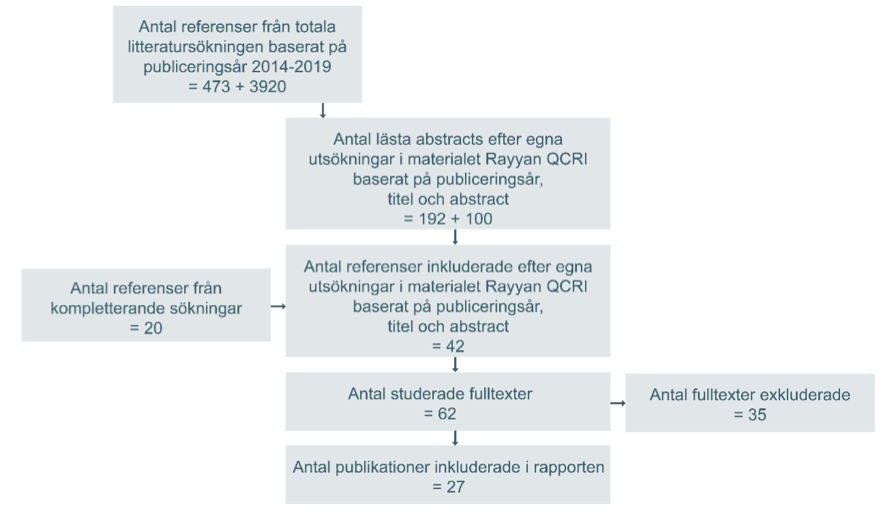
Out of 473 references in the first hit list, after delimitation by year of publication, a reading list of all 192 abstracts was made, and then included or excluded in this research overview. Out of 11,312 references in the second hit list, the number, after limiting the search by year of publication, resulted in 3,920 references. It was not possible to read through all the abstracts within the framework of the task. Therefore, targeted searches were performed in the list aiming to provide representation from all the Nordic countries, and aiming to provide grounds for harassment other than gender. In the second hit list, a reading list of 100 abstracts was made, of which only a few could be included based on the purpose of the task.
The roughly 300 abstracts were screened in order to identify studies of scholarly quality that dealt with sexual harassment in the Nordic countries. For this reason, mainly peer-reviewed articles were included. The majority of the publications were from Norway and Sweden and thereafter Denmark, while publications from Iceland and Finland were few.
In order to obtain a broader representation of all the Nordic countries, additional searches were conducted outside KvinnSam’s searches, for example by asking representatives in the Nordic reference group[1]Consisting of Eva Sophia Myers (University of Southern Denmark), Marjut H. Jyrkinen (Helsinki University), Ásta Snorradóttir (University of Iceland), Cathrine Holst (University of Oslo) and Gunilla Carstensen (Stockholm University).. These resulted in 20 hits and were sorted into the category “references from supplemental searches”.
A total of 62 full text references were included for reading, 35 of which were excluded on the grounds that they did not fall within the scope of the purpose and focus of this research overview. Finally, 27 references were included for close reading in this research overview. In addition, there are references that are not part of the included selection but which constitute relevant background knowledge, including articles of a theoretical nature.
Footnotes
- ^ Consisting of Eva Sophia Myers (University of Southern Denmark), Marjut H. Jyrkinen (Helsinki University), Ásta Snorradóttir (University of Iceland), Cathrine Holst (University of Oslo) and Gunilla Carstensen (Stockholm University).
Annex 2. Ongoing and recently completed research projects in the Nordic countries
Research projects on sexual harassment in the workplace are under way or have recently been concluded in the Nordic countries. The search process that NIKK has conducted is described first. This is followed by a summary of the tasks that NIKK has learned about from each country.
Search process
Ongoing and recently completed research projects on sexual harassment in the Nordic countries were mapped during work on this research overview. The aim was to provide a picture of research that has not yet been published as searchable publications. In view of the scope of the task, this search was limited to all national research funders in the Nordic countries. How national research funding is organised varies from one Nordic country to the next.
In September 2019, all national research councils in the Nordic countries were contacted and requested to provide NIKK with information on funded research projects concerning sexual harassment in the workplace. The request was sent in English, as was the reminder email that was sent out. The research councils were asked to search for research projects on sexual harassment in the workplace granted funding in the last five years (2014–2019). The research councils were also asked to use alternative search terms, such as gender-based harassment and gender-based violence in the searches. Finally, all the research councils were requested to provide NIKK with information on other actors financing ongoing or recently concluded research on sexual harassment.
Eight research councils were contacted, and five of them came back with information. All had conducted searches in both their own Nordic language and in English. NIKK has thus learned about both state-funded projects and projects financed by other actors. Anyone wishing to come in contact with the responsible researcher working on these projects is welcome to contact the researcher directly or NIKK.
Denmark
In Denmark, there are no projects on sexual harassment in the workplace funded by the Independent Research Fund Denmark. Research projects funded by other actors are listed below:
National Research Center for the Working Environment (NFA)
Workplace sexual harassment and gender harassment: a qualitative pilot study (2019)[1]https://nfa.dk/da/Forskning/Udgivelse?journalId=42dd4795-e776-4a32-967c-f2db9eae4d68
In this pilot study, Dea Busk Larsen, Ida E. H. Madsen, (both NFA) and Maj Britt Dahl Nielsen, (the National Institute of Public Health Denmark) have studied how gender harassment is linked to, and how it differs from, other types of sexual harassment that occur in Danish workplaces.
The preliminary results show that workplace culture is a key factor in understanding gender harassment. Gender and sexual minorities experience a high degree of gender harassment.
Uønsket seksuel opmærksomhed fra ledere og kollegaer (Pågående - 2018-2021)[2]https://nfa.dk/da/Forskning/Projekt?docId=96c10231-6e56-4471-897a-78563ddc6005
Maj Britt D. Nielsen (SDU), Anna P. Folker (SDU), Ida E.H. Madsen (NFA), Thomas Clausen (NFA), Per T. Aldrich (NIRAS), Susie A. Kjær (Arbejdspsykologisk Praksis), Laura V. Kvorning (COWI) and Gry Grundtvig (COWI).
The project is developing tools to help companies prevent sexual harassment in the workplace.
Seksuel chikane i omsorgsarbejdet (2018)[3]https://nfa.dk/da/Forskning/Projekt?docId=d56fd083-a1eb-4256-9283-c73641097f9c
Nielsen MBD, Kjær S, Aldrich PT, Madsen IEH, Friborg MK, Rugulies R, Folker AP.
The project developed methods that can help workplaces develop effective strategies for preventing/dealing with sexual harassment by customers in care work.
Finland
Academy of Finland
Analysis report on harassment and other inappropriate treatment on theatre and film industry
In September 2018, the Ministry of Education and Culture published a comprehensive report on sexual harassment. The report was written by LL.D Jaana Paanetoja. The study shows, among other things, how film production companies have taken their employer responsibility into account based on working life legislation which aims to ensure a work environment free from harassment and other unfair treatment.
Finnish Center for Integrity in Sports (SUEK)
Mapping of sexual harassment in sports in Finland
In the autumn of 2019, a study/survey of sexual harassment in Finnish sports that involve group training or coaching was initiated to investigate its prevalence. The survey covers all Finnish sports of this kind, and there are publications on football, ice hockey and tennis for example. The report will be included in the spring of 2020.
Iceland
Violence in the workplace: An investigation of the prevalence and nature of bullying and harassment in the Icelandic labour market (2019)[1]https://www.stjornarradid.is/lisalib/getfile.aspx?itemid=ce38c409-dae1-11e9-944d-005056bc530c
Snorradóttir, Á., Valdimarsdóttir, M., Gústafsdóttir, G., Snæfríðar- og Gunnarsdóttir, H. & Tryggvadóttir, G. B.
The purpose of the study was to identify the extent and nature of bullying and sexual and gender-based harassment in the Icelandic labour market. The study used mixed methods and research designs: surveys, qualitative interviews, and focus groups. The survey results show that just over 20 per cent have been bullied at work, and 16 per cent have been sexually harassed. The analysis showed a contradiction between the view that workers/employees have on the one hand, and managers or HR staff on the other. Only 38 per cent of victims of bullying and 19 per cent of victims of sexual harassment made a formal complaint. Bullying and harassment are a major problem on the Icelandic labour market and have their roots in the workplace culture. Preventive efforts are inadequate and victims do not receive the support they want and need.
The results also show that individuals with a foreign background or with disabilities are at particularly high risk of bullying and harassment in the workplace. Thirty-five per cent of people with disabilities and 20.9 per cent of foreign citizens had experienced bullying at work, compared to 12.4 per cent of Icelandic citizens.
Footnotes
- ^ https://www.stjornarradid.is/lisalib/getfile.aspx?itemid=ce38c409-dae1-11e9-944d-005056bc530c
Norway
In Norway there is a state research council, the Research Council of Norway. Funding for research on sexual harassment was advertised as a call for proposals as part of the Research Council of Norway’s BALANSE programme in 2019. However, no proposals were received.
Other actors that produced research on sexual harassment in the workplace include the National Institute of Occupational Health, and the independent FAFO research foundation.
The National Institute of Occupational Health in Norway
Effectiveness of the Labour Inspection Authority’s regulatory tools for work environment and employee health: study protocol for a cluster-randomised controlled trial among Norwegian home-care workers (Ongoing – 2021)[1]https://bmjopen.bmj.com/content/9/11/e031226
Anne-Marthe R Indregard, Stein Knardahl, Jan Shahid Emberland, Øivind Skare and Håkon A Johannessen
This intervention study, which is a collaboration between the National Institute of Occupational Health (STAMI) and the Norwegian Labour Inspection Authority is looking at the effects of the Norwegian Labour Inspection Authority’s efforts in relation to the psychosocial work environment among employees in the home help service. Sexual harassment is being investigated as part of the psychosocial work environment and also weighing in organisational and mechanical aspects based on the aim of getting answers to what works best to help improve the work environment.
Footnotes
- ^ https://bmjopen.bmj.com/content/9/11/e031226
Sweden
Swedish Research Council
#MeToo activism in Sweden: Development, consequences, strategies.
Karin Hansson (Media Studies)
A four-year research project that is investigating #MeToo as a locally and globally cohesive movement, using a combination of methods and multidisciplinary approaches such as Computer and Systems Sciences, Social Psychology, Gender Studies, and Media and Communication Studies.
Towards a greater understanding of sexual harassment in the academic workplace/student environment: a multi-facetted study of exposure, determinants, consequences, and handling strategies.
Anette Agardh (Public Health Science, Global Health, Social Medicine and Epidemiology).
The aim of the three-year research project is to investigate sexual harassment as an individual and structural phenomenon in working life. The target group is employees and students at Lund University. Methods are in-depth interviews, focus group interviews, and online surveys.
FORTE
How can trade union organisations help to promote gender equality in the workplace? A study of LO as a gender politics actor.
Christina Bergqvist (Political Science)
The study examines trade union feminist demands within the Swedish Trade Union Confederation (LO) where more and more women are taking part in decision-making structures. The aim of the project is to investigate what is happening in an organisation like LO, with roots in the class struggle, when a new dimension of conflict based on feminist ideas is to be incorporated.
Gender-based harassment and victimisation in Swedish workplaces: Longitudinal connections with mental ill-health in survey and register data.
Anna Nyberg (Stress Studies)
The aim of this project is to develop new knowledge, based on an intersectional perspective in representative samples of the Swedish working population, about the significance of the individual’s relative risk of being subjected to gender-based harassment in the workplace, and how this relates to self-assessed mental ill-health, sickness absence, sickness presence, register-based sickness absence and the prescription of antidepressants, tranquilizers and sleeping pills over time. The data has been obtained from the Swedish Work Environment Authority’s surveys.
Clients with "benefits” – #MeToo, power and gender in client-interactive service work.
Anna Fyrberg Yngfalk (Business Administration)
The aim of the project is to investigate how customer orientation ideals interact with broader power and gender structures and what implications this has for the work environment; how it can legitimise and support customers’ sexual harassment, but also limit employees’ opportunities to take action. The project is based on approximately 70 interviews with employees in services that involve close interactions with customers/clients. The survey is based on how employees experience their situation, as well as secondary data through published #MeToo stories.
Negative social vulnerability at work – organisational risk factors, consequences and mitigation measures.
Michael Rosander (Psychology)
This research project focuses on negative social exposure in the workplace such as threats, violence, discrimination, sexual harassment and bullying, with a focus on organisational circumstances. Risk groups will be identified based on age, ethnic background, type of employment, education and position in different sectors. The main data is longitudinal survey data (approximately 10,000 responses).
Exposure to work-related negative social behaviours – expanded knowledge on their psycho-social work-related and organisational determinants and risk of morbidity and mortality.
Linda Magnusson Hansson (Stress Studies)
This programme aims to raise awareness of whether exposure to work-related negative social behaviours including violence/threats of violence, bullying and sexual harassment is related to serious health outcomes. The data comes from several of the largest cohorts worldwide focusing on work and health, including Sweden, Denmark, and Finland. The data includes a total of more than 300,000 individuals.
About this publication
Sexually harassed at work
An overview of the research in the Nordic countries
Malin Svensson, PhD, Swedish Secretariat for Gender Research, for Nordic Information on Gender, NIKK
ISBN 978-92-893-6659-5 (PDF)
ISBN 978-92-893-6663-2 (ONLINE)
http://dx.doi.org/10.6027/temanord2020-521
TemaNord 2020:521
ISSN 0908-6692
© Nordic Council of Ministers 2020
Disclaimer
This publication was funded by the Nordic Council of Ministers. However, the content does not necessarily reflect the Nordic Council of Ministers’ views, opinions, attitudes or recommendations.
Rights and permissions
This work is made available under the Creative Commons Attribution 4.0 International license (CC BY 4.0) https://creativecommons.org/licenses/by/4.0.
Translations: If you translate this work, please include the following disclaimer: This translation was not pro-duced by the Nordic Council of Ministers and should not be construed as official. The Nordic Council of Ministers cannot be held responsible for the translation or any errors in it.
Adaptations: If you adapt this work, please include the following disclaimer along with the attribution: This is an adaptation of an original work by the Nordic Council of Ministers. Responsibility for the views and opinions expressed in the adaptation rests solely with its author(s). The views and opinions in this adaptation have not been approved by the Nordic Council of Ministers.
Third-party content: The Nordic Council of Ministers does not necessarily own every single part of this work. The Nordic Council of Ministers cannot, therefore, guarantee that the reuse of third-party content does not in-fringe the copyright of the third party. If you wish to reuse any third-party content, you bear the risks associ-ated with any such rights violations. You are responsible for determining whether there is a need to obtain per-mission for the use of third-party content, and if so, for obtaining the relevant permission from the copyright holder. Examples of third-party content may include, but are not limited to, tables, figures or images.
Photo rights (further permission required for reuse):
Any queries regarding rights and licences should be addressed to:
Nordic Council of Ministers/Publication Unit
Ved Stranden 18
DK-1061 Copenhagen
Denmark
pub@norden.org
Nordic co-operation
Nordic co-operation is one of the world’s most extensive forms of regional collaboration, involving Denmark, Finland, Iceland, Norway, Sweden, and the Faroe Islands, Greenland and Åland.
Nordic co-operation has firm traditions in politics, economics and culture and plays an important role in European and international forums. The Nordic community strives for a strong Nordic Region in a strong Europe.
Nordic co-operation promotes regional interests and values in a global world. The values shared by the Nordic countries help make the region one of the most innovative and competitive in the world.
The Nordic Council of Ministers
Nordens Hus
Ved Stranden 18
DK-1061 Copenhagen
pub@norden.org
Read more Nordic publications on www.norden.org/publications