

- Full page image w/ text
- Table of contents
- Foreword
- Acknowledgements
- Executive summary
- 1 Introduction
- 1.1 Aim of study
- 1.2 Process
- 1.3 Contents of the report
- 2 Offshore wind farms in the Nordics
- 2.2 Governmental instruments
- 3 Coexistence
- 3.1 Definition of coexistence
- 4 Nature-inclusive design (NID)
- 4.1 Definition of nature-inclusive design
- 4.2 Ecological opportunities and risks associated with nature-inclusive design
- 4.3 Current use of nature-inclusive design in OWFs
- 4.4 Possibilities for nature-inclusive design in OWFs in Nordic waters
- 5 Workshop summaries
- 5.1 Summary of discussion on coexistence and stakeholder engagement
- 5.2 Summary of discussion on stakeholder dialogue and partnerships
- 5.3 Summary of discussion on mapping and forecast
- 5.4 Summary of discussion on nature-inclusive design
- 6 Suggested governmental instruments
- 6.1 Coexistence and stakeholder engagement
- 6.2 Nature-inclusive design
- References
- About this publication
MENU
Contents
This publication is also available online in a web-accessible version at https://pub.norden.org/nordicenergyresearch2023-01.
Foreword
The energy transition needs to be environmentally and socially viable. While scaling up deployment of renewables, we must minimise climate and nature impacts, or even achieve a net-positive impact via active measures to develop biodiversity. Simultaneously, we must ensure vital societal interests are not displaced. These ambitions are integral to the Nordic vision of becoming the most integrated and sustainable region in the world.
The European Commission’s Offshore Renewable Energy Strategy recognises that the North and Baltic Seas will be instrumental in the anticipated twentyfold increase of Europe’s offshore wind capacity, to reach climate neutrality by 2050. However, this will create new challenges for ecosystems, commercial activities, and marine spatial planning. Impacts on nature and livelihoods in the region must be carefully managed.
Here, Nordic co-operation can add value. When correctly sited, mature renewable energy technologies, such as offshore wind, can provide clean, affordable energy with the lowest impacts on nature and adjacent activities. By exchanging knowledge across borders and sectors, spatial planners can coordinate at sea basin-scale, to develop new energy infrastructure in balance with other uses of the sea.
Nature is a stakeholder in the energy transition. Though it is yet to be a focus area in our region, regulators may consider a requirement in the licensing process that offshore wind farms provide nature-development solutions, and which actors are positioned to support this. The potential for active biodiversity restoration in energy infrastructure should be investigated in a Nordic context.
The discussions underpinning this publication gathered governments, industries, nature advocates, researchers, and civil society, to drive implementation of best-practice solutions for coexistence and nature inclusive design in Nordic offshore wind farms. I hope the views herein support regulators in issuing licensing and location requirements for new offshore wind farms, to enable a just transition to nature-sensitive energy systems.
Klaus Skytte, CEO
Nordic Energy Research
Acknowledge|ments
This publication was funded by the Nordic Council of Ministers. The report was prepared by DNV and NIVA. A Steering Group appointed by the Nordic Committee of Senior Officials for Energy Policies has overseen the preparation of this publication. Nordic Energy Research was the contracting authority and coordinator of this work.
Marte Rusten at DNV was the project manager and had overall responsibility for implementing the study. Solrun Figenschau Skjellum was responsible for NIVAs contributions.
Marton Leander Vølstad at Nordic Energy Research coordinated the project.
Disclaimer
The report primarily summarizes the opinions of the workshop participants. In addition, the reports expresses some opinions of the consultants (clearly labelled), and background has been provided by the consultants. They do not necessarily reflect the views of the Nordic Council of Ministers, Nordic Energy Research, or any entities they represent.
Team at Nordic Energy Research
Marton Leander Vølstad
Adviser
Astrid Bratli
Adviser
Team at DNV
Anna Kringlen Ervik
Senior Engineer
Eirik Færøy Sæbø
Consultant
Hans Cleijne
Principal Consultant
Hans Petter Dahlslett
Group leader
Kjersti Myhre
Senior Principal Consultant
Maria Angelil Gravelsæther
Consultant
Marte Rusten
Principal Consultant
Sigurd Solheim Pettersen
Senior Researcher
Tor Jensen
Vice President
Øivin Aarnes
Principal Specialist
Team at NIVA
Camilla With Fagerli
Senior Research Scientist (marine biology)
Froukje Maria Platjouw
Senior Research Scientist (law)
Mats Walday
Senior Research Scientist (marine biology)
Paul Ragnar Berg
Research leader for marine biology
Solrun Figenschau Skjellum
Development Director and Head of Ocean Wind
Workshop moderators
Anne Christine Utne Palm
Institute of Marine Research (NO)
Arne Myhrvold
Equinor (NO)
Christopher Harman
Norwegian Offshore Wind (NO)
Eirik Ørsland
Havfram (NO)
Erik-Jan Lock
Institute of Marine Research (NO)
Jan Henrik Sandberg
Fiskarlaget (NO)
Kristina Fröberg
WWF (NO)
Luke Purse
Aker Offshore Wind (NO)
Matthieu Povidis-Delefosse
Vattenfall (SE)
Sigrid Eskeland Schütz
University of Bergen (NO)
Salve Dahle
Akvaplan-niva (NO)
Sigurd Pettersen
DNV (NO)
Søren Enghoff
Energistyrelsen (DK)
Thomas Jensen
RWE (NO)
Valborg Øverland Birkenes
Fornybar Norge (NO)
Yngve Børstad
TechnipFMC (NO)
Øivind Tangen Ødegaard
NIVA (NO)
Øystein Refsland Andreassen
Aibel (NO)
Nordic Steering Group
Tobias Grindsted
Danish Energy Agency
Anna Arnkil
Metsähallitus (Finnish Forest Administration)
Ingvard Fjallstein
Faroese Environment Agency
Katrin Haraldsdóttir Jensen
Faroese Environment Agency
Almar Barja
Samorka (Icelandic Federation of Energy and Utility companies)
Anders Hekland
Norwegian Water Resources and Energy Directorate
Kristian Schoning
Swedish Energy Agency
Proofreading
The report was proofread by James Campbell at Samtext Norway AS.
Contact
Comments and questions are welcome and should be addressed to:
Marton Leander Vølstad, Nordic Energy Research, e-mail: marton.leander.volstad@nordicenergy.org
For enquiries regarding the presentation of results or distribution of the report, please contact Nordic Energy Research.
Additional materials, press coverage, presentations etc. can be found at www.nordicenergy.org.
Executive summary
To fulfil the European Commission’s (EU) climate neutrality target and to meet the increased demand for energy caused by the global political climate, a substantial expansion in renewable energy is required. Offshore wind (OW) energy will be an important part of the future energy supply. Recent development has shown that offshore wind energy is both scalable and cost competitive, and the industry is ready to deliver the volumes required. Key challenges to reach the needed expansion lie within potential conflicts for ocean space, permitting processes and nature conservation goals.
Offshore wind farms (OWFs) will require large surface areas of sea, often combined with claims of exclusive access. In addition to surface areas, grid connection, anchoring arrangements etc. will occupy a significant amount of pelagic and seabed space. The planned expansion will entail additional pressures on environmental assets and spatial competition with established marine uses like fisheries, shipping, military activities, aquaculture and tourism. In order to reach energy goals while at the same time accommodating established marine uses and nature, there is a need to find good solutions to coexistence to minimise conflicts and maximise synergies. It will be vital to move away from a sector-by-sector management of marine activities to a more comprehensive and integrated approach to ensure sustainable solutions.
The climate crisis and the nature crisis are two sides of the same coin. As the climate changes, natural habitats change, in turn aggravating climate change and causing biodiversity loss. It is key that the expansion of renewables will be fast while at the same time applying sustainability and mitigation of adverse impacts on nature as guiding principles.
Based on workshops with a wide range of stakeholders from Nordic countries, input on needs, opportunities, incentives and suggested governmental instruments to facilitate successful coexistence and nature-inclusive design (NID) have been collected. The project has been performed in a collaboration between DNV and NIVA. DNV has been responsible for the overall project management, workshop facilitation and the topic of coexistence, stakeholder dialogue, mapping and forecast. NIVA has been in charge of the NID aspect.
Coexistence and stakeholder dialogue
The key takeaway from the discussion on coexistence was that the participants did not question why coexistence is important. The focus was on how to find good solutions for, and optimise benefits from, coexistence. Successful coexistence was considered to be crucial to solving both the energy crisis and the nature crisis, and governments were considered to have the main responsibility in establishing a framework to ensure this. The list of opportunities identified was longer than the list of constraints identified during the workshops. Many of the constraints identified can be converted into opportunities – for example, those relating to knowledge gaps are opportunities to leverage the planned expansion to learn, share and adapt to acquired knowledge. Stakeholders representing fisheries expressed concerns about conflict for space with offshore wind development and knowledge gaps related to the impact of floating offshore wind structures on fisheries. There were also concerns about the challenges to prioritising environmental assets and to estimating the value of nature versus the value of energy. Marine spatial planning was highlighted as an important tool for both coexistence and stakeholder engagement, with transparency and communication of input data being important for building trust in the process and outcome.
A total of 22 governmental instruments (shown below) to inspire successful coexistence and stakeholder engagement were collected. Such instruments are relevant for the different phases of the site allocation and consenting process in the Nordic countries, including opening new areas for development, prequalification of tenderers and the awarding of tenders and licences. Knowledge, transparency and predictability were cross-cutting themes in the suggested instruments, which included suggestions related to frameworks and approaches to be applied during the entire consenting process, and non-price criteria to be applied during auctions. The suggested instruments have not been qualified or prioritised, and should be investigated further in the context of regulatory regimes in the different Nordic states (Denmark, Finland, Iceland, Norway, Sweden), autonomous entities (Faroe Islands, Greenland) and autonomous region (Åland).
| Governmental instruments for successful coexistence | General | Opening | Prequal | Tender award | Licence award |
| Apply a defined process to clarify what coexistence topics need handling. Explore the problem and do not focus on the solutions early. | x | x | x | x | x |
| Follow a clear and defined process to quantify coexistence and deliverables on coexistence, including agreed and communicated goals, basis and processes. | x | x | x | x | x |
| Apply transparent platforms and roundtables for processes and sharing information to secure transparent processes and trustworthy flow of data/information by using reliable third parties. | x | x | x | x | x |
| Make environmental monitoring programmes a “backbone” in a long-term strategy for OWFs to allow for knowledge-based adaptive management. | x | x | x | x | x |
| Stimulate and support strategic research and joint industry programmes and ensure knowledge transfer between programmes and towards society. | x | x | x | x | x |
| Consider cross-regulatory legislation and facilitate coordination between countries and between national agencies, as is the case with HELCOM or OSPAR. | x | x | x | x | x |
| Potential opportunities for coexistence should be a part of the process of opening areas and be integrated in Marine Spatial Planning (MSP). MSP should include mapping of stakeholders and need for coexistence in an area. | x | x | |||
| Apply consenting criteria/solutions that enforce coexistence solutions on the developer before they construct. | x | x | x | ||
| Set non-price criteria with transparent and robust evaluation criteria to be evaluated (e.g. by expert committee) in the tender process to be fulfilled before award. | x | x | x | ||
| Utilise market (and potentially public) dialogue as an instrument to design tender criteria and to facilitate coexistence approaches in the industry at large. | x | x | x | ||
| Consider combining requirements for energy production with production of food or other products to ensure collaboration in the design phase. | x | x | x | ||
| Apply a permit requirement that operators should accept new stakeholders in the licencing area if public authorities can balance operators’ interests against newcomers’. | x |
| Governmental instruments for successful stakeholder engagement | General | Opening | Prequal | Tender award | Licence award |
| Ensure efficient communication of scientific advice to governments and facilitate a common understanding of knowledge among stakeholders. | x | x | |||
| Identify and communicate incentives for stakeholders of planned activities. | x | x | |||
| Set the framework for the stakeholder discussion and agree with stakeholders on the framework, including the scope, language and information sets upon which the engagement process can be built. | x | x | |||
| Facilitate a safe and stable meeting space with a capable and neutral facilitator. | x | x | |||
| Ensure transparency around the broader stakeholder engagement scope and communicate timescales for regulatory activities that incorporate stakeholder engagement. | x | x | |||
| Facilitate knowledge transfer from other countries. | x | x | |||
| Start the engagement as early as possible and bring in local stakeholders. | x | x | x | x | x |
| Stakeholder engagement should be tailored to the process. | x | x | x | x | x |
| Ensure mandatory early stakeholder engagement as part of the public tender requirements for OWFs. | x | x | x | ||
| Include criteria for stakeholder engagement in competition. | x | x | |||
| Require stakeholder engagement plans after the tender award. | x | x |
Nature-inclusive design shows promise, but knowledge gaps must be filled
NID measures can be used to restore a degraded habitat, enhance ecological functioning, and promote biological production and diversity in an offshore wind farm (OWF), for cables to land and coastal infrastructures related to offshore wind. NID solutions must be tailored to the OWF technology and the biotope. NID measures are a fairly new mitigation option. While participating energy companies were familiar with the topic of NID, the awareness varied for other types of stakeholders. Stakeholder views also varied. The majority of workshop participants were positive, but pointed to challenges such as lack of knowledge, regulatory barriers and cost concerns. Four types of tender and allocation instruments were suggested, as shown in the table below.
| Governmental instruments for fostering NID in OWF developments | Legislation | Prequal | Tender award | Licence |
| State NID goals in tender – required conservation and restoration objectives should be defined in line with the status and importance of biodiversity in the areas. | x | |||
| Revise supporting regulations | ||||
| - Assess positive impacts of NID in Environmental Impact Assessments (EIAs) | x | x | x | |
| - Allow for keeping successful NID solutions after decommissioning | x | x | x | |
| Requirements to foster learning, including | ||||
| - Monitoring of NID solutions | x | x | ||
| - Knowledge and data sharing | x | x | ||
| - Facilitating research on site | x | x | ||
| - Overarching licensing programme – across sectors | x | x | x | |
| Non-price criteria – should be considered, but it would be useful to acquire more knowledge regarding the efficacy of NID solutions first. | x | x |
Additionally, several “non-tender” instruments were suggested, i.e. research, a Nordic evidence base for NID solutions, awareness raising, a verification concept and compensation for monitoring costs. The need for early stakeholder dialogue was also emphasised and a NID discussion forum suggested. It should be noted that the suggested instruments have not been qualified or prioritised, and that the Nordic EU and non-EU members do not have the same regulatory incentives for nature. All suggestions should be investigated further in a national context.
However, research and awareness-raising activities can and should be implemented without further delay. Several initiatives are calling business to action on biodiversity, for example the recently adopted Global Biodiversity Framework (GBF), which aims to halt and reverse biodiversity loss, and the proposed EU nature restoration law (Nordic EU members only). Several Nordic offshore wind players, such as Equinor, Hafslund, Mainstream Renewable Power (part of Aker Horizon), Vattenfall and Ørsted, already have goals addressing nature-positivity or net biodiversity gain. Internationally, NID solutions are pointed to as a key part of nature-positivity, and building the evidence base for NID should be a research priority. Options for NID research could be industry-funded research, the EU’s Horizon Europe programme, a joint action programme under JPI Oceans, or preferably a targeted joint Nordic Action on research. Knowledge needs highlighted in the workshops include solid baselines for the OWF sites and knowledge regarding the impacts of NID solutions. NIVA would also like to stress the need for knowledge to tailor NID solutions to offshore wind in Nordic waters, in particular for floating wind. Impacts of a changing climate, non-commercial species, natural variation and cumulative impacts of OWFs, as well as the positive and negative impacts of NID solutions on fisheries, should also be addressed.
The willingness to facilitate and fund on-site research on NID could be rewarded in the consenting process. Should NID solutions prove to be effective in the long term, non-price criteria requiring NID measures could be introduced. The Nordic countries could then also jointly initiate an OSPAR assessment of whether full removal of offshore structures is the most environmentally friendly decommissioning strategy, keeping in mind the potential disadvantages of partial removal to other stakeholders.
 Photos: Unsplash.com
Introduction
To fulfil the European Commission’s (EU) climate neutrality target and to meet the increased demand for energy, a substantial expansion in renewable energy is required. For offshore wind (OW) the targets are to increase production from today’s 190 GW to 510 GW in 2030 and 1300 GW in 2050 (EU, 2022). Development equivalent to 32 GW per year is required to hit the target for 2030. Recent development has shown that OW energy is both scalable and cost competitive, and the industry is ready to deliver the volumes required (WindEurope, 2022a). Key challenges to reach the needed expansion lie within potential conflicts for ocean space between OW and established maritime uses, nature conservation goals and permitting processes.
The ongoing development of offshore wind farms (OWFs) will require large surface areas of sea, often combined with claims of exclusive access. In addition, surface areas, grid connection, anchoring arrangements etc. will occupy a significant amount of pelagic and seabed space. The planned expansion of OW will entail additional pressures on environmental assets and spatial competition with established maritime uses like fisheries, shipping, military activities, aquaculture and tourism. An additional driver for future competition for marine space results from the Post-2020 Global Biodiversity Framework that was adopted at the UN Biodiversity Conference (CBD COP15). The framework includes a commitment for the signatory parties to effectively conserve or manage at least 30 per cent of terrestrial, inland water and coastal and marine areas by 2030.
The competition for space in the North Sea and the Baltic Sea, taking spatial requirements of different sea users and marine protected areas into account towards 2030 and 2050, is shown in Figure 1‑1 (DNV, 2023).
In order to reach energy goals while at the same time accommodating established maritime uses and nature, there is a need to find good solutions to coexistence to minimise conflicts and maximise synergies. It will be vital to move away from a sector-by-sector management of marine activities to a more holistic and integrated approach to ensure sustainable solutions (DNV, 2023).
DNV’s Energy Transition Outlook (DNV, 2022) identifies the following key permitting barriers for renewable energy projects and power and grid developments: rules are complex, procedures are slow, and there are too many administrative authorities involved (at national, regional and municipal level). These barriers result in projects being hindered from the start and permitting costs being added to development costs and risk, which deters investors from developing projects. Reaching build-out targets will require reforms to current regulatory frameworks concerning permitting and tender design. The European Council is taking serious action in this matter and in October 2022 called for a fast-tracking of the simplification of permitting procedures in order to accelerate the rollout of renewables and grids, including by means of emergency measures.
Nature is currently under severe pressure from the activities of a growing human population. Awareness of the overall footprint of new activities is a must. According to the Living Planet Report 2022, there has been an average decline of 69 per cent in species populations since 1970 (WWF, 2022). The climate crisis and the nature crisis are two sides of the same coin. As the climate changes, natural habitats change, in turn aggravating climate change and causing biodiversity loss. Nature-based solutions are also key to solving the climate crisis. There is a double interlinked emergency of climate change and the loss of biodiversity. It is key that the expansion of renewables will be fast while at the same time applying sustainability and mitigation of adverse impacts on nature as guiding principles. Investigating how OW development could benefit nature while at the same time contribute to climate goals could be realised by implementing nature-inclusive design (NID). NID refers to options that can be integrated or added to the design of an anthropogenic structure to increase habitat suitability for target species or communities. NID is an area that has received a lot of interest lately but is less studied in the Nordic countries.
In this project we study opportunities related to consenting, stakeholders and the natural environment in a Nordic context for coexistence and NID. The project has been performed in a collaboration between DNV and NIVA. DNV has been responsible for the overall project management, workshop facilitation and the topic of coexistence, stakeholder dialogue, mapping and forecast. NIVA has been in charge of the NID aspect.
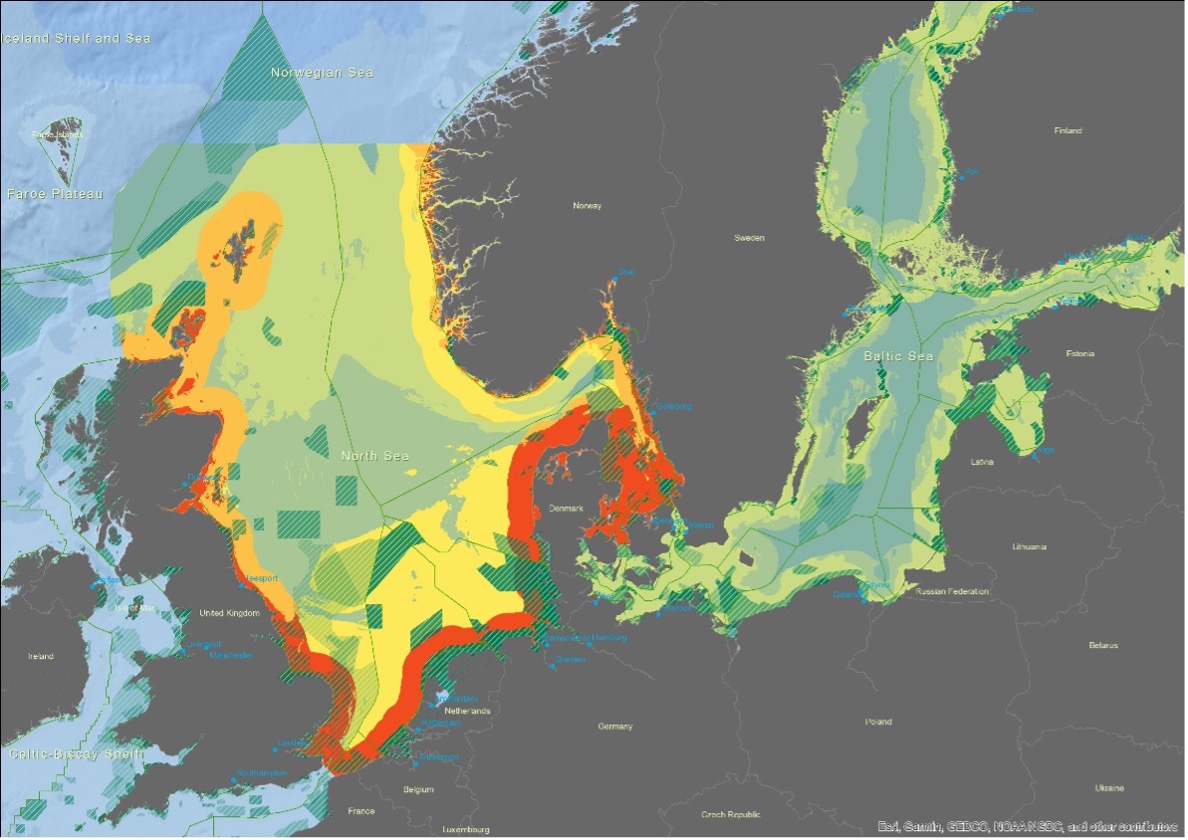
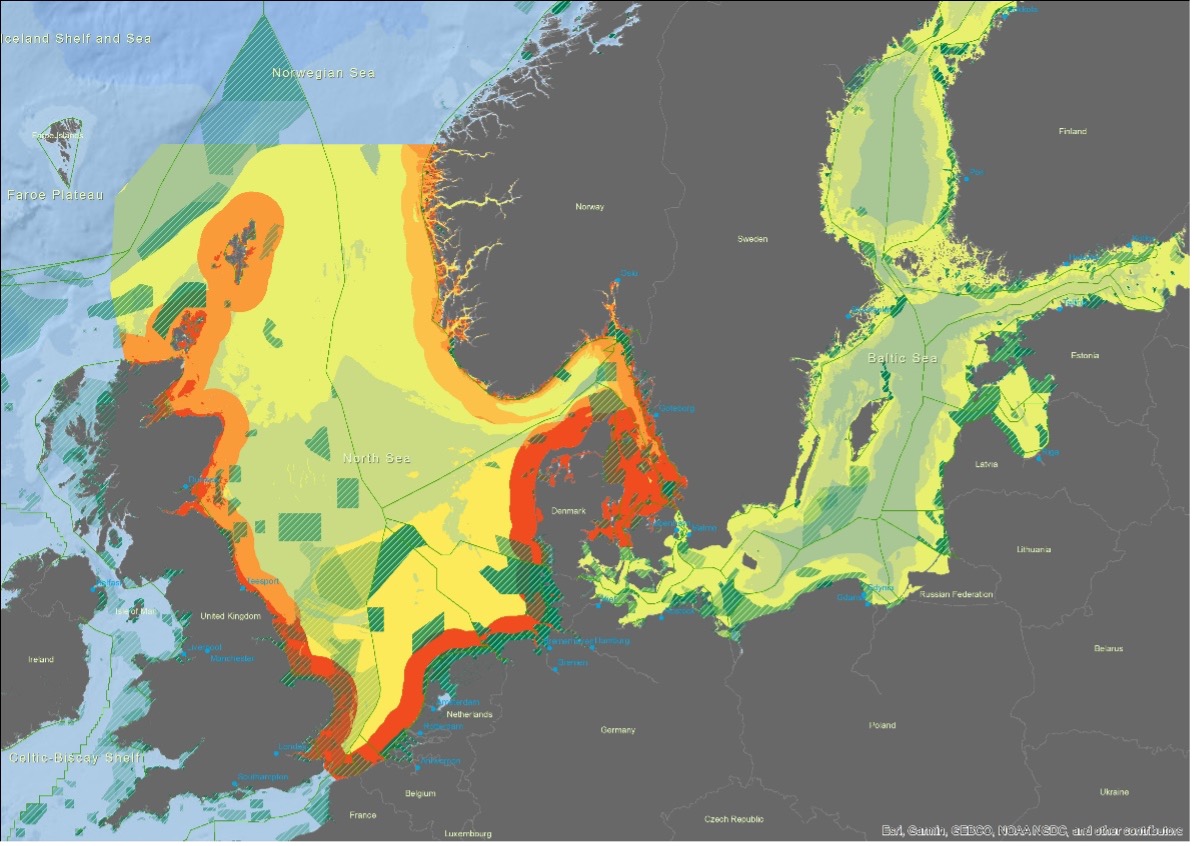
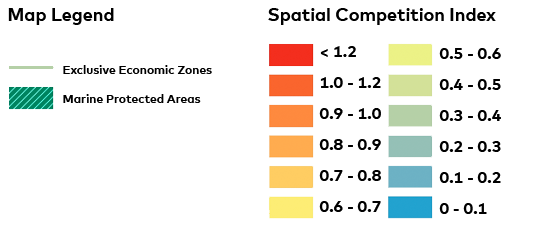
The scale is a measure of combined area utilisation from all industries present in relation to available area. Red (as seen in the coastal zone) indicates all available area is used, implying competition for space, and that need for coexistence is prevalent. Marine Protected Areas are shown in shades of green. (DNV, 2023).
1.1 Aim of study
The aim of this study was to collect stakeholder views on how governmental instruments in the consenting process for OW development in the Nordics can be used to facilitate successful coexistence and NID. The study gives a list of suggested allocation and tendering instruments to inspire Nordic governments when deciding on process and criteria for opening areas for development, during prequalification of tenderers and the awarding of tenders and licences.
1.2 Process
1.3 Contents of the report
- a high-level introduction to the status of and licencing procedures for OWF development in the Nordics
- definitions and key concepts related to coexistence and NID for OWFs
- examples of categories and uses of non-price criteria in OWF licencing processes
- workshop structure and key takeaways from discussions
- suggested governmental instruments to facilitate successful coexistence and NID for future OWF development.
 Photos: Unsplash.com and Vattenfall
Offshore wind farms in the Nordics
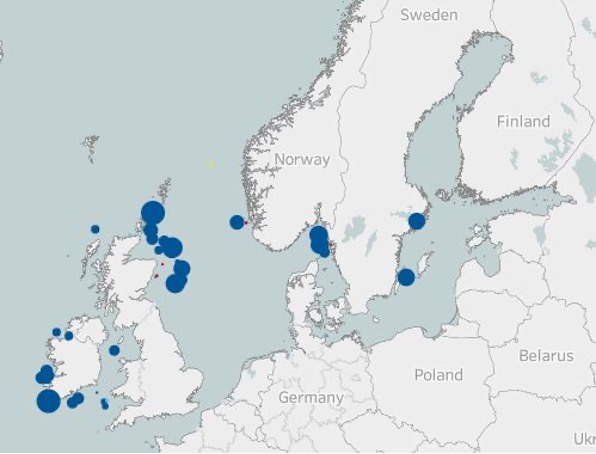
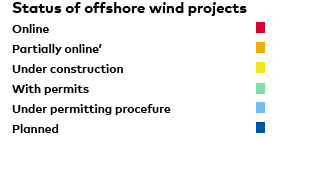
The status of fixed and floating OWF projects in the Nordics and neighbouring countries is shown in Figure 2 1. Bottom-fixed substructures are currently the most used design, and most of the development has taken place in the southern part of the North Sea, in the Kattegat and in the southern Baltic Sea. Two floating OWFs are online in Norway: Hywind Tampen, which provides electricity for the Snorre and Gullfaks oil and gas fields, and another for research purposes. There is one floating OWF online in Sweden. In the Nordics, Denmark is the country producing the most energy from offshore wind by far (2,308 MW), followed by Sweden (192 MW), Finland (71 MW) and Norway (2 MW) (WindEurope, 2022). By comparison, the UK is producing the most electricity from OWF in Europe, with 12,739 MW and 2,542 turbines connected. OW is currently in the planning phase in Iceland, the Faroe Islands, Greenland and Åland. The 2050 vision for the North Sea is 212 GW and for the Baltic Sea is 83 GW, so there will be considerable expansion compared to current capacities.

2.1 Consenting processes
There are differences and similarities between the various consenting processes in the Nordic countries for existing or near-future plans for OWF development: they can either follow a government-led process or an open-door process (Sweden and Denmark). Key phases of government-led consenting processes include screening to identify areas to be developed, prequalification of tenderers (based on financial capacity and competence within technological, environmental and safety aspects), followed by tender award/site allocation (often based on an action model), and finally the construction licence award (Figure 2 2). In the open-door process, the operators themselves take the initiative to identify areas and suggest project design. The open-door process is considered to be a higher risk for developers than the government-led process. A high-level description of consenting processes in Nordic countries is provided below.

2.2 Governmental instruments
In this study we define governmental instruments as measures and actions taken by governments during all phases of the OWF consenting process. This includes the process or framework applied during opening/screening for new development areas (baseline studies, stakeholder engagement processes etc.), requirements for prequalification of tenderers, action models for the tender award and requirements for construction and operation licences. Non-price criteria are an important instrument to reward solutions for coexistence and nature-inclusive design.
2.2.1 Non-price criteria
- complement, but do not duplicate, existing policy instruments
- are clear, objective, comparable and easy to assess/measure/monitor
- do not create additional administrative or management costs
- build upon the wind industry’s strengths and incentivise incremental innovation
- are matched by equal and coordinated policies in adjacent economic sectors and supply chains
- prioritise three categories of criteria:
- sustainability and biodiversity
- system integration and innovation
- European supply chain development and benefits to communities
Sustainability and biodiversity
- Reward circularity of current turbine design
- Reward projects with a recycling strategy
- Reward projects with a GHG emissions-reduction plan
- Reward projects with low biodiversity impacts
- Reward projects enhancing coexistence between species and with other economic sectors (e.g. organic agriculture or mussel farms)
- Reward projects built on degraded or agricultural land, man-made forests or non-pristine maritime areas
System integration and innovation
- Reward projects that increase a wind farm’s capacity factor, e.g. through co-location with electric storage and/or solar, hydrogen production or demand
- Reward projects that secure cost-efficient integration of wind energy into the energy system through direct and indirect renewables electrification
- Reward projects that deliver ancillary services
- Reward projects that apply and invest in the development of new technology solutions, e.g. testing new (composite) materials or technologies (different floating foundations and moorings)
- Reward projects that enhance cybersecurity
European supply-chain development and benefits to European communities
- Ensure supply-chain development rules are set at European level and used in a coordinated manner
- Reward projects that have a strong community engagement offering
- Reward projects that contribute to a Just Transition, replacing fossil-fuel generation with renewables and re-skilling workers
- Reward projects that foster new business opportunities with other economic or societal actors
 Photos: Unsplash.com
Coexistence
3.1 Definition of coexistence
Coexistence with established maritime uses is defined as activities taking place in the same geographical ocean area – ocean multi-use – but with different temporal, provisional and functional integration, as illustrated in Figure 3 1. The provisioning dimension refers to activities supporting the main function of use, like monitoring environmental data or safety installations. The functional dimension refers to a connection between one use function and the other, e.g. multi-purpose platforms designed to accommodate different uses and users. Opportunities and positive synergies increase when the level of integration between actors increases.
Coexistence between an OWF and nature includes aspects other than coexistence with maritime users, and is more about understanding and managing the OWF’s impacts on and potential benefits for the natural environment. This understanding requires baseline data on the natural environment, application of the mitigation hierarchy (Bennum et al., 2021) to minimise impacts and optimise benefits, and continuous adaptive environmental monitoring of potential impacts. The planned expansion of OWFs in the Nordic will represent additional pressure on ecosystems that are already under pressure, but also opportunities, as summarised in DNV’s recent report “Accommodating Biodiversity in Nordic Offshore Wind Projects” (NER, 2022). Challenges can be turned into opportunities by leveraging possibilities for increased understanding/learning combined with adaptive management as OW development proceeds.

 Photos: Unsplash.com
Nature-inclusive design (NID)
Offshore wind farm (OWF) projects can affect biodiversity, for example by introducing physical changes, by producing noise and by creating electromagnetic fields from subsea power cables. Pelagic and benthic nutrient cycles may also be altered due to increased activity from a high accumulation of suspension feeders (Slavik et al., 2019). The intention of NID is to reduce adverse effects on affected areas and ensure that measures to protect nature are included in OWF development plans and projects. NID measures can be used to promote rehabilitation of a degraded habitat, enhance ecological functioning and increase biological production and diversity in an OWF area.
4.1 Definition of nature-inclusive design
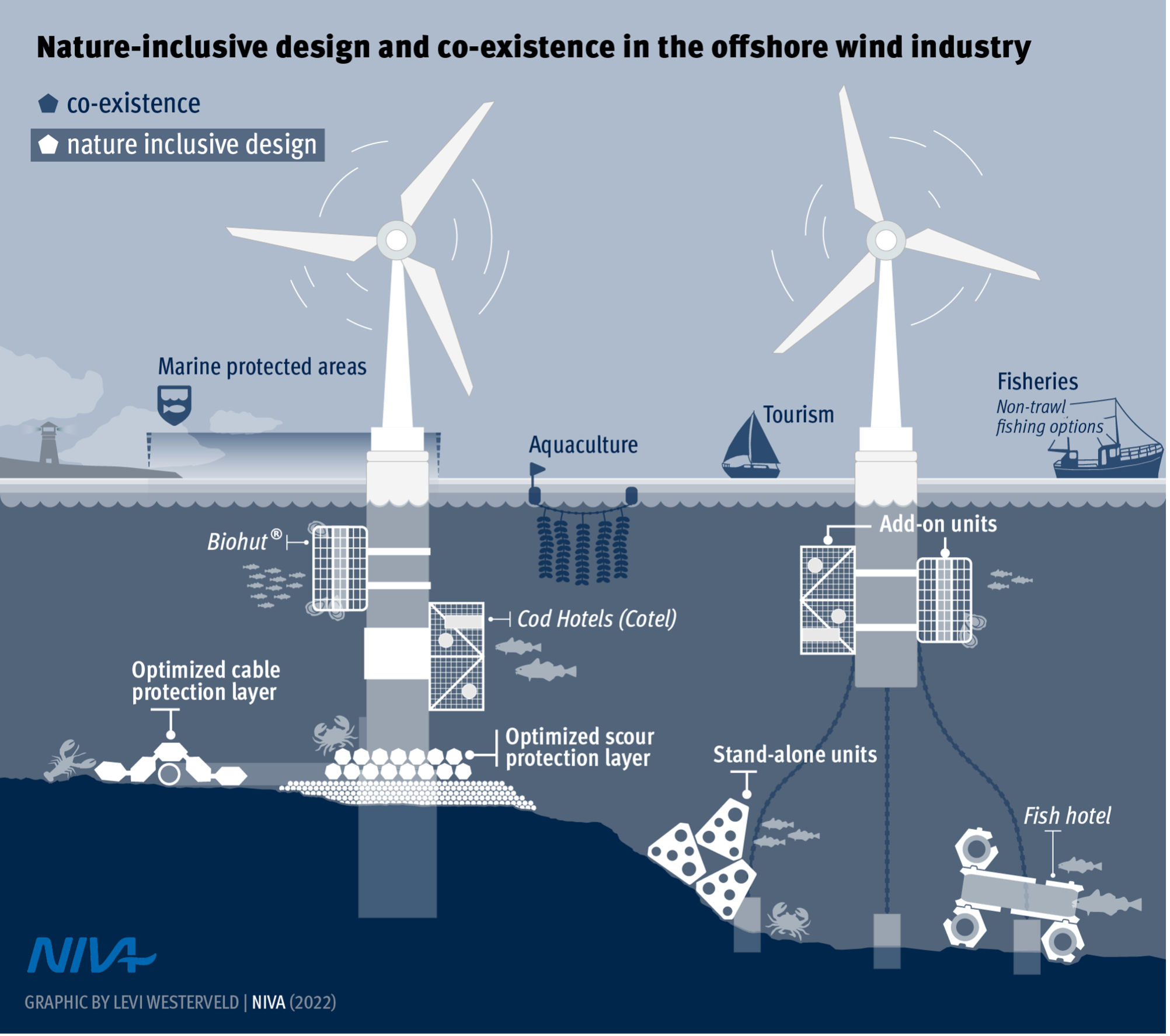
NID options have primarily been tested and developed for bottom-fixed structures (Figure 4-1), while similar options for floating structures remain unexplored. NID options can be classified into three categories, based on the part of the OWF infrastructure they apply to (Hermans et al., 2020):
- Add-on options refers to structural additions to the design of an offshore substation (or a monopile), thus making NID integral to it (e.g. the Biohut® and cod hotels).
- Optimised scour protection layer refers to an optimisation of a standard scour protection design for a monopile or a substation (e.g. additional rock layer, adapted grading armour layer) or placing units on or in the scour protection layer (e.g. habitat pipes, reefball and Eco armour block, etc.).
- Optimised cable protection layer refers to an optimisation of a standard cable protection design for subsea power cables or cable crossings.
In addition, changing the composition of concrete etc. can foster different growth. Calcium carbonate (CaCO₃) or natural shell can be mixed into concrete structures to provide a suitable chemical composition for larval settlement by calcareous organisms such as bivalves. Standalone, artificial reef units of various shapes can also be introduced to the OWF area to add habitat complexity and offer shelter to bottom-associated species.
4.2 Ecological opportunities and risks associated with nature-inclusive design
4.3 Current use of nature-inclusive design in OWFs
On behalf of the Dutch authorities, Hermans et al. (2020) developed a catalogue of NID options that can be applied in the Dutch OWFs. The NID options in the catalogue are ready to use, with clear design guidelines and associated risks and costs. The catalogue was created to support the Dutch government in elaborating on nature regulations in future wind farm site decisions or related instruments, but also to support asset owners, wind developers and end users in implementing NID as a new standard in the offshore wind development industry, thus making it relevant for wind farm developers outside the Netherlands. US authorities have a similar catalogue targeted towards sea areas around the USA (INSPIRE Environmental and The Nature Conservancy, 2021).
4.4 Possibilities for nature-inclusive design in OWFs in Nordic waters
Furthermore, the results derived from NID will vary depending on the initial state and resilience of the OWF area, with increased potential and chance for nature-positive effects in areas already altered or affected by human impact (i.e. areas where the seabed is physically disturbed from bottom trawling or petroleum activities). It is therefore important that NID options and target organisms are selected based on site-specific ecological knowledge, and that the spatial and temporal distribution of sensitive species is carefully assessed. For example, Nordic Seas areas have strong gradients in salinity and species diversity.
 Photos: Unsplash.com
Workshop summaries
| Stakeholder groups | Organisations |
| Energy companies | Aker Offshore Wind (NO), Statkraft (NO), Vattenfall (SE), Ørsted (DK), Vårgrønn (NO), RWE (DK), Equinor (NO), Technip FMC/Magnora (NO), Seagust (NO) |
| Aquaculture | Utror (NO) |
| Trade organisations | Offshore Norway (NO), Norwegian Offshore Wind (NO), Havfram (NO), Danmarks fiskeforening (DK), Fiskarlaget (NO) |
| Governmental organisations | VASAB (B), Statnett (NO), Norwegian Environment Agency (NO), Danish Energy Agency (DK) |
| Financial institutions | DNB (NO), KLP (NO) |
| Technology providers | Bladt Industries (DK), Aibel (NO), Kongsberg Maritime (NO), De Rijke Noordzee (NL), Spoor (NO), Nature Metrics (UK), Wee (NO) |
| Research | University of Bergen (Faculty of Law) (NO), University of Århus (DK), Royal Belgium Institute of Natural Sciences (BE), Institute of Marine Research (NO), The Netherlands Enterprise Agency (NL), Akvaplan-NIVA (NO), Aqua DTU (DK), IVL – Swedish Environmental Research Institute (SE), Biodiv-Wind SAS (UK) |
| NGOs | WWF (NO, DK), Bellona (NO), Tenketanken hav (DK), Green Power Denmark (DK) |
NO = Norway, SE = Sweden, DK = Denmark, B = Baltic, BE = Belgium, NL= The Netherlands, UK = The United Kingdom.
The workshops were organised as a combination of presentations from subject-matter experts and facilitated group discussions. Significant efforts were made to find relevant and inspiring experts to introduce the topics. External subject-matter experts who contributed presentations included
- Steven Degraer (Royal Belgium Institute of Natural Sciences, Workshop 1)
- Paulina Ramirez-Monsalve (NIVA Denmark, Workshop 2)
- Jan Peter Oelen (Netherlands Enterprise Agency, Workshop 2).
Internal experts from the project team who contributed presentations included
- Camilla With Fagerli (NIVA, Workshop 1)
- Øivin Aarnes (DNV, Workshop 2)
- Anna Ervik (DNV, Workshop 2)
- Solrun Figenschau Skjellum (NIVA, Workshops 1 and 2)
- Marte Rusten (DNV, Workshops 1 and 2).
Participants were divided into groups of six to ten for discussions. The groups had an assigned facilitator from the participant group and a record-keeper from the project team. In Workshop 1, the NID groups were primarily facilitated by the NIVA group.
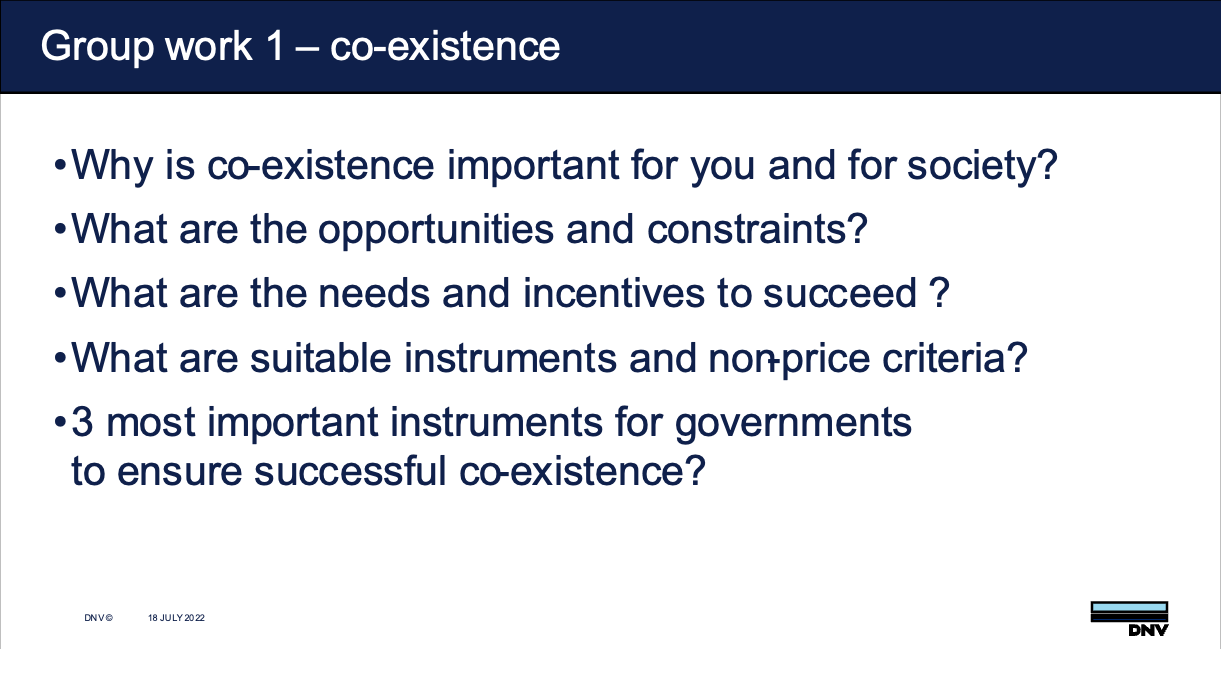
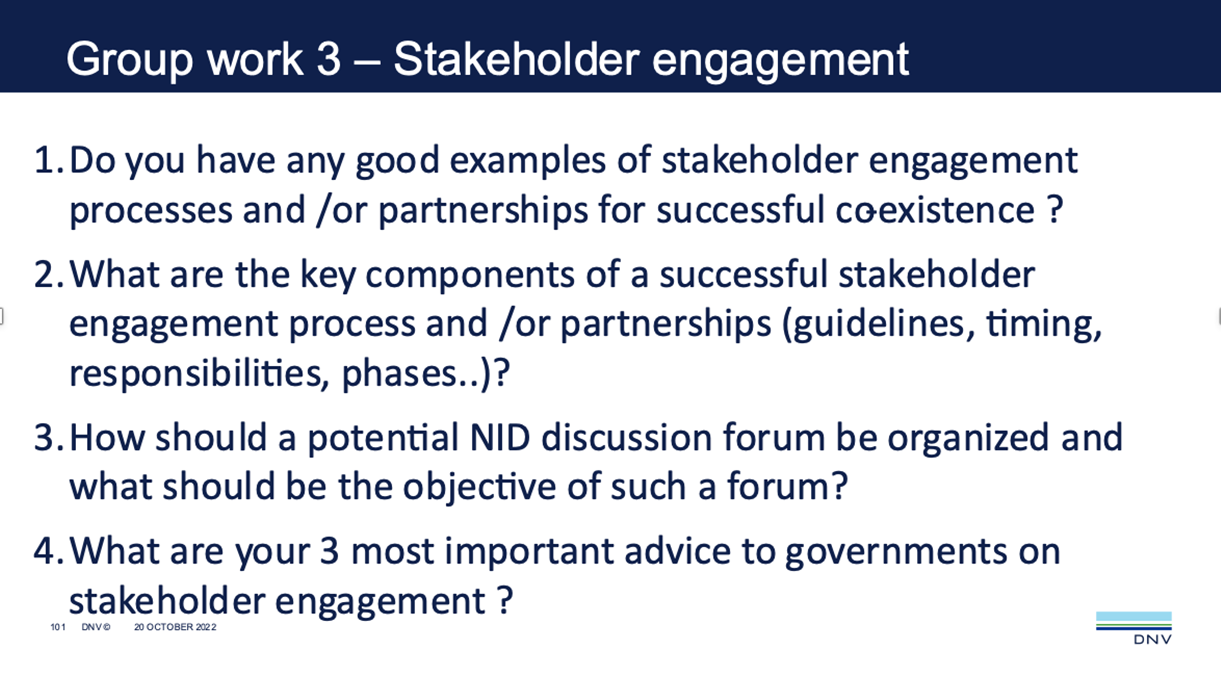
Different aspects of coexistence and NID were covered, the overall aim being to collect stakeholders’ views on governmental instruments to inspire successful coexistence and nature-inclusive design. The first workshop focused on identifying stakeholder needs to achieve successful coexistence and NID, whereas the second focused on stakeholder engagement including processes and dialogue, together with mapping and forecasting tools for marine spatial competition. An overview of the questions discussed is provided in Figure 5‑1.


5.1 Summary of discussion on coexistence and stakeholder engagement
In order to capture views from different stakeholders’ perspectives, group work 1 was performed in groups with participants representing similar stakeholder interests (to the degree possible). Participants expressed general views on coexistence, as well as opportunities, needs and constraints for successful coexistence within innovation, data and knowledge, finance, stakeholder engagement, climate and regulations. Discussions are summarised below and in Table 5-2.
General perspectives on coexistence
Energy company representatives considered planning for and implementing good solutions for coexistence as part of their licence to operate. They also expressed that governments should take responsibility for setting a framework for coexistence. They considered that successful coexistence would be crucial to solving both the climate crisis and the nature crisis, and that it would help in avoiding delays in the concession process.
From a fisheries perspective, coexistence was considered challenging because of a potential conflict for space as OWF developers often seek shallow waters, which are the same areas often used for fishing. In reality (from the perspective of the Norwegian fishermen), it is currently not possible to fish in areas that are used for OW, but efforts should be made to identify solutions/technology to accommodate this. They also expressed that there is a lack of data on distribution and impact of OWFs on pelagic species, that there is confusion around area requirements for planned OWFs, that wind farms must not be placed in spawning grounds and that there is a lack of knowledge about coexistence between fisheries and floating OWFs.
- Opportunity in itself to identify new opportunities for coexistence and related benefits
- Opportunity to establish great industry development, circular economy and energy transition
- Opportunity to drive technology development
- Opportunity to make coexistence not be a risk
- Opportunity to develop operational factors that do not hinder coexistence with fisheries
- Opportunity to develop technology for fishing methods compatible with OWFs
- Opportunity to develop new value chains
Need
- To develop technology for environmental monitoring, including unmanned sensors that are cost-efficient and have a smaller environmental footprint
DATA & KNOWLEDGE
Opportunities
- Opportunity to obtain data on the environment (leverage the number of installations in the water)
- Opportunity to coordinate data collection
- Opportunity to learn along the way and allow for an iterative process
Constraints
- Challenging to prioritise environmental factors
- Knowledge gaps and lack of understanding nature at a high, general and system level
- Lack of understanding between stakeholders (fisheries and renewables sector)
- Lack of clear framing of the problems coexistence should solve
- Lack of clear, understandable communication of knowledge
- Not clear how to measure the value of nature vs energy
- Established perception that wind farm areas must be no-go zones because of safety issues
- Too little resources and mandate for environmental authorities (in Norway)
Needs
- Environmental baseline before start
- Criteria to be used in consenting process should be based on robust data
- Clear definitions of objectives for coexistence
- Marine spatial plan
- Site-specific knowledge about resources (nature mapping and seabed) opportunities for coexistence and stakeholders
- A better understanding of risk related to coexistence
- Better sharing of data, possibly linked to the national environmental monitoring programmes
- Better utilisation of funding of research
- Structured, standardised way of collecting data at sea basin levels (protocols and best practice for data collection before, during and after). Can be area-specific
- Key to profitability
- Successful coexistense is key to profitability
- Could allow larger investments, as there is a possibility to monetise in several sectors at the same time
- Identify and focus on value creation at the interfaces between actors
- Benefits from investments in nature restoration
- Identify financial solutions to compensate impact (shipping)
Opportunities
- Increase trust
- Opportunity to learn more about stakeholders’ needs and concerns
- No-go fishing areas may be positive for ecosystem and provide increased fishing outside the wind farm
- Opportunities for nature enhancement
- Opportunities for reducing climate footprint by coordinating logistics
- To use tendering as a main instrument to obtain coexistence
- Licences could include obligation to allow for new sea users
- Include standards and guidelines on monitoring and research and nature-inclusive design, quantitative guiding in regulations
- The same call can include a requirement to produce both energy and food from the ocean
- Move away from price criteria, as they can hinder development of solutions and innovation
- Regulatory requirements may “force” sectors to interact
- OWF owners need to be incentivised to give other users access to space
- Coordinate regulations in different sectors
Needs
- In Denmark there could be a better system to reward positive impacts of the activities – this is better captured in Norway through the ESIA (Environmental and Social Impact Assessment)
- Predictable (good) concession processes that balance cost and responsibility
- Coordination of legislations is essential
- Governmental instruments should be specific, quantifiable and verifiable (need to be verified after a certain number of years to verify that the criteria work as they should)
- Sustainability should be first priority for non-price criteria (including local content and coexistence)
- Pre-qualification process/criteria should be general (basic requirements to qualify)
- An expert committee for setting/evaluating the criteria
- Site-specific considerations: should differentiate with some areas, with tenders focusing on innovation
- Dynamic assignment of areas
5.2 Summary of discussion on stakeholder dialogue and partnerships
Examples of successful stakeholder dialogue at the project level included Equinor’s process featuring discussions with the UK Ministry of Defence as part of project developments in south-east England. Early in the project phase there was a major issue due to interference with radar signals. The military is a complex stakeholder with a high threshold for satisfying requirements. Discussions took several years but a good solution was identified. It was also mentioned that offshore wind farms have been positive for some fisheries south of England, and for lobster fisheries in particular. The collaboration between Ørsted and local lobster fisheries was mentioned as an example of a fruitful partnership. The activities by the aquaculture companies Lovundlaks and Utror on the small island of Lovund were mentioned as examples of how new industry could be beneficial for the local community by creating new jobs and investment possibilities.
- Availability: Information and data are a required basis for stakeholder engagement and to identify workable and practical solutions.
- Quality and competence: In addition to availability, data must be of the required quality and resolution, and be combined with competence to evaluate the data in a local context. There is also a need to understand/accept that not everything is known.
- Communication: Honest, transparent and understandable communication of data is fundamental for successful stakeholder engagement.
- Experience transfer: Leverage experience and best practice from other countries.
Process
- General: The stakeholder process should have a clear mandate and include social scientists. The process can be proactive or reactive. An ideal process will be proactive, solving issues at an early stage. Stakeholders should agree on a common goal, otherwise it will not work.
- Responsibility: Stakeholder processes should primarily be managed by the governments during the opening processes and governemnts should set the framework for project-based stakeholder engagement.
- Participation: All affected parties should be listened to. Everyone who wants to join the process should be invited, and in turn they should ask their network to join. Same-level participation is important and the process should be balanced with the need for efficiency.
- Timeline: Early contact/engagement is important. Stakeholder engagement should from the outset be based on a plan that defines all stakeholders and key stakeholders, communication channels (including feedback loops) and knowledge sharing.
- Trust: Trust in the process should be built from the local level to the municipality level, to the county level, to the national level. Trust is linked to transparency. The process should be facilitated by an independent party (chairperson) with knowledge about the process.
- Predictability is difficult but key.
- It is impportnat to obtain predictable timelines of activities and early engagement with a clear goal (cf. community of practice approach in the Netherlands).
- Rules and regulations must be clear.
- Regulatory bodies should communicate with each other and have an understanding of each other’s points.
- Stakeholder engagement should be long-term and continuous.
5.3 Summary of discussion on mapping and forecast
FEATURES/CONTENTS
- be adaptive and easily take in new information on developments (e.g. new wind farm designs, tidal, wave, floating solar)
- represent dynamics of nature, ecosystems etc., including baseline indicators
- communicate potential gains for new infrastructure at a local level
- be based on a common understanding of definitions
- display residual risks associated with development of a particular area
- propose a list of stakeholders, include stakeholder-relevant information, and be based on multiple stakeholders’ input to mitigate the risk of blind spots
- be open-source
- include cross-border data that provides a full picture in all impacted areas
- include forecasting that highlights the differences among alternative scenarios for different development objectives (energy, food, conservation)
QUALITY/TRUST IN DATA
- be based on controlled and updated input data (important to build trust)
- include degree of accuracy/reliability of the data
- include information about when updates are available for the data upon which the forecast is based
- be based on an agreed set of input data that are analysed by experts
USER-FRIENDLINESS AND COMMUNICATION
- be easy to use and easy to communicate
- be accessible for the wider public
- not create barriers by using difficult language – the person in the street should be able to understand the “message”
5.4 Summary of discussion on nature-inclusive design
Key takeaways from discussions on NID solutions
| Many think NIDs are a necessity, but some think money is better spent elsewhere |
| Consensus on minimizing damage to ecosystems |
| Insufficient koowledge - need to monitor, learn and research |
| Regulatory barriers (i.a. decomissioning requirements) and cost concerns |
| Want even playing field, but also rewards for NIDs |
| Need early stakeholder dialouge and some suggest a discussion forum |
The questions asked about NID were identical to the questions regarding coexistence, with the exception that the question regarding the importance of NID was an open question, not assuming a positive opinion. This was done to test whether there is caution or scepticism linked to nature-inclusive design. This was confirmed. There appeared to be consensus regarding the importance of minimising negative impacts on ecosystems, but not consensus on whether NID solutions are a required tool to ensure biodiversity. The majority were positive to NID, but some argued that there are other, more efficient, ways of conserving and restoring biodiversity. However, a key cause of the caution/scepticism towards NID appeared to be the lack of documented long-term impact of NID measures. All groups emphasised knowledge gaps and in particular limited knowledge on the impact of NID solutions. The need for monitoring, learning and research was underlined by many of the groups.
Some of the groups pointed to regulatory barriers to NID measures, in particular decommissioning requirements. Denmark, Finland, Iceland, Norway and Sweden are all contracting parties to the OSPAR Convention, which aims to protect the marine environment of the north-east Atlantic, including the Greater North Sea (ospar.org). The OSPAR framework’s default is that all offshore installations should be fully removed at end-of-life. If “significant” reasons exist, the coastal state can issue a permit to leave parts of the infrastructure at sea, typically extremely heavy steel installations and some types of concrete installations (Trubbach, 2020). Several of the groups were concerned that removing the OWF structures and associated NID solutions could potentially outweigh any long-term ecological benefits of NID.
The Rig-to-Reef project in the USA has been testing out leaving artificial reefs behind. Upon decommissioning of oil and gas platforms in the Gulf of Mexico and California, developers apply to leave a portion of each structure in place to continue functioning as an artificial reef. Part of the costs saved by not removing the entire structure are put toward management of the artificial reef. Monitoring studies that have been sponsored by the federal government include addressing habitat value, fish recruitment and attraction, and impacts to species upon platform removal (Nature Conservancy and Inspire Environmental, 2021). Some results from the USA point in a positive direction. However, there is little information from OSPAR waters. Monitoring and research in OSPAR waters is required for OSPAR to consider revisions of the decommissioning regime. It should also be noted that partial removal is not without risk or disadvantages, and can for example pose a coexistence problem for fisheries.
In addition, Environmental Impact Assessments for offshore wind typically focus on reducing negative impacts, not on positive impacts, which some of the stakeholders find may impede the development of NID solutions. Cost concerns, in particular for additional monitoring, were also highlighted as a barrier.
Interestingly, there was support for both “a level playing field for NID” (e.g. cost sharing) and rewards for applying NID. The importance of early stakeholder dialogue and the involvement of researchers were underlined, and several groups suggested a NID discussion forum for sharing knowledge.
The compiled list of top 3 instruments is presented in Appendix A. See also Table 6-3 for instruments.
Details on opportunities, constraints, needs and incentives
Details regarding the groups’ answers on opportunities, constraints, needs and incentives are shown in Table 5-5.
- Licence to operate
- Claim of nature-positivity (when possible to document)
- Attract investors/capital
- Possible to increase knowledge as many ongoing projects
Needs
- Insufficient knowledge – intended impact not guaranteed
- Technical constraints – must be understood by regulators
- Cannot yet document nature-positivity
- Regulatory barriers, e.g. decommissioning and Environmental Impact Assessments (EIAs)
- Increased costs
- Risks associated with NID
Needs and incentives
- Need to increase knowledge and learn
- Need to use funding and financial resources more strategically (to learn)
- Need to tackle monitoring costs for NID (share or compensate)
- Need early dialogue/discussion forum
- Even playing field vs reward innovation
 Photos: Unsplash.com
Suggested governmental instruments
6.1 Coexistence and stakeholder engagement
Suggested governmental instruments to ensure successful coexistence and stakeholder engagement are presented in Table 6-1. Many of the instruments are of a general nature and are applicable throughout the consenting process focusing on frameworks, process and cross-border collaboration, data collection and research. Non-price criteria are suggested as a tool to facilitate both coexistence and stakeholder engagement. The suggested tender and allocation instruments have not been qualified or prioritised. All the suggestions should be investigated further in the context of the different Nordic states, autonomous territories and regions.
| Governmental instruments for successful coexistence | General | Opening | Prequal | Tender award | Licence award |
| Apply a defined process to clarify what coexistence topics need handling. Explore the problem and do not focus on the solutions early. | x | x | x | x | x |
| Follow a clear and defined process to quantify coexistence and deliverables on coexistence, including agreed and communicated goals, basis and processes. | x | x | x | x | x |
| Apply transparent platforms and roundtables for processes and sharing information to secure transparent processes and trustworthy flow of data/information by using reliable third parties. | x | x | x | x | x |
| Make environmental monitoring programmes a “backbone” in a long-term strategy for OWFs to allow for knowledge-based adaptive management. | x | x | x | x | x |
| Stimulate and support strategic research and joint industry programmes and ensure knowledge transfer between programmes and towards society. | x | x | x | x | x |
| Consider cross-regulatory legislation and facilitate coordination between countries and between national agencies, as is the case with HELCOM or OSPAR. | x | x | x | x | x |
| Potential opportunities for coexistence should be a part of the process of opening areas and be integrated in Marine Spatial Planning (MSP). MSP should include mapping of stakeholders and need for coexistence in an area. | x | x | |||
| Apply consenting criteria/solutions that enforce coexistence solutions on the developer before they construct. | x | x | x | ||
| Set non-price criteria with transparent and robust evaluation criteria to be evaluated (e.g. by expert committee) in the tender process to be fulfilled before award. | x | x | x | ||
| Utilise market (and potentially public) dialogue as an instrument to design tender criteria and to facilitate coexistence approaches in the industry at large. | x | x | x | ||
| Consider combining requirements for energy production with production of food or other products to ensure collaboration in the design phase. | x | x | x | ||
| Apply a permit requirement that operators should accept new stakeholders in the licencing area if public authorities can balance operators’ interests against newcomers’. | x |
| Governmental instruments for successful engagement | General | Opening | Prequal | Tender award | Licence award |
| Ensure efficient communication of scientific advice to governments and facilitate a common understanding of knowledge among stakeholders. | x | x | |||
| Identify and communicate incentives for stakeholders of planned activities. | x | x | |||
| Set the framework for the stakeholder discussion and agree with stakeholders on the framework, including the scope, language and information sets upon which the engagement process can be built. | x | x | |||
| Facilitate a safe and stable meeting space with a capable and neutral facilitator. | x | x | |||
| Ensure transparency around the broader stakeholder engagement scope and communicate timescales for regulatory activities that incorporate stakeholder engagement. | x | x | |||
| Facilitate knowledge transfer from other countries. | x | x | |||
| Start the engagement as early as possible and bring in local stakeholders. | x | x | x | x | x |
| Stakeholder engagement should be tailored to the process. | x | x | x | x | x |
| Ensure mandatory early stakeholder engagement as part of the public tender requirements for OWFs. | x | x | x | ||
| Include criteria for stakeholder engagement in competition. | x | x | |||
| Require stakeholder engagement plans after the tender award. | x | x |
6.2 Nature-inclusive design
Suggested instruments for governments to ensure successful NID are presented below.
| Governmental instruments for fostering NID in OWF developments | Legislation | Prequal | Tender award | Licence |
| State NID goals in tender Required conservation and restoration objectives should be defined in line with the status and importance of biodiversity in the areas. | x | |||
| Revise supporting regulations | ||||
| - Assess positive impacts of NID in Environmental Impact Assessments (EIAs) | x | x | x | |
| - Allow for keeping successful NID solutions after decommissioning | x | x | x | |
| Requirements to foster learning, including | ||||
| - Monitoring of NID solutions | x | x | ||
| - Knowledge and data sharing | x | x | ||
| - Facilitating research on site | x | x | ||
| - Overarching licensing programme – across sectors | x | x | x | |
| Non-price criteria Should be considered, but it would be useful to acquire more knowledge regarding the efficacy of NID solutions first. | x | x |
No groups specifically discussed prequalification requirements for NID. However, a general prequalification requirement for nature (see coexistence) will foster NID, as NID solutions are essentially a tool for enabling coexistence.
Other governmental instruments
Some of the suggested policy instruments did not relate to tender and allocation. Given that NID solutions are new, awareness raising, communication and a common terminology ensuring understanding across stakeholders were mentioned. Compensation for monitoring costs and/or cost-sharing schemes for NID pioneers were suggested. The majority of other instruments did however address the need to increase knowledge and build trust through research calls, including calls for learning and evaluations, joint EU and/or Nordic funding, joint industry projects, a common evidence base for the Nordics, as well as early stakeholder dialogue including researchers and an NID discussion forum to share knowledge. In addition, a third-party verification concept was suggested.
NIVA recommends tailoring NID solutions to OWFs in Nordic waters and testing long-term impact
In December 2022, the Post-2020 Global Biodiversity Framework (GBF) was approved at the 15th Conference of the parties to the Convention on Biological Diversity (CBD). The GBF aims to halt and reverse biodiversity loss, ensure sustainable management of biodiversity and protect indigenous rights by 2050. By 2030, the world should effectively conserve or manage at least 30 per cent of terrestrial, inland water, and of coastal and marine areas, and ensure that at least 30 per cent of areas of degraded terrestrial, inland water, and coastal and marine ecosystems are under effective restoration. The framework also points to the private sector’s responsibility in achieving these goals. For example, it states that actions should be taken to ensure that large and transnational companies and financial institutions regularly monitor, assess, and transparently disclose their risks, dependencies and impacts on biodiversity. This is relevant for several of the Nordic offshore wind players. Similarly, the task force for nature-related financial disclosures encourages the private sector to raise ambitions for biodiversity actions (not yet finalised), and the EU is working actively on new instruments that are relevant to the private sector, such as the EU taxonomy (in force) and a suggested nature restoration law for land and ocean.
Globally, several companies are already responding to this development through objectives related to nature-positivity. In the Nordics, some examples of offshore wind players with ambitions related to nature-positivity or net biodiversity gain include Ørsted (Denmark), Equinor, Hafslund and Mainstream Renewable Power, part of Aker Horizon (Norway) and Vattenfall (Sweden). In a literature review NIVA has performed for Equinor, we found that “nature-positivity” lacks a clear definition and a methodology for documenting positivity, but nature-inclusive design is discussed as a key tool for nature-positivity (Pardo et al., 2023, submitted). We therefore believe it is important that NID solutions be tested in and tailored to OWFs in Nordic waters. Should NID solutions prove to be effective in the long term, the Nordic countries could jointly initiate an OSPAR assessment of whether full removal of offshore structures is the most environmentally friendly decommissioning strategy, keeping in mind the potential disadvantages of partial removal to other stakeholders. It should be noted that OSPAR also includes a definition stating that “An artificial reef is a submerged structure placed on the seabed deliberately, to mimic some characteristics of a natural reef” (OSPAR, 2013). This excludes wind turbine structures per se, but includes NID solutions.
Also, the biodiversity impacts of OWFs are not confined to wind farms. The use of NID should also be considered elsewhere, e.g. for cables to land and coastal infrastructure, such as sites for manufacturing and storing turbine components and industrial harbours.
Nature-positivity should be interpreted as net biodiversity gain, at least at project level. Such an approach could also include coastal and marine restoration projects in areas not impacted by OWFs. In the Kattegat, Ørsted has worked with WWF Denmark to install “biohuts” and custom, 3D-printed concrete reefs to help improve the local stock of cod, which thereby help to maintain the marine ecosystem balance by preying on other species, such as green crabs (orsted.com). Similarly, in Norway, Equinor has worked with NIVA and the Institute of Marine Research to install artificial reefs to restore kelp forests and associated species in urchin deserts off the Northern-Norwegian coast.
NIVA recommends further investigation of instruments in a national context
The suggested tender and allocation instruments have not been qualified or prioritised. All the suggestions should be investigated further in a national context. Three of the Nordic countries (Denmark, Finland and Sweden) and one of the autonomous regions (Åland) are members of the EU (Åland has some exemptions). Iceland and Norway are EEA members, but nature management is not part of the EEA agreement. The Faroe Islands and Greenland are neither EU nor EEA members. While several EU instruments entail legal incentives for the countries to explore and adopt NID in their OWFs, for example the Habitats and Birds Directives, the Marine Strategy Framework Directive and the proposed Nature Restoration Law (see 5.5), other incentives need to be explored to stimulate the use of nature-inclusive constructions by all Nordic non-EU members. Similarly, the non-EU members may have other relevant legislation. Given the varying governance and legal landscapes, different needs for incentives and tools may exist.
Knowledge gaps and other actions that should be taken immediately
Notwithstanding the need for legal contextualisation, research and awareness-raising activities can and should be implemented throughout the Nordic area without further delay. Options for research could be industry-funded research, the EU’s Horizon Europe programme, a joint action programme under JPI Oceans, or preferably a targeted joint Nordic research collaboration programme. In the workshops, the need to fill knowledge gaps was a recurring topic. The knowledge needs that were specified by several groups were linked to solid baselines for the OWF sites and knowledge regarding long-term impacts of NID solutions. NIVA would also like to highlight the need for knowledge about suitable NID measures for the Nordic waters, in particular for floating wind. The impacts of a changing climate, non-commercial species, natural variation, and the cumulative impacts of OWFs, as well as the positive and negative impacts of NID solutions on fisheries, should also be addressed.
References
Bennun, L., van Bochove, J., Ng, C., Fletcher, C., Wilson, D., Phair, N., Carbone, G., 2021. Mitigating biodiversity impacts associated with solar and wind energy development. Guidelines for project developers. Gland, Switzerland: IUCN and Cambridge, UK: The Biodiversity Consultancy. 2021.
Danish Energy Agency, 2022. Procedures and Permits for Offshore Wind Parks. Site visited 13 July 2022. https://ens.dk/en/our-responsibilities/wind-power/offshore-procedures-permits. 2022.
Degraer, S., D.A. Carey, J.W.P. Coolen, Z.L. Hutchison, F. Kerckhof, B. Rumes, and J. Vanaverbeke, 2020. Offshore wind farm artificial reefs affect ecosystem structure and functioning: A synthesis. Oceanography 33(4): 48–57, https://doi.org/10.5670/oceanog.2020.405
DNV, 2022. Energy Transition Outlook. 2022.
DNV, 2023. Ocean’s Future to 2050, Spatial Competition Forecast. 2023.
EU, 2022. European Commission 2022. 2030 climate & energy framework. https://climate.ec.europa.eu/eu-action/climate-strategies-targets/2030-climate-energy-framework_en. 2022.
Fowler, A.M., A.M. Jørgensen, J.W.P. Coolen, D.O.B. Jones, J.C. Svendsen, R. Brabant, B. Rumes, and S. Degraer, 2020. The ecology of infrastructure decommissioning in the North Sea: What we need to know and how to achieve it. ICES Journal of Marine Science. 77(3): 1,109–1,126, https://doi.org/10.1093/icesjms/fsz143.
Hermans A., Bos O.G., Prusina I., 2020. Nature-Inclusive Design: a catalogue for offshore wind infrastructure. Witteveen+Bos, Technical report 114266/20-009.718. 50 pp + appendices.
INSPIRE Environmental and The Nature Conservancy, 2021. Turbine Reefs: Nature-Based Designs for Augmenting Offshore Wind Structures in the United States. Technical report, November 2021. The Nature Conservancy and INSPIRE Environmental. 23 pp + appendices.
MPE, 2021. The Norwegian Ministry of Petroleum and Energy. 2021. Guidelines for site allocation, licencing process and applications for offshore wind projects. https://www.regjeringen.no/contentassets/5a7268e3397b4f4ea6eb4fa84897808e/veileder-for-arealtildeling-konsesjonsprosess-og-soknader-for-vindkraft-til-havs-l1244319.pdf. 2021.
NER, 2022. Nordic Energy Research 2022. Accommodating Biodiversity in Nordic Offshore Wind Projects. https://www.norden.org/en/publication/accommodating-biodiversity-nordic-offshore-wind-projects. 2022.
OSPAR Guidelines on Artificial Reefs in relation to Living Marine Resources, 2013.
Pardo et al., 2023. Nature positive approaches in the offshore wind industry: a systematic review, submitted.
Physical Living Environment Consultative Body, The Netherlands, 2020. The North Sea Agreement. https://www.noordzeeloket.nl/en/policy/north-sea-agreement/. 2020.
Schupp et al. 2019. Schupp M.F., Bocci M., Depellegrin D., Kafas A., Kyriazi Z., Lukic I., Schultz-Zehden A., Krause G., Onyango V. and Buck B.H. Toward a Common Understanding. Front. Mar. Sci. 6:165. doi: 10.3389/fmars.2019.00165. 2019.
Slavik, K., Lemmen, C., Zhang, W. et al. The large-scale impact of offshore wind farm structures on pelagic primary productivity in the southern North Sea. Hydrobiologia 845, 35–53 (2019). https://doi.org/10.1007/s10750-018-3653-5
Trubbach, 2020. Should the OSPAR framework for offshore decommissioning in the North Sea be reviewed to include artificial reefing as a potential option? Ocean Governance & Marine Policy – December 2020.
WindEurope, 2022a. https://windeurope.org/about-wind/wind-energy-today/
WindEurope, 2022b. European Offshore Wind Farms Map. Site visited 13 July 2022. https://windeurope.org/intelligence-platform/product/european-offshore-wind-farms-map-public/. 2022.
WindEurope, 2022c. WindEurope position on non-price criteria in auctions. https://windeurope.org/wp-content/uploads/files/policy/position-papers/20220413-WindEurope-Position-paper-non-price-criteria-in-auctions.pdf. 2022.
WWF, 2022. Living Planet Report 2022 – Building a naturepositive society. Almond, R.E.A., Grooten, M., Juffe Bignoli, D. & Petersen, T. (Eds). WWF, Gland, Switzerland. 2022.
About this publication
Coexistence and nature-inclusive design in Nordic offshore wind farms
© Nordic Energy Research 2023
http://doi.org/10.6027/NER2023-01
Front page images
Upper left: Unsplash
Upper right: IRIS
Lower left: iStock
Lower right: Janne K. Gitmark (NIVA)
Layout: Mette Agger Tang
Published: March 2023
About DNV
DNV is an independent expert in risk management and assurance, operating in more than 100 countries. Through its broad experience and deep expertise, DNV advances safety and sustainable performance, sets industry benchmarks, and inspires and invents solutions.
Whether assessing a new ship design, optimising the performance of a wind farm, analysing sensor data from a gas pipeline or certifying a food company’s supply chain, DNV enables its customers and their stakeholders to make critical decisions with confidence.
Driven by its purpose – to safeguard life, property and the environment – DNV helps tackle the challenges and global transformations facing its customers and the world today and is a trusted voice for many of the world’s most successful and forward-thinking companies.
About Nordic Energy Research
Nordic Energy Research is an institution under the Nordic Council of Ministers which manages and finances international research programs and projects that add value to national work in the Nordic countries. In addition, we perform certain secretariat and analytical functions in the energy policy cooperation under the Nordic Council of Ministers.