Intention
This paper is produced within the project Transfrontier Collaboration in wildlife management with a special focus on wildlife crime, with additional support from national and regional officials in each country. In this paper, wildlife crime covers activities related to poaching.
The existing wildlife crime prevention and enforcement in Fennoscandia could be further enhanced through building on the existing common structure for transnational networking and collaboration. This would further support the extensive collective capacity in national enforcement authorities to be utilised for promoting and fostering joint efforts across the borders. The intention of this paper is to investigate the preconditions, challenges and possibilities for developing the existing structure.
Further, this paper presents a structural model for a transnational coordinating platform that would provide a long-term basis for future networking and collaboration between experts and field personnel. In addition, it shows a suggestion for a structural model for a cross-border regional networking and collaboration. This paper also suggests themes that could be brought up for discussion on a Fennoscandian level. The themes have been collated from a survey sent to national and regional officials working with large carnivore management, and to enforcement officials.
An additional paper focuses specifically on Fennoscandian conditions and networking possibilities in enhancing transnational and cross-border large carnivore governance and management.
Wildlife crime in the Fennoscandia region
Wildlife crime can be pursued based on different motives. Lack of trust in the authorities in charge of large carnivore policy and management is one of them, which has in its extreme form led to serious problems with wildlife crime. This poses threats to biodiversity, the rule of law and to the democratic institutions. Wildlife moves freely across national borders. The countries share elongated borders, that are difficult to effectively surveil and patrol. This creates an enabling environment for trans-boundary crimes including large carnivore poaching.
Wildlife crime in the Nordics differs from other types of crime in the region, as these crimes are difficult to detect. The perpetrators of illegal killings seem to be partly surrounded by a culture of silent acceptance and, to some extent, a support of the underlying motives and driving forces behind the offences. This creates conflicts with law enforcement agencies and community members who object to wildlife crime.
Wildlife crime activities in the Fennoscandian countries occurs continuously. The estimated number of undetected cases of wildlife crime is significant. Few of the suspected cases are investigated and even fewer lead to criminal convictions. Hence, most wildlife crime still go undetected and unpunished.
The Fennoscandian countries share many legal, ecological, economic and sociopolitical conditions. The growing populations of large carnivores is a conservation success. However, it has also resulted in increasing damages, worries and differing views and values on large carnivores and their management, and eventually even lack of trust in the authorities.
Legal framework for cross border law enforcement collaboration
International frameworks for enforcement collaboration on wildlife crime and wildlife conservation builds on agreements, conventions and laws: CITES, Bern Convention, EU’s birds habitats directives.
Collaboration between law enforcement agencies within EU is designed to prevent, detect and investigate serious criminal offences and organised crime across country borders. This collaboration involves Ministries of Justice and Internal Affairs, courts, prosecutor authorities, customs, police authorities, border guards and surveillance authorities.
Relevant EU conventions and agreements for enforcement collaboration
Treaty on the Functioning of the EU (TFEU)
- Convention Implementing the Schengen Agreement (CISA)
- Prüm Convention
These agreements contain rules on operational police cooperation, such as Police patrolling, investigation, intelligence sharing, effective notification and use of biometric data (DNA files etc.)
Stepping up the Nordic police collaboration
An example of an agreement on police collaboration in the Nordic countries, is the Administrative cooperation agreement between the police authorities in the Nordic countries. This agreement was signed in 2018. It aims to facilitate cross-border police cooperation and simplify procedures in the Nordic countries.
What about Norway?
Since Norway is not a member of the EU, it does not have to adhere to the strict EU legal frameworks, but does follow the obligations and policies of other international agreements.
Stronger together, despite challenges
Evaluation reports suggest that cross-border law enforcement cooperation in the Fennoscandian region is critical to successfully combat wildlife crime and trafficking. Although the Nordic countries have signed and ratified international and regional agreements, and absorbed them into the national legislation, there is still room for improvement on the operational level. However, there is a strong common interest in increasing the efforts to smoothen cross-border activities.
The joint Nordic law enforcement efforts handling the risk of increasing wildlife crime has so far mainly been operated through internal processes in each country despite facing the same challenges. While some joint measures have been introduced, law enforcement is often weak and cross-border cooperation targeting wildlife crime is insufficient on an operative level.
What do we lack?
Challenges to overcome
- Joint cross-border governance mechanisms and clear mandates on law enforcement collaboration
- Clear sectoral boundaries between enforcement authorities
- Joint partner state policy framework
- Joint investigative and analytical capacity, in particular intelligence analysis
- A perspective on the problem at a Fennoscandian level
- Limited resources. Agencies struggle with an overwhelming workload which does not correspond to available resources.
- Limited or unclear mandates
- Cultural differences between authorities and countries, leading to misunderstandings
- Legislation system conflicts
- Trust issues between law enforcement-officials, which is detrimental to any initiative on transboundary collaboration.
What do we lack?
Challenges to overcome
Established networks and collaboration
Transnational networking and communication between enforcement agencies have a long history, but a structured cross-border interaction in combating wildlife crime has not been established in Fennoscandia. The cross-border networking and collaboration is mainly based on personal and ad hoc initiatives, which makes it vulnerable to changes. Cross-border networking and collaboration have so far been established only to some extent and for certain levels and themes.
Hence, there is a potential for further enhancing the present dialogue and collaboration between the countries to meet the increasing need for cooperation in cross-border crime prevention and law enforcement. The functions of continuity, process management and learning are more efficient if they are organised at a Nordic level, available to all authorities.
Transnational Model for National Collaboration and Management
An initial step forward would be forming a Fennoscandian structural model that facilitates continuity. The national model aims at supporting national experts and authorities to address common issues, challenges and opportunities of common concern. The model is designed to be slim, adaptive and adjustable to support the coordination, administration and communication of the cross-border collaboration in the long-term.
This model proposes establishing a strategical level with annual directorate meetings consisting of representatives from the national enforcement authorities, such as the police directorates or boards. The expert level would consist of a joint group of national focal points (one per country) that would provide coordination, facilitation and communication services. The focal points would also act as the first point of contact between the platform and the national networks of authorities and experts. The model proposes a possibility to form expert groups on demand. Suggested themes that could be covered are presented on page 9 in this paper. These groups could easily be modified or closed when needed. Operative actions, such as projects and task forces, could be initiated by any level in the model.
Cross-border Regional Networking and Collaboration
The structural model also aims at supporting regional authorities to address common issues, challenges and opportunities on an operational level.
At the regional level, the model is also focusing on the expert level by presenting a joint group of regional focal points (one per region) that would provide coordination and facilitation services on a regional level. It would be connected to both regional and national decision makers through the relevant focal points. Regional expert groups could be formed upon demand to address issues of common interests (examples of themes on next page). These groups can easily be modified or closed when needed. Operative actions, such as projects and task forces, could be initiated by any level in the model. The presented flexible structural model allows for varying structures between countries and regions.
Directorate meetings
- Discussions on political and governance level
- Joint frameworks
- Delegation of development or implementation of joint interests
↑↓
National focal points
- 1-2 persons per nation
- Reports to Directorate meeting
- Coordinatiing, facilitatiing and communicating on themes and initiatives
- The first point of contact between the platform and the national networks of authorities and experts.
- May initiate national expert groups and operative action on demand
↑↓
Regional focal points
- 1-2 persons per region
- Reports to the national focal point
- Coordinatiing, facilitatiing and communicating on joint regional themes and initiatives
- The first point of contact between the platform and the regional networks of authorities and experts.
- May initiate regional expert groups and operative action on demand
Suggested themes for networking and collaboration
The following examples of themes for networking and collaboration could be of mutual interest in the future on a Fennoscandian level. Examples of suggestions that build upon surveys and meetings within the project on themes of common interest.

Governance
Evaluation of prerequisites for harmonisation

Capacity building
and mentorship
and mentorship
Joint operations
Staff exchange
Joint operations

Rules and regulations
Permanent permission
to cross the border
to cross the border

Communication
and dialogue
and dialogue
Proactive engagement with community
Relation building

Monitoring
and evaluation
and evaluation
Structured cooperation to ensure continuity
Relation building

Conflict resolution
Mixed patrols
Joint information campaigns

Research and development
Monitoring tool for cross border collaboration
Joint standard operating procedure (SOP)

Intelligence and information sharing
Joint information sharing
Tools for conflict resolution
Harmonisation of information sharing for operative and intelligence work
Suggestions for next steps
Based on discussions with decision makers in all three countries at the transnational meetings, the project suggest that the structural model could be further developed through:
- a civil service assignment within the official large carnivore management administration in the three countries.
- testing its functionality in a pilot project in some regional cross-border areas.
Annexes
- Overview of national management structures and functions
- Structural models for transnational networking and collaboration platforms
- Further information on national Law enforcement on wildlife crime and transnational collaboration models in wildlife management
- About the project
Overview of enforcement structures and functions
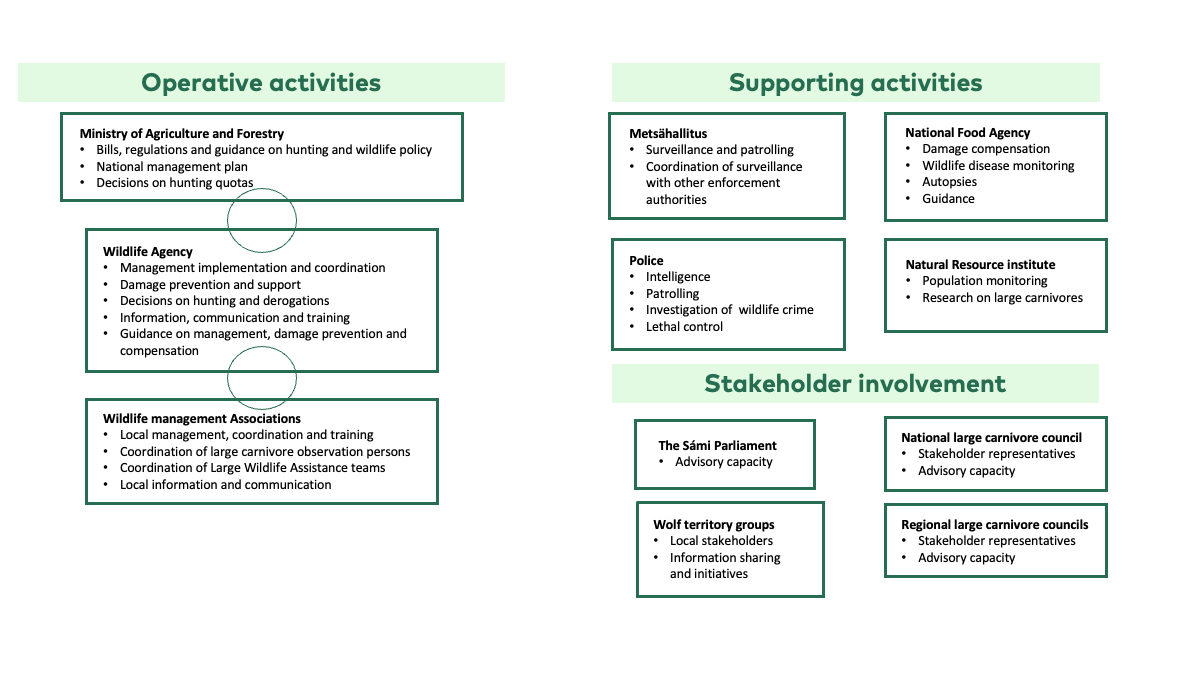
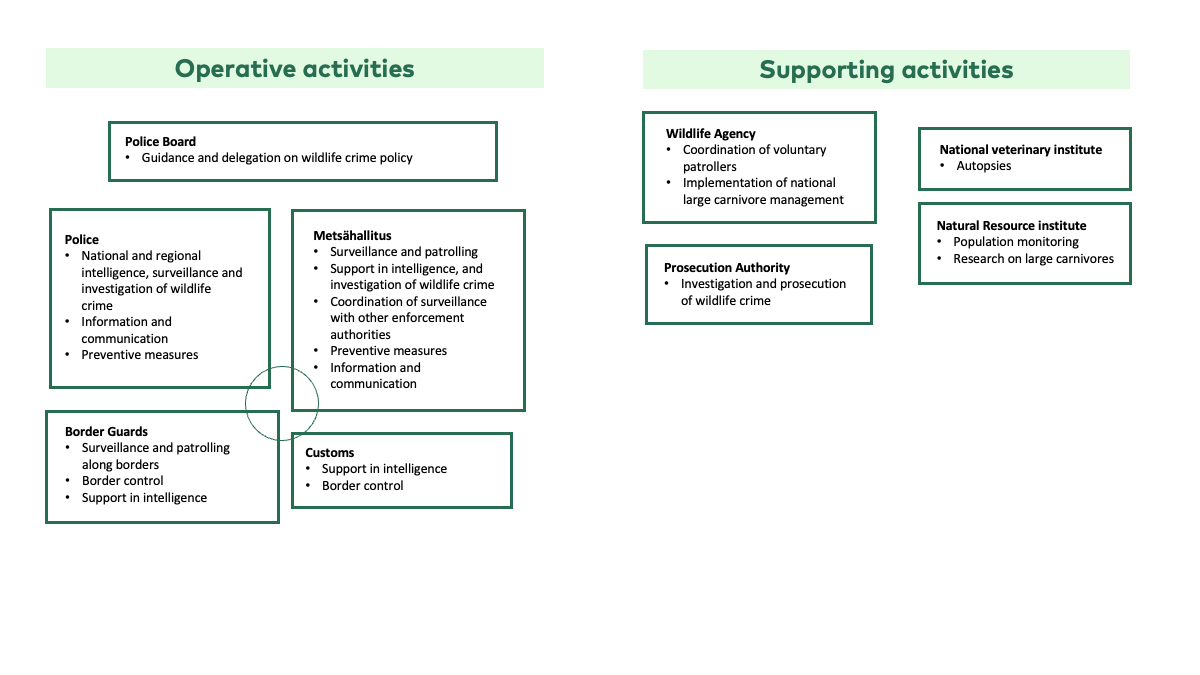
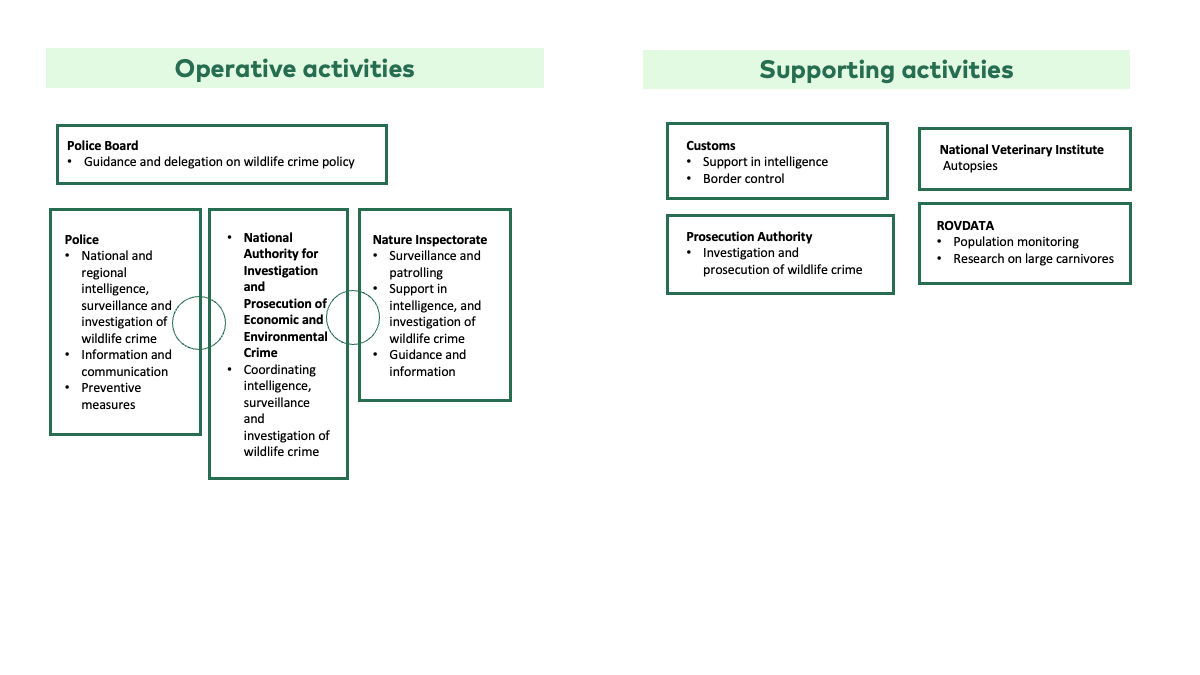
Benchmarking structural models for transnational networking and collaboration
Structural models for transnational and regional networking and collaboration have many advantages. The functions of continuity, process management and learning are more efficient if they are organized at a transnational level, available to all national and regional authorities. Another advantage is that they can build on already existing collaboration and management structures. The project has gathered inspiration from various parts of the world.
The Barents Euro-Arctic Council is the official body for inter-governmental co-operation in the Barents Region. The objective of Barents collaboration is sustainable development in all fields of cooperation.
Nordkalottrådet is a political network and a Nordic collaboration body under the Nordic Council of Ministers. It develops common policies and co-ordinates the operational activities.
Gränsetjänsten / Border Service is in charge of the operative cross-borders activities between Finland, Norway and Sweden. It is governed by the Nordkalottenrådet.
Trans Frontier Conservation Area (TFCA) aims at collaboratively governing and managing shared natural and cultural resources across national borders for improved biodiversity conservation and socio-economic development.
Grensevilt project developed a structural model for a solid base for enhanced transnational, inclusive, conflict-reducing multispecies wildlife management. The regional operational model was adapted to the Swedish - Norwegian border.
Commission for Environmental Cooperation (CEC) is an intergovernmental organization supporting transnational cooperation, covering environmental, economic and social linkages between Canada, Mexico and the United States.
Further information on national Law enforcement on wildlife crime and transnational collaboration models in wildlife management
Information on Wildlife crime and enforcement authorities.
FINLAND
Ministry of the Interior: https://intermin.fi/en/frontpage
The Finnish border guard: https://raja.fi/en/frontpage
The Finnish Customs: https://tulli.fi/en/frontpage
Ministry of Agriculture and Forestry: https://mmm.fi/en/wildlife-and-game
Metsähallitus, Game and fisheries services: https://www.eraluvat.fi/en/wilderness-supervision/game-and-fisheries-wardens
NORWAY
Police: https://www.okokrim.no/
Environment Agency: https://www.environmentagency.no/
County Governor - www.statsforvalterne.no
Ministry of Climate and Environment - www.kld.dep.no
Rovdata - www.rovdata.no
Rovbase - www.rovbase.no
Miljøvedtaksregisteret - www.miljovedtak.no
Lovdata - www.lovdata.no
SWEDEN:
The Swedish police: https://polisen.se/en/
County administrative boards: https://www.lansstyrelsen.se/english.html
Environment Agency: https://www.naturvardsverket.se/en/
Information on large carnivores: https://www.de5stora.com/
rovbase.se: https://rovbase.se
Wildlife damage center: https://www.slu.se/centrumbildningar-ochprojekt/viltskadecenter/
Examples of Agreement on transnational collaboration between law enforcement authorities
The Schengen Agreement and convention: EC: Agreement on Environmental Cooperation: http://www.cec.org/about/agreement-on-environmental-cooperation/
Nordic agreement on cross-border police collaboration: www.norden.org/sv/news/forstarkt-nordiskt-polissamarbete
Reports on illegal hunting and wildlife crime:
- Brå report. 2007. Illegal jakt på stora rovdjur.
- Suutarinen J, and Kojola I. 2017. Poaching regulates the legally hunted wolf population in Finland.
- Häggström H. 2022. Wildlife crime and trans-frontier law enforcement cooperation- a case study on Northern Europe. Försvarshögskolan. Inte publicerad.
- ETS No.104 Convention on the Conservation of European Wildlife and Natural Habitats:
- Skogen K, and Krange O. 2020. The Political Dimensions of Illegal Wolf Hunting: Anti-Elitism, Lack of Trust in Institutions and Acceptance of Illegal Wolf Killing among Norwegian Hunters.
- Boucht J. 2024. Cross-border Use of Police Powers within the EU – A Finnish, Norwegian and Swedish Perspective
Examples of templates for strategic and operational plans and Terms of Operation for expert groups for transnational collaboration in wildlife management.
CEC:
CEC’s Strategic Plan 2021-2025: Strategic Plan 2021-2025 (cec.org)
Operational Plan 2023: Operational Plan 2023 (cec.org)
Terms of operation of expert groups: Terms of Operation Working Groups (cec.org)
About the Project
The project Transfrontier Collaboration in wildlife management with a special focus on wildlife crime is a collaboration between The Swedish Environmental protection Agency, County Board of Värmland (Sweden), Natural Resources Institute Finland LUKE and Police Academy in Oslo (Norway). This paper has been produced in close collaboration with Henrik Häggström, Swedish Defence university. The project is closely working with national and regional authorities and agencies in all three countries throughout the project.
The one year project is financed by the Nordic working group for Biodiversity (NBM) under the Nordic Council of Ministers and aims to:
- Introduce transfrontier collaboration models and networks for the Fennoscandian large carnivore governance, management and law enforcement authorities
- Produce a plan for future steps to enhance collaboration on national and regional levels
- Enhance transfrontier collaboration on existing structures and processes