Intention
This paper is produced within the project Transfrontier Collaboration in wildlife management with a special focus on wildlife crime, with additional support from national and regional officials in each country.
The existing large carnivore management in Fennoscandia could be further enhanced through building on the existing common structures for transnational networking and collaboration. This would further support the extensive collective capacity in Nordic management systems to be utilised for promoting and fostering increased collaboration in wildlife management and governance efforts across the borders. The intention of this paper is to investigate the preconditions, challenges and possibilities for developing the existing structures.
Further, this paper presents a structural model for a transnational coordinating platform that would provide a long-term basis for future networking and collaboration between scientists, experts and practitioners. This paper also suggests themes that could be discussed on a Fennoscandian level. The themes have been collated from a survey sent to national and regional officials working with large carnivore management, to enforcement officials, and NGO’s.
An additional paper focuses specifically on Fennoscandian conditions and networking possibilities in preventing wildlife crime.
Common preconditions
A story of conservation success but also conflicts
The large carnivore populations in the Fennoscandian area have recovered during the last decades. While the benefits of conserving wildlife populations are clearly visible and enjoyed by most residents, the increasing number of large carnivores has also resulted in human-wildlife conflicts in rural areas, partly exacerbated by the polarisation between rural and urban parts of society, trust issues with different values and perspectives on wildlife management. The large carnivore issue is also used as a political tool for the rural-urban conflict debate.
Wicked problem
The management of large carnivores can be seen as a so called “wicked problem”. Characteristics of these unsolvable society issues are a high level of complexity due to uncertain circumstances and many conflicts of values involved. Handling the large carnivore conflict successfully requires knowledge and understanding about the complexity of the problems and the solutions.
Committed to preserve
In order to protect species and environments in a sustainable way, the Nordic countries have committed to preserving the large carnivores in the long-term. Through international agreements, legal frameworks and national laws and decisions, the populations have increased in number and distribution. Sweden, Norway and Finland have signed a framework paper for transboundary cooperation on management and conservation of wolves and wolverines in Fennoscandia. The implementation of the population management is based on national policies and strategies in each country.
Legal frames
All Fennoscandian countries have signed the Convention on Biodiversity, The Bern Convention, Convention on International Trade in Endangered Species of Wild Fauna and Flora, the Malawi Principles and The Aarhus Convention. Since Sweden and Finland are members of the EU they also have to adhere to the Habitats Directive, while Norway can manage their wildlife according to the frameworks of the international agreements. Norway has committed to safeguarding the interests of the Sami people through the ratification of the ILO Convention. Within these frames each country has developed their own policy and regulations on large carnivore management.
Wildlife knows no borders
No physical barriers close the borders between our countries. Wildlife moves freely across our national frontiers, sometimes seen as a resource on one side and causing damages on the other. The home ranges of large carnivores often cross administrative borders and span more than one administrative unit.
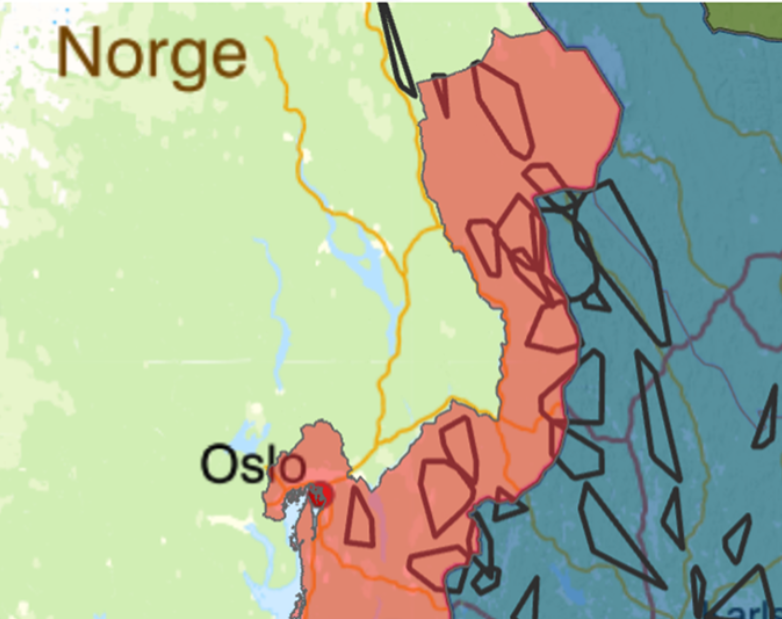
The map shows an example of wolf territories located right at the Swedish-Norwegian border.
Source: Rovbase
Ecological frames
Fennoscandian countries have the area’s natural resources in common, including wildlife. The countries share geographical gradient differences regarding temperature, season length and habitat types, as well as the challenges that come with sharing the landscape with wildlife and human activities such as livestock breeding, reindeer herding, forestry, hunting and other forms of recreation. The management of all four large carnivores should strive to secure the connectivity within the populations and allow sufficient gene flow.
Complex issue demands extensive resources
Wildlife populations that can cause concerns, damages and fear require extensive management efforts. The landscape is shared by humans and large carnivores, sometimes in a way that results in increased demands on management actions. Growing large carnivore populations is ecologically beneficial, but does at the same time claim increasing costs.
Swedish national state support to the County Boards of Administration for large carnivore monitoring 2024. | |
Compensation paid for large carnivore related to damages on sheep (2022) and reindeer (2022-23) in Norway. | |
Annual cost for wolf pack monitoring in Finland. | |
Cost examples (million €) from large carnivore management in each country. | |
Economic frames
Global and European commitments aiming for a strict conservation of large carnivores has led to growing populations. All fennoscandian countries have shown a political will to finance the costs as a result of the growing populations. This has resulted in an increasing demand of economic resources for management actions such as mitigation and compensating for the negative impacts on human livelihoods and activities. There are costs at all levels of the management system, also indirectly through mental and physical constraints to pursue livelihoods and ways of life in the rural areas.
Towards coexistence
The majority of Nordic citizens view large carnivores as a valuable part of nature, increasing the biodiversity. However, the presence of large carnivores can also raise concerns and fears. Mostly it is associated with losses of livestock, semidomestic reindeer and hunting dogs. Reaching and sustaining viable large carnivore populations is a challenge if people feel they cannot coexist with them. Strongly differing views on how to manage the populations have led to a polarising political debate. This is apparent in societal discourse, not least on social media platforms.
One frequent discussion concerns criticising the authorities in charge of the management. The lack of trust towards the authorities poses substantial challenges for the management, and has in its extreme form led to the occurring of poaching of large carnivores. These expressions is a threat to biodiversity, the rule of law and to the democratic institutions.
Socio-political frames
The Fennoscandian countries share many societal preconditions, such as history, culture, values and society structure. The common high valuation of nature is deeply rooted, both for its intrinsic value and as a resource for sustainable use. Fennoscandia is built on transparent democratic societies. This provides a basis for striving for the common good, but also requires a fair and equitable approach to large carnivore management. Policy and management of large carnivores are frequently put on the political agenda in all three countries.
Enhanced collaboration, despite differences
The Fennoscandian countries differ in the structures and policies of the large carnivore management systems, despite similar historical and cultural backgrounds and challenges. The differences are apparent both in the way that management authorities are organised, as well as by the administrative level where management decisions are made (see annexes). In Sweden and Norway, the management is partly decentralised, while in Finland it is more centralised.
Despite differences in governance and management systems, the countries are dependent on each other to sustain thriving large carnivore populations and to work towards a fair and equitable coexistence. Through enhancing the existing transnational networking and collaboration structure, the extensive capacity in the national management systems would be further developed. It would also support and engage the authorities and stakeholders involved to find a common path towards managing the conflict and coexistence.
Additional approaches needed
There is a long tradition of using a wide selection of wildlife management tools in Fennoscandia. The challenges with increasing large carnivore populations require more attention in the management systems to enhance the coexistence. Enhanced collaboration and dialogue between citizens, stakeholders, scientists and authorities is one example.
Established networks and collaboration
There is a long history of transnational networking and collaboration regarding large carnivores. Today, governance issues are discussed annually in directorate meetings (coordinated by the Ministry of Agriculture and Forestry of Finland, Norwegian Environment Agency and Swedish Environmental Protection Agency). On an expert level, a joint population monitoring group is coordinating and developing the common monitoring methods and processes, the database and data sharing.
To further develop and strengthen the cooperative management of the shared large carnivore populations, joint framework papers for transboundary cooperation on wolves and wolverines have been adopted. Although the documents are not legally binding (links on page 18), they describe the long history of collaboration between governments and authorities, and outlines ongoing and future collaboration to secure viable large carnivore populations in Fennoscandia.
Scientific networks, national wildlife conferences and Nordic scientific platforms are other examples of established networks and platforms. To some extent, personnel exchange between countries have occurred.
Hence, there is a history of dialogue and collaboration between the countries that could be further enhanced to meet the increasing need for cooperation in cross-border large carnivore management.
Transnational structural Model for Networking and Collaboration
There is a long history of transnational networking and collaboration regarding large carnivores. Today, governance issues are discussed annually in directorate meetings (coordinated by the Ministry of Agriculture and Forestry of Finland, Norwegian Environment Agency and Swedish Environmental Protection Agency). On an expert level, a joint population monitoring group is coordinating and developing the common monitoring methods and processes, the database and data sharing.
To further develop and strengthen the cooperative management of the shared large carnivore populations, joint framework papers for transboundary cooperation on wolves and wolverines have been adopted. Although the documents are not legally binding (References further down in the document), they describe the long history of collaboration between governments and authorities, and outlines ongoing and future collaboration to secure viable large carnivore populations in Fennoscandia.
Scientific networks, national wildlife conferences and Nordic scientific platforms are other examples of established networks and platforms. To some extent, personnel exchange between countries have occurred.
The model proposes to further expand a possibility to form expert groups upon demand, in addition to the existing monitoring group. Suggested themes that could be covered are presented (further down in the document) . These groups could easily be modified or dissolved as necessary. Operative actions, such as projects and task forces, could be initiated by any level in the model.
Cross-border Regional Networking and Collaboration
The structural model also aims at supporting regional authorities to address common issues, challenges and opportunities on an operational level.
At the regional level, the model is also focusing on the expert level by presenting a joint group of regional focal points that would provide coordination and facilitation services on a regional level. It would be connected to both regional and national decision makers through the relevant focal points. Similar expert groups as in the national model could be formed upon demand to address issues of common interests (examples of themes on page 12). These groups can easily be modified or closed when needed. Operative actions, such as projects and task forces, could be initiated by any level in the model. The presented flexible structural model allows for varying structures between countries and regions.
The structural models are suggestions brought forward by this project. They are not representing the views of the official large carnivore management administration.
Directorate meetings
- Discussions on political and governance level
- Joint frameworks
- Delegation of development or implementation of joint interests
↑↓
National focal points
- 1-2 persons per nation
- Reports to Directorate meeting
- Coordinatiing, facilitatiing and communicating on themes and initiatives
- The first point of contact between the platform and the national networks of authorities and experts.
- May initiate national expert groups and operative action on demand
↑↓
Regional focal points
- 1-2 persons per region
- Reports to the national focal point
- Coordinatiing, facilitatiing and communicating on joint regional themes and initiatives
- The first point of contact between the platform and the regional networks of authorities and experts.
- May initiate regional expert groups and operative action on demand
Suggested themes and subjects of common interest
The following examples of themes for networking and collaboration could be of mutual interest in the future at the Fennoscandian level. The themes have been identified with other transnational collaboration models as inspiration.

Prerequisites for harmonising frameworks, structures and processes

Common reference values for the Fennoscandian populations

Rules and regulations
Common rules and regulations for collaboration

Communication and dialogue
Common guidelines on how to communicate in LC management

Management
Implementation of framework papers

Stakeholder involvement
Sharing materials and tools for communication, dialogue and stakeholder involvement

Monitoring
Harmonisation of reporting and documentation

Conflict resolution
Joint training packages in conflict resolution in the Nordics

Research and development
Cost-benefit analysis of wildlife management

Wildlife crime
Established coordination and facilitation of cross border collaboration
Suggestions for next steps
Based on discussions with decision makers in all three countries at the transnational meetings, the project suggest that the structural model could be further developed through:
- a civil service assignment within the official large carnivore management administration in the three countries.
- testing its functionality in a pilot project in some regional cross-border areas.
Annexes
- Overview of national management structures and functions
- Structural models for transnational networking and collaboration platforms
- Further information on national large carnivore management and transnational collaboration in wildlife management
- About the project
Overview of enforcement structures and functions
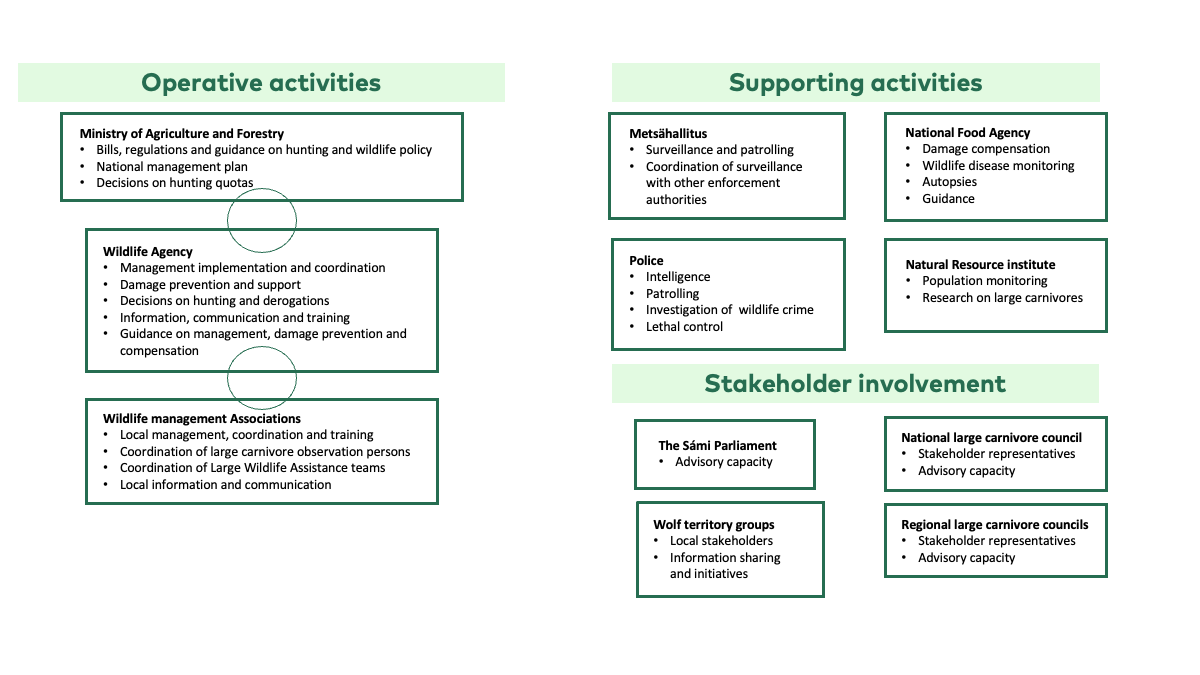
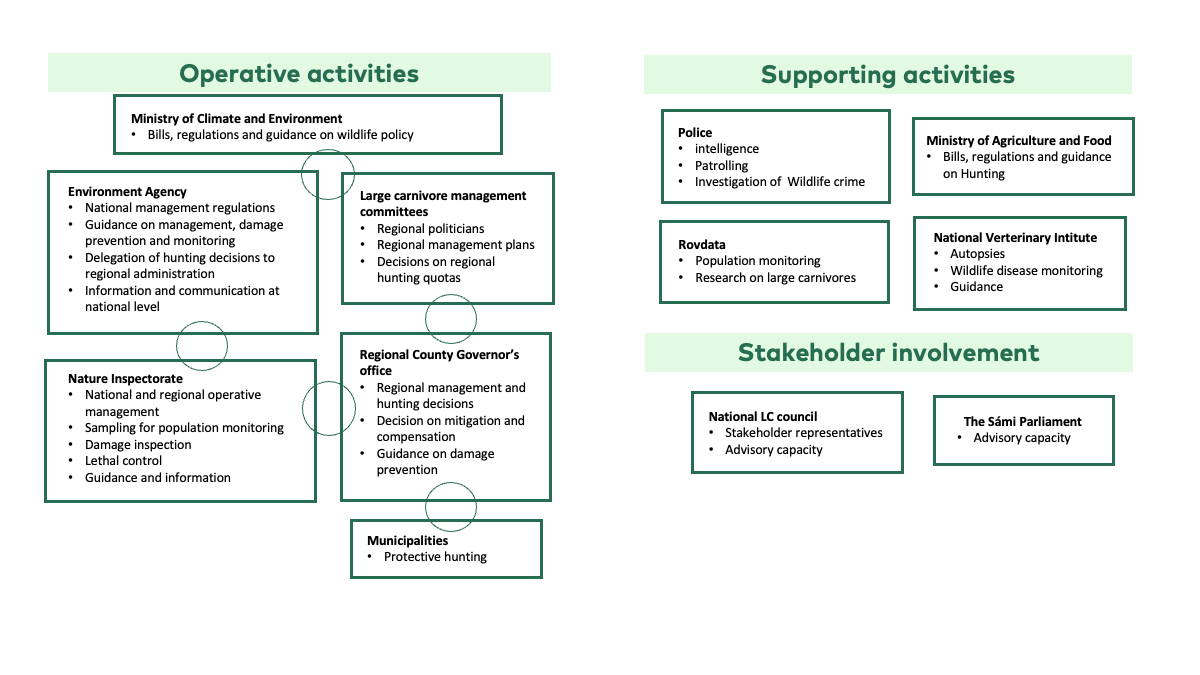
Benchmarking structural models for transnational networking and collaboration
Structural models for transnational networking and collaboration have many advantages. The functions of continuity, process management and learning are more efficient if they are organised at a transnational level, available to all national and regional authorities. Another advantage is that we can build on already existing collaboration and management structures. The project has gathered inspiration from various parts of the world.
The Barents Euro-Arctic Council is the official body for inter-governmental co-operation in the Barents Region. The objective of Barents collaboration is sustainable development in all fields of cooperation.
Nordkalottrådet is a political network and a Nordic collaboration body under the Nordic Council of Ministers. It develops common policies and co-ordinates the operational activities.
Gränsetjänsten / Border Service is in charge of the cross-borders operational activities between Finland, Norway and Sweden. It is governed by the Nordkalottenrådet.
Trans Frontier Conservation Area (TFCA) aims at collaboratively governing and managing shared natural and cultural resources across national borders for improved biodiversity conservation and socio-economic development.
Grensevilt project developed a structural model for a solid base for enhanced transnational, inclusive, conflict-reducing multispecies wildlife management. The regional operational model was adapted to the Swedish - Norwegian border.
Commission for Environmental Cooperation (CEC) is an intergovernmental organisation supporting transnational cooperation, covering environmental, economic and social linkages between Canada, Mexico and the United States.
Further information on national large carnivore management and transnational collaboration in wildlife management
Examples of Agreements and frameworks on transnational collaboration wildlife management.
Frameworks for transboundary cooperation on management and conservation of large carnivores in Fennoscandia:
- Memorandum of Understanding regarding the establishment and continuance of a public web-based database (Skandobs) for geographic information on large carnivore observations in Norway and Sweden (Norwegian Institute for Nature Research and Swedish Environmental Protection Agency). 25 March 2012. Inte publicerad
- Memorandum of Understanding regarding the establishment and continuance of a monitoring system for large carnivores in Sweden and Norway (Norwegian Environment Agency and Swedish Environmental Protection Agency). 25 March 2015. Inte publicerad
CEC: Agreement on Environmental Cooperation: http://www.cec.org/about/agreement-onenvironmental-cooperation/
Examples of templates on working papers for transnational collaboration in wildlife management.
CEC:
Further information on national large carnivore governance and management
FINLAND
- Ministry of Agriculture and Forestry: https://mmm.fi/en/wildlife-and-game
- Wildlife Agency: https://riista.fi/en/gameadministration/finnish-wildlife-agency/
- Information on large carnivores: https://www.largecarnivores.fi/frontpage.html
- Population monitoring: https://www.luke.fi/fi/luonnonvaratieto/tiedetta-ja-tietoa/suurpedot
NORWAY
- Environment Agency: https://www.environmentagency.no/
- County Governor www.statsforvalterne.no
- Ministry of Climate and Environment www.kld.dep.no
- Rovdata - www.rovdata.no
- Rovbase - www.rovbase.no
- Miljøvedtaksregisteret www.miljovedtak.no
- Lovdata - www.lovdata.no
SWEDEN
- Environment Agency: https://www.naturvardsverket.se/en/
- Information on large carnivores: https://www.de5stora.com/
- County administrative boards: https://www.lansstyrelsen.se/english.html
- rovbase.se: https://rovbase.se/
- Viltskadecenter: https://www.slu.se/centrumbildningar-ochprojekt/viltskadecenter/
About the Project
The project Transfrontier Collaboration in wildlife management with a special focus on wildlife crime is a collaboration between the Swedish Environmental Protection Agency, The County Board of Värmland (Sweden), Natural Resources Institute Finland LUKE and Police Academy in Oslo (Norway). The project is closely working with national and regional authorities and agencies in all three countries throughout the project.
The one year project is financed by the Nordic working group for Biodiversity (NBM) under the Nordic Council of Ministers and aims to:
- Introduce transfrontier collaboration models and networks for the Fennoscandian large carnivore governance, management and law enforcement authorities
- Produce a plan for future steps to enhance collaboration on national and regional levels
- Enhance transfrontier collaboration on existing structures and processes