

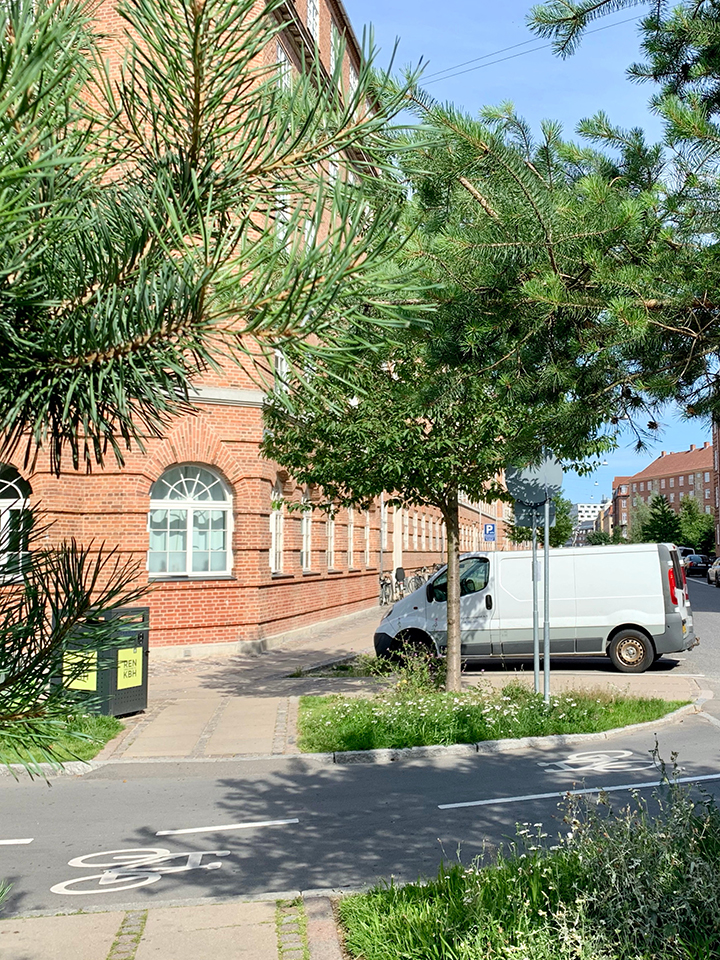
Contents
This publication is also available online in a web-accessible version at
https://pub.norden.org/nord2022-018
Preface
In 2018 the Nordic Council of Ministers for Climate and Environment appointed a Nordic Working Group for Sustainable Cities. The overall objective and purpose of this working group have been to contribute to achieving the sustainable development goals of Agenda 2030 with an emphasis on strengthening the exchange of experiences and co-operating on Nordic solutions for sustainable urban development. The importance of urban green spaces in achieving this has been a key focus of the group’s work during the years 2019–2021.
This policy brief is a result of the Group’s work, and the text was prepared by Cecil C. Konijnendijk under assignment from the Working Group. The key target group for this brief is policy makers at the national level, but also links to the work of decision makers and other stakeholders at the regional and especially the local level. Greater collaboration across governmental levels, between sectors, as well as in partnership with other stakeholders, will enhance the development of the future Nordic green city.
Highlights of the policy brief
- From city parks to urban woodland, from lakes to water fronts and riverbanks, and from green schoolyards to community gardens, urban green (and blue) space is crucial for vibrant, resilient, and healthy Nordic cities, especially for climate adaptation and mitigation, health promotion, biodiversity conservation and restoration.
- Green space should be considered part of critical infrastructure, assets essential for the functioning of societies and economies.
- Nordic cities have a long history of striving to be green and sustainable but urban green space and the benefits it provides need to be strengthened further.
- To develop the Nordic Green City of the Future, urban green space needs to meet the principles of Proximity, Diversity, Connectivity, and Equity. These principles can be translated into specific guidelines to inform policy, planning, design, and management.
- Further national policy and guidance and knowledge sharing are needed to assist cities in developing and implementing stronger urban green space programs and strategies.
 Photo: Cecil Konijnendijk
Scope
As the Nordic countries, like other parts of the world, face a climate emergency, biodiversity loss, and public health challenges (most recently the global COVID-19 pandemic), increasing focus is on the places where most of us live: cities. The need to develop urban environments that are healthy and resilient, and where individuals and communities can thrive, is increasingly recognised by policy makers. At the global level, several Sustainable Development Goals link to the importance of healthy and green living environments, with Sustainable Development Goal 11[1]https://sdgs.un.org/goals/goal11 specifically addressing cities and calling for universal access to urban green space. Urban ecosystems are a focus area of the new UN Decade of Restoration as well[2]https://www.decadeonrestoration.org/. At the European level, cities are recognised as key deliverers of climate objectives and the EU Green Deal’s call for carbon neutral economies[3]https://ec.europa.eu/info/strategy/priorities-2019-2024/european-green-deal_en. One of the key mechanisms is to expand natural carbon sinks. The EU Biodiversity Strategy for 2030 is one of the latest documents that stressed the need for greener cities[4]https://ec.europa.eu/environment/strategy/biodiversity-strategy-2030_en. The EU Forestry Strategy calls for the planting of an additional 3 billion trees, including in and near urban areas[5]https://ec.europa.eu/environment/strategy/forest-strategy_en. The New European Bauhaus (2021), which calls for beautiful, sustainable, and inclusive forms of living[6]https://europa.eu/new-european-bauhaus/index_en, as well as its specific Nordic adaptation through a process of co-design, also provide an important international framework. The Nordic Vision 2030[7]https://www.norden.org/en/declaration/our-vision-2030 links up to these initiatives, reaffirming the Nordic Countries’ global leadership in sustainable urban development:
"The Nordic Region will becom the most sustainable and integrated region in the world."
In this context, this policy brief addresses why urban green spaces (which are considered here as including blue spaces as well) are essential for Nordic cities and citizens. It discusses what types of initiatives and actions can be taken to enhance these spaces and the benefits they provide and sets out directions for initiatives at the national level, as a way of linking international commitments to local level delivery specific to a Nordic context.
Footnotes
- ^ https://sdgs.un.org/goals/goal11
- ^ https://www.decadeonrestoration.org/
- ^ https://ec.europa.eu/info/strategy/priorities-2019-2024/european-green-deal_en
- ^ https://ec.europa.eu/environment/strategy/biodiversity-strategy-2030_en
- ^ https://ec.europa.eu/environment/strategy/forest-strategy_en
- ^ https://europa.eu/new-european-bauhaus/index_en
- ^ https://www.norden.org/en/declaration/our-vision-2030
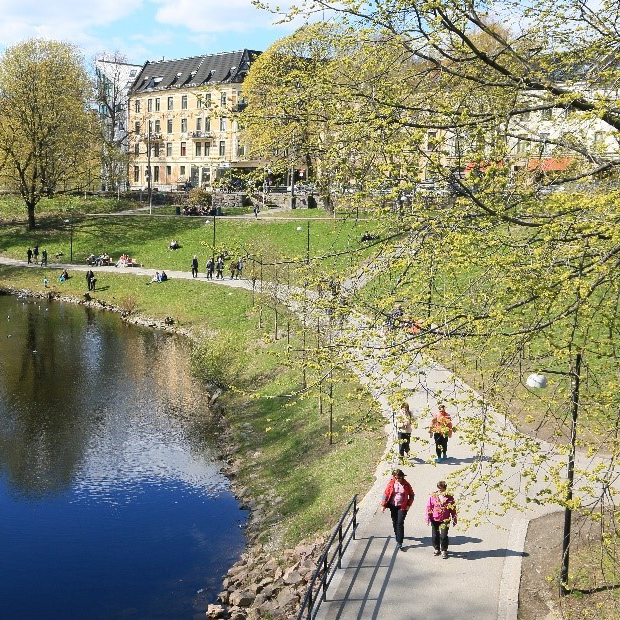 Photo: Øyvind Holmstad, Wikimedia Commons
Essential Urban Green Space
The many essential benefits and ecosystem services provided by urban green and blue spaces (hereinafter ‘green space’) have become widely recognised, and the past years have seen a rapid increase in research and evidence. Among the many important contributions of urban green space are, for example, beautifying our urban settings, ensuring daily contact with nature, and building attachment to local environments. Three areas of green space benefits should be particularly highlighted:
- Helping urban communities with climate change adaptation and mitigation, for example by cooling, reducing stormwater issues, and serving as carbon sinks and storage.
- Promoting public health and wellbeing, by offering environments that inspire, reduce stress, and give us the chance to restore ourselves, enhance physical activity and provide green and safe routes for walking and cycling, and stimulate social interactions. The COVID-19 pandemic has put further emphasis on these essential roles.
- Harbouring important biodiversity – urban green spaces can sometimes even host richer flora and fauna than areas outside cities.
The above benefits have become well documented and more has also become known about the reasons behind the benefits. We know, for example, that urban tree canopy is essential for shading and cooling[1]Ziter, C.D., Pedersen, E.J., Kucharik, C.J., et al., 2019. Scale-dependent interactions between tree canopy cover and impervious surfaces reduce daytime urban heat during summer. Proceedings of the National Academy of 116(15): 7575-7580. DOI: 10.1073/pnas.1817561116. , and that proximity and visibility of trees and other vegetation, as well as water, enhances our mental wellbeing[2]Larkin, A., Hystad, P., 2019. Evaluating street view exposure measures of visible green space for health research. Journal of Exposure Science and Environmental Epidemiology 29: 447–456. https://doi.org/10.1038/s41370-018-0017-1; Nutsford, D., Pearson, A.L., Kingham, S., et al., 2016. Residential exposure to visible blue space (but not green space) associated with lower psychological distress in a capital city. Health & Place 39: 70-78. https://doi.org/10.1016/j.healthplace.2016.03.002. . A diverse range of green spaces, with rich vegetation and landscape structures, can host high levels of biodiversity[3] Nielsen, A.B., van den Bosch, M., Maruthaveeran, S., et al., 2014. Species richness in urban parks and its drivers: A review of empirical evidence. Urban Ecosystems 17: 305–327. https://doi.org/10.1007/s11252-013-0316-1. Having public green spaces within easy reach will make us more inclined to visit these spaces regularly, thus making positive contributions to our physical and mental health while also enhancing social interactions[4]Toftager, M., Ekholm, O., Schipperijn, J., et al., 2011. Distance to green space and physical activity: a Danish national representative survey. Journal of Physical Activity and Health 8(6): 741-9. doi: 10.1123/jpah.8.6.741..
Also important are the economic benefits related to the above (e.g., avoided cost of climate change adaptation and mitigation and healthcare)[5]Arbor Day Foundation, 2021. Economics of urban forestry in the United States. https://www.arborday.org/urban-forestry-economic/, as well as to for example, the contributions green spaces can make to the local economy through tourism, creating business opportunities, and attracting investments[6]Saraev, V., 2020. The economic benefits of green space. Research Report. Forest Research, Edinburg. https://www.forestresearch.gov.uk/publications.
From the above relationships specific targets and indicators can be derived that can inform policy. An example of this is the 3-30-300 guideline for urban greening which was recently introduced by an urban greening expert based on research on the health and climate adaptation benefits of urban green space[7]Konijnendijk, C., 2021. The 3-30-300 Rule for Urban Forestry and Greener Cities. Biophilic Cities Journal 4(2). https://mailchi.mp/biophiliccities/3-30-300rulebcjv4n2. The guideline calls for every urban resident having a view of at least 3 trees, living in a neighbourhood with at least 30 percent canopy cover, and being able to access a public green space within 300 metres from their residence.
Footnotes
- ^ Ziter, C.D., Pedersen, E.J., Kucharik, C.J., et al., 2019. Scale-dependent interactions between tree canopy cover and impervious surfaces reduce daytime urban heat during summer. Proceedings of the National Academy of 116(15): 7575-7580. DOI: 10.1073/pnas.1817561116.
- ^ Larkin, A., Hystad, P., 2019. Evaluating street view exposure measures of visible green space for health research. Journal of Exposure Science and Environmental Epidemiology 29: 447–456. https://doi.org/10.1038/s41370-018-0017-1; Nutsford, D., Pearson, A.L., Kingham, S., et al., 2016. Residential exposure to visible blue space (but not green space) associated with lower psychological distress in a capital city. Health & Place 39: 70-78. https://doi.org/10.1016/j.healthplace.2016.03.002.
- ^ Nielsen, A.B., van den Bosch, M., Maruthaveeran, S., et al., 2014. Species richness in urban parks and its drivers: A review of empirical evidence. Urban Ecosystems 17: 305–327. https://doi.org/10.1007/s11252-013-0316-1
- ^ Toftager, M., Ekholm, O., Schipperijn, J., et al., 2011. Distance to green space and physical activity: a Danish national representative survey. Journal of Physical Activity and Health 8(6): 741-9. doi: 10.1123/jpah.8.6.741.
- ^ Arbor Day Foundation, 2021. Economics of urban forestry in the United States. https://www.arborday.org/urban-forestry-economic/
- ^ Saraev, V., 2020. The economic benefits of green space. Research Report. Forest Research, Edinburg. https://www.forestresearch.gov.uk/publications
- ^ Konijnendijk, C., 2021. The 3-30-300 Rule for Urban Forestry and Greener Cities. Biophilic Cities Journal 4(2). https://mailchi.mp/biophiliccities/3-30-300rulebcjv4n2
 Photo: Wikimedia Commons
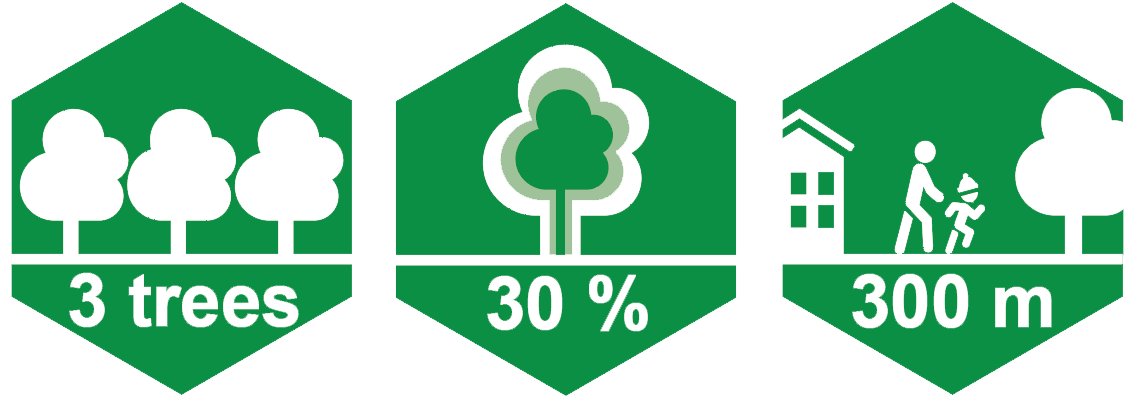
Box 1. The 3-30-300 guideline.
Vision for the Nordic Green City of the Future
The Nordic countries and cities pride themselves on their environmental and sustainability policies which are often viewed as international examples. Many people across the world know about, for example, Copenhagen’s Finger Plan, the National Urban Parks of Finland and Sweden, and Oslo’s green infrastructure planning[1]Nilsson, K., Weber, R., Rohrer, L. (Eds.), 2021. Green visions: greenspace planning and design in Nordic cities. Arvinius + Orfeus Publishing, Stockholm; Nordh, H., Olafsson, A.S., 2021. Plans for urban green infrastructure in Scandinavia, Journal of Environmental Planning and Management 64(5): 883-904, DOI: 10.1080/09640568.2020.1787960. . When further developing Nordic Green Cities that are not only green, but also resilient, healthy, and competitive, the following key principles should be applied:
Footnotes
- ^ Nilsson, K., Weber, R., Rohrer, L. (Eds.), 2021. Green visions: greenspace planning and design in Nordic cities. Arvinius + Orfeus Publishing, Stockholm; Nordh, H., Olafsson, A.S., 2021. Plans for urban green infrastructure in Scandinavia, Journal of Environmental Planning and Management 64(5): 883-904, DOI: 10.1080/09640568.2020.1787960.
Proximity: Public green space should be within easy reach, e.g., not more than a 5-10 minutes’ walk away, as recommended by the World Health Organization[1]World Health Organization – Regional Office for Europe, 2017. Urban green spaces: A brief for action. Bonn. https://www.euro.who.int/__dataassets/pdf_file/0010/342289/Urban-Green-Spaces_EN_WHO_web3.pdf. This will increase the regular use of these spaces, and with this come important health benefits. To ensure proximity, cities need to have dense green networks, with an evenly distributed urban tree canopy cover that provides essential climate adaptation, public health, and other benefits. Studies have shown that a canopy cover of 30-40% at the neigbourhood level results in major health gains and cooling impacts[2]Ziter et al. (2019) – see above; Middel, M., Chhetri, N., Quay, R., 2015. Urban forestry and cool roofs: Assessment of heat mitigation strategies in Phoenix residential neighborhoods. Urban Forestry & Urban Greening 14(1): 178-186. https://doi.org/10.1016/j.ufug.2014.09.010. . Proximity also relates to visibility, as recent research has demonstrated the crucial importance of being able to see trees and other vegetation from our homes, places of work, and schools. Visual access to trees and other greenery, for example from our windows, strengthens our mental health, ability to focus, and creativity increase[3]Lottrup, L., Grahn, P., Stigsdotter, U.K., 2013. Workplace greenery and perceived level of stress: Benefits of access to a green outdoor environment at the workplace. Landscape and Urban Planning 110: 5-11. https://doi.org/10.1016/j.landurbplan.2012.09.002. . The 3-30-300 guideline mentioned above can help guide and benchmark urban greening programs.
Footnotes
- ^ World Health Organization – Regional Office for Europe, 2017. Urban green spaces: A brief for action. Bonn. https://www.euro.who.int/__dataassets/pdf_file/0010/342289/Urban-Green-Spaces_EN_WHO_web3.pdf
- ^ Ziter et al. (2019) – see above; Middel, M., Chhetri, N., Quay, R., 2015. Urban forestry and cool roofs: Assessment of heat mitigation strategies in Phoenix residential neighborhoods. Urban Forestry & Urban Greening 14(1): 178-186. https://doi.org/10.1016/j.ufug.2014.09.010.
- ^ Lottrup, L., Grahn, P., Stigsdotter, U.K., 2013. Workplace greenery and perceived level of stress: Benefits of access to a green outdoor environment at the workplace. Landscape and Urban Planning 110: 5-11. https://doi.org/10.1016/j.landurbplan.2012.09.002.
 Photo: Urbio
Diversity: Cities need a mix of green spaces, from larger natural areas to neighbourhood parks, and from green schoolyards to community gardens to green roofs and walls. These allow for a range of different uses and experiences[1]Palliwoda, J., Banzhaf, E., Priess, J.A., 2020. How do the green components of urban green infrastructure influence the use of ecosystem services? Examples from Leipzig, Germany. Landscape Ecology 35: 1127-1142. https://doi.org/10.1007/s10980-020-01004-w. Diversity also relates to offering a variety of landscapes within green space, the importance of enhancing biodiversity, and of developing a diverse urban tree population. It also ensures that green spaces provide a diverse range of ecosystem services. Diversity of green spaces and the experiences and benefits they offer places emphasis on quality and appropriate planning, design, and management.
Footnotes
- ^ Palliwoda, J., Banzhaf, E., Priess, J.A., 2020. How do the green components of urban green infrastructure influence the use of ecosystem services? Examples from Leipzig, Germany. Landscape Ecology 35: 1127-1142. https://doi.org/10.1007/s10980-020-01004-w
 Photo: Jonatan Malmberg
Connectivity: Cities need to have well-connected green networks, linking up different green spaces, and providing safe, green corridors between them. Connectivity enhances recreational use and active transportation (which in turn reduces air pollution), but also benefits flora and fauna. Connectivity helps build resilience and leads to better functioning urban ecosystems that provide a wide range of ecosystem services. This also relates to the importance of connecting urban green structures with surrounding natural areas and countryside, which allows for better linking for urban and rural areas.
 Map: City of Jyväskylä
Equity: All residents should have physical and visible access to green space, which means that a city’s green infrastructure needs to be evenly distributed over the city. This also relates to good accessibility. Unbalanced greening can have negative side-effects, such as the possibility of green gentrification or even segregation . Everybody should be able to use green spaces, which means that e.g., paths and infrastructure need to cater for different users, including those who are less mobile. Universal access is something to strive for. This aspect also relates to engagement of people in local greening programs, which will promote a sense of community and social cohesion.
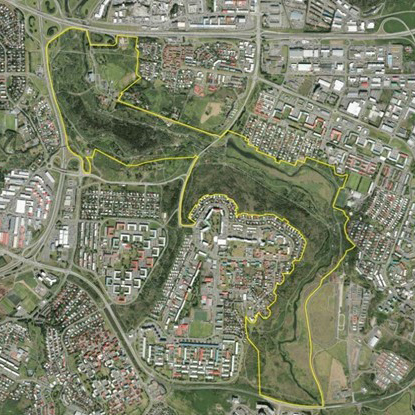 Photo: Reykjavik City
Recommendations for developing national policies and initiatives
With by far most Nordic citizens living in cities, and given the current climate, biodiversity, and public health emergencies, it is important to increase awareness and knowledge on the importance of urban green spaces and stimulate further policy and actions. Local governments play an essential role in planning and managing urban green spaces, but the role of other levels of government and other stakeholders, including community groups, non-profit organisations, businesses, and educational institutions can be enhanced. International initiatives and programmes such as the Sustainable Development Goals, the UN Decade of Restoration (which also focuses on urban ecosystems), the EU’s Biodiversity Strategy 2030, and the New European Bauhaus raise awareness of our (physical) environments and sustainable development. These need to be brought into the specific Nordic context. National governments will be an important facilitator for this, bridging between international initiatives on the one hand, and local-level action in Nordic cities on the other.
National guidance and support for urban green space in the Nordic countries should focus on the following aspects and components:
Recognising urban green spaces as critical infrastructure and raising their profile in planning frameworks
Urban (and regional) planning provides essential frames for the delivery and conservation of urban green spaces. Consideration of urban green spaces, including the use of the term green infrastructure, should be promoted. Although the Nordic countries have different planning legislation and frameworks, opportunities exist to address this issue also at the national level. Planning frameworks should incentivise the conservation and development of green space as part of development projects, and better integration of ‘green’ and ‘grey’ (such as buildings and roads). Critical infrastructure is a term used by governments to describe assets that are essential for the functioning of a society and economy. Green and blue infrastructure is part of this critical infrastructure, and it should be considered as central to planning and implementation as other types of infrastructure as roads and energy supply. Green spaces should be made an integral part of e.g., climate adaptation strategies and disaster risk management strategies. This calls for political leadership and coordinated, cross-sectoral efforts.
Developing urban green space strategies, guidelines, norms, and funding
In line with international policies and initiatives, cities should be asked to develop urban green space strategies that provide longer-term, strategic direction for the development and protection of urban green spaces and the benefits (or ecosystem services) these provide. At the national level, important guidance for the development of these strategies can be provided, for example, on how these plans should be structured. The Swedish National Board of Housing, Building and Planning has together with the Environmental Protection Agency provided detailed guidance on how to develop green plans, for example[1] Boverket, 2021. Ta fram en grönplan. Website. https://www.boverket.se/sv/PBL-kunskapsbanken/teman/ekosystemtjanster/verktyg/gronplan/.
Nordic cooperation provides an important platform for coordinating these efforts and sharing knowledge and good practice. Urban green space strategies will also be an important mechanism for enhanced policy integration, as these strategies should be coordinated with, and inform other relevant policies and strategies, such as general city plans and climate action strategies. Strategies need to include dedicated funding programs and financial instruments, for example as part of climate action or public health programs. They also need to include clear targets and the inclusion of evidence-based guidelines and norms can assist. Examples of this that are already used by some Nordic countries and cities are proximity standards, tree canopy targets, green space norms and compensation requirements for new urban developments, and biodiversity targets. Green infrastructure guidance from the Norwegian government recommends having small green space within 200 meters of each dwelling, and the maximum distance to the nearest green corridor or larger green area to be 500 meters[2]The Norwegian Environment Agency. 2014. “Planlegging av grønnstruktur i byer og tettsteder. Veileder M100-2014.” https://www.miljokommune.no/Documents/Arealplan/M100.pdf. . New evidence and opportunities offered in terms of assessment and monitoring can support the developments of guidance as well as implementation of existing guidelines such as the 3-30-300 guideline. Other areas where guidelines and norms can be developed include share of permeable soil in a city, presence of larger parks and other green spaces to promote ecosystem integrity and biodiversity, connectivity and equitable distribution of green space, and management practices and standards (including integrated and sustainable pest management[3]https://ec.europa.eu/info/law/better-regulation/have-your-say/initiatives/12413-Pesticides-sustainable-use-updated-EU-rules-_en).
Footnotes
- ^ Boverket, 2021. Ta fram en grönplan. Website. https://www.boverket.se/sv/PBL-kunskapsbanken/teman/ekosystemtjanster/verktyg/gronplan/
- ^ The Norwegian Environment Agency. 2014. “Planlegging av grønnstruktur i byer og tettsteder. Veileder M100-2014.” https://www.miljokommune.no/Documents/Arealplan/M100.pdf.
- ^ https://ec.europa.eu/info/law/better-regulation/have-your-say/initiatives/12413-Pesticides-sustainable-use-updated-EU-rules-_en
Generating and sharing knowledge and good practice
National governments can play an important role in supporting the general of research and knowledge that can support urban green space planning, design, and management. Dedicated research agendas and funding streams should be set up, if these are not already in place, and research agendas should be developed jointly with municipal and other stakeholders. Capacity building should also be supported, e.g., by supporting education and training, exchange of experiences and good practices, and networking. Where possible, Nordic collaboration and synergies should be achieved. The Nordic countries already have a wealth of experience in developing urban green spaces. A more coordinated approach to learning, testing, identification and sharing of good practices and innovations would be highly beneficial. Visions and strategies are one thing but their implementation in complex urban contexts is another, which further enhances the need for sharing success stories.
About this publication
Policy Brief: Nordic Cities – Green, Resilient, Healthy
Fostering national policies and initiatives for urban green space
Nord2022:018
ISBN 978-92-893-7395-1 (PDF)
ISBN 978-92-893-7396-8 (ONLINE)
http://dx.doi.org/10.6027/nord2022-018
Layout: Louise Jeppesen
Cover photo: Wikimedia Commons, Sankt Kjelds Plads, Copenhagen
Nordic co-operation
Nordic co-operation is one of the world’s most extensive forms of regional collaboration, involving Denmark, Finland, Iceland, Norway, Sweden, the Faroe Islands, Greenland, and Åland.
Nordic co-operation has firm traditions in politics, the economy, and culture. It plays an important role in European and international collaboration, and aims at creating a strong Nordic community in a strong Europe.
Nordic co-operation seeks to safeguard Nordic and regional interests and principles in the global community. Shared Nordic values help the region solidify its position as one of the world’s most innovative and competitive.
Nordic Council of Ministers
Nordens Hus
Ved Stranden 18
DK-1061 Copenhagen
www.norden.org
Read more Nordic publications: www.norden.org/publications