

- Frontpage
- Table of contents
- Executive summary
- 1. Introduction
- 1.1 Objectives and aim of the study
- 1.2 Presentation of the consortium
- 1.3 Content of the report
- 2. Methodology – approach to the data collection
- 2.1 Activities of the project
- 2.2 Deliverables of the project
- 3. Defining and examining digital inclusion
- 3.1 Understanding digital inclusion
- 3.2 Reaching a draft definition
- 3.3 Existing definitions of digital inclusion
- 3.4 The prevalent approaches to the term digital inclusion
- 4. Monitoring digital inclusion
- 4.1 Monitoring of digital inclusion in the Nordic-Baltic region
- 5. Snapshot of digital inclusion
- 5.1 State of digital inclusion
- 5.2 Characteristic traits in the Nordic and Baltic countries
- 5.3 Current monitoring as a foundation for policy making
- 6. Nordic-Baltic added value
- 6.1 Improving the foundation for digital inclusion
- 6.2 Nordic-Baltic cooperation on digital inclusion
- 7. Findings of the study
- 7.1 Summary of findings
- 7.2 Findings by study questions
- 8. Recommendations
- 9. Digital inclusion in the context of the Nordic and Baltic countries and autonomous areas
- 9.1 Denmark
- 9.2 Estonia
- 9.3 Finland
- 9.4 Faroe Islands
- 9.5 Greenland
- 9.6 Iceland
- 9.7 Latvia
- 9.8 Lithuania
- 9.9 Norway
- 9.10 Sweden
- 9.11 Åland
- Appendix A – survey respondents
- Reference list
- About this publication
MENU
Contents
This publication is also available online in a web-accessible version at https://pub.norden.org/nord2022-007

Executive summary
The Ministerial Council for Digitalisation consisting of the Nordic and Baltic ministers responsible for digital development have decided on the policy goal of promoting digital inclusion, empowerment, and equality in the Nordic and Baltic countries. A high-speed digital transformation of societies includes a risk of leaving groups of people behind. Knowledge gathering and policy actions on digital inclusion are a significant step to avoid this development.
The current study will contribute to providing a knowledge-based foundation for potential common Nordic-Baltic actions on digital inclusion. The study is structured by four thematic areas: Defining digital inclusion, Monitoring digital inclusion, Snapshot of digital inclusion, and Nordic-Baltic added value.
The study was commissioned by the High-Level Group for Digitalisation (HNG DIGITAL), consisting of members that represent the Nordic and Baltic governments/ministries working with the national digital agenda and policies. The study has been conducted by the consultancy consortium “Digital Europe”.
The methodological approach of the study is a combination of various research methods, such as a comprehensive desk research, combined with and followed by e-surveys, stakeholder interviews, and workshops. Key information for the analysis has been provided by the national authority representatives from each Nordic and Baltic country and autonomous area.
Study findings
The Nordic and Baltic region is composed of 11 digitalised societies. The digital divide is present in the region to various degrees, but generally the digitally excluded groups are identified as minor parts of the populations. The level of digital inclusion is measured to a varying degree, but does not provide a comprehensive picture of digital inclusion sufficient for policymaking. The international databases on digitalisation provide some indication of digital inclusion, and the 8 Nordic and Baltic countries included in the international databases score well in these. The Nordic and Baltic countries and autonomous areas are missing indicators and data on digital capabilities and consequences of digital exclusion, detailed on digitally excluded sub-groups of the populations.
In general, few Nordic and Baltic countries and autonomous areas present a definition of digital inclusion as such, and there is no shared definition in the Nordic-Baltic region. The same picture is present for the international institutions. This study has reached the following definition of digital inclusion: “Digital inclusion is prevailing when all people, including the most disadvantaged and vulnerable groups, have access to, the ability to use and benefit from ICT related to public sector services.” A digital divide is caused by access and capability barriers and have consequences, such as digital exclusion and/or not benefitting from public digitalisation. The sub-groups of the Nordic-Baltic populations that are at the highest risk of digital exclusion are elderly people, people with disabilities, immigrants, people in rural areas and people with low/no education.
A comprehensive picture of digital inclusion is not present in the Nordic-Baltic region. In general, current monitoring is to a higher degree on Digital Access, and less on Digital Capability and rarely on Digital Consequences, as well as on detailed knowledge about the potential digitally excluded sub-groups of people. 8 out the 11 countries and autonomous areas of the Nordic-Baltic region are currently monitoring digital inclusion to some extent. However, these countries state that the current monitoring does not provide a comprehensive picture of digital inclusion. International institutions’ databases on digitalisation provide an indication on digital inclusion, but does not provide an explicit, comprehensive, or detailed picture.
Today, the cooperation between the countries and autonomous areas in the Nordic-Baltic region on digital inclusion is limited. The countries and areas can successfully work together on establishing a shared definition of digital inclusion, elaborate on the indicators they are missing from the existing monitoring framework, and set up shared measuring mechanisms. As part of providing more sufficient indicators, the countries can also work together on encouraging the EU to expand the approach and indicators used for data collection on digital inclusion. Another area where Nordic-Baltic cooperation can provide substantial added value is sharing experiences about methods of monitoring and about policy initiatives and their effect.
The following box contains a set of recommendations from the Digital Europe consortium.
RECOMMENDATIONS
R1: The Nordic and Baltic countries/ autonomous areas should work to become clearer in their definition of the concept of digital inclusion. Disassembling the concept is a prerequisite for being able to start monitoring and support policymaking sufficiently.
R2: It would be advantageous to establish a common approach and definition to digital inclusion across the Nordic-Baltic region. This will create a common knowledge base and support the less mature nations/autonomous areas in working in the field of digital inclusion.
R3: The Nordic and Baltic countries/autonomous areas should set up indicators that identify digital inclusion and start taking regular and systematic measurements that are comparable over time. This should particularly focus on digital capability and digital consequences, focused on potentially digitally excluded sub-groups of citizens.
R4: It would be advantageous for the Nordic and Baltic countries/autonomous areas to establish indicators and monitor the quality of the digital solutions, focusing on the quality and complexity that people encounter when using public digital services.
R5: The Nordic and Baltic countries and autonomous areas should, in their national administration, clarify the organisational responsibility for digital inclusion monitoring, policy development and implementation in the individual country/autonomous area.
R6: The Nordic Council of Ministers should initiate an analysis of the national and international policy initiatives related to digital inclusion and their effects. This will pave the way for a regional evaluation and create a foundation for the dissemination of experience between the countries, as well as for policymaking.
R7: It would be advantageous to establish closer cooperation between the Nordic and Baltic countries and autonomous areas, covering knowledge sharing on policy initiatives and their effects, as well as creating common methods and indicators for monitoring digital inclusion. This could be done by establishing a network of national authorities led by the Nordic Council of Ministers.
R8: It would be advantageous to approach the European Commission based on a common Nordic-Baltic position to include more measures explicitly related to digital inclusion in the DESI. This is an extensive initiative that will require a long-term and common Nordic-Baltic effort.

1. Introduction
1.1 Objectives and aim of the study
The Ministerial Council for Digitalisation (MR DIGITAL) has decided on the policy goal of promoting digital inclusion, empowerment, and equality in the Nordic and Baltic countries, which is part of the policy goals of MR DIGITAL’s Digital North 2.0 ministerial declaration and focuses on promoting the sustainable and inclusive digital transformation of our societies.[1]The Ministerial Council for Digitalisation (2021). Common statement on the importance of promoting digital inclusion as a central part of the digital transformation in the Nordic-Baltic region.
The Nordic and Baltic ministers responsible for digitalisation (MR DIGITAL) approved a common statement at their meeting on November 26th, 2021, on the concept of digital inclusion and the importance of its promotion in the Nordic-Baltic region. The excerpt below is part of that statement:
“We, the Nordic and Baltic ministers for digitalisation, want to ensure that the Nordic-Baltic region maintains its position as a leader in digitalisation. To achieve this, we need to be frontrunners also in digital inclusion. To that effect, we will strive to implement measures to make digital services more accessible to all our inhabitants and we will take steps to ensure that those who do not possess the necessary level of skills will get the opportunity to acquire.
Our societies in the Nordic-Baltic region are built on democracy, equality, human capital and social responsibility. We need to make sure that the digital transformation of our region adheres to these principles now and in the future. Digital inclusion is a prerequisite to a successful digital transformation and the competitiveness of our region. Therefore, we are working for an inclusive, human-centered digital transformation, where all citizens and businesses in Nordic-Baltic societies can benefit from digitalisation, and no one is left behind.”[2]ibid.
A roadmap has been created for the implementation of Digital North 2.0, which lays out the content of MR DIGITAL’s work in 2021 – 2024. The roadmap consists of three main strategic areas and five workstreams, where this study will contribute to the “Digital Accountability” main strategic area and workstream, which entails, among other things, that the Nordic-Baltic region shall “increase knowledge of digital divides to improve and develop policy measures”. One of the main goals is to identify and establish a shared baseline for monitoring digital inclusion within the Nordic-Baltic region, which is supported by the workstream ‘monitoring digital inclusion and promoting a fair and secure data-economy’, that will be realised between 2021 and 2022.
The study will contribute to providing a foundation for common Nordic-Baltic actions on digital inclusion. The main deliveries of the study are:
- A mapping of current measures on monitoring digital inclusion in the Nordic and Baltic countries, including relevant, existing indicators at the international level (EU, UN, OECD).
- Facilitating one-two workshops on digital inclusion to provide valuable input and insights from participating authorities and stakeholders across the Nordic-Baltic region.
- A study report summarizing the findings and providing a snapshot of the state of digital inclusion in the Nordic and Baltic countries at national, as well as regional levels (including visualisation of existing data). The report also includes recommendations on next steps, based on identifying Nordic added value, as well as material suitable for presentations, e.g., PowerPoint.
The study is structured in four thematic areas:
- Defining digital inclusion
- Monitoring digital inclusion
- Snapshot of digital inclusion
- Nordic-Baltic added value
This study was commissioned by the High-Level Group for Digitalisation (HNG DIGITAL) consisting of members that represent the Nordic and Baltic governments/ministries’ working with the national digital agenda and policies.
1.2 Presentation of the consortium
The study team is the consortium “Digital Europe”, consisting of Swedish and Danish consultants from the three firms based in Denmark and Brussels: Nextpuzzle, Cobrus Consulting, and VVA Consulting. The consortium is composed of experts with:
- Extensive experience with digital inclusion
- Knowledge of conducting international research studies and policy evaluations in EU and the Nordic region
- Knowledge about digitalisation of the public sector in the Nordic and Baltic countries
- Direct experience with implementing digital inclusion measures
1.3 Content of the report
The rest of the report will be structured in the following manner:
- Chapter 2 covers the methodology of the report. This includes an overview of the main activities and deliverables of the project. More specifically, the activities include the means of data collection, whereas the deliverables cover the material presented to, submitted to, and approved by the Secretariat of the Nordic Council of Ministers.
- Chapter 3 considers the definition of the concept of digital inclusion. This is done by looking at the existing definitions in the Nordic-Baltic region and those used by international organisations, such as the EU, the OECD, and the UN.
- Chapter 4 examines the overall state of the monitoring of digital inclusion in the Nordic-Baltic region, more specifically by looking at the current monitoring in the Nordic-Baltic region and the monitoring done by international organisations, such as the EU, the OECD, and the UN.
- Chapter 5 covers the current state of digital inclusion in the Nordic-Baltic region, or a ‘snapshot’ of digital inclusion in the region. This includes a general comparison with digital inclusion at the EU, UN, and OECD level. The chapter will also illuminate the traits of the Nordic-Baltic region regarding digital inclusion.
- Chapter 6 considers the added value of Nordic-Baltic cooperation on the issue of digital inclusion.
- Chapter 7 lays out the findings of the report. This includes a section summarising the findings by the focus areas of the study and a presentation of the findings by the 11 study questions of the study.
- Chapter 8 covers the recommendations of this study team on the issue of monitoring digital inclusion in the Nordic-Baltic region. The recommendations include the supporting findings, on which the recommendations are based.
- Chapter 9 provides a detailed view of the state of digitalisation and digital inclusion in the individual countries and areas covered in the report.
2. Methodology – approach to the data collection
The methodological approach of the study is a combination of various research methods, such as a comprehensive desk research, combined with and followed by e-surveys, stakeholder interviews and workshops, which emphasise a detailed contextual analysis of the complex subject. Mapping and workshops are useful tools to increase the understanding of a complex subject that can extend experience and/or knowledge to what is already known through previous research.
2.1 Activities of the project
Kick-off meeting
The first part of the study dealt with a fine-tuning of the proposed methodology and study design through a kick-off meeting among the study team and the steering committee, including representatives from the Nordic Council of Ministers and the Finnish presidency. The outcome of the kick-off meeting was eventually formulated in the inception report, which works as a conceptual and methodological baseline and agreement for the whole study. The purpose of the proposed methodological framework is to make sure that the study covers the following study questions:
Definition(s) of digital inclusion
-
Mapping of definitions in the participating countries and the EU/OECD/UN -
Which approaches to digital inclusion is included in the definitions/what components are included (skills, literacy, access, empowerment, equality etc.)?
Monitoring digital inclusion
How is digital inclusion already monitored in the participating countries and the EU/OECD/UN? How and by whom is data collected? Are monitoring measures or results coordinated between Nordic and Baltic countries? If so, how, how often and by whom?
Snapshot of digital inclusion
- Based on the existing data gathered, what is the state of digital inclusion in the Nordic-Baltic region? How does this look in comparison to the EU, or globally (e.g. OECD, UN)?
- What are characteristic traits (e.g. strengths and weaknesses) of the Nordic-Baltic region regarding digital inclusion?
- Do these existing indicators provide sufficient information on digital divides to improve and develop policy measures?
Nordic added value
- Which relevant information is not provided by existing indicators? If so, what kind of new indicators or monitoring mechanisms should be developed to provide information on digital divides?
- Are there any specific characteristics to the Nordic-Baltic region that merit closer attention? If so, is there a need for new indicators, monitoring mechanisms or cooperation?
- Are there any areas where Nordic-Baltic cooperation would provide added value? If so, how should data collection be organised?
Workshop I: October 5th, 2021
A workshop was conducted on October 5th between the Nordic Council of Ministers, the study team, and the national and autonomous area authority representatives from the Nordic-Baltic region, to discuss and formulate a shared definition of digital inclusion.
- The national authority representatives who participated in the workshop were:
| Name | Organisation | Country/area |
| Nicolai Mohr Balle | The Ministry of Finance | Faroe Islands |
| Waltteri Heino | The Ministry of Finance | Finland |
| Viena Rainio | The Regional State Administrative Agency | Finland |
| Avijâja A. Mouradi | The Agency for Digitisation | Greenland |
| Einar Gunnar Gudmundsson | The Ministry of Finance and Economic Affairs | Iceland |
| Jānis Krakops | The Ministry of Environmental Protection and Regional Development | Latvia |
| Petras Jakavonis | the Ministry of Economy and Innovation of the Republic of Lithuania | Lithuania |
| Stian Lindbøl | The Ministry of Local Government and Modernisation | Norway |
| Andreas Richter | The Swedish Post and Telecom Authority | Sweden |
| Jan Gulliksen | The Royal Institute of Technology | Sweden |
- The main agenda for the workshop was to establish a conceptual starting point for the study regarding the definition of digital inclusion. The discussion about defining the term is presented in chapter 3 of this Final Report.
- During the workshop, a common stakeholder mapping was conducted to identify relevant stakeholder respondents for the upcoming e-survey. It was agreed that the representatives should identify certain researchers and interest organisations/NGOs, to make sure that the study covers a broad and nuanced picture of the various aspects and conditions that relate to digital inclusion within the Nordic-Baltic countries.
Desk research
- The desk research was based on a combination of various quantitative and qualitative data, such as: Screening and reviewing of key documentation, (inter)national policy papers, research studies, consultancy reports, interest position papers, surveys, newspapers, etc.
- Scraping of quantitative data from various official national statistics and surveys, including international statistics e.g., Eurostat database and OECD Statistics.
- The aim of the desk research was to map out the current context of digital inclusion within the different Nordic and Baltic countries and autonomous areas from (inter)national perspectives. The data will be presented in this Final Report.
e-surveys
- The e-surveys targeted representatives from relevant government administrations and other stakeholders, that were selected individually by the authority representatives.
- The e-surveys were sent out to 59 representatives from national authorities, researchers, and interest organisations in all the Nordic and Baltic countries/areas. 26 answered the survey. Most important was a geographical spread and a sufficient number of answers from the national authorities, which was accomplished.
- The e-surveys were tailored to the following three levels of stakeholder groups: 1) national authorities, 2) researchers, and 3) interest organisations.
- The e-surveys were related to the relevant study questions from the tender notice conditions and consisted of both closed and open-ended questions.
- The aim of the e-surveys was to gather detailed information and insights on measures, indicators, and state of play related to digital inclusion in the Nordic and Baltic countries and autonomous areas.
- The aim was furtherly to gather qualitative data from first-hand sources – which are individuals with know-how, expertise, and a professional relation to the topic of digital inclusion.
Stakeholder interviews
- The stakeholder interviews are a follow-up activity on the e-survey responses from the national authority representatives.
- The purpose was to gather an in-depth picture of how the national authorities are dealing with 1) the monitoring of digital inclusion, 2) a snapshot of digital inclusion, and 3) the Nordic-Baltic added value.
The national authority representatives who participated in the interviews were:
| Name | Organisation | Country/area |
| Nicolai Mohr Balle | The Ministry of Finance | Faroe Islands |
| Viena Rainio | The Regional State Administrative Agency | Finland |
| Avijâja A. Mouradi | The Agency for Digitisation | Greenland |
| Einar Gunnar Gudmundsson | The Ministry of Finance and Economic Affairs | Iceland |
| Jānis Krakops | The Ministry of Environmental Protection and Regional Development | Latvia |
| Petras Jakavonis | the Ministry of Economy and Innovation of the Republic of Lithuania | Lithuania |
| Stian Lindbøl | The Ministry of Local Government and Modernisation | Norway |
| Andreas Richter | The Swedish Post and Telecom Authority | Sweden |
| Kristi Kivilo | Digital Skills Coordination Director, Government CIO Office | Estonia |
| Casper Freundlich Larsen | Danish Agency for Digitisation | Denmark |
| Ronny Lundström | Ålands landskapsregering | Åland Islands |
In addition to the interviews with representatives from the national authorities, an interview was conducted with European Commission representatives from DG CNECT (DG Connect), DG EMPL (DG Employment, Social Affairs and Inclusion) working with monitoring and analysing within the framework of DESI: Emoke Maembe, Ainars Freimanis (DG CNECT) and Inmaculada Placencia Porrero (DG EMPL), as well as relevant representatives from the OECD’s Directorate for Public Governance, Benjamin Welby, Felipe Gonzalez-Zapata, and Seong-Ju Park.
Workshop II: December 3rd, 2021
A second workshop was conducted on December 3rd between the Nordic Council of Ministers, the study team, and the national authority representatives from the Nordic-Baltic region, to provide a status on the project, present a snapshot of digital inclusion in the Nordic-Baltic region and most importantly to discuss the preliminary recommendations of the study team and collect input for additional recommendations
- The national authority representatives who participated in the workshop were:
| Name | Organisation | Country/area |
| Durita Hansen | The Ministry of Finance | Faroe Islands |
| Katja Väänänen | The Ministry of Finance | Finland |
| Viena Rainio | The Regional State Administrative Agency | Finland |
| Avijâja A. Mouradi | The Agency for Digitisation | Greenland |
| Casper Freundlich Larsen | The Agency for Digitisation | Denmark |
| Jānis Krakops | The Ministry of Environmental Protection and Regional Development | Latvia |
| Petras Jakavonis | the Ministry of Economy and Innovation of the Republic of Lithuania | Lithuania |
| Andreas Richter | The Swedish Post and Telecom Authority | Sweden |
| Kristi Kivilo | Ministry of Economic Affairs and Communications | Estonia |
2.2 Deliverables of the project
Inception report: The inception report summarised the decisions made during the kick-off meeting held on the 20th of September 2021, with the following participants: Cecilia Leveaux, Signe van Zundert, Anna Kietz, Waltteri Heino, Louise Palludan Kampmann and Lasse Wulff Andersen. The inception report includes the refined and approved method, activities, and plan for the study.
Mapping report: The mapping report was submitted on the 25th of November 2021. The mapping report included the mapping of the definition of digital inclusion, current monitoring and state of digital inclusion, and the snapshot of digital inclusion in the Nordic-Baltic region. This included chapters 1 to 5, as well as chapter 9.
Draft final report: The draft final report was submitted on the 10th of December 2021. The draft final report includes all chapters of the final report. The purpose of this submission of the report will be to collect any necessary feedback or corrections from the Nordic Council of Ministers, the Finnish presidency, and the coming Norwegian presidency to be included in the final version of the report.
Final report: The final report was submitted on the 22nd of December 2021.

3. Defining and examining digital inclusion
-
What definition of digital inclusion is used? Mapping of definitions in the participating countries and the EU/OECD/UN -
Which approaches to digital inclusion is included in the definitions/what components are included (skills, access etc.)?
3.1 Understanding digital inclusion
Behind the concept of digital inclusion is another term that needs to be understood to deal with the concept. The term is digital divide.[1]Adhikari, J., Mathrani, A., & Scogings, C. (2017). A longitudinal journey with BYOD classrooms: issues of access, capability, and outcome divides. Australasian Journal of Information Systems, 21. The digital divide refers to the gap between those who benefit from digitalisation and those who do not.
But why is the digital divide even a problem in the first place? Some of the most important answers to this question are:
- The digital divide is a barrier to realizing the full potential of digitalisation
- The digital divide can prevent people from achieving their democratic rights as equal members of a society (gaining access to information, services, etc. from the public sector)
- The digital divide can prevent people from having an easy and accessible everyday life when forced digitalisation has been introduced in the private (and in some countries also in the public) sector: they miss out on economically advantageous offers because they are not digital, they can have challenges with physical accessibility e.g., to park with an app, etc.
The Nordic and Baltic countries are ambitious when it comes to public digitalisation. Many countries and autonomous areas are initiating digital strategies with the purpose of streamlining processes and providing easy access for the people to the public sector. It is even shown that the use of digital channels in communicating with the public sector is made mandatory for people. But if this digital transformation means that groups of people are excluded from participating, a new challenge has arisen. That is the reason why the risk of excluding groups of people is highly relevant for the public sector and policymakers, as well as the need for gaining more knowledge on the scale of the challenge.
As a consequence of the pandemic, people’s daily lives and activities have to a larger extent been carried out or moved online. The everyday has become increasingly digital, which creates or intensifies barriers for some groups of the population. Therefore, the pandemic has intensified the challenges of digital exclusion. During long and, for some countries, ongoing COVID lockdowns, vulnerable and digitally excluded people have met challenges with working from home. Also, a lot of information about handling the COVID information has been disseminated online from national authorities to the population.
One could argue that the problem with the digital divide and the risk of digital exclusion is bigger in the most digitally mature countries/autonomous areas, than in countries/autonomous areas that are less mature. However, one could also argue that the groups of people being excluded from participating in the digitalised society will be more or less the same, but that the consequences will be much more serious in the mature countries, where many more aspects of life and the communication with the public sector are digitalised.
As shown in the diagram below, digital exclusion is defined through the different barriers to becoming digitally included (access and capabilities) and the consequences of being excluded (the digital exclusion outcome e.g., lack of access to information, to digital public services and benefits etc.).
Footnotes
- ^ Adhikari, J., Mathrani, A., & Scogings, C. (2017). A longitudinal journey with BYOD classrooms: issues of access, capability, and outcome divides. Australasian Journal of Information Systems, 21.

Figure 1: Digital exclusion framework
The model depicts the process of digital exclusion across three stages:
- The barriers to inclusion (the lack of digital access and capabilities)
- The resulting digital exclusion
- The outcomes or the consequences of the digital exclusion (i.e., lack of information, social inequality, social exclusion, etc.).
The digital divide can be found both at the barriers to inclusion (a divide in access to ICT and a divide in capability to use ICT) and in how we benefit from ICT. Some meet challenges at the access level, for example due to low Internet connectivity or a lack of access to a digital device, others at the capability stage, because of a low level of ICT-skills. At the stage of consequences there is a difference in the way people benefit from ICT, e.g., equality in receiving public services or social benefits when applying and being entitled to receiving it. Or the divide in people benefitting from gaining information and thereby participating in society using digital tools.
3.2 Reaching a draft definition
On the 15th of October 2021, a workshop was held as part of this study with representatives from public authorities from the participating countries and areas. In the workshop, a definition of the term digital inclusion was discussed. An initial definition was presented by the study team and the workshop participants were asked to comment and/or suggest changes to this definition.
Initial definition of digital inclusion:
The activities necessary to ensure that all people, including the most disadvantaged and vulnerable groups, have access to and the ability to use ICT.
In the subsequent discussions, it was mentioned that it is necessary to focus not only on the activity, but also on the result, as digital inclusion should not be defined only as the activities promoting digital inclusion, but also as the obtainment of digital inclusion (through a number of activities).
Also, it was mentioned that the goal of all people having access to and being able to use ICT is an unrealistic goal. Therefore, “all people” in this context must be understood more as an intention and as a term for “as many as possible”, than as a definite goal.
Another part of the discussion focused on whether to emphasise peoples’ digital contact with the private, the public or both sectors. The Nordic-Baltic region has large public sectors providing services for people in numerous service areas, which means that people need to be in contact with the public sector in many aspects of life-event related service-areas (health, education, employment, social benefits, pensions, etc.) and these services are to a large extent digitalised. Because of the public sector´s great importance for people´s lives, it was suggested – and agreed upon – that focus on people’s contact with the public sector and access to public sector services was the most important aspect of this study. Consequently, focus will only to a low degree be on private companies or people’s access to private companies' services.
The discussions of the workshop led to the following revised definition that was used in the following study work on creating a survey, interviewing key resource persons, etc.
Revised definition of digital inclusion:
Digital inclusion is prevailing when all people, including the most disadvantaged and vulnerable groups, have access to and the ability to use ICT related to public sector services.
3.3 Existing definitions of digital inclusion
This section will include the definitions and approaches used in the Nordic and Baltic countries and autonomous areas, followed by a presentation of international definitions and approaches of the concept. Finally, the section includes a comparison between the presented definitions and approaches.
3.3.1 Existing definitions/approaches in the Nordic-Baltic region
When looking at the information from the survey, the interviews, and the desk research, we find that few countries/autonomous areas present a definition of digital inclusion as such.
The approach to digital inclusion found in policy documents, digitalisation strategies and interviews implies an understanding of the term digital inclusion and what components the term contains.
In the interpretation of the countries and autonomous areas’ approach to digital inclusion, it is useful to structure the mentioned challenges by 1) the barriers to becoming digital, 2) the consequences of being digitally excluded and 3) the groups of people that are at risk of digital exclusion. These three important parts will be examined below. Starting with the barriers, they are gathered and explained in the table below.
The Nordic and Baltic countries’/autonomous areas’ indications of challenges and barriers to digital inclusion:
- Access barriers
Under this heading, the analysed countries/autonomous areas highlight challenges emerging from:
- Access to Internet
- Access to a digital device
- Usability; making ICT more accessible for all
- Capability barriers
Under this heading, the analysed countries/autonomous areas highlight challenges emerging from:
- Digital skills
- Literacy
- Language difficulties (immigrants, etc.)
- Lack of “domain knowledge” (“public language” – do not know the public sector and where to find the right self-service solution and/or don´t understand the “public language”)
- Unwillingness e.g., because of mistrust, feeling insecure etc.
Approximately one third of the countries/autonomous areas highlight exclusion from access barriers, but most of the countries/autonomous areas highlights issues concerning capability as reasons for digital exclusion.
The digital exclusion consequence is the second important part brought up by the countries/autonomous areas when discussing the concept digital inclusion. In the Nordic-Baltic region, many areas of society are digitalised, in some of the countries/autonomous areas even to a very high degree. Digital exclusion can therefore have the consequence that people are being excluded from equally participating in society when our societies are digitalised.
Digital exclusion consequences
Under this heading, the analysed countries/areas highlight challenges such as:
- Inequality (e.g., not getting information, troubles with applying for and receiving public services e.g., social benefits)
- Social exclusion
Only a few countries/autonomous areas highlight exclusion consequences as an important part of defining digital inclusion.
The third important part of examining the countries/autonomous areas’ approaches to digital inclusion is defining which groups of people are at risk of digital exclusion.
The study shows that the groups of people that are at risk of digital exclusion in the Nordic and Baltic countries and areas are:
- Elderly people
- People with disabilities
- People with low or no education
- People living in rural areas
- Immigrants
- Young people
- People from socially marginalized groups (low income, homeless, addicts etc.)
The answers show a clear preponderance of the first five mentioned groups.
Almost all countries/autonomous areas indicate that they need a better understanding about the groups of vulnerable/digitally excluded people.
3.3.2 International definitions
Our research confirms that all European and global institutions within scope (EU, OECD, and UN) to some extend have approaches to defining digital inclusion.
The United Nations (UN)
Starting with the United Nations, its most authoritative document on definitions and metrics of Digital Inclusion was published in 2019 by the Digital Future Society on behalf of the UN.[1]Digital Future Society (2019) Measuring the margins: A global framework for digital inclusion This is a report that sets out to present a comprehensive framework that can measure and monitor digital inclusion. The study provides both an indirect and a direct definition of digital inclusion. Indirectly it is defined as:
The other definition used – and included in the report’s glossary is:
”The elimination of the digital divide by ensuring those who do not have the skills and ability needed to access and use digital devices and content can do so confidently, safely and effectively.”
The OECD
The OECD does not define the term ‘digital inclusion’ but there is a definition of the ‘digital divide’, which is:
“The gap between individuals, households, businesses and geographic areas at different socio-economic levels with regard to both their opportunities to access information and communication technologies (ICTs) and to their use of the Internet for a wide variety of activities”[3]OECD. (2006). Glossary of statistical terms – Digital Divide.
The definition comes from the OECD’s publication “Understanding the Digital Divide” which was published in 2001. It is therefore quite dated and the context which accompanies the definition refers to the digital divide as an emerging concept.
More recent definitions of digital inclusion do not appear to exist when searching the literature. Instead, the OECD promotes the concept of digital inclusion within its broader policy framework of “Going Digital: Shaping Policies, Improving Lives” (2019), without going into the specific concept of digital inclusion.[4]OECD iLibrary. (2019). Going Digital: Shaping Policies, Improving Lives.
The European Union
With regards to definitions articulated and used by institutions in Europe, it is difficult to single out an individual definition with regards to the European Union, since the European Commission has developed initiatives relevant to digital inclusion from a range of policy perspectives. However, the common denominator visible across these policy initiatives is the aim
“To pursue digital policies that empower people and businesses to seize a human centred, sustainable and more prosperous digital future.”[5]European Commission (2021). Communication 2030 Digital Compass: the European way for the Digital Decade; p. 2
When summarising the efforts relevant for promoting and achieving digital inclusion, the Commission describes this as an EU-wide effort to ensure that everybody can contribute to and benefit from digitalisation and acknowledges that the opportunities brought about with digitalisation are not equally shared. EU activities to counteract this degree of exclusion, give some indication of the wide scope of digital inclusion (digital skills, active and assistive living, and social inclusion) at EU level:
- accessible ICT: making ICT more accessible for all and fostering the development of accessible technologies.
- assistive technologies: supporting the development of ICT that assists people with disabilities in the digital world.
- skills and digital skills: empowering people to fight marginalisation and social exclusion, including in careers, through ICT in education.
- social inclusion: increasing the participation rate of disadvantaged people in public, social and economic activities through social inclusion projects.
In addition to these types of activities, the EU also count language barriers among issues to address with regards to online participation (there are 24 official EU languages, not counting regional languages and dialects within the EU-27).[6]European Commission. (2021). Digital Inclusion.
However, the most recent and at the same time flagship strategy for digital policy is that of the 2030 Policy Programme, known as the Digital Decade and presented by Commission President von der Leyen on September 15th (2021).[7]European Commission. (2021). Proposal for a Decision establishing the 2030 Policy Programme “Path to the Digital Decade”. This 10-year programme promises action relevant to digital inclusion.
Footnotes
- ^ Digital Future Society (2019) Measuring the margins: A global framework for digital inclusion
- ^ In turn, this definition is taken from the Institute of Museum and Library Services 2009: Institute of Museum and Library Services. (2009). Museums, Libraries, and 21st Century Skills.
- ^ OECD. (2006). Glossary of statistical terms – Digital Divide.
- ^ OECD iLibrary. (2019). Going Digital: Shaping Policies, Improving Lives.
- ^ European Commission (2021). Communication 2030 Digital Compass: the European way for the Digital Decade; p. 2
- ^ European Commission. (2021). Digital Inclusion.
- ^ European Commission. (2021). Proposal for a Decision establishing the 2030 Policy Programme “Path to the Digital Decade”.
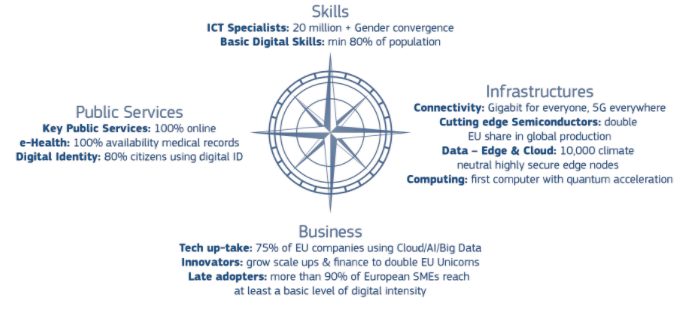
Figure 2: EU Digital Compass for the EU's digital decade
The European Commission suggests that targets around the above-mentioned areas will be set and monitored (through set targets and projected trajectories) and that the monitoring will be governed by “a robust joint framework”, which will also address insufficiencies.
3.4 The prevalent approaches to the term digital inclusion
There are many similarities between the approaches to the term digital inclusion found among the Nordic/Baltic countries and autonomous areas and those found at an international level. The most prominent feature is that all approaches include the issues of access and skills.
A focal point in the UN and the EU approach is digital exclusion consequences. The UN calls it “inequalities through a lack of access to digital infrastructure” while the EU focuses on “the social inclusion”. This emphasis on exclusion from the benefits seems to be more dominant in the Nordic countries than in the Baltic countries. Here we find a stronger focus on the connection between digital inclusion and social inclusion and the way digital skills can contribute to increasing social inclusion. However, this is an indication more than it is a significant difference.
The EU understanding of digital inclusion includes a focus on making ICT and technology more accessible and not only focusing on the user’s skills. When increasing accessibility/usability of ICT, more people can use them, which is not only contributing to increasing digital inclusion, but making the use easier for everybody. This focus on the quality of ICT, instead of the user´s capabilities, is more salient but still not dominant in the Nordic countries than in the Baltic countries.
When looking at the groups of people being vulnerable and facing the risk of digital exclusion, there is, to a large extent, agreement between the countries on which groups are relevant.
The answer to the study question concerning the definitions in the Nordic and Baltic countries and autonomous areas is that there is no common definition of the concept of digital inclusion.
Based on workshop discussion and further collection of the countries/autonomous areas' highlighted aspects of digital inclusion concerning the consequences of digital inclusion, we can present a new and improved definition. The definition is:
Digital inclusion is prevailing when all people, including the most disadvantaged and vulnerable groups, have access to, the ability to use and benefit from ICT related to public sector services.
When answering the second study question concerning approaches to digital inclusion, it is clear that the countries/autonomous areas are defining the term by explaining the barriers, the outcomes and the groups of people risking digital exclusion. The components in the approach to digital inclusion are the following:
The most highlighted barriers are:
- Lack of digital skills,
- Unwillingness due to mistrust, insecurity, low motivation, and
- Language difficulties
Some countries/autonomous areas also highlight exclusion outcomes/consequences:
- Inequality
- Social exclusion
The top 5 of groups of people risking digital exclusion highlighted by the Nordic and Baltic countries/autonomous areas are:
- The elderly,
- People with disabilities,
- People with low/no education,
- People in rural areas, and
- Immigrants

4. Monitoring digital inclusion
How is digital inclusion already monitored in the participating countries/autonomous areas and in the EU/OECD/UN? How and by whom is data collected? Are monitoring measures or results coordinated between Nordic and Baltic countries?
The first section of the chapter will focus on the current monitoring of digital inclusion in the covered countries/autonomous areas and at the international level, together with a view on the used indicators and monitoring operation. The second section of the chapter comprises the level of coordination between Nordic and Baltic countries/autonomous areas when it comes to monitoring digital inclusion.
4.1 Monitoring of digital inclusion in the Nordic-Baltic region
In general, policy monitoring of policy areas/initiatives, such as digital inclusion, is essential in effective design, implementation, and delivery of public sector results and services. Structured policy monitoring confirms the policy results and achievements based on evidence and data. Sufficient policy monitoring supports the policy cycle with:
- Supporting strategic planning and policymaking by improving the links between policy interventions and their outcomes and impact
- Enhancing accountability and providing legitimacy for the use of public funds and resources
- Promoting learning and enhancing policy efficiency and effectiveness[1]OECD. Policy Monitoring and Evaluation.
First, this section will focus on the current measurement of digital inclusion in the Nordic and Baltic countries/autonomous areas, followed by a section on international monitoring of digital inclusion.
Footnotes
- ^ OECD. Policy Monitoring and Evaluation.
4.1.1 Current monitoring in the Nordic and Baltic countries/areas
Eight countries out the 11 countries and autonomous areas of the Nordic-Baltic region are currently monitoring digital inclusion. Denmark, Estonia, Finland, Norway, and Sweden have indicated in this study that they monitor digital inclusion to some degree. Iceland, Latvia, and Lithuania have indicated in this study that they do not explicitly monitor digital inclusion. However, the three countries measure some aspects of digital inclusion and are reporting to and included in the DESI index and/or the OECD Digital Toolkit, which to some degree measure digital inclusion.
| Monitoring countries | Non-monitoring countries/areas |
| Denmark | Faroe Islands |
| Estonia | Greenland |
| Finland | Åland |
| (Iceland) | |
| (Latvia) | |
| (Lithuania) | |
| Norway | |
| Sweden | |
Note: Iceland, Latvia, and Lithuania have answered “no” in the study survey to currently monitoring digital inclusion in their country. However, the three countries are part of either the EU’s DESI index and/or the OECD Digital Toolkit. | |
The group of monitoring countries can all be characterized as being highly digitalised societies, having a strong underlying ICT infrastructure, with a complete national mobile-cellular network coverage and 90+ percent of households having Internet access.[1]ITU Statistics. Digital Development Dashboard. These countries also all have a high level of digitalised public services, or e-government services, and all seem to follow a general ‘digital-first’ principle in terms of their public services, meaning that all current services are digitalised, and new services will be established digitally.[2]Mergel, I. (2019). Digital service teams in government. Government Information Quarterly, 36(4), 101389. Similarly, most of these countries have a centralise government agency that forms policy and coordinates the government’s digital efforts, and thereby also a centralise digitalisation strategy.
All countries are far enough along in their digital maturity level to recognize that while most of the population possess the necessary digital skills and infrastructure (Internet access, smartphones, and PCs) to use digital public services, there are some groups that do not. All countries have initiated monitoring of their population, including the groups of people that have not yet started to use the Internet and digital public services (e.g., the elderly, immigrants, people with disabilities) to the same degree as the general population, and will have some idea of the level of the challenge. Characteristically, these countries will have identified specific groups, an idea of why these groups may struggle, and established a policy on how to address these groups and their problems.
Despite being similar, these countries also have different approaches and maturity levels in monitoring digital inclusion. On one hand, e.g., Denmark and Norway have a centralise, structured, and frequent approach to the monitoring, on the other hand e.g., Estonia, Finland, and Sweden have a more decentralised approach across the public administration in relation to measuring digital inclusion and not yet a comprehensive national picture of the level of digital inclusion. In some countries (Denmark and Norway), the concept of digital inclusion and its definition is formalized and monitored concretely, whereas in the other countries (Estonia, Finland, Iceland, Latvia, and Lithuania, and Sweden), digital inclusion is a recognized issue, but is not yet necessarily monitored as a comprehensive concept by the centralise digital agency. While Finland has established a ‘Finnish Digital Agency (DVV)’, the agency delegates various tasks related to digitalisation to other agencies, making the compiling of the collected data an issue. While Sweden also has an ‘Agency for Digital Government’, the specific issue of digital inclusion does not seem to be addressed by the agency solely, and is therefore dealt with by other organisations, such as the Swedish Post and Telecom Authority (PTS) and various interest organisations.
The non-monitoring countries/autonomous areas see themselves as maturing on the public sector digitalisation agenda. However, in comparison to the monitoring countries, these countries/autonomous areas see themselves as less mature in terms of public digitalisation, in general, and have not yet started institutionalising and structuring the monitoring of digital inclusion. A generalised descriptive picture of these countries and autonomous areas is that they focus on and discuss digital inclusion but have not yet systematised a comprehensive strategic and monitoring approach to digital inclusion.
The box below presents an aggregation of the most used indicators in monitoring digital inclusion in the monitoring countries.
- Access to Internet
- Internet users
- Use of digital services
- Digital skills
- Accessibility of ICT equipment and digital services
A deep dive into the monitoring indicators of the two most structured countries, Denmark and Norway, in terms of monitoring digital inclusion, is presented in the table below and show some similarities between the two countries.
| Denmark | Norway |
| Access to Internet | Access to Internet |
| Internet users | Internet users |
| Level of usage of digital post - split by people | Uptake of ICT equipment |
| The people’s knowledge of digital service support | Different levels of digital skills |
| The people’s knowledge of supporting tools for digital services | Use of digital services |
| Uptake on mandatory use of digital infrastructure | Needs and barriers to developing digital skills |
| Desires for training in digital skills |
The indicators presented in the above table are mostly centred on the barrier Digital access, which include Internet access and use together with digital service use. Less focus is given to the barriers related to Digital capabilities and the consequences of digital exclusion, which includes aspects such as digital skills and the level of exclusion – as illustrated in the previous chapter of this study.
In addition to the above-mentioned quantitative indicators in the table, countries such as Denmark and Finland have during this study mentioned networks used in the collection of qualitative information and knowledge, such as the Danish Network for Interest Organisations for Digitally Challenged Citizen Groups and the Nordic-Baltic Accessibility Network (NOBAN).
In the monitoring countries, the indicators used for measuring digital inclusion are either fully or partly agreed and coordinated across the national public administration. The initiative and responsibility for measuring given indicators can be spread among various public institutions, which can cause challenges in establishing a comprehensive national picture. As mentioned, the monitoring role in Denmark and Norway is more centralised than the other monitoring countries.
All Nordic and Baltic countries and autonomous areas, express a need for a deeper knowledge about subgroups of excluded people, e.g., the elderly and immigrants, and their group size and reason for being digitally excluded. The group of monitoring countries expresses the following indicators as additional or deeper measures to monitor digital inclusion more sufficiently:
- Barriers for digital participation (how many and who experience which barriers)
- Knowledge about excluded subgroups
- Usability of ICT hardware, apps, and websites
In addition to the above relevant indicators for monitoring digital inclusion, several of the monitoring countries have also mentioned measuring the quality of the provided public digital services in providing a picture of the digital inclusion. Low digital service quality would naturally have a negative impact on digital inclusion, just as a high-quality digital service would support a higher level of digital inclusion.
The next section will focus on monitoring of digital inclusion at international level.
4.1.2 Current international monitoring of digital inclusion
European Union (EU)
With regards to the EU’s latest Digital Decade policy strategy, the European Commission envisages setting up a Digital Compass to translate the EU’s digital ambitions for 2030 into concrete targets and to ensure that these objectives will be met, including insights on the EU’s digital vulnerabilities and capacities.[1]European Commission (2021). The Digital Compass. The planned Compass is to become an extension of the current Digital Economy and Society Index (DESI), which is the main monitoring tool on digitalisation (since 2014).
The current DESI measuring connectivity, integration of digital technology, digital public services, and human capital is to be enhanced along the lines of the four main points of the Digital Decade policy strategy 1) digital capacities in infrastructures, 2) education & skills, 3) digital transformation of business, and 4) public services. The monitoring tool will include dedicated resilience dashboards, including one for the digital dimension, which will provide complementary insights on EU’s digital vulnerabilities and capacities. [2]European Commission (2021). The Digital Compass.
The DESI is a composite index that summarises relevant indicators on Europe’s digital performance and tracks the evolution of EU Member States, across four main dimensions: Connectivity, Integration of Digital Technology, Digital Public Services, and Human Capital. The dimensions include a set of sub-indicators and individual indicators. The below table contains the DESI dimensions and the DESI sub-indicators.
| DESI dimensions | DESI sub-indicators |
| Connectivity | Fixed broadband take-up |
| Fixed broadband coverage | |
| Mobile broadband | |
| Broadband price index | |
| Integration of Digital Technology | Digital intensity |
| Digital technologies for businesses | |
| e-Commerce | |
| Digital Public Services | e-Government |
| Human Capital | Internet User Skills |
| Advanced Skills and Development |
Comparing the above-mentioned dimensions of the DESI index with the digital barriers for digital inclusion presented in the previous chapter of this study report, which illustrate the key elements of digital inclusion, it becomes clear that the DESI mostly include data on the barrier Digital access (connectivity and digital public services), and to a lesser degree on the barrier Digital capability. The DESI does not include data on Digital consequences of digital exclusion. This is further supported by the interviewees from the DG CNECT, DG EMPL working with DESI.
In addition to the DESI, the European Commission runs two other datasets at the EU level, related to digitalisation:
- Key Indicators: European Commission services several selected indicators, divided into thematic groups, which illustrate some key dimensions of the European information society (Telecom sector, Broadband, Mobile, Internet usage, Internet services, eGovernment, eCommerce, eBusiness, ICT Skills, Research and Development). These indicators allow a comparison of progress across European countries, as well as over time. Multiple interactive charts enable assessing countries' profiles.[1]European Commission. Data Visualisation Tool – Data & Indicators.
- e-Government Benchmark: The e-Government Benchmark framework corresponds with the key policy priorities in the e-government Action Plan and the Tallinn Declaration and brings insights on the state-of play of e-government in Europe. The measurement evaluates the maturity of online public services in terms of User centricity, Transparency, and use of Key enablers. It also brings the dimension of Cross-border service delivery, which is a truly European metric. Various indicators allow the comparison over time and across countries. The list of countries currently includes the European Union Member States, Iceland, Norway, Montenegro, Republic of Serbia, Switzerland, Turkey as well as Albania and North Macedonia.[2]Ibid.
Despite the focus on social and digital inclusion in various policies and strategies at the EU level, as well at the above-mentioned comprehensive and detailed monitoring schemes related to digitalisation, the EU datasets or monitoring schemes do not include an explicit, comprehensive, and predefined monitoring on digital inclusion. However, it would presumably be an option to select among the current indicators and datasets on digitalisation and create a relevant dataset to support monitoring some aspect of digital inclusion.
OECD
The OECD also monitors data related to digital societies on an ongoing basis. The Going Digital Toolkit helps countries assess their state of digital development and formulate policies in response. Data exploration and visualisation are key features of comprehensive datasets on digital societies included in the Toolkit.[1]OECD. Going Digital Toolkit. The Going Digital Toolkit is structured along seven policy dimensions of the OECD Going Digital Integrated Policy Framework, which cuts across policy areas to help ensure a whole-of-economy and society approach to realising the promises of digital transformation for all.
The seven policy dimensions of the Going Digital Toolkit, including related indicators are listed in the table below.
Footnotes
- ^ OECD. Going Digital Toolkit.
| Policy dimensions | Going Digital Toolkit indicators |
| Access | |
| Access to communications infrastructures, services and data underpin digital transformation and become more critical as more people and devices go online |
|
| Use | |
| The power and potential of digital technologies and data for people, firms and governments depends on their effective use. |
|
| Innovation | |
| Innovation pushes out the frontier of what is possible in the digital age, driving job creation, productivity, and sustainable growth. |
|
| Jobs | |
| As labour markets evolve, we must ensure that digital transformation leads to more and better jobs and to facilitate just transitions from one job to the next. |
|
| Society | |
| Digital technologies affect society in complex and interrelated ways, and all stakeholders must work together to balance benefits and risks. |
|
| Trust | |
| Trust in digital environments is essential; without it, an important source of economic and social progress will be left unexploited. |
|
| Market openness | |
| Digital technologies change the way firms compete, trade, and invest; market openness creates an enabling environment for digital transformation to flourish. |
|
In addition to the Going Digital Toolkit scheme, the OECD monitor the area of ICT and broadband comprehensively. There are 21 individual indicators for the area of ICT, which are drawn from various publications and databases produced by the OECD.[1]OECD. Key ICT Indicators. In addition to the ICT related ones, the OECD collects data on approximately 31 broadband statistical variables.[2]OECD. Broadband Portal.
| ICT | Broadband |
| Penetration and data usage | |
| 1. Access lines and access paths in total / per 100 inhabitants for OECD | 1. Total fixed and mobile broadband subscriptions by country |
| 2. Mobile subscriptions in total / per 100 inhabitants for OECD | 2. Fixed and mobile broadband subscriptions per 100 inhabitants |
| 3. Trends in telecommunication revenue, investment, and access paths | 3. Fixed and mobile broadband subscriptions by technology |
| 4. Broadband subscriptions per 100 inhabitants in OECD countries | 4. Yearly penetration increase |
| 5. Percentage of fibre connections in total broadband | 5. Historical time series, fixed and mobile broadband penetration |
| 6. Households with broadband connections, urban and rural | 6. Historical penetration rates, fixed and mobile broadband, top 5 |
| 7. Enterprises’ broadband connectivity, by firm size | 7. Historical penetration rates, fixed and mobile broadband, G7 |
| 8. Small and medium enterprises with broadband access, fixed or mobile | 8. Five largest OECD fixed and mobile broadband markets |
| 9. Employment of ICT specialists across the economy, as share of total employment, by category | 9. Broadband penetration and GDP |
| 10. Employment in the ICT sector and sub-sectors | 10. Percentage of fibre connections in total broadband |
| 11. Growth of employment in the ICT sector and its sub-sectors in the OECD area | 11. Growth of fibre subscriptions |
| 12. Telecommunication services revenue in total for OECD | 12. Machine to machine subscriptions |
| 13. Telecommunication infrastructure investment in total for OECD | 13. Mobile data usage per mobile broadband subscription |
| 14. Value added of ICT sector and sub-sectors | 14. Top six countries in mobile data usage per mobile broadband subscription |
| Speeds | |
| 15. ICT and total business expenditure on R&D intensities | 15. Fixed broadband subscriptions per 100 inhabitants, per speed tiers |
| 16. Specialisation in ICT-related patents, 2012-15 | 16. Fixed broadband experienced download speed |
| Household and business usage | |
| 17. International co-inventions in ICT, 2012-15 | 17. Enterprises’ broadband connectivity, by firm size |
| 18. ICT goods and services in manufacturing exports, by economy or region of value-added origin | 18. Enterprises with a website or home page, by firm size |
| 19. Changes in wages relative to labour productivity, 2001-16 | 19. Diffusion of selected ICT tools and activities in enterprises |
| 20. ICT investment by capital asset, as a percentage of GDP | 20. Use of enterprise resource planning software, by firm size |
| 21. Evolution of ICT investments, as a percentage of total investments | 21. Enterprises using cloud computing services, by firm size |
| 22. Enterprises performing big data analysis | |
| 23. Total number of industrial robots operational worldwide | |
| 24. Top ten industries for share of industrial robots in use | |
| 25. Internet users by age | |
| 26. Internet users by age and educational attainment | |
| 27. Diffusion of selected online activities among Internet users | |
| 28. Diffusion of online purchases | |
| 29. Use of cloud computing by individuals in selected OECD countries by age class | |
| 30. Individuals who attended an online course | |
| 31. Individuals using e-government services |
As for the EU perspective, the OECD datasets or monitoring schemes do not include an explicit, comprehensive, and predefined monitoring on digital inclusion, despite the OECD focus in these areas. Again, it would presumably be an option to select among the current indicators and datasets on digitalisation and create a relevant dataset to support some aspects of monitoring digital inclusion.
United Nations
The UN has no explicit monitoring of digital inclusion. However, it does have an annual national ranking of e-governments, meaning how digital the 193 UN member state governments are, which it scores using the E-Government Development Index (EDGI). In their explanation of the survey’s function, the UN states that it “supports countries’ efforts to provide effective, accountable and inclusive digital services to all and to bridge the digital divide and leave no one behind.[1]United Nations (2020). 2020 United Nations E-Government Survey. This explanation highlights that the notion of digital inclusion, or digital divide, is a concept that the UN considers to be relevant, both on a national and an international level. The most recent of these reports is the United Nations E-Government Survey 2020.
Footnotes
- ^ United Nations (2020). 2020 United Nations E-Government Survey.
Figure 3: EDGI component indicators
Source: UN E-Government Survey 2020.
The three components are:
Online Service Index
Assesses the various national public services websites, such as the national e-services portal, and the websites of related applicable ministries (i.e., ministries of education, labour, social services, etc.
Telecommunication Infrastructure Index
Consists of four indicators:
- estimated Internet-use per 100 inhabitants;
- number of mobile subscribers per 100 inhabitants;
- active mobile-broadband subscriptions; and
- number of fixed broadband subscriptions per 100 inhabitants.
Human Capital Index
Consists of four components:
- adult literacy rate;
- the combined primary, secondary and tertiary gross enrolment ratio;
- expected years of schooling; and
- average years of schooling.
In addition to the UN E-Government Survey, the UN commissioned a report on digital inclusion in 2020 from the Digital Future Society titled Measuring the Margins: A global framework for digital inclusion. In addition to multiple recommendations for future measurements of digital inclusion, the report also proposes several dimensions and indicators that can be used in “local contexts” (whether regional, national, etc.) for the monitoring of digital inclusion.
| Dimensions | Indicator clusters | Layer 1 indicators | Layer 2 indicators |
| Access to electricity | |||
| Access to telephony | |||
| Access | Access to device | 12 | 14 |
| Access to internet | |||
| Quality of connectivity | |||
| Point of access |
Figure 4: Four key dimensions of a global framework for digital inclusion.
Source: Measuring the Margins: A global framework for digital inclusion, p. 25.
| Dimensions | Indicator clusters | Layer 1 indicators | Layer 2 indicators |
| Adult literacy | |||
| Skills | Academic life expectancy | 12 | 21 |
| Digital skills |
| Use internet | |||
| Basic activities | |||
| Use eCommerce | |||
| Use | Use ebanking | 8 | 16 |
| Use eGovernment | |||
| eWork/entrepreneurship | |||
| Social media | |||
| eParticipation |
| Affordability | |||
| Legally valid identification | |||
| Supportive environment | Banking and financial inclusion | 11 | 29 |
| Trust | |||
| Security |
As for the EU and OECD perspective, the UN datasets or monitoring schemes do not yet include an explicit, comprehensive, and predefined monitoring on digital inclusion – and it would presumably be an option to select among the current indicators and datasets on digitalisation and create a relevant dataset to support some aspects of monitoring digital inclusion.
4.1.3 Operation of the national and international monitoring
This section provides a picture of who is operating the monitoring and with which frequency the datasets are collected at national and international level.
National level – Nordic and Baltic countries/autonomous areas
The below table includes an overview of the operating institution that is responsible for the collection of monitoring data and the frequency of the collection, structured by monitoring country.
| Monitoring country | Operating institution | Frequency |
| Denmark | Agency for Digitisation and National statistics authority | Quarterly or annually (Vary from indicator) |
| Estonia | Statistics Estonia, Ministry of Economic Affairs and Communications | Annually |
| Finland | Digital inclusion matters are currently developed especially by the Ministry of Finance and the Ministry of Social Affairs and Health. | (First survey specifically on digital inclusion launched – expected in December 2021) Vary from indicator, some frequently some every few year |
| Norway | Statistics Norway, Norwegian Directorate for Higher Education and Skills, Norwegian Digitalisation Agency, and industry organisation Finance Norway. | Annually or some every 2 to 3 year (vary from indicator) |
| Sweden | Post and telecom authority (Internetstiftelsen, Begripsam) | Annually (Depending on their financing) |
Iceland, Latvia, and Lithuania – as well as the other EU member states and OECD countries – provide information to the European Commission’s statistic office, Eurostat, which assemble and create the DESI as well as to the OECD, which creates the Digital Toolkit.
International level
EU: Data collected for the European Commission’s DESI, the Key Indicators, and the e-Government Benchmark is published in a series of annual reports that cover thematic topics, national level member state reports, and a dedicated website. There is also an international report that benchmarks the EU member states to other major world economies.[1] European Commission (2020). I-DESI 2020: How digital is Europe compared to other major world economies? The majority of the data is collected by the European Commission’s statistical agency – Eurostat and updated annually.
OECD: The OECD Digital Toolkit is produced by the OECD’s Directorate for Science, Technology, and Innovation. These are updated annually or on a rolling basis, as data become available. The data are supplied by the member countries’ governments and fed into various publications covering digital topics. OECD data are also used for various other ad-hoc international and regional analyses related to digital topics.
UN: The E-Government Development Index (EDGI) is updated annually for the 193 UN member states and fed into various publications covering digital topics. The most recent of these reports is the United Nations E-Government Survey 2020.
Footnotes
- ^ European Commission (2020). I-DESI 2020: How digital is Europe compared to other major world economies?
The monitoring countries collect the information on digital inclusion in a different frequency ranging from quarterly to every 2nd or 3rd year. Also, it is a mixed picture when it comes to the responsible institutions for the data collection. In some countries/autonomous areas, it is a single organisation that has the responsibility, and in other countries/ autonomous areas it is the responsibility of various organisations. All EU member states, OECD countries, and UN countries in the Nordic-Baltic region provide data to the annual update of the DESI index, the Digital Toolkit and the EDGI, respectively. Both the European Commission, the OECD, and the UN update their international databases annually.
4.1.4 Coordination of monitoring between the Nordic and Baltic countries/autonomous areas
This section includes a view on the level of coordination related to the monitoring of digital inclusion between the Nordic and Baltics region, together with a view on the knowledge of international monitoring in the region.
In the study survey, one country – out of the 10 countries and autonomous areas that have answered the survey – has answered that they have knowledge of coordination with regards to one aspect of digital inclusion across Nordic and Baltic countries. Finland is the only country to point out an example of cross-national coordination within the area of digital inclusion, which is the previously mentioned Nordic-Baltic Accessibility Network (NOBAN). The NOBAN network is a network consisting of the Nordic and Baltic monitoring authorities that monitor the WAD (Web Accessibility Directive). All monitoring is done according to the WAD and EU guidelines. The network shares experiences, methods, and best practices.
The initiative for creating the network came as a response to the EU’s directive on web accessibility from 2019, in which the Nordic and Baltic countries are participating. The network has received funding from the Nordic Council of Ministers’ secretariat for administrative support. It should be noted that this network exclusively focuses on accessibility and the implementation of the related EU directive, and therefore not on digital inclusion as such.
The coordination related to the monitoring of digital inclusion between the Nordic and Baltics countries and autonomous areas is limited and confined to a specific topic (web accessibility).
With regards to work and coordination related to monitoring digitalisation and digital inclusion at the international level, all countries and areas included in this study mentioned and have knowledge of the European Commission’s Digital Economy and Society Index (DESI). Most of the countries and areas also regard the DESI as the most comprehensive data sample on digitalisation in the EU, which can provide some facts related to digital inclusion. However, the DESI is not directly measuring digital inclusion. Few countries/autonomous areas mention the OECD’s Going Digital Toolkit as another dataset measuring public digitalisation and, again, including related facts about digital inclusion without providing a complete picture of digital inclusion.

5. Snapshot of digital inclusion
Based on the existing data gathered, what is the state of digital inclusion? How does this look in comparison to the EU, or globally? What are the characteristic traits (e.g., strengths and weaknesses) of the Nordic-Baltic region regarding digital inclusion? Do these existing indicators provide sufficient information on digital divides to improve and develop policy measures?
The first section of the chapter will focus on the state of digital inclusion in Nordic-Baltic region, together with the comparison with the international level. The second section will include an examination of the strengths and weaknesses in the Nordic-Baltic region in relation to digital inclusion. The third and final section will contain a look at the current information on the ability of digital inclusion to support policy making in the area.
5.1 State of digital inclusion
The importance of focusing on increasing digital inclusion and the eradication of existing inequalities is widely accepted by governments and international organisations across the globe and – if not directly, then indirectly in the UN Sustainable Development Goals (SDGs), as well as in the EU strategy and policies related to digitalisation – Shaping Europe’s digital future.[1]Digital Future Society (2020). Measuring the Margins: A Global Framework for Digital Inclusion.,[2]European Commission. Digital inclusion.
A successful digital transformation in the Nordic-Baltic region is essential to ensure a successful future for the region. A high-speed digital transformation of societies includes a risk of leaving groups of people behind and digitally excluded. Therefore, knowledge gathering and policy actions on digital inclusion are important on the digital journey.
To have the possibility to intervene at either a national or international level, it is of utmost importance to both have a clear definition of digital inclusion, and monitoring schemes in place, as dealt with in the two previous chapters of this study. However, it is perhaps equally or more important to have knowledge about the baseline related to the state of digital inclusion in the covered region, countries, and autonomous areas. Therefore, the overview of the state of digital inclusion in this section is essential for any future national or international policy initiative and policymaking in digital inclusion.
5.1.1 Snapshot of digital inclusion in the Nordic and Baltic countries and autonomous areas
Monitoring digital inclusion requires a variety of component indicators, as previous chapters of this study have shown. In this way a broader perspective of the state of digital inclusion can be established. The purpose of this section is to examine the overall state of digital inclusion in the Nordic-Baltic region and the broader differences between the various countries and autonomous areas in the region. To do so, several data sources from the study’s data collection and existing indicators will be examined to establish a general picture of the state of digital inclusion in the Nordic-Baltic region. As described in the previous chapters, all Nordic and Baltic countries and autonomous areas face difficulties estimating exactly the size of the group at risk of being digitally excluded and facing difficulties giving an exact picture of their challenges. Therefore, it is challenging to provide an exact snapshot of the situation in the countries and autonomous areas, as the data and knowledge is not present. Though the available information might not provide a complete and exact picture of the state of digital inclusion on their own in the Nordic-Baltic region, they can be used for an estimated baseline to begin to assess the broader state of digital inclusion.
In the study’s e-survey to the national authority representatives, 10 out of the 11 countries have expressed challenges related to the potential digital excluded group of people on a scale from ‘minor group with few challenges’ to ‘large group with significant challenges. See the illustration.
| Minor group
Few challenges | 1 | ||
| 2 | Denmark, Estonia, Finland, Faroe Islands, Iceland, Latvia, Norway | ||
| ↓ | 3 | Lithuania | |
| 4 | Sweden | ||
| Large group
Significant challenges | 5 | Greenland |
This assessment, illustrated above, of the challenged group of people by the countries and autonomous areas shows a pattern in most of the countries, estimating the digitally excluded group as being smaller and with few challenges. The two geographically large countries, Greenland and Sweden, assess a larger group of digitally challenged people.
In relation to the above-mentioned assessment, more countries mention that the challenges the vulnerable groups face should be taken seriously, and measures should be developed systematically, regardless of the size of the group of people, statistically speaking. This is seen as a political and cultural value in the Nordic-Baltic region and means that no one should be left behind in the digital transformation of our societies and that all should be able to use digital public services in their every-day lives. People who belong to a group at risk of social exclusion are simultaneously also at risk of digital exclusion, and some of the countries also described the risk inverse: Digital exclusion can lead to social exclusion.
Following the above perspective on the size of the potential group of digital excluded people, it is relevant to split this overall group into the specific groups of challenged people, as well as looking into the specific digital challenges of the excluded groups. As also mentioned in chapter 3 focusing on the definition and approach to digital inclusion, the study shows that the groups of people that are at risk of digital exclusion in the Nordic-Baltic region are:
- Elderly people
- Young people
- People with disabilities
- Immigrants
- People with low or no education
- People living in rural areas
- People from socially marginalized groups (low income, homeless, addicts, prisoners etc.)
In the data collection of the study, there is a clear pattern in the region stating elderly people, people with disabilities, immigrants, and people with low/no education as the most vulnerable groups of people for digital exclusion. Nearly all countries and autonomous areas indicate that there is a need for a better understanding of the groups of vulnerable/digitally excluded people.
In chapter 3, which focuses on the definition and approach to digital inclusion, we illustrated a framework for viewing digital inclusion that separates digital inclusion into two barriers for digital inclusion 1) Digital access and 2) Digital capability, that can cause digital inclusion consequences. In the table below, the most common reasons for being digitally excluded in the Nordic-Baltic region is listed, structured by the two above-mentioned barriers and their consequences.
Digital access barriers:
- Access to Internet
- Access to a digital device
- Usability; making ICT more accessible for all
Digital capability barriers:
- Digital skills
- Literacy
- Language difficulties (immigrants etc.)
- Lack of “domain knowledge” (do not know the public sector and where to find the right self-service solution and/or do not understand the “public language”)
- Unwillingness e.g., because of mistrust, feeling uncertain or anxious, etc.
Digital exclusion consequences:
- Inequality (e.g. not getting information, troubles with applying for and receiving public services e.g. social benefits)
- Social exclusion
The above-mentioned reasons for digital exclusion are identified in our data collection and identified by the Nordic and Baltic countries and autonomous areas as being the barriers for people´s digital participation of the society. Approximately one-third of the countries and autonomous areas highlight exclusion from digital access as a participating barrier. Almost all the countries/autonomous areas highlight issues concerning digital capability as reasons for digital exclusion.
5.1.2 Comparison with international level
In addition to the information above, related to the state of play on digital inclusion in the Nordic-Baltic region, the EU’s DESI index is a relevant supplementary data source. As mentioned in chapter 4 focusing on monitoring, the DESI index is not measuring digital inclusion explicitly. However, the DESI index includes some relevant information on two digital barriers: Digital access and Digital capability, which was concluded above as the main reasons for digital inclusion in the Nordic and Baltic countries and autonomous areas. This data is at aggregate level by EU member states and Norway, and are not detailed on sub-groups, as rated relevant by the countries in this study.
Translating the two digital barriers: Digital access and Digital capability into DESI terms would mean matching the digital barrier, Digital access with the DESI dimension, Connectivity. In the same way it means matching the digital barrier, Digital capabilities with the DESI dimensions, Digital Public Services and Human Digital Capital. This is presented in the table below.
| Digital barrier / DESI index | Digital Access | Digital Capabilities | DESI Total | |
| Connectivity | Digital Public Services | Human Digital Capital | ||
| Denmark | 74.1 | 87.1 | 61.2 | 70.1 |
| Finland | 51.3 | 86.7 | 71.1 | 67.1 |
| Sweden | 59.6 | 83.9 | 64.6 | 66.1 |
| Norway | 56.7 | 80.0 | 64.4 | 63.2 |
| Estonia | 46.6 | 91.8 | 57.9 | 59.4 |
| Lithuania | 41.8 | 78.0 | 46.1 | 51.8 |
| Latvia | 50.4 | 79.6 | 41.1 | 49.5 |
| Greenland | - | - | - | - |
| Iceland | - | - | - | - |
| The Faroe Islands | - | - | - | - |
| Åland | - | - | - | - |
| EU | 50.2 | 68.1 | 47.1 | 50.7 |
Table 1: EU snapshot of digital inclusion in the Nordic-Baltic region (2021-period)
The table illustrates that four EU member states (Denmark, Estonia, Finland, and Sweden) and Norway are well above the EU average, and that Latvia and Lithuania are at the EU average. In fact, Denmark, Finland, and Sweden are the three top rated EU member states in the DESI index and Estonia is number six. Four of the Nordic-Baltic countries/areas (Greenland, Iceland, The Faroe Islands, Åland) are not covered by the DESI.
Though there are some identifiable differences between the Nordic and Baltic countries included in the DESI index, they can all be characterized as being highly digitalised. In terms of infrastructure or connectivity, Table 1 highlights scores well above the EU average for five out of the seven countries – and the others at level with the EU average. All seven countries have a high level of digitalised public services, or e-government services, and all seem to follow a general ‘digital-first’ principle in terms of their public services.
The countries included in the DESI index also all have a fairly centralise government agency that forms policy and coordinates the government’s digital efforts, and thereby also a centralise digitalisation strategy. These commonalities indicate that these seven countries are at an advanced and comparable stage related to digital maturity.
A similar data view (to the DESI overview) can be conducted based on the OECD’s Digital Toolkit as presented in Chapter 4, focusing on monitoring. The Digital Toolkit parameters have a strong focus on Digital access and use (or capability), among other things. In this way, the OECD’s Digital Toolkit encapsulates both the access and capability barriers to digital inclusion. The issue with the data is that several other indicators are needed within both the access and the capability barriers to get a more complete picture of digital inclusion in these countries. The OECD Digital Toolkit data for 8 of the 11 countries and areas covered in this study are presented in two tables below for the Access barrier and the Capability barrier, respectively.
| Digital barrier/Digital Toolkit | Digital Access | |
| Share of households with broadband connections % | Urban-rural broadband divide | |
| Denmark | 93 | 4.26 |
| Estonia | 89 | 2.23 |
| Finland | 95 | 3.94 |
| Iceland | 97 | - 0.74 |
| Latvia | 88 | 3.25 |
| Lithuania | 82 | 9.76 |
| Norway | 96 | 8.56 |
| Sweden | 91 | 7.8 |
| Greenland | - | - |
| The Faroe Islands | - | - |
| Åland | - | - |
Table 2: OECD snapshot of access barriers in the Nordic-Baltic region
| Digital barrier / Digital Toolkit | Digital Capability | ||||
| Internet users as a share of individuals % | Share of individuals using the internet to interact with public authorities % | Percentage of individuals aged 55–74 using the Internet % | Percentage of low-income Internet users % | Top-performing students in science, mathematics and reading % | |
| Denmark | 98.7 | 90.7 | 96.5 | 94.7 | 15.8 |
| Estonia | 89.1 | 80.3 | 70.8 | 66.5 | 22.5 |
| Finland | 97 | 88.2 | 92.2 | 95.4 | 21 |
| Iceland | 99.5 | 93.7 | 98.7 | 96.6 | 13.6 |
| Latvia | 88.9 | 76.3 | 74.2 | 73.8 | 11.3 |
| Lithuania | 83.1 | 57.7 | 60 | 59.3 | 11.2 |
| Norway | 97.6 | 91.9 | 92.6 | 94.4 | 17.8 |
| Sweden | 97.1 | 85.7 | 94.1 | 89.8 | 19.4 |
| Greenland | - | - | - | - | - |
| The Faroe Islands | - | - | - | - | - |
| Åland | - | - | - | - | - |
Table 3: OECD snapshot of capability barriers in the Nordic-Baltic region
As shown in the tables above, the OECD Digital Toolkit includes data that is highly comparable to the DESI. Their data on Digital access (or ‘Connectivity’ in the DESI), is based on similar indicators, that being predominantly statistics such as broadband and 4G coverage. Neither the OECD’s nor the EU’s indicators on access cover the issue of devices (i.e., phones, tablets, and computers). In this sense, the word ‘connectivity’ is perhaps more accurate to describe their indicators than ‘access’ is. For the indicators related to the capability barrier (largely encapsulating the idea of ‘digital skills’), the DESI groups these in their ‘Human capital’ area, which includes indicators on the level of digital skills and the number of ICT specialists. The OECD Digital Toolkit has no concrete capability or skills parameter, but has a number of different indicators (shown in the table above) that encapsulate various aspects of a population’s level of digital skills, including between various segments or groups in the population.
As the EU’s DESI and the OECD’s Digital Toolkit, the UN tracks several different indicators in relation to national digitalisation in its E-Government Development Index (EDGI), or what it calls a “leading benchmarking reference on e-government”.[1]UN (2020). E-Government Survey 2020, p. xix The EDGI is a composite index, composed of three smaller indices: the Telecommunications Infrastructure Index (TII), the Human Capital Index (HCI) and the Online Service Index (OSI). As the TII consists of indicators such as broadband and mobile subscriptions, it can be compared to the ‘Access’ or ‘Connectivity’ indicators from the DESI and the Digital Toolkit seen above. Likewise, the HCI is an index for the general capabilities of a population, looking at the adult literacy rate and the average years of schooling, comparable to the ‘Human Capital’ parameters of the DESI. Lastly, the OSI assesses the various national public services websites, such as the national e-services portal, and the websites of related applicable ministries (i.e., ministries of education, labour, social services, etc.). These indices and the overall EDGI rankings for the Nordic-Baltic countries are shown below in Table 4.
Footnotes
- ^ UN (2020). E-Government Survey 2020, p. xix
| Digital divide / UN EDGI 2020 | EDGI Rank | OSI VALUE | HCI VALUE | TII VALUE | EDGI (2020) |
| Denmark | 1 | 0.9706 | 0.9588 | 0.9979 | 0.9758 |
| Finland | 4 | 0.9706 | 0.9549 | 0.9101 | 0.9452 |
| Sweden | 6 | 0.9000 | 0.9471 | 0.9625 | 0.9365 |
| Norway | 13 | 0.8765 | 0.9392 | 0.9034 | 0.9064 |
| Iceland | 12 | 0.7941 | 0.9525 | 0.9838 | 0.9101 |
| Estonia | 3 | 0.9941 | 0.9266 | 0.9212 | 0.9473 |
| Lithuania | 20 | 0.8529 | 0.9218 | 0.8249 | 0.8665 |
| Latvia | 49 | 0.5824 | 0.9172 | 0.8399 | 0.7798 |
| Greenland | - | - | - | - | - |
| The Faroe Islands | - | - | - | - | - |
| Åland | - | - | - | - | - |
Table 4: UN snapshot of digital inclusion in the Nordic-Baltic region 2020
Another relevant comparison is an assessment between what the countries and areas in the Nordic-Baltic region indicate as relevant indicators to measure the level of digital inclusion and what is included in the three international databases (DESI index, the OECD Digital Toolkit, and the UN EDGI). This is illustrated in the table below.
| Relevant indicators | Included in DESI | Included in OECD Digital Toolkit | Included in UN EDGI |
| Digital access | |||
| Access to Internet | X | X | X |
| Access to a digital device | - | - | - |
| Usability | - | - | X |
| Digital capability | |||
| Digital skills | X | X | - |
| Literacy | - | - | X |
| Language difficulties | - | - | |
| Lack of “domain knowledge” | - | - | |
| Unwillingness | - | - | |
| Digital outcome | - | - | |
| Inequality | - | - | |
| Social exclusion | - | - |
The table above shows that the three international databases provide a limited picture when it comes to measuring digital inclusion, as the term digital inclusion is defined and discussed in this study. The access barrier is generally well covered by the international databases. The capability barrier is vaguely covered, and the consequence of digital exclusion is not covered by the international databases at all.
In addition to the lack of coverage in relation to relevant measures of digital inclusion, it is also relevant to mention that the databases do not include detailed data on the challenged groups of people, e.g., the elderly, immigrants, etc. This is a detailed level that the countries and autonomous areas of the Nordic-Baltic region consider to be utmost relevant.
Thus, the measurement of digital inclusion in the Nordic-Baltic region is challenged by a lack of indicators, both in terms of coverage and illumination of the digital barriers and the more detailed level. However, based on a combination of data collected in this study and the three international databases, an indication of the overall picture of digital inclusion can be established.
All countries and autonomous areas in the Nordic-Baltic region state that a digital divide is present. Despite the challenge related to measuring digital inclusion, due to a lack of indicators/data, the data collection of this study indicates that the digitally challenged group of Nordic and Baltic people is limited to a minor part of the population(s) – however, some differences are present between countries/autonomous areas. The countries and autonomous areas agree on the specification of the digitally challenged sub-groups, e.g., the elderly, people with disabilities, and people living in rural areas.
Comparing the level of digital inclusion between the Nordic-Baltic region and the EU is relevant. The above Table 1 presents the average EU/DESI score on the digital barriers: Digital access and Digital capability. This shows that 5 out of the 7 EU member states and Norway in the Nordic-Baltic region are well above the EU average. In fact, these 5 countries are in the top-6 of the entire EU. The two other countries are at level with the EU-average. It should be noted that this comparison is mainly focused on the barrier Digital access, and to a smaller degree on Digital capability – and not on the consequences of digital exclusion.
In comparison with the other EU countries, the Nordic-Baltic region is at the EU-average, or above, when it comes to the limited aspects of digital inclusion measured in the DESI, this being connectivity, digital public services, and human digital capital. A similar picture is seen in the OECD and UN databases.
5.2 Characteristic traits in the Nordic and Baltic countries
This section will provide a brief overview of the characteristics of digital inclusion in the Nordic-Baltic region structured by strengths and weaknesses.
Digital inclusion is present in the Nordic-Baltic region and the countries and autonomous areas in the region. This is a result of increasingly maturing digital societies where the potential flipside is digital divide. The study data indicates that the higher maturity level of the public sector digitalisation in the countries/autonomous areas, the more focus the term, digital inclusion and support is given. A related presumption is that in the digitally advanced societies the consequences of digital exclusion are more serious, especially in cases with mandatory digital solutions, as seen for example in Denmark.
Thus, there is a clear pattern in the study’s qualitative data that shows that the most digitally matured countries and autonomous areas are forced to initiate policy and monitoring of digital inclusion, because of their high level of digital maturity, in general. The study also shows that the less digitally matured countries and autonomous areas do discuss digital inclusion and prioritise to collect knowledge on other countries’ policy initiatives on digital inclusion. However, these countries and autonomous areas are not as advanced in defining, intervening, and monitoring digital inclusion.
The strengths of the Nordic-Baltic region related to digital inclusion are:
- In the above DESI data, it is illustrated that the EU member states of the Nordic-Baltic region are characterised by:
- a high level of connectivity and Internet access;
- usage;
- an advanced infrastructure and usability regarding public sector services; and
- a highly skilled ICT population.
- The Nordic-Baltic region and its population is also characterised by:
- A high education level (for most societies), welfare services and solid economic structures.
- In general, the Nordic and Baltic countries and autonomous areas have strong attention and focus on digital inclusion, despite differences in digitalisation levels and maturity related to digital inclusion policies and measures.
- The Nordic Council of Ministers has increased its focus on public sector digitalisation in recent years, including focus on inequality and digital inclusion.
The weaknesses of the Nordic-Baltic region related to digital inclusion are:
- The Nordic-Baltic region is characterised by several geographically large countries with thinly populated areas. Naturally, digitalisation of public services is a support to rural areas. However, connectivity, as well as general society exclusion, can present issues in these rural areas.
- Lack of sufficient knowledge about digital inclusion related to Digital capabilities and Digital exclusion consequences.
- Lack of sufficient knowledge of the size of digitally excluded sub-groups, e.g., elderly, immigrants, and people with disabilities.
- Even though the Nordic-Baltic region includes mostly highly digitalised societies, the region is also characterised by some lack of definitions of digital inclusion and relevant indicators and data for monitoring digital inclusion both at an area, national, and regional level.
- Lack of coordination and knowledge sharing across the Nordic-Baltic region in the field of digital inclusion, even though the region is relatively coordinated in other policy areas and includes some of the most digitalised and welfare strong nations and societies in the world.
The Nordic-Baltic region is positively characterised by effective connectivity, and a highly digitalised and ICT-skilled population. In addition, the region is characterised by countries and areas with strong education levels (for most societies), welfare systems, and economic structures. On the opposite side, the region is characterised by large rural areas, lack of knowledge, definitions, indicators, and data to sufficiently monitor digital inclusion. Moreover, a lack of cross-border knowledge sharing, and coordination is present.
5.3 Current monitoring as a foundation for policy making
This section focuses on the level of sufficiency in the current indicators across the Nordic-Baltic region.
The general picture is that the knowledge level related to digital inclusion in the region can be improved to achieve a stronger foundation for generating policy in the area. This being at an area, national, and/or regional level.
The following knowledge and indicators are needed to support policy making and initiatives in digital inclusion:
- Usage and quality of digital service solutions;
- Knowledge and indicators on Digital capabilities and Digital exclusion consequences; and
- A nuanced picture of the size and reasons for potential sub-groups being digitally excluded
When asked, the country representatives argue that the current indicators are not sufficient to cover the full picture of what they perceive to be contained in the concept of digital inclusion.
The countries mention several unilluminated aspects of digital inclusion, such as better data on vulnerable groups, lack of “domain knowledge” (lack of knowledge of the public sector and where to find the right self-service solution and/or do not understand the “public sector language”), unwillingness e.g., because of mistrust, feeling insecure, etc.
In addition, several countries highlight that there is a special need to nuance the approach to digital inclusion itself. For example, Denmark and Norway argue that there should to a lesser extent be focus on the groups of people as "those who are digital" and "those who are not digital". The argument is to not divide the population into these two "simplified" groups, but to nuance the picture and look more at which groups of people have challenges and with which tasks. The idea is that, as an elderly person, for example, it can be easy to use some types of digital communication, while other digital disciplines are difficult, and that the quality and user-friendliness of the digital solutions that the public sector offers the people is crucial. These aspects – about the complexity of people’s abilities and limitations – are not included in the existing indicators in the Nordic and Baltic countries, and the image that can be created with the current indicators and data, therefore, does not provide the whole picture of what is contained in the concept of digital inclusion, especially among the most digitally mature countries. Therefore, the existing indicators are not sufficient to improve and develop policy initiatives and initiatives in the field of digital inclusion.
Despite differences in the Nordic and Baltic countries and autonomous areas’ level of maturity in knowledge, indicators, and data related to digital inclusion, the general picture is that the current knowledge-level based on existing indicators and data must be improved to become the best possible foundation for future policymaking. Several of the essential indicators pointed out as relevant by the Nordic and Baltic representatives are missing from the current indicators. Some countries and autonomous areas do not monitor basic indicators, other than those from the DESI or the OECD Digital Toolkit. Other countries monitor several indicators, but still argue that they need more nuanced indicators and data. For example, key knowledge about the potential sub-groups of digitally excluded people is lacking, as well as more varied data and knowledge of the challenges met by these groups of people.

6. Nordic-Baltic added value
Which relevant information is not provided by existing indicators? If so, what kind of new indicators or monitoring mechanisms should be developed to provide information on digital divides? Are there any specific characteristics to the Nordic-Baltic region that merit closer attention? If so, is there a need for new indicators, monitoring mechanisms or cooperation? Are there any areas where Nordic-Baltic cooperation would provide added value? If so, how should data collection be organised?
6.1 Improving the foundation for digital inclusion
There are many findings of the previous chapters to build on in identifying Nordic-Baltic added value. Today, the cooperation on digital inclusion between countries and autonomous areas in the Nordic-Baltic region is limited. Most countries and autonomous areas have no knowledge about Nordic and/or Nordic-Baltic cooperation or knowledge sharing in the field of digital inclusion. At the same time, most countries and areas desire a higher degree of common knowledge sharing and a monitoring scheme in the region.
Currently, a common definition, monitoring schemes and/or comprehensive picture covering Digital access, Digital capability, and consequences do not exist in the region. The previous chapter providing a snapshot of digital inclusion in the Nordic-Baltic countries and autonomous areas also concluded on what kind of data is missing in the current data collection in the Nordic-Baltic countries, autonomous areas, and in the international indices. Most countries and autonomous areas have knowledge about the European Commission’s DESI measures and monitoring of digitalisation in the EU and use this information in their work on digital inclusion. Most countries desire a clearer and more elaborated perspective on digital inclusion in the DESI index. It would be natural for the Nordic-Baltic countries and autonomous areas to work together on starting a conversation with the EU about expanding the understanding of digital inclusion and the indicators used for data collection in the DESI.
The following list presents information that would support developing indicators that could create a more sufficient picture of digital inclusion in the Nordic-Baltic region. This is information that is not present today.
- Usage and quality of digital service solutions
- Knowledge and indicators on digital capabilities and digital exclusion consequences
- A nuanced picture of the size and reasons for potential sub-groups being digitally excluded, hereby also nuancing the picture of “digital” or “not digital” groups of people
- The Nordic-Baltic countries and areas can share experiences and work together on elaborating these indicators
- As part of providing more sufficient indicators, the Nordic-Baltic countries and autonomous areas can work together on initiating a dialogue with the EU about expanding the approach/understanding of digital inclusion and the indicators used for data collection in the DESI
6.2 Nordic-Baltic cooperation on digital inclusion
As mentioned earlier, some of the countries in the Nordic-Baltic region are at the forefront of international rankings on the maturity of digitalisation of society. That gives access to experiences that can be used fruitfully in the region. These experiences can be good or bad, but either way they provide learnings that other countries can benefit from. Therefore, there is a Nordic-Baltic added value by working closer together in the region and using each other's experiences.
Digital inclusion is a problem that must be addressed – it is not going to go away. On the contrary, the more you digitalise, the more prominent the problem becomes, because the consequences for those affected become greater. It is a lesson to be learned from the journey made by the most advanced countries. In Chapter 4 on monitoring, it is shown how the most mature countries have a clearer picture of digital inclusion and measure more systematically. Also, the mature countries have more experiences with developing initiatives to deal with the challenge of digital inclusion while other countries and areas are more hesitant towards initiating new policy initiatives, because they are unsure about which initiatives are effective.
The most mature countries therefore have 1) the awareness of the need to deal with the problem, 2) the experience of what a nation needs - e.g., the right data and indicators, and 3) experience with initiatives to deal with the challenge and the effect of these initiatives. Therefore, it is obvious that the most mature countries share knowledge and take the lead in sharing it. As there is still variation in how far the Nordic and Baltic countries and autonomous areas have come with digitalisation, there is a great added value in sharing knowledge between the countries.
Areas where Nordic-Baltic cooperation can provide added value are:
- Establishing a common definition of digital inclusion that can create a shared knowledge base across the countries/autonomous areas.
- A common definition can be the starting point of developing specific indicators together and set up shared measuring mechanisms (must only be developed once).
- Sharing experiences about methods of monitoring
- Sharing knowledge of policy initiatives and their effect across the region would help sharpening the selection of the most effective initiatives by the individual country/autonomous area. This would require gathering information on the initiatives and data on their effect from the Nordic and Baltic countries/autonomous areas.

7. Findings of the study
7.1 Summary of findings
The following includes a summary of the study findings structured by the focus areas of the study (Defining digital inclusion, Monitoring digital inclusion, Snapshot of digital inclusion, and Nordic Baltic added value).
Defining digital inclusion: In general, few Nordic and Baltic countries and areas present a definition of digital inclusion as such, and there is no shared definition between the countries/autonomous areas. The same picture is present for the international institutions. Digital exclusion is caused by access and capability barriers and have consequences, such as digital exclusion and/or not benefitting from public sector digitalisation. The sub-groups of the Nordic-Baltic populations that are at the highest risk of digital exclusion are elderly people, people with disabilities, immigrants, and people with low/no education. This study has reached the following definition of digital inclusion: “Digital inclusion is prevailing when all people, including the most disadvantaged and vulnerable groups, have access to, the ability to use and benefit from ICT related to public sector services.”
Monitoring digital inclusion: A comprehensive picture of digital inclusion is not present in the Nordic and Baltic countries and autonomous areas. In general, monitoring is to a higher degree on Digital access, and less on Digital capability and rarely on Digital consequences, as well as on detailed knowledge about the potential digitally excluded sub-groups of people. Eight out the 11 countries and areas of the Nordic-Baltic region are currently monitoring digital inclusion to some extent. However, these countries state that the current monitoring does not provide a comprehensive picture of digital inclusion. The international institutions’ databases on digitalisation provide an indication on digital inclusion, but does not provide an explicit, comprehensive, or detailed picture.
Snapshot of digital inclusion: The Nordic and Baltic region is composed of 11 digitalised societies (countries and autonomous areas). The digital divide is present in the region to various degrees, but generally the digitally excluded groups are identified as minor parts of the populations. The level of digital inclusion is measured to a varying degree, but does not provide a comprehensive picture of digital inclusion sufficient for policymaking. The international databases on digitalisation provide some indication of digital inclusion, and the eight countries included in the international databases score well. The Nordic and Baltic countries and autonomous areas are missing indicators and data on Digital capabilities and consequences of digital exclusion, detailed on digitally excluded sub-groups of the populations.
Nordic-Baltic added Value: Today the cooperation on digital inclusion between the countries/autonomous areas in the Nordic-Baltic region is limited. The countries and autonomous areas can successfully work together on establishing a shared definition of digital inclusion, elaborate the indicators they are missing from the existing framework of monitoring and set up shared measuring mechanisms. As part of providing more sufficient indicators, the countries can also work together on encouraging the EU to expand the approach and indicators used for data collection on digital inclusion. Another area where Nordic-Baltic cooperation can provide substantially added value is sharing experiences about methods of monitoring, and also about policy initiatives and their effect.
7.2 Findings by study questions
| Study question | Findings | |
| Defining digital inclusion | ||
| 1 | What definition of digital inclusion is used? Mapping of definitions in the participating countries and the EU/OECD/UN | There is no common definition of digital inclusion in the Nordic-Baltic region. Only few Nordic and Baltic countries and areas present a definition of digital inclusion as such. A focal point in the UN and the EU approach is exclusion caused by Digital Consequences. The UN calls it “inequalities through a lack of access to digital infrastructure” while the EU focuses on “the social inclusion”. This emphasis on exclusion from Digital Consequences seems to be more dominant in the Scandinavian countries than in the Baltic countries. Here we find a stronger focus on the connection between digital inclusion and social inclusion and the way digital skills can contribute to increasing social inclusion. The EU understanding of digital inclusion includes a focus on making ICT and technology more accessible and not only focusing on the user’s skills. When increasing accessibility/usability of ICT, more people can use them, which is not only contributing to increasing digital inclusion, but making the use easier for everybody. This focus on the quality of ICT, instead of the user´s capabilities, is more salient in the Nordic countries than in the Baltic countries. The activities of this study have supported the formulation of the following definition of digital inclusion: “Digital inclusion is prevailing when all people, including the most disadvantaged and vulnerable groups, have access to, the ability to use and benefit from ICT related to public sector services.” |
| 2 | Which approaches to digital inclusion is included in the definitions/what components are included (skills, access etc.)? | The Nordic and Baltic countries and autonomous areas are defining digital inclusion by explaining the barriers, consequences, and the groups of people at risk of digital exclusion. The components in the approach to digital inclusion are the following: Most highlighted barriers are:
|
A minor part of the countries/ autonomous areas also highlights exclusion consequences:
| ||
The top 5 of groups of people at risk of digital exclusion highlighted by the Nordic and Baltic countries/autonomous areas are:
| ||
| Monitoring digital inclusion | ||
| 3 | How is digital inclusion already monitored in the participating countries/areas and in the EU/OECD/UN? | Eight out the 11 countries and areas of the Nordic-Baltic region are currently monitoring digital inclusion. Denmark, Estonia, Finland, Iceland, Latvia, Lithuania Norway, and Sweden have indicated in this study that they monitor digital inclusion to some degree. Some of these countries' monitoring is limited to being part of the international databases on digitalisation. The most used indicators are:
|
| Despite the focus on social and digital inclusion in various policies and strategies at the EU, OECD and UN level, the datasets do not include an explicit, comprehensive, and predefined monitoring on digital inclusion. However, it would presumably be an option to select among the current indicators and datasets on digitalisation and create a relevant dataset to support monitoring some aspect of digital inclusion. | ||
| 4 | How and by whom is data collected? | The monitoring countries collect the information on digital inclusion in a different frequency ranging from quarterly to every 2nd or 3rd year. Also, it is a mixed picture when it comes to the responsible institutions for the data collection. In some countries/areas it is a single organisation that has the responsibility, and in other countries/areas it is the responsibility of various organisations. All EU member states, OECD countries, and UN countries in the Nordic-Baltic region provide data to the annual update of the DESI index, the Digital Toolkit and the EDGI, respectively. Both the European Commission, the OECD, and the UN update their international databases annually. |
| 5 | Are monitoring measures or results coordinated between Nordic and Baltic countries? | The coordination related to monitoring of digital inclusion between the Nordic and Baltics countries and autonomous areas is limited and confined to a specific topic (web-accessibility). |
| Snapshot of digital inclusion | ||
| 6 | Based on the existing data gathered, what is the state of digital inclusion? How does this look in comparison to the EU, or globally? | All countries and autonomous areas in the Nordic-Baltic region state that a digital divide is present. Despite the challenge related to measuring digital inclusion, due to a lack of indicators/data, the data collection of this study indicates that the digitally challenged group of Nordic and Baltic people is limited to a minor part of the population(s) – even though some differences are present between countries/autonomous areas. The countries and autonomous areas agree on the specification of the digitally challenged sub-groups of people, e.g., elderly people, people with disabilities, and people living in rural areas. In comparison with the other EU countries, the Nordic-Baltic region is at the EU-average, or above, when it comes to the limited aspects of digital inclusion measured in the DESI, this being connectivity, digital public services, and human digital capital. A similar picture is seen in the OECD and UN databases. |
| 7 | What are the characteristic traits (e.g., strengths and weaknesses) of the Nordic-Baltic region regarding digital inclusion? | The Nordic-Baltic region is positively characterised by effective connectivity, and a highly digitalised, and ICT-skilled population. In addition, the region is characterised by countries and areas with strong education levels (for most societies), welfare systems, and economic structures. Among the disadvantages, the region is characterised by large rural areas, lack of knowledge, definitions, indicators, and data to sufficiently monitor digital inclusion. Moreover, a lack of cross-border knowledge sharing, and coordination is present. |
| 8 | Do these existing indicators provide sufficient information on digital divides to improve and develop policy measures? | Despite differences in the Nordic and Baltic countries and autonomous areas’ level of maturity in knowledge, indicators, and data related to digital inclusion, the general picture is that the current knowledge-level based on existing indicators and data must be improved to create the best possible foundation for future policymaking. Several of the essential indicators pointed out as relevant by the Nordic and Baltic representatives are missing from the current indicators. Some countries and areas do not monitor basic indicators, other than those from the DESI or the OECD Digital Toolkit. Other countries monitor several indicators, but still argue that they need more nuanced indicators and data. For example, key knowledge about the potential sub-groups of digitally excluded people is lacking, as well as more varied data and knowledge of the challenges met by these groups of people. |
| Nordic-Baltic added Value | ||
| 9 10 | Which relevant information is not provided by existing indicators? If so, what kind of new indicators or monitoring mechanisms should be developed to provide information on digital divides? Are there any specific characteristics to the Nordic-Baltic region that merit closer attention? If so, is there a need for new indicators, monitoring mechanisms or cooperation? | Study questions 9 and 10 have a joint answer. The following list presents information that would support providing indicators that could create a more sufficient picture of digital inclusion in the Nordic-Baltic region. This is information that is not present today.
|
| The Nordic-Baltic countries can successfully share experiences and work together on elaborating these indicators more. As part of providing more sufficient indicators, the Nordic-Baltic countries can work together on starting a conversation with the EU about expanding the approach/understanding of digital inclusion and the indicators used for data collection in the DESI. | ||
| 11 | Are there any areas where Nordic-Baltic cooperation would provide added value? If so, how should data collection be organised? | Areas where Nordic-Baltic cooperation can provide added value are: 1. Establishing a common definition of digital inclusion that can create a shared knowledge base across the countries/ autonomous areas. 2. A common definition can be the starting point of developing specific indicators together and set up shared measuring mechanisms (must only be developed once). 3. Sharing experiences about methods of monitoring. |
| Sharing knowledge of policy initiatives and their effect across the region would help sharpening the selection of the most effective initiatives by the individual country/autonomous area. This would require gathering information on the initiatives and data on their effect from the Nordic and Baltic countries/autonomous areas. This could be organised in a study such as this one. | ||

8. Recommendations
The recommendations are the consortium Digital Europe’s recommendations based on input from the Nordic Council of Ministers secretariat and from the 11 countries and autonomous areas of the Nordic-Baltic Region as well as on the research and data collection in connection to the 11 study questions of the present study. Firstly, the recommendations are presented. Secondly, the recommendations are introduced together with the supporting findings.
RECOMMENDATIONS
R1: The Nordic and Baltic countries/autonomous areas should work to become clearer in their definition of the concept of digital inclusion. Disassembling the concept is a prerequisite for being able to start monitoring and support policymaking sufficiently.
R2: It would be advantageous to establish a common approach and definition to digital inclusion across the Nordic-Baltic region. This will create a common knowledge base and support the less mature nations/autonomous areas in working in the field of digital inclusion.
R3: The Nordic and Baltic countries/autonomous areas should set up indicators that identify digital inclusion and start taking regular and systematic measurements that are comparable over time. This should particularly focus on Digital capability and Digital consequences, focused on potentially digitally excluded sub-groups of citizens.
R4: It would be advantageous for the Nordic and Baltic countries/autonomous areas to establish indicators and monitor the quality of the digital solutions, focusing on the quality and complexity that people encounter when using public digital services.
R5: The Nordic and Baltic countries and autonomous areas should, in their national administration, clarify the organisational responsibility for digital inclusion monitoring, policy development and implementation in the individual country/autonomous area.
R6: The Nordic Council of Ministers should initiate an analysis of the national and international policy initiatives related to digital inclusion and their effects. This will pave the way for a regional evaluation and create a foundation for the dissemination of experience between the countries, as well as for policymaking.
R7: It would be advantageous to establish closer cooperation between the Nordic and Baltic countries and autonomous areas, covering knowledge sharing on policy initiatives and their effects, as well as creating common methods and indicators for monitoring digital inclusion. This could be done by establishing a network of national authorities led by the Nordic Council of Ministers.
R8: It would be advantageous to approach the European Commission based on a common Nordic-Baltic position to include more measures explicitly related to digital inclusion in the DESI. This is an extensive initiative that will require a long-term Nordic-Baltic effort.
Each of the 8 recommendations is presented below, including the supporting findings.
| Defining digital inclusion |
| R1: The Nordic and Baltic countries/autonomous areas should work to become clearer in their definition of the concept of digital inclusion. Disassembling the concept is a prerequisite for being able to start monitoring and support policymaking sufficiently. Supporting findings:
|
| R2: It would be advantageous to establish a common approach and definition to digital inclusion across the Nordic-Baltic region. This will create a common knowledge base and support the less mature nations/autonomous areas in working in the field of digital inclusion. Supporting findings:
|
| Monitoring digital inclusion |
| R3: The Nordic and Baltic countries/autonomous areas should set up indicators that identify digital inclusion and start taking regular and systematic measurements that are comparable over time. This should particularly focus on digital capability and digital consequences, focused on potentially digitally excluded sub-groups of citizens. Supporting findings:
|
| R4: It would be advantageous for the Nordic and Baltic countries/autonomous areas to establish indicators and monitor the quality of the digital solutions, focusing on the quality and complexity that people encounter when using public digital services. Supporting findings:
|
| R5: The Nordic and Baltic countries and autonomous areas should, in their national administration, clarify the organisational responsibility for digital inclusion monitoring, policy development and implementation in the individual country/autonomous area. Supporting findings:
|
| Nordic-Baltic added value |
| R6: The Nordic Council of Ministers should initiate an analysis of the national and international policy initiatives related to digital inclusion and their effects. This will pave the way for a regional evaluation and create a foundation for the dissemination of experience between the countries, as well as for policymaking. Supporting findings:
|
| R7: It would be advantageous to establish closer cooperation between the Nordic and Baltic countries and autonomous areas, covering knowledge sharing on policy initiatives and their effects, as well as creating common methods and indicators for monitoring digital inclusion. This could be done by establishing a network of national authorities led by the Nordic Council of Ministers. Supporting findings:
|
| R8: It would be advantageous to approach the European Commission based on a common Nordic-Baltic position to include more measures explicitly related to digital inclusion in the DESI. This is an extensive initiative that will require a long-term Nordic-Baltic effort. Supporting findings:
|

9. Digital inclusion in the context of the Nordic and Baltic countries and autonomous areas
This chapter will serve as additional background and context for the previous chapters on defining, monitoring, and providing a snapshot of the state of digital inclusion in the countries and areas. The country overview is presented in alphabetical order, and the national country representatives have provided feedback on their respective country sections.
9.1 Denmark
9.1.1 Key facts
Denmark is the highest-ranking country regarding digitalisation of the public sector among the 193 United Nations member states in 2020. Denmark also ranks 1st out of the 27 EU member states in the Digital Economy and Society Index (DESI) 2021.[1]United Nations, Department of Economics and Social Affairs. (2020). E-Government Survey 2020.
Denmark is one of the frontrunners when it comes to the integration of digital technology and digital public services users, with the highest rate of e-government use (92% of Internet users). The country ranks 1st in connectivity, with 94% of households connected to a very-high-capacity network and 99% have used the Internet within the last year. Denmark has a high score within the parameter of strong digital skills compared to other EU countries, but 30% of the adults and 25% of the labour force still lack basic digital skills.[2]European Commission. (2021). Digital Economy and Society Index (DESI) Denmark 2021.
9.1.2 Public sector digital strategy
The Danish government has actively been collaborating with municipalities and regions since 2001 to establish a shared direction for the digitalisation of the public sector. The newest digitalisation strategy from 2016-2020 is titled “A stronger and more secure digital Denmark” and declares that “digitisation is for everyone”, outlining the measures for more digital participation in the Danish society.[3]Digitaliseringsstyrelsen. (2016). Den fællesoffentlige digitaliseringsstrategi.
In March 2019 the government, the Danish Regions and the Association of Municipalities established an agreement “The Digitisation Pact” which aims to maintain and rethink the joint public collaboration on digitalisation. It has the same purpose as the previous digitalisation strategies, namely, to ensure cooperation and a common direction for digitalisation in the state, the regions, and the municipalities.[4]Digitaliseringsstyrelsen. (2016). Digitaliseringspagten.
The Digitisation Partnership was formed by the Government, which in the spring 2021 invited digital experts and top managers from the business community, professional organizations, industry organizations, the National Association of Local Authorities and Danish Regions to discuss how Denmark as a digital pioneer can ensure future Danish growth and export of digital solutions and technology. The Digitisation Partnership has come up with 46 recommendations for future digitisation, including the public sector of the future and a data-driven society. Based on the partnership's recommendations, the government will launch a new overall digitalisation strategy for the whole of Denmark. This new joint public digitalisation strategy is expected to be launched in early 2022.
9.1.3 Digital strategy and inclusion
The digital strategy is divided into three main objectives where the theme “Safety and trust in centre” is the one closest related to the issue of digital inclusion. The theme highlights the need for the public authorities to identify vulnerable social groups (i.e., the elderly or people from non-western countries) and to communicate with these groups in clear language, adapted to the needs of these groups.
The Danish government has a strong belief that the digital inclusion of those who are it-challenged is a prerequisite for national success. The strategy refers to “those who stumble on the way” and how these people “have taken some time to adjust to new ways of dealing with things”. This is also stated in the new report “Digital inclusion in the digitised community” from 2021, conducted by the Agency for Digitisation and the Association of Municipalities. The report explains that upcoming changes to the national e-ID is likely to have greater consequences for those who are not prepared or not able to install and deploy new solutions.
9.1.4 Governing public authority
The Agency for Digitisation: The central agency dealing with the digitalisation of the Danish public sector. Exists as a part of the Ministry of Finance. The coordination of tasks dealing with digital inclusion has been assigned to central public authorities, where the Agency for Digitisation has a special department for digital inclusion, which is responsible for the implementation of projects and systems dealing with mitigating the digital divide. The department for digital inclusion distributes information and educational material to relevant internal and external stakeholders and is responsible for communications campaigns whereby information about digital inclusion is spread. Furthermore, the Agency is responsible for the network for digital inclusion, which is a collaboration between non-governmental organisations, libraries, municipalities, governmental agencies, councils, national advocacy groups, labour unions, etc. – about 67 entities that work with IT-challenged people. The network was established in 2015, because of the implementation of mandatory digital communication between the public authorities and the population. The goal is to strengthen the national focus on digital inclusion, influencing strategies and policies, and knowledge-sharing.[5]Digitaliseringsstyrelsen. (2021). Netværk for digital inklusion.
9.1.5 Challenges related to digital inclusion
According to The Agency of Digitisation, around 17–22% of the Danish adult population has IT-related challenges, which make them vulnerable to digital and social exclusion. Furthermore, approximately 10–15% of the adult population are able to use digital devices and services but need help occasionally. The Agency even claims that the share could potentially be higher, due to urgent incidents occurring for people who usually manage to interact digitally by themselves. In the report by the Agency and the Association of Municipalities (KL), they strongly emphasise the fact that there is a “digital grey zone”, due to the difficulty in identifying the exact indicators and numbers of digitally vulnerable people. It is stated in the report that the quantification and identification of those people, who are struggling with adapting to new technologies, are filled with “dark numbers” and are far more complex to identify. The digital competencies are depending on the actual context. The report makes the distinction between individuals with mobility disabilities and elderly people struggling with incipient dementia, as the challenges these groups face are very different.
“For example, you can see citizens with mobility disabilities who are more digitally dependent than when they received paper mail. Conversely, we see a high number of elderly people who so far have been able to manage themselves digitally but must give up due to incipient dementia. Therefore, it is not always meaningful to divide citizens into those who can or can’t.”[6]Digitaliseringsstyrelsen. (2021). Digital inklusion i det digitaliserede samfund; p. 10
Therefore, it is difficult to monitor and identify those people who are struggling with digital adaptation, depending on the context and the technology they use. However, there are still some ongoing indicators connected to certain groups who are vulnerable to digital exclusion:
- Elderly people:
- Those who have not used a computer in their professional life
- Those who have been digitally independent, but are no longer
- Young people:
- Those between 15–25 years, struggling with digital administration systems
- Those between 15–25 years, struggling with digital administration systems
- People with other ethnic backgrounds than Danish
- People with lower levels of education:
- Also including those who have special needs due to cognitive impairments and functional disabilities [7]Digitaliseringsstyrelsen. (2021). Digital inklusion i det digitaliserede samfund; p. 12
In a broader view, it is interesting that in Denmark, digital Inclusion is seen as a matter of both focusing on identifying groups that are challenged and on the digital service they meet, and the obstacles identified in the usability and quality of the digital services. In this sense, the answers to the challenges must be found in building up the population’s digital capabilities and at the same time increasing the quality and usability of the digital service.
9.1.6 Monitoring digital inclusion
The Agency for Digitisation is primarily responsible for monitoring digital inclusion, both with quantitative and qualitative data that relate to the issue. In terms of quantitative data, Statistics Denmark annually collects indicators related to digital inclusion, which are used by the Agency. Some of these indicators are more general in terms of the number of Internet users in households and the level of digital skills. Others are more specific regarding people’s Internet behaviour and personal experiences and struggles with digital public self-services. Some of the indicators for monitoring digital inclusion are the following:
- What is the number of Internet users?
- How many users are there of Digital Post and which population groups are using it?
- How many users are opening their Digital Post and which population groups are these?
- How many people need help for using the digital public self-services?
- How many users need assistance in terms of having someone else to be a digital procuration for them?
- How many users think that the digital public self-services are confusing or too complicated?
- How many people are aware of the digital help that public libraries provide?
Statistics Denmark annually releases an extended report on people’s digital behaviour “IT-use in the population”, which covers various aspects, such as peoples’ Internet-use patterns, welfare technologies, use of smartphones, Internet of Things, etc. These indicators are used by several public agencies, regions, and municipalities.
The Agency for Digitisation is primarily collecting qualitative data from various stakeholders from the digital inclusion network to gain a more nuanced and in-depth understanding of the vulnerable groups and their conditions.
Footnotes
- ^ United Nations, Department of Economics and Social Affairs. (2020). E-Government Survey 2020.
- ^ European Commission. (2021). Digital Economy and Society Index (DESI) Denmark 2021.
- ^ Digitaliseringsstyrelsen. (2016). Den fællesoffentlige digitaliseringsstrategi.
- ^ Digitaliseringsstyrelsen. (2016). Digitaliseringspagten.
- ^ Digitaliseringsstyrelsen. (2021). Netværk for digital inklusion.
- ^ Digitaliseringsstyrelsen. (2021). Digital inklusion i det digitaliserede samfund; p. 10
- ^ Digitaliseringsstyrelsen. (2021). Digital inklusion i det digitaliserede samfund; p. 12
9.2 Estonia
9.2.1 Key facts
Estonia is one of the most developing information societies in Europe, ranking 7th out of 27 EU member states in the DESI 2021. The Estonians are the absolute frontrunners in digital public services, ranking 1st of all other member states in the DESI 2021. Estonia has a highly developed e-government and e-health systems, with a share of 89% e-government users (EU average at 64%). One of the main reasons is the advanced digital information infrastructure (data exchange layer called X-road), which effectively connects over 900 organisations daily, and a very high uptake of secure digital identity that allows people to access digital public services.[1]X-tee (2021). Factsheet. Estonia also has a highly digitally skilled population, ranking 5th in the DESI for human capital. This is due to a population where 62% has at least basic digital skills (EU 56%) and 37% above basic digital skills (EU 31%). Estonia remains a medium performer in connectivity and are still lagging in the deployment of 5G.[2]European Commission. (2021). Digital Economy and Society Index (DESI) Estonia 2021.
9.2.2 Public sector digital strategy
In 2000, the Estonian government declared Internet access to be a human right, ensuring that even those living in rural areas have online access. Digital skills are specified as a policy priority in the Digital Agenda 2020 and the Estonian Education Strategy 2035, and the Lifelong Learning Strategy 2020.
In the Digital Agenda 2020 strategy, made by The Ministry of Economic Affairs and Communications, the main objectives are to increase the ICT skills of the population: “Promotion of ICT skills is important not only for preventing the widening of the digital divide. Skilful use of ICT has significant potential for creating jobs with higher added value and improving the quality of life on personal level.” [3]The Ministry of Economic Affairs and Communications. (2020). Digital agenda 2020 for Estonia; p. 21 Estonia’s new Digital Agenda 2030 focuses more specifically on promoting knowledge and skills required for the development of digital government in the public sector, while the Education Strategy 2035 addresses digital skills among the general population.
9.2.3 Digital strategy and inclusion
Estonia uses the word “e-inclusion” when related to the digital divide issue. In terms of dealing with e-inclusion, there is a focus on how to mitigate the digital divide in terms of improved access to free and fast Internet. Also, there is a focus on mitigating the digital skills divide, but the focus is more on a higher level of ICT skills in the population in general. One of the main statements is that Estonians will only be benefiting from existing and future ICT-solutions if they acquire the necessary skills. One of the guiding principles in the new Digital Agenda 2030 is to ensure that everyone has an equal opportunity to participate in digital society. This includes improving the user-centricity and accessibility of services, including switching to proactive e-services.
“Considering the limited resources of the public administration, it will at some point soon become too costly to maintain the so-called traditional services requiring face-to-face interaction for Internet non-users. Furthermore, basic ICT skills are a prerequisite for acquiring higher ICT skills necessary for achieving the objectives of growth and more jobs."[4] The Ministry of Economic Affairs and Communications. (2020). Digital agenda 2020 for Estonia; p. 10
9.2.4 Governing public authority
Ministry of Economic Affairs and Communications: Has the political responsibility for the development of the state information policy. This includes the state’s economic policy and development plans, and the drafting of legislative bills, for fields such as information technology, information systems, cybersecurity, research and development, and innovation.
- Government Chief Information Officer Office: This office in the Ministry of Economic Affairs and Communications is the main actor for development of the Estonian information society policy.
The Estonian Association of Information Technology and Telecommunications (ITL): A non-profit organisation that coordinates efforts between Estonian information technology and telecommunications companies, to promote the development of Estonia towards an information society.
e-Estonia Council (until end of 2021): A government committee that directs the development of the digital society and eGovernment for Estonia, composed of ICT sector representatives and experts, three ministers and the Prime Minister. [5]European Commission (2020). Digital Public Administration factsheet 2020: Estonia.
Steering group of the Digital Agenda (from 2022): A steering committee that approves the development plan and forwards them to the government, composed of representatives of different ministries, ICT sector representatives and non-governmental expert(s) in the field of digital society development. The head of the committee is the minister responsible for digital development and the work of the steering group is organised by the Deputy Secretary General for Digital Development of the Ministry of Economic Affairs and Communications.
9.2.5 Challenges related to digital inclusion
According to Estonian research (from 2012), there are several groups vulnerable to digital exclusion, such as:
- The elderly
- The unemployed
- The Russian speaking community (language barriers contributes to the digital exclusion)
- People with disabilities
Thus, Estonia appears to have a digital divide between generations. According to a 2019 national survey between generational groups, only 25% above 75 years of age and 62% in the group of 60–74 years are Internet users.[6]Walsh, K., Scharf, T., Van Regenmortel, S., & Wanka, A. (2021). Social Exclusion in Later Life: Interdisciplinary and Policy Perspectives According to the digital strategy, approximately 300,000 Estonians are non-it-users even though the Internet penetration is above the EU average.[7]The Ministry of Economic Affairs and Communications. (2020). Digital agenda 2020 for Estonia; p. 10
9.2.6 Monitoring Digital Inclusion
Estonia’s Digital Agenda 2020, Estonian Education Strategy 2035, and the Lifelong Learning Strategy 2020 emphasise the importance of improving the Estonian population’s digital skills. Likewise, several different Estonian initiatives have been implemented to improve these skills, often executed by various local institutions and organisations, such as libraries.[8]Hechavarria, L. M. S. (2012). Implementation of e-Inclusion in public libraries: a case study of Tallinn Central Library (Master's thesis, Høgskolen i Oslo og Akershus. Institutt for arkiv, bibliotek-og info. fag). Estonia’s awareness of the overall state of digital inclusion comes from national statistics (Estonian Statistics, www.stat.ee) and international monitoring, such as that conducted by the EU in the form of the DESI, Eurostat, or OECD’s tracking of various relevant indicators.
The Estonian Education Strategy 2035 includes specific indicators that measure the share of the population with above-basic digital skills. And Estonia is today also monitoring the number of e-government users and the use of eID.
Footnotes
- ^ X-tee (2021). Factsheet.
- ^ European Commission. (2021). Digital Economy and Society Index (DESI) Estonia 2021.
- ^ The Ministry of Economic Affairs and Communications. (2020). Digital agenda 2020 for Estonia; p. 21
- ^ The Ministry of Economic Affairs and Communications. (2020). Digital agenda 2020 for Estonia; p. 10
- ^ European Commission (2020). Digital Public Administration factsheet 2020: Estonia.
- ^ Walsh, K., Scharf, T., Van Regenmortel, S., & Wanka, A. (2021). Social Exclusion in Later Life: Interdisciplinary and Policy Perspectives
- ^ The Ministry of Economic Affairs and Communications. (2020). Digital agenda 2020 for Estonia; p. 10
- ^ Hechavarria, L. M. S. (2012). Implementation of e-Inclusion in public libraries: a case study of Tallinn Central Library (Master's thesis, Høgskolen i Oslo og Akershus. Institutt for arkiv, bibliotek-og info. fag).
9.3 Finland
9.3.1 Key facts
Finland ranks 2nd out of the 27 EU member states in the Digital Economy and Society Index (DESI) 2021. The country continues to be a frontrunner in the areas of human capital, integration of digital technology and digital public services among all EU Member states. Finland excels in the availability and use of e-government and has a significantly high level of digital skills, at 76% with basic digital skills (EU at 56%) and 50% above basic digital skills (EU at 31%).
The country ranks 13th in connectivity, with 57% overall fixed broadband take-up, partly due to the high usage of mobile Internet and upcoming 5G infrastructure construction. However, a significant urban-rural divide exists e.g., due to a low population density and many areas with low economic incentive to roll out connectivity networks.[1]European Commission. (2021). Digital Economy and Society Index (DESI) Finland 2021.
Since 2010, a broadband Internet access has been considered a legal right for all people and businesses. High-speed connections are also available in remote rural areas, and the number of 5G networks is quickly growing. Correspondingly, the number of Internet users has steadily increased, especially among older age groups. It is estimated that the Internet penetration rate will reach nearly 98 percent by 2024.[2]J. Clausnitzer. (2021). Internet usage in Finland - statistics & facts. Statista.
According to numbers from Statistics Finland, almost 92% of the population has used the Internet within the past 3 months in 2021 and 96% has access to the Internet from home.[3]Ibid. 2% of the population have never used the Internet.[4]Eurostat Databrowser. (2020). Individuals who have ever used the internet. According to a study by The Union for Senior Services, VALLI in 2017, people’s ability to adapt the digital services may be limited for the following reasons:
- 140,000 people over the age of 65 have low income, so purchasing equipment can be a barrier
- 300,000 people over the age of 75 do not have a computer
- 500,000 people over the age of 65 do not have a smartphone
- 393,000 Finns have memory or other cognitive symptoms that impair their everyday life, and 192,000 of them have been diagnosed with memory disease
- Immigrants are left behind due to the language barrier
- Some young people need help dealing with the authorities.[5]Ministry of Finance Finland. (2017). Digituen toimintamalliehdotus; p. 8
88% of the population interacted with public authorities within the last 12 months.[6]Eurostat Databrowser. (2020). E-government activities of individuals via websites. When it comes to digital skills among its population, Finland has a high score in ICT skills. 76% of the population has basic or above overall digital skills.[7]Eurostat Databrowser. (2019). Individuals who have basic or above basic overall digital skills. Furthermore, only 19% have low overall digital skills.[8]Eurostat Databrowser. (2019). Individuals who have low overall digital skills.
9.3.2 Public sector strategy
The Finnish government has been working on mitigating the digital divide since it became a policy issue during the programme of Prime Minister Sipilä’s government in 2015–2019. Various projects have been established, such as the programme “Let us digitalise public services” with the main goal to establish principles for digitalisation for all public services, including helping people who are unfamiliar with or unable to use digital additional services.[9]Finnish Government. (2015). Ratkaisujen Suomi; p. 26
Prime Minister Marins´s government 2019–2022 has set a new Strategy for Public Governance Renewal which includes policies to organise public services in a people-centric and diverse way. By making use of digitalisation, the aim is to expand opportunities to exert influence and encourage people to participate in policy preparation and decision-making. The aim is also to strengthen service design and network management capabilities as well as use language that is understandable to those involved. In the Government Programme it is stated that the Government will ensure the equal treatment of all people by improving the accessibility of digital public services and ensuring the provision of sufficient support services.
9.3.3 Digital strategy and inclusion
In Finland, some of the measures to strengthen digital inclusion are legal obligations, as stated for example in the Act on the Provision of Digital Services. The Act obliges public authorities to follow EU’s accessibility criteria as well as to organise their digital public services in a way that is secure, safe, findable, and easy to use. In addition, public authorities are required by law to provide free-of-charge assistance in the use of their services. In addition to legal requirements, digital support services are provided all over the country by organisations, communities, and businesses. The cooperation between the public, private and third sector is central.”
In Finland, the term digital support is often used when referring to digital inclusion and could be seen as a significant component of digital inclusion in Finland. However, it must be emphasise that digital support is far from the only aspect of digital inclusion found in the Finnish approach. But still according to a Finnish research study from Tampere University, the frequent use of the term digital support in national strategies and policies, also creates a different framing of how the Finnish government perceives the issue of digital exclusion and therefore also how they approach the digital divide. Instead of digital inclusion/exclusion, the perspective is primarily from the digital service providers. The focus is mainly on the driving forces of the digital support development, because they are perceived as a prerequisite for better digital usage. [10]Hatinen, T. (2020). Frames of digital divide in digitalization policies in Finland, Denmark and Sweden and the legitimacy of the implementing agency; p. 36 However, even though there is a significant focus on the digital service providers, the usage gap is also considered to be a problem of inequality.[11]Ministry of Finance Finland. (2017). Digituen toimintamalliehdotus. The study concludes that even though official reports recognize several areas of digitalisation, whereby an individual would need new skills, the focus is strongly on the use of (public) digital services.
9.3.4 Governing public authority
Ministry of Finance: Tasked with policymaking and the development of state IT operations. Has the overall responsibility for the public sector digitalisation policy and its objectives. [12]EU Commission (2020). Digital Public Administration factsheet 2020: Finland.
- Public Sector ICT Department: A part of the Ministry of Finance. The department is responsible for the overall development of eGovernment, public administration information management, corporate data, information management governance in the central government and partly for data security and protection[13]Ibid.
- Finnish Digital Agency (DVV): Responsible for the development of eGovernment services and promoting the overall digitalisation of society, securing data availability and providing services for the life events of its customers.[14]EU Commission (2020). Digital Public Administration factsheet 2020: Finland.
Ministry of Transport and Communications: Responsible for i.e. transport and communications networks and partly for data security and protection.[15]Ibid.
9.3.5 Challenges related to digital inclusion
In the report “a proposal for the operational model of digital support” from the Ministry of Finance, there are two main reasons why some people have difficulties using digital services. Firstly, there is a digital access gap, where some people miss the right equipment due to poverty or living in areas with bad telecommunication conditions. Secondly, there is a digital skills gap due to some people lacking the right know-how and are struggling with understanding ICT literacy.[16]Ministry of Finance Finland. (2017). Digituen toimintamalliehdotus; p. 8
The report mentions certain groups of people who are vulnerable to digital exclusion for which age is one of the typical indicators, as well as income levels. Especially older and younger people need support. The elderly has typically not completed their careers before IT skills have become a requirement. On the other hand, younger people do have digital skills, but some of them are struggling with understanding digital service systems. Furthermore, people with disabilities are mentioned, immigrants as well as people living in rural areas.[17]Ministry of Finance Finland. (2017). Digituen toimintamalliehdotus; p. 7
9.3.6 Monitoring digital inclusion
Statistics Finland is collecting some amount of data with relevance for monitoring digital inclusion. However, digital inclusion is regarded as a broad concept and as such the responsibility of several different authorities and organisations in Finland. Therefore, various monitoring mechanisms are developed from the perspectives of the different actors, such as monitoring web accessibility. Currently, no comprehensive national picture or indicators exists. To answer to this demand, a national study has been commissioned as part of the government´s analysis, assessment, and research activities. The study will include a perspective on indicators and metrics that can be used in the assessment of digital inclusion. The results are planned to be available by the end of 2021.
Footnotes
- ^ European Commission. (2021). Digital Economy and Society Index (DESI) Finland 2021.
- ^ J. Clausnitzer. (2021). Internet usage in Finland - statistics & facts. Statista.
- ^ Ibid.
- ^ Eurostat Databrowser. (2020). Individuals who have ever used the internet.
- ^ Ministry of Finance Finland. (2017). Digituen toimintamalliehdotus; p. 8
- ^ Eurostat Databrowser. (2020). E-government activities of individuals via websites.
- ^ Eurostat Databrowser. (2019). Individuals who have basic or above basic overall digital skills.
- ^ Eurostat Databrowser. (2019). Individuals who have low overall digital skills.
- ^ Finnish Government. (2015). Ratkaisujen Suomi; p. 26
- ^ Hatinen, T. (2020). Frames of digital divide in digitalization policies in Finland, Denmark and Sweden and the legitimacy of the implementing agency; p. 36
- ^ Ministry of Finance Finland. (2017). Digituen toimintamalliehdotus.
- ^ EU Commission (2020). Digital Public Administration factsheet 2020: Finland.
- ^ Ibid.
- ^ EU Commission (2020). Digital Public Administration factsheet 2020: Finland.
- ^ Ibid.
- ^ Ministry of Finance Finland. (2017). Digituen toimintamalliehdotus; p. 8
- ^ Ministry of Finance Finland. (2017). Digituen toimintamalliehdotus; p. 7
9.4 Faroe Islands
9.4.1 Key facts
The Faroe Islands are a subnational island jurisdiction (SNIJ) composed of 18 separate islands, with a population of about 53,000 people spread among these islands.[1]McBride, K. (2019). Sailing towards digitalization when it doesn't make cents? Analysing the Faroe Islands' new digital governance trajectory. Island Studies Journal, 14(2), p. 194. As of 2017, 97.6% of the Faroese population use the Internet.[2]The World Bank (2017). Individuals using the Internet (% of population) – Faroe Islands. The outlying islands also have good Internet connection, and most people have a mobile phone.[3]Randall & Berlina (2019), p. 32. The Faroe Islands’ primary focus therefore lies in interconnecting public IT-systems and in the provision of more digital public services.[4]ibid, p.32.
9.4.2 Public sector digital strategy
The National Digitalisation Programme of the Faroe Islands (Talgildu Føroyar) was published in 2015. The strategy has the stated purpose to “enable citizens and businesses to communicate digitally with the public sector, make public administrative services available online and digitalise deliverables and procedures in the public administration.”[5]Talgildu Føroyar (2015). The national digitalisation programme of the Faroe Islands. Essentially, this can be understood as a strategy to modernize and digitalise the services of the public sector in the Faroe Islands. This strategy is the first Faroese digitalisation strategy and is funded 60 percent by the government, 17 percent by municipalities and 23 percent by private companies.[6]ibid More concretely, the project is divided into four main initiatives:
- The creation of a national e-ID (digital identity, signature, and authority). This enables people to access both public and private digital services, such as accessing tax and health information, or for use as a digital signature.
- A digital service portal. The ‘Citizen Service Portal’ will be a web portal to access digital public services, reducing the need for physical offices and paper forms.
- Access to basic data. A means by which public authorities can access previously submitted data, creating a more efficient and user-friendly work process.
- IT-architecture: “Heldin”. This is the Estonian X-road infrastructure project, which has the purpose of enabling IT systems to communicate with one another.
9.4.3 Digital strategy and inclusion
The Faroese digitalisation strategy does not directly mentions digital inclusion, or anything closely resembling it (i.e., digital divide), however, it does have a section in its ‘Guidelines for the National Digitalisation Programme’ titled Digitalisation for everyone. This section states that “digitalisation must make it easier for all citizens, including the disabled, the physically challenged, those located on outlying islands, those at sea or located abroad, to use public services.” It also mentions the importance of issues surrounding immigrants and language. The social groups that the section makes mention of (immigrants, the disabled and those in non-urban areas) overlap very significantly with the groups that are often among the more digitally excluded in most countries. The issue of digital inclusion and the social groups most likely to be excluded are taken into consideration by the government of the Faroe Islands, including the design of WCAG and cooperation with various interest groups.
9.4.4 Governing public authority
The Ministry of Finance: Established and oversees the National Digitalisation Programme of the Faroe Islands (Talgildu Føroyar):
- Talgildu Føroyar: The project was launched by the Ministry of Finance, but is a Public-Private Partnership coordinated by many stakeholders, such as municipalities, banks, telecommunications companies, and individuals.[7]ibid, p. 200. The total budget is 150 million DKK.[8]Talgildu Føroyar.
9.4.5 Challenges related to digital inclusion
As the Faroe Islands currently has no monitoring of digital inclusion, the challenges that the Faroese population is facing with regards to digital inclusion may not be as well understood by the members of the National Digitalisation Programme, Talgildu Føroyar, as in countries and areas where monitoring exists. The national authority representatives pointed out that the Faroe Islands is a small country with almost the same complexity as its bigger neighbouring countries. The Faroe Islands do not always get the same fiscal gain from digital investments, as for example Denmark. They will not make vast savings in postal stamps by using digital post, but their population still expect the services to be on the same level as in Denmark. Secondly, as a nation of islands, Faroe Islands still have parts of the population that are not connected to the mainland. However, the number of people on these islands is small, but does bring challenges to the small, isolated communities.
Another point is that much of the population of the Faroe Islands works in other countries, this is not just in the fishing industry, but maritime industries in general. This creates some obstacles for people, when they reside on the Faroe Islands, pay taxes in Norway, and have a pension in Denmark. They are often not able to access their personal affairs in other countries. That is why it is so important for the Faroe Islands to create digital solutions that can be used cross-border.
9.4.6 Monitoring digital inclusion
As mentioned above, the Faroe Islands currently do not monitor digital inclusion. Having only recently developed and launched the eID service, the Faroe Islands are not quite mature enough yet in their digitalisation to have begun to monitor digital inclusion. 70 to 75 percent of the Faroese population have now created an eID, which will allow the authorities to track some statistics about the usage of the eID in the future. While this does provide some information about the population’s use of digital services, this information is quite basic, being largely limited to data about age or gender of the users. The national authority representatives mentioned the importance of their collaboration with interest organisations to understand many of the needs of specific vulnerable groups. In terms of monitoring, however, this also provides limited information and data, and would most likely be more useful for developing and sharing more informal ‘best practices’ with other similar agencies or organisations, potentially in neighbouring countries.
Footnotes
- ^ McBride, K. (2019). Sailing towards digitalization when it doesn't make cents? Analysing the Faroe Islands' new digital governance trajectory. Island Studies Journal, 14(2), p. 194.
- ^ The World Bank (2017). Individuals using the Internet (% of population) – Faroe Islands.
- ^ Randall & Berlina (2019), p. 32.
- ^ ibid, p.32.
- ^ Talgildu Føroyar (2015). The national digitalisation programme of the Faroe Islands.
- ^ ibid
- ^ ibid, p. 200.
- ^ Talgildu Føroyar.
9.5 Greenland
9.5.1 Key facts
Greenland is an island in the North Atlantic Ocean with a population of about 56,000 people. As of 2017, about 83 percent of the Greenlandic population has access to the Internet from home and 89 percent of the population have smartphones.[1]Greenlandic Agency for Digitalisation (2017). Citizens and IT (“Borgere og IT”). Greenland’s digitalisation strategy from 2018 states that Greenland is in line with the EU average for the digitalisation of society.[2]Greenlandic Agency for Digitalisation (2018). The digital society: National digitalisation strategy 2018-2021 (“Det digitale samfund: National digitaliseringsstrategi 2018-2021”).
9.5.2 Public sector digital strategy
The Government of Greenland “Naalakkersuisut“, including the Agency for Digitalisation, has been working for several years to ensure efficient digital communication among Greenland’s population. As a result, Greenland has developed its own digital strategy, titled The Digital Society: National Digitalisation Strategy 2018– 2021. The strategy contains six central themes around which Greenland’s digitalisation effort is built: 1) The digital citizen, 2) Security and privacy, 3) The digital education, 4) Digital innovation, entrepreneurship, and business, 5) Shared digital architecture, and 6) A more digital health sector. These themes highlight the broad focus of the strategy (containing everything from digital public services and cybersecurity to improving digital skills and digitalising the health sector), which shows the large leap that Greenland’s digitalisation is undertaking.
9.5.3 Digital strategy and inclusion
The term digital inclusion and the group of people it involves is not specifically emphasise in the strategy, but indicators of the digital divide and how to mitigate it are to some extend addressed. One of the main goals of the strategy is to improve digital public solutions and make them more accessible to create equal access to the public sector. It is highlighted in the strategy that equal access to digital services is a prerequisite for digital inclusion in Greenland. The strategy acknowledges that some inhabitants are lagging digitally. In the theme “The digital education”, it is stated that “The Naalakkersuisut will ensure that education offers, which support the development of different competencies that will be demanded in the future, are available to all citizens, regardless of age and location.”[3]The government of Greenland (2018). The Digital Society: National Digitalisation Strategy 2018– 2021, p. 17.
The strategy has a principle titled “transparency, openness and inclusion” that states that all individuals and businesses must access digital public services through the same online public portals and get equal access to digital public services:
“Until all citizens have access to the Internet and can use the digital solutions, sullissivik.gl has set up citizen PCs in all the municipalities' citizen services and rural offices as a joint public service. The help that citizen service employees provide must be made visible and further developed, and it must be possible to make self-service a more private and safe experience for the citizen."[4]The government of Greenland, 2018; p. 9.
Furthermore, it is stated that there is a difference in peoples’ ICT skills, which creates an incentive to follow international guidelines regarding ease-of-use and user-friendliness in the development and design of digital public services.[5]Ibid p.9.
9.5.4 Governing public authority
The digitalisation agency: The agency sets the direction for the digitalisation of Greenland by developing standardised digital solutions. The agency works both with digitalisation and the maintenance of Greenland’s public IT-systems.
PDA (Common Public Digital Portfolio Steering Group): Coordinates and advises decision-makers in the Self-Rule Government and the municipalities, within the scope of public digital projects.
9.5.5 Challenges related to digital inclusion
According to the latest Greenlandic survey on “Citizens and IT” from 2017: [6]Greenlandic Agency for Digitalisation (2017). Citizens and IT (“Borgere og IT”).
- 88% of the population has access to the Internet. Likewise, the share of non-Internet users is at almost 12% in 2017.
- 47% of the population have interacted with digital public services within the last 3 months (prior to the survey in 2017), while 12% have approached the public sector within the past year.
- 69% of the population have used public self-service solutions (for example regarding tax return, hunting certificate, etc.)
- 48% of people that primarily speak Greenlandic never use the Internet to find information about the public sector, or any digital public services.
As these statistics highlight, the amount of information that the government of Greenland and the digitalisation agency have about the challenges related to digital inclusion in Greenland is still very limited.
From speaking with a representative from Greenland’s government, it is however clear that Greenland does have qualitative or anecdotal awareness of some of the challenges that its population faces. The representative highlights a number of the social groups experiencing most challenges regarding digital inclusion, namely the elderly, immigrants, those with disabilities, and those with little education. In addition, connectivity is a challenge in Greenland and can cause digital exclusion. Digitalisation makes sense in a country of this size with a relatively small population widespread.
9.5.6 Monitoring digital inclusion
Currently, Greenland has no concrete monitoring of digital inclusion. As explained by the national authority representative, the upcoming national digital strategy of Greenland will have emphasis on the issue of digital inclusion and accessibility. However, as of now the monitoring that Greenland does is very limited. As seen in sub-chapter 3.10.5, Greenland does have some broader statistics about Internet access, digital public service-use, and these splits among various age groups, but these are not monitored for the explicit purpose of tracking digital inclusion, nor do they provide the full picture of digital inclusion on their own.
Footnotes
- ^ Greenlandic Agency for Digitalisation (2017). Citizens and IT (“Borgere og IT”).
- ^ Greenlandic Agency for Digitalisation (2018). The digital society: National digitalisation strategy 2018-2021 (“Det digitale samfund: National digitaliseringsstrategi 2018-2021”).
- ^ The government of Greenland (2018). The Digital Society: National Digitalisation Strategy 2018– 2021, p. 17.
- ^ The government of Greenland, 2018; p. 9.
- ^ Ibid p.9.
- ^ Greenlandic Agency for Digitalisation (2017). Citizens and IT (“Borgere og IT”).
9.6 Iceland
9.6.1 Key facts
Iceland has a population of around 366,000 people. The country has the highest level of Internet access by households in Europe, with a coverage of 98 percent of households.[1]Eurostat Databrowser. (2020). Level of internet access – households. Iceland also scores 1st among OECD countries for general Internet use with 98 percent of the population having used the Internet (daily or almost daily) in the last three months.[2]OECD (2020). Internet users as a share of individuals.
Here are a number of Iceland’s regional and international rankings relating to digital government:
- Iceland ranks 12th of 193 countries on UN’s E-Government Development Index for 2020.[3]UN (2020). E-Government Development Index.
- On the EU’s eGovernment Benchmark maturity ranking, Iceland scores 7th of 36 countries.[4]Publication Office of the European Union (2021). eGovernment Benchmark 2021, p.9.
9.6.2 Public sector digital strategy
Iceland published a new Digital strategy for digital public services in 2021.[5]Iceland’s Digital Strategy for the Public sector In addition, the Ministry has established a taskforce (Digital Iceland), which has the purpose of coordinating digital matters in the public sector, including the implementation of digital projects.[6]OECD (2021). OECD Economic Surveys: Iceland 2021. Digital Iceland operates the national portal, island.is, where people have access to digital public services. Iceland has a separate strategy for cyber security, Icelandic National Cyber Security Strategy 2015–2026, which focuses primarily on cyber threats and crime.[7]The Government of Iceland (2015). Icelandic National Cyber Security Strategy 2015–2026. A draft of a new cyber security strategy has already been released for consultation and is expected to be published in its final version early 2022.[8]The Government of Iceland (2021). Whitebook on network and information security.
9.6.3 Digital strategy and inclusion
Iceland has not established a concrete strategy for digital inclusion, however the digital public services strategy for 2021 does state the importance of services being accessible to all and are adapted to the needs of different groups. As is apparent from several national strategies, such as the Icelandic State and Municipal Policy on the Information Society 2013–2016 “E-Power expansion –create, connect, participate” [9]Icelandic State and Municipal Policy on the Information Society 2013–2016 “E-Power expansion –create, connect, participate”. and more recently the Iceland 2020 strategy[10]Iceland 2020 (2020). Governmental policy statement for the economy and community: Knowledge, sustainability, welfare., for the last several years, the focus in Iceland has been on establishing the necessary IT infrastructure, and more recently also the improvement of its digital public service offering to its population. Several projects to promote inclusion are underway or have been concluded such as educational programs, power of attorney for digital services, and various outreach and language services for minorities.[11]The Government of Iceland (2021). Education in technical reading skills for the elderly. [12]The Government of Iceland (2021). Scanning of public websites. [13]ibid.
9.6.4 Governing public authority
Ministry of Finance and Economic Affairs: Responsible for the establishment of policy on digital transformation and handles all ICT affairs within the government.
- Digital Iceland taskforce: Coordinates digital matters in the public sector and is responsible for the implementation of digital projects.
Cyber Security Council: Supervises the implementation of the National Cyber Security Strategy.
Ministry of Transport and Local Government: Handles all telecommunications, digital communication, Internet security and postal services.
9.6.5 Challenges related to digital inclusion
As mentioned, Iceland has no official monitoring of digital inclusion as such. As a result, the concrete challenges that they are facing with regards to digital inclusion are harder to identify. However, the Icelandic Ministry of Finance and Economic Affairs, has stated that the challenges Iceland faces in terms of digital inclusion are largely believed to be with the elderly, immigrants, and those with severe disabilities.
However, Iceland is a highly digitalised country, with a very strong ICT infrastructure and according to several OECD indicators regarding Internet use, digital communication with the public authorities, and use of the Internet among the elderly and those with low income, a very high percentage of Iceland’s population uses the Internet and digital public services on a regular basis.[14]OECD Going Digital Toolkit.
9.6.6 Monitoring digital inclusion
Though Iceland currently has no formalized monitoring of digital inclusion, the Icelandic national statistical agency (Statistics Iceland) does monitor several indicators related to Internet usage among various groups in the population (different age segments, across gender, education-level, income-level, etc.), as well as digital communication with public authorities, data on Internet subscription types and other infrastructure-related information.
Footnotes
- ^ Eurostat Databrowser. (2020). Level of internet access – households.
- ^ OECD (2020). Internet users as a share of individuals.
- ^ UN (2020). E-Government Development Index.
- ^ Publication Office of the European Union (2021). eGovernment Benchmark 2021, p.9.
- ^ Iceland’s Digital Strategy for the Public sector
- ^ OECD (2021). OECD Economic Surveys: Iceland 2021.
- ^ The Government of Iceland (2015). Icelandic National Cyber Security Strategy 2015–2026.
- ^ The Government of Iceland (2021). Whitebook on network and information security.
- ^ Icelandic State and Municipal Policy on the Information Society 2013–2016 “E-Power expansion –create, connect, participate”.
- ^ Iceland 2020 (2020). Governmental policy statement for the economy and community: Knowledge, sustainability, welfare.
- ^ The Government of Iceland (2021). Education in technical reading skills for the elderly.
- ^ The Government of Iceland (2021). Scanning of public websites.
- ^ ibid.
- ^ OECD Going Digital Toolkit.
9.7 Latvia
9.7.1 Key facts
Latvia ranks 17th out of the 27 EU Member States in the Digital Economy and Society Index 2021. Latvia is one of the fast-developing information societies in Europe, ranking 10th in digital public services with 85% e-governments users among Internet users, and the number continues to increase annually. The country is also one of the frontrunners when it comes to advanced fast broadband coverage and take-up (NGA) at 93%, which is above EU average at 87%. However, the digital divide is still present, despite investments in middle-mile connections in rural areas.
Internet use by the Latvian population is moderate, in line with its neighbouring countries. Differences exist among demographic groups (based on age, education, and gender) and narrowing such differences is essential to achieving the goals of the Digital Transformation Guidelines for 2021 – 2027.[1]The Government of Latvia (2021). On the Digital Transformation Guidelines 2021-2027. When it comes to the level of digital skills, Latvia ranks 20th out of the 27 Member states, since only 43% of the population between 16 and 74 years have basic digital skills (EU at 56%).[2]European Commission. (2021). Digital Economy and Society Index (DESI) Latvia 2021.
9.7.2 Public sector digital strategy
The Digital Transformation Guidelines for 2021–2027 were approved by the Cabinet of Ministers and entered into force in July of 2021. The document continues the digitalisation policy set out in the ‘Information Society Development Strategy 2014–2020’. The new digital strategy defines priority directions for action, and for the digital transformation of the economy. The government platforms, processes and services are an integral part of the national digital infrastructure. In addition, data should become integrated assets to stimulate further development of the digital economy, with open government digital platforms becoming catalysts for the digitalisation of small and medium-sized enterprises (SMEs) in particular.
The Digital Transformation Guidelines for 2021–2027 were made by the Ministry of Environmental Protection and Regional Development in partnership with the 12 sectoral ministries and NGO’s more than 200 experts from multiple institutions participated in the development of this document. The goal of the digital transformation guidelines is to develop a society, economy and public administration that uses digital technologies that are currently available at the same time constantly developing new digital opportunities and the digital environment – therefore improving the quality of life for every individual and the society facilitating the competitiveness of the state and the economy in the process.
9.7.3 Governing public authority
Ministry of Environmental Protection and Regional Development: The leading state regulatory authority for all matters related to Digital Transformation, eGovernment and the information society.
- The Public Administration Services Development Department: Responsible for developing, coordinating, and implementing national policy in the field of public administration services.
- The Information Society Development Department: Responsible for the development, coordination, and implementation of the national policy in the field of the information society.
- The Information and Communication Technology Development Department: Responsible for the development, coordination, and implementation of the national ICT policy.
- State Regional Development Agency (SRDA): Implements national and EU financial instruments that require electronic services and ICT infrastructure for regional development.[3]European Commission (2020). Digital Public Administration factsheet 2020: Latvia.
9.7.4 Digital strategy and inclusion
The Digital Transformation Guidelines for 2021 – 2027 puts, among other things, a special emphasis on improving ICT education and e-skills among the population: in terms of improving basic digital skills and providing training in more advanced skills – in which the government has developed several policies to promote digital literacy, that primarily have been implemented through the network of public libraries.
The guidelines highlight action in five directions and cover all key aspects of the digital societal breakthrough:
- Digital skills and education;
- Digital security and credibility;
- Access to telecommunications and services;
- Digital transformation of the economy (including the public sector);
- ICT innovation development and commercialization, industry and science.
9.7.5 Challenges related to digital inclusion
The issue of the digital divide is mostly specified as groups of older people or people living in rural areas. The terms digital divide or inclusion are mentioned very few times. The following quote is one example:
It is underlined that several programmes are in place to encourage ICT usage among Latvians, mainly with a focus on providing digital skills, so people can use the digital services effectively. However, it is recognized, that it tends to be on a small scale. It is stated that there is a higher request of a community-based approach to promote the use of digital technologies: “Update training under the Third Father’s Son programme, provides libraries with sufficient resources for ICTs, and create a community-based ICT training programme.”
It is acknowledged that the digital transformation may exacerbate existing inequalities between high and low-skilled individuals, and urban vs rural regions.[5]ibid.; p. 8 The focus on digital inclusion seems to occur in terms of better ICT skills in general among the population, and in terms of better access and coverage of Internet access. The government puts some emphasis on the elderly and people living in rural areas – however, the focus on digital inclusion directed towards digitally vulnerable groups is not significant.
Improving skills forms an important part of the efforts to increase ICT usage. Absence of basic digital skills hinders use of ICTs by individuals, with half of the adult population in Latvia lacking such skills (for instance the ability to move or copy files between folders). Especially the digital divide between rural and urban areas is significant in Latvia.[6]OECD. (2021). Going Digital in Latvia 2021; p. 85
According to the OECD report, the EU-funded rural broadband project represents a positive step towards closing the digital divide in Latvia.[7]EU Commission (2017). Next-generation network for rural areas of Latvia. A key challenge, however, is the dependence on last-mile infrastructure set up by operators. To fully benefit from the programme, the next phase should focus on ways to provide better last-mile connectivity.[8]Ibid.; p. 71
9.7.6 Monitoring digital inclusion
Latvia has no established national monitoring of digital inclusion but does take part in the EU’s DESI Index. As stated earlier, Latvia’s Digital Transformation Guidelines do place significant emphasis on the need to improve the population’s digital skills and the IT infrastructure, which does demonstrate a focus from the Latvian government on improving digital inclusion, but without any concrete monitoring initiatives attached.
Footnotes
- ^ The Government of Latvia (2021). On the Digital Transformation Guidelines 2021-2027.
- ^ European Commission. (2021). Digital Economy and Society Index (DESI) Latvia 2021.
- ^ European Commission (2020). Digital Public Administration factsheet 2020: Latvia.
- ^ OECD. (2021). Going Digital in Latvia 2021; p. 22
- ^ ibid.; p. 8
- ^ OECD. (2021). Going Digital in Latvia 2021; p. 85
- ^ EU Commission (2017). Next-generation network for rural areas of Latvia.
- ^ Ibid.; p. 71
9.8 Lithuania
9.8.1 Key facts
Lithuania is one of the fast-developing information societies in Europe, ranking 14th of the 27 EU member states in the DESI Index 2021. Lithuania has a relatively high score in digital public services, ranking 12th – especially with regards to the area of “pre-filled forms”, where Lithuania ranks 4th with 89% (EU at 63%). In addition, there is a gradual growth of e-government users at 69% of the Internet users (EU at 64%). However, Lithuania rank 25th out of 27 member states in connectivity, where many households are covered by fast broadband (NGA) 71%, but in rural areas only 29.6% have fast broadband access. Also in human capital, Lithuania ranks 17th with 56% of the population having basic digital skills (EU 56%) and 32% having above basic digital skills (EU at 31%).[1]European Commission. (2021). Digital Economy and Society Index (DESI) Lithuania 2021.
9.8.2 Public sector digital strategy
Lithuania approved the National Digitalisation Development Program 2021–2030, which sets the following priorities for digitalisation: 1) consolidating state information resources, IT infrastructure and services, 2) ensuring reliable public-sector data and the possibility to share them across sectors, 3) developing advanced tools and technological solutions and integrating them into electronic services to ensure the interoperability, security, convenience and accessibility (especially for people with disabilities) of these services, not only at national but also cross-border level, and 4) increasing digital competencies, needed in everyday life for the growing need to behave safely in the online space, and to understand technologies such as artificial intelligence or the Internet of Things, or to be able to use smart devices.[2]The Government of the Republic of Lithuania (2021). Regarding the approval of the State Digitization Development Program of the Ministry of Economy and Innovation of the Republic of Lithuania for 2021–2030.
It should be noted that digitalisation, including digital inclusion, is decentralise in Lithuania. The Ministry of Education, Science and Sport of the Republic of Lithuania is responsible for the proper integration of digital competence education into the education system. The Ministry of Social Security and Labour also contributes to digital inclusion.
9.8.3 Governing public authority
The Ministry of Economy and Innovation: The main governmental body responsible for the policy setting and coordination in the digital government domain.
The Ministry of Economy and Innovation: The main actor in charge of coordinating the efforts in the domain of digital government. It works on setting up policy on the harnessing of emerging new technologies, better service delivery to people and businesses, and open data.
- The Information Society Development Committee: A body under the Ministry of Economy and Innovation. Coordinates processes related to developing the information society.
9.8.4 Digital strategy and inclusion
The National Digitalisation Development Program 2021–2030 includes a progress measure “Enhancing digital skills for vulnerable groups”. Evaluation criteria: a) people not using the Internet; b) people who use the Internet regularly; c) persons with disabilities satisfaction with public services.
The National Digitalisation Development Program 2021–2030 has a strong focus on reducing the digital divide: the aim is to make public digital services accessible to all (disabled people, foreigners), regardless of their place of residence or income. The aim is to ensure that children acquire basic digital skills at school and to provide digital skills training for adults.
According to a Lithuanian research study, which examines several governmental strategies, policies, and measures on programme level - and their perspectives on the digital divide issue, the most visible and consistent problem is the unequal access to ICT between regions, together with the ICT infrastructure in general. There is a much less noticeable focus on motivation and ability, and the benefits of ICT.[3]Manžuch, Z., Gudinavičius, A., & Šuminas, A. (2018). Measures for Reducing Digital Exclusion in Lithuania; p. 84
However, the problems related to the differences in motivation and abilities are becoming more relevant in the recent digital strategy. The study additionally concludes that the focus on the digital divide issue is more often about the differences between the rural and urban population compared to the disabled, who are rarely mentioned. The digital strategy names other socially excluded groups in the abstract, such as the elderly and people with low-income, but without further explanation of the groups. In conclusion, the strategy documents usually either vaguely describe or do not specify what social and economic benefits and needs are achieved with the use of ICT.
9.8.5 Challenges related to digital inclusion
There is a relatively high digital divide in Lithuania, where 15% of the population have never used the Internet compared to the EU at 9%. Lithuania has improved its overall score in different areas of the digital economy, but progress has not been fast enough to meet the digital divide, which is stated in the DESI report. According to the OECD, the rural-urban gap in digital skills between Lithuanians is significantly high and the basic digital skills among people in rural areas are some of the lowest in all OECD countries. [4]European Commission. (2020). Digital Economy and Society Index (DESI) Lithuania 2021.
According to Eurostat, 15% of the population have never used the Internet in 2020, which is the highest share of all the Baltic states. The following is a list of reasons for not having internet access at home, depending on the geographical area in 2019:
- Access is not needed (content is not useful, not interesting etc.): urban areas 11%, largest cities 9.6%, rural areas 15.1%
- Expensive equipment: urban areas 2.9%, largest cities 2.7%, rural areas 4.1%
- Access cost too high: urban areas 2.6%, largest cities 2.2%, rural areas 4.4%
- Lack of skills: urban areas 7.1%, largest cities 5.2%, rural areas 10.3%
- Broadband internet is not available in the rural areas: 0.8%
- Physical disabilities: no data.[5]Official Statistics Portal. (2020). Reasons for not having internet access at home Lithuania.
According to DESI 2021, the gradual growth in e-Government users shows that people are embracing digital public services, currently at 69% and above the EU average.[6]European Commission. (2020). Digital Economy and Society Index (DESI) Lithuania 2021.
9.8.6 Monitoring digital inclusion
Statistics Lithuania (Lithuania’s official statistics) collects few specific types of data, but only for the use of the DESI index. In addition, sporadic digital skills training projects collect data, such as those initiated by interest organisations. The collected data concerns access to and use of Internet in Lithuania. These data collections are random and there is no knowledge of indicators being agreed or coordinated across the national administration. The monitoring that is done does not seem to provide a clear or sufficient picture of digital inclusion to support policy making in the field.
Footnotes
- ^ European Commission. (2021). Digital Economy and Society Index (DESI) Lithuania 2021.
- ^ The Government of the Republic of Lithuania (2021). Regarding the approval of the State Digitization Development Program of the Ministry of Economy and Innovation of the Republic of Lithuania for 2021–2030.
- ^ Manžuch, Z., Gudinavičius, A., & Šuminas, A. (2018). Measures for Reducing Digital Exclusion in Lithuania; p. 84
- ^ European Commission. (2020). Digital Economy and Society Index (DESI) Lithuania 2021.
- ^ Official Statistics Portal. (2020). Reasons for not having internet access at home Lithuania.
- ^ European Commission. (2020). Digital Economy and Society Index (DESI) Lithuania 2021.
9.9 Norway
9.9.1 Key Facts
Norway is one of the most digitally engaged countries, ranking 5th compared to the 27 member states in the DESI Index 2021. Norway continues to show progress in the areas of broadband, mobile coverage, public digital services, and digital competences. The country has a high score in the use of Internet at 99% of the population (EU average at 85%), and similarly, only 1% of Norwegians have never used the Internet (EU average at 9%). In general, Norway has a high score above EU averages with regards to IT usage e.g., online use of services, video calls, participation in online courses, banking, reading news etc. With half of the workers employed in knowledge-intensive jobs, the Norwegian population is the most skilled population when it comes to above basic digital skills at 51% (EU average at 31%). Norway has a higher score than its Nordic neighbours when it comes to digital interaction with public authorities at 94% in 2020 (EU at 64%)[1]European Commission. (2021). Digital Economy and Society Index (DESI) Norway 2021. and Internet access in households at 96% in 2020 – only below Iceland at 98%. [2]Eurostat Databrowser. (2020). Level of internet access – households.
9.9.2 Public sector digital strategy
The Norwegian government has actively been working on mitigating the digital divide since 2014, and officially addressing the need to avoid digital exclusion in their national policy, “Digital agenda for Norway: ICT for a simpler everyday life”, since 2015–2016. One of the main priorities in the policy paper was to increase the level of digital competence and participation with digital support “in all phases of life”, and to provide a universal ICT design, so that everyone, regardless of functional ability, age, and level of education, has equal access to digital services.[3]Regjeringen.no. (2015). Meld. St. 27 (2015–2016) Digital agenda for Norge — IKT for en enklere hverdag og økt produktivitet.
The Norwegian government has an ambitious plan for the digitalisation of the public sector, which is identified in various national policies and strategy papers, such as their latest national digital strategy, “One digital public sector”, from 2019 to 2025. The digital strategy defines the common goals and focus-areas on digital activities, and aims to support digital transformation, in terms of promoting a more efficient public sector, more value creation in the business sector, and a simpler everyday life for most people. The national strategy from The Ministry of Local Government and Modernisation (KMD), was released in 2021 and focuses more specifically on the issues regarding digital inclusion. The strategy is called “Digital throughout Life” a national strategy for increased digital participation and competence within the population that aims to “counter digital exclusion and ensure that all people who want it, can get the digital refill needed to use digital speech tools and services that we today have become so dependent on. Everyone must also be able to participate in society, democratic processes and a social community by using digital tools”.[4]Kommunal- og moderniseringsdepartementet. (2021). Digital hele livet. Nasjonal strategi for økt digital deltakelse og kompetanse i befolkningen; p. 4
9.9.3 Digital strategy and inclusion
Digital inclusion is a term that relates to digital competence in the national strategy “Digital throughout Life”, but not only regarding the improvement of ICT skills for people in general – rather it is specifically directed towards people who are facing digital and social exclusion in society. The strategy does not only have a strong emphasis on increasing physical access to digital services, but furthermore a special focus on addressing the inequalities that some groups are facing when using these technologies. The focus on mitigating the digital divide has been shifted from primarily dealing with the issue of digital connectivity and access, such as differences in access to computers, Internet, and public services, and the quality of broadband coverage – to additionally concern the level of digital usage and skills. It is stated in the strategy that the reason why some people are less involved in the digital society is a matter of access, skills, motivation, and confidence in using the digital services.
“With this strategy, we strengthen the work of including more people in the digital community. It will be easier to raise their digital competence. This may apply to young people who do not have knowledge of how the administration works, older people with a lack of knowledge about the use of smartphones, and newly arrived immigrants who do not understand how to use the tax administration's digital services.”[5]Kommunal- og moderniseringsdepartementet. (2021). Digital hele livet. Nasjonal strategi for økt digital deltakelse og kompetanse i befolkningen; p. 3
Based on the “Digital throughout Life” strategy, there is a well-described list of strategic objectives and measures for how to achieve full digital participation in Norway. It is stated in the strategy that no one should be excluded if they are unfamiliar with the technology, and it is therefore a governmental duty to ensure, that everyone who wants it, should be offered basic digital training. The following are the five main prerequisites that must be in place to ensure full digital inclusion in Norway:
- Internet access (the digital foundation)
- Available ICT equipment
- Basic digital skills
- User-friendly digital services (such as clear language, etc.)
- Digital judgement.[6]Ibid, p. 14–19.
9.9.4 Governing public authority
The Ministry of Local Government and Modernisation: Coordinates the national ICT policy and the modernisation of the public sector.
- The Minister of Regional Development and Digitalisation: A position within the Ministry of Local Government and Modernisation. The Minister has responsibility for ICT policy, electronic communications, and business-oriented ICT, as well as the administration and modernisation of the public sector, including the Norwegian Digitalisation Agency.
- The Norwegian Digitalisation Agency: Subordinate to the Ministry of Local Government and Modernisation. The agency sets the rules for digitalisation, has the highest level of expertise within information security and has various functions related to coordinating the digitalisation of the Norwegian public sector. [7]EU Commission (2020). Digital Public Administration factsheet 2020: Norway.
9.9.5 Challenges related to digital inclusion
One survey from The Directorate for Higher Education and Skills (2021), regarding Norwegians' digital skills, estimates that 3% of the inhabitants do not use the Internet, smartphone, PC, or tablet. The group consists primarily of seniors, but in addition people from outside the labour market and people with lower levels of education.[8]EU Commission (2020). Digital Public Administration factsheet 2020: Norway.
According to a researcher from the independent research organisation SINTEF, funded by the Norwegian Labour and Welfare Administration (NAV), some of the characteristics of the digital vulnerable groups dealing with digital public services are:
- Entry barriers: use of digital key-enablers, personal guidance, and weak finances
- Lack of digital competencies: using a keyboard, orientation in software to find, fill and upload forms
- Understanding of bureaucratic language systems
- Health challenges
Health issues can be related to cognitive barriers, physical barriers, and confidence barriers, which is also related to motivation.[9]Kommunal- og moderniseringsdepartementet. (2021). Digital hele livet. Nasjonal strategi for økt digital deltakelse og kompetanse i befolkningen; p. 8–9
Various other surveys have been used to understand Norway’s status on digital exclusion, such as the Tech Trouble Survey “Nordic status on digital exclusion 2020” conducted by the company Elkjøp. According to this study, almost 8% feel excluded from society, due to the fact that technology has become too demanding. 66% believe it is more difficult to keep up with technological developments than it was five years ago and 27% believe that the access to and knowledge of digital tools has created a class divide today.[10]Elkjøp Nordic (2020). Tech Trouble 2020 - Nordic status on digital exclusion.
The survey also states that 23% of the Norwegians over 18 years of age believe that they miss important information due to a lack of knowledge of technology. Age is also an important aspect of the survey, as almost 48% believe that it could increase the quality of life for the elderly if they knew more about technology.[11]ibid.
Several actors, such as Statistics Norway, along with the Ministry of Local Government and Modernisation (KMD) point out certain vulnerable groups who are at risk of being unequally treated and falling out digitally:
- Elderly over 65 years
- First-generation immigrants from non-western countries, especially women
- People without employment or education
- People with various disabilities
- People with temporary or permanent health challenges
These are the same groups that were identified in 2018 in the report from the project group of “Digihjelpen”, a municipal guidance service dealing with basic digital skills.[12]Prosjektgruppen for Digihjelpen (2018). Digihjelpen – et kommunalt veiledningstilbud i grunnleggende digital kompetanse.
9.9.6 Monitoring digital inclusion
Statistics and various big-scale surveys, both from public authorities and private companies, are gathering information of people’s digital behaviour, which is highly used by the Norwegian government. One of the most significant actors monitoring peoples’ digital behaviour is The Directorate for Higher Education and Skills, which has conducted an extensive survey in 2021 “The populations’ digital competencies and participation – with an extra focus on elderly and unemployed”. KMD refers to the survey in their national strategy for increased digital participation. The survey was made as a request from KMD, who needed a more in-depth analysis of Norwegians’ digital skills. Some of the main indicators that the survey monitors are:
- Use of the Internet and digital tools (smartphone, computer, and tablet)
- Basic digital skills
- Needs and barriers to developing digital skills
- Motivation for training in digital skills[13]Kompetanse Norge (2021). Befolkningens digitale kompetanse og deltakelse.
Another significant survey is the Norwegian “Media Barometer 2020” conducted by Statistics Norway, which is an annual survey on Norwegians’ media use in terms of which type of media the Norwegians use and how they use it, and the differences between generations. The survey is a representative sample of Norwegian individuals aged 9–79 years, who answers questions regarding media access and use in households.[14]Statistics Norway. (2021). Norwegian Media Barometer 2020.
The government furthermore has a close collaboration with The Norwegian Association of Local and Regional Authorities (KS) and Skills Norway to provide the Digihjelpen service, which is an offer of digital assistance provided locally for those people with little or no basic digital skills. In addition, more than 100 local authorities and interest organisations, that wish to offer local digital literacy courses and guidance sessions, have received governmental support schemes – including the Seniornett that receives funding to provide digital literacy courses specifically for the elderly.[15]Regjeringen.no. (2021). Our new digital world. The Norwegian government has, in collaboration with several organizations and stakeholders, developed an ambitious plan to continue mitigating the digital divide – and has a history of supporting a broad and varied spectrum of 106 different organisations, including 33 public, 52 non-profit and 21 private organisations.[16]Kommunal- og moderniseringsdepartementet. (2021). Digital hele livet. Nasjonal strategi for økt digital deltakelse og kompetanse i befolkningen; p. 10
Footnotes
- ^ European Commission. (2021). Digital Economy and Society Index (DESI) Norway 2021.
- ^ Eurostat Databrowser. (2020). Level of internet access – households.
- ^ Regjeringen.no. (2015). Meld. St. 27 (2015–2016) Digital agenda for Norge — IKT for en enklere hverdag og økt produktivitet.
- ^ Kommunal- og moderniseringsdepartementet. (2021). Digital hele livet. Nasjonal strategi for økt digital deltakelse og kompetanse i befolkningen; p. 4
- ^ Kommunal- og moderniseringsdepartementet. (2021). Digital hele livet. Nasjonal strategi for økt digital deltakelse og kompetanse i befolkningen; p. 3
- ^ Ibid, p. 14–19.
- ^ EU Commission (2020). Digital Public Administration factsheet 2020: Norway.
- ^ EU Commission (2020). Digital Public Administration factsheet 2020: Norway.
- ^ Kommunal- og moderniseringsdepartementet. (2021). Digital hele livet. Nasjonal strategi for økt digital deltakelse og kompetanse i befolkningen; p. 8–9
- ^ Elkjøp Nordic (2020). Tech Trouble 2020 - Nordic status on digital exclusion.
- ^ ibid.
- ^ Prosjektgruppen for Digihjelpen (2018). Digihjelpen – et kommunalt veiledningstilbud i grunnleggende digital kompetanse.
- ^ Kompetanse Norge (2021). Befolkningens digitale kompetanse og deltakelse.
- ^ Statistics Norway. (2021). Norwegian Media Barometer 2020.
- ^ Regjeringen.no. (2021). Our new digital world.
- ^ Kommunal- og moderniseringsdepartementet. (2021). Digital hele livet. Nasjonal strategi for økt digital deltakelse og kompetanse i befolkningen; p. 10
9.10 Sweden
9.10.1 Key Facts
Sweden is one of the main digital leaders, ranking 3rd out of the 27 Member States in the DESI Index 2021. Along with other Nordic countries, the Swedish population has a high level of Internet accessibility with a fast and effective coverage of broadband and Wi-Fi. According to the DESI Index 2021, Sweden ranks 2nd in digital capacity connectivity, together with a high share of Internet users.[1]European Commission. (2021). Digital Economy and Society Index (DESI) Sweden 2021. Also, 9 out of 10 people aged 16–85 years use the Internet on daily basis. According to the report “Digitally excluded 2020 Q1” from The Swedish Internet Foundation almost 96% of Swedes used the Internet (93% at least once a day) in 2020.[2]Internetstiftelsen. (2020). Digitalt utanförskap 2020 Q1. Sweden has one of the most advanced and efficient e-governments and ranks 5th in the EU on digital public services. The number of e-government users is 88% in 2020, which is above the EU average at 64%.[3]European Commission. (2021). Digital Economy and Society Index (DESI) Sweden 2021.
9.10.2 Public sector digital strategy
The Swedish government has a digitalisation strategy from 2018 titled “For a sustainable digitalised Sweden” which sets the direction for the government’s digitalisation policy. The overall goal for the government is to become the best in the world in using the possibilities of digitalisation, with five interim objectives listed: digital competence, digital innovation, digital security, digital infrastructure, and digital management.[4]Regeringskansliet. (2018). För ett hållbart digitaliserat Sverige–en digitaliseringsstrategi.
9.10.3 Digital strategy and inclusion
One of the milestones of the national digitalisation strategy is called “Digital competence”, which is the one closest directed towards the area of digital inclusion. In this milestone, it is stated that the Digitalisation Council wishes enhanced competencies as a strategically significant area for future policies. It is stated within this objective that: “all people, women and men, girls and boys, regardless of social background, functional ability and age, shall be offered conditions to take part of digital information and services from the public and participate in one equivalent way in society.”[5]ibid, p. 13
The milestone is further divided into the goals: 1) ability and possibility to contribute and participate in the digital society, 2) modernisation of the education system, 3) matching the competence, and 4) digital competence in public agencies and state-owned companies.[6]ibid, p. 13–15
The strategy places a special emphasis on the term “digital competence” as a prerequisite for adapting to the accelerating pace of the changing of society. The strategy states: “digital competence means that everyone should be familiar with digital tools and services and have an ability to follow and take part in the digital development according to their abilities”.[7]Regeringskansliet. (2018). För ett hållbart digitaliserat Sverige – en digitaliseringsstrategi.
9.10.4 Governing public authority
Ministry of Infrastructure: Responsible for digitalisation and is supported by the Unit of Digital Government.
The Agency for Digital Government: Coordinates public sector digitalisation and support the central, regional and local levels. The agency is also responsible for various other functions, such as e-Invoicing, digital post and web accessibility.
The Swedish National Digitalisation Council: Coordinates with the government and is responsible for promoting and supporting the implementation of the government’s digitalisation strategy, with analysis and proposals for concrete measures.
The Swedish Post and Telecom Authority (PTS): Responsible for supporting better communication solutions for all people, including telephone services for those living with disabilities. PTS also has a responsibility to promote the idea that companies and individuals should have the confidence, ability and possibility to use information and communication technologies (ICT).[8]Förordning (2007:951) med instruktion för post- och telestyrelsen, 11 §
9.10.5 Challenges related to digital inclusion
The National Digitalisation Council has made a proposal to the Swedish government, which concerns some issues regarding digital inclusion. One of the conclusions from the proposal is that there is a significant lack of systematic work for increased digital inclusion in Sweden.
“The government’s efforts for digital inclusion are extensive, but often small and temporary, spread across many different actors. The responsibility is spread across several different ministries, also across a variety of actors on a regional and local level (…) there is a weakness in terms of a lack of an actor with responsibility for the whole picture. By the whole picture, we mean to deeply understand the challenges and underlying causes of digital exclusion. It’s not enough to know which groups it is about.”[9]Digitaliseringsrådet. (2018). Digitaliseringsrådet – En lägesbild av digital kompetens; p. 18
The Digitalisation Council states that the public sector would benefit from more strengthened and structured coordination of digital inclusion, with a central entity having the overall responsibility. There is a focus on mitigating the digital divide, but the issue is more frequently addressed on a decentralised level across multiple grassroot organisations and companies.
According to a widespread survey from the Swedish non-governmental public organisation “Internetstiftelsen”, some people are still vulnerable to social and digital exclusion. According to numbers from Internetstiftelsen, 6% of the population do not use the Internet at all. The report emphasises that as more services and offerings become digital, there is an urgent need to help the people who are at risk of being left out. According to the survey, some main characteristics are consistent for those groups who are vulnerable to digital exclusion, such as:
- They are often elderly people
- They have a lower degree of education and more often live in a low-income household
- They are often living in rural areas
- They are often living alone
Sweden has a daily Internet user statistic at 93%, compared with rare and non-users at 6%. Differences appear in demographics and socio-economic conditions, such as income, age, and education. The oldest, singles, and those with the lowest income are already groups that are vulnerable to social exclusion, which makes them at risk of double exclusion.[10]Internetstiftelsen. (2020). Digitalt utanförskap 2020 Q1. (Model 1.5)Furthermore, around 3 out of 10 people with disabilities state that they would ask for digital help with an account for a streaming service, transferring photos from mobile to computer, install mobile bank ID (the most accepted eID in Sweden), accounts on social media and book / pay for a ticket online for a trip. What is furthermore important to emphasise is that the Internetstiftelsen has, along with other data-gathering agencies, struggled with including people with health issues, such as dementia, reading and speaking difficulties. It is estimated that the number of rare and non-users of the Internet is less than one million.[11]Internetstiftelsen. (2020). Digitalt utanförskap 2020 Q1. (Model 2.7)
9.10.6 Monitoring digital inclusion
As stated in the proposal from the National Digitalisation Council, the national database Statistics Sweden (SCB) does not provide a sufficient and descriptive picture of the real causes of digital exclusion. The following is also stated on their national website:
“In our analyses, we also see that the development of knowledge needs to be strengthened, stimulated and coordinated. We need to understand even more about what exclusion and the digital barriers are all about. The available statistics are too basic and show Internet-use first and foremost. More systematic follow-up is needed that can deepen the knowledge of different groups' needs and conditions.”[12]Digitaliseringsrådet. (2021). Welcome to the Swedish National Digitalisation Council.
The Council acknowledges that Sweden Statistics provides sufficient monitoring indicators of where the challenges lie and which groups are vulnerable, but not why they are vulnerable in terms of their needs, experiences, motivations and challenges. There is a limited understanding of these groups. The analysis and studies are available, but the descriptions are neither comprehensive nor sufficiently detailed. The current picture of the digitally excluded becomes too simple and homogeneous, and there is a risk of initiatives being misdirected, ineffective or overlapping.[13]Digitaliseringsrådet. (2018). Digitaliseringsrådet – En lägesbild av digital kompetens; p. 16
Another monitoring entity is the Swedish Post and Telecom Authority (PTS), which provides information and in-depth studies of how people with disabilities use the Internet, their abilities, and challenges. PTS is monitoring “Access to broadband” and other non-governmental organisations, such as Interrnetstiftelsen and Begripsam, are monitoring other kinds of indicators. In return, the public agencies are allowed to use the published data provided by these interest organisations.
Internetstiftelsen makes a survey annually, which broadly covers the population and their digital behaviour, called “The Swedes and the Internet”. The survey has prioritised focus on monitoring people’s digital behaviour and some of the findings from the 2021 survey are:
- Among those who use the Internet there is still a large group who risk extended exclusion. This includes those who lack the knowledge to use the various online functions - some of whom do not even know that several essential public services exist online.
- Others are familiar with public services but cannot use them without assistance.
- Others who are using the Internet daily do still need assistance with things such as: installing Mobile Bank ID on their own, a necessary service for identifying themselves, paying for various things online, etc.
- The elderly do not know of, or have not even heard of, various digital concepts, such as cloud services and 5G.
- 1 in 5 Internet users actively refrain from using public digital services because they do not feel they are secure, due to a lack of trust.[14]Digitaliseringsrådet. (2018). Digitaliseringsrådet – En läge
Begripsam, which is a non-governmental organisation, who works with accessibility for people with cognitive difficulties, has made two extensive surveys regarding access to digital devices for people living with disabilities. Among the findings of Begripsam, approximately one third of persons with disabilities do not use an eID such as Mobile Bank ID, which is a prerequisite for accessing most public e-services as well as many private transaction services. The Agency for Digital government is responsible for monitoring the Web Accessibility directive (WCAG) and reporting the status quo to the European Commission.
Footnotes
- ^ European Commission. (2021). Digital Economy and Society Index (DESI) Sweden 2021.
- ^ Internetstiftelsen. (2020). Digitalt utanförskap 2020 Q1.
- ^ European Commission. (2021). Digital Economy and Society Index (DESI) Sweden 2021.
- ^ Regeringskansliet. (2018). För ett hållbart digitaliserat Sverige–en digitaliseringsstrategi.
- ^ ibid, p. 13
- ^ ibid, p. 13–15
- ^ Regeringskansliet. (2018). För ett hållbart digitaliserat Sverige – en digitaliseringsstrategi.
- ^ Förordning (2007:951) med instruktion för post- och telestyrelsen, 11 §
- ^ Digitaliseringsrådet. (2018). Digitaliseringsrådet – En lägesbild av digital kompetens; p. 18
- ^ Internetstiftelsen. (2020). Digitalt utanförskap 2020 Q1. (Model 1.5)
- ^ Internetstiftelsen. (2020). Digitalt utanförskap 2020 Q1. (Model 2.7)
- ^ Digitaliseringsrådet. (2021). Welcome to the Swedish National Digitalisation Council.
- ^ Digitaliseringsrådet. (2018). Digitaliseringsrådet – En lägesbild av digital kompetens; p. 16
- ^ Digitaliseringsrådet. (2018). Digitaliseringsrådet – En läge
9.11 Åland
9.11.1 Key facts
The Åland Islands are an autonomous region of Finland, comprising many islands with a total population of about 30,000. A study conducted by Åland’s statistical agency (ÅSUB) in 2020 indicated that 98 percent of Ålanders have access to the Internet, an increase from 88 percent in 2009. [1] Statistics and Research Åland (2020). Media habits in Åland 2020, p. 38.
9.11.2 Public sector digital strategy
The Government of Åland published the digital strategy A Digital Agenda in 2012, which focused on modernising Åland and creating economic opportunities through the digitalisation of Åland. This strategy focused on more foundational elements of digitalisation, such as the establishment of the necessary IT infrastructure and improved e-government services.[2]Ålands Landskapsregering (2012). Digital Agenda for Åland.
The Government established a Digital Council in 2016, which published a digital strategy in 2017, “Åland 2.0 Simpler and Safer”. The strategy is centred around the following themes: 1) The establishment of a digitalisation forum for work within and between the public, private and third sector, 2) taking part in digitalisation projects and following the digitalisation taking place in neighbouring countries, and 3) the role of legislation in developing the digital skills of people.[3]Randall L, Berlina A, Teräs, J & Rinne T (2018). Digitalisation as a tool for sustainable Nordic regional development: Preliminary literature and policy review. Discussion paper prepared for Nordic thematic group for innovative and resilient regions, Stockholm, p. 22.
A new and more detailed strategy was approved by the Government in June 2018.[4]The Government of Åland (2018). Development of IT strategy. The strategy has a strong connection to the barkraft.ax network. The vision for the network “Everyone Can Flourish in a Viable Society” also deals with inclusion, especially the second goal “Everyone feels trust and has real possibilities to participate in society”.[5]Barkraft (2021). About the Vision. There is also a digital strategy approved by the government for the educational sector.[6]The Government of Åland (2018). IT-strategi 2018 – 2020 for the education sector on Åland.
9.11.3 Digital strategy and inclusion
None of Åland’s digital strategies have had any concrete focus on the issue of digital inclusion. The digital strategy from 2017 contains five recommendations for Åland’s digitalisation process, of which the fourth recommendation is to “raise all Ålanders digital skills”.[7]Ålands landskapsregering (2017). The Digital Council’s vision for Åland 2.0: Easier and safer. This is indicative of an awareness that the level of a society’s digital skills is an essential component in digitalising the society.
Likewise, the 2012 strategy emphasised the need to ensure access to a reliable IT infrastructure on Åland. Stable and efficient access to the Internet and digital services are an important aspect of digitalising the population and protecting groups of the society from becoming digitally excluded.
9.11.4 Governing public authority
The Government of Åland: Has the broader responsibility for the actions of all government authorities.
- Digitalisation unit: Organised directly under the Secretary General of the Government. The role of the unit is to strengthen the digital competences of the population.
Åda AB: Supports IT services in the public sector.
9.11.5 Challenges related to digital inclusion
According to a national survey from Åland Statistics, only 2% of the respondents state that they do not have access to the Internet, which suggests that the proportion who have access to the Internet has increased to 98% compared to 88% in 2009. [8]Research and Statistics Åland (2020), p. 10.
In the age group 13–44, all respondents have access to the Internet, in the age group 45–64, 99% have access and among those who are 65 or older, 92 % have access. The proportion of people who use the Internet among the respondents in the survey is 97%. Among those under the age of 65, everyone uses the Internet, while the proportion of Internet users among those who are 65 years or older is 89%. In the upper age-range, those who are 75 years and older, the Internet use is significantly lower, at only 73%.[9]ibid, p. 38.
The access and use of the Internet clarify the existence of a measurable generational gap and shows the risk of digital exclusion. In total, 98% of the respondents have access to Internet, while 97% use the Internet. Among those who are 75 years and older, it is 82% and 73%, respectively.[10]ibid, p. 10.
A representative from the government of Åland highlights that one of the challenges regarding digital inclusion in Åland is the issue of language. As many people in Åland have migrated from abroad, many do not speak the local language (Swedish), which all of Åland’s digital public services use.
9.11.6 Monitoring digital inclusion
The Finnish government (DVV) has provided an opportunity for all provincial associations, including Åland, to apply for a grant for regional coordination of digital support. A total of 2.4 million EUR was allocated for the regional development of digital support for the period from October 1st, 2019, to October 31st, 2020. The regional coordination task is a collaboration that aims to make digital services comprehensive and equal within the Finnish digital society, since digital support varies significantly from region to region.[11]Ministry of Finance Finland. (2011). Regional coordination of digital support is expanding.
Footnotes
- ^ Statistics and Research Åland (2020). Media habits in Åland 2020, p. 38.
- ^ Ålands Landskapsregering (2012). Digital Agenda for Åland.
- ^ Randall L, Berlina A, Teräs, J & Rinne T (2018). Digitalisation as a tool for sustainable Nordic regional development: Preliminary literature and policy review. Discussion paper prepared for Nordic thematic group for innovative and resilient regions, Stockholm, p. 22.
- ^ The Government of Åland (2018). Development of IT strategy.
- ^ Barkraft (2021). About the Vision.
- ^ The Government of Åland (2018). IT-strategi 2018 – 2020 for the education sector on Åland.
- ^ Ålands landskapsregering (2017). The Digital Council’s vision for Åland 2.0: Easier and safer.
- ^ Research and Statistics Åland (2020), p. 10.
- ^ ibid, p. 38.
- ^ ibid, p. 10.
- ^ Ministry of Finance Finland. (2011). Regional coordination of digital support is expanding.
Appendix A – survey respondents
Denmark | ||
| Casper Freundlich Larsen | The Agency for Digitisation | National/area authority |
| Louise Kambjerre Scheel | Ældresagen - DaneAge Association | Interest Organisation |
Estonia | ||
| Kristi Kivilo | Digital Skills Coordination Director, Government CIO Office | National/area authority |
| Alar Teras | Ministry of Economic Affairs and Communications | National/area authority |
Faroe Islands | ||
| Durita Hansen | Ministry of Finance | National/area authority |
Finland | ||
| Waltteri Heino | Ministry of Finance | National/area authority |
| Viena Rainio | The Regional State Administrative Agency for Southern Finland | National/area authority |
| Olli Kuusisto | Technical Research Centre of Finland | Researcher |
| Sari Vapaavuori | VALLI - The Finnish Union for Senior Services | Interest Organisation |
| Artem Kuosti | Moniheli - Network of Multicultural Associations | Interest Organisation |
Greenland | ||
| Avijâja A. Mouradi | The Agency for Digitisation | National/area authority |
| Oline Inuusuttoq Olsen | Tilioq - The spokesperson on disabilities | Interest Organisation |
Iceland | ||
| Einar Gunnar Gudmundsson | Ministry of Finance and Economic Affairs | High level group member |
| Stefán Vilbergsson | The Icelandic Disability Alliance | Interest Organisation |
Latvia | ||
| Normunds Grigus | Ministry of Environmental Protection and Regional Development of Latvia | National/area authority |
| Daina Podziņa | PEIRONS - Organisation of people with disabilities and their friends | Interest Organisation |
| Karina Palkova | The Riga Stradins University | Researcher |
| Živile Krēsliņa | Latvian University | Researcher |
Lithuania | ||
| Petras Jakavonis | Ministry of Economy and Innovation of the Republic of Lithuania | High level group member |
| Loreta Kryžanauskienė | Langas į ateitį (Window to the Future) | Interest Organisation |
Norway | ||
| Stian Lindbøl | Kommunal- og moderniseringsdepartementet | National/area authority |
| Camilla Ulven Søgård | The Norwegian Directorate for Higher Education and Skills | National/area authority |
| Kristin Ruud | Seniornett Norge - NGO educating seniors in ICT | Interest Organisation |
| Oda Edvardsen | KS - Interest organisation for all municipalities | Interest Organisation |
| Torunn Tømmervold | Trondheim library | Public Library |
Sweden | ||
| Andreas Richter | Post- och telestyrelsen (PTS) | National/area authority |

Reference list
Adhikari, J., Mathrani, A., & Scogings, C. (2017). A longitudinal journey with BYOD classrooms: issues of access, capability and outcome divides. Australasian Journal of Information Systems, 21.
Retrieved from: https://www.researchgate.net/publication/321349147_A_Longitudinal_Journey_with_BYOD_Classrooms_Issues_of_Access_Capability_and_Outcome_Divides#pf8
All Digital. (2014). ASSOCIATION "LANGAS Į ATEITĮ" (WINDOW TO THE FUTURE).
Retrieved from: https://all-digital.org/window-to-the-future/
Barkraft (2021). About the Vision. Retrieved from: https://www.barkraft.ax/info-english/vision/about-vision
Danmarks Statistik. (2020). “it-anvendelse i befolkningen 2020”.
Retrieved from: https://www.dst.dk/Site/Dst/Udgivelser/GetPubFile.aspx?id=29450&sid=itbef2020
DIGG. (2021). Agency for Digital Government.
Retrieved from: https://www.digg.se/en
Digitaliseringsstyrelsen. (2016). Den fællesoffentlige digitaliseringsstrategi.
Retrieved from: https://digst.dk/media/12811/strategi-2016-2020-enkelt-tilgaengelig.pdf
Digitaliseringsstyrelsen. (2016). Digitaliseringspagten.
Retrieved from: https://digst.dk/strategier/digitaliseringspagten/
Digitaliseringsstyrelsen. (2021). Digital inklusion i det digitaliserede samfund.
Retrieved from: https://digst.dk/media/24389/digital-inklusion-i-det-digitaliserede-samfund.pdf
Digitaliseringsstyrelsen. (2021). Netværk for digital inklusion.
Retrieved from: https://digst.dk/digital-service/digital-inklusion/netvaerk-for-digital-inklusion/
Digdir. (2020). About the Norwegian Digitalisation Agency.
Retrieved from: https://www.digdir.no/digdir/about-norwegian-digitalisation-agency/887
Digidel. (2019). Om kurspakkene.
Retrieved from: https://www.digidel.no/
Digitaliseringsrådet. (2021). Welcome to the Swedish National Digitalisation Council.
Retrieved from: https://digitaliseringsradet.se/om-webbplatsen/english/
Digitaliseringsrådet. (2018). Digitaliseringsrådet – En lägesbild av digital kompetens.
Retrieved from: https://digitaliseringsradet.se/media/1213/lagesbild_digitalkompetens_slutversion_utanappendix.pdf
Digital and Population Data Services Agency at the beginning of 2020.
Retrieved from: https://valtioneuvosto.fi/en/-/10623/population-register-centre-and-local-register-offices-will-merge-to-form-the-digital-and-population-data-services-agency-at-the-beginning-of-2020
Digital Future Society (2019). Measuring the margins: A global framework for digital inclusion. Digital Future Society, p. 11. Retrieved from: https://digitalfuturesociety.com/report/un-marco-para-medir-la-inclusion-digital-a-nivel-mundial/
Elkjøp Nordic. (2020). Tech Trouble 2020 – Nordic status on digital exclusion.
Retrieved from: https://www.elkjopnordic.com/tech-trouble-2020#Digitalt-utenforskap
Eurostat Databrowser. (2020). Level of internet access – households.
Retrieved from: https://ec.europa.eu/eurostat/databrowser/view/tin00134/default/table?lang=en
Eurostat Databrowser. (2020). E-government activities of individuals via websites.
Retrieved from: https://appsso.eurostat.ec.europa.eu/nui/show.do?dataset=isoc_ciegi_ac&lang=en
Eurostat Databrowser. (2019). Individuals who have basic or above basic overall digital skills.
Retrieved from: https://appsso.eurostat.ec.europa.eu/nui/show.do?dataset=isoc_sk_dskl_i&lang=en
Eurostat Databrowser. (2019). Individuals who have low overall digital skills.
Retrieved from: https://appsso.eurostat.ec.europa.eu/nui/submitViewTableAction.do
Eurostat Databrowser. (2020). Individuals who have ever used the internet.
Retrieved from: https://ec.europa.eu/eurostat/databrowser/view/isoc_ci_ifp_iu/default/table?lang=en
Eurostat Databrowser. (2020). Level of internet access – households. Retrieved from: https://ec.europa.eu/eurostat/databrowser/view/ISOC_CI_IN_H__custom_89016/bookmark/table?lang=en&bookmarkId=f984d8bf-3b2f-49e4-976b-2b2c006489f1
Eurostat Databrowser. (2020). Individuals who used the Internet for public e. services in Lithuania.
Published: https://osp.stat.gov.lt/statistiniu-rodikliu-analize?indicator=S4R155#/
Eurostat Databrowser. (2019). Reasons for not having internet access at home.
Retrieved from: https://ec.europa.eu/eurostat/databrowser/view/tin00026/default/table?lang=en
European Commission. (2020). Digital Public Administration factsheet 2020 Lithuania.
Retrieved from: https://joinup.ec.europa.eu/sites/default/files/inline-files/Digital_Public_Administration_Factsheets_Lithuania_vFINAL.pdf
European Commission. (2021). Digital Economy and Society Index (DESI) Sweden 2021.
Retrieved from: https://digital-strategy.ec.europa.eu/en/policies/desi-sweden
European Commission. (2021). Digital Economy and Society Index (DESI) Norway 2021.
Retrieved from: https://digital-strategy.ec.europa.eu/en/policies/desi-norway
European Commission. (2020) Digital Economy and Society Index (DESI) Estonia 2020.
Retrieved from: https://digital-strategy.ec.europa.eu/en/policies/desi-estonia
European Commission. (2021). Digital Economy and Society Index (DESI) Denmark 2021.
Retrieved from: https://digital-strategy.ec.europa.eu/en/policies/desi-denmark
European Commission. (2021). Digital Economy and Society Index (DESI) Finland 2021.
Retrieved from: https://digital-strategy.ec.europa.eu/en/policies/desi-finland
European Commission. (2021). Digital Economy and Society Index (DESI) Latvia 2021.
Retrieved from: https://digital-strategy.ec.europa.eu/en/policies/desi-latvia
European Commission. (2021). Digital Economy and Society Index (DESI) Lithuania 2021.
Retrieved from: https://digital-strategy.ec.europa.eu/en/policies/desi-lithuania
European Commission. (2020). Digital Economy and Society Index (DESI) Lithuania 2020.
Retrieved from: https://digital-strategy.ec.europa.eu/en/policies/desi-lithuania
European Commission (2021). Communication 2030 Digital Compass: the European way for the Digital Decade. Retrieved from: https://eufordigital.eu/library/2030-digital-compass-the-european-way-for-the-digital-decade/
European Commission. (2021). Digital Inclusion.
Retrieved from: https://digital-strategy.ec.europa.eu/en/policies/digital-inclusion
European Commission. (2021). Proposal for a Decision establishing the 2030 Policy Programme “Path to the Digital Decade”. Retrieved from: https://digital-strategy.ec.europa.eu/en/library/proposal-decision-establishing-2030-policy-programme-path-digital-decade
European Commission. Data Visualisation Tool – Data & Indicators.
Retrieved from: https://digital-agenda-data.eu/
European Commission. (2020). I-DESI 2020: How digital is Europe compared to other major world economies?
Retrieved from: https://digital-strategy.ec.europa.eu/en/library/i-desi-2020-how-digital-europe-compared-other-major-world-economies
European Commission (2021). The Digital Compass.
Retrieved from: https://eur-lex.europa.eu/legal-content/en/TXT/?uri=CELEX%3A52021DC0118
Epinion. (2018). Borgere og IT.
Retrieved from: https://docplayer.dk/147889740-Borgere-og-it-metodenotat-rapport-groenlands-selvstyre-digitaliseringsstyrelsen-15-januar-2018.html
The Government of Finland (2015). Ratkaisujen Suomi.
Retrieved from: https://vnk.fi/julkaisu?pubid=6405
The Government of Finland (2019). Population Register Centre and local register offices will merge to form the Digital and Population Data Services Agency at the beginning of 2020.
Retrieved from: https://vm.fi/en/-/population-register-centre-and-local-register-offices-will-merge-to-form-the-digital-and-population-data-services-agency-at-the-beginning-of-2020
The Government of Iceland (2015). Icelandic National Cyber Security Strategy 2015-2026.
Retrieved from: https://www.stjornarradid.is/media/innanrikisraduneyti-media/media/frettir-2015/Icelandic_National_Cyber_Security_Summary_loka.pdf
The Government of Iceland (2021). Education in technical reading skills for the elderly.
Retrieved from: http://utbodsvefur.is/kennsla-i-taeknilaesi-fyrir-eldra-folk/
The Government of Iceland (2021). Scanning of public websites.
Retrieved from: https://island.is/skonnun-opinberra-vefja
The Government of Iceland (2021). Whitebook on network and information security.
Retrieved from: https://samradsgatt.island.is/oll-mal/$Cases/Details/?id=3017
The Government of Latvia (2021). On the Digital Transformation Guidelines 2021-2027.
Retrieved from: https://likumi.lv/ta/id/324715-par-digitalas-transformacijas-pamatnostadnem-20212027-gadam
Government of the Republic of Lithuania. (2017). On the approval of information society development programme for 2014-2020 ‘Digital agenda for the republic of lithuania’.
Retrieved from: https://eimin.lrv.lt/uploads/eimin/documents/files/30310_LRV%20nutarimas(en).pdf
The Government of the Republic of Lithuania (2021). Regarding the approval of the State Digitization Development Program of the Ministry of Economy and Innovation of the Republic of Lithuania for 2021–2030.
Retrieved from: https://www.e-tar.lt/portal/lt/legalAct/13206c504e8d11ec862fdcbc8b3e3e05
The Government of Åland (2018). Development of IT strategy.
Retrieved from:
https://www.regeringen.ax/sites/www.regeringen.ax/files/attachments/protocol/nr35-2018-enskild-f1.pdf (Nr 66)
The Government of Åland (2018). IT-strategi 2018 – 2020 for the education sector on Åland.
Retrieved from: https://www.regeringen.ax/styrdokument-rapporter-publikationer/it-strategi-2018-2020-undervisningssektorn-pa-aland
Greenlandic Agency for Digitalisation (2017). Citizens and IT (“Borgere og IT”).
Retrieved from: https://digitalimik.gl/emner/strategi/borgerne-og-it?sc_lang=da
Greenlandic Agency for Digitalisation (2018). The digital society: National digitalisation strategy 2018-2021 (“Det digitale samfund: National digitaliseringsstrategi 2018-2021”).
Retrieved from: https://digitalimik.gl/emner/strategi?sc_lang=da
Hatinen, T. (2020). Frames of digital divide in digitalization policies in Finland, Denmark and Sweden and the legitimacy of the implementing agency (Master's thesis, University of Agder).
Hechavarria, L. M. S. (2012). Implementation of e-Inclusion in public libraries: a case study of Tallinn Central Library (Master's thesis, Høgskolen i Oslo og Akershus. Institutt for arkiv, bibliotek-og info. fag).
Iceland 2020 (2020). Governmental policy statement for the economy and community: Knowledge, sustainability, welfare.
Retrieved from: https://www.government.is/media/forsaetisraduneyti-media/media/2020/iceland2020.pdf
Icelandic State and Municipal Policy on the Information Society 2013-2016 “E-Power expansion –create, connect, participate”
Retrieved from: https://rafhladan.is/handle/10802/23557
Internetstiftelsen. (2020). Digitalt utanförskap 2020 Q1.
Retrieved from: https://svenskarnaochinternet.se/rapporter/digitalt-utanforskap-2020/
Internetstiftelsen. (2021). The two sides of digital life.
Retrieved from: https://svenskarnaochinternet.se/rapporter/svenskarna-och-internet-2021/summary-in-english/
Institute of Museum and Library Services. (2009). Museums, Libraries, and 21st Century Skills.
Retrieved from: https://www.imls.gov/publications/museums-libraries-and-21st-century-skills-report
ITU Statistics. Digital Development Dashboard.
Retrieved from: https://www.itu.int/en/ITU-D/Statistics/Dashboards/Pages/Digital-Development.aspx
ITU Statistics. List of indicators included in the World Telecommunication/ICT Indicators Database.
Retrieved from: https://www.itu.int/en/ITU-D/Statistics/Documents/publications/wtid/WTID2021_ListOfIndicators_JulyEdition.pdf
J. Clausnitzer. (2021). Internet usage in Finland – statistics & facts. Statista.
Retrieved from: https://www.statista.com/topics/7400/internet-usage-in-finland/#dossierKeyfigures
Kommunal- og moderniseringsdepartementet. (2021). Digital hele livet Nasjonal strategi for økt digital deltakelse og kompetanse i befolkningen.
Retrieved from: https://www.regjeringen.no/no/dokumenter/digital-hele-livet/id2870833/
Kompetanse Norge. (2021). Befolkningens digitale kompetanse og deltakelse.
Retrieved from: https://www.kompetansenorge.no/statistikk-og-analyse/publikasjoner/befolkningens-digitale-kompetanse-og-deltakelse/
Manžuch, Z., Gudinavičius, A., & Šuminas, A. (2018). Measures for Reducing Digital Exclusion in Lithuania: Goals, Audiences and Application Results. Public Policy and Administration, 17(1), 84–98.
McBride, K. (2019). Sailing towards digitalization when it doesn't make cents? Analysing the Faroe Islands' new digital governance trajectory. Island Studies Journal, 14(2).
Mergel, I. (2019). Digital service teams in government. Government Information Quarterly, 36(4), 101389.
Retrieved from: https://www.sciencedirect.com/science/article/pii/S0740624X17304963
Ministry of Finance Finland. (2017) Digituen toimintamalliehdotus.
Retrieved from: https://api.hankeikkuna.fi/asiakirjat/2c278a11-3503-448d-803b-14adb2c9c681/33bb419a-a58d-4783-a77c-8266aa7c18bb/KIRJE_20180131130831.pdf
Ministry of Finance Finland. (2011). Regional coordination of digital support is expanding.
Retrieved from: https://valtioneuvosto.fi/-/10623/digituen-alueellinen-%20koordinointi-laajenee
Ministry of Environmental Protection and Regional Development of the Republic of Latvia. (2020). Information Society Development Guidelines for 2014–2020.
Retrieved from: https://www.varam.gov.lv/en/policy-planning-documents
OECD. (2021). Going Digital in Latvia 2021.
Retrieved from: https://www.oecd-ilibrary.org/docserver/8eec1828-en.pdf?expires=1633348918&id=id&accname=guest&checksum=9C4597C5D86D86BC0C8922C88CBDAE2E
OECD (2019). Digital Government Index.
Retrieved from: https://www.oecd.org/gov/digital-government-index-4de9f5bb-en.htm
OECD (2021). OECD Economic Surveys: Iceland 2021.
Retrieved from: https://www.oecd-ilibrary.org/sites/eee7e821-en/index.html?itemId=/content/component/eee7e821-en#section-d1e7340
OECD (2001). Understanding the Digital Divide, OECD, p. 5.
Retrieved from: https://www.oecd.org/digital/ieconomy/1888451.pdf
OECD Going Digital Toolkit Iceland.
Retrieved from: https://goingdigital.oecd.org/countries/isl
OECD Going Digital Toolkit.
Retrieved from: https://goingdigital.oecd.org/
OECD Key ICT Indicators.
Retrieved from: https://www.oecd.org/sti/ieconomy/oecdkeyictindicators.htm
OECD. Policy Monitoring and Evaluation.
Retrieved from: https://www.oecd.org/gov/policy-monitoring-evaluation.htm
OECD Broadband Portal.
Retrieved from: https://www.oecd.org/sti/broadband/broadband-statistics/
OECD (2020). Internet users as a share of individuals.
Retrieved from: https://goingdigital.oecd.org/indicator/20
OECD (2021). OECD Economic Surveys: Iceland 2021.
Retrieved from: https://www.oecd-ilibrary.org/sites/eee7e821-en/index.html?itemId=/content/component/eee7e821-en#section-d1e7340
OECD. (2006). Glossary of statistical terms – Digital Divide.
Retrieved from: https://stats.oecd.org/glossary/detail.asp?ID=471
OECD iLibrary. (2019). Going Digital: Shaping Policies, Improving Lives.
Retrieved from:
https://www.oecd-ilibrary.org/science-and-technology/going-digital-shaping-policies-improving-lives_9789264312012-en?_ga=2.121309953.840396455.1633937596-1951108319.1633346387
OECD. Policy Monitoring and Evaluation.
Retrieved from: https://www.oecd.org/gov/policy-monitoring-evaluation.htm
Official Statistics Portal (Lithuania). (2021). Households having personal computers, Internet access.
Retrieved from: https://osp.stat.gov.lt/statistiniu-rodikliu-analize?indicator=S4R029#/
Official Statistics Portal. (2020). Reasons for not having internet access at home Lithuania.
Retrieved from: https://osp.stat.gov.lt/statistiniu-rodikliu-analize?indicator=S4R155#/
PROSJEKTGRUPPEN FOR DIGIHJELPEN. (2018). Digihjelpen – et kommunalt veiledningstilbud i grunnleggende digital kompetanse.
Retrieved from: https://www.ks.no/globalassets/fagomrader/digitalisering/digihjelpen/digihjelpen-rapport.pdf
Publication Office of the European Union (2021). eGovernment Benchmark 2021, p.9.
Retrieved from: https://op.europa.eu/en/publication-detail/-/publication/d30dcae1-436f-11ec-89db-01aa75ed71a1
Randall, L., & Berlina, A. (2019). Governing the digital transition in Nordic regions: The human element. Nordregio.
Regeringskansliet. (2018). För ett hållbart digitaliserat Sverige–en digitaliseringsstrategi. Retrieved from: https://www.regeringen.se/49adea/contentassets/5429e024be6847fc907b786ab954228f/digitaliseringsstrategin_slutlig_170518-2.pdf
Regjeringen.no. (2015). Meld. St. 27 (2015–2016) Digital agenda for Norge — IKT for en enklere hverdag og økt produktivitet.
Retrieved from: https://www.regjeringen.no/no/dokumenter/meld.-st.-27-20152016/id2483795/?ch=1
Regjeringen.no. (2021). Our new digital world.
Retrieved from: https://www.regjeringen.no/en/dokumenter/var-nye-digitale-kvardag/id2828388/?ch=2
Sambruk. (2021). The Digidel network.
Retrieved from: https://sambruk.se/digidelnatverket/
Statistics Finland. (2021). “Use of the Internet for following the media and for communication has increased”.
Retrieved from: https://www.stat.fi/til/sutivi/2020/sutivi_2020_2020-11-10_tie_001_en.html
Statistics Estonia. (2019). Households not having internet connection at home by place of residence and reason for not having the internet.
Retrieved from: https://andmed.stat.ee/en/stat/majandus__infotehnoloogia__infotehnoloogia-leibkonnas/IT23
Statistics Norway. (2021). Norwegian Media Barometer 2020.
Retrieved from: https://www.ssb.no/en/kultur-og-fritid/artikler-og-publikasjoner/norwegian-media-barometer-2020
Talgildu Føroyar.
Retrieved from: https://www.talgildu.fo/english/english/
Talgildu Føroyar (2015). The national digitalisation programme of the Faroe Islands.
Retrieved from: https://d3pnpprk515r42.cloudfront.net/media/1990/digital-strategy-v1.pdf
The government of Greenland. (2018). The Digital Society: National Digitalisation Strategy 2018– 2021.
Retrieved from: https://naalakkersuisut.gl/da/H%C3%B8ringer/Arkiv-over-h%C3%B8ringer/2018/Digitale-samfund
The Ministry of Economic Affairs and Communications. (2020). Digital agenda 2020 for Estonia.
Published: https://www.mkm.ee/sites/default/files/digital_agenda_2020_estonia_engf.pdf
The World Bank (2017). Individuals using the Internet (% of population) – Faroe Islands.
Retrieved from: https://data.worldbank.org/indicator/IT.NET.USER.ZS?locations=FO
United Nations, Department of Economics and Social Affairs. (2020). E-Government Survey 2020.
Retrieved from: https://publicadministration.un.org/egovkb/Portals/egovkb/Documents/un/2020-Survey/2020%20UN%20E-Government%20Survey%20(Full%20Report).pdf
UN (2020). E-Government Development Index.
Retrieved from: https://publicadministration.un.org/egovkb/en-us/Data/Country-Information/id/76-Iceland
Walsh, K., Scharf, T., Van Regenmortel, S., & Wanka, A. (2021). Social Exclusion in Later Life: Interdisciplinary and Policy Perspectives (p. 450). Springer Nature.
Retrieved from: https://www.springer.com/gp/book/9783030514051
X-tee (2021). Factsheet.
Retrieved from: https://www.x-tee.ee/factsheets/EE/#eng
Ålands Landskapsregering (2012). Digital agenda för Åland.
Retrieved from: https://docplayer.se/1489532-Digital-agenda-for-aland.html
Ålands landskapsregering (2017). The Digital Council’s vision for Åland 2.0: Easier and safer.
Retrieved from: https://www.regeringen.ax/nyheter/digitaliseringsradets-vision-aland-20-enklare-tryggare
Ålands landskapsregering (2017). The Digital Council.
Retrieved from: https://www.regeringen.ax/andra-verksamheter-hor-forvaltningen/digitaliseringsradet
Ålands statistik- och utredningsbyrå. (2020). Medievanor på Åland 2020.
Retrieved from: https://www.asub.ax/sites/www.asub.ax/files/reports/medievanor_pa_aland_2020.pdf

About this publication
Nord 2022:007
ISBN 978-92-893-7233-6 (PDF)
ISBN 978-92-893-7234-3 (ONLINE)
http://dx.doi.org/10.6027/nord2022-007
© Nordic Council of Ministers 2022
This report has been produced by Consortium “Digital Europe” (Nextpuzzle, Cobrus Consulting, and VVA Consulting) and was funded by the Nordic Council of Ministers. The content does not necessarily reflect the Nordic Council of Ministers’ views, opinions, attitudes or recommendations
Published 9/2/2022
Layout: Louise Jeppesen
Cover photo: Maud Lervik/Norden.org
Photo: Norden.org, Unsplash.com, Johner.dk, Momenti.lv
Nordic co-operation is one of the world’s most extensive forms of regional collaboration, involving Denmark, Finland, Iceland, Norway, Sweden, and the Faroe Islands, Greenland and Åland.
Nordic co-operation has firm traditions in politics, economics and culture and plays an important role in European and international forums. The Nordic community strives for a strong Nordic Region in a strong Europe.
Nordic co-operation promotes regional interests and values in a global world. The values shared by the Nordic countries help make the region one of the most innovative and competitive in the world.
The Nordic Council of Ministers
Nordens Hus
Ved Stranden 18
DK-1061 Copenhagen
www.norden.org
Read more Nordic publications on www.norden.org/publications