

MENU
 Photo: Unsplash.com
Nordic integration and settlement policies for refugees
This report is a short version of the report Nordic integration and settlement policies for refugees: A comparative analysis of labour market integration outcomes, Nordic Council of Ministers 2019. This report highlights some off the main findings from the full report. The chief aim, of this accessible version from the Nordic Welfare Centre and the programme Nordic co-operation on integration of refugees and migrants, is to provide policy-relevant knowledge by conducting a comparative analysis of refugee labour-market integration in Scandinavia.
For more information on the project Nordic co-operation on integration of refugees and migrants, please visit:
www.integrationnorden.org
 Photo: Scanpix.dk
Introduction
The Nordic countries have seen high levels of immigration in recent years, both through labour migration from other European countries and as humanitarian migration from third countries. In 2015 and 2016, Europe faced one of its worst refugee crises since the Second World War, with more than one million people applying for asylum. The refugee crisis peaked in the Nordic countries during fall of 2015, but the number of refugees had been growing since the 1990s.
This development is a source of both opportunity and concern. On the one hand, migration of relatively young people in core working age can be considered a key component to counteract the demographic development of an aging population and population decline in rural areas. On the other hand, the settlement and integration of refugees is costly, and especially if they remain excluded from the labour market and receive public transfers over long periods. High employment rates, among both men and women, is a cornerstone of Nordic Welfare states. Given the combination of high taxes and social benefits, (labour market) exclusion and unemployment represents a dual loss. Tax income is lost while the state simultaneously incurs high costs.
However, integrating refugees into the labour market has proven to be a challenge in all Western European countries. Previous studies show the persistent gap between the labour-market participation of native-born and immigrants in general, and refugees in particular. This gap has become a major policy issue since labour-market integration is widely seen as a path to social integration and cohesion. To quote a Danish governmental statement: It is at the workplace where you learn Danish culture and norms, get training in the Danish language and ultimately create the foundation for self-sufficiency and a good life as an active citizen.
The different Nordic countries have chosen different approaches to migration and integration: Concerning migration and access, Denmark has gained a reputation as one of the strictest in Europe while Sweden has been touted as one of the most liberal countries in Europe. There is no such thing as one distinct and unified Nordic model of migration. With the sharp increase in refugee admissions, designing and implementing appropriate integration policies for promoting inclusion becomes even more crucial. Faced with these realities, Nordic governments have designed specific introduction programmes. In this study we examine these national policies for refugee settlement and integration programmes for refugees.
 Photo: Johnér
Integration and settlement policies
Settlement policies
Refugee settlement policies is the first step in national integration policies. Refugee dispersal settlement policies entail that refugees who have obtained a residence permit, but are not yet national citizens, may be subject to certain policies that regulate their right to free settlement within the country. In the Nordic countries, all refugees are welcome to settle wherever they wish, if they are self-sufficient.
However, most refugees need public assistance to find initial housing and are initially dependent on financial support. For refugees who are not self-sufficient, the government impose restrictions on where they may settle – or, where they are settled – in order to be eligible for social benefits, public assistance in finding accommodation, and the right to participate in integration programmes.
The Scandinavian countries exemplify three alternative models of refugee settlement that differ with respect to who ultimately decides where refugees should live: the central government, the municipalities or the refugees themselves. The models prioritize competing normative and political considerations differently, especially concerning the questions of individual autonomy versus publically steered settlement, and central allocation versus municipal autonomy. Both the Danish and Norwegian models prioritize publically steered settlement, but the Danish models distribute refugees through central allocation, while the Norwegian model is based on voluntary municipal settlement agreements. The main principle in the Swedish model has historically been individual autonomy. Nevertheless, as not all refugees manage to find housing for themselves; this model of free settlement is combined with assisted settlement through voluntary municipal settlement agreements.
Introduction programme
With its 1999 Integration Act, Denmark became the first Scandinavian country to formalize the right and obligation to participate in an integration programme. Norway followed the same path with the Introduction Act in 2004. In Sweden, integration programmes had been an option at the local level since the early 1990s, but responsibility was centralized in 2010 with the implementation of the Establishment Act.
In a European perspective, introduction programmes in the Nordic countries for newcomers share many similarities. They are full-time and last for two to three years. Participants are mainly adult refugees and family members who have been reunified with them. Language instruction, social studies and measures to ease participants’ transition to the labour market form the basic elements of the programmes. Introduction programmes in all of the countries are meant to help participants find work, gain an education, and in the longer term, achieve economic independence. To achieve this, participants complete individually tailored programmes. In Sweden the public employment service, Arbetsförmedlingen, is responsible for labour market measures within the introduction programme but municipalities provide language instruction social studies. In Denmark and Norway municipalities are the main providers of language instruction social studies and labour market measures.
 Photo: Mads Schmidt Rasmussen / norden.org
Who are the refugees who settle in the Nordic countries?
The three Scandinavian countries introduced restrictions on labour-market immigration in the period 1972-1975. From the 1970s and onward, refugees increasingly dominated migration to the Scandinavian countries. In the 1970s this generally involved organized transfers of UN quota refugees; the unorganized immigration of refugees grew during the 1980s, with the three countries experiencing an increase in persons who arrived unannounced at the borders, seeking asylum. Since then, the number of asylum-seekers has fluctuated greatly, with Sweden consistently receiving a significantly larger share than Norway and Denmark.
In the period from 2008 until 2016, a total of 220,000 adult refugees (and their family members) participated in introduction programmes in the Denmark, Norway and Sweden (almost 22,000 in Denmark, 48,000 in Norway and 150,000 in Sweden). In this group, 4 out of 10 were women. Most of the refugees were young, with 7 out of 10 between the age of 20-35 at the time of settlement. Almost 6 out of 10 are married, and 27 per cent have children below the age of six when they settle. The composition of refugees by country background differs somewhat over time and between countries, with Afghanistan, Eritrea, Iraq, Iran, Somalia and Syria as the largest groups. Syrian refugees are by far the largest group of refugees and especially for the most recent years of settlement, 2014-2016.
Many refugees lack relevant skills. 36 per cent of programme participants have primary school as the highest completed level of education. There is a large group of refugees where educational background is missing, especially for recent arrivals.
Overall, 2 out 3 refugees are settled in urban areas. Either in the metropolitan area or other cities. In Norway and Denmark, there is higher proportion of refugees settled in rural areas (around 50 per cent) compared with Sweden (28 per cent).
More than half of all refugees who participate in introduction programme has been granted Convention Refugee status. 16 per cent have been granted family reunification with a refugee, 18 per cent subsidiary protection, and 7 per cent are resettled refugees (UN quota status).
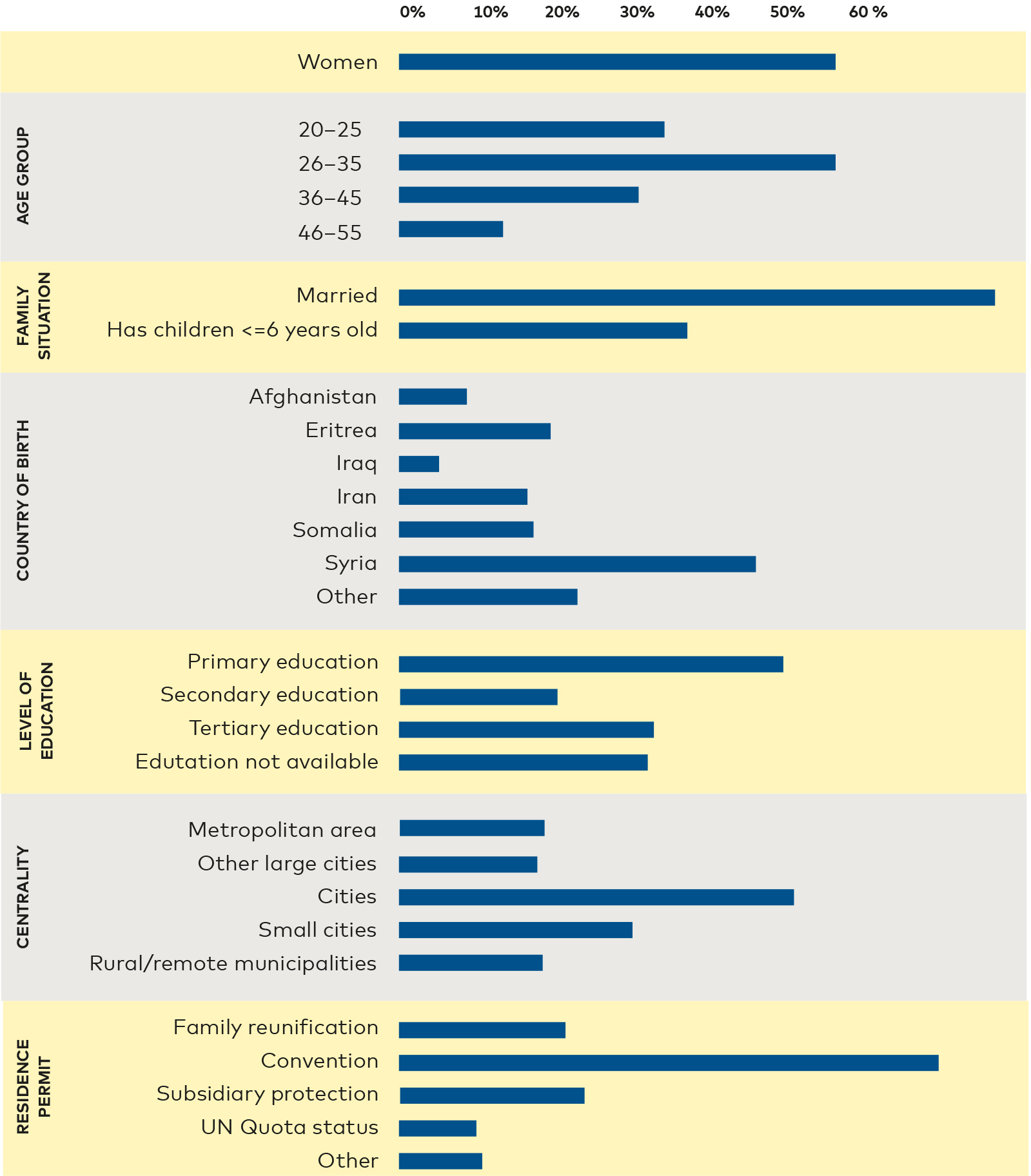
Figure 1
Characteristics of participants in Nordic introduction programmes 2008-2016 at the time of settlement. (Weighted average for DK, NO, SE). N= 219,733.
 Photo: Yadid Levy / norden.org
How many transition to employment?
The Nordic countries, such as Denmark, Sweden and Norway are ideal candidates for a comparative study because of their political, social, cultural and economic similarities. Their introduction programmes for newly arrived refugees share many of the same features, such as language training, social studies and labour market measures. Analysis of the process of being included in the labour market, usually referred to as labour market integration, is enabled by national population- and administrative registers that allows researchers to follow newly arrived refugees from the year of settlement and over time.
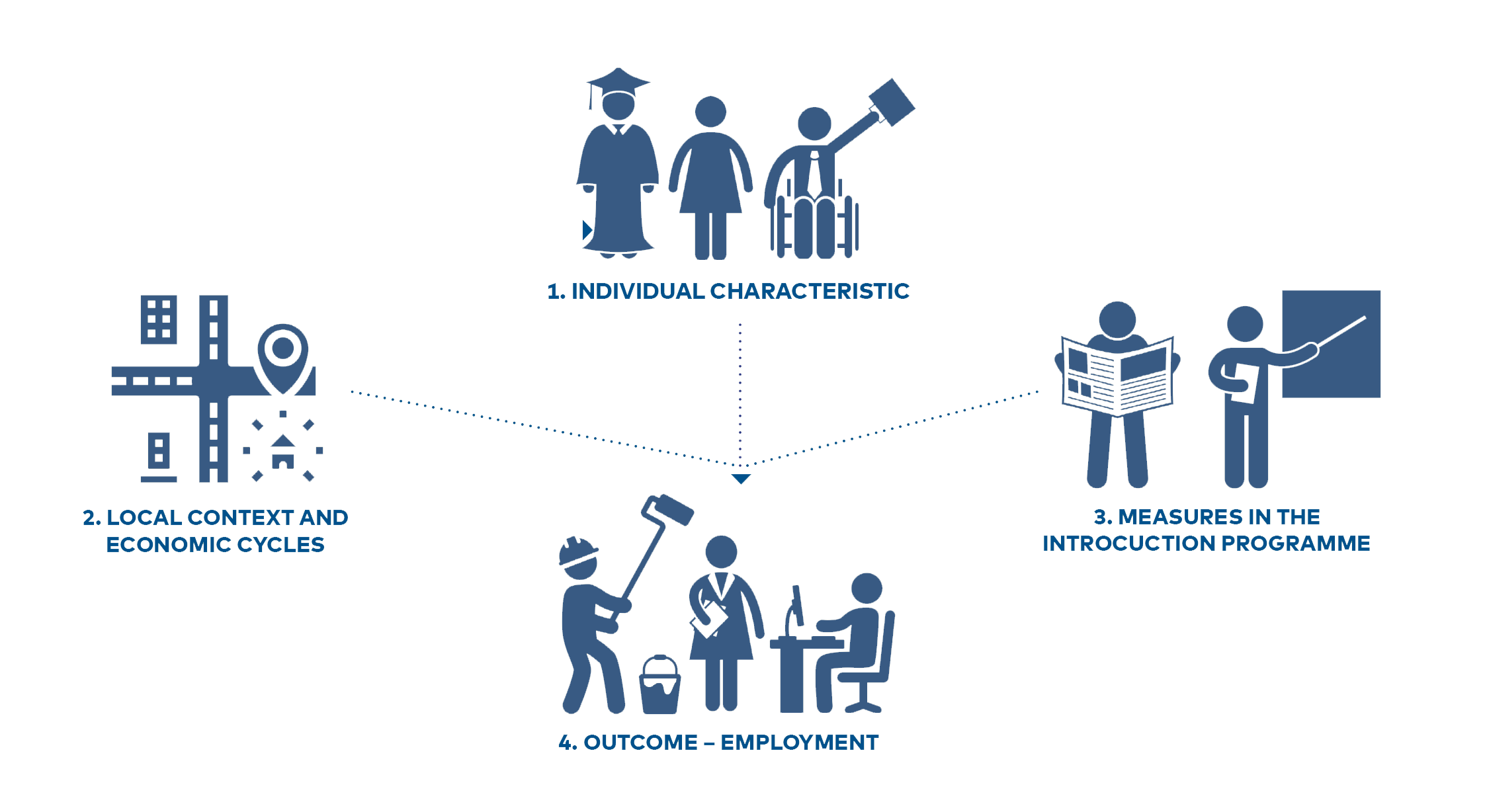
Analytic model
- Individual characteristic (gender, age, education, family situation, country of origin, residence permit)
- Local context, economic cycles (local unemployment, year, centrality)
- Measures in the introduction programme (language training, job-seeking, subsidized employment, work practise, etc...)
- Outcome – employment.
Icons:
Gan Khoon Lay
Noun Project
The analysis shows that individual characteristics of the refugees at the time of settlement predicts their chances of getting a job. Adult refugees who arrive in a Nordic country have a mean age of approximately 30 years when they settle. Younger refugees have much better chances of getting a job compared to older refugees. Refugee women who migrate with children in pre-school age (<6 years) are less likely to get a job compared with women who do not have children at the time of settlement. For refugee men, on the other hand, having small children increases the likelihood of employment. Not surprisingly, formal education matters. Refugees who have completed at vocational education or have a degree from a university have much better chances in the labour market compared with refugees who have no formal education or only primary education from their country of origin. The study suggest that country of origin is also a predictor of your chances in the labour market. Even when adjusting for level of education and family situation, refugees from countries like Syria and Eritrea have better outcome in the labour market compared with refugees’ originating from e.g. Somalia or Iraq. Refugees who have been granted asylum are more likely to get a job compared with resettled refugees.
What skills and competences the refugees have matters. However, the demand side of the labour market also plays an important role in labour market integration of refugees. Refugees, who settle in a regional labour market with higher unemployment rates, are much less likely to be employed compared to refugees settled in more favourable labour markets. This study also find that being settled in less central municipalities, e.g. outside of the metropolitan area, reduces the employment probability for refugees significantly.
By following all 220,000 refugees settled in the period 2008-2016 over time it is possible to estimate employment probabilities by year since settlement. These estimates are plotted in the graph below and adjust for the different composition of refugees, business cycle and local labour market conditions over time and between countries. These trajectories are estimated separately for men and women and reveals that employment probability are very low in the first year of settlement. With duration of residence the employment probabilities increases for both men and women in all three countries.
- Norway has a substantially better outcome for refugee for women, and a relatively low employment gap between men and women compared to Sweden and particularly Denmark.
- Denmark generally has better estimated employment rates in the first years, for all groups of education levels on arrival. However, Norway has the best employment results over time for those with lower education. The best employment trajectories for those with secondary and tertiary education are found in Sweden and Norway, where trajectories converge for those with the longest duration of residence.
- In each country, a different age-group of male participants has the highest estimated employment trajectory. Denmark has the best estimated outcomes for men aged 20–25, Norway for those aged 26–45, and Sweden for those aged 46–55. Although Norway generally shows better employment outcomes for women, Sweden also has higher estimated outcomes for female participants aged 46–55.
Figure 2
Estimated employment trajectories for men and women with years since settlement, separated by country.
 Photo: Scanpix.dk
What kind of measures do refugees get in the introduction programme?
Over time and between the Nordic countries included in this analysis, there are different level of details and categorizations concerning the different measures provided to programme participants. Hence, direct comparison is difficult. Differents kind of language training and practice, job-seeking, work practice or other work related measures and courses are provided in all countries. In in all three countries it is possible to differentiate between three similar measures in the programme: regular education, subsidized employment and language courses.
An overwhelmingly majority (95% +/-) of refugees in all three countries attend language courses. However, there are substantial differences between the countries concerning the usage of regular education in the programmes. In Denmark, only 7-9 per cent participate in regular education (in the education system, with public student grants), as this is only rarely offered as part of the integration programme. Instead, they may be offered education as an active labour market programme. In Sweden, around 20 per cent of the participants have attended regular education as part of the programme since 2011, while in Norway, regular education has gone from being a rarely used measure to being used by over 30 per cent of the participants.
There are also large differences between the usage of subsidized employment across the Nordic countries. In Sweden, about 30 per cent of participants in introduction programme are offered subsidized employment – nearly twice as many as Norwegian and Danish participants. In all three countries, men participate in subsidized employment more often than women do. This discrepancy is substantially greater in Sweden (men 38% / women 16%) and Denmark (20% / 5%), and lowest in Norway (13% / 8%). This finding is particularly interesting, because it reflects cross-national differences concerning the employment gap between men and women described in Figure 2, Employment trajectories (previous page), where the employment gap is greater in Sweden and particularly Denmark, compared to Norway.
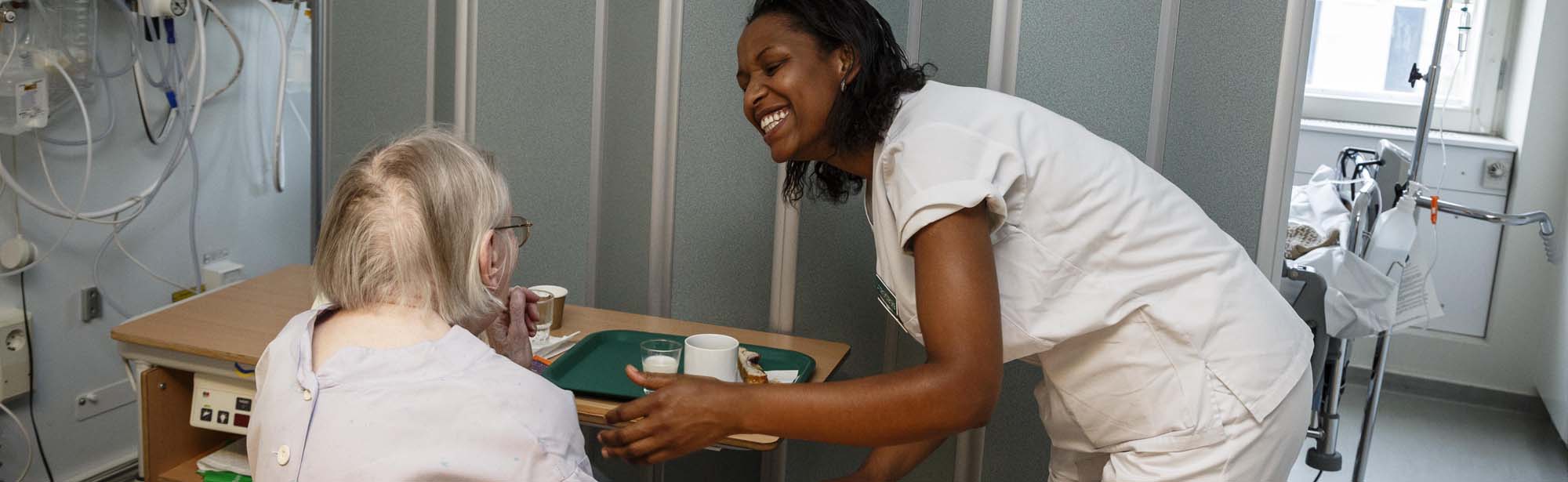 Photo: Yadid Levy / norden.org
And what works?
The findings indicate that Sweden has invested more in regular education for participants in the integration programme than Norway and Denmark, particularly for refugees with higher education from abroad. Norway, on the other hand, has focused more on educating those with low education levels on arrival. Our findings also show that the employment differences in the longer run correspond to the differences in education investments. The results therefore indicate that the higher long-term employment out-comes in Norway and Sweden compared to Denmark could be caused partly by the investment in education.
In all three countries, subsidized employment is the measure with the highest positive effects on employment rates, between 23 and 34 percentage point (ppt) higher employment probabilities than for non-participants, and between 7 and 10 ppt higher for women than for men. Still, as discussed in earlier studies, the positive association between employment and participation in these activities may be due partly to selection: that those selected to receive subsidized employment are those with better prospects for getting employed in the first place. However, this ‘argument of selection’ could be challenged by the Swedish results. Sweden has around twice the share of participants who have subsidized employment as a programme measures compared to Norway and Denmark; still, the estimates for employment rates match Norwegian levels and are actually better than the Danish results. These results indicate that there is a potential for using subsidized employment for a larger share of participants in Norway and Denmark. Another finding is that in all three countries, men participate in subsidized employment more than women do; however, this discrepancy is substantially greater in Sweden and Denmark and lowest in Norway. This finding reflects cross-national differences concerning the employment gap between men and women, where the employment gap is greater in Sweden and particularly Denmark, compared to Norway.
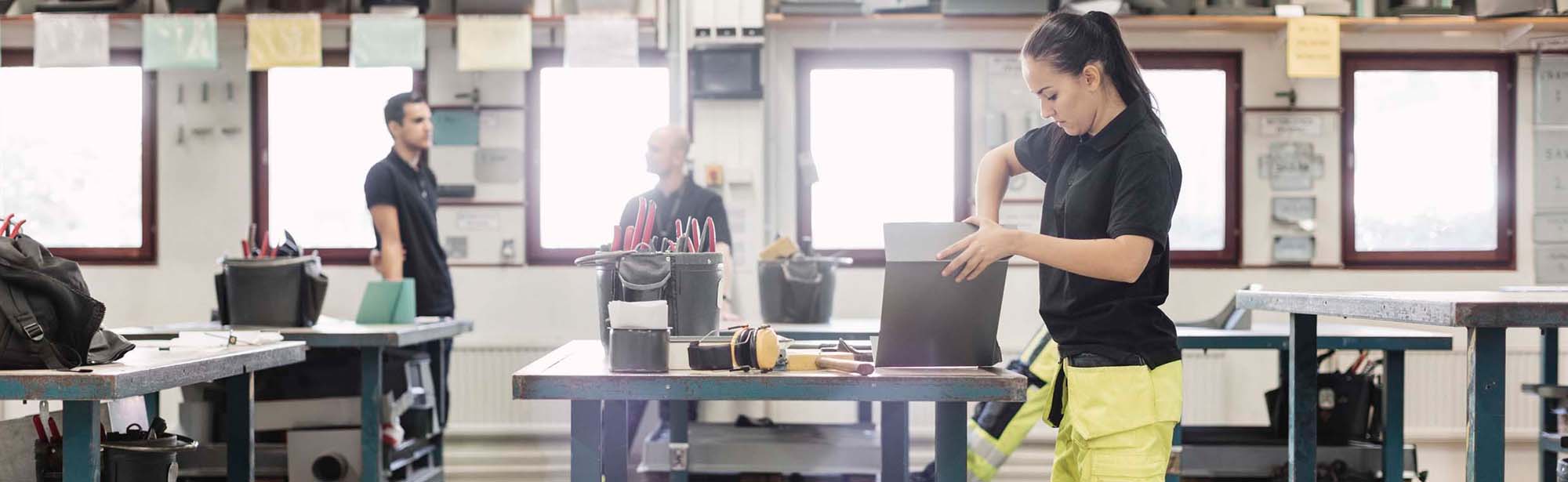 Photo: Johnér.com
Who has the best outcome…
Analyses show that which country has the best results depends on when the outcomes is measured.
Denmark has the best initial employment levels, for both men and women, in the first years after settlement. Then, because employment rates in Denmark have a less steep growth, the other two countries catch up or surpass Danish employment levels over time (figure 2).
After two to four years in the country, participants in the integration programme in Norway generally have higher employment levels than participants in the integration programme in Sweden and Denmark.
However, this employment gap between Norway and the other two countries decreases for male participants over time, but remains (Sweden) or increases (Denmark) for female participants. For Sweden, it takes several years until male participants approach or surpass Norwegian or Danish employment levels.
However, Sweden does slightly better for female participants than Denmark, at least in the long run. In all three countries, the more recent cohorts do better than the earlier ones (except for female participants in Denmark); the improvement for more recent cohorts compared to earlier cohorts is greatest in Sweden.
 Photo: Ricky John Molloy / vf.dk
…and what to learn from whom
- Analyses of programme measures shows that Sweden has almost twice the share of participants who receive subsidized employment during their integration programme. Although the positive effect of subsidized employment has been shown in many earlier studies, all studies note that this measure is rarely used. Two explanations of why subsidized employment is not used more commonly are that that it can be hard to attract employers to hire persons on subsidized employment, and that subsidized employment is a measure that works only for those with good preconditions for employment. As Sweden not only has twice the share participating in this measure compared to Norway and Denmark, but also has substantially more participants in absolute numbers, it is relevant to know more about what Sweden has done to achieve this.
- Concerning regular education as a programme measure, our analysis indicates that the increased long-term employment outcomes in Sweden could be caused partly by their investment in supplementary education for participants with higher education levels on arrival. Additionally, Norway’s focus on educating those with low education levels on arrival could provide the context to the relatively better long-term results for this group. Still, future studies should explore how each country’s focus on education has impacted these groups, and whether there are other elements that make them better at getting these groups employed in the long run.
- In relation to these findings, it is relevant to note that the Danish integration programme has been very focused – and successfully so – on achieving a rapid transition to employment, and uses education to a much lower extent than Denmark or Norway. This could shed light on why Denmark’s employment rates are higher the first years after settlement, and is further strengthened by the reform of the programme in July 2016, which explicitly highlighted that a rapid transition to employment should be prioritized. However, our study indicates that this emphasis may have negative long-term effects on employment outcomes. One reason could be that less emphasis on upgrading education levels in the initial years of the programme leaves participants more vulnerable to labour market fluctuations in the long run.
About this publication
Short version:
Nordic integration and settlement policies for refugees
Vilde Hernes, Jacob Nielsen Arendt, Pernilla Andersson Joona and Kristian Rose Tronstad
Nord 2020:026
ISBN 978-92-893-6572-7 (PDF)
ISBN 978-92-893-6573-4 (ONLINE)
http://doi.org/10.6027/nord2020-026
© Nordic Council of Ministers 2020
Layout: Mette Agger Tang
Cover photo: Isabella Lindblom
Nordic co-operation
Nordic co-operation is one of the world’s most extensive forms of regional
collaboration, involving Denmark, Finland, Iceland, Norway, Sweden, the Faroe
Islands, Greenland, and Åland.
Nordic co-operation has firm traditions in politics, the economy, and culture. It plays an important role in European and international collaboration, and aims at creating a strong Nordic community in a strong Europe.
Nordic co-operation seeks to safeguard Nordic and regional interests and principles in the global community. Shared Nordic values help the region solidify its position as one of the world’s most innovative and competi-tive.
Nordic Council of Ministers
Nordens Hus
Ved Stranden 18
DK-1061 Copenhagen
www.norden.org
Read more Nordic publications: www.norden.org/publications